Q4 2027 Isn't Tested: Who Gets Paid When Samsung Files Vietnam Test Fabs
Samsung’s 5 October filings to Thai Nguyen set a $3.9 billion memory-test plan. Who gets paid first is the builders, then Korean toolmakers. The stuck step is V1 live in Q4 2027 — a plan is not a tested chip.
Samsung’s 5 October filings to Thai Nguyen set a $3.9 billion memory-test plan. Who gets paid first is the builders, then Korean toolmakers when 1,612 testers land. The stuck step is the first line going live in Q4 2027 — a plan is not a tested chip, and about 63% of the money waits on profits the plant has not made.
KOREA PULSE · Data as at 6 Oct 2026 · Next update: after Samsung Q3 prelim (~8 Oct, usual timing) or a confirmed V1 tool-in
Affects: Semiconductors · Hyperscalers · Neoclouds — Markets: Korea · Taiwan · US · China
Education only, not advice to buy or sell any security. Filed figures are labelled as reported. Percentages labelled our arithmetic are Second Order’s sums from those filings. The same-day Wire on this print is a short brief; this Pulse is the country door. Earlier Korea Pulses on the $60.3B chip-export month, the HBM4 ask, and HBM wafer mix are cross-linked, not re-led.
The numbers that matter this month
Total plan (5 Oct filing)
$3.9B
105.7944 trillion dong · ~5.48 trillion won · two phases
PrimaryCash up front (our arithmetic)
~37%
Affiliates 34.6% + investor 2.5%
Paying nowWaits on profit (filed)
~63%
66.6401 of 105.7944 trillion dong — our arithmetic
Stuck cashFirst line live
Q4 2027
Tools in July 2027 · a plan is not a tested chip
Stuck stepNew tools on the permit
1,612
712 burn-in · 332 testers · 332 handlers · Korean-made, 100% new
PermitSite
265,895 m²
Yen Binh CN-11/CN-12 · reported as 37 soccer fields · next to the phone plant
ReportedSources: Seoul Economic Daily, 5 Oct 2026 (two reports); Businesskorea, 31 Aug 2026 (permit). Status chips are Second Order’s read.
On this page: Why Korea? · What changed · Our math · Where money sticks · Is the test line still stuck? · Dates next · How this differs · What would change this · FAQ
Why does Korea matter now?
Because Korea makes most of the world’s memory, and memory still has to pass test before a customer pays. A wafer off Pyeongtaek is not a shippable DRAM. A packaged stack from Cheonan is not a shippable stack until it has been burned in, sorted, and signed off. That last gate has sat at Cheonan and Onyang. Samsung is now dating a second copy of it — in Thai Nguyen, Vietnam — and the dates are a year out.
September already showed what Korea can ship: MOTIR’s 1 Oct print put chip exports at $60.30 billion — see the $60.3B shipped Pulse. This Pulse is the other side: how Samsung plans to test more of that memory outside Korea, and which cheque clears now. Same map as HBM, explained and the Korea Markets hub.
1 · Builders, now
Who: Site contractors on the up-front ~37%
Paid: On concrete and clean-room, not on tested bits
2 · Korean toolmakers, July 2027
Who: Burn-in, tester, handler, sorter vendors
Paid: When 1,612 new tools land — still before a Vietnam-tested chip
3 · V1 live, Q4 2027
Who: Samsung, on tested DRAM/NAND that actually ships
Paid: Not until the first-floor line runs. ~63% of the plan waits on those profits
If you only remember one thing: Korea still gets paid on memory that already passed test at home. Vietnam is a dated plan to copy the last gate. Copying the gate is not opening it.
What changed
The fresh primary print is dated 5 October 2026. Seoul Economic Daily obtained Samsung documents submitted to the Thai Nguyen Provincial People’s Committee (first report, second report). That is a company filing to a provincial government, not a ministry survey and not a monthly sales flash.
What the filing actually says: Samsung Vietnam Semiconductor (SVS), set up in March 2026, is building test fabs in Yen Binh CN-11 and CN-12, next to the Thai Nguyen phone plant (265,895 m²). Packaged DRAM and NAND from Cheonan will be electrically tested and burned in; only chips that pass ship. Sedaily’s gloss: a second export base if labour, disaster or tariff trouble hits Cheonan and Onyang.
What changed versus the August permit is the clock. Businesskorea (31 Aug) already had the money split and the 1,612-tool list. The 5 Oct filing is the first dated print we have for V1 tools in July 2027 and V1 official operation in Q4 2027. It does not name wafers per month, SKUs, customers, or HBM. Do not turn $3.9 billion into yearly sales. The two same-day reports disagree on V2 (October 2028 versus Q1 2028) and put about 2 trillion won on the first plant. Treat V2 as unsettled.
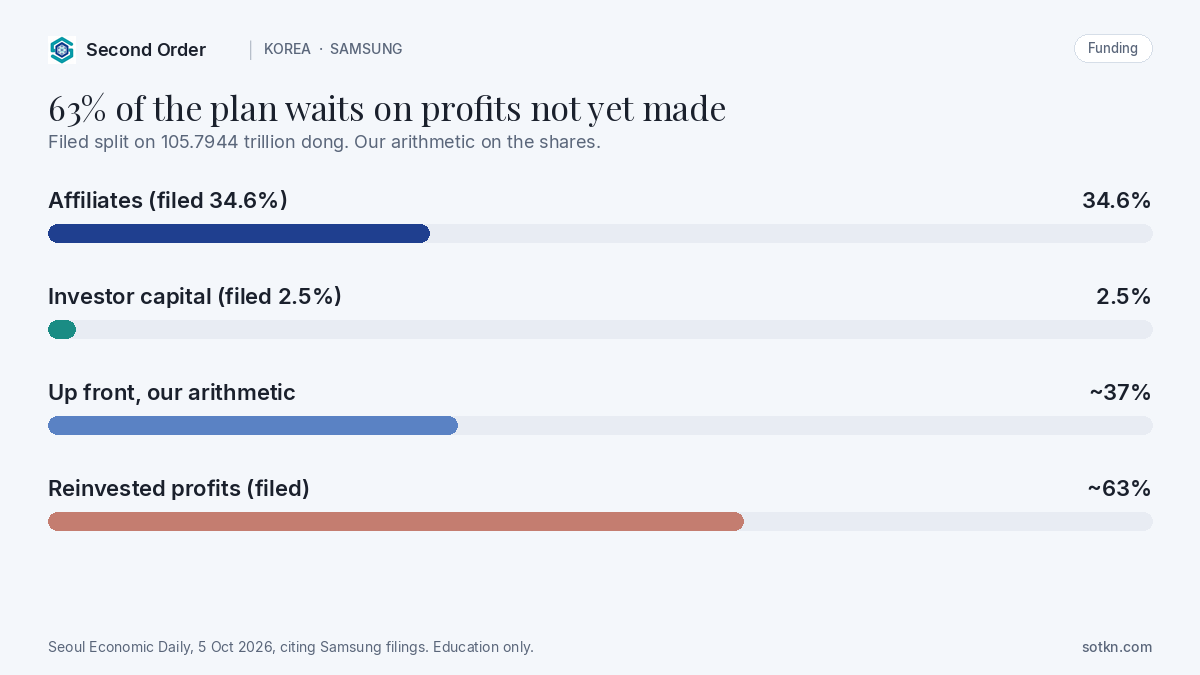
- Seoul Economic Daily (5 Oct): 105.7944 trillion dong; affiliates 34.6%; investor 2.5%; 66.6401 trillion dong from profits; no bank loans
- Same: V1 equipment July 2027, operation Q4 2027; V2 equipment May 2028, operation October 2028 (first report)
- Second report, same day: V2 Q1 2028; second plant from 2028; first plant about 2 trillion won
- Businesskorea (31 Aug): permit $4.08B; $100M own capital, $1.41B affiliates, $2.57B future profit; 1,612 new Korean-made tools
- Same permit: 712 burn-in chambers, 332 testers, 332 handlers, 136 sorters, plus mark/inspect/pack
- 103 Vietnamese engineers on SEED training at Cheonan/Onyang since July (Sedaily) — staff, not output
Samsung Electro-Mechanics’ 2.51 trillion won FC-BGA plan in the same park is neighbour colour, not this lead. See IC substrates and ABF, explained. The back end of Korea’s AI chain is spreading. Spreading is not the same as shipping.
Our math — labelled our arithmetic
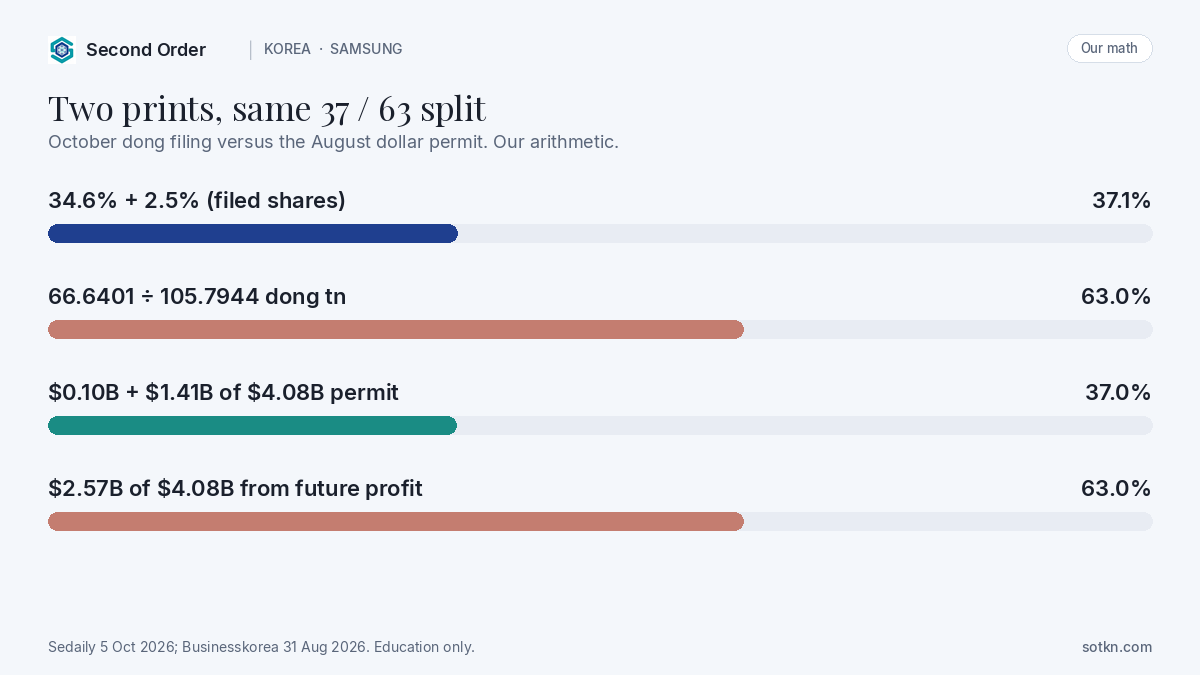
The filings already print the shares. The arithmetic here is about whether the October dong print and the August dollar permit tell the same story — and what they do not clear.
Our arithmetic — print vs stuck step
Inputs: Sedaily 5 Oct filed shares and dong totals; Businesskorea 31 Aug dollar permit and tool list. The sums and the 361-day count are Second Order’s arithmetic. “Not 1:1” is our judgment, not guidance.
What this tells you: the October filing and the August permit rhyme. About 37% is cash that can leave now. About 63% is a claim on profits a line that is not live cannot have earned. The dollar headline moves with the exchange rate ($3.9B vs $4.08B); the split does not.
What it does not tell you: how many chips a month V1 will test, whether HBM stays in Cheonan, or whether Samsung’s Q3 prelim later this week will even mention Thai Nguyen. That cash colour is a neighbour clock. Herald Business said the prelim is due Thursday morning; we treat ~8 Oct as usual timing, not a locked IR notice.
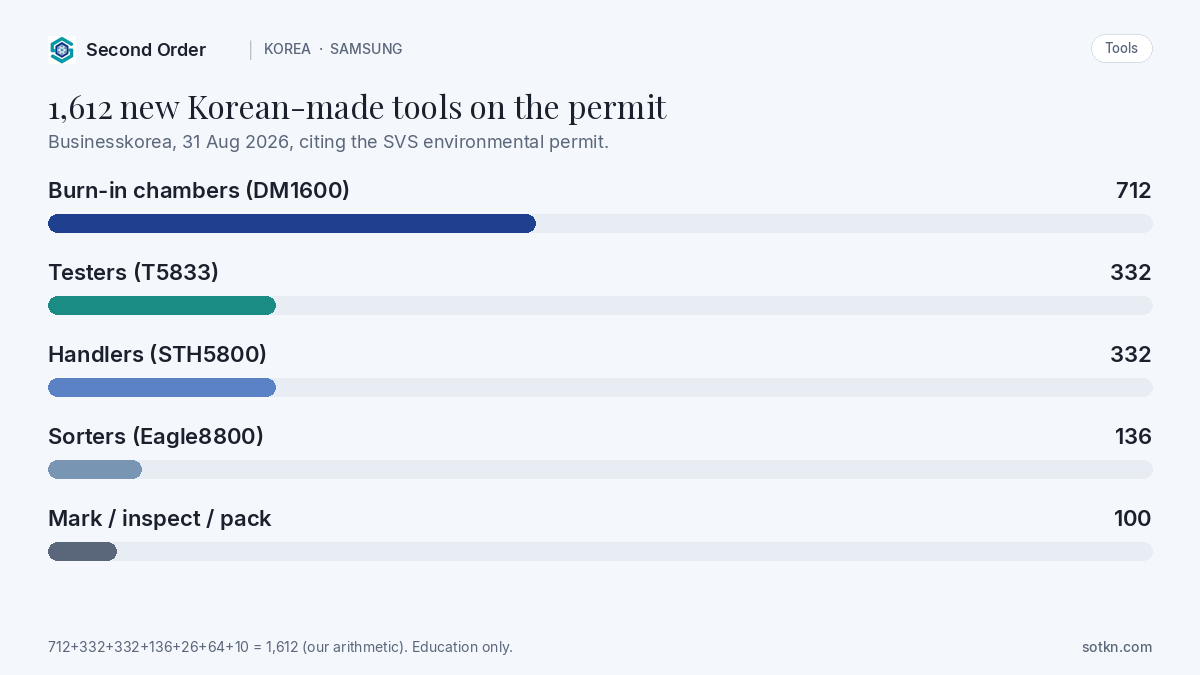
The tool list is the honest physical clock. Burn-in chambers are the largest slice (712 of 1,612, about 44% on our arithmetic). Testers and handlers match at 332 each. All 1,612 are specified as new Korean origin — so this is not a crate-shift of Cheonan tools. New tools still have to land, install, and qualify. A permit line is not a handler in production.
Where does the money stick?
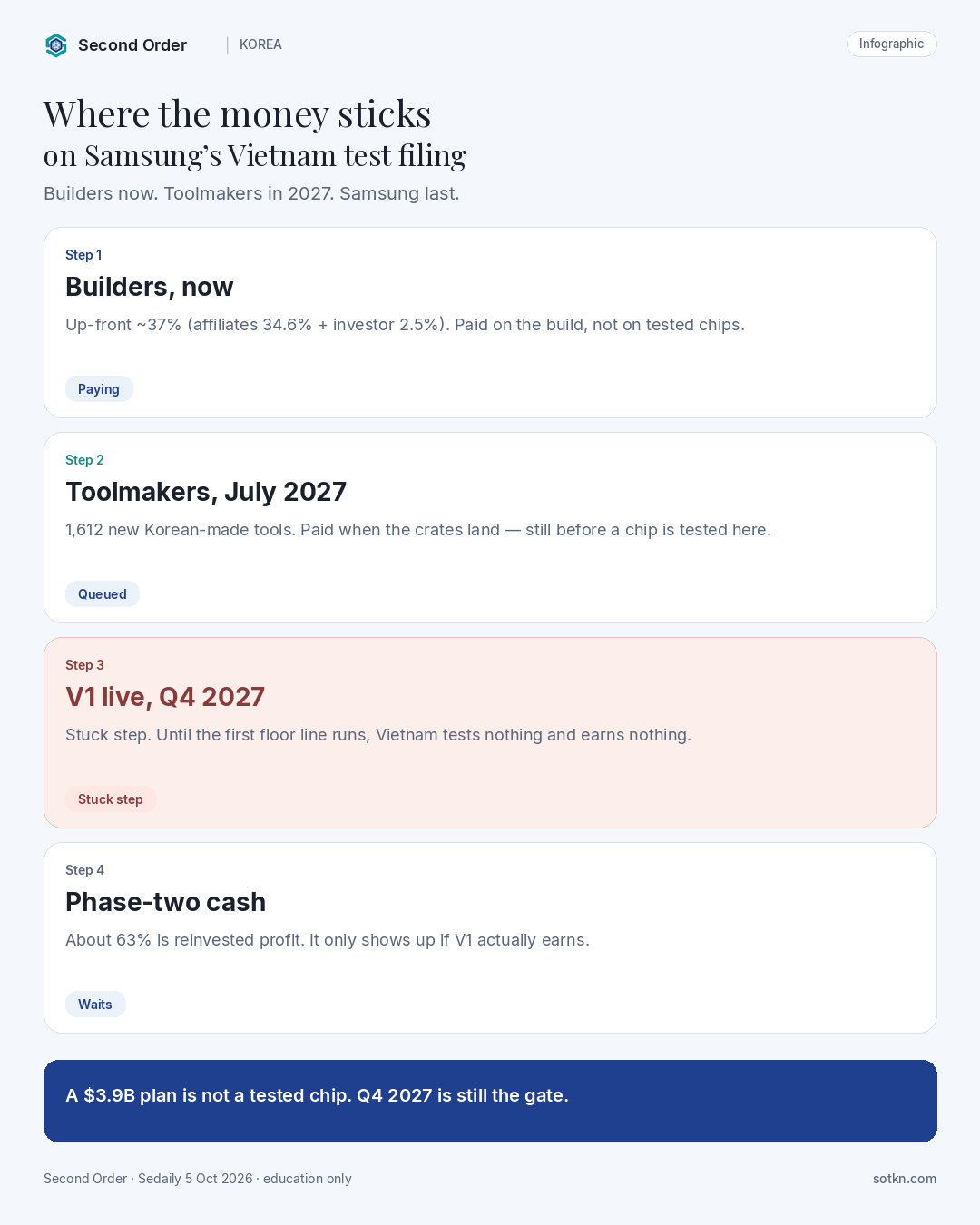
Follow the chip, then follow the cheque.
A DRAM die is made in Korea. It is packaged at Cheonan. Under this plan it flies to Thai Nguyen, sits in a burn-in chamber, gets sorted, and only then goes to a server builder or a cloud. Who is paid at each step on this filing?
Builders get the up-front ~37% during the build — concrete and clean-room — whether or not a chip later passes. Korean toolmakers get paid when 1,612 new tools land from July 2027. That is still not a memory invoice. Samsung is paid last, on tested chips, from Q4 2027 at the earliest. Phase two waits on the 63% that is reinvested profit. Memory buyers do not get extra tested supply from Vietnam this year; September’s $60.3 billion already left through the Korean test gate.
Neighbour US door: Micron locking over 75% of 2027 output. Micron has buyers for chips it has not made. Samsung is dating the last gate that turns made chips into shippable ones. An Inha professor, quoted by Sedaily, expects HBM to stay at Cheonan and Onyang. That is his view, not a Samsung statement. Until Samsung files HBM onto this site, treat the squeeze as still a Korea-campus gate — HBM wafer-mix Pulse.
Is the first test line still stuck?
Yes. A dated plan does not test a chip.
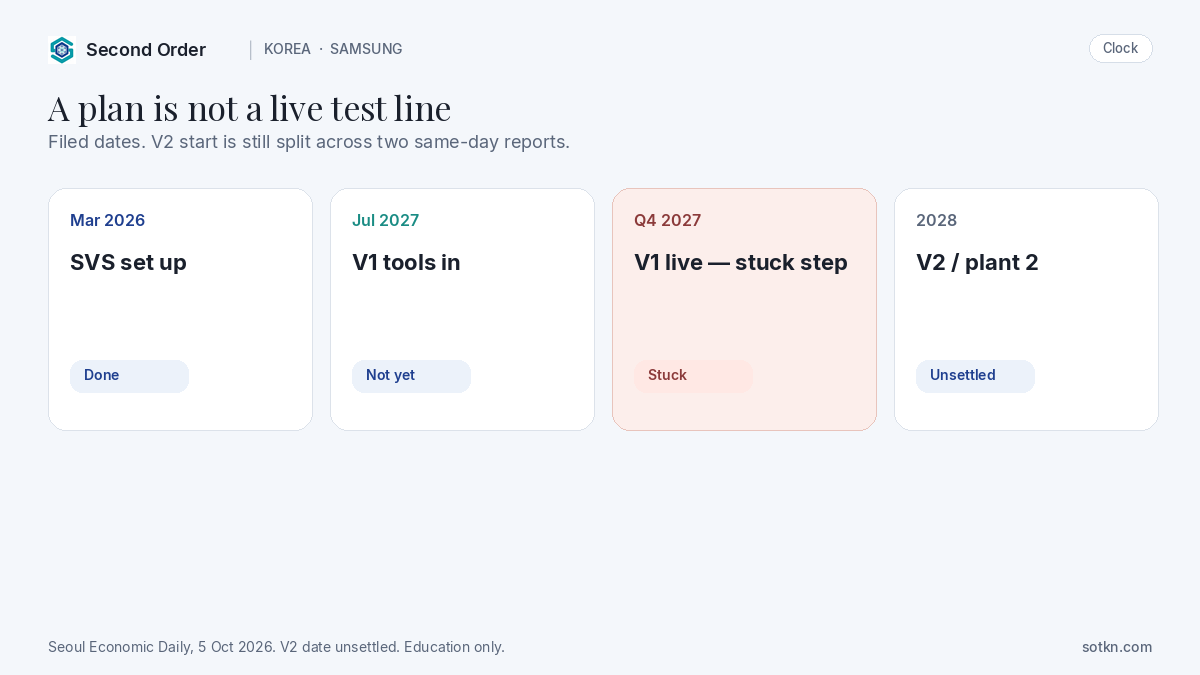
Think about the three steps the filing itself lays out.
- Plant built. Under way. SVS exists. The site is being built. 103 Vietnamese engineers have been on the floor at Cheonan and Onyang since July under SEED. That is preparation. It is not output.
- Tools in, line live. Not done. Equipment starts arriving in July 2027. Official operation is Q4 2027. On our arithmetic that is 361 days from the 5 Oct filing to the first day of Q4 2027. Until the line runs, Vietnam tests nothing.
- Profits fund phase two. Not done. About 63% of the plan is paid from the plant’s own profits. If V1 earns less, or later, that money comes later or smaller. There is no date on that cheque.
Two cautions before you read “$3.9 billion Vietnam fab” as tomorrow’s supply:
- Variant still matters. The filing names DRAM and NAND final test. It does not name HBM. A commodity-test line does not substitute for an HBM stack that still has to clear Korea.
- Built is not working. New burn-in chambers take time to qualify to a customer’s spec. Watch tool-in in July 2027, then first-lot yields — not the headline dong figure.
If the Vietnam line qualifies on time, the stuck step on this door moves: from “no second test base” to “does V1 actually earn enough to fund the 63%?” The Korea-wide memory stuck step — new wafer output — is a different door, still live on the $60.3B export Pulse. Test capacity abroad does not install a DRAM tool in Pyeongtaek. See also Where does the stuck step move? and the Micron clean-room Analysis.
What dates matter
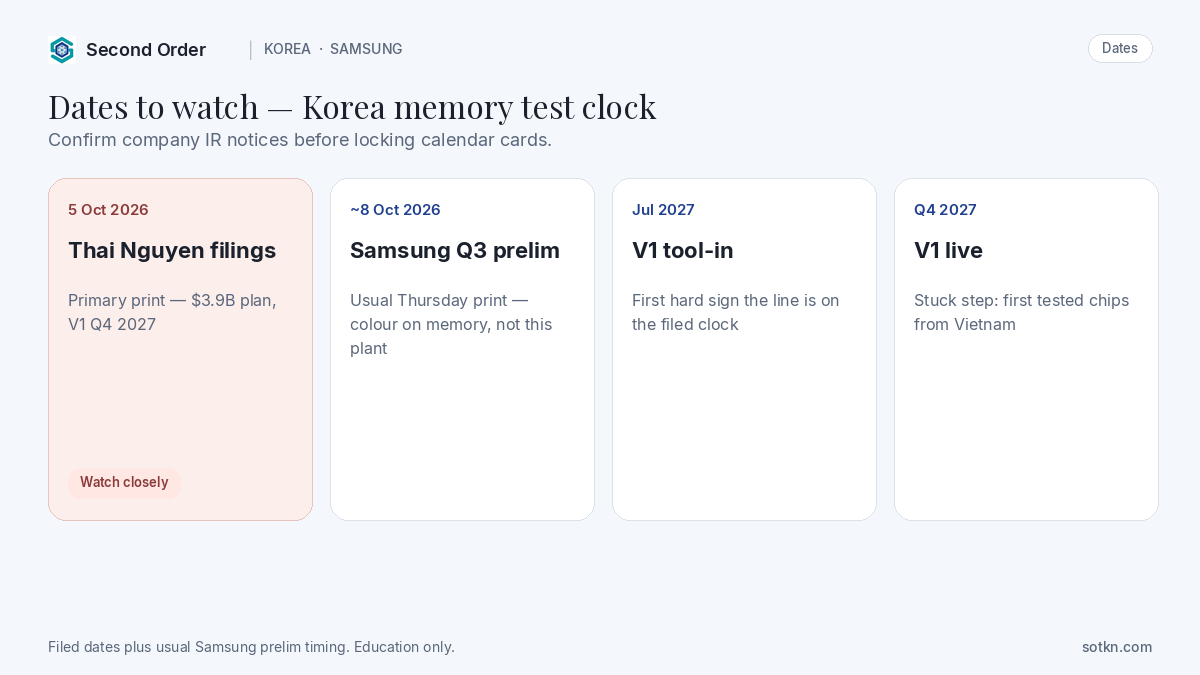
Dates to watch
Sedaily 5 Oct 2026. Q3 prelim is press-reported usual timing, not a Samsung IR calendar lock we checked. Do not invent a monthly output date Samsung has not filed.
TSMC’s September monthly sales print on 8 Oct is a Taiwan cash clock. It is not a reason to skip this Korea door, and it is not evidence that V1 is live.
How is this different from …
- $60.3B shipped Pulse (5 Oct): chips that already left. This is a test line that has not started.
- Wire on this print: same filing, short brief. This Pulse is the country map.
- HBM4 ask Pulse (3 Oct): ask ≠ ASP. A plan ≠ a tested stack.
- HBM wafer-mix Pulse: why supply stays tight at home.
- Taiwan PMI Pulse: a 63.4 survey is not CoWoS slots. A $3.9B plan is not V1 live.
- China SMIC Pulse: full is not more leading-edge cash. A filed fab is not more tested bits.
What would change this view?
The “plan isn’t tested chips / V1 in Q4 2027 is still the gate” read weakens if:
- Samsung or the province confirms V1 go-live ahead of Q4 2027, with a lot that a customer will accept
- Samsung names output (chips per month) and which memory, including whether any HBM is in scope
- Profit-linked money starts moving early, which would mean the plant is earning faster than the 63% structure implies
- Tool-in slips past July 2027 without a new dated filing — the clock would be worse, not better
- Buyers report that test, not wafers, is the louder bind, which would raise this door’s importance
- The second-line date is locked so V2 stops being a two-report split
It stays intact while V1 is still a 2027 date, 63% of the plan is still future profit, and HBM has not been filed onto this site.
Practical takeaways
- Samsung’s 5 Oct filing to Thai Nguyen dates a ~$3.9 billion two-phase memory-test plan (105.7944 trillion dong)
- Who gets paid now: builders on the up-front ~37% (affiliates 34.6% + investor 2.5%, our arithmetic)
- Who gets paid next: Korean toolmakers, when 1,612 new tools land from July 2027
- Samsung gets paid last: on tested chips, from Q4 2027 at the earliest
- About 63% of the headline (66.6401 / 105.7944) waits on profits the plant has not made — our arithmetic; the August $4.08B permit rhymes at 37 / 63
- Stuck step: V1 live. A plan is not a tested chip. 361 days from this filing to the first day of Q4 2027
- V2 is unsettled (Q1 2028 vs October 2028). Do not pick one
- HBM staying in Korea is a professor’s view, not a Samsung statement — still the working map until Samsung says otherwise
- Watch ~8 Oct Samsung Q3 prelim for memory colour, July 2027 for tool-in, Q4 2027 for the gate
FAQ
What did Samsung file on 5 October 2026?
Seoul Economic Daily reported Samsung documents submitted to the Thai Nguyen Provincial People’s Committee: two memory test fabs at Yen Binh Industrial Park, total 105.7944 trillion dong (about 5.48 trillion won, ~$3.9 billion). V1 tools in July 2027; official operation Q4 2027. Packaged DRAM and NAND from Cheonan would be final-tested there.
Who gets paid?
Builders, now, on the up-front ~37%. Korean toolmakers, from July 2027, on 1,612 new testers, handlers and burn-in chambers. Samsung, last, on tested chips once V1 is live. This is a map of who gets paid — not a buy list.
What is the stuck step?
The first-floor line (V1) going live in Q4 2027. Until it runs, Vietnam tests nothing and earns nothing. About 63% of the plan is reinvested profit, so phase two waits on that gate too. A filing is not a tested chip.
How much of the $3.9 billion is cash now?
On our arithmetic, about 37%: filed affiliates 34.6% plus investor 2.5%. The remaining 66.6401 trillion dong, about 63% of 105.7944 trillion, is from future profits. The August permit shows the same split in dollars ($1.51 billion up front, $2.57 billion from profit, of $4.08 billion).
Does this ease the HBM squeeze?
Not on the text of the filing. The documents name DRAM and NAND final test. A professor quoted by Sedaily expects HBM to stay at Cheonan and Onyang. That is commentary, not a Samsung statement. Until Samsung files HBM onto this site, treat HBM as still a Korea-campus gate.
When does the first line go live?
The 5 Oct filing says V1 begins receiving equipment in July 2027 and starts official operation in the fourth quarter of 2027. V2 is unsettled between two same-day reports (Q1 2028 vs October 2028).
Is this investment advice?
No. Education only. It maps who gets paid and which step is stuck. It is not a recommendation to buy or sell any security.
Keep reading on the map
- Korea Markets hub — country door
- Wire: Samsung Vietnam test fab — same print, short brief
- $60.3B shipped Pulse — chips that already left
- Samsung HBM4 ask Pulse — ask is not ASP
- HBM wafer-mix Pulse — why supply stays tight
- HBM, explained — primer
- Memory process tools — front of the line
- Semiconductors stack — layer map
- Taiwan PMI Pulse — a survey is not slots
- Micron clean-room Analysis — the wafer clock
How we check this
Headline figures come from Seoul Economic Daily’s 5 Oct 2026 reports on Samsung filings to Thai Nguyen province. The tool list and dollar permit split come from Businesskorea (31 Aug 2026). Where we work something out ourselves — the 37/63 split, the tool sum, the 361-day count — the arithmetic is shown and labelled our arithmetic. A plan is not treated as output. V2 dates that disagree are labelled unsettled.
Last reviewed: 6 Oct 2026 · Next review: after Samsung Q3 prelim, a confirmed V1 tool-in, or a later provincial filing
Spot an error? Tell us and we will correct it and note the change here.
Not investment advice. Do your own research.
Sources
- Seoul Economic Daily — Samsung Thai Nguyen filings (5 Oct 2026): en.sedaily.com
- Seoul Economic Daily — second report, V1/V2 dates (5 Oct 2026): en.sedaily.com
- Businesskorea — environmental permit, $4.08B and 1,612 tools (31 Aug 2026): businesskorea.co.kr
- Reuters — first-phase about $1.5B (27 May 2026): reuters.com
- MOTIR — September 2026 exports neighbour print (1 Oct 2026): english.motir.go.kr