Nvidia Pays for the Lines: Who Gets Paid While Korea’s AI Chip Substrates Wait for 2029
Nvidia has amended its substrate deal with Samsung Electro-Mechanics and is reviewing more money for the Sejong and Busan plants. The shares jumped 8.6% on 19 November. But full-scale mass production is set for 2029. The stuck step is the new line.
Nvidia is paying a Korean company to build the small boards its AI chips sit on, and this week it said it may pay more. Samsung Electro-Mechanics’ shares jumped about 8.6% on 19 November. The money arrives now. The full new lines in Sejong and Busan do not: the company plans full-scale mass production from 2029. Until then, every extra board comes from running old lines harder. The stuck step is the new line.
KOREA PULSE · SUBSTRATES · ADVANCED PACKAGING · AI CHIPS · Data as at 19 Nov 2026 (Nvidia release 17 Nov US time; Samsung Electro-Mechanics release 18 Nov) · Next update: Samsung Electro-Mechanics Q4 results (late January 2027)
Affects: Semiconductors · CoWoS packaging — Markets: Korea · Taiwan · US
Education only, not advice to buy or sell any security. Money figures are Korean won (W) or US dollars ($) as marked; one trillion won is a thousand billion. A package substrate is the small multi-layer board an AI chip is mounted on. It carries power and signals from the chip to the main board. The high-end kind is called FC-BGA, and the film it is built from is called ABF. Our Catalyst desk covered Nvidia’s new deal with Taiwan’s Kinsus yesterday (Nvidia’s $1 billion for Kinsus). This note is about the Korean half of the same announcement, and what it means for Korea’s market.
The numbers that matter this week
Nvidia deal
Amended
17 Nov · better output at existing plants
NewMore Nvidia money
Under review
For Sejong and Busan plants and new equipment
NewSubstrate sales, Q3
W939bn
+58% year on year · +22% on the quarter
PaidShares, 19 Nov
+8.6%
W880,000 · from W810,000 the day before
PaidSejong line
Sep 2028
W4.27tn spend runs to 31 May 2028
WaitsThe gate
2029
Full-scale mass production of the new Nvidia lines
Stuck stepNvidia 17 Nov 2026; Samsung Electro-Mechanics 18 Nov 2026 and Q3 results 28 Oct; Yonhap 28 Sep; Hankyung 19 Nov. Status chips are Second Order’s read.
On this page: Why it matters · What changed · Whose money · How stocks read it · The business now · Our math · Who gets paid · What is stuck? · Dates next · FAQ
Why would Nvidia pay for someone else’s factory?
Think of a bakery that has more cake orders than it can fill. The ovens are fine. The flour is fine. What is short is the special trays the cakes must sit on to leave the shop. The tray maker says a new tray line will take two years. So the bakery does something unusual: it hands the tray maker money to build the line, in return for first claim on the trays.
That is roughly what is happening between Nvidia and Samsung Electro-Mechanics. Nvidia’s AI chips need a package substrate under them before they can be shipped. As the chips get bigger and join more memory, the boards need more area and more layers. More layers mean more steps and more chances for a defect, so each board takes longer to make and fewer come out good. Only a handful of factories, in Japan, Taiwan and Korea, can make the top grades in volume.
Samsung Electro-Mechanics is the Korean name on the short list of board makers Nvidia keeps paying to grow, alongside IBIDEN in Japan and Kinsus and Unimicron in Taiwan. The same pattern shows up elsewhere in the chip chain: when one step is slow, the buyer starts funding the seller (prepayments explained, take-or-pay versus purchase commitments).
For an investor in Korea, the question is not whether AI chips sell. Nvidia reported record sales this week. The question is who collects money while the board lines are being built, and who has to wait for them.
What changed between October and this week?
On 21 October 2026 the two companies announced a strategic partnership. Samsung Electro-Mechanics said they would jointly invest in dedicated ABF substrate lines at Sejong and Busan, with deliveries starting in 2026. It said the volume it ships to Nvidia should grow at a double-digit rate each year, and that by 2028 the share of its total substrate capacity set aside for Nvidia would be “significant”. The boards go into Nvidia’s computing chips and its high-speed network switches.
On the same day, Nvidia said deals with IBIDEN of Japan, Samsung Electro-Mechanics and Taiwan’s Unimicron would together raise substrate capacity for its products by 2.5 times over three years. So October was the plan.
This week added four things:
- An amended contract. Nvidia said on 17 November, alongside its quarterly results, that it and Samsung Electro-Mechanics had amended their substrate agreement to improve operations at existing factories. In plain words: squeeze more good boards out of lines that already run.
- More money, maybe. Samsung Electro-Mechanics said on 18 November that, on top of the large-scale funding agreed in October, Nvidia is reviewing additional funding for production infrastructure and new equipment at Sejong and Busan. “Reviewing” is not “signed”, and no amount was given.
- A date. The company said that, based on this, it will set up a full-scale mass production system from 2029.
- A second product. The partnership now covers MLCCs, the tiny capacitors that keep the power to an AI chip steady. Samsung Electro-Mechanics already signed a W879.3 billion AI server MLCC supply contract in October with a customer it did not name, starting 21 December 2026, which our Catalyst desk covered.
Put simply, the October plan has moved into the doing stage, KB Securities said on 19 November. The doing stage starts with the old lines, because the new ones are not ready (Samsung Electro-Mechanics’ W879 billion MLCC deal).
Whose money is building the Korean lines?
The company’s own number came first. On 28 September 2026 Samsung Electro-Mechanics filed plans to spend W4.27 trillion expanding substrate production at Sejong, the largest single-product investment in its history, according to Yonhap. The spending window runs to 31 May 2028, and the new line is due to start mass production in September 2028. Its Vietnam unit filed a separate W2.51 trillion plan the same day, taking the total to about W6.78 trillion.
At the time, ChosunBiz reported, the company said it would ease the cost by getting investment support from global customers in return for medium- to long-term volumes. Neither Nvidia nor Samsung Electro-Mechanics has published how much Nvidia is putting in. Korean press reports give a range. ChosunBiz said customer support was in the W3 trillion range, with Nvidia’s share in the W2 trillion range and other big tech customers making up the rest.
Treat those amounts as reports, not filings. What is confirmed is the shape: customers are paying part of the bill for factories they do not own, and this week Nvidia said it may pay more. For the substrate maker, that lowers the risk of building a very expensive line and then finding it half empty. For Nvidia, it buys a place at the front of the queue.
How did Korean stocks read it on 19 November?
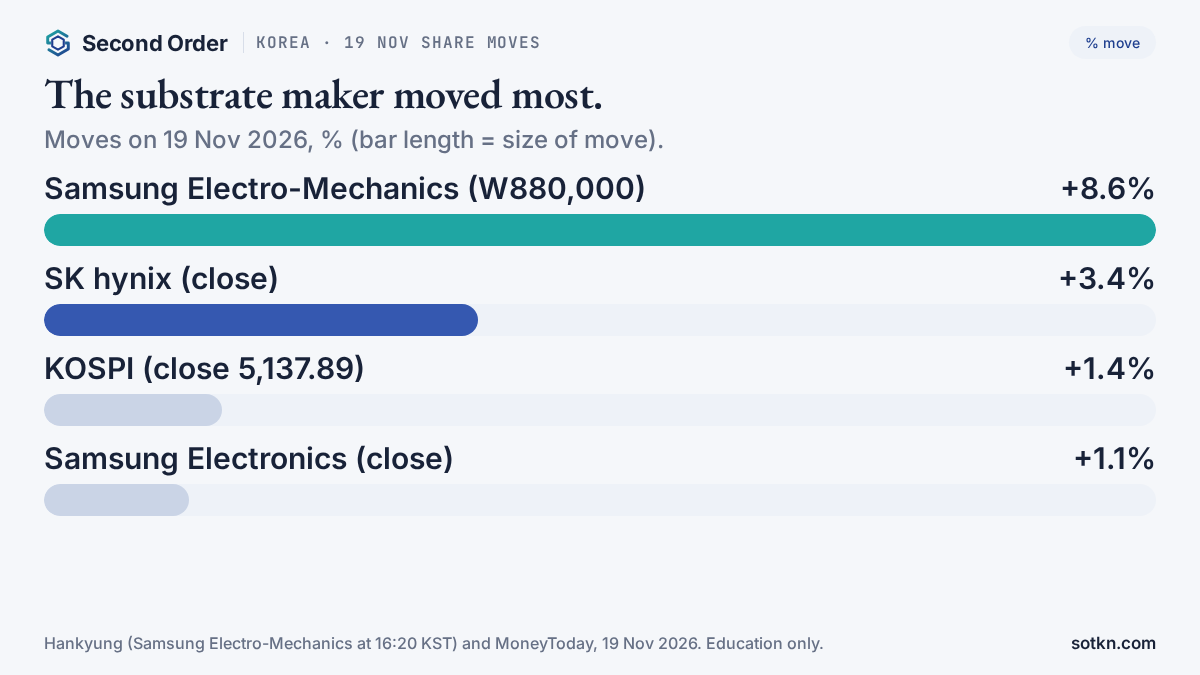
The market moved one name much more than the rest. Samsung Electro-Mechanics opened at W810,000, the previous close, slipped to W797,000 at about 10am, then climbed in steps through the afternoon. Hankyung recorded it at W880,000, up 8.64%, at 4:20pm. The big memory makers rose less: Samsung Electronics closed up 1.13% at W196,900 and SK hynix up 3.41% at W1,183,000. The KOSPI index closed up 1.39% at 5,137.89.
The wider chip supply chain also rose. MoneyToday listed double-digit gains on the KOSDAQ market for equipment and materials makers such as GST, TES, PSK and Hana Materials. That is a mood, not a contract. Only Samsung Electro-Mechanics has a named Nvidia substrate deal in Korea; we have seen no comparable announcement for the others.
Two caveats. First, one day of trading carries plenty of other news, including Nvidia’s own results, which our Wire and Analysis desks covered (Nvidia’s $81 billion still owed). Second, Samsung Electro-Mechanics’ price was taken at 4:20pm rather than a formal closing table, so the last digit may differ slightly from an official close.
How is the substrate business doing before the new lines exist?
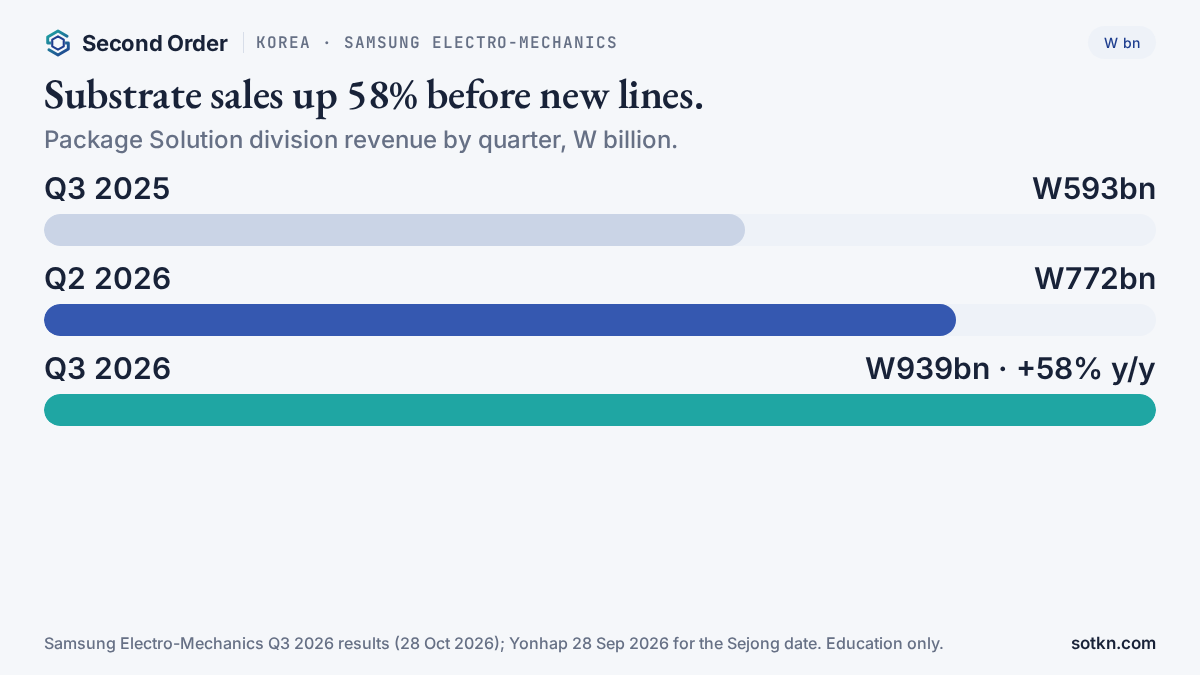
Already very well. In the third quarter of 2026, Samsung Electro-Mechanics’ Package Solution division, which makes the substrates, had revenue of W939.0 billion. That is up 58% from W593.2 billion a year earlier and up 22% from W771.6 billion in the second quarter. The company said the growth came from high-value boards for server processors, AI accelerators and network gear, plus boards for driver-assistance systems in cars.
The whole company made record sales of W3,763.3 billion and record operating profit of W691.0 billion in the quarter, an operating margin of 18.4%, up from 12.7% in the second quarter. By our arithmetic, the substrate division alone provided about 55% of the company’s sales growth from the second quarter to the third.
In its results release, the company said customers tied to AI data centres keep asking it to increase supply, and that it would add capacity at each production site on schedule while supplying new high-end boards for server processors and AI accelerators. That is the key point for who gets paid. When a factory is short of capacity, it can choose which orders to take first and ask for better prices. It does not need the new line to earn more; it needs the new line to sell more.
This is the same pattern our Korea desk saw in memory packaging, where Samsung’s new HBM stacking line in Onyang is not due until 2028 (Samsung’s W46 trillion Onyang line), and in chip tools, where makers were paid ahead of lines that took years (Wonik IPS and the net line).
What does the arithmetic say?
A few simple sums help size the story. All of these are our arithmetic from the figures above, rounded.
Substrate sales now
Size of the Sejong bet
Who pays (reported, not disclosed)
The clock
Demand versus capacity (KB, citing IBIDEN)
Samsung Electro-Mechanics Q3 2026 results; Yonhap 28 Sep 2026; ChosunBiz 22 Oct and 19 Nov 2026; Nvidia 17 Nov 2026. The 44% line assumes the whole reported W3tn range went into the W6.78tn of plans, which no company has confirmed; it could be lower or higher. The full-year line simply repeats Q3 four times.
Read the table this way. The Sejong plan alone is worth more than a year of today’s substrate sales, which is why customer money matters so much. Even if the reports are only roughly right, customers may be paying something like two fifths of the build. And the last box is the reason they pay: if demand for top boards grows several times faster than the factories that make them, a two-year wait for a line is a long time to be short.
KB Securities, in its 19 November note, forecast Samsung Electro-Mechanics’ 2027 revenue at W19.3 trillion and operating profit at W4.9 trillion, up 34% and 113% on the year. Working backwards, that implies roughly W14.4 trillion of revenue and W2.3 trillion of operating profit for 2026 (our arithmetic). KB also said the substrate division’s operating margin, now in the 20% range, could rise to 30–40% as more of the output is high-value. These are one broker’s forecasts, not company guidance.
Who gets paid, and who waits?
1 · The substrate maker
Who: Samsung Electro-Mechanics (Sejong, Busan)
Paid: Customer money for plants, a richer mix, more say on price
2 · Machines and builders
Who: Tool makers, plant builders and their subcontractors
Paid: Orders for new equipment; faster cash under a new payment pact
3 · Korean board and test suppliers
Who: Board makers, test and packaging firms
Paid: Wider AI demand; no named Nvidia substrate deals
4 · AI chip buyers
Who: Nvidia and the clouds that buy its systems
Paid: Pay up front; chips can outrun the boards to seat them
5 · Other substrate customers
Who: Buyers whose boards share the same lines
Paid: A tighter share as Nvidia’s portion grows by 2028 (our read)
6 · The new line
Who: Sejong from Sep 2028; full-scale Nvidia lines from 2029
Paid: Sets the timing for rows 4 and 5
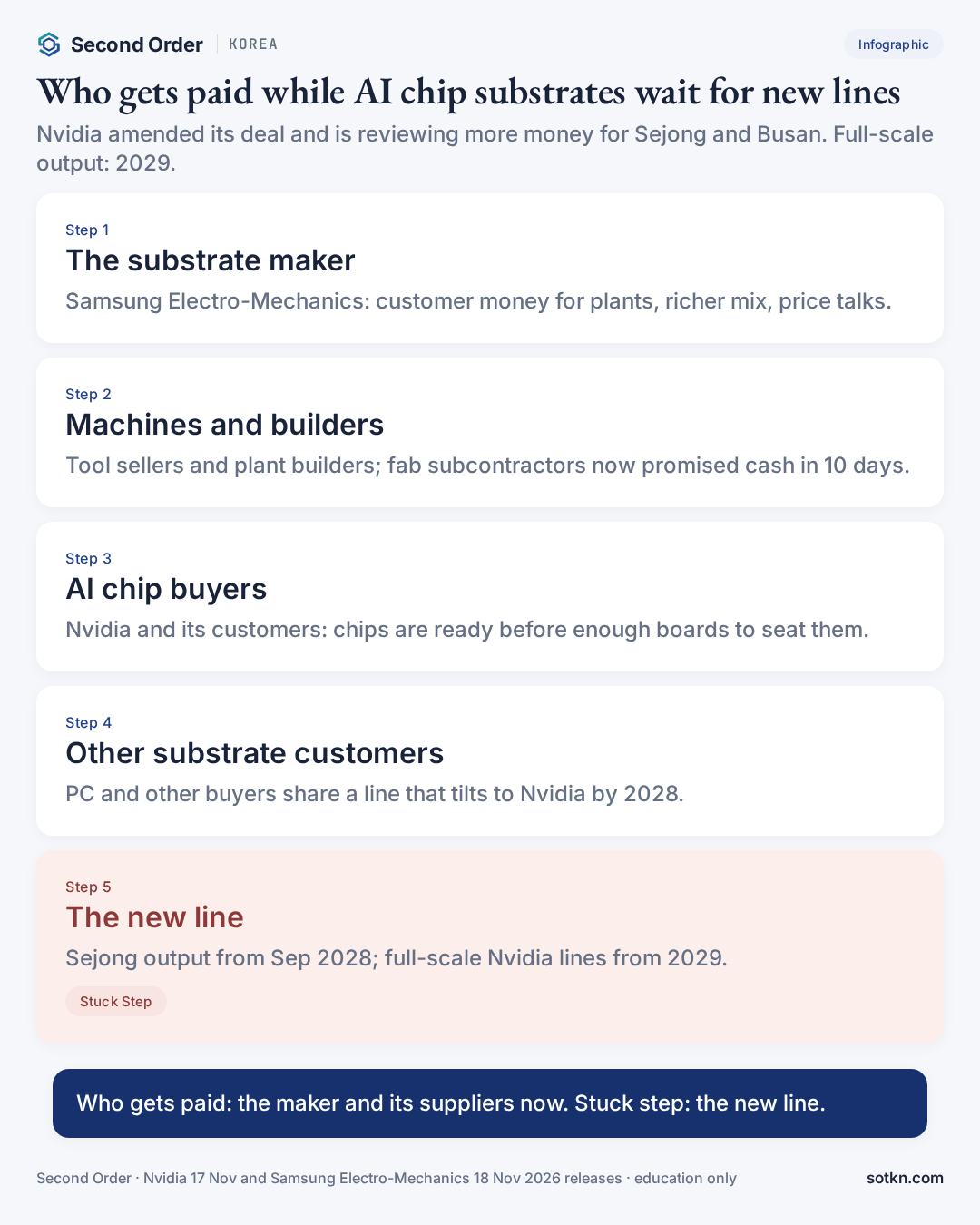
First paid, the substrate maker. It gets money from customers to build, it gets a richer mix as more of its output is high-end AI boards, and it gets more say over prices while supply is short. KB Securities expects exactly that mix shift to lift substrate margins. The customer money also protects it if demand cools before the line is full.
Next, the companies that build and equip the lines. Samsung Electro-Mechanics said this week that the extra Nvidia money would go to production infrastructure and state-of-the-art equipment. Whoever sells it the plating, drilling, laminating and inspection machines, and whoever builds the clean rooms, gets paid before a single new board ships.
There is a small Korean twist on getting paid here. On 18 November Samsung Electronics, SK hynix, Samsung C&T and SK ecoplant signed an agreement at the National Assembly to pay chip-plant construction subcontractors in cash within 10 days of an invoice, unless there are special circumstances. Until now, some chip building projects paid the main contractor with promissory notes due in 90 days, and the main contractor paid subcontractors with notes due in 60 days. Samsung Electro-Mechanics was not named in the report, but the direction is clear: in Korea’s chip build-out, the people pouring concrete and fitting pipes are being promised faster cash.
Third, the wider Korean board and test chain, which rallied on 19 November. Here we would be careful. Rising AI demand helps the whole chain, but a funded line with a named customer is a different thing from a share price move. The test is whether any of them announces a similar customer-funded deal (how Hanmi’s Q3 money moved).
Who waits? Nvidia itself, and the clouds that buy its systems. They are paying now, in cash and in commitments, for capacity that only arrives in full in 2028 and 2029. In between, the supply of top-grade boards grows only as fast as existing lines can be pushed, which is exactly what the amended contract is about.
The other group that may wait is less visible: everyone else who buys from the same lines. Samsung Electro-Mechanics said in October that Nvidia’s share of its total substrate capacity would be significant by 2028. When one customer takes a bigger slice of a tight factory, the others either pay more or get less. That is our read; no other customer has said it is being squeezed.
What is stuck, exactly?
The stuck step is the new substrate line. It is not demand: Nvidia, the company and the broker all describe shortage. It is not money: customers are funding part of the build, and Nvidia may add more. It is the time it takes to build, equip and tune a line that can make large, many-layered boards with few defects. Samsung Electro-Mechanics’ own plan puts the Sejong line into mass production in September 2028, and full-scale output of the Nvidia-funded expansion in 2029.
The clock has three parts. First, building and equipping, which the Sejong filing says runs until 31 May 2028. Second, starting up, with mass production on the new Sejong line from September 2028. Third, reaching full scale, planned from 2029. Each step can slip, and none can be skipped by paying more. What money can buy is more output from today’s lines, which is why this week’s amendment is about existing factories.
There are honest reasons for caution. First, the extra Nvidia money is under review, not signed. Second, the funding amounts are press reports. Third, the 2029 date is for full-scale mass production; some new output may come earlier. Fourth, Taiwan’s Kinsus is adding Nvidia capacity on a similar clock, with production from the second half of 2027 and the extra capacity targeted for the third quarter of 2028, so Korea is one of several taps being opened at once. Fifth, demand forecasts four years out can be wrong. The pattern our Analysis desk keeps returning to still applies: the slow step sets the timing, and money gathers around whoever is not stuck behind it (where the stuck step moves).
Which dates test the read?
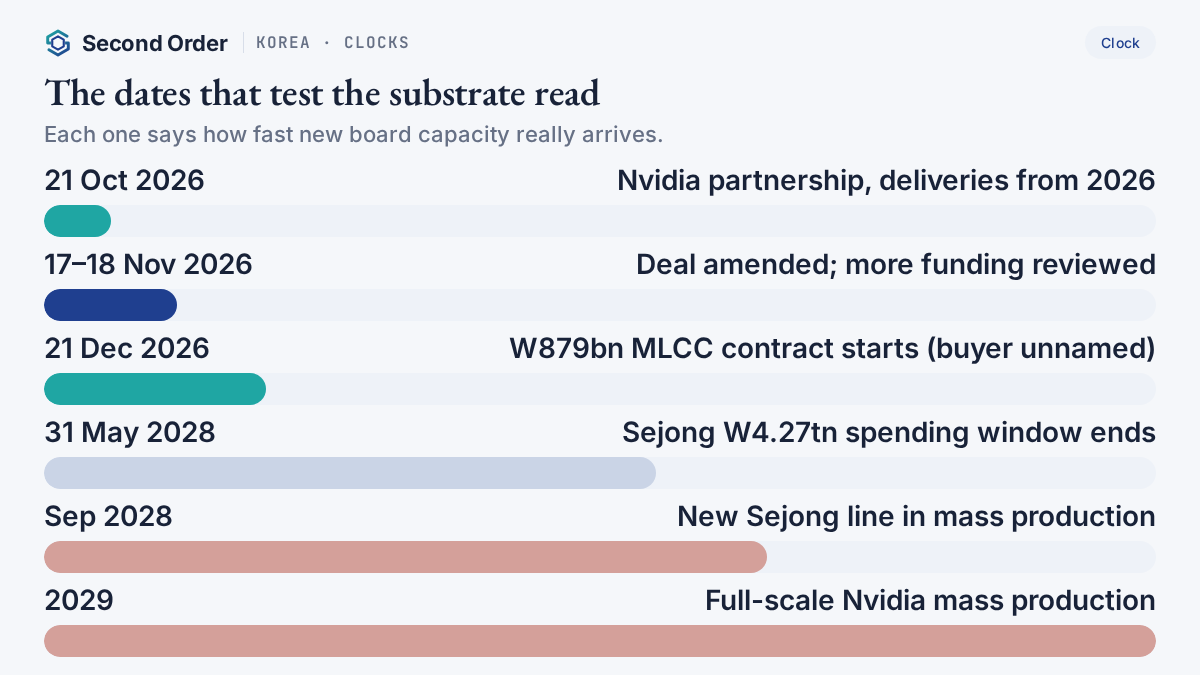
- 21 October 2026 — strategic partnership announced; deliveries to Nvidia from 2026.
- 17–18 November 2026 — agreement amended; more Nvidia funding under review; MLCCs added; full-scale mass production planned from 2029.
- 21 December 2026 — the W879.3 billion AI server MLCC supply contract (customer not named) starts.
- Late January 2027 — fourth-quarter results: does substrate revenue keep growing from W939 billion, and does the company disclose any Nvidia funding?
- 31 May 2028 — the W4.27 trillion Sejong spending window ends.
- September 2028 — the new Sejong line is due to start mass production.
- 2029 — full-scale mass production of the Nvidia-funded Sejong and Busan expansion.
Dates from Samsung Electro-Mechanics and Nvidia releases, Yonhap’s report of the 28 September filing, and the MLCC contract terms. The late-January date follows the company’s usual results timing and is our estimate.
How does this look from Taiwan, the US and China?
From Taiwan, it is the same story with a nearer clock: Nvidia is putting more than $1 billion into Kinsus for capacity due from late 2027, and Unimicron is in the October group (Taiwan Markets, Kinsus). Taiwan also buys more and more Korean memory for its AI rack makers (Korea is Taiwan’s top supplier).
From the US, it is one line in a much bigger list of supply commitments Nvidia is making across packaging, testing and boards, including Amkor (US Markets, what Amkor does, the packaging money). From China, where AI chips face US limits, the open question is how easily local chip designers can get top-grade boards while the leading makers fill up with Nvidia orders (China Markets). For all of our Korea notes, see Korea Markets.
How we check this. The deal terms come from Nvidia’s own release of 17 November 2026 and Samsung Electro-Mechanics’ release of 18 November, read against the two companies’ October announcements. Revenue and profit come from Samsung Electro-Mechanics’ third-quarter results. The Sejong investment and its dates come from the company’s 28 September filing as reported by Yonhap. Customer funding amounts were not disclosed by either company; the figures we quote are press reports and are labelled that way. Share moves come from Hankyung and MoneyToday for 19 November. Analyst views are KB Securities’ as reported by ChosunBiz, and we leave out its price target and rating on purpose. Every sum we worked out is labelled “our arithmetic”. We do not guess which customers lose a share of capacity when no company has said so. The references we used are listed at the end. Our editorial standards →
FAQ
What did Nvidia and Samsung Electro-Mechanics agree this week?
Nvidia said on 17 November (US time) that it had amended its substrate supply agreement with Samsung Electro-Mechanics to improve production at existing factories. The Korean company said on 18 November that Nvidia is reviewing additional funding for its Sejong and Busan plants, that full-scale mass production is planned from 2029, and that the partnership now also covers MLCCs, the tiny capacitors that steady power to AI chips.
What is a package substrate, and why does it matter?
It is the small multi-layer board an AI chip sits on. It carries power and signals from the chip to the main circuit board. AI chips keep getting bigger, so their substrates need more area and more layers, and only a few factories in Japan, Taiwan and Korea can make the top grades. Without enough substrate, finished chips cannot be packaged and shipped.
What is stuck?
New substrate lines. Samsung Electro-Mechanics’ own W4.27 trillion Sejong expansion runs to May 2028 with mass production from September 2028, and full-scale output from the Nvidia-funded Sejong and Busan expansion is planned from 2029. Until then, extra supply comes only from running existing lines harder.
Who gets paid first?
Samsung Electro-Mechanics, through higher-value products, more say on price and customer money for its factories; the companies that sell it machines and build its plants; and Korean board and test suppliers as AI demand spreads. Buyers of AI chips, and other substrate customers who may get a smaller share of a tight line, wait.
Is this investment advice?
No. Education only. It maps who gets paid and which step is stuck. It is not a recommendation to buy or sell any security, and we leave out price targets and ratings on purpose.
References
Outbound links below are nofollow. We list only the sources actually used. Internal sotkn.com links in the body are separate.
- NVIDIA Newsroom, NVIDIA Expands Commitments With Supply Chain Partners to Support AI Infrastructure Buildout, 17 Nov 2026. nvidianews.nvidia.com — the amended Samsung Electro-Mechanics agreement, the new Kinsus deal and its 2027–2028 timing, and the October goal of 2.5x substrate capacity over three years.
- Samsung Electro-Mechanics, Samsung Electro-Mechanics and NVIDIA Strengthen Collaboration to Expand AI Infrastructure, 18 Nov 2026. samsungsem.com — Sejong and Busan, the additional funding under review, full-scale mass production from 2029, and the MLCC extension.
- Samsung Electro-Mechanics, Samsung Electro-Mechanics and NVIDIA Announce Strategic Partnership to Supply ABF Substrates, 21 Oct 2026. samsungsem.com — joint investment in dedicated lines, deliveries from 2026, double-digit yearly volume growth, and Nvidia’s share of capacity by 2028.
- Samsung Electro-Mechanics, Q3 2026 earnings release, 28 Oct 2026. samsungsem.com — company and Package Solution revenue and profit by quarter, and the fourth-quarter supply outlook.
- Yonhap News Agency, Samsung Electro-Mechanics to invest 6.7 trillion won in domestic and Vietnam substrate expansion (Korean), 28 Sep 2026. yna.co.kr — the W4.27 trillion Sejong investment, its May 2028 end date and September 2028 mass-production start, and the W2.51 trillion Vietnam plan.
- ChosunBiz, Big tech fund Samsung Electro-Mechanics’ Korea substrate expansion, 22 Oct 2026. biz.chosun.com — reported customer funding in the W3 trillion range, with Nvidia’s share in the W2 trillion range.
- ChosunBiz, KB Securities sees earnings boost from Samsung Electro-Mechanics-Nvidia deal, 19 Nov 2026. biz.chosun.com — the substrate margin view, the 5.4x demand versus 80–90% capacity estimate, and the 2027 forecasts.
- Korea Economic Daily (Hankyung), Samsung Electro-Mechanics strong for a second day on Nvidia expectations (Korean), 19 Nov 2026. hankyung.com — the share price path on 19 November.
- MoneyToday, Samsung and SK hynix rise for 2nd day as experts say sustained earnings hold key to undervalued stocks, 19 Nov 2026. mt.co.kr — KOSPI, Samsung Electronics and SK hynix closes and the biggest chip-equipment gainers on 19 November.
- The Asia Business Daily, Semiconductor construction subcontractor payments to be made in cash within 10 days, 18 Nov 2026. asiae.co.kr — the payment-terms agreement signed by Samsung Electronics, SK hynix and their builders.
Not investment advice. Do your own research. Education only. Map of who gets paid and which step is stuck — not a buy list.
More on this desk: Korea Markets · Semiconductors · HBM explained · fab utilization explained · all Markets.