What Is a Customer Prepayment? Why AI Buyers Pay Before Delivery, and Who It Protects
A customer prepayment is cash a buyer pays before it gets what it ordered. In AI infrastructure it has become a way to fund the build: CoreWeave held US$10 billion of it in September. It is cheap money until a contract becomes cancellable.
EXPLAINED · Mechanism · Last reviewed: 14 Nov 2026 · Next review: after CoreWeave’s fourth-quarter 2026 results and Fermi’s 31 December 2026 lease deadline
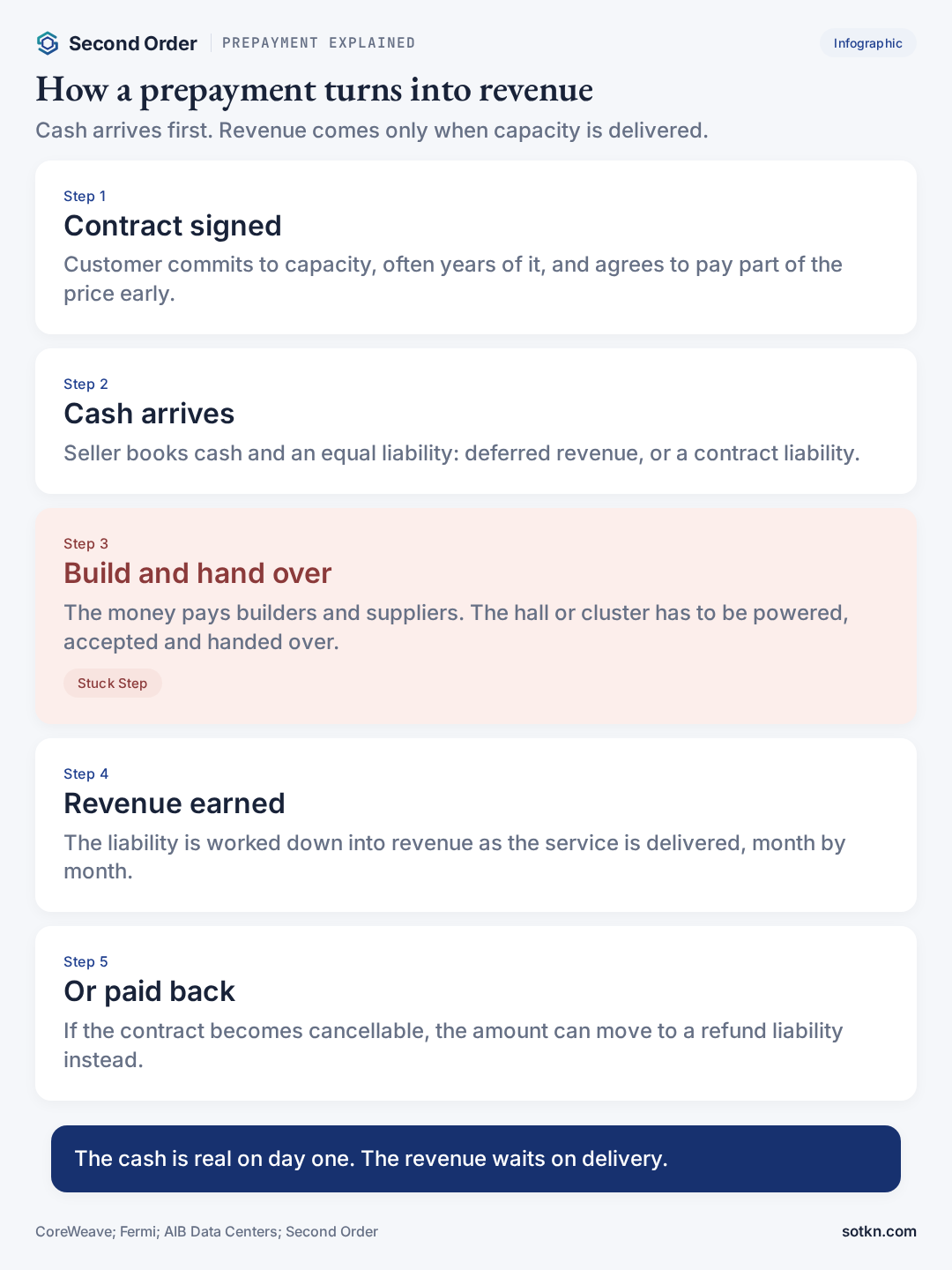
A customer prepayment is money a customer pays before it receives the product or service it has bought. The seller holds the cash straight away but cannot count it as revenue until it delivers, so it records a liability that is worked down as the service is provided.
In short. A prepayment is the customer paying first and the seller delivering later. In AI infrastructure it has turned into a way to fund the build: CoreWeave held US$10.0 billion of deferred revenue at the end of September, and an unnamed hyperscaler has committed US$200 million to Fermi before signing a lease. The cash is real on day one, but it only becomes revenue when capacity is delivered, and it can turn into a refund if the contract becomes cancellable. Our read: the stuck step is the handover of powered capacity. Prepayments move money forward; they do not move the delivery date.
Why an investor cares: AI capacity is scarce, so buyers are paying for it before it exists. That cash funds data halls and GPU clusters that would otherwise need more debt or new shares. It also sits on the seller’s balance sheet as a promise to deliver. Read it right and a prepayment tells you who is funding the build, who is protected, and what has to happen before anyone earns a profit. This page sits under our Neoclouds layer.
What is a prepayment?
A prepayment is any payment made before the thing paid for is delivered. Paying a year’s rent in advance is a prepayment. So is a cloud customer paying for two years of GPU capacity on signing, or a chipmaker paying a wafer supplier to hold capacity for it.
The word is used from both sides. The customer who pays has made a prepayment and holds a prepaid asset: the right to receive something later. The company that receives it has a customer prepayment, sometimes called a customer advance or customer deposit, and owes the customer that something. This page is mostly about the second side, because that is where the cash shows up.
How does a customer prepayment work?
The mechanism has three moving parts: the cash, the obligation and the clock.
- The cash arrives first. The seller can spend it at once, on buildings, equipment or interest. For a company building AI capacity, that is the point: the customer’s money pays suppliers before revenue starts.
- An obligation is booked. The seller records a liability of the same size. Accountants call it deferred revenue, unearned revenue or a contract liability. It is not debt, because it is repaid in service, not cash, as long as the seller delivers.
- The clock runs on delivery. Each month the capacity is provided, part of the liability becomes revenue. If delivery slips, revenue slips with it, even though the cash came in long ago.
How is a prepayment accounted for?
The simple version is in the table. Our deferred revenue Explained covers the liability side in more depth.
| Moment | Seller’s books | Customer’s books |
|---|---|---|
| Cash is paid | Cash up; deferred revenue (a contract liability) up by the same amount. No revenue yet. | Cash down; prepaid asset up. No expense yet. |
| Service is delivered | Deferred revenue worked down into revenue, month by month. | Prepaid asset worked down into expense. |
| Contract becomes cancellable | The amount that may be returned can move to a refund or customer liability. | Holds a claim to get the money back. |
| Payment is years ahead of delivery | Part of the prepayment may be treated as a loan, with interest expense recorded. | Effectively earns a return through a lower price. |
A simplified view of how most listed companies account for prepayments. Each company’s notes give the exact treatment.
Two details matter more than they look. First, when a payment arrives long before delivery, the rules can treat part of it as a loan from the customer. The seller then records interest expense on that loan and a little more revenue later. CoreWeave recorded US$204 million of non-cash interest on revenue agreements with significant financing components in the first nine months of 2026, against US$19 million a year earlier, more than ten times as much by our arithmetic.
Second, a prepayment is only revenue-in-waiting while the customer cannot take it back. If the contract becomes cancellable, the amount that might be returned is no longer a promise to deliver service. It is money that may have to go back, and it can be moved to a refund or customer liability.
Why are AI customers paying up front in 2026?
Because the scarce thing is time. Power-ready halls and installed GPU clusters take years to build, and a buyer who pays early gets a place in the queue. Four examples from the last two months show the range.
| Who paid early | Who received it | How much | What it pays for | What it still waits on |
|---|---|---|---|---|
| CoreWeave’s customers | CoreWeave | US$10.0bn of deferred revenue at 30 Sept 2026 | GPU cloud capacity under committed contracts | Delivery of the capacity; US$1.9bn now sits as customer liabilities after contracts became cancellable |
| An unnamed investment-grade hyperscaler | Fermi | US$200m prepayment plus US$15m early construction | 600 MW of powered land in Texas from 2027 | A definitive lease; the letter of intent is non-binding |
| Nebius | AIB Data Centers | Prepayment above AIB’s roughly US$100m of equity in an US$800m build | A 50 MW site in South Carolina on a 12-year contract | About US$700m of debt and preferred equity still to be raised; first hall around 10 months after escrow funds arrive |
| Chipmakers | GlobalWafers | NT$21.2bn, about US$0.67bn | Silicon wafer supply under long-term agreements | New capacity, which is still under evaluation |
From each company’s filings, release, presentation or investor call listed under References. Not a ranking of investments.
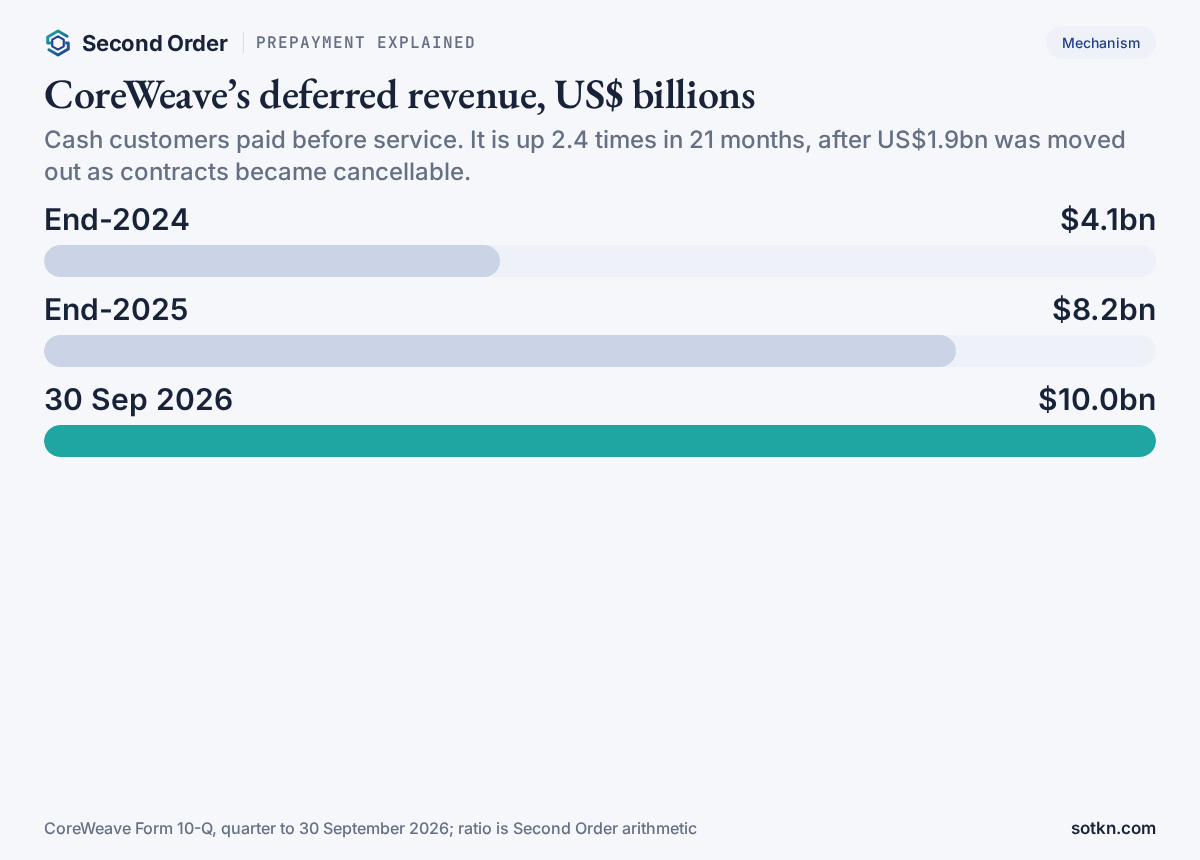
- CoreWeave. The GPU cloud provider held US$10.0 billion of deferred revenue at 30 September 2026, up from US$8.2 billion at the end of 2025 and US$4.1 billion at the end of 2024, 2.4 times in 21 months by our arithmetic. In its 10-Q it says it has received, and may continue to seek, upfront payments from customers under committed contracts in connection with deploying capacity for them. See what does CoreWeave do.
- Fermi. The pre-revenue Texas power and data centre developer said an investment-grade hyperscaler had agreed a US$200 million prepayment and a US$15 million early construction agreement for 600 MW of powered land from 2027, ahead of any lease. The prepayment is worth about 63% of the US$315.5 million of cash Fermi held at the end of September, by our arithmetic. Our Catalyst note on Fermi covers the deadlines.
- Nebius and AIB Data Centers. Nebius’s prepayments under a 12-year, 50 MW contract are meant to cover the developer’s own equity in an US$800 million build, with about US$560 million of construction debt and US$140 million of preferred equity still to be raised. Our Wire on the Nebius prepayment has the timeline.
- GlobalWafers. The same mechanism runs further up the chain. The wafer maker reported NT$21.2 billion of customer prepayments, about 1.4 times its third-quarter revenue by our arithmetic, and said further expansion is being evaluated alongside long-term agreement and prepayment talks. Our silicon wafer Explained covers why that supply is tight.
How big are prepayments at CoreWeave?
Large enough to matter for funding. In the first nine months of 2026, deferred revenue added US$3,492 million to CoreWeave’s operating cash flow of US$5,638 million, about 62%, by our arithmetic. That is about 15% of the US$23,558 million it spent on property and equipment over the same nine months. Customer cash is not the main source of funding, but it is the cheapest one: it carries no cash coupon.
The balance is also large relative to sales. US$10.0 billion of deferred revenue is about 2.7 times CoreWeave’s third-quarter revenue of US$3,661 million, by our arithmetic. In the third quarter, US$462 million of revenue came out of the deferred revenue balance held at the start of the quarter.
Deferred revenue is only part of the contracted book. CoreWeave reported US$132.3 billion of remaining performance obligations at 30 September, both billed and unbilled, of which 36%, about US$47.6 billion by our arithmetic, is expected to be recognised within 24 months. Our RPO Explained covers the difference.
What happens when a prepaid contract becomes cancellable?
CoreWeave’s third-quarter filing is a live example. It says US$1.9 billion of the deferred revenue balance from the start of the period was reclassified from deferred revenue to customer liabilities, inside other current liabilities, because contracts became cancellable during the quarter. Customer liabilities rose to US$1,915 million at 30 September from US$137 million at the end of 2025, about 14 times, by our arithmetic.
The filing does not say which contracts or why they became cancellable. What the reclassification tells you is the change in status: an amount equal to about 19% of the US$10.0 billion of deferred revenue still on the books at 30 September, by our arithmetic, is now shown as money that may have to be returned rather than service CoreWeave is due to deliver. If those customers keep their contracts, the amount can still become revenue. If they cancel, it leaves as cash.
Who gets paid?
Our read: the builders are paid first, the seller gets the cheapest money it can raise, and the customer who paid early gets the queue, with a claw-back if the contract allows one.
- Builders and equipment suppliers, first. Prepayments are spent on purchase orders: electrical gear, steel, cooling and GPUs. AIB said the Nebius money is meant to start equipment orders straight away, and Fermi is finalising a US$90 million steel and materials agreement with its hyperscaler.
- The seller, on its funding costs. Cash from a customer replaces equity or debt. For AIB, it replaces about US$100 million of its own equity. For CoreWeave, it is cash that does not carry a coupon, unlike its loans. Our GPU financing Explained covers the rest of the stack.
- The customer, on position. The buyer who pays early gets capacity on its timetable. Where the payment is far ahead of delivery, it may also get a lower price, which is the other side of the financing component above.
- Lenders, through the back door. Lenders read prepayments as proof of demand. Fermi’s 10-Q shows the reverse: one of its equipment loans must be prepaid if an approved customer agreement is not in place by 31 December 2026.
Where is the stuck step?
Our read: the handover of powered capacity. A prepayment moves money forward, but it does not move the date when a hall is energised, a cluster passes acceptance, or a lease is signed. Until that happens, the seller holds the cash and an obligation, and the customer holds a claim.
The dates are written down. AIB placed its first 25 MW hall about 10 months after escrow funds arrive and the second about 14 months after, with rent starting around the fourth quarter of 2027. Fermi needs a notice to proceed from Texas Tech University System by 31 December 2026 before vertical construction, and that notice depends on a Phase 1 lease of at least 200 MW. Fermi’s letter of intent is non-binding, so its US$200 million is a prepayment ahead of a lease, not rent. Our GPU cluster acceptance Explained covers the handover test.
Prepayment vs deferred revenue vs RPO
The three are related but not the same. A prepayment is the cash event. Deferred revenue is the liability left on the seller’s books after the cash arrives. Remaining performance obligations count all contracted work not yet delivered, whether or not it has been paid for. A company can have a large RPO with little deferred revenue if customers pay as they go. Our revenue backlog vs RPO and take-or-pay GPU contracts pages show where each one sits.
What would change the view?
- The customer liabilities turn back into revenue. If CoreWeave’s US$1,915 million of customer liabilities shrinks because contracts are confirmed and delivered, the reclassification will look like a timing point.
- Refunds go out. If the same balance leaves as cash, prepayments are a less reliable source of funding than they looked, and debt fills the gap.
- Letters become leases. If Fermi signs a definitive lease before the 31 December deadline, the prepayment becomes the first payment on a contracted project rather than money ahead of one.
- Capacity stops being scarce. If power-ready halls become easier to find, buyers lose the reason to pay early, and the cheapest money in the build goes away.
The clocks: Fermi’s 31 December 2026 notice-to-proceed deadline; CoreWeave’s fourth-quarter results, which will show where the US$1,915 million of customer liabilities went; AIB’s escrow funding date, which starts its 10-month clock; and GlobalWafers’ next update on expansion and prepayment talks.
Common misconceptions
- People assume a prepayment is revenue. Actually it becomes revenue only as the service is delivered. Until then it is a liability.
- People assume prepaid cash is free money. Actually it is owed back in service, and sometimes in cash. When payment is far ahead of delivery, the accounts even record interest on it.
- People assume a prepayment means a signed lease. Actually Fermi’s US$200 million sits alongside a non-binding letter of intent. The lease is still to be agreed.
- People assume prepayment always means paying a customer bill early. Actually on a loan it means repaying debt before it is due, and the same filing can use both meanings.
FAQ
What is a customer prepayment?
Money a customer pays before it receives what it bought. The seller has the cash at once, but it records a liability, usually called deferred revenue or a contract liability, and turns it into revenue only as it delivers.
Is a prepayment revenue?
Not when it arrives. Under the accounting rules most listed companies use, a prepayment becomes revenue only as the product or service is delivered. Until then it sits on the balance sheet as money owed in the form of future service.
Is a prepayment an asset or a liability?
It depends whose books you look at. For the customer who paid, it is an asset, often shown as a prepaid expense. For the company that received it, it is a liability until it delivers.
Why do AI customers pay up front?
To secure capacity that is scarce. Power-ready data halls, GPU clusters and some materials have long waiting lists. Paying early funds the build and puts the buyer near the front of the queue. Nebius’s prepayment to AIB Data Centers and an unnamed hyperscaler’s US$200 million prepayment to Fermi are 2026 examples.
Can a prepayment be refunded?
Yes, if the contract allows it or the seller fails to deliver. CoreWeave reclassified US$1.9 billion of prepaid amounts from deferred revenue to customer liabilities in the third quarter of 2026 because the contracts became cancellable.
What is the difference between a prepayment and a deposit?
In everyday use the words overlap. A deposit is usually a smaller sum held as security and often returnable; a prepayment is part of the price paid early. What matters to an investor is the contract: whether the money can be clawed back, and on what conditions.
What does prepayment mean on a loan?
Something different: paying back a loan before it is due. Fermi’s filing uses the word both ways, for the hyperscaler’s customer prepayment and for a lender’s right to require early loan repayment if no customer agreement is signed by 31 December 2026.
Is this advice to buy or sell any company?
No. This page explains how customer prepayments work and who they pay. It does not rank companies as investments or give buy or sell calls. Not investment advice. Do your own research.
Related: deferred revenue; RPO; purchase commitment; cloud commitment; data center lease; who finances GPU clusters.
Stack doors
Layer: Neoclouds. Players: CoreWeave and Nebius. Start with what a neocloud is.
Get the Wire — short daily notes on where AI computing gets built and who pays for it.
Not investment advice. Do your own research.
How we check this
CoreWeave’s deferred revenue, the US$1.9 billion reclassification, customer liabilities, remaining performance obligations, cash flows and financing-component interest come from its Form 10-Q for the quarter to 30 September 2026, filed on 12 November 2026. Fermi’s prepayment, early construction and steel agreements, cash and lease termination come from its results release of 12 November 2026, and its land-lease deadline, letter of intent and loan terms from its Form 10-Q of the same day. The AIB Data Centers and Nebius deal comes from MarketBeat’s report of AIB’s investor call on 8 October 2026 and DCD’s report of 1 October 2026. GlobalWafers’ prepayments, revenue and expansion comments come from its results release and earnings call presentation of 3 November 2026. Accounting descriptions are a simplified guide to how most listed companies record prepayments, not a replacement for each company’s notes. Company statements about plans and timing are their own outlooks, not facts about the future. Ratios and multiples are our arithmetic, checked in code and labelled as ours on the page. We do not convert currencies except where a company gives its own conversion. Who gets paid and the stuck step are our read. The featured photograph is credited in its caption. This page explains a mechanism and who it pays. It does not rank companies as investments or give buy or sell calls. Not investment advice. Do your own research.
Last reviewed: 14 Nov 2026 · Next review: after CoreWeave’s fourth-quarter 2026 results and Fermi’s 31 December 2026 lease deadline
Spot an error? Tell us and we will correct it and note the change here.
References
- CoreWeave — Quarterly report on Form 10-Q for the quarter ended 30 September 2026 (filed 12 Nov 2026) — Deferred revenue of US$10.0 billion; US$1.9 billion reclassified to customer liabilities as contracts became cancellable; customer liabilities US$1,915 million; RPO US$132.3 billion; cash flow and financing-component interest
- Fermi — Fermi announces new agreements with investment-grade hyperscaler and third quarter 2026 financial results (12 Nov 2026) — US$200 million prepayment agreement and US$15 million early construction agreement for 600 MW from 2027 ahead of a lease; US$90 million steel agreement being finalised; TensorWave lease terminated; US$315.5 million of cash
- Fermi — Quarterly report on Form 10-Q for the quarter ended 30 September 2026 (12 Nov 2026) — Non-binding letter of intent of 10 November; notice to proceed needed from Texas Tech by 31 December 2026, conditioned on a Phase 1 lease of at least 200 MW; loan prepayment requirement if no approved customer agreement by that date
- MarketBeat — BlockchAIn Digital Infrastructure says Nebius prepayment funds $800M data center build (8 Oct 2026) — Investor call: US$800 million budget, about US$560 million of construction debt and US$140 million of preferred equity, prepayment covering about US$100 million of equity, hall timings and rent from around the fourth quarter of 2027
- DCD — Nebius signs 50MW lease with AIB Data Centers (1 Oct 2026) — 50 MW, 12-year agreement at the CLT1 site in South Carolina, two five-year renewal options, Nebius on time-to-power
- GlobalWafers — GlobalWafers reports Q3 2026 results (3 Nov 2026) — Third-quarter revenue NT$14.87 billion; demand above capacity in Texas and Missouri; long-term agreements supporting capacity planning
- GlobalWafers — Q3 2026 earnings call presentation (3 Nov 2026) — Customer prepayments of NT$21.2 billion (US$0.67 billion); further expansion under evaluation, supported by long-term agreement and prepayment talks