Who Makes DRAM? The Memory Makers Behind AI Servers, and Who Gets Paid
Three companies make 88% of the world’s DRAM by revenue. AI servers have turned that memory into a shortage, the makers are being paid on price, and new supply waits on clean rooms that will not be ready until 2028.
EXPLAINED · Players · Last reviewed: 14 Nov 2026 · Next review: after Counterpoint’s fourth-quarter 2026 DRAM share data and the makers’ fourth-quarter results
DRAM is made by a handful of companies: Samsung Electronics, SK hynix and Micron Technology took 88% of global DRAM revenue in the third quarter of 2026, with China’s CXMT on 9% and smaller makers such as Nanya Technology sharing the rest.
In short. Samsung, SK hynix and Micron make most of the world’s DRAM, and China’s CXMT is a growing fourth. In the third quarter of 2026 the market was worth nearly US$200 billion, 369% more than a year earlier, while the makers shipped only about 4% more bits than in the quarter before. They are being paid on price, and they are selling years ahead under long-term agreements. Our read: the stuck step is clean-room space. Every maker is building, but the major new fabs do not produce until 2028.
Why an investor cares: every AI server needs two kinds of memory, the HBM stacked beside the accelerator and a much larger pool of ordinary DRAM beside the CPU. Both come from the same few companies and the same fabs. When those fabs are full, the price of memory, not the number of chips, decides who gets paid. This page sits under our Semiconductors layer.
What is DRAM?
DRAM, or dynamic random-access memory, is the working memory of a computer. It holds the data a processor is using right now, in billions of tiny capacitors that leak and must be refreshed many times a second. It is fast and cheap per bit, but it forgets everything when the power goes off, which is why computers also need storage such as NAND flash.
DRAM comes in several forms: modules for servers and PCs, low-power chips soldered into phones and laptops, graphics memory, and HBM, which stacks several DRAM dies into one tower beside an AI processor. Our HBM vs DDR5 page compares the two that matter most for AI servers, and HBM Explained covers the stack itself.
Who makes DRAM?
DRAM is made by five companies that matter, and three of them make almost all of it. Counterpoint Research put Samsung Electronics at 38% of global DRAM revenue in the third quarter of 2026, SK hynix at 29% and Micron at 21%. China’s CXMT had 9%. That leaves about 3% for everyone else, by our arithmetic, led by Taiwan’s Nanya Technology and Winbond.
| Maker | Home | Share of DRAM revenue, Q3 2026 | Latest quarter (reported) | What it said about supply |
|---|---|---|---|---|
| Samsung Electronics | South Korea | 38% | Memory revenue ₩140.7tn, July–Sept (29 Oct) | Managed its product mix towards AI amid capacity constraints; scaled up HBM4 sales |
| SK hynix | South Korea | 29% | Revenue ₩104.6tn, 80% operating margin (28 Oct) | Long-term agreements cover more than half of 2027–2028 capacity; demand above supply through 2030 |
| Micron Technology | United States | 21% | DRAM revenue US$39.8bn, fiscal quarter to 3 Sept (30 Sep) | No line of sight to when supply and demand balance; most 2027 HBM already under agreement |
| CXMT | China | 9% | Revenue ¥118.7bn, July–Sept (30 Oct) | Conventional DRAM rather than HBM; quarterly growth slowed to 19.3% |
| Nanya Technology and others | Taiwan and elsewhere | About 3% together | Nanya revenue NT$133.6bn, July–Sept (12 Oct) | Prices up more than 60% as old contracts ended; new fab moves in tools in early 2027 |
Shares from Counterpoint Research; the 3% for others is our arithmetic. Results from each company’s materials listed under References. Not a ranking of investments.
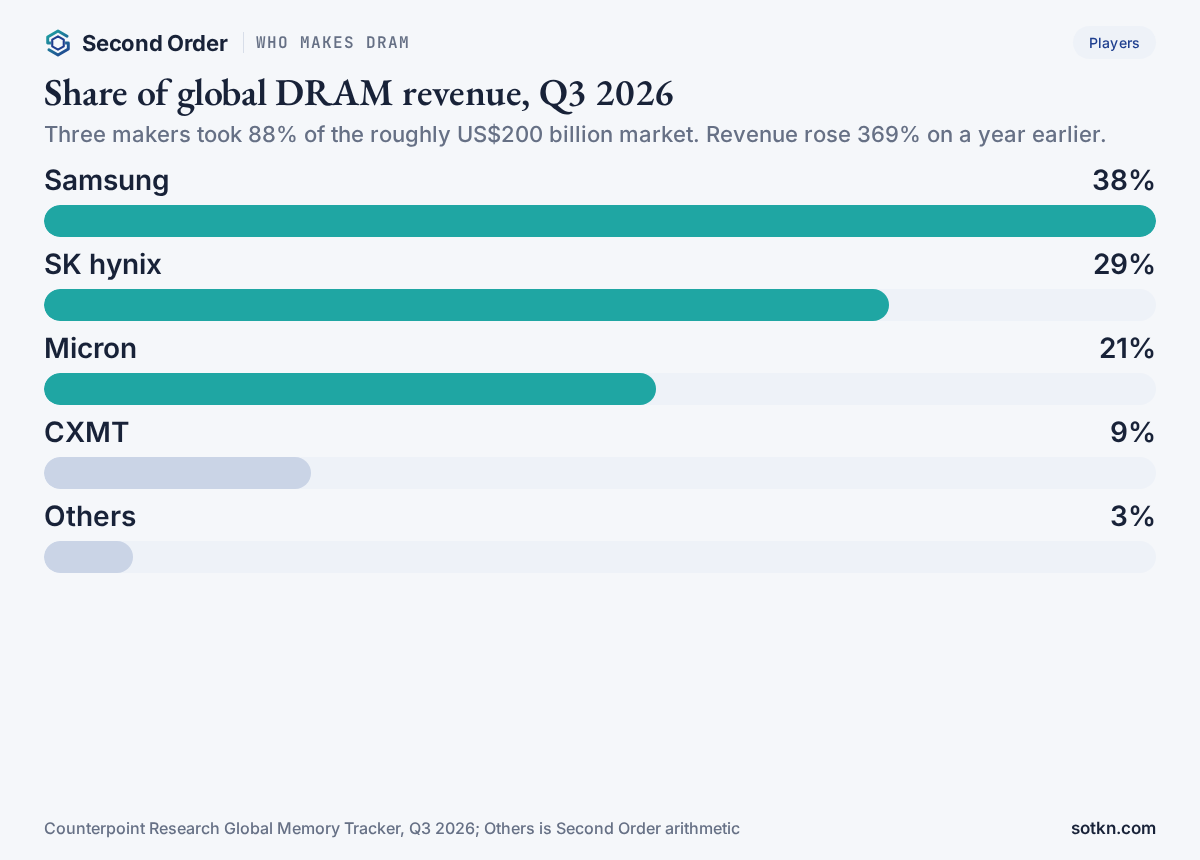
The order has moved this year. Counterpoint said SK hynix’s DRAM revenue rose more than 40% in the quarter, narrowing the gap with Samsung, while Micron grew more slowly and CXMT slipped from 10% to 9% after a quarter in double digits. Shares here are by revenue, so they move with each maker’s prices and product mix as much as with its output.
What does each DRAM maker do?
- Samsung Electronics. The largest DRAM maker and the broadest: server, PC and phone memory, HBM, and NAND flash. Its chip division made ₩106.5 trillion of operating profit in the third quarter, 99% of the whole group’s, by our arithmetic. Memory revenue was ₩140.7 trillion, up about 16% on the quarter and 5.3 times a year earlier. Samsung said it managed its product mix towards AI products amid capacity constraints. Our what does Samsung do page covers the business model.
- SK hynix. The leader in the last generation of HBM, HBM3E, and now selling much more server DDR5 alongside it. Revenue passed ₩100 trillion for the first time, at ₩104.6 trillion, with an 80% operating margin. It said HBM4 shipments began in earnest and should become its main HBM product from the fourth quarter. See what does SK hynix do.
- Micron Technology. The only large DRAM maker based in the United States. DRAM revenue was US$39.8 billion in its fiscal fourth quarter to 3 September, 73% of the company’s sales, up 27% on the quarter and 4.4 times a year earlier, by our arithmetic. It is building new fabs in Idaho, New York and Japan. See what does Micron do.
- CXMT. China’s largest DRAM maker, listed on Shanghai’s STAR Market in July. Third-quarter revenue was 118.7 billion yuan, up 613% on a year earlier but only 19.3% on the quarter. It sells mainly conventional DRAM, not HBM, and Counterpoint expects its share to stay under pressure as rivals ship more HBM4. Our China Pulse on CXMT’s quarter has the filing detail.
- Nanya Technology and the smaller makers. Nanya, in Taiwan, makes conventional DRAM for servers, PCs and consumer devices. Its revenue rose 61.9% in the third quarter to NT$133.6 billion, almost entirely on price: average prices rose more than 60% while bit shipments fell. More than 20% of its revenue now comes from AI infrastructure. Our Taiwan Pulse on Nanya follows its prices.
Who makes HBM, and is it the same list?
Mostly, yes. HBM is DRAM, stacked, so it comes from the same companies. SK hynix, Samsung and Micron make almost all of it, and CXMT is not yet a major HBM supplier. The difference is in the mix: each maker decides how much of its wafer capacity goes to HBM and how much to ordinary DRAM. Our who makes HBM page covers that market on its own.
That choice is why the two markets are tied. Counterpoint said HBM revenue almost doubled in the third quarter, yet its share of DRAM revenue fell, because conventional DRAM grew even faster. Server CPUs are using more ordinary memory than before; Counterpoint said CPU memory per socket in Nvidia’s Vera Rubin rack rises almost threefold to 1.5 terabytes.
How big is the DRAM market in 2026?
The DRAM market was worth nearly US$200 billion in the third quarter of 2026, according to Counterpoint Research, 369% more than a year earlier. That puts the year-ago quarter at roughly US$43 billion, by our arithmetic. Bit shipments rose only about 4% on the quarter, and the average price reached US$1.9 per gigabit.
Counterpoint called it a pricing super-cycle, not yet a volume cycle. The makers’ own numbers say the same. Nanya shipped fewer bits and earned 61.9% more. Micron said its DRAM bit shipments rose by a mid-single-digit percentage in its last quarter while prices rose by a high-teens percentage.
How is DRAM sold?
DRAM used to be sold like a commodity, on contracts that reset every month or quarter, plus a spot market. In 2026 more of it is being sold years ahead under long-term agreements, and buyers are asking for longer terms, not lower prices.
| Maker | How far ahead it has sold |
|---|---|
| SK hynix | Long-term agreements with 14 major customers, typically five years, covering more than 50% of 2027 and 2028 production capacity, with prices moving inside an agreed range |
| Micron | Agreements for the vast majority of its calendar 2027 HBM supply, at significantly higher prices than 2026 |
| Nanya | Long-term agreements cover about 50% to 70% of its business, from three months to three years; customers are asking for three years or more |
From SK hynix’s results release, Micron’s results presentation and TrendForce’s report on Nanya’s results call.
Contract timing explains why makers’ results differ in the same market. Nanya’s prices jumped in the third quarter because older, lower-priced agreements signed in 2025 ran out at the end of June. Counterpoint said terms of these agreements may make results differ between suppliers in the short term. The buyer’s side of the same contract is covered in our purchase commitment Explained.
Who gets paid?
Our read: the memory makers are paid now, on price; the buyers who signed early are protected; and everyone else pays the new price or waits.
- The big three, on price. SK hynix’s 80% operating margin, Nanya’s 85.7% gross margin and Samsung’s 72% chip-division operating margin, by our arithmetic, are what a shortage looks like in a business that sells mostly on price. Output is not rising fast enough to explain the profit.
- Customers with long contracts. Cloud companies and AI chip makers that signed multi-year deals get first claim on supply, and some price protection inside an agreed range. Some Nanya customers have asked about taking equity stakes to secure capacity.
- Buyers without contracts. Phone, PC and consumer device makers pay the higher price or ship less memory. Counterpoint said rising server use is creating headwinds for those edge markets.
- Builders and toolmakers. The cash the makers are earning is going into new clean rooms first. Micron said most of its extra spending for fiscal 2027 is construction, to bring clean-room space forward. Our clean room Explained and who makes wafer fab equipment cover who gets paid for that.
- The smaller makers, on the gap. As the big three move capacity towards HBM and server memory, older and consumer products are left to Nanya, Winbond and CXMT, at prices they have not seen before.
Where is the stuck step?
Our read: clean-room space. The makers have the cash and the customers. What they cannot buy quickly is a finished, fitted fab floor to put tools in.
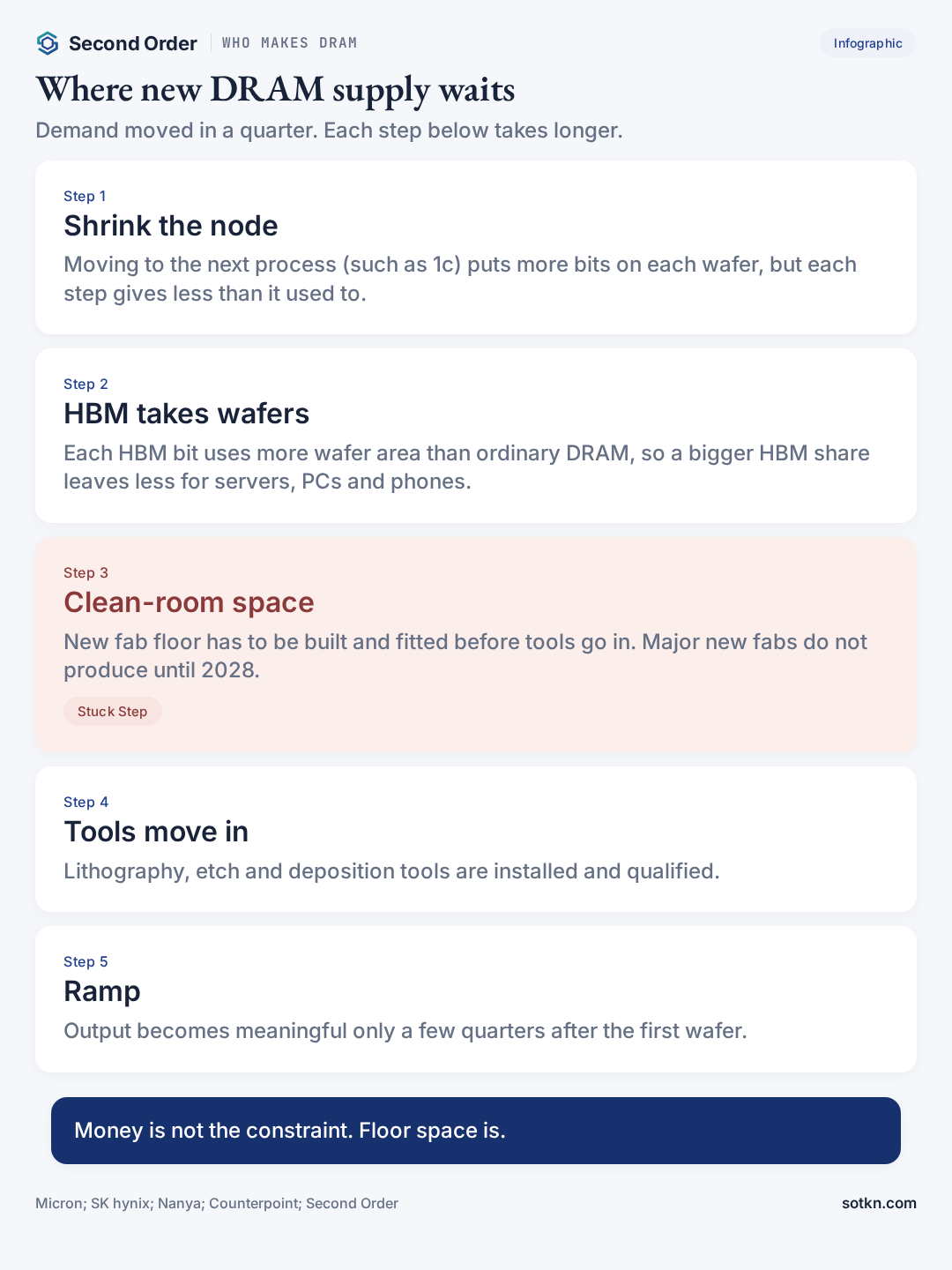
They say so directly. Micron said cleanroom additions are required to narrow the gap between supply and demand, and that even with the industry’s planned space it has no line of sight to when the two return to balance. SK hynix said the technical difficulty of leading-edge processes and the long lead time to build new facilities mean demand will exceed supply through 2030. Counterpoint said major new fabs will not start production until 2028.
The dates line up. Micron’s first new Idaho fab is due to start wafer output in mid-2027 and its second in late 2028, with a Japan expansion also in late 2028 and its first New York fab in 2030. Nanya’s new fab moves in equipment in the first quarter of 2027 and reaches 30,000 wafers a month by the end of 2028, 60% of its planned 50,000, by our arithmetic. SK hynix’s Yongin Phase 1 enters full operation next year. And Micron noted that new fabs become meaningful only a few quarters after first output.
Node shrinks still add bits, but less each time. Micron expects industry DRAM bit shipments to grow in the mid-20s per cent in 2026 and in the low 20s in 2027 and 2028, with the industry still short in both years. Our Korea Pulse on Samsung building clean rooms first and our Analysis on Micron’s clean-room stuck step go deeper on the same bind.
What would change the view?
- Prices stop rising. If contract prices flatten while bit shipments keep growing, the market would be turning from a price cycle into a volume cycle, and the makers’ margins would follow.
- Clean rooms arrive early. If Micron’s Idaho fab or SK hynix’s Yongin site ramps faster than planned, the 2028 wall moves forward.
- Edge demand breaks. If phone and PC makers cut orders hard, more supply would be freed for servers and prices could ease outside the AI market first.
- CXMT closes the HBM gap. A credible HBM product from CXMT would change the share picture and add a fourth HBM supplier.
The clocks: Micron reports its fiscal first quarter in December against guidance of US$61.5 billion; Samsung and SK hynix report the fourth quarter in late January; Counterpoint’s fourth-quarter share data follows; Nanya’s new fab moves in tools in the first quarter of 2027 and Micron’s first Idaho fab starts output in mid-2027.
Common misconceptions
- People assume Nvidia makes the memory in its chips. Actually it buys HBM and DRAM from SK hynix, Samsung and Micron.
- People assume HBM and DRAM are separate markets. Actually HBM is stacked DRAM made in the same fabs, so every wafer used for HBM is one not used for ordinary memory.
- People assume a record quarter means record output. Actually bit shipments rose only about 4% in the third quarter. The record came from price.
- People assume the makers can simply spend their way out. Actually they are spending, but new clean-room space takes years, and the major new fabs do not produce until 2028.
FAQ
Who makes DRAM?
A handful of companies. Samsung Electronics, SK hynix and Micron Technology took 88% of global DRAM revenue in the third quarter of 2026, according to Counterpoint Research. China’s CXMT had 9%. Smaller makers such as Nanya Technology and Winbond share the remaining few per cent.
Who is the largest DRAM manufacturer?
Samsung Electronics, with 38% of global DRAM revenue in the third quarter of 2026, according to Counterpoint Research. SK hynix was second with 29% and Micron third with 21%.
Does Nvidia make DRAM?
No. Nvidia designs AI processors and buys memory from DRAM makers. The high-bandwidth memory (HBM) stacked beside its chips comes from SK hynix, Samsung and Micron, and the ordinary DRAM in its servers comes from the same small group.
Is HBM the same as DRAM?
HBM is a kind of DRAM: several DRAM dies stacked on top of each other and connected with through-silicon vias, placed beside the processor. It uses more wafer area per bit than ordinary DRAM, which is one reason AI is tightening supply of both.
Why are DRAM prices rising in 2026?
Because AI servers need far more memory than makers can produce. Counterpoint said third-quarter DRAM revenue rose 369% from a year earlier while bit shipments rose only about 4% on the quarter: buyers are paying more for roughly the same output.
Is there a Chinese DRAM maker?
Yes. CXMT (ChangXin Memory Technologies) is China’s largest DRAM maker. It reported third-quarter 2026 revenue of 118.7 billion yuan and had 9% of global DRAM revenue, according to Counterpoint. It mainly sells conventional DRAM rather than HBM.
When will DRAM supply catch up?
Not soon, on the makers’ own words. Micron said it has no line of sight to when supply and demand return to balance, SK hynix expects demand to exceed supply through 2030, and Counterpoint said major new fabs will not start production until 2028.
Is this a list of stocks to buy or sell?
No. This page explains who makes DRAM and how they are paid. It does not rank companies as investments or give buy or sell calls. Not investment advice. Do your own research.
Related: who makes HBM; HBM; HBM vs DDR5; HBM base die; silicon wafer; clean room.
Stack doors
Layer: Semiconductors. Markets: Korea, Taiwan, China and US. Markets note: Micron’s Idaho build in its annual report.
Get the Wire — short daily notes on where AI computing gets built and who pays for it.
Not investment advice. Do your own research.
How we check this
Market shares, the size of the market, bit growth, average price and the 2028 fab view come from Counterpoint Research’s Q3 2026 memory release of 5 November 2026. Samsung’s figures come from its results release and earnings presentation of 29 October 2026. SK hynix’s results, contracts and outlook come from its release of 28 October 2026. Micron’s results, DRAM revenue, contract cover, supply outlook and fab timelines come from its release and results presentation of 30 September 2026. Nanya’s results and fab plan come from its release of 12 October 2026, and its contract terms from TrendForce’s report of the same day. CXMT’s results come from Seoul Economic Daily’s report of 30 October 2026 on the company’s third-quarter filing. Company statements about supply and demand are their own outlooks, not facts about the future. Market trackers measure share differently, so another firm’s numbers may not match Counterpoint’s. Growth rates, ratios and the share for smaller makers are our arithmetic, checked in code and labelled as ours on the page. We do not convert currencies. Who gets paid and the stuck step are our read. The featured photograph is credited in its caption. This page explains who makes a product and how they are paid. It does not rank companies as investments or give buy or sell calls. Not investment advice. Do your own research.
Last reviewed: 14 Nov 2026 · Next review: after Counterpoint’s fourth-quarter 2026 DRAM share data and the makers’ fourth-quarter results
Spot an error? Tell us and we will correct it and note the change here.
References
- Counterpoint Research — Q3 2026 DRAM super-cycle nears $200B: Samsung holds No. 1 with 38%, SK hynix gains (5 Nov 2026) — Q3 2026 DRAM revenue shares; revenue up 369% from a year earlier on bit shipments up about 4% on the quarter; average price US$1.9 per gigabit; major new fabs not producing until 2028
- Samsung Electronics — Samsung Electronics announces third quarter 2026 results (29 Oct 2026), with the 3Q 2026 earnings presentation — DS division revenue ₩147.1 trillion and operating profit ₩106.5 trillion; memory revenue ₩140.7 trillion versus ₩120.8 trillion in Q2 and ₩26.7 trillion a year earlier; HBM4 sales scaled up amid capacity constraints
- SK hynix — SK hynix announces 3Q26 financial results (28 Oct 2026) — Revenue ₩104.6 trillion, operating profit ₩83.3 trillion; long-term agreements with 14 major customers covering more than 50% of 2027–2028 capacity; M15X and Yongin Phase 1; demand above supply through 2030
- Micron Technology — Micron reports record fiscal fourth-quarter and full-year 2026 results (30 Sep 2026) — Fiscal Q4 revenue US$54.23 billion versus US$11.32 billion a year earlier; fiscal Q1 2027 guidance of US$61.5 billion
- Micron Technology — Fiscal Q4 2026 financial results presentation (30 Sep 2026) — DRAM revenue US$39.8 billion, 73% of the total; industry DRAM bit growth outlook; vast majority of 2027 HBM under agreement; clean-room space and fab timelines for Idaho, New York and Japan
- Nanya Technology — Nanya Technology reports results for the third quarter 2026 (12 Oct 2026) — Revenue NT$133.6 billion, up 61.9% on the quarter; average prices up more than 60% as bit shipments fell; gross margin 85.7%; new fab capacity of 30,000 wafers a month by end-2028 and 50,000 by end-2030
- TrendForce — Nanya’s 3Q DRAM ASPs surge over 60% QoQ as gross margin hits 85.7% (12 Oct 2026) — Long-term agreements cover about 50% to 70% of Nanya’s business at three months to three years; customers seeking longer terms and equity stakes; older low-price contracts expired in June
- Seoul Economic Daily — China’s CXMT posts sevenfold revenue jump but growth slows (30 Oct 2026) — CXMT third-quarter revenue of 118.7 billion yuan, up 613% from a year earlier and 19.3% on the quarter; net profit 54.4 billion yuan; listed on the STAR Market in July