
₩198 Trillion in Cash, Few New Chips: Who Gets Paid While Samsung Builds Clean Rooms First
Samsung earned a record ₩107.4 trillion in one quarter, mostly from memory prices rather than more chips. It has ₩198 trillion of net cash and a ₩84 trillion build plan, and says 2027 spending still won't lift 2028 output much. The stuck step is the clean room.

Samsung Electronics just had the most profitable quarter any tech company has ever reported, and it barely sold more chips to do it. On 29 October it said operating profit hit ₩107.4 trillion, almost all of it from memory, as DRAM prices rose about 20% in three months while shipments grew only a few percent. It holds ₩198 trillion more cash than debt and plans to spend ₩84 trillion this year. Yet it told investors that next year’s spending will do little for output in 2028. Money is not the problem. The stuck step is the clean room.
KOREA PULSE · SEMICONDUCTORS · Data as at 29 Oct 2026 · Next update: Samsung fourth-quarter results, late January 2027
Affects: Semiconductors · Hyperscalers — Markets: Korea · Taiwan · US
Education only, not advice to buy or sell any security. Figures are as published by Samsung Electronics in its 29 October release and call materials, or as said on its call, unless another source is named. Our own sums are labelled.
The numbers that matter this week
Operating profit, Q3 2026
₩107.4tn
+20% q/q · 55.0% margin · record
RecordMemory revenue, Q3
₩140.7tn
+16% q/q · +427% y/y
RisingDRAM price vs shipments
~+20% vs low-mid single digit
Average price vs bits, from Q2
Price-ledNet cash, 30 Sep
₩197.6tn
Up from ₩167.6tn in June
Cash-rich2026 capital spending
₩84.4tn
+₩31.7tn on 2025 · chips ₩76.8tn
RaisedNew clean room space
P5: 2028
Shell first, tools as demand shows
Stuck stepFigures from Samsung’s Q3 2026 release and call materials (29 Oct). Price and shipment changes from the call. P5 timing as reported by ZDNet Korea. y/y = from a year earlier; q/q = from the quarter before. Status chips are Second Order’s read.
On this page: Why it matters · The quarter · Price, not volume · The cash pile · ₩84 trillion · Why 2028 stays tight · Sold out and signed up · Foundry and Taylor · Our math · Who gets paid · What is stuck? · Dates next · What would change this · FAQ
Why does Samsung’s quarter matter to who gets paid?
Because every AI server needs memory, and Samsung makes more of it than anyone else. The fast memory stacked beside an AI chip (HBM), the large memory sticks in the server (server DRAM) and the flash drives that store data (SSDs) all come from a small number of fabs, most of them in Korea. On 28 October we looked at the other big Korean memory maker, SK hynix (the SK hynix Q3 Pulse). Samsung’s numbers fill in the rest of the picture.
What makes this quarter useful is not the size of the profit. It is what Samsung said about why it cannot simply make more. A company with this much cash can buy almost anything. What it cannot buy quickly is a finished, fitted clean room — the sealed, filtered factory floor where wafers are made. That is the question for this Pulse: when demand is certain and cash is plentiful, who gets paid first, and what sets the pace for everyone else?
The answer from the 29 October numbers is that builders and toolmakers are paid first, as space is built and tools are ordered. Samsung is paid now, but on price rather than volume. Shareholders are paid out of the surplus. Phone and PC makers, including Samsung’s own phone business, pay the higher memory bill. And the step that decides how fast more memory arrives is the clean room.
1 · Builders and toolmakers
Who: Fab shells, clean room fit-out, piping, wafer tools
Paid: Paid on progress, deposits and delivery
2 · Samsung’s memory lines
Who: HBM, server DRAM and SSDs from existing fabs
Paid: Paid now · on price, not volume
3 · The clean room
Who: New space such as Pyeongtaek P5, due 2028
Paid: Bits grow only once it is built and fitted
4 · Chip and device buyers
Who: Hyperscalers, AI chip makers, phone and PC brands
Paid: Pay more, or sign multi-year deals to get supply
What did Samsung report on 29 October?
Samsung Electronics has two big halves. Device Solutions (DS) is the chip business: memory, the foundry that makes chips for other companies, and System LSI, which designs its own phone chips and camera sensors. Device eXperience (DX) is phones, TVs and home appliances. It also owns most of Samsung Display and the audio and car electronics firm Harman.
Group revenue in the third quarter was ₩195.3 trillion, up 14% from the second quarter and 127% from a year earlier. Operating profit was ₩107.4 trillion, up 20% in three months, for an operating margin of 55.0%, against 52.2% in the second quarter and 14.1% a year earlier. Net profit was ₩75.1 trillion. Samsung said it is the first global tech company to make more than ₩100 trillion of operating profit in a single quarter.
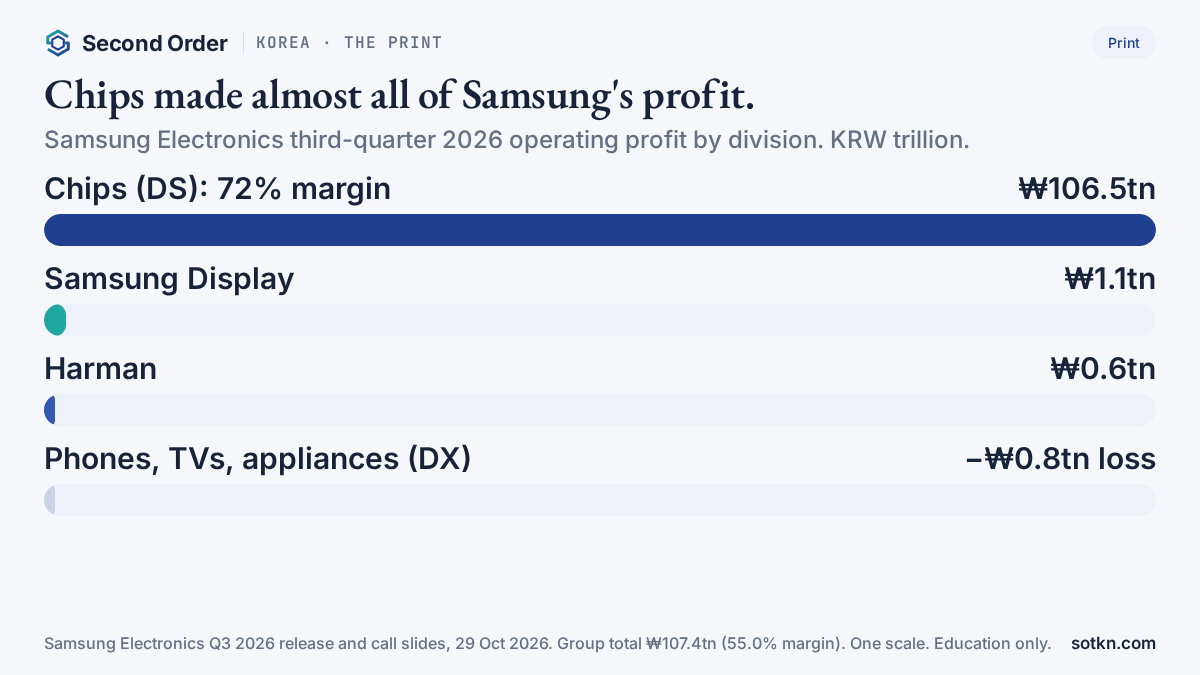
The chip division did nearly all the work. DS revenue was ₩147.1 trillion, up 15% from the second quarter, and its operating profit was ₩106.5 trillion, a 72% margin. That is about 99% of the group’s operating profit (our arithmetic). Memory alone brought in ₩140.7 trillion of revenue, up 16% from the quarter before and 427% from a year earlier, or about 96% of the chip division’s sales (our arithmetic).
The rest of the group is a different story. The devices half made ₩52.1 trillion of revenue but an operating loss of ₩0.8 trillion. Phones and networks lost ₩0.6 trillion and TVs and appliances lost ₩0.2 trillion. Samsung Display made ₩1.1 trillion on ₩8.0 trillion of sales, and Harman ₩0.6 trillion, helped by one-off US tariff refunds. A weaker US dollar and euro cut operating profit by about ₩10 trillion from the second quarter, mainly in the component businesses, Samsung said.
Did Samsung sell more chips, or the same chips for more?
Mostly the same chips for more. On the call, Samsung’s memory sales head Jaejune Kim said DRAM shipments, measured in bits, rose by low-to-mid single digit percentages from the second quarter, and NAND flash shipments by mid single digits. Over the same three months, Samsung’s average DRAM price rose by about 20% and its average NAND price by the high teens. Prices rose across every kind of customer, led by servers.
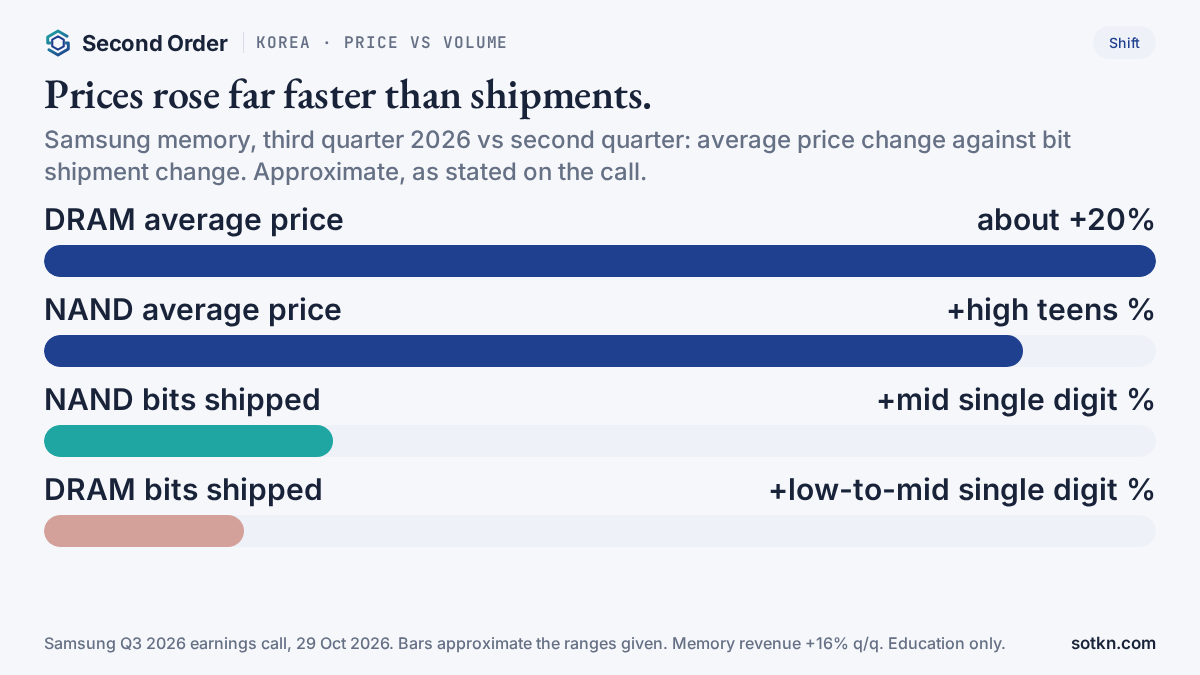
That gap is the whole quarter in one line. Memory revenue rose 16% while the amount of memory shipped rose only a few percent. Cost of sales for the whole group was ₩60.0 trillion, just 30.7% of revenue, against 61.1% a year earlier. When a factory sells the same output for much more money, almost all of the extra revenue becomes profit.
Samsung’s own words explain why. Its slides say it managed its product mix toward AI products “amid limited capacity”. It is choosing which customers get the bits it has. It said it would keep putting more of its output into HBM, server DRAM and server SSDs, where demand is strongest, rather than phones and PCs.
For the fourth quarter, Samsung guided DRAM bit shipments up by mid-to-high teens percentages and NAND by mid teens, helped by demand for memory linked to new CPU and GPU platforms and a large new order for high-capacity QLC flash for AI agent services. Even so, it said demand growth continues to outpace its effort to raise production. More bits this quarter come mainly from squeezing existing fabs and shifting the product mix, not from new space.
Is money the problem?
No. Samsung ended September with ₩214.8 trillion of cash and short-term financial assets and ₩17.2 trillion of debt, for net cash of ₩197.6 trillion, up from ₩167.6 trillion at the end of June. Its debt-to-equity ratio was 3%. Operations brought in ₩98.6 trillion of cash in the quarter, while cash paid for property and equipment was ₩26.9 trillion.
That leaves roughly ₩71.7 trillion of cash from operations after plant spending in one quarter (our arithmetic). Samsung used part of it to buy back ₩12.5 trillion of its own shares, and its board approved a third-quarter dividend of ₩4,601 per share, about ₩30 trillion in total, to be paid in November. Of the ₩90 trillion to ₩110 trillion it expects to return to shareholders for 2026, it said ₩55 trillion to ₩75 trillion is still to come, including a substantial share buyback and cancellation. The final plan is due after a board meeting in late January 2027.
Compare that with Taiwan’s ASE, which reported the same day. ASE is borrowing heavily to build new packaging and test floors (the ASE Q3 Pulse). Samsung is building with cash to spare and still paying out more to shareholders. If money were the bind, Samsung would be the one company free of it. It is not free of it, which tells you the bind is somewhere else.
What is the ₩84 trillion buying?
Samsung spent ₩29 trillion on plant and equipment in the third quarter, up ₩12.2 trillion from the second quarter and ₩19.8 trillion from a year earlier. Of that, ₩27.2 trillion went to the chip division. For the first nine months it spent ₩56.9 trillion. For all of 2026 it expects about ₩84.4 trillion, ₩31.7 trillion more than in 2025, with ₩76.8 trillion for chips and ₩3.9 trillion for display.
That implies about ₩27.5 trillion of spending in the fourth quarter, of which about ₩24.0 trillion for chips (our arithmetic). The quarterly pace has more than tripled from about ₩9.2 trillion in the third quarter of 2025 (our arithmetic), and it is now about 2.4 times the ₩11.9 trillion of depreciation booked in the quarter (our arithmetic). In plain terms, Samsung is adding plant far faster than its old plant wears out on paper (capex vs depreciation).
Samsung said the memory money goes on new fabs and other infrastructure for AI demand and for readiness in the middle and long term. Foundry spending rises too, mainly for its fab in Taylor, Texas. Display spending goes on upgrading existing lines.
One detail matters more than the total. Net property, plant and equipment on the balance sheet rose only from ₩224.4 trillion to ₩234.0 trillion in the quarter, about ₩9.6 trillion or 4% (our arithmetic). A lot of the spending is going into buildings and deposits that take years to become running lines. That is exactly what Samsung went on to say on the call.
Why does Samsung say 2028 stays tight?
An analyst asked what happens after 2027. Samsung’s answer is the most useful part of the call for anyone mapping the AI supply chain. It expects 2027 spending across the memory industry to rise sharply, but said several things will stop that spending from turning into many more bits in 2028:
- New space comes first. Much of the extra spending goes on acquiring new space — fab buildings and clean rooms — before any tool goes in.
- Building costs more. Construction cost per unit of space is higher than in the past, so the spending figures look bigger than the capacity they buy.
- The lead time is long. Given the long gap from new fab construction to actual wafer output, Samsung said 2027 spending is unlikely to add meaningfully to 2028 output.
- Tools cost more and take longer. Equipment prices are higher, buyers pay upfront to lock in supply, and longer order lead times make it harder to get tools on time.
- Each HBM wafer yields less. Next-generation HBM4E and HBM5 dies are larger and need many more metal layers, so moving wafers from ordinary DRAM to HBM shrinks the bits each wafer makes.
Weighing all of that, Samsung said tight supply should continue into 2028, while noting that big economic shocks could change the picture. Then it stated its plan: make pre-emptive investments to secure clean rooms in advance, and stay flexible on when to install equipment as it watches demand. Korean trade press calls this “shell first”.
The flagship of that plan is P5, the fifth fab at Samsung’s Pyeongtaek campus south of Seoul. ZDNet Korea reported in February that P5 will have three floors and six clean rooms, against two floors and four clean rooms in the campus’s other fabs, that Samsung pulled its clean room build forward by about six months, and that P5 targets operation in 2028, with HBM as its main product. In September the same outlet reported that the first phase’s clean room work had begun in the third quarter of 2026, and that Samsung was discussing moving tool move-in for that phase from July–August 2027 to around May–June 2027, even asking for some tools in early 2027 to store elsewhere. These timings are press reports, not company guidance.
Put those together and the order of events is clear. The building is going up now. The tools follow in 2027. Real output from the new space comes in 2028. Until then, more memory comes mostly from existing fabs, which is why prices are doing the work. Korea’s grid adds its own limits around the capital region (Korea’s data centre grid queue; fast-track permits vs power lines).
How much of next year is already sold?
For HBM, all of it. Samsung said its HBM4 sales more than tripled from the second quarter and now make up about 60% of its HBM sales. It said its share of the HBM market caught up with its share of the overall DRAM market in the third quarter, earlier than its second-half target. Its 2027 HBM supply is sold out at agreed target prices, and key customers keep asking for more. It shipped HBM4E samples in May and plans to start mass production in the first half of 2027, ramping in the second half.
Beyond HBM, Samsung is locking in buyers for years. It said it has signed multi-year supply contracts with 10 major customers and is negotiating with 10 more, several near the final stage. Interest has spread from hyperscalers, server makers and AI chip firms to phone, car and network customers. It said its goal of having 60% to 70% of its mid-to-long term capacity under such contracts is becoming more visible; The Elec’s Korean transcript puts that target at 2030. Some customers already under contract are asking for extra supply for periods already covered.
This is the same pattern SK hynix described earlier this week (SK hynix’s sold-out years), and the same question our Analysis asks about where the cash sticks when memory is sold years ahead (if half of 2027–28 memory is sold). A buyer who signs a multi-year deal is really reserving space in a clean room that does not yet exist.
What about Samsung’s foundry and Taylor?
The same limit shows up in Samsung’s contract chipmaking. Foundry sales improved on HBM base dies — the logic chip at the bottom of an HBM stack, made on Samsung’s 4nm process — and on more advanced-node work for outside customers. Samsung said it keeps winning 2nm orders from large cloud and AI customers and expects its 2nm project count to more than double this year.
For 2027 it said demand for every node below 8nm will substantially exceed its production capacity, with those lines running above 100% utilization. At Taylor, Texas, clean room operation has begun at the first fab, tool installation has started and wafers are going in to set up the line, with operations due to begin in 2027. Samsung said it is looking at more fabs in the US and Korea, plus advanced packaging capacity. Again, the limit it names is space and lines, not orders.
Our math: what do the numbers say?
- Profit mix: ₩106.5 trillion of chip profit out of ₩107.4 trillion group operating profit is about 99% (our arithmetic).
- Memory weight: ₩140.7 trillion of memory sales out of ₩147.1 trillion chip division sales is about 96% (our arithmetic).
- Price vs volume: memory revenue +16% q/q against DRAM bits up low-to-mid single digits and NAND mid single digits means most growth came from price (our reading of Samsung’s figures).
- Cash after plant: ₩98.6 trillion from operations minus ₩26.9 trillion paid for plant is about ₩71.7 trillion in one quarter (our arithmetic).
- Fourth-quarter spend implied: ₩84.4 trillion full year minus ₩56.9 trillion to September is about ₩27.5 trillion; chips about ₩24.0 trillion (our arithmetic).
- Spend vs wear: ₩29 trillion of quarterly capex against ₩11.9 trillion of depreciation is about 2.4 times (our arithmetic).
- Plant on the books: net plant and equipment up about ₩9.6 trillion, or 4%, in the quarter (our arithmetic).
- 2025 base: ₩84.4 trillion minus the ₩31.7 trillion increase puts 2025 spending near ₩52.7 trillion, so 2026 is about 60% higher (our arithmetic).
What this tells you: Samsung has more buyers than bits, it is charging more for the bits it has, and it has more than enough cash to build. Its profit is real. But the next big step in output is limited by how fast new clean rooms can be finished and filled with tools, and Samsung itself says that will not show up in volume until 2028.
Who gets paid first?
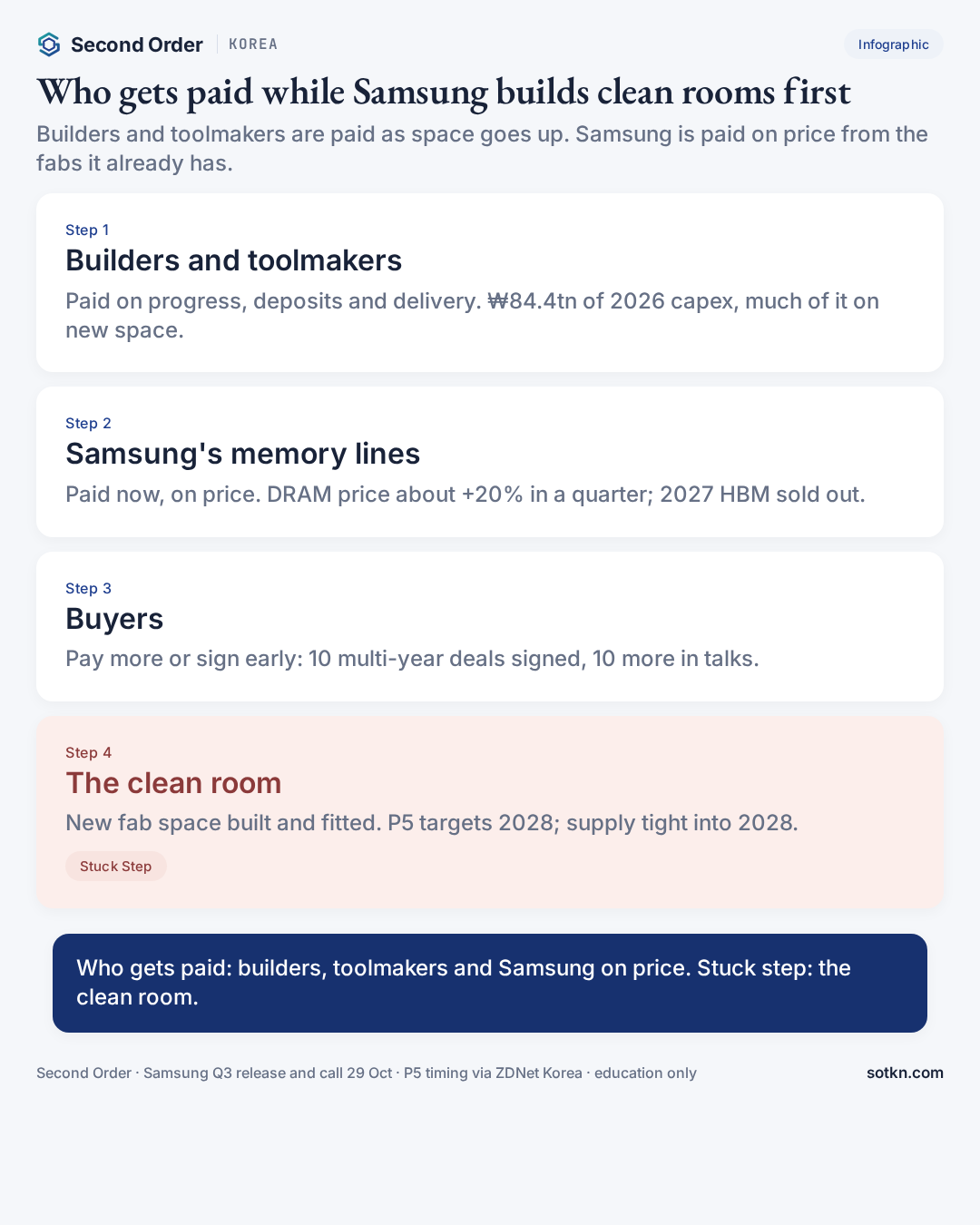
First, the builders — on progress. Shell first means construction firms, clean room fitters, piping, air, water and power system suppliers are paid as the building rises, years before a wafer comes out. P5 alone has six clean rooms.
Second, the toolmakers — on deposits and delivery. Samsung said buyers now pay upfront to lock in equipment and that tool prices are higher. Makers of lithography, etch, deposition and inspection tools are paid before the new lines earn anything (how EUV tools work; the inspection stuck step).
Third, Samsung — now, on price. Existing fabs are full and every extra won of price falls almost straight to profit. This is the part of the chain being paid most right now.
Fourth, shareholders — from the surplus. A ₩30 trillion quarterly dividend, ₩12.5 trillion of buybacks in the quarter, and ₩55 trillion to ₩75 trillion more to come for 2026.
Last, the buyers — who pay more or sign up early. Cloud companies and AI chip makers sign multi-year contracts to secure supply (who the hyperscalers are). Phone and PC makers pay the higher memory bill or cut cheaper models. Samsung’s own phone business is one of them: it lost money in the quarter as component costs rose, and Samsung expects those costs to stay high into 2027.
One-line rule: at Samsung, builders and toolmakers are paid as the clean rooms go up; Samsung is paid on price from the fabs it already has; buyers pay more or sign early. The stuck step is the clean room.
So what is the stuck step?
The clean room: new fab space that is built, fitted and ready for tools. Not demand, which Samsung says will far exceed supply in 2027. Not money, which it has in abundance. Four things make it stick:
- Buildings take years. Samsung said the gap from new fab construction to wafer output is long. P5 started its first clean room work in 2026 and targets 2028.
- Tools come after the room. Tools can only go in once the clean room is sealed and running, and tool lead times are getting longer.
- HBM eats space. Bigger HBM dies with more layers mean each wafer gives fewer bits, so the same clean room supports less memory than before.
- Shell first is a choice. Samsung builds space ahead but adds tools only as demand shows, so the pace of new output follows its own read of demand, not just the calendar.
This is the bind our stuck-step Analysis describes: once money and orders are in place, the bind moves to the slowest physical input. At Samsung that input is finished clean room space.
Which dates test this read next?
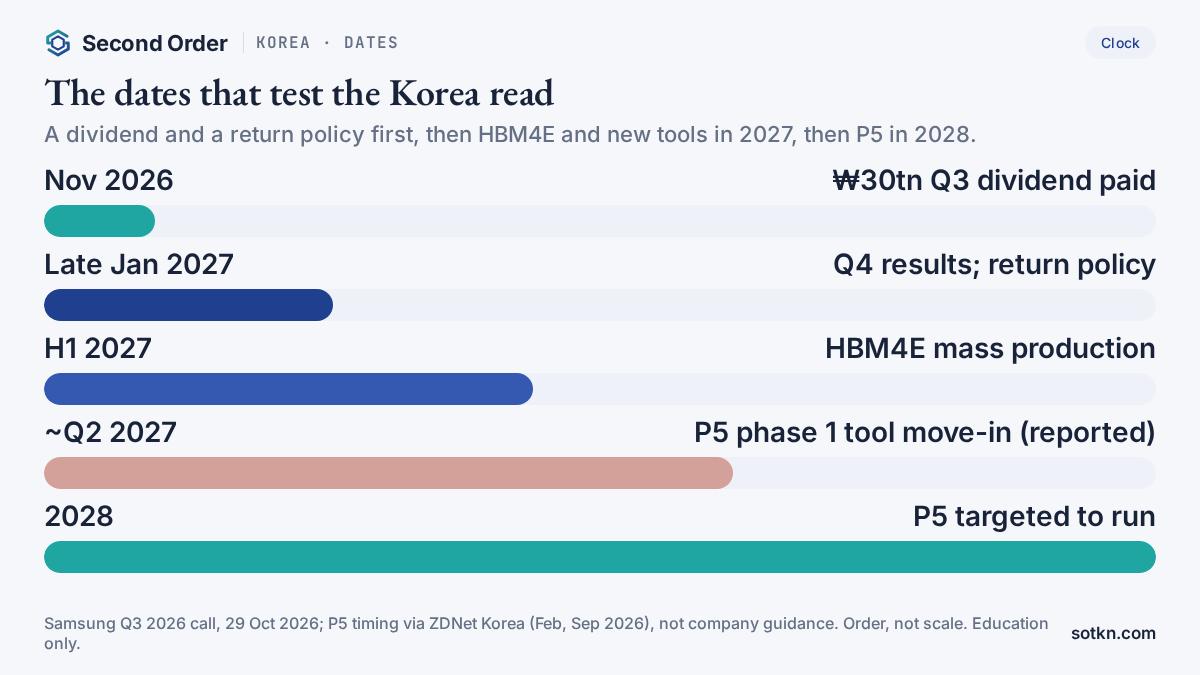
- November 2026 — The ₩30 trillion third-quarter dividend is paid. Korean export data for October will show whether memory prices are still rising.
- Late January 2027 — Fourth-quarter results, the board’s final 2026 shareholder return and the new return policy. A test of the mid-to-high teens DRAM bit guide.
- First half 2027 — HBM4E mass production due to start, with ramp in the second half.
- Around Q2 2027 — P5 phase 1 tool move-in, as reported by ZDNet Korea (not company guidance). Taylor operations due to begin during 2027.
- 2028 — P5 targeted to run. Samsung expects tight memory supply to last into this year.
What would change this view?
- Bits arrive faster. If fourth-quarter shipments beat the mid-to-high teens guide by a wide margin, existing fabs have more room than Samsung suggests and the clean room bind loosens.
- Clean rooms open early. If P5 tools go in sooner and output starts before 2028, the stuck step moves to tools or power.
- Prices stall. If DRAM prices stop rising, profit growth would need volume Samsung says it does not yet have.
- AI spending slows. If hyperscalers cut 2027 budgets, sold-out HBM and multi-year contracts would be tested, and Samsung would slow tool installs, as its shell-first plan allows.
Practical takeaways
- Samsung made ₩107.4 trillion of operating profit in the third quarter, about 99% from chips
- DRAM prices rose about 20% in three months while DRAM shipments grew only low-to-mid single digits
- It holds ₩197.6 trillion of net cash and plans ₩84.4 trillion of 2026 capex, much of it on new space
- 2027 HBM is sold out; 10 multi-year contracts signed and 10 more in talks
- Builders and toolmakers are paid now; Samsung is paid on price; stuck step: the clean room, with P5 due in 2028
FAQ
What did Samsung Electronics report on 29 October 2026?
Samsung reported third-quarter 2026 revenue of ₩195.3 trillion, up 14% from the second quarter and 127% from a year earlier, and operating profit of ₩107.4 trillion, a 55% margin. The chip division made ₩106.5 trillion of that. Memory revenue was ₩140.7 trillion, up 427% from a year earlier.
Why did profit rise so much if Samsung shipped only slightly more chips?
Because prices did the work. Samsung said its average DRAM price rose about 20% from the second quarter and NAND prices rose by the high teens, while DRAM shipments grew only low-to-mid single digits and NAND mid single digits.
What is the stuck step?
The clean room. Samsung said much of its higher spending goes on new space, that the gap from building a fab to making wafers is long, and that 2027 spending is unlikely to lift 2028 output much. Its plan is to build clean rooms first and add tools as demand shows. Its big new Pyeongtaek P5 fab targets 2028.
Is this investment advice?
No. Education only. It maps who gets paid and which step is stuck. It is not a recommendation to buy or sell any security, and we leave out share prices, broker ratings and price targets on purpose.
Keep reading on the map
- Korea Markets hub — country page
- SK hynix Q3 and HBM4 · Korea’s data centre grid queue · Fast-track permits vs power lines · Korea’s daily chip exports
- ASE’s new floors · Microsoft’s GPU handover — other markets
- SK hynix sells out 2027–28 · Micron’s vertical HBM · AWS sold out into 2028 · Samsung Xi’an NAND
- Capex vs depreciation · Free cash flow explained · High-NA EUV explained · Who are the hyperscalers?
- If half of 2027–28 memory is sold · KLA’s inspection stuck step · Where does the stuck step move?
- Semiconductors on the stack · All Markets doors — Taiwan, Korea, US, China, Singapore, Australia, Malaysia
How we check this. Revenue, operating profit by division, capital spending, the dividend, the balance sheet and the cash flow come from Samsung Electronics’ own third-quarter 2026 release and earnings call presentation of 29 October 2026, in Korean won. Price and shipment changes, the 2028 supply view, the clean-room-first approach, the long-term contract count, HBM and the Taylor update are as said on the 29 October call, checked against an English transcript and The Elec’s Korean transcript, with Chosun Biz’s same-day report. The P5 build timings are as reported by ZDNet Korea in February and September and are not company guidance. Every sum we worked out is labelled “our arithmetic”. Share prices, broker ratings and price targets are left out on purpose. The references we used are listed at the end. Our editorial standards →
Not investment advice. Do your own research.
References
- Samsung Electronics Global Newsroom, Samsung Electronics announces third quarter 2026 results, 29 Oct 2026. news.samsung.com — revenue, operating profit by division, outlook, dividend, shareholder returns and capital spending.
- Samsung Electronics Investor Relations, 3Q 2026 earnings call presentation, 29 Oct 2026. images.samsung.com — segment tables, balance sheet, cash flow, net cash and plant and equipment.
- Stock Analysis (Quartr), Samsung Electronics Q3 2026 earnings call transcript, 29 Oct 2026. stockanalysis.com — price and bit growth, the 2028 supply view, clean rooms first, multi-year contracts, HBM and Taylor.
- The Elec, Samsung Electronics third-quarter 2026 earnings call in full (Korean), 29 Oct 2026. thelec.kr — the Korean wording of the capex, clean room and long-term contract answers, including the 2030 target.
- Chosun Biz, Samsung: memory shortage to last to 2028, limits to output even with new plants (Korean), 29 Oct 2026. biz.chosun.com — the reasons Samsung gave for slow output growth.
- ZDNet Korea, Samsung speeds up first P5 production line; tool move-in pulled to second quarter of 2027 (Korean), 28 Sep 2026. zdnet.co.kr — the P5 phase 1 clean room start and the reported tool move-in timing.
- ZDNet Korea, Samsung brings forward P5 clean room build under a shell-first strategy (Korean), 17 Feb 2026. zdnet.co.kr — the size of P5 (three floors, six clean rooms) and the 2028 operating target.


