Samsung moves Xian to 286-layer NAND as SK Hynix eyes 240 at Dalian
Samsung targets 40,000 wafers a month of 286-layer NAND at Xian by December 2027 and SK Hynix wants 240 layers at Dalian. How far the US has licensed the tools is undisclosed.

WIRE · SEMICONDUCTORS · NAND · Data as at 21 Oct 2026
Samsung and SK Hynix are upgrading their memory fabs in China, Reuters reported on 21 October 2026, citing four people familiar with the plans. Samsung is converting its Xian plant, which makes about 40% of its global NAND, to 286-layer V9 chips, aiming for 5,000 wafers a month by December 2026 and 40,000 by December 2027. SK Hynix wants to move its Dalian fab from 192 layers to 240 or more. Both companies confirmed upgrades are under way "in close consultation with Washington". What nobody has disclosed is how far the US has licensed the American tools the upgrades need. On the semiconductors layer, the scarce thing for these two fabs is not wafers or demand. It is a signature in Washington.
What happened
21 October 2026 · Reuters, four people familiar with the plans
Samsung's "Monami" project turns Xian into a 286-layer NAND fab
Xian makes chips of about 200 layers today. The V9 line targets 5,000 wafers a month in December and 40,000 by December 2027. Samsung says it is not adding capacity or building new facilities
SK Hynix and Solidigm
Dalian moves from 192 layers toward 240 or more
Dalian, bought from Intel in 2021, is the only NAND fab of Solidigm, which is preparing a US listing. One person said SK Hynix is authorised up to 240 layers there and may ask to do research on 300-plus layers
The rule they work under
Annual US licences for American tools, and a stated "no upgrades"
The US removed both China fabs from its validated end-user list from 31 December 2025. The Commerce Department said it would license running the existing fabs, not expanding capacity or upgrading technology, and still points to that statement
The rival
YMTC now leads China's NAND market at 38.5%
Omdia puts YMTC at 38.5% in the second quarter, up from 28% for 2025. Samsung slipped to 33.5% from 36% and SK Hynix to 17% from 20%. YMTC already makes a small amount of 294-layer chips
Why cash cares
NAND is the memory inside solid-state drives, and AI data centers are now buying a lot of them. More layers on the same wafer means more storage per wafer and a lower cost per bit. Going from about 200 to 286 layers is roughly 40% more layers on every wafer Xian already runs (our arithmetic). That is how Samsung can say it is not adding capacity and still ship far more storage out of the same building.
Xian is not a side plant. It is about 40% of Samsung's NAND. If it stays a generation behind Korea, Samsung's cost per bit stays higher on almost half its output, while YMTC keeps climbing. The Omdia numbers show what waiting cost: between 2025 and the second quarter of 2026, YMTC gained 10.5 points of China's market and the two Korean firms lost 5.5 between them (our arithmetic).
The ramp is steep. Going from 5,000 to 40,000 V9 wafers a month is eight times in a year (our arithmetic). Each step of that needs new etch and deposition tools in the cleanroom, and many of the best ones are American.
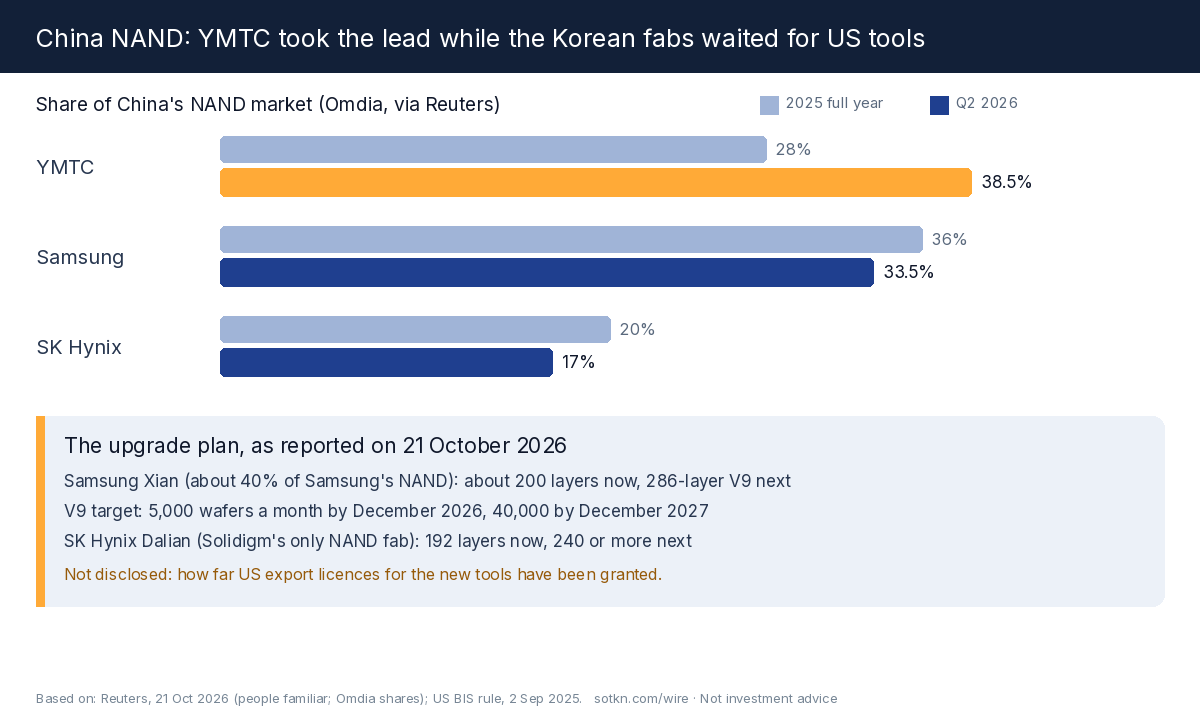
Figure: YMTC took the lead while the Korean fabs waited for US tools. What Reuters reported on 21 October 2026.
The second-order read
Who gets paid. The tool makers, if the licences come. Reuters names etching machines as the kind of US equipment that now needs an annual licence for China, and when the waivers were pulled in 2025 it named Lam Research, Applied Materials and KLA as the suppliers most affected. A 286-layer conversion at a fab this size is a large tool order. Next are the buyers of enterprise SSDs for AI data centers, who get more supply at a lower cost per bit without anyone building a new fab. Then Solidigm, whose IPO story reads better with a newer node at its only NAND fab.
Who carries the risk. Samsung and SK Hynix shareholders. The companies say they are compliant. The Commerce Department, asked directly, only repeated its 2025 line that it would not license technology upgrades. If a licence is narrowed or not renewed, a half-converted fab is the worst place to be.
Who waits. YMTC's customers in China for now have a local supplier with rising share. If Xian reaches 286 layers on schedule, that lead gets harder to hold on cost.
Stuck step. The US export licence. Wafers, cleanroom space and demand are all there. The tools are not, until Washington signs, and it signs once a year.
Two cautions
This is an unconfirmed report from people familiar with the plans. Samsung and SK Hynix confirmed upgrades are under way but did not confirm the layer counts, wafer targets or dates.
Reuters could not determine how far US licences for the upgrade tools have been granted. Korean press reported earlier this year that Xian had already moved part of its output to 236-layer V8 chips, so some of this conversion may already be licensed and running.
What would change the view
- A clear US statement allowing technology upgrades at the two fabs without new capacity, which would turn the stuck step into a tool order.
- A narrowed or refused annual licence for 2027, which would freeze Xian and Dalian a generation behind.
- YMTC moving to volume above 300 layers before Xian reaches 40,000 V9 wafers a month.
What to watch
- Samsung's and SK Hynix's third-quarter results later this month, for any word on China conversion spending.
- The 2027 annual licences. The 2026 ones were reported granted on 30 December 2025, so the next decision should come near the end of this year.
- Solidigm's IPO filing, which should say what Dalian is allowed to make.
Read: the semiconductors layer, Samsung agrees to TSMC 3nm base dies, and ASML says its 2027 and 2028 supply won't meet chip demand
Get the Wire. A free brief every day, here and in your inbox. Subscribe free →
Not investment advice. Do your own research. The 40%, eight times and 10.5 and 5.5 point figures are our arithmetic from the reported layer counts, wafer targets and Omdia shares.
References
- Reuters via CNBC, "Samsung, SK Hynix upgrading China plants to make more advanced chips, people say", 21 Oct 2026
- US Bureau of Industry and Security, "Revocation of Validated End-User Authorizations in the People's Republic of China", Federal Register, 2 Sep 2025
- Reuters, "US makes it harder for SK Hynix, Samsung to make chips in China", 29 Aug 2025
- Reuters, "US approves Samsung, SK Hynix chipmaking tool shipments to China for 2026, sources say", 30 Dec 2025
- TrendForce, "Samsung reportedly begins V9 NAND build-out in Xi'an following V8 ramp-up", 25 May 2026