Tenstorrent raises $1.5B at $6.2B for AI servers that skip HBM
Tenstorrent closed a $1.5 billion Series E at a $6.2 billion valuation on 19 October to build Galaxy servers in volume. Each carries 32 Blackhole chips and 1 TB of GDDR6, and no HBM. It skips the HBM queue, not the memory queue.
WIRE · SEMICONDUCTORS · US · Data as at 20 Oct 2026
Tenstorrent, the AI chip company run by Jim Keller, closed a $1.5 billion Series E at a $6.2 billion valuation on 19 October 2026. The money goes into building its Galaxy servers in volume. What makes this a semiconductors layer story is what those servers leave out. Each one carries 32 Blackhole chips and 1 TB of GDDR6 graphics memory, and no HBM, the stacked memory that Nvidia, AMD and the custom chips all queue for. Tenstorrent is raising money to sell AI compute that never joins that queue.
What happened
19 October 2026 · Tenstorrent
$1.5 billion of new equity at a $6.2 billion post-money valuation
Led by Trace Capital and Innovation X, with ARK Invest, Fidelity, T. Rowe Price, Morgan Stanley, Sandisk, Tether Investments and others. The company says it will deploy Galaxy servers at scale, serve open-weight language and video models, and keep licensing its chip designs to companies such as Samsung and LG
19 October 2026 · Reuters and TechCrunch
The price more than doubled, after it chose not to sell
The last round raised $693 million in December 2024 at a $2 billion pre-money valuation. Intel and Qualcomm were reported in May to have shown takeover interest at valuations of as much as $5 billion. Keller told Bloomberg the company stayed independent after its Galaxy servers showed they could run DeepSeek models
Tenstorrent product listing, as at 20 October 2026
One Galaxy server: 32 chips, 1 TB of GDDR6, 8 to 10 kW, $160,000 list
Each Blackhole chip has up to 32 GB of GDDR6 at 512 GB a second. Tenstorrent made Galaxy Blackhole generally available on 28 April 2026
Why cash cares
The headline number hides a split. Our arithmetic: $6.2 billion after the round, less the $1.5 billion that came in, puts the business itself at $4.7 billion before the new money. That is a little under the "as much as $5 billion" Intel and Qualcomm were reported to have floated in May. The headline valuation is about 2.3 times the December 2024 one on our numbers. Before the new money, though, the business is valued at about 1.7 times what it was then. The rest of the jump is the cash itself, so the test is what that cash turns into.
It turns into servers, and the bill of materials is where the second-order read sits. An Nvidia H200 carries 141 GB of HBM3e. A Blackhole chip carries 32 GB of GDDR6, the memory used on graphics cards, soldered beside the chip rather than stacked and packaged on top of it. That means no HBM allocation and no advanced packaging slot, the two steps where AI chip supply has been stuck all year. The price is less memory and far less bandwidth per chip: 512 GB a second against 3.35 TB for Nvidia's older H100. Tenstorrent makes up for it by wiring many chips together over Ethernet.
To give the round a sense of size, here is what $1.5 billion would buy at Galaxy's list price. It is a ceiling, not a plan: the company has not said how much of the money goes into servers, and list price includes its margin.
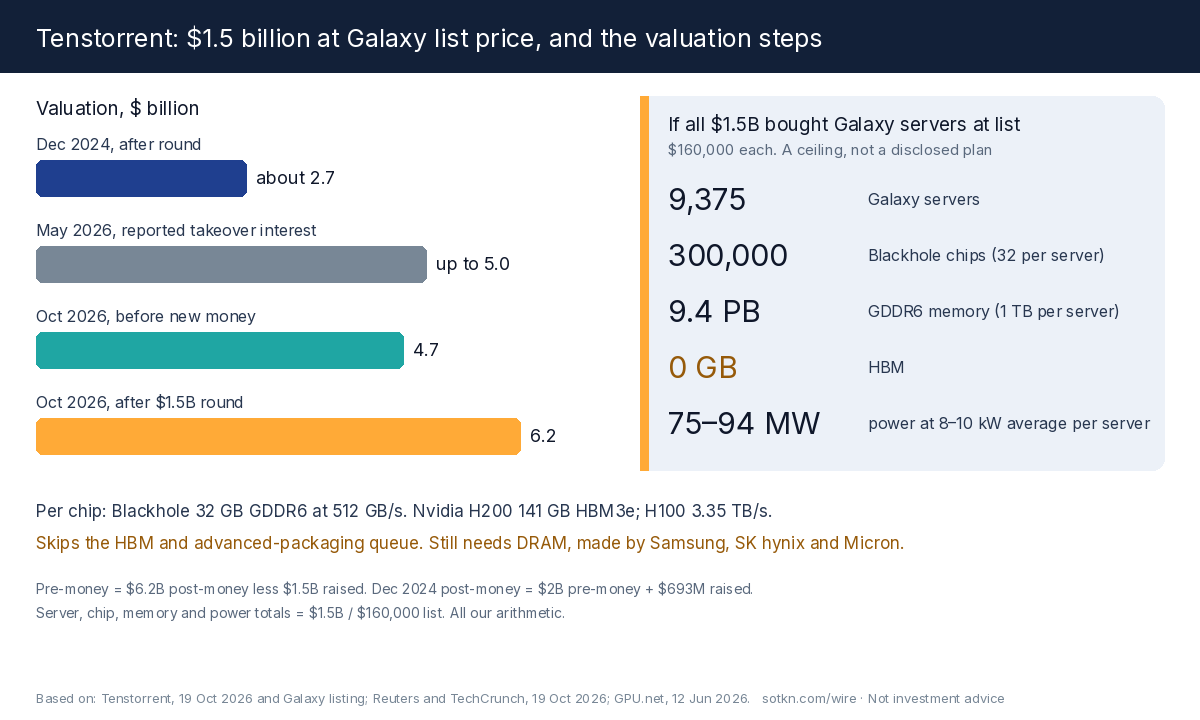
Figure: $1.5 billion at Galaxy list price, and how the valuation got to $6.2 billion. Product figures from Tenstorrent's Galaxy listing. Server, chip, memory and power totals and the pre-money valuation are our arithmetic.
The second-order read
Who gets paid. The GDDR6 makers first. At about 1 TB a server, 9,375 servers would need around 9.4 petabytes of graphics memory. Samsung, SK hynix and Micron make GDDR6, the same three that make HBM. Samsung Foundry is Tenstorrent's named maker for its next chiplets, on its 4nm SF4X process, under a deal announced in October 2023. Data center hosts get paid too: at 8 to 10 kW a server, that ceiling fleet would draw 75 to 94 MW.
Who carries the risk. The new shareholders, who paid $6.2 billion for a private company that does not publish its revenue. Sandisk, a flash memory maker, is now one of them. The release does not say why.
Who waits. The open-weight model hosts and companies running models on their own sites that Tenstorrent sells to. They get servers that do not wait on HBM, if the software runs their models well enough. Tenstorrent says 90% of Hugging Face models "just work" on its hardware.
Stuck step. Memory, but a different line in the queue. Skipping HBM does not skip DRAM. With its results on 30 September, Micron said more than 75% of its fiscal 2027 output is already committed, and supply will stay tighter in 2027 and 2028 than this year. GDDR6 comes out of the same DRAM fabs.
Two cautions
The $5 billion figure was reported interest, not a bid. The 2.3 times uplift uses a December 2024 post-money of about $2.7 billion, which is $2 billion plus the $693 million raised. Some reports put that round at "more than $2.6 billion".
The memory comparison is per chip. Tenstorrent's case is that pooled memory across many linked chips does the job. That holds for some models and not others, and the published speed results are its own.
What to watch
- The first named Galaxy buyer at scale, with a server count or a megawatt figure. The release names investors, not customers.
- The Galaxy list price. If GDDR6 contract prices keep rising with the rest of DRAM, a fixed $160,000 price would squeeze Tenstorrent's margin, and a higher one would test buyers.
- Samsung's SF4X chiplets reaching production, the first Tenstorrent parts with a named foundry deal behind them.
Read: HBM vs GDDR, Who makes custom AI chips? and Micron locks up 75% of its 2027 memory output
Get the Wire. A free brief every day, here and in your inbox. Subscribe free →
Not investment advice. Do your own research. The $4.7 billion pre-money valuation, the 2.3 times and 1.7 times comparisons, and the server, chip, memory and power totals at list price are our arithmetic.
References
- Tenstorrent, "Tenstorrent Announces a $1.5B Series E at a $6.2B valuation", 19 Oct 2026. Round size, valuation, investors and use of funds.
- Reuters, "AI chip startup Tenstorrent more than doubles its valuation to $6.2 billion in funding round", 19 Oct 2026. The December 2024 round of $693 million at a $2 billion pre-money valuation.
- TechCrunch, "Tenstorrent hits $6.2B valuation to scale open-weight AI chips", 19 Oct 2026. Reported Intel and Qualcomm interest and Keller's comments to Bloomberg.
- Tenstorrent, Galaxy product listing, as at 20 Oct 2026, and Blackhole product listing. Chips, memory, power and list price.
- Tenstorrent, Galaxy Blackhole general availability, 28 Apr 2026.
- GPU.net, "Inside the Tenstorrent Chips: Grayskull, Wormhole, Blackhole, and Galaxy", 12 Jun 2026. H200 and H100 memory figures used for comparison.
- Tenstorrent, "Tenstorrent Selects Samsung Foundry to Manufacture Next-Generation AI Chiplet", Oct 2023. SF4X process.
- Korea Herald on Micron's fiscal fourth-quarter results, 1 Oct 2026. More than 75% of fiscal 2027 output committed; tighter supply in 2027 and 2028.