Israel caps data centers at 200 MW as 27 GW queues for power
Israel's power regulator capped new data centers at 200 MW and set a NIS 2 million guarantee per megawatt. Developers asked for 27,000 MW; about 1,300 MW of new connections are on offer to 2030.
WIRE · AI DATA CENTERS · ISRAEL · Data as at 20 Oct 2026
Israel has put a size limit and a price on a place in its power queue. On the night of Sunday 18 October 2026, the plenum of the Electricity Authority, the country's power regulator, agreed that no new data center may connect more than 200 MW. Developers will have to post a bank guarantee of NIS 2 million for every megawatt they ask for. About 1,300 MW of new connections will be handed out to 2030, on top of roughly 2,000 MW already approved. Against that, Noga, the grid operator, is holding requests for 27,000 MW, more than the 18,800 MW of generation the whole country has installed. On the AI data centers layer, the scarce thing in Israel is no longer the building. It is an approved connection, and behind it, the power plant.
What happened
18 October 2026 · Electricity Authority plenum, reported by Calcalist and Globes
A 200 MW ceiling on any new data center
Calcalist reports 1,000 MW more for large data centers. Globes reports 1,300 MW in total to 2030, of which 300 MW must serve local use. With about 2,000 MW already approved, the Authority puts the sector at about 20% of Israel's projected 2030 consumption
The queue
27,000 MW requested, against 18,800 MW of installed generation
Average consumption is about 9,000 MW and peak demand reached 17,300 MW in August 2025. The Authority froze answers to new data center requests earlier this year while it wrote the rules
The price of a place in line
NIS 2 million per requested MW, so NIS 400 million for a full-size 200 MW campus
TheMarker reported that half comes back only once 60% of the requested capacity is running. Calcalist puts the cost of building a 200 MW site at more than NIS 4 billion
The off switch and the clock
Data centers must accept backup arrangements that let the grid cut them off at extreme peaks
The full decision goes out for a three-week public consultation. Globes says the first new approvals are at least several months away, and rules on centre versus periphery and on sites that bring their own generation are still to be set
Why cash cares
Until now a grid application in Israel was a cheap option. File for a very large campus, wait, and either build it or sell the approved site to someone who will. That is how the queue reached 27,000 MW, about three times the country's average use. The Authority says the guarantee is there to stop developers reserving capacity for projects with little chance of being built, or trading the approvals. At NIS 2 million a megawatt, the whole queue would need NIS 54 billion of bank guarantees (our arithmetic). Most of it will not post them.
The new connections are also tiny next to the queue. About 1,300 MW against 27,000 MW requested is less than one megawatt in twenty (our arithmetic). At 200 MW a site, 1,300 MW means at least seven campuses, a point made to Globes by Asher Bichonsky, a project finance partner at the law firm Arnon, Tadmor-Levy. The regulator has to spread the power across more sites, some of them less suitable, to keep the market open to more players.
The biggest plans no longer fit. Mega DC's request for about 1,100 MW at the old Alliance tyre factory in Hadera is more than five times the ceiling. SDS's 875 MW in Nesher is more than four times it, and a 720 MW plan at Neve Yamin is more than three and a half times. Calcalist reported on 14 October that projects of that size would not be eligible as planned. They can split into smaller sites, but each one then needs its own guarantee.
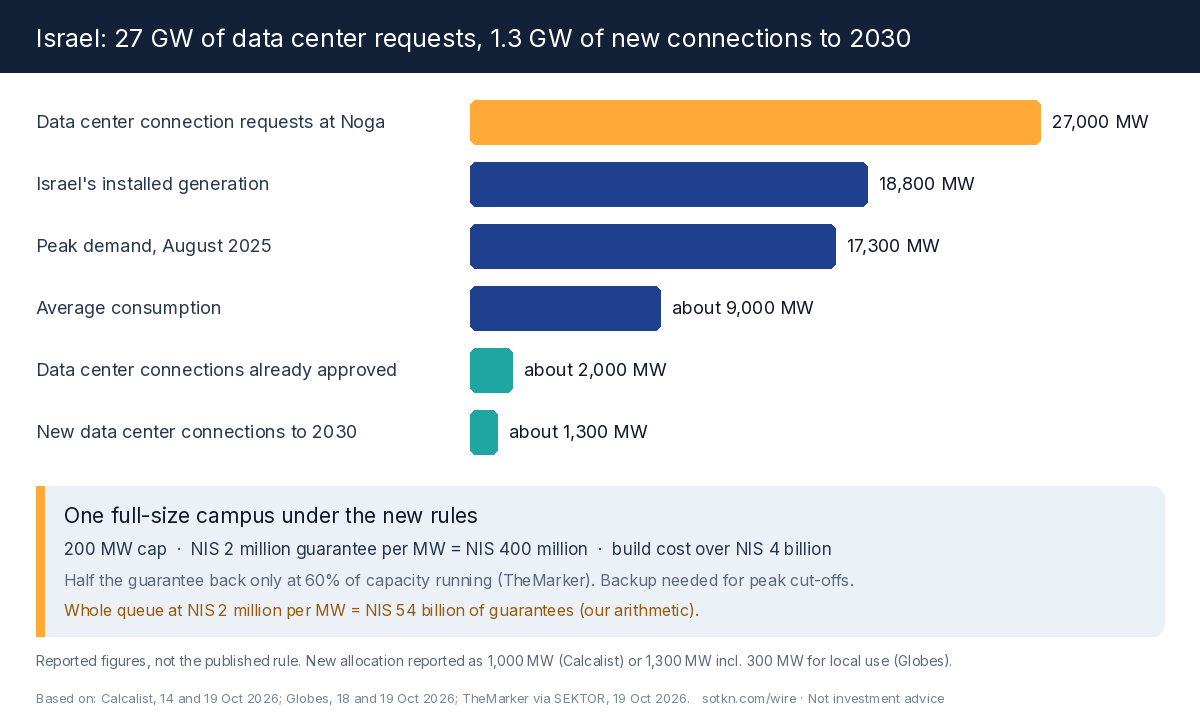
Figure: 27 GW asked, 1.3 GW on offer. What was reported on 14, 18 and 19 October 2026.
The second-order read
Who gets paid. Whoever already holds an approved connection. Avi Shkuri, a senior analyst at Psagot, told Globes that a project with a connection commitment, a signed tenant and capital is now in the better position, and that the connection itself has become a product people pay for. Doral, for example, has announced a new data center near Beit Shemesh with Ampa on a connection that was already approved. Next come the banks that write the guarantees: NIS 400 million per full-size campus and about NIS 2.6 billion across 1,300 MW (our arithmetic). Their fees are not disclosed. Then whoever sells backup power, the generators and batteries big enough to carry a hall when the grid cuts it off at a peak.
Who carries the risk. Developers who filed big and early. A senior executive at one developer told Calcalist that a short-notice disconnection rule would be a deal-breaker, because backup for 200 MW could make a project uneconomic. The same executive called the 200 MW ceiling itself reasonable.
Who waits. Tenants. Large cloud and AI customers want power that does not switch off. A hall that can be cut at a peak is a harder lease to sign, and the first new approvals are months away.
Stuck step. Generation. Israel has 18,800 MW of plant and developers asked for 27,000 MW. The new rules ration the grid. They do not build a single power station. Calcalist also ties the decision to warnings that gas prices, and so power prices, could rise: a gas supply deal involving NewMed and Ratio, partners in the Leviathan field, has collapsed, and the Israel Electric Corporation's legal adviser warned in June that prices could climb.
Two cautions
This is a plenum decision reported by the press, not the published rule. The full text has not been released, and a three-week consultation can change the cap, the guarantee and the disconnection terms.
The new allocation is reported two ways. Calcalist says 1,000 MW more for large data centers. Globes says 1,300 MW, with 300 MW for local use, and TheMarker describes a 300 MW slice for defence needs. We use 1,300 MW as the total of new connections and treat the split of the 300 MW as unsettled.
What would change the view
- The final rules letting one site connect in several 200 MW steps, which would bring the megaprojects back in a different shape.
- The disconnection rule softened, which would make Israeli halls easier to lease to big cloud tenants.
- New gas, solar or storage capacity approved with dates, or a rule that favours sites bringing their own generation, which would let the ceiling move.
What to watch
- Publication of the full decision and the end of the three-week consultation.
- The first approvals under the new rules, which Globes says are at least several months away, and how the 300 MW slice is defined.
- Whether Mega DC, SDS and other large applicants resize their Hadera, Nesher and Neve Yamin plans to fit 200 MW, and post the guarantees.
Read: the AI data centers layer, Booked, not used, and Duke's pay 75%, used or not
Get the Wire. A free brief every day, here and in your inbox. Subscribe free →
Not investment advice. Do your own research. The NIS 54 billion, NIS 2.6 billion and one-in-twenty figures are our arithmetic from the reported guarantee, queue and allocation.
References
- Ctech by Calcalist, "Israel caps new data centers at 200 megawatts as demand overwhelms power grid", 19 Oct 2026. The 200 MW cap, 1,000 MW more, about 2,000 MW approved, the 27,000 MW queue, the NIS 2 million guarantee, disconnection, the NIS 4 billion build cost and the gas warning.
- Ctech by Calcalist, "Israel to cap new data centers at 200 megawatts amid AI power crunch", 14 Oct 2026. Installed generation of 18,800 MW, the August 2025 peak, Mega DC and SDS, and the developer executive's comments.
- Globes, "The Electricity Authority decided: these are the limits on server farms" (Hebrew), 18 Oct 2026. 1,300 MW to 2030, the 300 MW for local use, and the criteria still to go to consultation.
- Globes, "Only 4% of requests will be approved: new rules for server farms, and who loses" (Hebrew), 19 Oct 2026. Comments from Arnon, Tadmor-Levy, Psagot and Leader Capital, the Neve Yamin plan and Doral's Beit Shemesh project.
- SEKTOR, citing TheMarker, "Electricity Authority: NIS 2 million guarantee per megawatt for server farms" (Hebrew), 19 Oct 2026. The 60% refund trigger and the 300 MW for defence needs.
- DCD, "Israel to cap capacity of new data centers at 200MW - report", 19 Oct 2026. The backup and disconnection requirement and the connection freeze.