
Booked, Not Used: Who Gets Paid as Malaysia Bills Idle Data Centre Power
Malaysia's trade minister told Parliament on 15 October that data centres will pay for power they book but do not use, and must fund the grid upgrades their projects need. The cost of an empty, powered hall moves from the grid to the hall's owner.
Malaysia will make data centres pay for power they book and then do not use. Investment, Trade and Industry Minister Johari Abdul Ghani told Parliament on 15 October that an operator that asks for 200 MW and uses 100 MW will be charged for the other 100, and that investors must also pay for the grid upgrades their projects need. The grid is paid on the booking either way. What changes is who carries an empty, powered hall: now it is the hall's owner. The stuck step becomes a signed tenant for every megawatt booked.
MALAYSIA · AI DATA CENTERS · Data as at 17 Oct 2026 · Next update: the rate and start date of the unused-power charge (not yet published)
Affects: AI Data Centers · Hyperscalers · Neoclouds — Markets: Malaysia · Singapore · Taiwan · Australia
Education only, not advice to buy or sell any security. Figures are as stated in Parliament, by the companies, or as reported. The rate and start date of the new charge have not been published. Our own sums are labelled.
The numbers that matter this week
Minister's example
200 → 100 MW
Booked 200, used 100, the other 100 billed
PolicyOperating data centres
57 · 6,237 MW
Power they require, per the minister
StatedPipeline
60 · 11,172 MW
In approval or development
StatedActual data centre load
1,256 MW
TNB, June 2026
ReportedTask-force approvals
27 · RM225.97B
16 in Johor · one operating
StatedSigned tenant per booked MW
The bind
An empty booking is now a bill
Stuck stepFigures from the Dewan Rakyat session of 15 October 2026 as reported by The Star and The Edge, TNB's analyst briefing of 28 August 2026 and the Digital Ministry's written reply reported on 16 October 2026. Status chips are Second Order’s read.
On this page: Why it matters · What changed · The rule · The queue · The money · Taiwan vs Malaysia · Our math · Who gets paid · What is stuck? · Dates next · What would change this · FAQ
Why does a charge on unused power change who gets paid in AI halls?
Because a power booking is a promise, and somebody has to pay for a promise that is not used. When a data centre signs up for, say, 200 MW, the power company plans wires, transformers and generation to deliver that much on a date. If the hall then uses half, the other half cannot simply be handed to the next customer. The minister said exactly that: Tenaga Nasional cannot freely reallocate the unused capacity, because it stays committed to the operator's future needs.
Until now, the cost of that idle half has been blurred. Part of it sat with the power company, part with contracts nobody outside could see, and part, politically, with every other electricity user in the country. The 15 October answers move it into one place in plain view. The hall's owner pays for what it booked, and pays for the grid work its project needs. That makes an AI data centre in Malaysia less like a bet on land with a power slot, and more like a business that has to find its tenant before the power arrives.
This builds on two earlier Malaysia Pulses rather than repeating them. On 10 October our Malaysia power-use Pulse set out how far booked power runs ahead of used power on TNB's grid. On 13 October our DayOne financing Pulse followed RM30 billion of loans for Johor halls waiting on their high-voltage hookups. This piece is about the new rule that decides who pays for the gap between the two.
For what these buildings are, see what an AI data center is. For why a hall's rent starts only when power and tenant both arrive, see data center leases, explained.
1 · The booking
Who: TNB and the grid
Paid: Paid on what is booked, used or not · grid upgrades funded by the investor
2 · The build
Who: Local contractors and suppliers
Paid: 30% local-content floor · paid as each site goes up
3 · The money
Who: Banks, then project finance and private credit
Paid: S&P: funding needs pass bank limits within three years
4 · The tenant
Who: A signed customer for each booked megawatt
Paid: No tenant, and the empty booking is a bill
What changed between 14 and 16 October?
Four items in three days, all from Kuala Lumpur, drew one picture. The government is still approving data centres at scale, but it now wants them to pay their own way on power and to leave more of the money in Malaysia.
- 14 to 16 October — the approvals tally. In a written parliamentary reply, the Digital Ministry said 27 data centre projects with an estimated RM225.97 billion of investment have been approved since the national Data Centre Task Force was set up in February last year. Johor has 16 of them, Selangor 10 and Negeri Sembilan one. One is operating; 26 are being built. Each must meet at least 30% local content, checked by the Malaysian Investment Development Authority through reports every six months.
- 15 October — the unused-power charge. Answering questions in the Dewan Rakyat, Johari said operators will pay for capacity they commit to and do not use. “If you do not pay, we tell you that you cannot operate,” he said, as reported by The Star. The Edge reported him adding: “We charge you. That is our policy now.” He said 57 operating data centres require 6,237 MW and 60 more in approval or development could require 11,172 MW.
- 15 October — the grid bill moves too. In the same session, The Edge reported, Johari said transmission upgrades a project needs should be part of the investor's own spending, with TNB advising on what is needed, so that businesses that were there before data centres are not hurt. Data centre power is to be kept separate from homes and other industry, without subsidies, and where it comes from gas, at the market gas price.
- 15 October — a local contractor is hired. AWC, a Bursa-listed engineering group, said its unit Qudotech signed a RM39.7 million subcontract with Gamuda Engineering for cold-water, rainwater, water reticulation, fire hydrant and sanitary systems at a hyperscale data centre in Bandar Spring Hill, Port Dickson, running from 14 August 2026 to 22 October 2027.
- 16 October — the funding warning. S&P Global Ratings said Malaysia's funding needs for data centres and the GPUs inside them are expected to exceed domestic bank lending limits over the next three years. It also said Malaysia's data centre market is projected to grow 33% a year from 2025 to 2030, but that growth has “hit a reset mode because of tighter regulations”.
Read together, this is not a slowdown story. It is a cost story. Malaysia is still saying yes to data centres, but it is attaching a bill to every part of the promise that a power booking used to carry for free.
What exactly did the minister say?
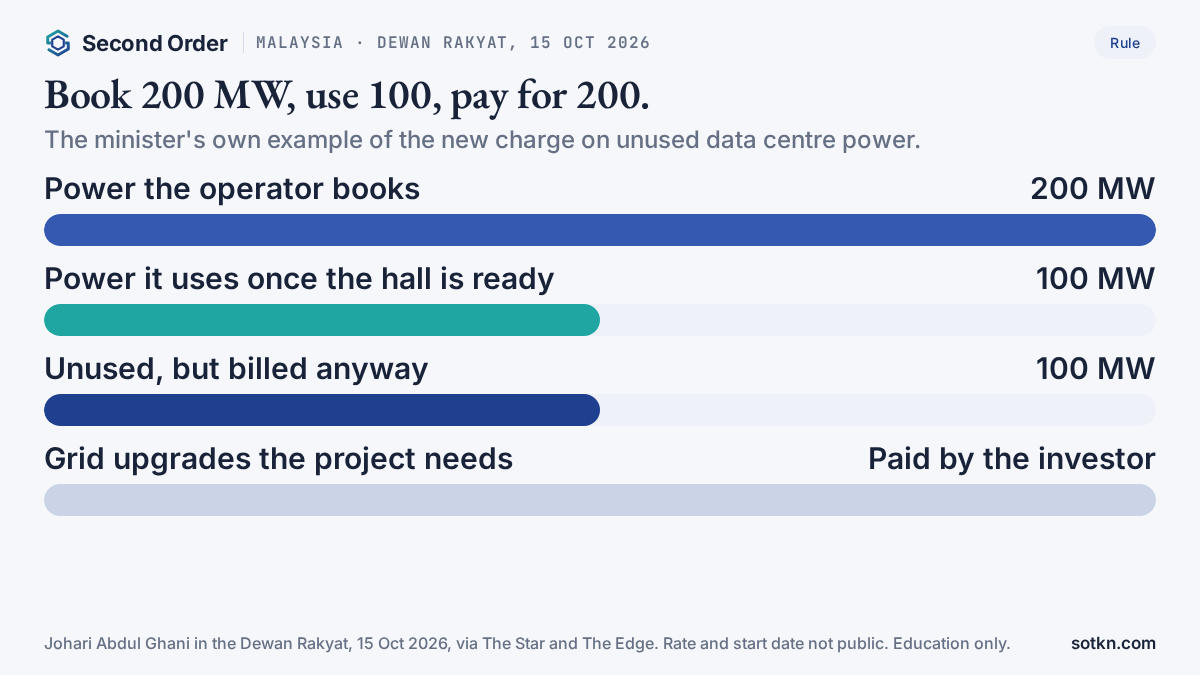
His example was simple. “If you come to build a data centre and request 200 megawatts, but when the facility and power supply are ready you use only 100, we will charge you for the other 100,” he said, as reported by The Star. The Edge quoted him: “The other 100MW that you do not use, we assume you have used it.” The charge bites once both the building and the supply are ready, not while the hall is still being built.
He gave the reason in the same answer. The government wants data centre investment to benefit Malaysia beyond its relatively cheap electricity and water. “We welcome them to come, but it is not about getting cheap energy from us,” he said. The question he was answering, from Ayer Hitam MP Wee Ka Siong, asked how Malaysia would avoid becoming merely a place where people rent space because power and water are cheap.
Three further points came with the charge, according to The Edge. First, the transmission upgrades each project needs are to be part of the investor's project spending, not passed to local players. Second, data centre power is to be treated separately from supply to households and other industries, without subsidies, to protect the reserve margin the rest of the economy relies on. Third, where generation relies on gas, its market price should be reflected in the cost of supplying the data centre.
Stated on 15 Oct
Not yet public
How new is this? Less new for TNB than for everyone else. Our 10 October Pulse reported an RHB note saying TNB's data centre customers already sign five-year take-or-pay power contracts, so the utility recovers its spending whatever a hall uses. What the minister added is public, national policy with an operating licence behind it, plus the grid-upgrade bill and the end of any subsidy. For a developer, the difference is between a private contract term and a rule that applies to every site and every lender's model.
How big is the queue the rule is aimed at?
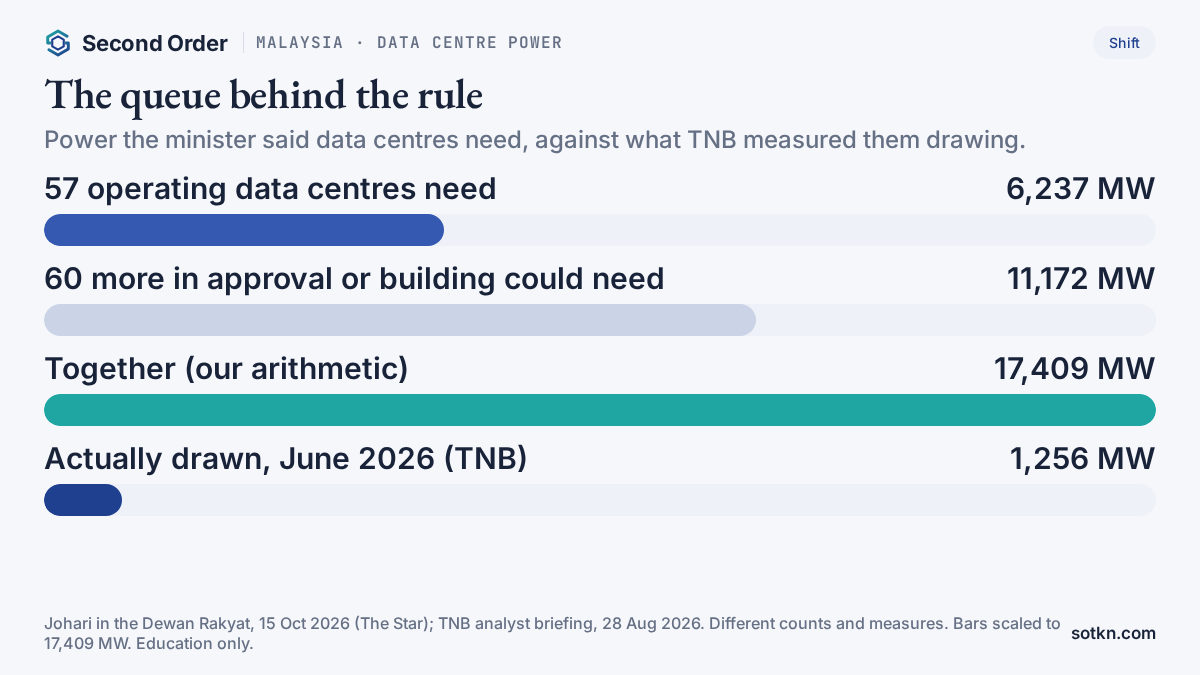
Big, and mostly not drawing power yet. The minister said Malaysia has 57 operating data centres that require 6,237 MW of electricity, and another 60 at various stages of approval or development that could require a further 11,172 MW. Against that, TNB's own analyst briefing of 28 August showed actual data centre load on its grid of 1,256 MW in June 2026, up from 603 MW a year earlier.
The counts do not line up neatly, and that is worth saying plainly. The Edge reported that TNB supplies 36 data centres; TNB's briefing counted 42 projects in its system at June with 5.65 GW of total maximum demand; the minister spoke of 57 operating data centres needing 6,237 MW. They are different counts from different people, likely using different cut-offs, and “require” may mean the power a site has asked for rather than the power it draws. We do not add them together or treat them as one series.
What they agree on is the shape. The power booked or asked for runs several times ahead of the power actually drawn, and the queue behind it is larger still. On TNB's own like-for-like figures, actual load in June was about 22% of the maximum demand already in its system. That ratio is why a charge on unused capacity matters: it puts a price on most of what is booked today.
Two cautions. A full hall never draws its whole maximum demand, because the figure includes headroom for cooling peaks and spare equipment, so not all of the gap is idle booking. And many sites fill in stages, so a low ratio early in a hall's life is normal. The rule, as described, charges for unused capacity once the hall and supply are ready, which is when staged filling starts to cost money.
Who pays for the build, now that the grid bill moves?
The developer, and the people who lend to it. Moving the transmission upgrade into each project's own budget raises what every new site costs before it earns. A high-voltage line and substation for a large campus is not a small item. Our DayOne Pulse followed a RM293.88 million award to build two 275,000-volt landing stations for a single data centre in the central region of Peninsular Malaysia. That is the scale of grid work one site can need, and under the rule as described, the upgrades a project requires sit with the investor.
That lands at an awkward moment for the banks. S&P's Yijing Ng said on 16 October that Asia-Pacific data centre operators have relied heavily on bank loans and equity, but banks are increasingly reaching their sector lending limits, and GPU loans are now competing for the same room. Her view was that Malaysia's funding needs for data centres and GPUs will exceed domestic bank lending limits within three years.
Where does the money come from instead? S&P pointed to three routes. Asset-backed securities work for finished, stable sites, and S&P said Australia, Singapore and Japan already have a track record there. Where there is construction risk, it expects project finance or private credit. REITs and funds come later in an operator's life. Each route costs more or asks more of the borrower than a plain bank loan, and every one of them prices the same question: when will this hall be full? For how lenders think about the chips inside, see GPU financing, explained; for why the listing route has just got harder next door, see our Singapore data centre REIT Pulse.
The charge on unused power makes that question sharper. A lender to a half-empty hall used to worry about rent that had not arrived. Now it also has to model a power bill on capacity the hall is not using. That favours borrowers who arrive with a signed tenant, and it makes speculative halls dearer to fund.
How does Malaysia's rule compare with Taiwan's?
Two Asian grids reached the same worry in the same week by different routes. On 14 October Taipower's chairman said giving a power slot to someone who holds only land and a possibility can block a real investor, and that Taipower is designing a fairer filter; we covered it in our Taipower grid piece. He wants applicants who can show a cloud customer has committed and a site is chosen.
Malaysia's approach works the other way round. It does not try to screen out the would-be landlord at the door. It lets the booking go ahead, then bills for the part that is not used once the hall and supply are ready. Taiwan screens at the door; Malaysia bills at the meter. The aim is the same: stop scarce grid capacity from being held by sites that are not ready to fill it.
Australia shows the opposite end of the same problem. In Sydney, as our Australia Pulse found today, new connections are sold out, so a site with approved power is the prize and tenants sign for 15 years to get it. Malaysia still has power to offer, which is why it can afford to charge for holding it. The lesson for an AI developer across the region is the same: the power slot is worth most to whoever can fill it fastest.
Our math: what do the numbers say?
- Minister's example: booking 200 MW and using 100 MW leaves 50% of the booking billed as unused (our arithmetic on his example).
- Queue: 6,237 MW for operating sites plus 11,172 MW in the pipeline is about 17,409 MW, or 17.4 GW; the pipeline alone is about 1.8 times what operating sites require (our arithmetic on the minister's figures).
- Drawn versus booked on TNB's grid: 1,256 MW of actual load in June against 5.65 GW of maximum demand in system is about 22%, leaving about 4.4 GW booked but not drawn (our arithmetic on TNB's figures; maximum demand is never fully drawn).
- Drawn versus the minister's queue: 1,256 MW is about 7% of 17,409 MW (our arithmetic; different sources and measures, so a rough scale only).
- Load growth: 603 MW to 1,256 MW in a year is an increase of about 653 MW, roughly 2.1 times (our arithmetic on TNB's figures).
- Fill time: at about 653 MW a year, closing a 4.4 GW gap would take roughly six to seven years if the pace held and nothing new were booked (our arithmetic; an illustration, not a forecast).
- Approvals: RM225.97 billion across 27 task-force projects is about RM8.4 billion a project on average, and Johor's 16 are about 59% of the count (our arithmetic on the Digital Ministry's figures).
- Who invested: RM114 billion domestic out of RM385.7 billion approved since 2021 is about 30%; foreign money is about 70% (our arithmetic on the minister's figures).
- Global capex backdrop: S&P's US$1.3 trillion of AI spending in 2027 against US$870 billion in 2026 is a rise of about 49% (our arithmetic on S&P's figures).
What this tells you: Malaysia has far more power booked and queued for data centres than it has data centres drawing. The 15 October rule turns that gap into a cost for the people who booked it. At the pace load grew over the past year, the gap would take years to close on its own, so the charge will be felt.
Who gets paid first?
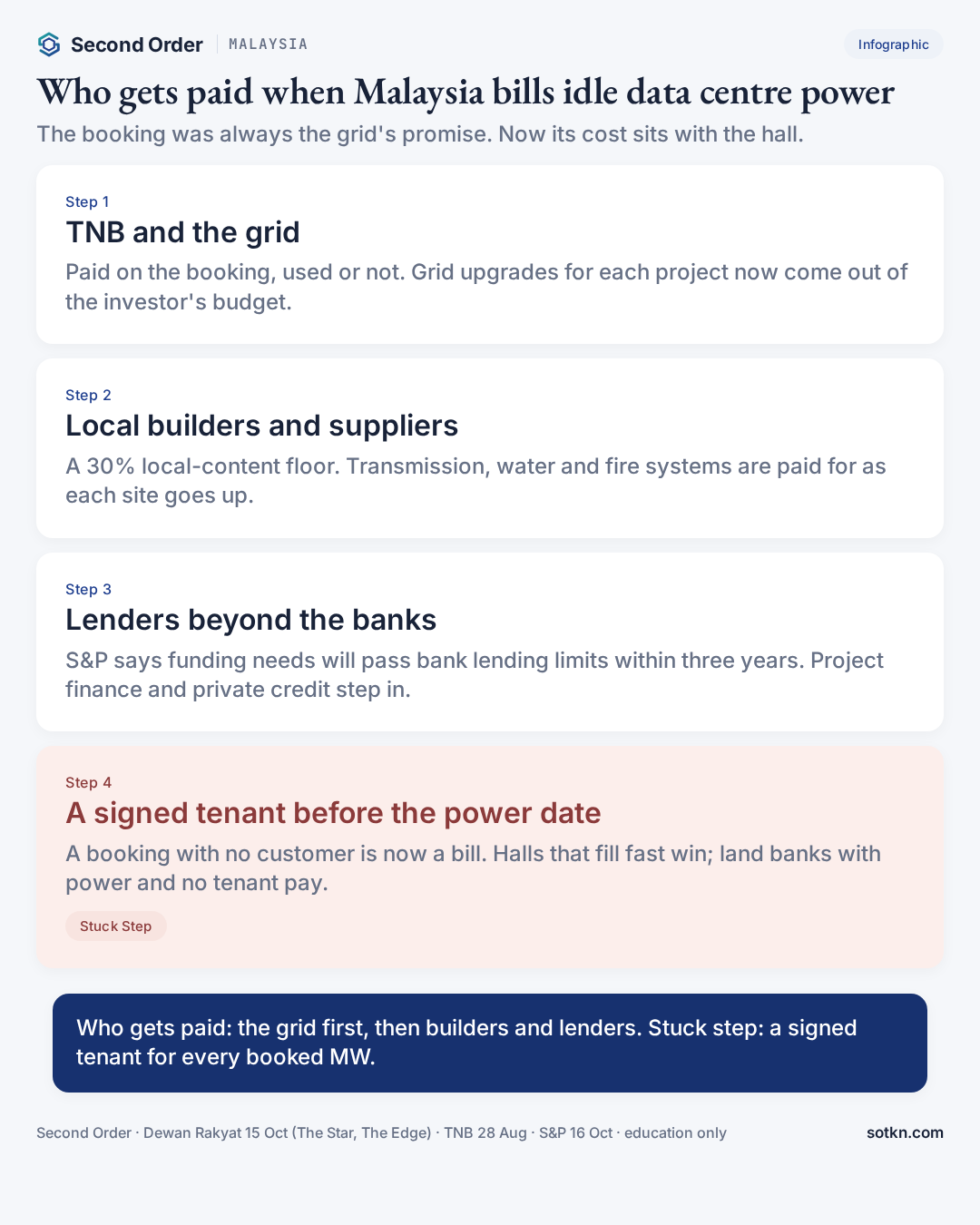
First, TNB and the grid — on the booking. The power company is paid for what is booked whether or not it is used, and now the grid work each project needs comes out of the investor's budget rather than the utility's. Without a subsidy, and with gas-fired supply at market price, the bill reflects what the power really costs to deliver. For why utilities tend to collect before halls do, see the members' utilities Analysis.
Second, the local builders and suppliers — as each site goes up. A 30% local-content floor, backed by six-monthly checks, steers work in construction, engineering, cooling and electrical equipment to Malaysian firms. AWC's RM39.7 million water-systems subcontract under Gamuda Engineering in Port Dickson is the kind of job that rule protects; it sits on the same Bandar Spring Hill campus where Kinergy won RM47.5 million of electrical work, as our DayOne Pulse noted. Transmission work now paid for by investors adds to the pool.
Third, the lenders — as money is drawn, and increasingly not the banks alone. If S&P is right that funding needs pass bank limits within three years, project finance houses and private credit funds pick up the construction risk and charge for it. They are paid on drawdown, whether or not the hall fills on time.
Fourth, the hall owners with signed tenants — as tenants move in. A developer that booked power for a customer who is ready to use it pays little or nothing extra under the rule. One that booked power for a customer it has not found yet now carries a bill on an empty hall. Our Bitdeer Wire covered a Johor site secured with no customer signed; that is the position the charge makes costlier. The Edge reported on 5 October that YTL Power has 298 MW contracted at its Kulai park and another 200 MW due by June 2027, with tenants still being sought.
Fifth, the landlords holding power without a tenant — later, and at a cost. Their booking used to be an option worth holding. Under the rule it becomes a liability once the supply is ready. For the wider pattern of halls built before customers, see our halls-before-customers Analysis; for operators across the layer, see what Nxera does, one of the regional builders with Johor plans.
One-line rule: in Malaysia now, the grid is paid on the booking, local builders and lenders are paid as sites go up, hall owners are paid as tenants move in, and an empty booking is a bill. The stuck step is a signed tenant for every booked megawatt.
So what is the stuck step?
A signed tenant for every megawatt booked, in place before the power is ready. Not the grid for sites already connected: TNB has the power booked for them. Not approvals: 27 task-force projects are through. Not demand in general: S&P still sees 33% a year. Three things make this step stick:
- The bill starts when the hall is ready, not when the tenant arrives. Under the minister's description, unused capacity is charged once the facility and supply are ready, so any gap between switch-on and move-in now costs money.
- Money is getting dearer and choosier. With banks nearing sector limits, project finance and private credit ask for a credible tenant before they fund the build, and price the risk if there is none.
- The grid upgrade is now the developer's cost. A site with no tenant now carries both the upgrade bill and the unused-power bill, which raises the price of waiting.
So-what: a power slot in Malaysia is still valuable, but only to whoever can fill it. The rule pushes the industry toward build-to-suit halls for named customers and away from powered land banks. In Malaysian AI data centres this week, the scarce thing is not power. It is a customer ready to use it.
Which dates test this read next?
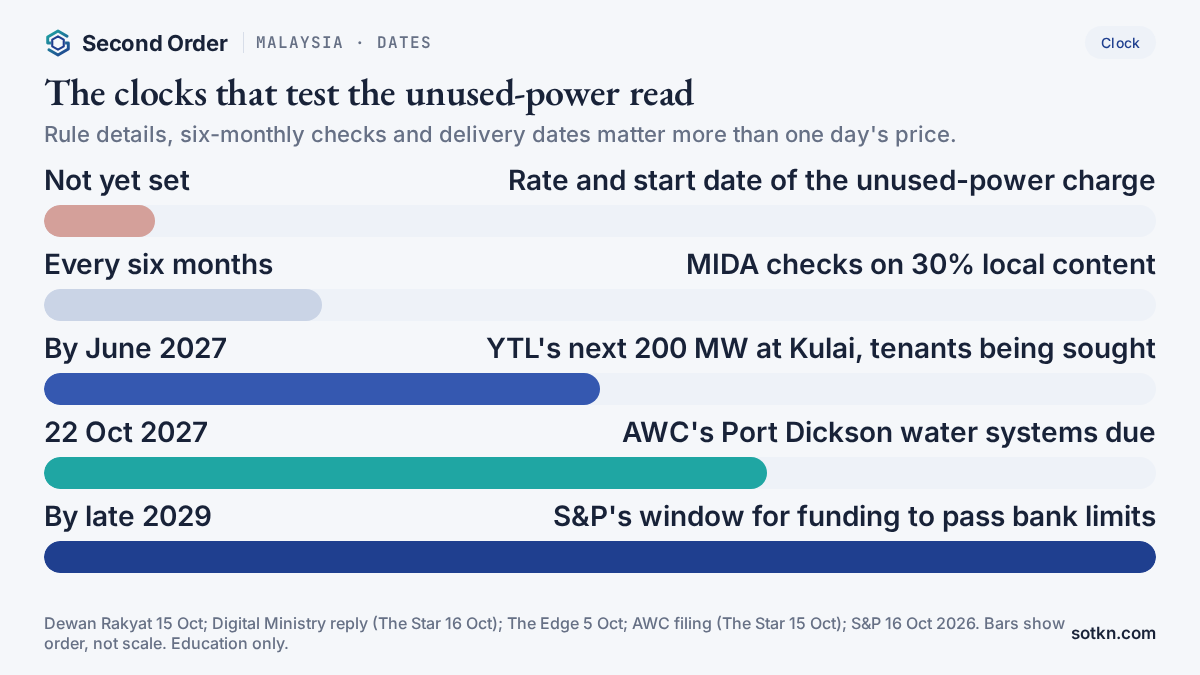
- Not yet set — the rate, start date and coverage of the unused-power charge. The test: whether it applies to existing contracts and how “used” is measured.
- Every six months — MIDA's implementation reports on the 30% local-content rule. The test: whether local builders and suppliers really capture the work.
- By June 2027 — YTL Power's next 200 MW at Kulai, as reported by The Edge. The test: whether new capacity arrives with tenants signed, or waits for them.
- 22 October 2027 — AWC's Port Dickson subcontract due for completion. The test: whether local work on hyperscale sites runs to schedule.
- By late 2029 — the end of S&P's three-year window for funding needs to pass bank limits. The test: whether project finance, private credit or bonds take over.
The charge details test how hard the rule bites. The 2027 dates test whether new halls arrive with customers. The financing window tests who pays for the ones that do not.
What would change this view?
- The charge turns out to be small, delayed, or limited to new contracts — the cost of holding an empty booking would stay low and land banks would keep their value.
- Tenants sign quickly for the booked capacity — if load keeps rising faster than the past year's 653 MW, the gap shrinks and the charge matters less.
- Banks get more room, or bond and asset-backed markets open sooner than S&P expects — funding would stop being a second filter on speculative halls.
- The government softens the grid-upgrade rule to win a large project — the cost would drift back toward TNB and other users.
Practical takeaways
- 15 Oct, Dewan Rakyat: data centres will pay for capacity they book but do not use; non-payers cannot operate
- 15 Oct: investors fund the grid upgrades their projects need; no subsidy; gas-fired supply at market price
- 57 operating data centres require 6,237 MW; 60 more could require 11,172 MW; TNB measured 1,256 MW drawn in June
- 27 task-force approvals worth RM225.97 billion, 16 in Johor, one operating; 30% local content
- S&P (16 Oct): funding needs to pass bank lending limits within three years
- The grid is paid first, then local builders and lenders; hall owners as tenants move in
- Stuck step: a signed tenant for every booked megawatt
FAQ
What did Malaysia announce about unused data centre power?
On 15 October 2026, Investment, Trade and Industry Minister Johari Abdul Ghani told the Dewan Rakyat that data centre operators will pay for electricity capacity they commit to but do not use. His example: an operator that asks for 200 MW and uses 100 MW once its hall and supply are ready will be charged for the other 100 MW. He said an operator that does not pay cannot operate, and called it the government's policy now.
Why can't TNB just give the unused power to someone else?
Because it has promised it. The Edge reported the minister as saying Tenaga Nasional cannot freely reallocate unused capacity, since it stays committed to meeting the operator's future needs. The wires, transformers and generation behind a booking are built and held for that customer, so somebody has to pay for them.
Who pays for grid upgrades for new data centres in Malaysia?
The investor. The minister said transmission upgrades a project needs should be part of the investor's own project spending, with TNB advising on what is needed, so that businesses that were there before data centres are not hurt. He also said data centre power should be treated separately from households and other industries, with no subsidies, and with gas-fired supply priced at market.
How is this different from TNB's existing take-or-pay contracts?
TNB's data centre customers already sign take-or-pay power contracts, as our 10 October Malaysia Pulse reported from an RHB note. What changed on 15 October is that a minister set out the charge as national policy in Parliament, tied it to permission to operate, and added three things: investors pay for the grid upgrades their projects need, data centre supply carries no subsidy, and gas-fired power is priced at market. The rate, start date and treatment of existing contracts were not published.
How does Malaysia's approach compare with Taiwan's?
Both are trying to stop power being held by sites that are not ready to use it. Taipower said on 14 October it wants to give large AI data centre supply to applicants with a real cloud customer and site, and is still designing that filter. Malaysia's rule works after the fact: it lets the booking go ahead and charges for the part that is not used. Taiwan screens at the door; Malaysia bills at the meter.
Is this investment advice?
No. Education only. It maps who gets paid and which step is stuck. It is not a recommendation to buy or sell any security, and we leave out share prices, broker ratings and price targets on purpose.
Keep reading on the map
- Malaysia Markets hub — country page
- Malaysia power-use Pulse — booked power against used power
- DayOne financing Pulse — RM30 billion and the high-voltage hookup
- Taipower grid piece — Taiwan's filter for real investors
- Australia Sydney power Pulse — when connections are sold out
- Bitdeer Johor Wire — a site secured before a customer
- AI Data Centers on the stack · What Nxera does
- How long it takes to build an AI data center · AI data center water use
- All Markets doors — Taiwan, Korea, US, China, Singapore, Australia, Malaysia
How we check this. The unused-power charge, the 6,237 MW and 11,172 MW figures, the 30% local content floor and the approved-investment totals come from Investment, Trade and Industry Minister Johari Abdul Ghani's answers in the Dewan Rakyat on 15 October 2026, as reported by The Star that day. The grid-upgrade, no-subsidy and gas-price points, and the count of 36 data centres TNB supplies, come from The Edge's report of the same session, published on 16 October. We could not reach the official Hansard when we checked. Booked and actual data centre load come from Tenaga Nasional's own analyst briefing of 28 August 2026. The 27 task-force approvals come from the Digital Ministry's written parliamentary reply as reported by The Star on 16 October. S&P Global Ratings' views come from its 16 October webinar as reported by Bernama. AWC's subcontract comes from its Bursa Malaysia filing as reported on 15 October, and YTL Power's Kulai figures from The Edge on 5 October. Share prices, broker ratings and price targets are left out on purpose. Anything we worked out ourselves is labelled “our arithmetic”. The references we used are listed at the end. Our editorial standards →
Not investment advice. Do your own research.
References
- The Star, Data centres must pay for unused power allocations, says Johari, 15 Oct 2026. thestar.com.my — the unused-capacity charge, 57 operating data centres needing 6,237 MW, 60 more needing 11,172 MW, 30% local content, RM385.7 billion approved since 2021.
- The Edge, Data centre investors must bear necessary grid upgrade costs, says Johari Ghani (via i3investor), 16 Oct 2026. klse.i3investor.com — investors pay for transmission upgrades, TNB cannot reallocate booked capacity, no subsidies, gas at market price, TNB supplying 36 data centres.
- Tenaga Nasional Berhad, Analyst Briefing 2QFY2026, 28 Aug 2026. tnb.com.my — 42 projects with 5.65 GW of maximum demand in system, 1,256 MW actual load in June 2026, 61 projects and 8.35 GW secured.
- The Star, Dozens of data centre projects worth RM226bil approved, 16 Oct 2026. thestar.com.my — Digital Ministry written reply: 27 task-force approvals worth RM225.97 billion, 16 in Johor, one operating.
- The Star (Bernama), Malaysia's data centre, GPU funding expected to exceed bank lending limits in three years - S&P Global Ratings, 16 Oct 2026. thestar.com.my — banks nearing sector lending limits; shift to project finance, private credit and asset-backed securities.
- The Star (Bernama), Malaysia data centre market projected to grow 33% CAGR from 2025-2030, 16 Oct 2026. thestar.com.my — S&P: 33% yearly growth to 2030 and a reset under tighter rules.
- The Star (Bernama), AWC wins RM39.7mil data centre job, 15 Oct 2026. thestar.com.my — Qudotech subcontract from Gamuda Engineering for a hyperscale data centre in Port Dickson, Aug 2026 to Oct 2027.
- The Edge Malaysia, Potential data centre business listing fuels interest, 5 Oct 2026. theedgemalaysia.com — YTL Power: 298 MW contracted at Kulai; another 200 MW due by June 2027 with tenants still being sought.