
5.65 GW Plugged In, 1.26 GW Used: Who Gets Paid While Malaysia's Data Centres Fill
TNB had 42 data centre projects plugged into Malaysia's grid by June 2026, with room for 5.65 GW. They drew 1,256 MW. On 9 Oct the Budget papers said data centre demand could reach 12.9 GW by 2030. The power company is paid on the booking; halls get paid as they fill.
By June 2026 Malaysia's power company had 42 data centre projects plugged into its grid, with room to draw 5.65 GW. They drew 1,256 MW. The wires are mostly there. The computers are still arriving. The power company is paid on the booking; the hall owners get paid as the halls fill.
MALAYSIA PULSE · Data as at 10 Oct 2026 · Next update: when TNB reports its next quarter of data centre load
Affects: AI Data Centers · Hyperscalers · Neoclouds — Markets: Malaysia · Singapore · Australia · US
Education only, not advice to buy or sell any security. Company and government figures are as reported. “Maximum demand” is what a customer has booked, not what it uses. Our own sums are labelled.
The numbers that matter this week
Data centres in TNB's system, June 2026
5.65 GW
42 projects · booked maximum demand
PrimaryActual data centre load, June 2026
1,256 MW
Up from 603 MW in June 2025
PrimaryAll signed data centre projects
8.35 GW
61 projects · 67% of secured capacity in Johor
PrimaryGovernment outlook for 2030 (9 Oct)
12.9 GW
Data centre power demand · 20.9 GW by 2040
PrimaryShare of plugged-in power in use (our math)
~22%
1,256 ÷ 5,650 MW
Our mathComputers arriving in connected halls
The fill
Load is the clock · the grid is the gate for new halls
Stuck stepSources: TNB analyst briefing, 28 Aug 2026; Economic Outlook Report 2027 via Business Today, 9 Oct 2026; EdgeProp, 9 Oct 2026; BMI via Malay Mail, 9 Oct 2026. Status chips are Second Order’s read.
On this page: Why Malaysia? · What the numbers say · Booked vs used · Our math · Who gets paid · What is stuck? · Dates next · What would change this · FAQ
Why does Malaysia matter this week?
Because three things landed in two days. On 8 Oct a Hong Kong-listed property group signed a non-binding plan for an AI data centre of up to 300 MW in Johor. On 9 Oct the government tabled Budget 2027, and its Economic Outlook report put fresh numbers on how much power data centres use today and how much they could need by 2030. The same day, BMI, a unit of Fitch Solutions, said power remains the binding constraint on new projects.
This is our first Pulse from the Malaysia door. If you are new to the layer, start with what an AI data center is and the AI Data Centers stack: who owns the powered halls, who fills them with computers, and which step slows the money down. The question here is not “is Johor busy?” It plainly is. The question is who gets paid in the gap between the power a hall has booked and the power it actually uses.
That gap is unusually easy to see in Malaysia, because one company, Tenaga Nasional Berhad (TNB), supplies almost all of Peninsular Malaysia and reports both numbers. Most countries publish one or the other. Malaysia publishes both, and they are a long way apart.
1 · Cloud and AI buyers book Johor space
Who: Hyperscalers, AI labs, neoclouds
Paid: Much of it spills over from Singapore, where new power is rationed
2 · The power company is paid on the booking
Who: TNB, under five-year take-or-pay deals
Paid: It recovers its spending whatever the hall uses
3 · Halls get paid as computers move in
Who: Johor landlords and their tenants
Paid: 1,256 MW used of 5.65 GW plugged in
What do the new numbers say?
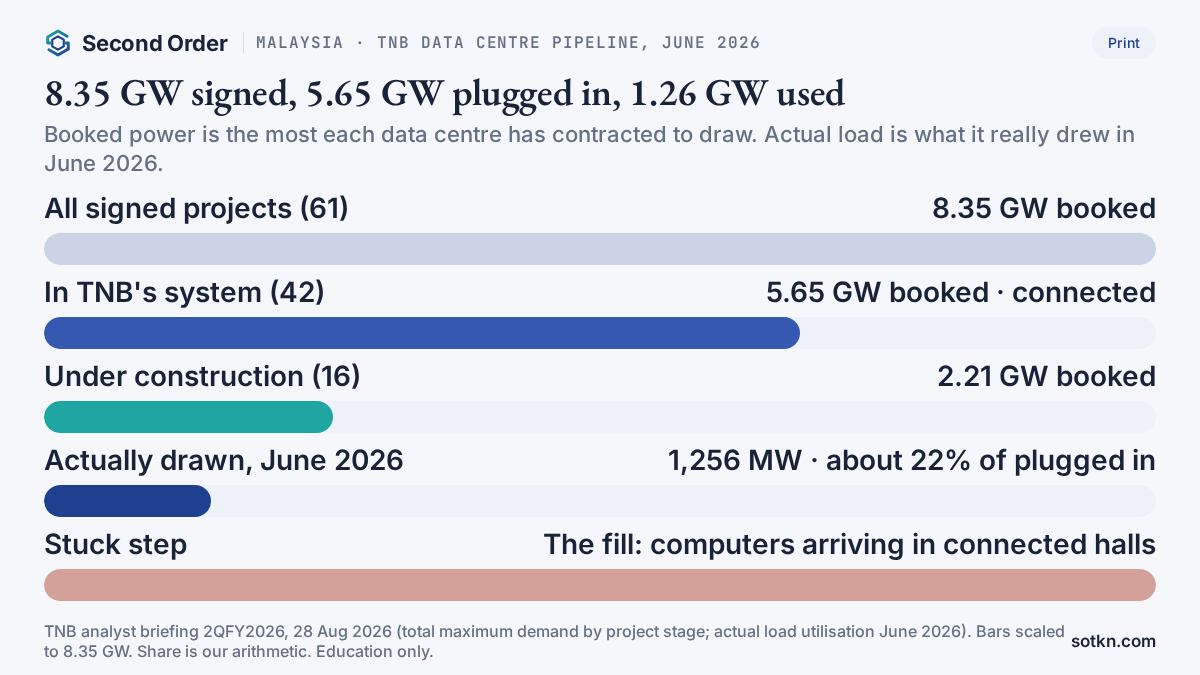
Start with TNB's own count, from its 28 Aug 2026 analyst briefing for the half-year to June. It splits data centre projects by stage, measured in “total maximum demand” — the most power each customer has contracted to draw.
- 35 projects, 4.46 GW, finished before this financial year.
- 7 projects, 1.19 GW, finished in the first half of 2026. Together that is 42 projects and 5.65 GW in the system.
- 16 projects, 2.21 GW, under construction.
- 3 projects, 0.49 GW, with signed supply deals but not yet building.
- 61 projects and 8.35 GW in all. Johor holds 29 of them and 5.6 GW, about 67%.
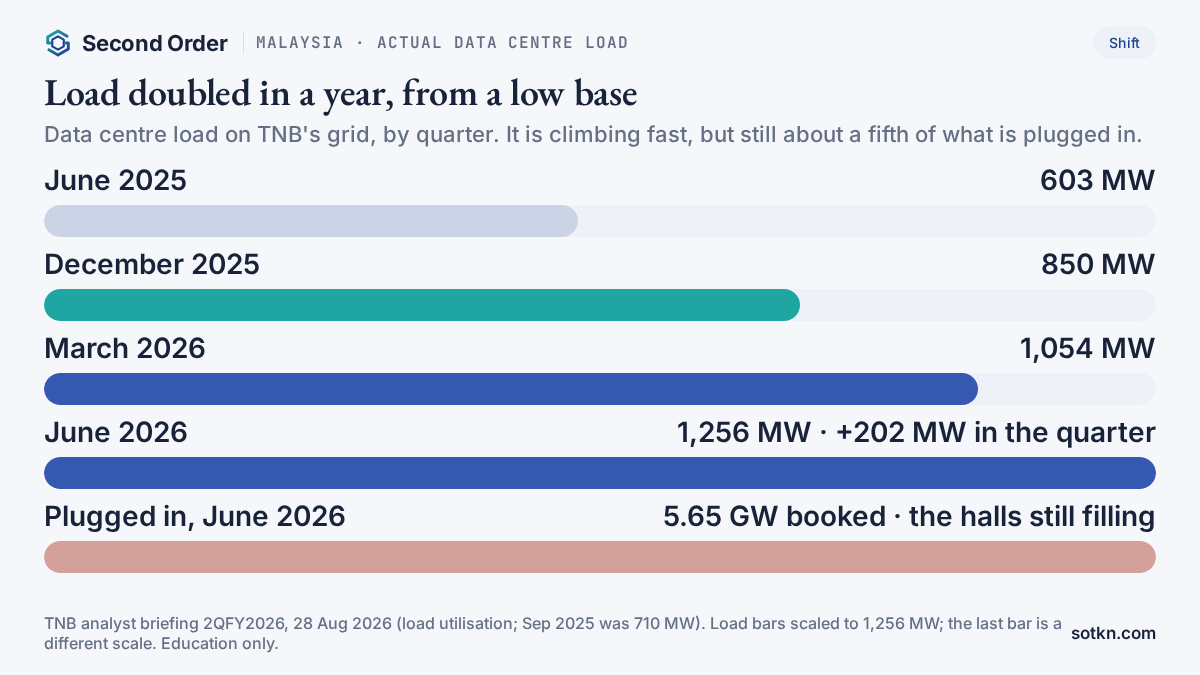
Then the line that matters most. In a box above the bars, TNB wrote: actual load utilisation, 1,256 MW, for June 2026. That is the power data centres really drew. On its demand page the same briefing shows that load climbing every quarter: 603 MW in June 2025, 710 MW in September, 850 MW in December, 1,054 MW in March and 1,256 MW in June. Data centre energy use in the half-year was 4.0 TWh, 2.1 times a year earlier.
The Budget papers on 9 Oct tell a matching story from the government's side. The Economic Outlook Report 2027 said actual data centre electricity use reached 710 MW in 2025, up from 405 MW in 2024, Business Today and Reuters reported. Citing the energy ministry, it said data centre demand could reach 12.9 GW by 2030 and 20.9 GW by 2040. TNB expects Peninsular Malaysia's total power use to rise 4.9% to 148.66 TWh in 2027.
TNB data centre pipeline (June 2026)
Government outlook (9 Oct 2026)
TNB analyst briefing 2QFY2026, 28 Aug 2026; Economic Outlook Report 2027 via Business Today, 9 Oct 2026.
Why is booked power so far ahead of used power?
Because a data centre books its full size on day one and fills up over years. A campus signs for, say, 200 MW of maximum demand so the power company builds the substation and lines once. Then the owner fits out one hall at a time, and each hall draws power only when a tenant moves its computers in and switches them on. A new AI hall can sit with live power and empty racks for months.
So the gap is not a sign that the halls are failing. It is a sign that the slow part has moved. Getting a grid connection used to take three to four years in Malaysia. TNB's Green Lane Pathway for data centres cuts the usual 36 to 48 months to about 12, EdgeProp reported. Once the wire is fast, the waiting moves to the next step: the building, the cooling, the chips and the tenant.
A Bursa-listed Johor landlord shows the same shape. YTL Power has doubled its target for its Kulai data centre park to 1.2 GW. About 300 MW is secured, of which 150 MW is running, and another 200 MW is waiting on final contracts, Business Today reported on 6 Oct from a Hong Leong Investment Bank note. The Edge put YTL's contracted figure at 298 MW and said another 200 MW should be finished by June 2027. As at June 2026 YTL had put RM10.6 billion into its data centre business.
The new 300 MW Johor plan from Realord Technology is the other end of the line. Its 8 Oct filing calls it a memorandum of understanding that is not legally binding. There is no land deal yet, the first phase would be about 100 MW, and it still has to clear Malaysia's Data Centre Task Force. It counts as interest, not as booked power.
Our math: how big is the gap?
- Used share: 1,256 MW ÷ 5,650 MW ≈ 22% of plugged-in data centre power was drawn in June 2026 (our arithmetic).
- Idle booking: 5,650 − 1,256 ≈ 4,400 MW booked and connected but not yet drawn (our arithmetic).
- Speed: load rose from 603 MW to 1,256 MW in a year, about 2.1 times. The last quarter added 202 MW (1,054 to 1,256) (our arithmetic).
- Fill time: at 202 MW a quarter, the 4,400 MW already plugged in would take about 22 quarters, or five to six years, to fill. The full 8.35 GW signed pipeline would take about 35 quarters (our arithmetic, a simple pace sum, not a forecast).
- Energy: 1,256 MW running all year is about 11 TWh, roughly 7% of the 148.66 TWh TNB expects the peninsula to use in 2027 (our arithmetic).
- The 2030 outlook: 12.9 GW is about ten times June 2026's actual load (our arithmetic).
What this tells you: Malaysia's near-term limit for halls already connected is not wires. It is how fast computers arrive. Load is growing fast, but from a low base, and the booked number is far ahead of it.
What it does not tell you: how much each customer pays on unused booking, what minimum the take-or-pay contracts set, or how many tenants have signed for the empty halls. Those numbers are not public. For how to read money spent before it earns, see cash capex, explained.
Who gets paid first?
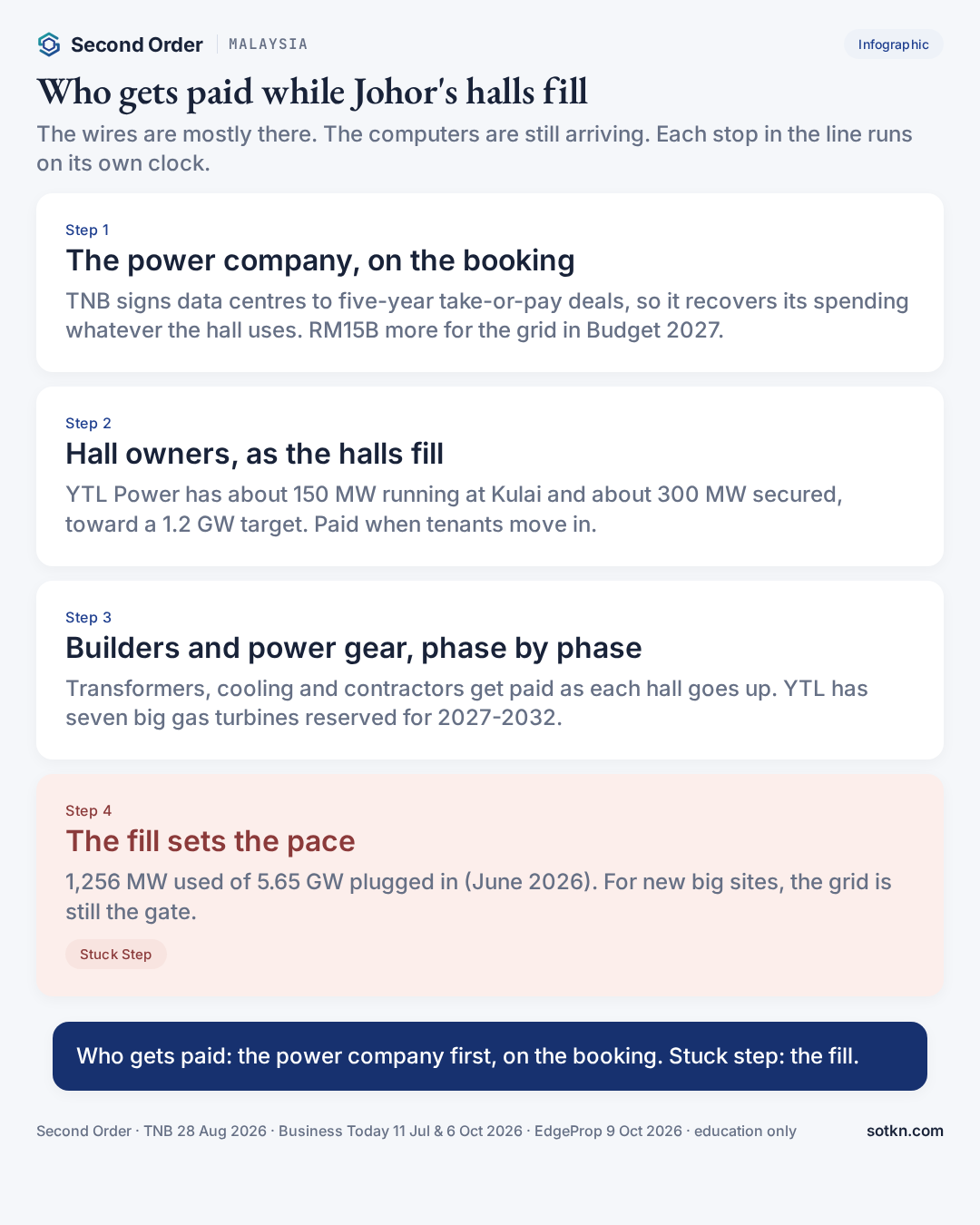
Follow one cloud customer that wants more room near Singapore next year. The money moves in a short line, and each stop runs on its own clock.
First, the power company — on the booking. TNB told RHB Research in July that all of its data centre customers sign five-year take-or-pay supply agreements, which let it recover its spending regardless of how much power the hall actually uses during the contract, Business Today reported. In plain words, the reservation is paid for, full or empty. TNB has RM43 billion of spending approved for 2025 to 2027 under its regulated plan, and the Budget on 9 Oct added RM15 billion to strengthen the grid. TNB targets about 1 GW of new data centre capacity a year.
The price is rising too. Under TNB's current tariff period, from July 2025 to December 2027, a new top-voltage rate of about 60 sen per kWh was introduced that analysts expect to apply to data centres, against an average base tariff of 45.40 sen, The Star reported. That is about a third higher (our arithmetic). BMI also flagged new tariffs for sites above 100 MW.
Second, the hall owners — as the halls fill. YTL Power, DayOne, AirTrunk, Bridge DC, Yondr and others get paid when a tenant moves in and starts paying for space and power. BMI says the market has shifted to large, costly AI builds run by platforms backed by private equity. HLIB's industry checks say newly built capacity is being taken up quickly. That is the fill showing up, one hall at a time.
Third, the builders and power-gear makers — on the owner's clock. Every phase needs transformers, switchgear, cooling and contractors, paid as it goes up. YTL has reserved seven large Siemens gas turbines, 5,250 MW in all, for delivery from 2027 to 2032, and its 600 MW Kulai solar farm is due in the second half of 2026, The Edge and Business Today reported.
Fourth, the tenants carry the cost of the wait. A customer that books 100 MW and uses 20 still owes whatever minimum its contract sets. See hyperscaler, explained and neocloud, explained for who fills these buildings with computers, and today's Analysis on utilities for why power companies collect before the halls do.
One-line rule: in Malaysia the power company is paid on the booking, the hall owner is paid on the fill, and the stuck step is computers arriving in halls that already have power.
So what is the stuck step?
There are two, on two clocks. For halls already connected, it is the fill: chips, racks and tenants arriving in buildings with live power. For new projects, it is still power. BMI said on 9 Oct that grid bottlenecks, new tariffs above 100 MW and stricter green screening raise the risk of delays, and push some operators to Thailand and Vietnam.
- Grid for the next wave: the government's 12.9 GW outlook for 2030 is well above the 8.35 GW TNB has signed. TNB plans to add 11.8 GW of new power plants by 2033 while retiring 6.6 GW, a net 5.2 GW.
- Clean power and water: the Finance Ministry said in August that data centre tax breaks will be tied to energy and water efficiency. Malaysia targets 40% renewable capacity by 2035. In Johor, water is being restructured, with three proposed water plants worth RM3.5 billion by 2030 tied to Ranhill.
- Fuel cost: Peninsular Malaysia runs mainly on gas and coal. The government is reviewing the fuel-cost charge, possibly from January 2027, and analysts say big business users could carry more of it.
- Paper plans: deals like Realord's 300 MW MOU need land, approvals and a supply deal before they count. Until then they are not in TNB's 8.35 GW.
What binds Malaysian halls now
What does not bind
So-what: in Malaysia the power company's money is the steadiest, because the booking is paid for. The hall owners' money depends on the fill. The new entrants' money depends on the grid. Same state, three clocks.
Compare Singapore across the Causeway, where the state hands out new power in small rounds and has just licensed every hall of 3 MW or more (the Singapore Pulse), and Sydney, where new halls must bring their own firmed clean power before they switch on (this morning's Australia Pulse). Johor's power looks easier to book than either. That is why the gap shows up here as empty racks, not as a queue.
Which dates test this read next?
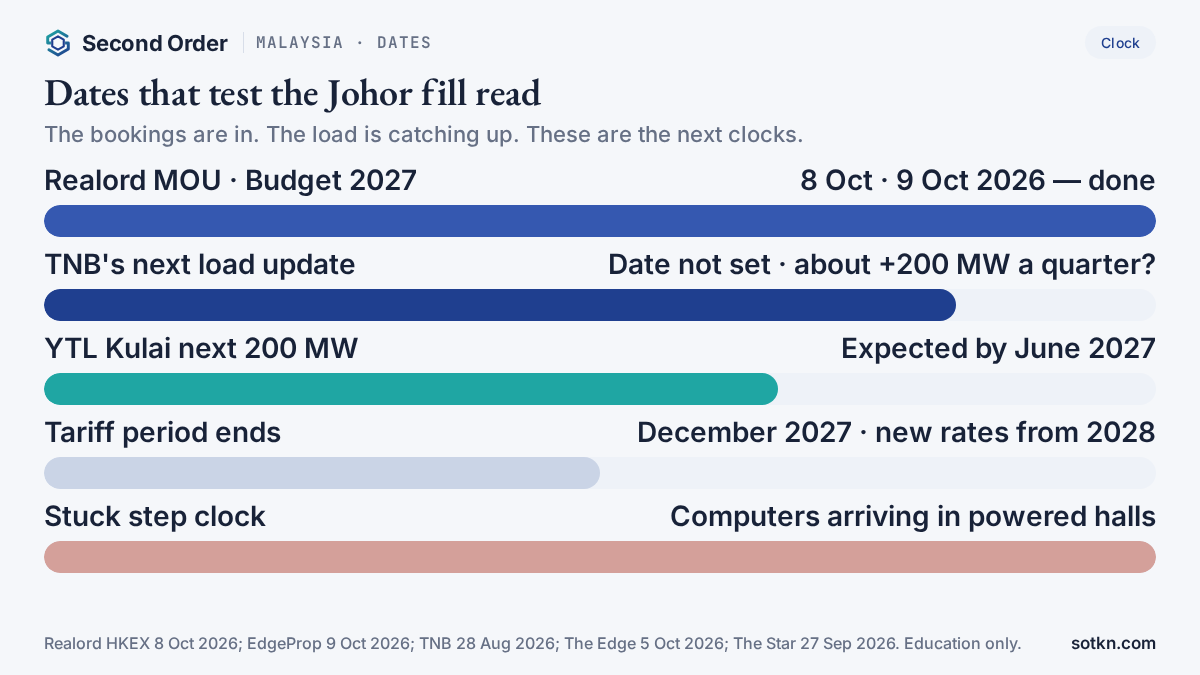
- 8 Oct 2026 — Realord signs its non-binding 300 MW Johor MOU. Done.
- 9 Oct 2026 — Budget 2027: RM15 billion for the grid; Economic Outlook gives 710 MW used in 2025 and 12.9 GW by 2030. Done.
- Second half of 2026 — YTL's 600 MW Kulai solar farm due to start.
- Date not set — TNB's next quarterly update on data centre load. The test: does load keep adding about 200 MW a quarter?
- January 2027, possible — changes to the fuel-cost charge after the government review.
- June 2027 — YTL's next 200 MW at Kulai expected to be finished, per The Edge.
- 2027 — YTL's possible listing of its data centre business.
- December 2027 — TNB's current tariff period ends; the next one sets data centre rates from 2028.
- 2030 — the government's 12.9 GW data centre demand outlook.
The quarterly load number matters most. If it keeps climbing by about 200 MW a quarter or faster, the fill is on track. If it stalls while bookings rise, the gap is a warning, not a timing issue.
What would change this view?
- Actual load jumps well above 200 MW a quarter — the fill is faster than it looks and the grid becomes the bind again.
- Load stalls while bookings keep growing — the halls are early, and tenants, not power, are the bind.
- TNB loosens take-or-pay terms to win customers — the power company's money becomes less steady.
- New tariffs from 2028 put much more of the cost on data centres — hall owners' margins, not TNB's, take the hit.
- Big projects move to Thailand or Vietnam, as BMI warns — Johor's pipeline shrinks before it fills.
- US chip export rules tighten for Malaysia — computers arrive slower and the fill stretches.
Practical takeaways
- TNB had 42 data centre projects, 5.65 GW, plugged in at June 2026; 61 projects and 8.35 GW are signed
- Actual data centre load was 1,256 MW, about 22% of what is plugged in, though it doubled in a year
- Budget 2027 papers (9 Oct) see data centre demand reaching 12.9 GW by 2030; TNB adds RM15 billion for the grid
- Who gets paid first: the power company, on five-year take-or-pay bookings; hall owners next, as halls fill
- Stuck step: computers arriving in connected halls; for new big sites, the grid is still the gate
FAQ
How much data centre power is plugged into Malaysia's grid?
At June 2026 Tenaga Nasional (TNB), the national power company for Peninsular Malaysia, had 42 data centre projects in its system with a combined maximum demand of 5.65 GW. Another 16 projects (2.21 GW) were being built and 3 more (0.49 GW) had signed supply deals, for 61 projects and 8.35 GW in all.
How much do those data centres actually use?
Far less than they booked. TNB put actual data centre load at 1,256 MW in June 2026, up from 603 MW a year earlier. The government's Economic Outlook report, released with Budget 2027 on 9 Oct 2026, said actual data centre use was 710 MW in 2025, up from 405 MW in 2024.
Who gets paid first?
The power company, on the booking. TNB says every data centre customer signs a five-year take-or-pay supply deal, so it recovers its spending whatever the hall uses. Hall owners get paid as tenants move computers in and start paying. Builders and power-gear makers get paid as each phase goes up.
Why is the fill the stuck step, not the grid?
For the halls already connected, the wires are there; what is missing is load: computers, tenants and the chips inside them. For new projects the grid is still the gate. BMI said on 9 Oct that power remains the binding constraint for new Malaysian projects.
Where does Singapore fit?
Singapore rations new data centre power, so a lot of demand spills into Johor, just across the Causeway. TNB says about 72% of data centre investment comes from the United States and Singapore, and 68% of the capacity it has secured sits in Johor.
Is this investment advice?
No. Education only. It maps who gets paid and which step is stuck. It is not a recommendation to buy or sell any security.
Keep reading on the map
- Malaysia Markets hub — country page
- AI Data Centers stack — layer map
- What is an AI data center? — the basics
- Utilities bill data centers before power (Analysis) — where cash sticks
- Singapore data centre licence Pulse (9 Oct) — the rationed-power case
- Australia power condition Pulse (10 Oct) — approved, not powered
- Duke's 75% data center power terms (Wire) — pay for power, used or not
- All Markets doors — Taiwan, Korea, US, China, Singapore, Australia, Malaysia
- Hyperscaler, explained · Neocloud, explained
How we check this. Grid and load figures come from TNB's own analyst briefing and the government's Economic Outlook report, as published or as reported by named outlets. Company plans come from exchange filings and named news reports. Analyst price targets and buy calls are left out on purpose. Anything we worked out ourselves is labelled “our arithmetic”. We do not invent power prices, lease rates or dates. Our editorial standards →
Not investment advice. Do your own research.
Sources
- TNB analyst briefing, 2QFY2026 (28 Aug 2026) — 42 projects / 5.65 GW in system, 1,256 MW actual load, 61 projects / 8.35 GW — tnb.com.my
- Business Today (9 Oct 2026) — Economic Outlook Report 2027: 148.66 TWh in 2027; data centre use 710 MW (2025); 12.9 GW by 2030 — businesstoday.com.my
- EdgeProp (9 Oct 2026) — Budget 2027: TNB RM15B grid; Green Lane 12 months; 36 operating / 4.5 GW — edgeprop.my
- Malay Mail / Bernama (9 Oct 2026) — BMI: 925.6 MW live, 2.0 GW building, power the binding constraint — malaymail.com
- Business Today (11 Jul 2026) — TNB: 59 projects, 8.3 GW, five-year take-or-pay — businesstoday.com.my
- The Star via Webull (27 Sep 2026) — TNB tariffs, AFA review, about 60 sen/kWh top-voltage rate — webull.com.my
- Business Today (6 Oct 2026) — YTL Power: Kulai 1.2 GW target, 150 MW running, RM10.6B invested — businesstoday.com.my
- The Edge Malaysia (5 Oct 2026) — YTL Power: 298 MW contracted, 200 MW more by June 2027, 600 MW solar — theedgemalaysia.com
- Realord Technology, HKEX announcement (8 Oct 2026) — non-binding MOU for up to 300 MW in Johor — aastocks.com