
71 MW for 15 Years: Who Gets Paid When Sydney's Data Centre Power Is Sold Out
A global tech firm, reported to be Anthropic, has taken 71 MW at DigiCo's SYD1 for 15 years. The site's edge is not the building. It is grid power that is already approved, in a Sydney where new connections are sold out until the 2030s.
A global technology firm has signed up for 71 megawatts at one Sydney data centre for 15 years. DigiCo Infrastructure REIT announced the contract for its SYD1 site on 15 October, and the Australian Financial Review reported the next day that the customer is Anthropic. The building is not what won the deal. The site already has approved grid power, in a city where new connections are sold out until the 2030s. The stuck step is the grid connection, and whoever already holds one gets paid first.
AUSTRALIA PULSE · AI DATA CENTERS · Data as at 17 Oct 2026 · Next update: IREN's Redbank scoping report, due end of October 2026
Affects: AI Data Centers · Hyperscalers · Neoclouds — Markets: Australia · Singapore · Malaysia · US
Education only, not advice to buy or sell any security. Figures are as stated by the companies or reported. The customer's name comes from a press report, not from DigiCo. Our own sums are labelled.
The numbers that matter this week
SYD1 contract
71 MW
15 years plus options · investment grade credit
SignedSYD1 contracted
100% of 88 MW
Ahead of a five-year plan
SignedDigiCo Australian lease length
~3 → 10+ yrs
Weighted by income, pro forma
ReportedFirst new MW earning
10 MW
Late in the year to June 2027
ClockNew western Sydney connections
1.5 GW
Signed by Transgrid · city now sold out
Stuck stepEdgeConneX–Stockland power
450 MW
Secured for Sydney and Melbourne
ReportedFigures from DigiCo's ASX release of 15 October 2026, The Australian as carried by Stockhead on 14 October 2026 and EdgeConneX's release of 14 October 2026. Status chips are Second Order’s read.
On this page: Why it matters · What changed · Inside the contract · Sydney sold out · Who else holds power · Our math · Who gets paid · What is stuck? · Dates next · What would change this · FAQ
Why does one Sydney lease matter to who gets paid in AI halls?
Because it shows what an AI tenant is really buying in Sydney right now. A data centre lease looks like a property deal: a tenant pays rent for space in a building. But an AI tenant does not need the space for its own sake. It needs a known date when a large block of power will switch on, so its chips can start earning. In most cities that date is set by the builder. In Sydney today it is set by the grid.
SYD1 is not a new campus on empty land. DigiCo describes it as an established data centre being reused and expanded, with approved grid capacity, water access and a State Significant Development approval already in place. That is the scarce part. A tenant signing for 15 years is paying for certainty that the power will be there, at a time when many rival Sydney projects cannot say when theirs will be.
This is a different stuck step from the ones we have mapped in Australia so far. On 10 October our New South Wales power condition Pulse followed two approved Sydney halls that cannot switch on until their power use is matched with new renewable supply. On 13 October our Australia funding Pulse followed what happens when the money to build gets dearer. This Pulse is about the step that sits between the two: the connection itself, and who already holds one.
For what these buildings are, see what an AI data center is. For why rent only starts when the power does, see data center leases, explained.
1 · New connections bind
Who: Sydney grid capacity for new halls
Paid: Sold out · big new lines from 2030–31
2 · Power already approved
Who: Owners of connected sites
Paid: SYD1: 71 MW for 15 years · 100% of 88 MW contracted
3 · Builders on fixed price
Who: Contractors for the expansion
Paid: Shape Australia head contractor · Laing O'Rourke delivery partner
4 · Waiting on the grid
Who: Sydney projects without a connection
Paid: Some may slip into the next decade
What changed between 14 and 16 October?
Five items in three days drew one picture. Power that is already secured is winning tenants. Power that is only requested is waiting, and the people who will host it are being asked to pay more for it.
- 14 October — Sydney is sold out. The Australian, carried by Stockhead, reported that data centres were told in August that Sydney had no electricity capacity left for them and that the industry must pay for costly network expansions. Transgrid said it had recently signed connection agreements for 1.5 GW of new data centre demand in western Sydney, roughly doubling the load there. Experts quoted by the paper said there was little room until the Sydney Ring South transmission project, built in two phases between 2030–31 and 2033–34. Projects still seeking power included Goodman's Eastern Creek plan, NEXTDC's S7, Stack Infrastructure's own SYD1 and AirTrunk's S4.
- 14 October — 450 MW changes hands into a new venture. EdgeConneX, a global builder of data centres for cloud and AI customers, entered Australia through a 50-50 joint venture with Stockland, the listed property group. The partners said they are advancing hyperscale campuses in Sydney and Melbourne with 450 MW of power secured, and are applying for more.
- 14 October — Tasmania asks hosts to pay their way. ABC News reported that the Tasmanian government will expect data centre operators to pay into a Local Community Benefit Fund, meet their own network costs and help grow the state's energy supply. The rule would apply to approved projects too. Firmus, which pulled its float earlier in the month, is negotiating with Hydro Tasmania for 444 MW. The same day IREN, the Nasdaq-listed AI cloud company, set out a 900 MW campus near Wagga Wagga targeting a grid connection in 2029.
- 15 October — DigiCo fills SYD1. DigiCo Infrastructure REIT told the ASX it had signed a 15-year contract, plus renewal options, for 71 MW at SYD1 with a global technology firm backed by investment grade credit, subject to customary conditions and approvals. SYD1 is now 100% contracted across 88 MW. DigiCo also signed a fixed-price building contract for the 52 MW expansion and said it needs no new equity to fund it.
- 16 October — the tenant is reported, and it is shopping elsewhere too. The Australian Financial Review reported that the SYD1 customer is Anthropic. The same day ABC News reported that Anthropic has also leased the first of four buildings at Zerra DC's proposed A$32 billion Western Downs Digital Park near Dalby in Queensland, for use as early as 2027. Zerra's data centre chief said the tenant, not the landlord, would pay for new power supply.
Put together, the picture is not that AI demand for Australian halls is slowing. It is that demand is flowing to whoever can promise power on a date, and that every government and grid operator is pushing more of the cost of new power back onto the people who want it.
What is inside the SYD1 contract?
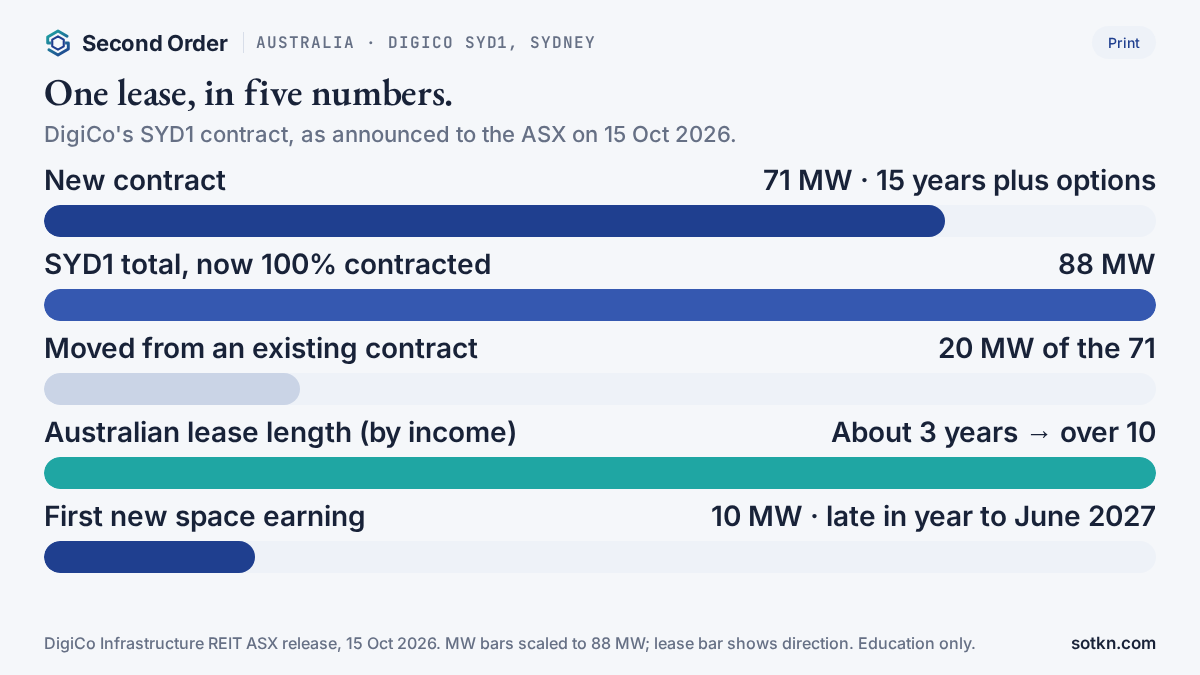
Start with the size. SYD1 has 88 MW of total capacity once expanded. The new customer takes 71 MW of it. That 71 MW includes 20 MW that was already contracted to someone else and has been moved to the new customer. The other 17 MW is leased to smaller co-location customers, the kind that rent racks and cages rather than whole halls. DigiCo says renewals across its Australian portfolio have come in about 8% higher on average since it listed.
Then the length. Before this deal, the average remaining lease across DigiCo's Australian portfolio, weighted by income, was about three years. With the new contract it is more than ten years, on DigiCo's pro forma basis that assumes all 88 MW is earning. The contract has average yearly rent rises of about 3%, using fixed steps and inflation-linked reviews that assume 3% inflation. For a landlord, that is the difference between rent that must be re-won every few years and rent that is locked in for a decade and a half.
Then the clock. Most of the 71 MW is not built yet. DigiCo expects the first 10 MW of the 52 MW expansion to be energised and earning late in its financial year to June 2027, with the rest arriving in stages through the year to June 2028, timed to what the customer needs. Works happen inside a running data centre, so existing customers keep their uptime while the new halls go in.
Then the money. Shape Australia is head contractor on a fixed-price, lump-sum design and construct deal, and Laing O'Rourke stays on as the integrated delivery partner. DigiCo says the contract fits its earlier estimate of A$1.2 billion of spending on SYD1 and a second site, ADL1 in Adelaide, across its 2027 and 2028 financial years, with A$300 million to A$500 million of that in the year to June 2027, weighted to the second half. It will pay from existing cash, available debt and the proceeds of selling US assets, with no new equity. It reaffirmed underlying earnings guidance of A$120 million to A$125 million for the 2027 year, and repeated a path to about A$250 million a year of earnings from its Australian platform once SYD1 and ADL1 are full and billing.
And the reason it could sign at all. In DigiCo's words, the expansion is the reuse of an established data centre with approved grid capacity, water access and state planning approval in place. When it bought SYD1, its plan was to lease and develop the site to 88 MW over five years. It now expects to get there well ahead of that plan. A tenant cannot get that kind of start date from a plot of land that is still waiting for Transgrid.
Why is new power the part that is sold out?
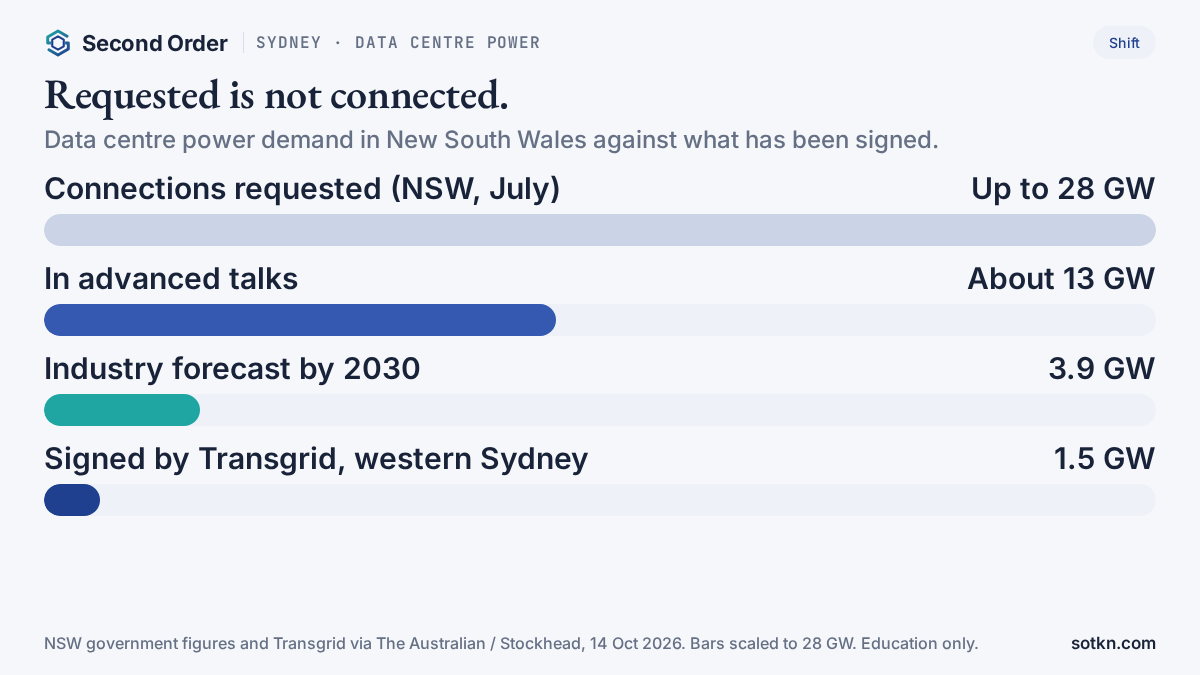
Because demand to connect has run far ahead of the wires. On New South Wales government figures cited by The Australian, data centres were seeking network connections of up to 28 GW as of July. About 13 GW of that was in advanced talks, more than the state's average daily electricity demand. Against that, Transgrid has signed agreements for 1.5 GW of new demand in western Sydney. Data Centres Australia, the industry body, forecasts 3.9 GW by 2030, not 13 GW in New South Wales alone, and experts warn the big numbers include projects that will never be built.
Sydney power, by the numbers
Who holds or wants power
Building the hall is no longer the slow part. Belinda Dennett, chief executive of Data Centres Australia, told The Australian that a data centre takes 18 months to two years to build, while a renewable energy project can take four to seven years. She said projects need a confirmed commitment to energisation before they can sign customers, secure capital and start building. That sentence is the whole SYD1 story in reverse: DigiCo had the energisation path, so it could sign the customer.
The rules are tightening at the same time. The federal government wants data centres to find new renewable supply to match what they use. The New South Wales government is proposing reforms so that data centres impose no net cost on other electricity users and help fund new supply. Tasmania now expects operators to meet their own network costs. In Queensland, Zerra's data centre chief said the AI tenant would pay for new power supply, the way a shop tenant pays its own bills. Every one of these moves makes a site with power already approved worth more, because it skips a cost and a queue that newcomers must face.
There is a regional escape valve, but it runs on its own clock. Transgrid may unlock up to 2 GW more in western Sydney and offer capacity in the Riverina and Hunter regions, where some power is available. That is why AirTrunk and CDC are looking at regional New South Wales, and why IREN chose Wagga Wagga; our IREN Redbank Catalyst traces that 900 MW plan and its 2029 power date. For how long the building itself takes, see how long it takes to build an AI data center.
Who else already holds power in Australia?
If secured power is the scarce input, the useful question is who owns it. The week's reports name several holders, each in a different position.
NEXTDC, the largest listed Australian builder, had 740.1 MW contracted at 30 June but only 175 MW billing; the rest is contracted space waiting to be built and switched on. Its planned S7 complex in Sydney was named by The Australian among projects still seeking power. We set out what its price assumes in our NEXTDC Analysis, and how its model works in what NEXTDC does.
Goodman, Australia's largest listed property group, plans a A$5 billion, 500 MW pair of buildings at Eastern Creek and told The Australian it is awaiting feedback from authorities on the connection timetable. It has also sought advice on finding a fresh tenant for the site from early 2027, which suggests it may not go ahead with a data centre there. Today's Goodman Analysis looks at the power it has banked across its portfolio.
Stockland brings land and planning work; EdgeConneX brings global hyperscale building experience. Together they start with 450 MW of power secured across Sydney and Melbourne, about five times SYD1's total. That is a new landlord arriving with the scarce input already in hand, rather than queuing for it.
Smaller operators sit further back. Macquarie Technology runs data centres for business and government; see what Macquarie Technology does. In Tasmania, Firmus is still negotiating for 444 MW from Hydro Tasmania after pulling its ASX float. The pattern is the same everywhere: the closer a site is to switching on, the more a tenant will commit to it.
The tenant side is worth noticing too. If the Australian Financial Review is right, Anthropic has now committed to a Sydney hall with power approved for mid-2027 and a Queensland building for as early as 2027, where it will pay for new supply itself. An AI developer is spreading its bets across a connected city site and a regional site that brings its own power. For the difference between whole-hall and rack-sized leases, see hyperscale vs colocation.
Our math: what do the numbers say?
- Single tenant share: 71 MW out of 88 MW is about 81% of SYD1 with one customer (our arithmetic on DigiCo's figures).
- New versus moved: 71 MW less the 20 MW moved from an existing contract is about 51 MW of newly contracted space, close to the 52 MW expansion (our arithmetic; DigiCo does not split it this way).
- Lease length: going from about 3 years to more than 10 years more than triples the average remaining lease across DigiCo's Australian portfolio (our arithmetic on DigiCo's pro forma figures).
- First step: 10 MW earning by mid-2027 is about 19% of the 52 MW expansion; the other 42 MW, about 81%, lands over the following year (our arithmetic).
- Spending pace: A$300 million to A$500 million in the year to June 2027 is about 25% to 42% of the A$1.2 billion planned for SYD1 and ADL1 over two years (our arithmetic).
- Earnings path: about A$250 million a year from the Australian platform once full is roughly double the A$120 million to A$125 million guided for the 2027 year (our arithmetic; the two are measured differently and include assets being sold).
- Connected versus requested: Transgrid's 1.5 GW of signed connections is about 12% of the 13 GW in advanced talks and about 5% of the 28 GW requested (our arithmetic on reported figures).
- Wait gap: a hall that takes 18 to 24 months against a renewable project of four to seven years leaves a gap of roughly two to five and a half years where the building could be ready and the power not (our arithmetic on the industry body's figures).
- Scale: EdgeConneX and Stockland's 450 MW of secured power is about five times SYD1's 88 MW (our arithmetic).
What this tells you: Sydney has far more demand to connect than wires to connect it. When that happens, the value moves to the sites that are already through the gate. DigiCo filled SYD1 years ahead of plan and turned a three-year lease book into a ten-year one, not by building faster, but by owning approved power.
Who gets paid first?
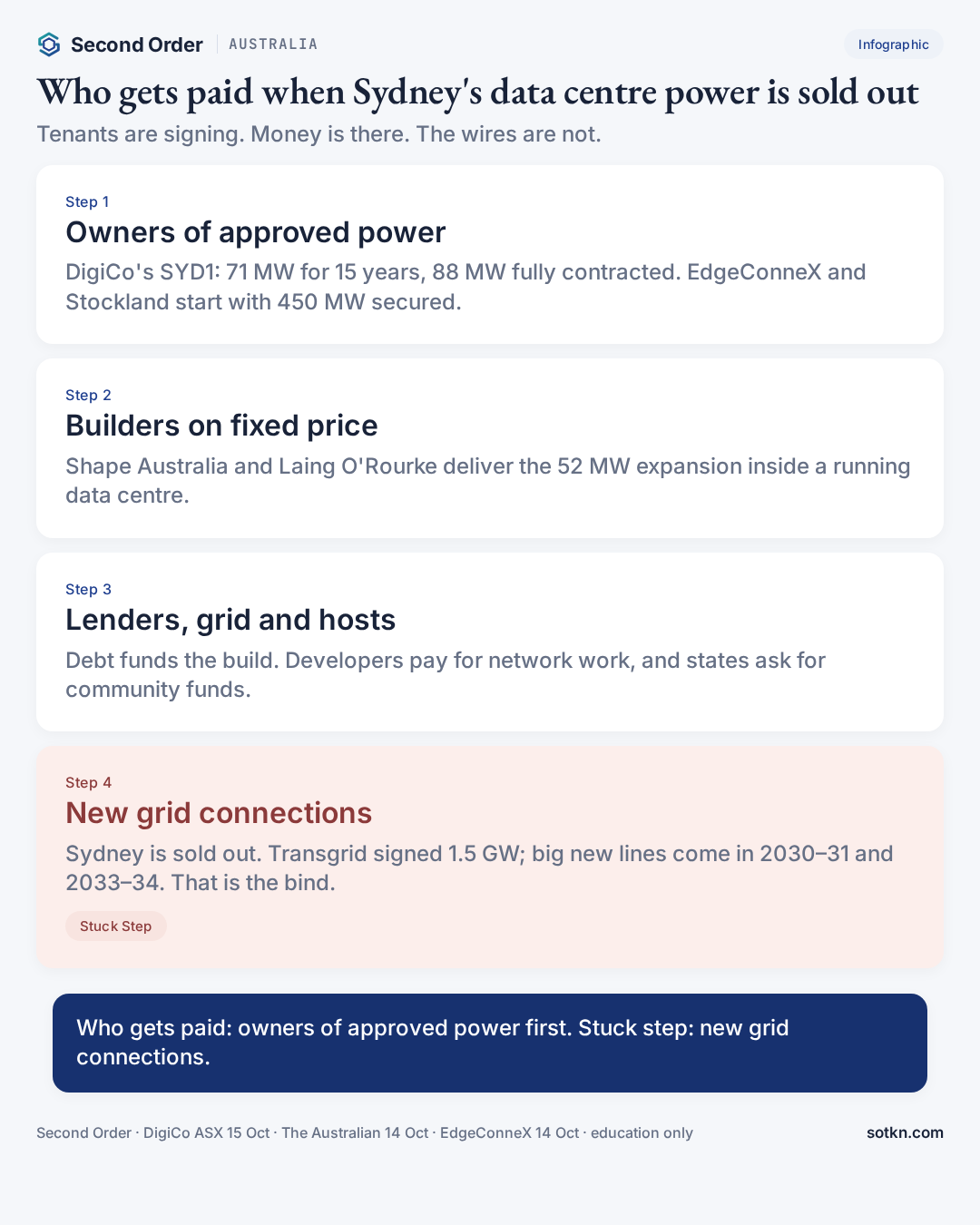
First, the owners of sites with power already approved — through long, rising rent. DigiCo now has 88 MW at SYD1 fully contracted, most of it for 15 years with yearly rises of about 3%. The rent on the new space starts as each block is energised, from mid-2027. Stockland and EdgeConneX hold 450 MW of secured power for the same reason: it is what tenants sign for.
Second, the builders — as the halls go in. Shape Australia is paid under a fixed-price contract to deliver the 52 MW expansion, and Laing O'Rourke leads overall delivery. Fixed price means the builder carries the risk of cost overruns and the owner gets a known bill, so the builder's margin depends on running the job well inside a live data centre.
Third, the lenders and the buyers of DigiCo's US assets — as the money is drawn. DigiCo is funding the expansion from cash, debt facilities and asset sale proceeds rather than new units. Banks earn interest as the facilities are used; the buyers of its US sites get assets in a deal that recycles cash into Sydney.
Fourth, the grid and the host communities — through connection costs and benefit funds. Developers must now fund network expansions in Sydney and are expected to pay their own network costs in Tasmania. IREN has pledged about A$200 million over 30 years to Wagga Wagga City Council for a community fund, infrastructure and rates, Capital Brief reported. That money is paid whether or not the halls fill quickly.
Fifth, the projects still waiting for a Sydney connection — later, or not at all. NEXTDC's S7, AirTrunk's S4 and Goodman's Eastern Creek plan were all named as still seeking power. Until they have an energisation date, they find it harder to sign tenants, which is the point Data Centres Australia made. For the wider pattern of cash sticking at the stuck step, see where the stuck step moves.
One-line rule: in Sydney right now, owners of approved power and the builders working for them are paid first, lenders and grid owners are paid as money is drawn, and projects without a connection wait. The stuck step is the grid connection.
So what is the stuck step?
New grid connections for data centres in Sydney. Not tenants: an AI developer just signed for 15 years. Not money: DigiCo is funding its expansion without new equity, and EdgeConneX arrived with a partner. Not the building: a hall takes under two years. Three things make this step stick:
- Wires: Sydney was told in August it was sold out, and the main new transmission line arrives in two stages, 2030–31 and 2033–34.
- Matching supply: new halls must bring new renewable power, and those projects take four to seven years against a building's two.
- Cost shift: New South Wales, Tasmania and the federal government all want data centres to pay for the extra supply and network they need, which raises the bill for anyone not already connected.
So-what: whoever already holds approved power in Sydney can sign long leases with AI tenants now, and gets paid from the day each block switches on. Whoever needs a new connection either moves to the regions or waits for the grid. In Australian AI data centres this week, the scarce thing is not land, chips or money. It is a date for the power.
Which dates test this read next?
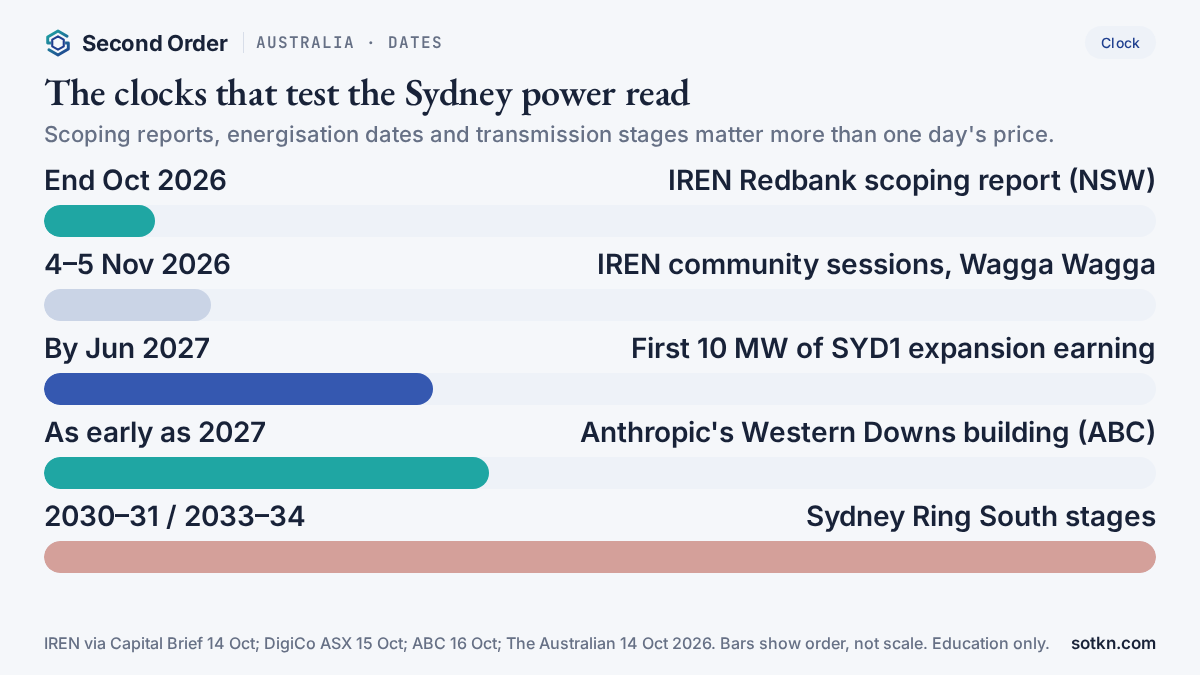
- End of October 2026 — IREN's Redbank scoping report to the New South Wales planning department. The test: how much of a regional 900 MW plan depends on the 2029 grid date.
- 4–5 November 2026 — IREN's community sessions in Wagga Wagga. The test: whether regional hosts accept large AI halls on the terms offered.
- Not set — the customary conditions and approvals on DigiCo's SYD1 contract. The test: whether the 71 MW deal closes as announced.
- Late in the year to June 2027 — the first 10 MW of DigiCo's SYD1 expansion energised and earning. The test: whether connected sites really do switch on when promised.
- As early as 2027 — Anthropic's first building at the Western Downs Digital Park, as reported by ABC News. The test: whether a tenant-funded power model can move faster than the Sydney queue.
- 2030–31 and 2033–34 — the two stages of Sydney Ring South. The test: when the stuck step finally eases for projects still waiting.
The 2027 dates test whether owners of connected and self-powered sites deliver. The transmission dates test how long everyone else waits.
What would change this view?
- Transgrid unlocks its extra 2 GW in western Sydney quickly, or the Riverina and Hunter connections arrive early — approved power would become less scarce and SYD1-style sites would lose some of their edge.
- The SYD1 contract fails its conditions or the first 10 MW slips well past mid-2027 — approved power would prove less certain than it looked.
- AI tenants start delaying or cutting Australian commitments — demand, not the grid, would become the story.
- New South Wales rules end up charging connected sites for new supply as well — the cost advantage of already holding power would shrink.
Practical takeaways
- DigiCo (15 Oct): 71 MW at SYD1 for 15 years with an investment grade-backed tech firm; SYD1 100% contracted across 88 MW
- AFR (16 Oct): the customer is reported to be Anthropic, which has also leased a Queensland building for as early as 2027
- The Australian (14 Oct): Sydney is sold out of new power for data centres; Transgrid signed 1.5 GW; big new lines from 2030–31
- EdgeConneX and Stockland (14 Oct): 450 MW of power secured for Sydney and Melbourne campuses
- Owners of approved power and their builders are paid first; projects without a connection wait
- Stuck step: new grid connections in Sydney
FAQ
What did DigiCo actually sign?
On 15 October 2026 DigiCo Infrastructure REIT told the ASX it had signed a 15-year contract, plus renewal options, for 71 MW at its SYD1 data centre in Sydney with a global technology firm backed by investment grade credit. The deal is subject to customary conditions and approvals. It takes SYD1 to 100% contracted across 88 MW. DigiCo did not name the customer. The Australian Financial Review reported on 16 October that it is Anthropic.
Why does already-approved grid power matter so much?
Because an AI tenant cannot use a hall that cannot switch on. The Australian reported on 14 October that data centres were told in August that Sydney was sold out of electricity capacity, and that big new projects may not connect until the next decade. DigiCo says SYD1 already has approved grid capacity, water access and a state planning approval. That lets it promise a start date a tenant can plan around.
Is SYD1 the same as Stack Infrastructure's SYD1?
No. They share a site code but are different projects. DigiCo's SYD1 is an existing data centre being expanded. The Australian listed a Stack Infrastructure project also called SYD1 among the Sydney schemes still seeking power.
When does the new rent start?
DigiCo expects the first 10 MW of its 52 MW expansion to be energised and earning in late Q4 of its 2027 financial year, which ends in June 2027. The rest comes in stages through the year to June 2028, in line with what the customer needs.
Is this investment advice?
No. Education only. It maps who gets paid and which step is stuck. It is not a recommendation to buy or sell any security, and we leave out share prices, broker ratings and price targets on purpose.
Keep reading on the map
- Australia Markets hub — country page
- New South Wales power condition Pulse — approved halls that cannot switch on
- Australia funding Pulse — when the money to build got dearer
- Goodman Analysis — 6.4 GW of power banked
- IREN Redbank Catalyst — 900 MW and a 2029 power date
- Singapore data centre REIT Pulse — when the listing door shut
- AI Data Centers on the stack · Hyperscalers
- All Markets doors — Taiwan, Korea, US, China, Singapore, Australia, Malaysia
How we check this. The SYD1 contract terms, the 88 MW total, the lease length, the start dates, the building contract and the funding come from DigiCo Infrastructure REIT's own ASX release of 15 October 2026. DigiCo did not name its customer; the Australian Financial Review reported on 16 October that it is Anthropic, and we treat that as a press report, not a company statement. Sydney's power shortage, Transgrid's signed connections, the Sydney Ring South timing and the New South Wales pipeline figures come from The Australian as carried by Stockhead on 14 October. The EdgeConneX and Stockland joint venture comes from EdgeConneX's release of 14 October. The Western Downs and Tasmania items come from ABC News on 16 and 14 October, and IREN's Wagga Wagga plan from Capital Brief on 14 October. Share prices, broker ratings and price targets are left out on purpose. Anything we worked out ourselves is labelled “our arithmetic”. The references we used are listed at the end. Our editorial standards →
Not investment advice. Do your own research.
References
- DigiCo Infrastructure REIT, ASX release: DGT executes long-term 71MW contract at SYD1, 15 Oct 2026. announcements.asx.com.au — 15-year contract for 71 MW; SYD1 100% contracted across 88 MW; first 10 MW of the expansion income-producing late in FY27; approved grid capacity in place.
- Australian Financial Review, Street Talk: Anthropic signs 15-year deal for DigiCo's SYD1 data centre in Sydney, 16 Oct 2026. afr.com — reports the SYD1 customer as Anthropic.
- Stockhead (The Australian), Data centre projects face years in limbo as electricity capacity sells out, 14 Oct 2026. stockhead.com.au — Sydney sold out of capacity; Transgrid 1.5 GW of new connections signed; Sydney Ring South 2030-31 and 2033-34; NSW pipeline figures.
- EdgeConneX, EdgeConneX enters Australia in partnership with Stockland, 14 Oct 2026. edgeconnex.com — 50-50 joint venture; Sydney and Melbourne campuses with 450 MW of power secured.
- ABC News, Proposed Dalby data centre to air-cool operations and harvest rainwater from roof, 16 Oct 2026. abc.net.au — Zerra DC's proposed A$32 billion Western Downs Digital Park; first building leased by Anthropic for use as early as 2027; tenant pays for power.
- ABC News, AI data centre companies expected to pay into new Tasmanian Community Benefit Fund, 14 Oct 2026. abc.net.au — operators to pay their own way on network costs and help grow energy supply; Firmus negotiating 444 MW.
- Capital Brief, IREN to spend more than $10b on Wagga Wagga data centre, 14 Oct 2026. capitalbrief.com — 900 MW Redbank campus; grid connection targeted for 2029; scoping study due end of October.