What Does NEXTDC's Price Assume About the Signed-Not-Billing Stuck Step?
NEXTDC has 740.1 MW contracted and 175.0 MW billing. At about A$7.12 billion, what does the price assume about the 565 MW still waiting to bill? Three scenarios, arithmetic shown.
ANALYSIS · MEMBERS CONTINUE · 5 min free / 13 min full · Data as at 13 Oct 2026
NEXTDC has 740.1 megawatts of customer contracts and is billing for 175.0. The gap — 565.1 MW of binding orders — is funded with A$8.7 billion of liquidity plus A$1.1 billion of cheap convertible notes, against a year of spending guided at A$5.25–5.75 billion. At about A$7.12 billion for the shares after today's close, what is the price already assuming about turning signed halls into billing halls while money is dearer?
In short
- The question: what is NEXTDC's price already assuming about the signed-not-billing stuck step — the gap between contracted megawatts and megawatts that actually bill?
- The answer: Scenario B. About A$7.12 billion of shares is about 28.6 times FY26 underlying EBITDA and about 7.1 times the company's floor of more than A$1.0 billion of contracted EBITDA if the whole book bills (ours). The price is not paying for today's 175 MW. It is paying for 565 MW to switch on before the 2029 note put
- Why: contracted utilisation is 740.1 MW on a pro forma basis. Billing utilisation is 175.0 MW. Built capacity is 287.9 MW. FY27 spending is guided at A$5.25–5.75 billion against net revenue of A$615–640 million. The Reserve Bank raised the cash rate to 4.60% on 29 September
- The size of the gap: each billing megawatt brought in about A$2.31 million of net revenue and A$1.42 million of underlying EBITDA in FY26 (ours). Interest expense of A$172.3 million, loaded on those 175 MW, is about A$0.99 million a megawatt, so coverage is about 1.44 times (ours)
- What would break it: billing conversion well short of 197 MW while spending stays at the top of the range (A), or conversion beating the guide with cheaper money and the shares back toward A$16.695 (C)
- Nothing here is a recommendation. This is a map of what the price requires, with the working shown
The numbers that matter
| What | Figure | Date | What it tells us |
|---|---|---|---|
| Contracted utilisation | 740.1 MW, up 495.3 MW (202%), pro forma | FY26 results, 27 Aug 2026 | Customers have signed |
| Billing utilisation | 175.0 MW, up 64.1 MW (58%) | Same, at 30 Jun 2026 | About 4.2 times contracted over billing (ours) |
| Built capacity | 287.9 MW, up 80.0 MW | Same | Some halls exist and still do not bill |
| Forward order book | 565.1 MW of binding contracts only | Same, pro forma | Signed, not billing |
| FY27 conversion guide | 197 MW to start billing in FY27; 221 MW in FY28 | Same | 74% of the book in two years (ours) |
| Contracted EBITDA | In excess of A$1.0 billion once the book bills | Same, management estimate | The cash the signatures are supposed to become |
| FY27 spend vs earn | Capex A$5.25–5.75bn; net revenue A$615–640m; underlying EBITDA A$385–410m | Same | Spend is about 8.8 times mid-point revenue (ours) |
| Liquidity and notes | Pro forma liquidity A$8.676bn; then A$1.1bn of 1.75% convertibles | 27 Aug and 10 Sep 2026 | FY27 spend is funded on paper |
| Share price | A$9.38 close; market value about A$7.12bn | 13 Oct 2026 | The price we test |
Why does NEXTDC sit at the signed-not-billing stuck step?
NEXTDC builds and runs data centres in Australia, with Kuala Lumpur open and Tokyo and Auckland in development. Customers sign for megawatts years ahead. NEXTDC then builds the hall and bills once those megawatts are live. What does NEXTDC do? is the free Stack read of that model. Today's Australia Pulse is the market door: money for the same build got dearer between 29 September and 9 October.
Three of the usual stuck steps look clear here:
- Customers. Signed. Contracted utilisation tripled to 740.1 MW. The forward order book of 565.1 MW is binding contracts only — no options, letters of intent or pipeline
- Power, on the existing book. NEXTDC says the operating portfolio and the 565 MW book are unaffected by the proposed New South Wales and national grid reforms, and that Transgrid confirmed in writing that its new capacity allocation policy does not apply to S4 Sydney
- A funded year. Pro forma liquidity of A$8.7 billion at 30 June, then A$1.1 billion of notes in September. FY27 capex is guided to be funded from operating cash flow and that liquidity
What is left is billing. Built capacity is 287.9 MW and billing is 175.0 MW, so even halls that exist do not all bill. The rest of the book is still to be built. Revenue starts only when a customer's megawatts are switched on. Signed is not billing, and built is not billing either.
That is the inverse of yesterday's map, where halls were signed before customers. The Australian difference: the central bank has just made the wait more expensive.
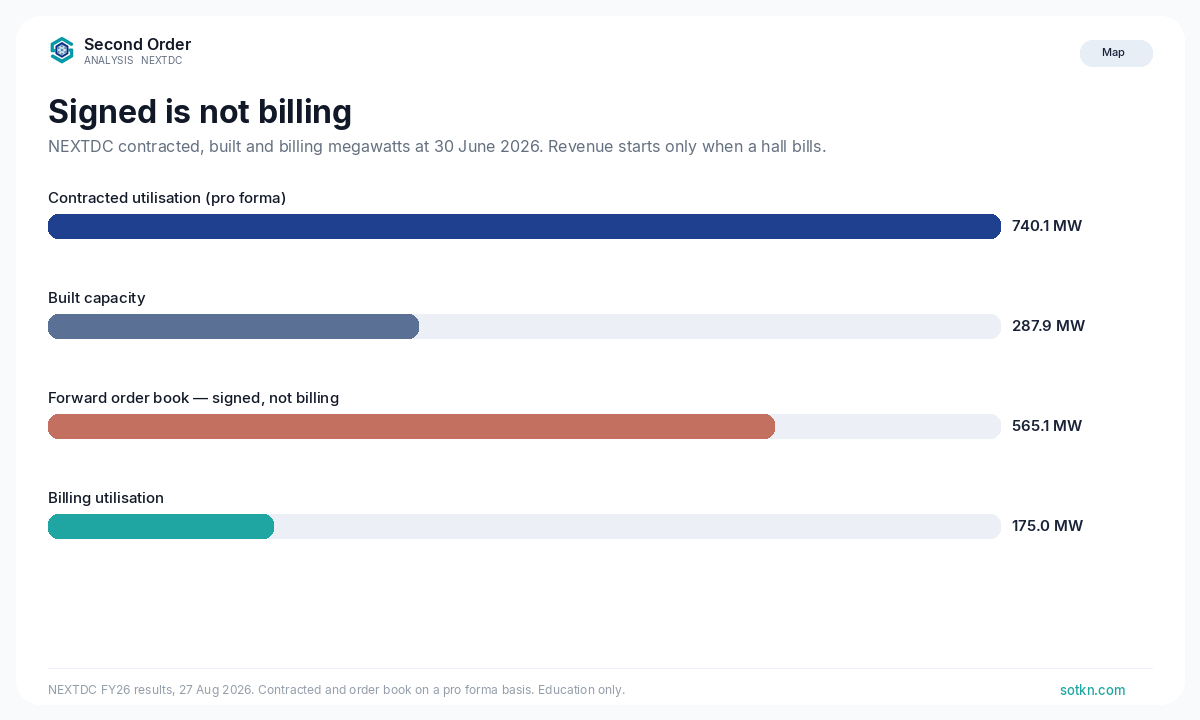
Chart 1 — Contracted, built, signed-not-billing, and billing megawatts at NEXTDC. Sources: NEXTDC FY26 results, 27 August 2026. Education only.
What does ~A$7.12 billion already assume?
Three answers compete:
- Billing arrives late. Well under 197 MW starts billing in FY27, spending stays large, and the next dollar of equity is raised near today's price. Noteholders do not convert. The 2029 put becomes the cash clock
- Billing keeps its clock. 197 MW starts billing in FY27 and 221 MW in FY28. Liquidity covers this year's A$5.5 billion mid-point spend. The book walks toward more than A$1.0 billion of contracted EBITDA
- Billing arrives early and money gets cheaper. Conversion beats the guide, the Reserve Bank is done raising, and the shares move back toward the A$16.695 conversion price on the notes
A tip sheet would pick a side. Analysis asks which answer today's price already needs.
Our read, in one line: the price already assumes Scenario B. At about 28.6 times this year's underlying EBITDA and about 7.1 times the contracted-EBITDA floor, the shares are not a 175 MW landlord. They are a claim on 565 MW billing before the notes can be put back in 2029. Customers are signed. FY27 cash is on the balance sheet. The stuck step is turning the order book into invoices while the cash rate sits at 4.60%. The scenarios and the arithmetic are below.
The free preview ends here.
—— Still to read · ~8 of 13 minutes ——
MEMBERS CONTINUE HERE — who gets paid · one billing megawatt · three scenarios · takeaways · FAQ