
US$1.5 Billion on Hold: Who Gets Paid While Singapore's Data Centre REIT Door Stays Shut
AirTrunk has shelved its US$1.5 billion Singapore data centre REIT listing until early 2027 as rates rise and S-REITs slide. The halls are built and the debt still flows. What is stuck is the listing door: new public equity at a yield buyers will accept.
One of South-east Asia's largest planned listings, a Singapore data centre REIT, is on hold. On 13 October Reuters reported that Blackstone-backed AirTrunk has postponed a Singapore REIT float that could have raised about US$1.5 billion and valued the trust at about US$15 billion. It now aims to list by early 2027. The halls behind it are built and leased, and loans for data centres are still being written. What is stuck is the listing door: new public equity at a yield buyers will accept.
SINGAPORE PULSE · AI DATA CENTERS · Data as at 17 Oct 2026 · Next update: Digital Core REIT unitholder vote, 22 Oct 2026
Affects: AI Data Centers · Hyperscalers · Neoclouds — Markets: Singapore · Malaysia · Australia · US
Education only, not advice to buy or sell any security. Figures are as stated by the companies or reported. A delay reported by people familiar with the plan is not a company announcement. Our own sums are labelled.
The numbers that matter this week
AirTrunk Singapore REIT raise
~US$1.5B
On hold · aim to list by early 2027
Stuck stepPlanned REIT value
~US$15B
One of South-east Asia's largest listings
ReportedYield considered
~6%
Up from 5.5% to win buyers
ReportedSingapore REIT index
−12%
Since late July (Bloomberg)
ReportedAsian DC M&A this year
US$21.3B
Record · vs US$10B in all of 2025 (Dealogic)
MovingAsian DC equity raised
US$5.4B
Down 4.6% · loans and bonds US$22.3B
ReportedFigures from Reuters as carried by The Business Times and The Straits Times on 13 and 16 October 2026, and Bloomberg as carried by The Star on 14 October 2026. Status chips are Second Order’s read.
On this page: Why it matters · What changed · Why the door shut · Where money still moves · Listed landlords · Our math · Who gets paid · What is stuck? · Dates next · What would change this · FAQ
Why does one delayed float matter to who gets paid in AI halls?
Because a REIT listing is how a data centre builder gets its money back. A company like AirTrunk spends years and billions building halls, signs long leases with cloud and AI tenants, and then sells part of the finished, rent-paying buildings to public investors through a trust. That sale returns cash to the owner, which can then fund the next campus. The Singapore Exchange has become the main door for that trade in Asia: it already hosts Keppel DC REIT, Digital Core REIT and NTT DC REIT, and AirTrunk's trust would have been the biggest of them.
When that door shuts, nothing breaks inside the halls. Tenants keep paying rent, servers keep running and the power bill still gets paid. What changes is the speed at which money circles back to the builder. The question for this Pulse is not whether AI demand in Asia is real. It is who gets paid while public investors ask for a higher payout before they will buy.
This is a different stuck step from the ones we have mapped in Singapore so far. On 9 October our data centre licence Pulse followed power and the new licence law, the rationing of new halls. On 11 October our Keppel DC REIT Tokyo Pulse followed one landlord buying full halls abroad. This Pulse is about the capital step that sits after the hall is built: who will buy a slice of it, and at what yield.
For what these buildings are, see what an AI data center is. For the layer this sits in, see our AI Data Centers stack page.
1 · Listed equity binds
Who: New S-REIT float for AI halls
Paid: AirTrunk ~US$1.5B on hold · yield ask up
2 · Rent keeps arriving
Who: Owners of full, leased halls
Paid: Tenants pay whether or not a float happens
3 · Debt and private deals move
Who: Banks, bond buyers, private funds
Paid: US$22.3B loans and bonds · US$21.3B M&A
4 · Recycling waits
Who: Sponsors planning a public exit
Paid: Cash for the next campus comes later or costs more
What changed between 13 and 16 October?
Four reports in four days drew the same picture. The first said the float was off for now. The next three explained why, and showed where the money went instead.
- 13 October — the float is paused. Reuters, citing two people with direct knowledge, said AirTrunk had postponed a planned Singapore REIT listing that could raise about US$1.5 billion. It had been due to launch in September or October. AirTrunk has not decided when to go but aims to complete the listing by early next year. The trust was expected to be valued at about US$15 billion, which would have made it one of South-east Asia's largest listings. The Wall Street Journal first reported the delay. The same day Asian shares slid to more than two-month lows, led by chipmakers.
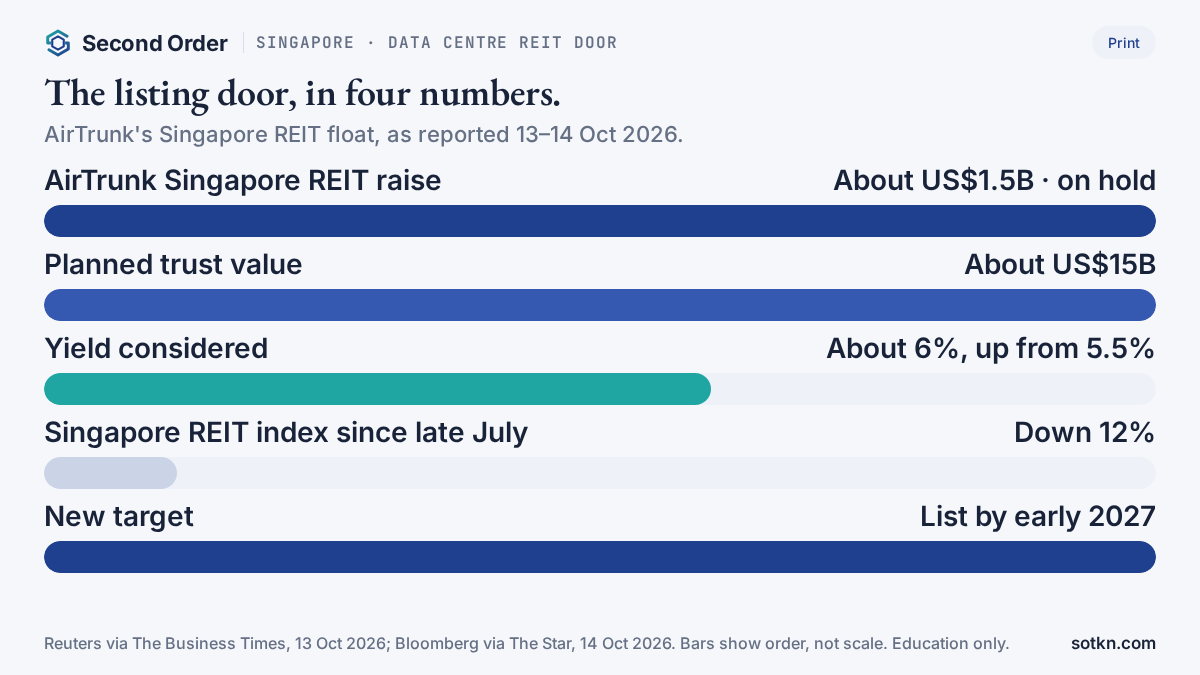
- 14 October — the price of the deal had already moved. Bloomberg, carried by The Star, said AirTrunk had planned to start gauging investor demand at the start of October. To sweeten the deal it had considered a yield of roughly 6%, up from a previously planned 5.5%. Even so, the September US rate rise and the chance of more kept buyers cautious. The data centre arm of a Philippine telecoms group had also pushed its own REIT float into next year. Singapore's main REIT index had fallen 12% since late July.
- 15 October — the rate backdrop. The Business Times tied the pause to the US Federal Reserve's 25 basis point rise on 16 September, to a range of 3.75% to 4%. Analysts told the paper that dividend-paying data centre REITs feel this twice: buyers can get more from bonds, and the REIT must refinance its own debt at higher rates. The iEdge S-REIT Index was down 12% for the year. The paper also noted that Firmus had withdrawn its Australian float in October.
- 16 October — private money still flows. Reuters, carried by The Business Times, said mergers and acquisitions of Asian data centres had reached a record US$21.3 billion by 13 October, more than double the US$10 billion of all 2025, according to Dealogic. Syndicated loans and bonds for the sector totalled US$22.3 billion. Equity raised was US$5.4 billion, down 4.6% on a year earlier. The same report said AirTrunk was nearing a sale of its Johor campus to a group including Malaysian pension fund Kwap at about US$1 billion, and that Bain Capital had received final bids for at least 40% of Bridge Data Centres at a value of around US$5 billion. Those parties declined to comment or could not comment.
Put together, the picture is not that money left Asian data centres. It is that one kind of money, new public equity bought for its payout, got dearer, while private buyers and lenders kept writing cheques.
Why did the listing door shut, when the halls are full?
A REIT is a payout machine. Investors buy units for the cash the buildings throw off, after interest and fees. That makes the price of a REIT very sensitive to what safe bonds pay. When bond yields climb, a buyer can get more income without owning a building, so the REIT has to offer more to compete. For a float that has not yet priced, offering more means one of two things: a lower price for the same rent, or a bigger slice of the rent.
That is exactly what the reports describe. AirTrunk had already weighed raising its offered yield to about 6% from 5.5% before pausing. At the same time, listed peers were being repriced in the market: a 12% fall in the Singapore REIT index since late July means existing trusts now trade on higher yields too, which sets the bar a new float has to clear. A sponsor that thinks its halls are worth a 5.5% yield will not happily sell at a price that implies 6% or more, so it waits.
The second squeeze is inside the REIT. A data centre trust borrows to buy its halls. When it rolls those loans at higher rates, more of the rent goes to the bank and less to unitholders. Analysts quoted by The Business Times said REIT dividends would struggle to outpace rising long bond yields. That is why the market is asking for more yield up front, rather than trusting that rent growth will catch up later.
Notice what is missing from the list of reasons: empty halls. Nothing in the reports says AirTrunk's tenants stopped paying or that its campuses are short of customers. On the demand side, the Ministry of Digital Development and Information said on 6 October that industry feedback on availability and prices suggests there is enough compute supply to meet current needs, while it keeps growing local capacity carefully. Singapore is still rationing new halls, not struggling to fill old ones. The door shut on price, not on use.
There is a cross-border pattern too. Australia saw the same shape a week earlier, when Firmus pulled its ASX float, which we followed in our Australia funding Pulse. The Singapore version is quieter: a lease-backed trust of finished buildings, not a growth company, and it still could not get the yield it wanted. That tells you the bind is the cost of public equity itself, not only doubts about one company's plan.
Where is AI data centre money still moving?
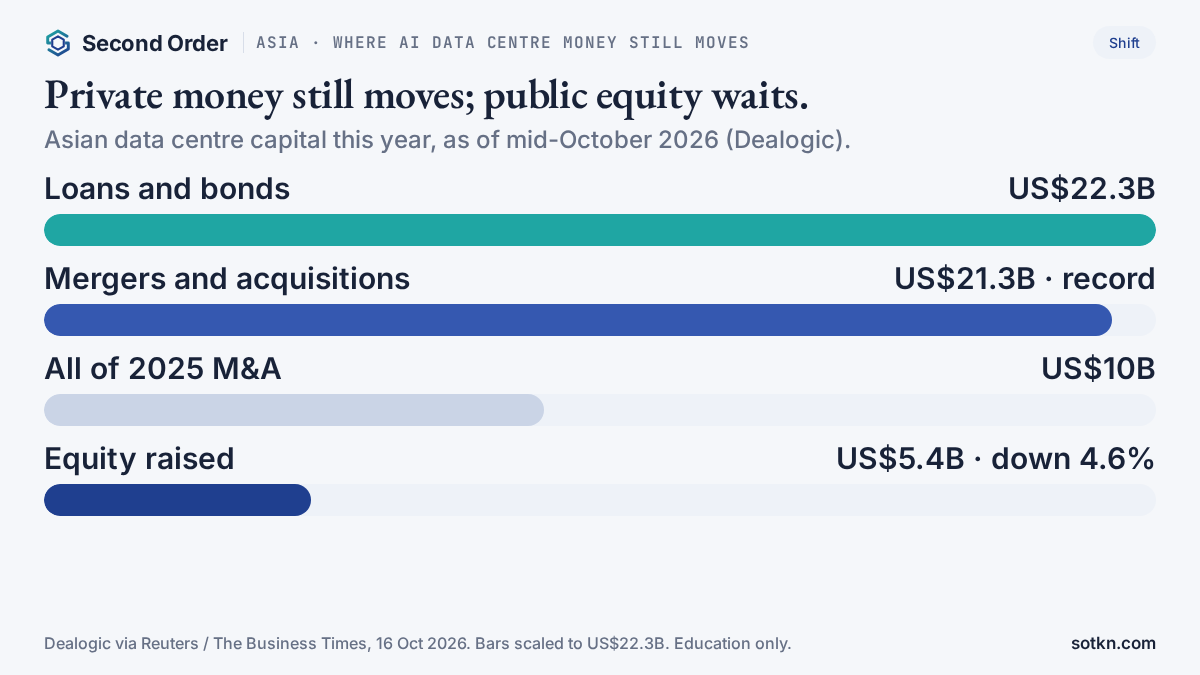
Through private deals and debt. The Dealogic figures quoted by Reuters are the clearest sign. Mergers and acquisitions involving Asian data centres reached US$21.3 billion by 13 October, a record and more than double the whole of 2025. Loans and bonds reached US$22.3 billion. Public equity, the money AirTrunk wanted from a float, was the one line that went backwards, at US$5.4 billion and down 4.6%.
What moved (Dealogic, to 13 Oct)
What paused or was pulled
The private side of the same sponsor shows the split clearly. While its Singapore float waits, AirTrunk is reported to be nearing a sale of its Johor data centre to a group including Kwap at a valuation of about US$1 billion. That is still capital recycling. It just goes through a negotiated sale to a pension fund rather than through thousands of public buyers. Bain Capital's sale process for at least 40% of Bridge Data Centres, at a value of around US$5 billion, is the same move in a different company.
Debt is doing the heavy lifting on the build side. Across the causeway in Johor, new halls are being financed by banks: our Malaysia DayOne Pulse followed seven lenders doubling Singapore-headquartered DayOne's loans to RM30 billion on 13 October. DayOne itself is going for a Nasdaq listing rather than Singapore; The Business Times reported that its first-half revenue more than tripled to US$512 million while its net loss widened to US$81.9 million, and that a later Singapore listing has not been ruled out.
Investors are not leaving the sector so much as sorting it. A partner at Freshfields told Reuters the talk had moved from growth at any cost to quality, and a TechInsights analyst said investors would separate wholesale operators with long customer contracts from riskier neoclouds and AI campus builders. A finished, leased Singapore hall is near the safe end of that line. It still could not clear the public market's new price.
What does the shut door mean for Singapore's listed landlords?
The three data centre REITs already on the Singapore Exchange are on the other side of the same trade. They own full halls that pay rent, but their unit prices sit inside the same 12% slide, and their next purchases have to be paid for with dearer money. Three recent filings show how each is handling it.
Digital Core REIT votes on 22 October on a deal that swaps North American halls for Asian ones, including 2.5% of Digital Loyang 2 in Singapore, known as SIN12. In its answers to unitholders, summarised on 16 October, the manager said that hall carries an agreed property value of about S$3.5 billion, about 44% more than the REIT's whole current portfolio, and that valuers used stabilised cap rates of 5.0% to 5.25%. A 100 basis point rise in rates would cut its interest cover from 3.2 times to 2.5 times; 70% of debt was hedged at the end of June at an average cost of 3.6%. It also confirmed it would sell a Toronto hall for US$141 million, against the US$203 million it paid at its listing, blaming higher rates and valuation yields among other things. We looked at what its unit price assumes in our Digital Core REIT Analysis.
NTT DC REIT, listed in July 2025, went the other way on 8 October: it proposed tying its manager's performance fee to growth in distribution per unit. No fee would be paid if DPU growth is 3% or less; above that, the fee would be 0.1% of the trust's property each year, rising to 0.2% when growth is at least 5%. The manager would also waive the fee for its 2026/27 year if DPU comes in under US$0.078. That is a REIT telling unitholders it knows the payout is what the market now prices.
Keppel DC REIT finished its Tokyo purchase before the window narrowed, using a placement of new units and yen debt; we covered the deal in our Keppel DC REIT Tokyo Pulse. Raising equity for the next deal of that size would now be tested against the same higher yields.
The common thread: the halls are fine, the rent is fine, but every listed landlord is now being judged on the spread between what its buildings yield and what its money costs. That spread is exactly what stopped the AirTrunk float.
Our math: what do the numbers say?
- Yield step: moving the offered yield from 5.5% to 6% on a trust valued at about US$15 billion is either about US$75 million a year more payout for the same price, or a price about 8% lower for the same payout, roughly US$1.25 billion off the value (our arithmetic on the reported figures; illustrative, not the actual terms).
- Float as a slice: a US$1.5 billion raise on a US$15 billion trust is about 10% of the value, so the sponsor was planning to sell a small slice, not the whole (our arithmetic).
- Deals vs equity: US$21.3 billion of M&A is about four times the US$5.4 billion of equity raised this year, and loans and bonds at US$22.3 billion are about the same multiple (our arithmetic on Dealogic figures).
- Record pace: US$21.3 billion by mid-October against US$10 billion for all of 2025 is about 2.1 times last year's total with two and a half months left (our arithmetic).
- Rent at SIN12: a property value of about S$3.5 billion at cap rates of 5.0% to 5.25% implies net property income of roughly S$175 million to S$184 million a year for the hall (our arithmetic on the disclosed figures).
- Rate sensitivity: Digital Core REIT's interest cover falling from 3.2 to 2.5 times on a 100 basis point move is a drop of about 22% in the cushion between rent and interest (our arithmetic).
- Listed vs private repricing: the Toronto hall's US$141 million agreed value against US$203 million at listing is about 30% lower (our arithmetic; the manager cites rates, currency, a softer market and a customer bankruptcy).
- Scarcity: Cushman & Wakefield's 232 MW in development plus 200 MW allocated is about 40% on top of roughly 1,068 MW operational in Singapore, all of it rationed by permit (our arithmetic on reported figures).
What this tells you: there is no shortage of buyers for Asian data centres at a private price, and no shortage of lenders. The shortage is public buyers willing to accept the yield a sponsor wants for a fresh Singapore trust. That gap, which AirTrunk had already tried to bridge with a half-point higher yield before pausing, is the stuck step.
Who gets paid first?
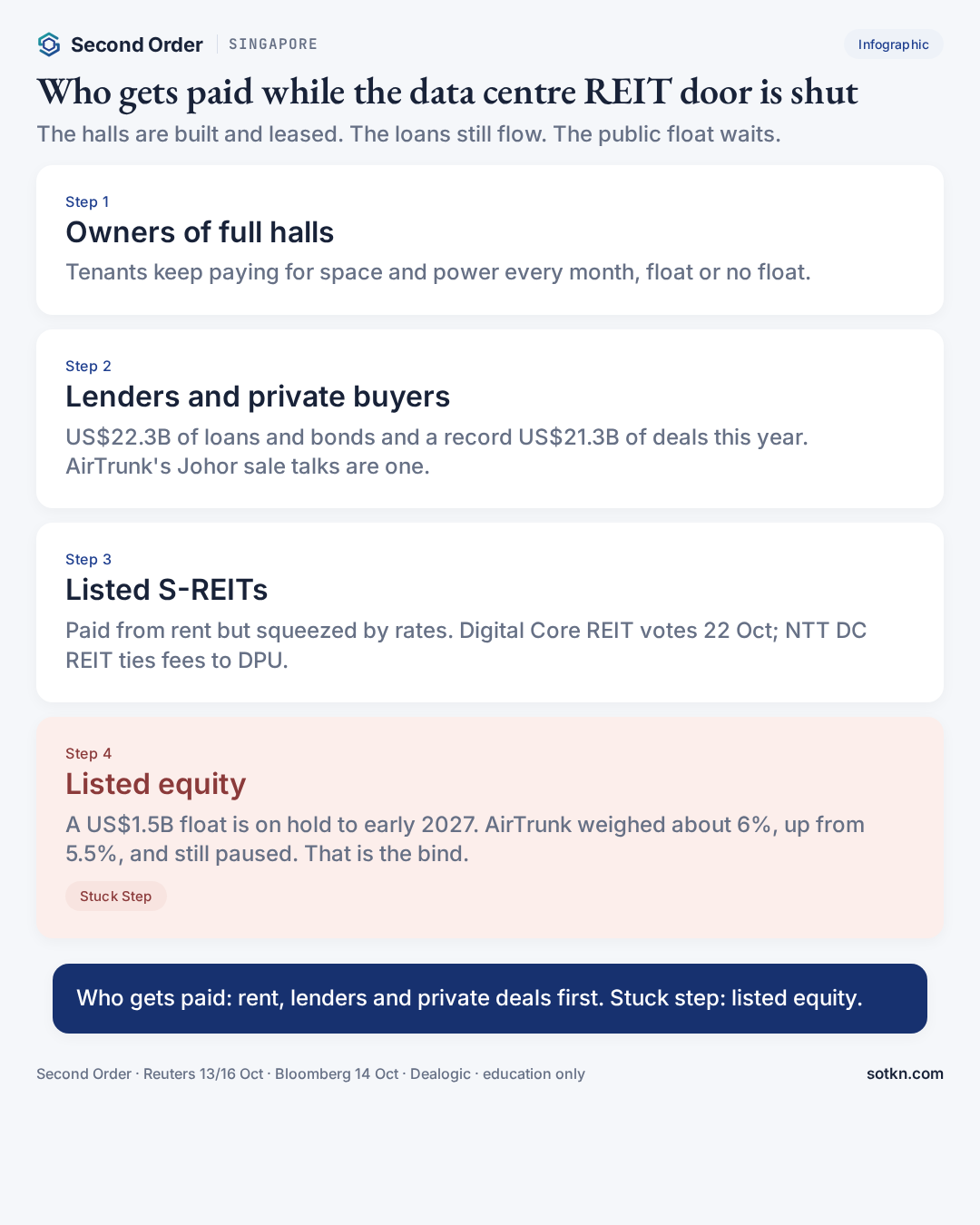
First, the owners of full, leased halls — every month, through rent. Tenants in Singapore pay for space and power whether or not their landlord lists. That income is why the halls are worth floating in the first place, and it does not pause because the float did.
Second, the lenders and bond buyers — as loans are drawn. With US$22.3 billion of loans and bonds written for the sector this year, banks earn fees and interest now. Higher rates make that debt more profitable for them, even as it squeezes the REITs that borrow it.
Third, the sellers and buyers in private deals — when they close. A record US$21.3 billion of M&A means sponsors are recycling capital through negotiated sales, like the Johor campus sale AirTrunk is reported to be near. Pension funds and private equity get assets at a negotiated price; the seller gets cash without waiting for the public market.
Fourth, the unitholders of the listed REITs — through distributions, but squeezed. They collect DPU from real rent, yet higher refinancing costs take a bigger share. Managers are responding with buybacks, asset swaps and fee changes tied to DPU, which tells you where the pressure sits.
Fifth, the sponsors waiting on a float — later, or for less. AirTrunk and its owner Blackstone keep the halls and the rent, but the cash they planned to pull out through Singapore now waits until 2027 or comes at a higher yield. For why idle money, like idle compute, earns nothing, see GPU utilization, explained. For the wider pattern of cash sticking at the stuck step, see where the stuck step moves.
One-line rule: in Singapore's data centre capital chain right now, hall owners, lenders and private dealmakers are paid as rent, loans and sales move, listed landlords are paid but squeezed, and sponsors who need a public float wait. The stuck step is listed equity.
So what is the stuck step?
Listed equity — the yield public investors demand before they will buy into a new data centre trust. Not power: Singapore still rations that, but it did not stop this float. Not tenants: the halls are leased. Not debt: loans are being written at record pace. Three things make this step stick:
- Rates: the US rise on 16 September to 3.75% to 4% lifted what safe bonds pay, and the chance of more rises keeps REIT buyers cautious.
- Repricing of peers: Singapore's REIT index fell 12% since late July, so a new trust has to clear the higher yields existing ones now trade on.
- Clock: AirTrunk now aims for early 2027, and no date is set; a Philippine data centre REIT also moved to next year.
So-what: whoever already owns full Singapore halls keeps collecting rent, and whoever lends against them or buys them privately gets paid now. Whoever needs public equity to fund the next campus pays more for it or waits. In AI data centres, the step that sets the pace is not always power or chips. This week in Singapore it is the price of the listing door.
Which dates test this read next?
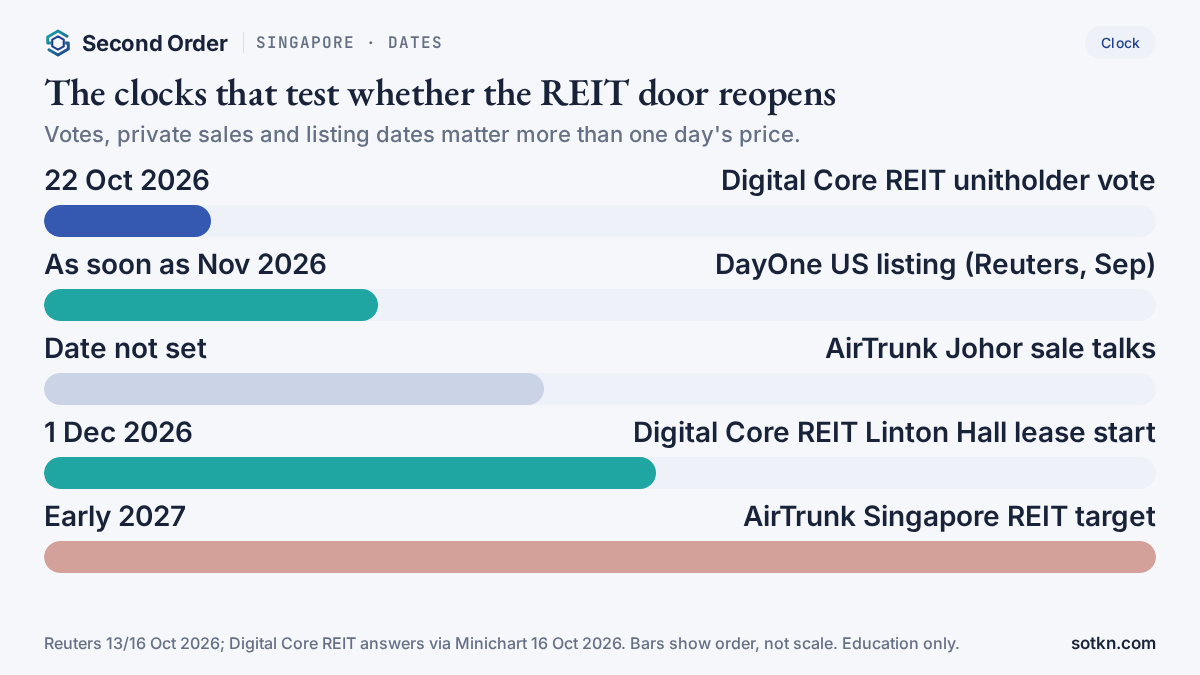
- 22 October 2026, 9.30am Singapore time — Digital Core REIT unitholder vote on its Singapore and Osaka swap. The test: whether unitholders back a sponsor deal priced at 5.0% to 5.25% cap rates while the market asks for more.
- As soon as November 2026 — DayOne's planned US listing, as reported by Reuters in September. The test: whether a Singapore-based data centre builder can raise public equity at all this year, and at what value.
- Not set — AirTrunk's Johor campus sale to a group including Kwap. The test: whether private buyers keep paying around US$1 billion-type prices while the public float waits.
- 1 December 2026 — Digital Core REIT's Northern Virginia Linton Hall lease start. The test: whether new rent lands on time to support the payout.
- Early 2027 — AirTrunk's target to complete its Singapore REIT listing. The test: whether rates and REIT prices have moved enough to reopen the door near 5.5%, or only at 6% and above.
The vote and the private sale test whether money keeps moving outside the public market. The 2027 date tests whether the public door reopens at all on the sponsor's terms.
What would change this view?
- US and Singapore bond yields fall back and the S-REIT index recovers its 12% — the yield gap closes and the float could relaunch sooner than 2027.
- AirTrunk relaunches at about 6% and the book fills quickly — the door was never shut, just repriced, and the sponsor accepts the lower value.
- Private deals start to fail or reprice, such as the Johor sale or the Bridge Data Centres stake — the bind would move from public equity to all equity.
- Tenants in Singapore halls start to cut or delay leases — demand, not the cost of money, would become the story.
Practical takeaways
- Reuters (13 Oct): AirTrunk has put a Singapore REIT float of about US$1.5 billion, valuing the trust at about US$15 billion, on hold until early 2027
- Bloomberg (14 Oct): AirTrunk had weighed a yield of about 6%, up from 5.5%; Singapore's main REIT index is down 12% since late July
- Dealogic via Reuters (16 Oct): Asian data centre M&A a record US$21.3 billion; loans and bonds US$22.3 billion; equity down 4.6% to US$5.4 billion
- Listed landlords are paid from rent but squeezed by rates: Digital Core REIT votes 22 Oct; NTT DC REIT ties fees to DPU growth
- Hall owners, lenders and private buyers are paid now; sponsors relying on a public float wait
- Stuck step: listed equity — the yield public buyers demand
FAQ
What did AirTrunk actually delay?
A planned listing of a real estate investment trust (REIT) on the Singapore Exchange that would hold some of its data centres. Reuters said on 13 October that the float could have raised about US$1.5 billion and valued the REIT at about US$15 billion. It had been meant to launch in September or October. The company now aims to list by early 2027, one source said. AirTrunk did not comment and Blackstone declined to comment.
Why would higher interest rates stop a data centre REIT?
A REIT is bought mostly for its payout. When safe bond yields rise, buyers want a higher payout from the REIT too, which means a lower price for the same rent. Bloomberg reported that AirTrunk had looked at offering a yield of about 6%, up from 5.5%. Higher rates also raise the REIT's own borrowing costs, which eats into what is left to pay out.
Does this mean Singapore has too many data centres?
No. The government said on 6 October that industry feedback points to enough compute supply for today's needs, and Singapore still rations new power for halls: about 200 MW was handed out this year against roughly 1,068 MW already running, according to Cushman & Wakefield. The halls are scarce. What got harder is selling a slice of them to public investors at the price the owner wants.
Who still gets paid while the listing waits?
Banks and bond buyers, because data centre loans and bonds are still being written. Sellers in private deals, because Asian data centre M&A is at a record. Owners of full, leased halls, because tenants keep paying rent. The party that waits is the sponsor that wanted to recycle cash through a public float.
Is this investment advice?
No. Education only. It maps who gets paid and which step is stuck. It is not a recommendation to buy or sell any security, and we leave out broker ratings and price targets on purpose.
Keep reading on the map
- Singapore Markets hub — country page
- Singapore data centre licence Pulse — power, permits and 200 MW
- Keppel DC REIT Tokyo Pulse — a landlord buying full halls
- Digital Core REIT Analysis — what the unit price assumes
- Malaysia DayOne Pulse — debt and the substation clock
- Australia funding Pulse — when the money to build got dearer
- AI Data Centers on the stack · Hyperscalers
- All Markets doors — Taiwan, Korea, US, China, Singapore, Australia, Malaysia
How we check this. The AirTrunk delay, the size of the planned raise and the value of the REIT come from Reuters as carried by The Business Times and The Straits Times on 13 October 2026, which relied on two people with direct knowledge; AirTrunk did not comment and Blackstone declined to comment. The yield the float had considered and the 12% REIT index fall since late July come from Bloomberg as carried by The Star on 14 October. Deal, loan and equity totals for Asian data centres are Dealogic figures quoted by Reuters on 16 October. Digital Core REIT figures come from its pre-meeting answers to unitholders as summarised on 16 October; NTT DC REIT figures from its 8 October proposal. Singapore capacity figures are Cushman & Wakefield's as reported on 16 October. Broker ratings and price targets are left out on purpose. Anything we worked out ourselves is labelled “our arithmetic”. A source-based report of a delay is not a company announcement, and we say so. The references we used are listed at the end. Our editorial standards →
Not investment advice. Do your own research.
References
- The Business Times (Reuters), Blackstone-backed AirTrunk delays Singapore Reit IPO amid AI stock sell-off, 13 Oct 2026. businesstimes.com.sg — about US$1.5 billion raise, about US$15 billion value, September or October launch put on hold, aim to list by early 2027.
- The Star (Bloomberg), AirTrunk puts Singapore REIT listing on hold amid volatility, 14 Oct 2026. thestar.com.my — yield of about 6% considered, up from 5.5%; Singapore's main REIT index down 12% since late July; PLDT unit defers its REIT.
- The Business Times, Why tech and data centre IPOs are facing delays now, 15 Oct 2026. businesstimes.com.sg — Fed rise on 16 Sep to 3.75-4%; iEdge S-REIT Index down 12% year to date; DayOne first-half figures.
- The Business Times (Reuters), Market sell-off, rising rates test AI data centre deal boom, 16 Oct 2026. businesstimes.com.sg — Dealogic: Asian data centre M&A US$21.3 billion, loans and bonds US$22.3 billion, equity US$5.4 billion; AirTrunk Johor sale talks.
- Minichart, Digital Core REIT pre-EGM Q&A, 16 Oct 2026. minichart.com.sg — SIN12 property value about S$3.5 billion at 5.0-5.25% cap rates; interest cover 3.2x to 2.5x on 100 bp; 22 Oct vote.
- The Business Times, NTT DC Reit proposes DPU-linked performance fee for manager, 8 Oct 2026. businesstimes.com.sg — no performance fee at 3% DPU growth or less; 0.1% and 0.2% tiers.
- The Jakarta Post, Southeast Asia's AI boom tests data center sustainability, 16 Oct 2026. thejakartapost.com — Cushman & Wakefield: Singapore about 1,068 MW operational, 232 MW in development, 200 MW allocated.
- Ministry of Digital Development and Information, reply to PQ on AI computing resources, 6 Oct 2026. mddi.gov.sg — industry feedback suggests sufficient compute supply for current needs.