
30% Below Market: Who Gets Paid on Keppel DC REIT's Tokyo Data Centre Buy
Keppel DC REIT has completed its purchase of two full, powered data centres in Inzai, Greater Tokyo, for about S$1.37 billion. Rents are estimated at least 30% under market. Sellers and tenants are paid first; unitholders wait on lease dates in a grid that is full.
Keppel DC REIT now owns most of two full Tokyo data centres. The halls are already powered, already let, and rented at least 30% below today's market. That gap is the prize, and it pays out on lease dates, not on the deal date.
SINGAPORE PULSE · AI DATA CENTERS · Data as at 11 Oct 2026 · Next update: Keppel DC REIT's next quarterly business update
Affects: AI Data Centers · Keppel DC REIT — Markets: Singapore · Malaysia · Australia
Education only, not advice to buy or sell any security. Figures are as reported by the company; pro forma numbers are illustrations, not forecasts. Our own sums are labelled.
The numbers that matter this week
Keppel DC REIT's share of the price
S$1.37B
JPY 168.4B for 88.62%
PrimaryPrice vs independent valuation
−2.1%
JPY 190.0B vs JPY 194.0B, 100% basis
PrimaryIn-place rents vs market
30%+ below
The REIT's own estimate
PrimaryPro forma DPU change
+2.6%
FY2025 illustration, 10.381 to 10.649 cents
PrimaryJapan share of rental income
9% → 23%
Singapore stays about 60%
PrimaryInzai power
Tight to 2030
New halls are hard to add
Stuck stepFigures from Keppel DC REIT's 1 September 2026 announcement and related SGX filings. Status chips are Second Order’s read.
On this page: Why a Singapore Pulse? · What was bought · How it was paid for · The rent gap · Our math · Who gets paid · What is stuck? · Dates next · What would change this · FAQ
Why is a Tokyo deal a Singapore Pulse?
Because the buyer, the money and most of the income are Singaporean. Keppel DC REIT is listed on the Singapore Exchange, raised the equity for this deal from investors in Singapore and abroad, and will still earn about 60% of its rental income from Singapore after the purchase, Keppel said on 1 September. For how the REIT makes money in the first place, see what Keppel DC REIT does. In the first half of 2026 its DPU rose 11.3% to 5.714 cents, about 95% of its power capacity was earning revenue, and leverage was 34.0%, Keppel said on 23 July.
There is a second reason. Singapore itself rations new data centre power, which we covered in the Singapore data centre licence Pulse. A landlord whose home market adds capacity slowly has to grow somewhere else. Japan is the largest data centre market in Asia Pacific outside China, the REIT's filing says, citing Cushman & Wakefield. And Greater Tokyo has the same problem Singapore has: not enough power to build new halls quickly.
So this deal is a clean example of a pattern across Asia. When the grid is the limit, the cheapest way to own AI-era data centre capacity is often to buy halls that are already plugged in, rather than wait years to build new ones.
1 · Cloud and AI tenants need halls
Who: Internet companies, IT services firms
Paid: Four investment-grade clients fill both buildings
2 · Inzai's grid is tight
Who: Power supply toward 2030
Paid: New halls are slow and hard to add
3 · Existing powered halls change hands
Who: Sellers, Keppel DC REIT, lenders
Paid: JPY 190.0B for 100%, 2.1% under valuation
4 · Rents move to market slowly
Who: Unitholders
Paid: Only at renewal; leases run years
What exactly did Keppel DC REIT buy?
Two five-storey, freehold data centres in Inzai City, east of central Tokyo in Chiba prefecture, one of Japan's most established hyperscale clusters. Tokyo Data Centre 4 was completed in 2021 and Tokyo Data Centre 5 in 2024. Both are fully fitted colocation halls, which means the landlord provides the power, cooling and fit-out, and the clients rent space and power inside.
- Size. About 163,294 square feet of net lettable area combined: 62,134 in Tokyo Data Centre 4 and 101,160 in Tokyo Data Centre 5.
- Occupancy. 100%. Four investment-grade internet and IT services clients, three in one building and two in the other, with one client in both.
- Leases. About 4.5 years left on average at Tokyo Data Centre 4 and about 10.6 years at Tokyo Data Centre 5, or about 8.3 years blended, by lettable area at 30 June 2026.
- Rent rises. Contracted at about 2.8% a year on average.
- Ownership. Keppel DC REIT holds 88.62%, its sponsor Keppel holds 1.38% through Keppel Japan, and the existing operator, described as an established global data centre owner and operator, keeps 10% and keeps running the halls.
The deal was announced on 1 September. The price for 100% of the two halls was JPY 190.0 billion, about S$1.55 billion, against an independent valuation by JLL of JPY 194.0 billion. Keppel DC REIT's share came to JPY 168.4 billion, about S$1.37 billion, and its total outlay including costs and the manager's fee was about JPY 170.7 billion, or S$1.39 billion.
Completion depended on Japan's foreign investment review, with a long-stop date of 1 November 2026, after which the agreement would have lapsed. It did not come to that. In an SGX filing reported by Singapore Business Review on 2 October, the REIT said the placement money had been fully used for the purchase as at 1 October, and its own milestones page now lists the acquisition as completed in October 2026.
How was it paid for?
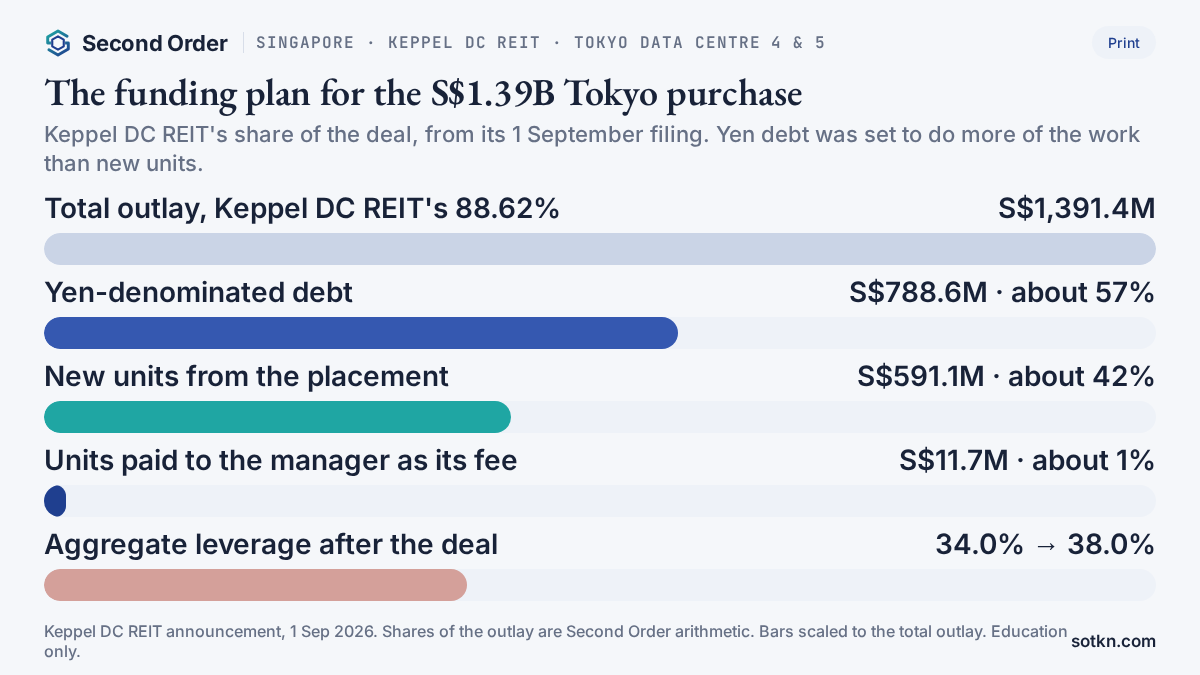
Mostly with yen borrowing. The 1 September plan set out about S$788.6 million of debt, about S$591.1 million from new units sold in a private placement, and about S$11.7 million paid to the manager in new units as its acquisition fee. That is roughly 57% debt and 43% equity.
The placement went well. On 2 September the REIT raised about S$625 million, up from a target of S$600 million, selling 297.62 million new units at S$2.10 each. It was about 3.4 times covered after the upsizing. Of that, about S$617.5 million ended up in the purchase, the 2 October filing said.
Borrowing in yen does two jobs. Japanese interest rates are low by Singapore standards, and yen debt against yen rents means the income and the interest move together when the currency moves. The REIT said the acquisition loans would be fully hedged before completion, and that its average cost of debt was 2.7% for the first half of 2026 on a pro forma basis.
The cost is a heavier balance sheet. Aggregate leverage, the REIT's debt measure, rises from 34.0% at 30 June to about 38.0% pro forma, or 39.0% if you count a short-term loan for about JPY 15.3 billion of Japanese consumption tax that should be refunded within nine months of completion.
The deal
The funding
Why are the rents 30% below market?
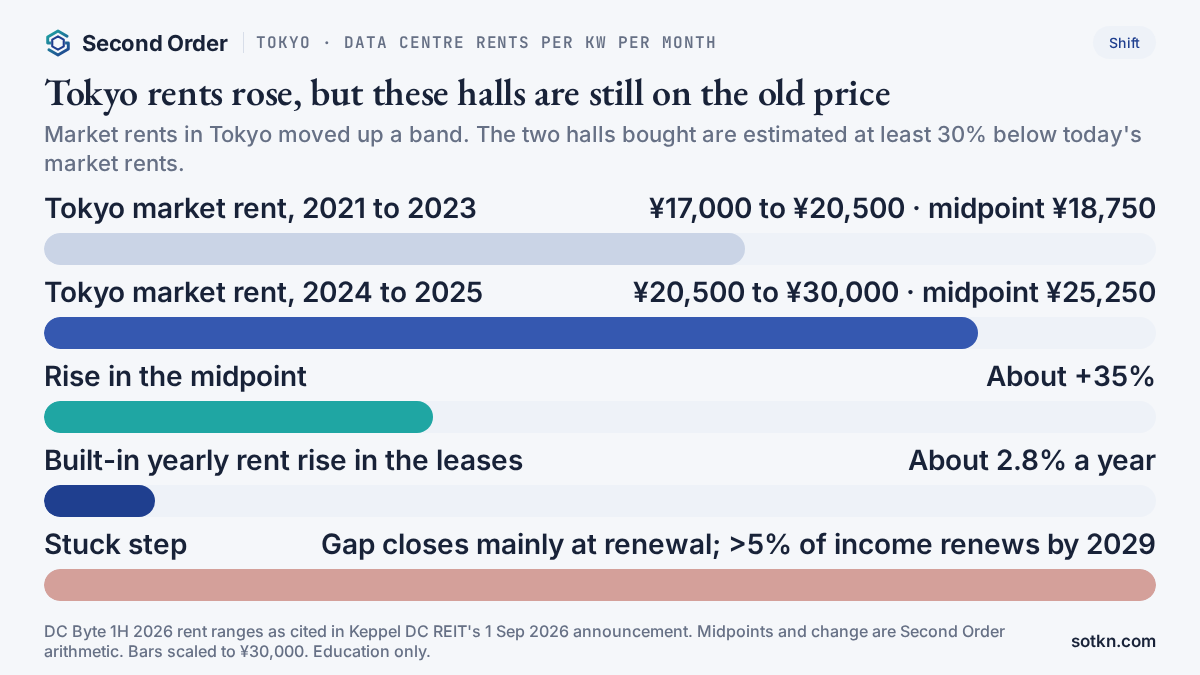
Because Tokyo data centre rents went up after these leases were signed. Keppel DC REIT's filing cites the research firm DC Byte: Tokyo rents were JPY 17,000 to 20,500 per kW per month during 2021 to 2023, and JPY 20,500 to 30,000 during 2024 to 2025. Data centre rent is priced per kilowatt of power a client reserves, not per square foot, which tells you what is actually scarce.
On that basis the REIT estimates the two halls are rented at least 30% below today's market. More than 5% of their contracted income comes up for renewal by 2029. Those renewals are where the gap can start to close.
Why did rents rise? The filing is direct about it: demand is outpacing supply in Greater Tokyo because of “power constraints, construction bottlenecks and land scarcity”. On Inzai specifically, it says the city is expected to face power supply constraints toward 2030 despite planned substation work, citing JLL. It is the same squeeze we have mapped in Malaysia's plugged-in halls, the New South Wales power condition and Texas's large-load rule.
This is the core of the deal. Keppel DC REIT is not buying growth from new buildings. It is buying halls whose power is already connected, in a place where adding more power is slow, at a price below their valuation, with rents that have room to rise. The power constraint is what protects the value. It is also what stops anyone, including Keppel, from simply building more next door.
Our math: how big is the gap, and how long to close it?
- Tokyo rent midpoints rose from about JPY 18,750 to about JPY 25,250 per kW per month, roughly 35% (our arithmetic, from the cited ranges). The top of the range rose about 46%.
- If in-place rents are 30% below market, market rent is about 1.43 times the current rent (our arithmetic: 1 divided by 0.7).
- At the contracted 2.8% a year, rents alone would take about 13 years to rise 43%, if market rents stood still (our arithmetic). Escalators do not close this gap. Renewals do.
- The pro forma lift in distributable income is about S$36.9 million on a S$1.39 billion outlay, about 2.7% (our arithmetic, FY2025 illustration). The deal works today because the money is cheap, not because the rents are high.
- New units: 297.62 million against about 2.45 billion in issue before the deal, about 12% more units (our arithmetic). Pro forma DPU still rises 2.6%, so income grows faster than the unit count.
- The placement price of S$2.10 sits about 20% above the pro forma net asset value of S$1.75 a unit (our arithmetic). Selling units above book value is part of what makes the sums work for existing holders.
- The halls' income is one slice of a bigger REIT. Japan rises to about 23% of rental income, and the top client's share falls from 43.5% to 38.2%.
What this tells you: the near-term payoff is modest and mostly comes from funding, with yen debt at about 2.7% against the income the halls already earn. The larger payoff, rents moving towards market, is real on the company's own estimate but arrives on a lease schedule.
What it does not tell you: what each tenant pays, which leases expire when, or what market rents will be in 2029. The filing does not give per-client rents or exact expiry dates, and the rent ranges are third-party estimates.
Who gets paid first?
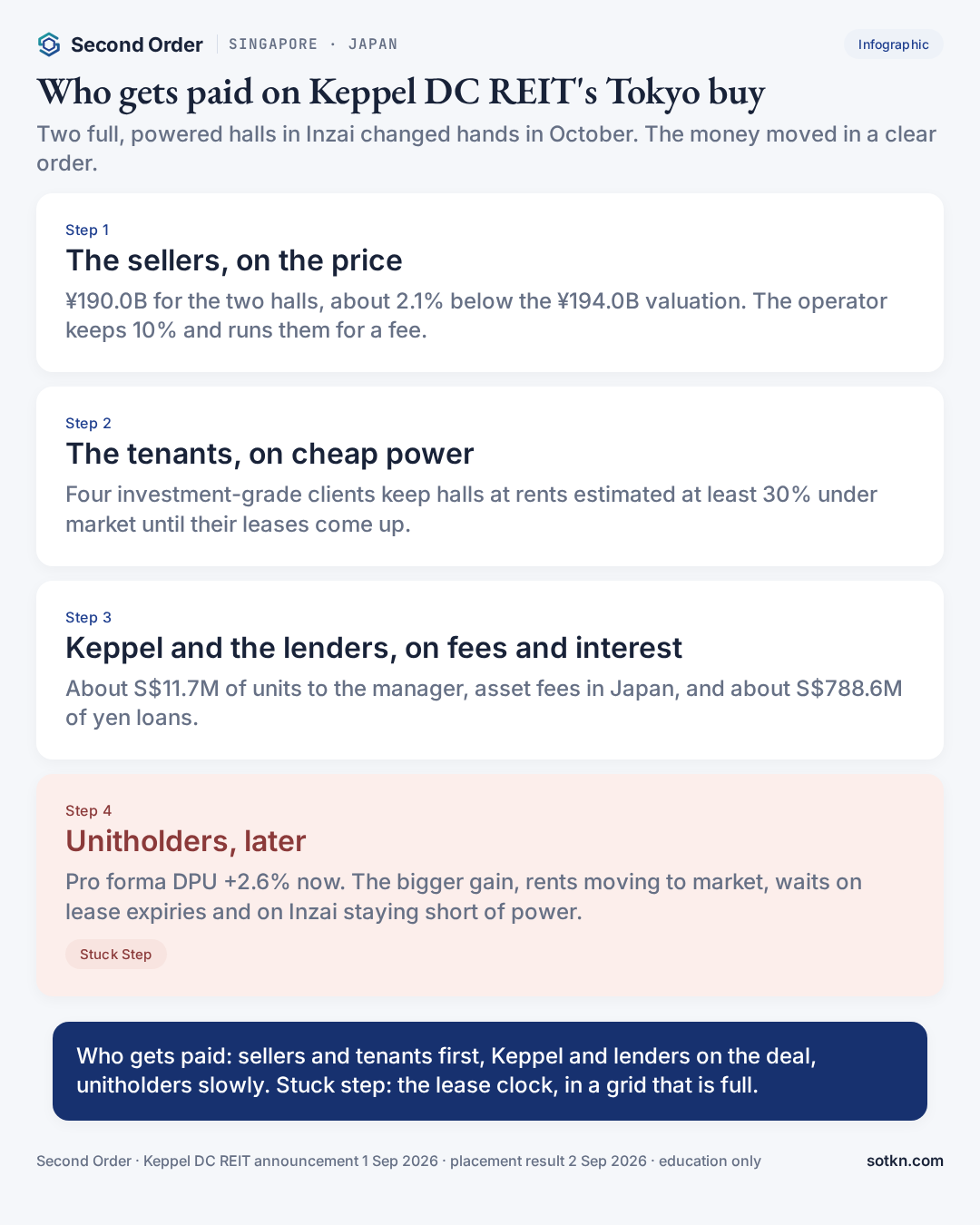
Follow the money from the signing to the rent roll.
First, the sellers — on the price. A global institutional investor and an established data centre operator sold two stabilised halls for JPY 190.0 billion, about 2.1% below their valuation, and were paid at completion. The operator also stays in: it keeps 10% and is paid to run the buildings under a services agreement. Selling most of a full building while keeping the operating role is how builders recycle money into the next project.
Second, the tenants — on cheap power. Four investment-grade clients hold space and power in a market where new power is hard to get, at rents estimated at least 30% below what a new client would pay. They keep that advantage until their leases end. In a full grid, a below-market lease on connected power is worth a lot.
Third, Keppel and the lenders — on the deal itself. The manager receives about S$11.7 million in new units as its 1% acquisition fee. Keppel Japan, as asset manager in Japan, earns its own fees. Assets under management rise from S$6.3 billion to about S$7.6 billion across 27 data centres in 10 countries, and management fees scale with that. The banks earn interest on about S$788.6 million of yen loans, and the placement banks earned their fees in September. For how other landlords make the same trade, see what Digital Realty does and what Equinix does.
Fourth, the unitholders — slowly. The pro forma DPU lift is 2.6%, from 10.381 to 10.649 Singapore cents on FY2025 numbers. That arrives with the first full periods of ownership. The bigger gain depends on two things that take years: leases coming up for renewal, and Inzai staying short of power so market rents hold.
One-line rule: on Keppel DC REIT's Tokyo buy, the sellers and tenants are paid first, Keppel and the lenders on the deal, and unitholders slowly as leases reset. The stuck step is the lease clock, in a grid that is full.
So what is the stuck step?
The lease clock, set inside a full grid. Not the money, which was raised easily, and not demand, since the halls are full. Three things make it stick:
- Time: Tokyo Data Centre 4 has about 4.5 years of leases left on average, and Tokyo Data Centre 5 about 10.6 years. Only a little over 5% of contracted income renews by 2029.
- Power: Inzai is expected to face power supply constraints toward 2030, the filing says, citing JLL. That supports rents, but it also means no easy expansion on the same campus.
- Money: leverage moves to about 38%. Each further purchase needs new units or more debt, so the next deal depends on the unit price and on interest rates.
So-what: this deal shows where value sits when power is scarce. It sits in connected halls, and whoever owns them collects more as old leases roll off. That is the same logic as NEXTDC's contracted-capacity model in Australia, seen from the landlord who buys rather than builds. For the layer view, see the AI Data Centers stack; for what an AI data centre actually is, see what is an AI data center.
Building is the slower alternative, which is why buying existing halls can make sense. See how long it takes to build an AI data center for why power is the longest clock, and the Korea fab power Pulse for the same limit on chip plants.
Which dates test this read next?
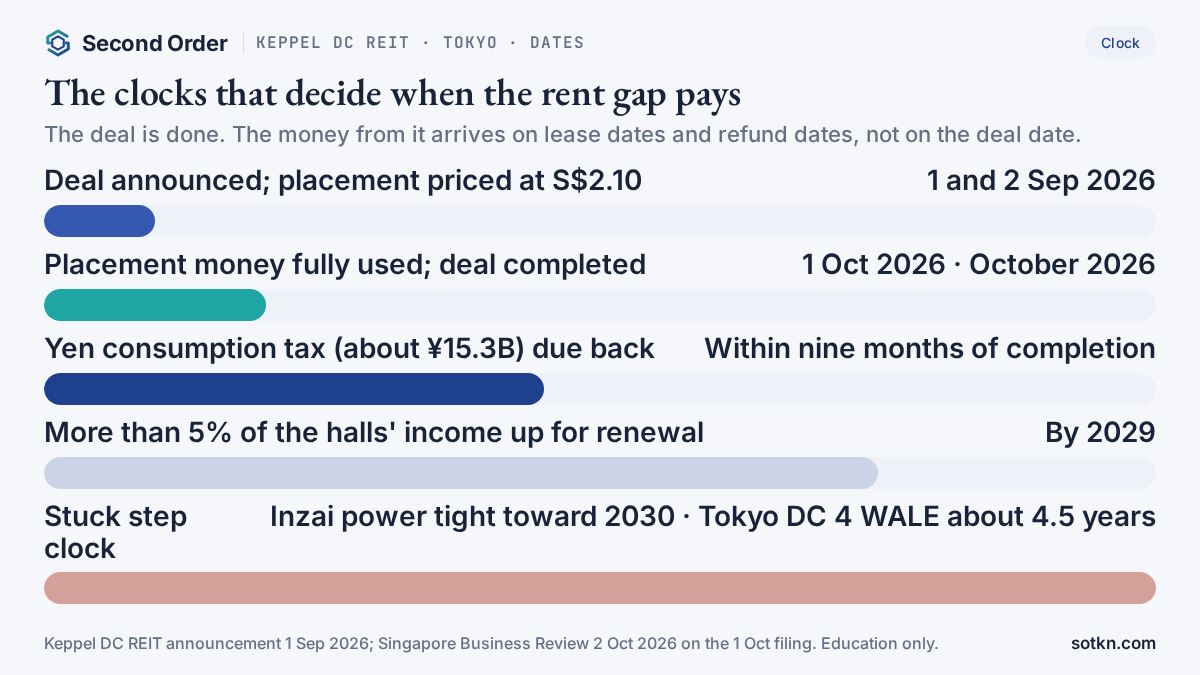
- 1 and 2 Sep 2026 — deal announced and placement priced at S$2.10. Done.
- 1 Oct 2026 — placement money fully used; acquisition completed in October. Done.
- Keppel DC REIT's next quarterly business update — the first figures that include the two halls. The test: occupancy, contracted power and leverage near the pro forma numbers.
- Within nine months of completion — the roughly JPY 15.3 billion consumption tax refund, and repayment of the loan that covered it.
- FY2026 full-year results — the first DPU with part of a year of Tokyo income.
- By 2029 — more than 5% of the halls' contracted income comes up for renewal. The test: do renewals land near market rents?
- Toward 2030 — Inzai's power outlook. New substation capacity would ease the squeeze; delays would tighten it.
The renewal date matters most. That is when the 30% estimate either turns into higher income or turns out to be optimistic.
What would change this view?
- Large new substation capacity arrives in Inzai earlier than expected — more new halls, less pressure on rents, smaller reversion.
- Renewals happen early at market rents — the gap closes faster than the lease schedule suggests.
- A tenant leaves at expiry — the hall needs re-letting, which tests how strong demand really is.
- Japanese interest rates rise sharply — the cheap yen funding that makes the sums work gets dearer once hedges roll off.
- Tokyo rents fall back towards the 2021 to 2023 band — the estimated gap shrinks.
- Keppel DC REIT announces another large purchase funded with new units — a sign the model is buying, not waiting.
Practical takeaways
- Keppel DC REIT completed its 88.62% purchase of Tokyo Data Centre 4 and 5 in Inzai in October 2026, for about S$1.37 billion
- Both halls are full, with rents the REIT estimates are at least 30% below market, and Inzai faces power limits toward 2030
- The deal is about 57% yen debt; leverage rises to about 38%; pro forma DPU rises 2.6%
- Who gets paid first: sellers on the price, tenants on cheap power, Keppel and lenders on fees and interest
- Stuck step: the lease clock, in a grid that is full
FAQ
What did Keppel DC REIT buy in Tokyo?
An 88.62% effective interest in Tokyo Data Centre 4 and Tokyo Data Centre 5, two freehold, fully fitted colocation data centres in Inzai City, Greater Tokyo. The price for 100% was JPY 190.0 billion, about S$1.55 billion; Keppel DC REIT's share was about JPY 168.4 billion, or S$1.37 billion. Both halls are 100% occupied by four investment-grade clients. The REIT lists the purchase as completed in October 2026.
Why are the rents below market?
The leases were signed when Tokyo data centre rents were lower. Keppel DC REIT estimates in-place rents are at least 30% below current market rents, which it cites as rising from JPY 17,000-20,500 per kW per month in 2021 to 2023 to JPY 20,500-30,000 in 2024 to 2025. The gap closes mainly when leases come up for renewal.
Is this a Singapore story or a Japan story?
Both. Keppel DC REIT is listed in Singapore and about 60% of its rental income still comes from Singapore after the deal. Japan's share of rental income rises from about 9% to about 23%. The money was raised in Singapore and spent on Japanese halls with power already connected.
How was the purchase funded?
The 1 September plan was about 57% yen-denominated debt and 43% equity. A private placement raised about S$625 million at S$2.10 a unit on 2 September. Aggregate leverage rises from 34.0% to about 38.0% on a pro forma basis.
Is this investment advice?
No. Education only. It maps who gets paid and which step is stuck. It is not a recommendation to buy or sell any security.
Keep reading on the map
- Singapore Markets hub — country page
- What does Keppel DC REIT do? — the landlord model
- Singapore data centre licence Pulse — why home growth is slow
- AI Data Centers stack — layer map
- What is an AI data center? · How long does it take to build one?
- All Markets doors — Taiwan, Korea, US, China, Singapore, Australia, Malaysia
How we check this. Deal terms, leases, rents, funding and pro forma figures come from Keppel DC REIT's own SGX announcement and Keppel's media releases. The placement result and the use of proceeds are as reported from the REIT's SGX filings by named outlets. The Tokyo rent ranges and the Inzai power outlook are third-party estimates that Keppel DC REIT cites in its filing; we say so where we use them. Analyst price targets and buy calls are left out on purpose. Anything we worked out ourselves is labelled “our arithmetic”. We do not invent margins, prices or dates. The references we used are listed at the end. Our editorial standards →
Not investment advice. Do your own research.
References
- Keppel DC REIT Management, Acquisition of two hyperscale colocation data centres located in Inzai City, Greater Tokyo, Japan (SGX announcement), 1 Sep 2026. keppel.com — price, valuation, stakes, leases, rents, funding, leverage, pro forma DPU, long-stop date, Inzai power outlook.
- Keppel, Keppel DC REIT acquires two freehold hyperscale colocation data centres in Inzai City, Greater Tokyo (media release), 1 Sep 2026. keppel.com — Japan and Singapore shares of rental income, expected completion.
- Minichart, Keppel DC REIT upsizes private placement to S$625M, prices new units at S$2.100 per unit, 2 Sep 2026. minichart.com.sg — placement size, price, cover and new units, from the SGX filing.
- Singapore Business Review, Keppel DC REIT buys 88.62% stake in two Japan data centres, 2 Oct 2026. sbr.com.sg — placement money fully used as at 1 October.
- Keppel DC REIT, Milestones, accessed 11 Oct 2026. keppeldcreit.com — acquisition completed in October 2026.
- Keppel, Unaudited results of Keppel DC REIT for the first half year ended 30 June 2026, 23 Jul 2026. keppel.com — 1H 2026 DPU, reversion, contracted power, leverage and cost of debt.