SK hynix Fell 31% in Seven Sessions. What Does the Price Assume?
At ₩1,277,000 SK hynix is worth about ₩933 trillion. That pays for about 11 more quarters at its second-quarter profit rate before a fall back to 2025's size. The HBM4 back end decides 2027's share. What the price assumes, arithmetic shown.
ANALYSIS · MEMBERS CONTINUE · 5 min free / 14 min full · Data as at 19 Oct 2026
SK hynix makes more than half of the world's high-bandwidth memory, the stacked chips that sit beside every AI processor. In the second quarter it earned more operating profit than in the whole of 2025. Then its shares fell 31% in seven sessions to 15 October, on fears about Chinese rivals and dearer money, while a report said some of the tools that finish its newest memory stacks would arrive next year instead of this one. On 19 October the shares closed at ₩1,277,000, down 56% from June's peak. What does the price already assume?
In short
- The question: what is SK hynix's price assuming about the back-end step, the stage where finished memory wafers are thinned, stacked, bonded and tested into HBM4 that a customer will accept?
- The answer: Scenario B. At ₩1,277,000 the price pays for about 11 more quarters at the second quarter's profit rate, roughly to early 2029, and then a business the size of 2025 (ours). That is far more than a cycle ending this year, and far less than today's profits lasting
- Why: the market value is about ₩933 trillion (ours). That is about 3.9 times the second quarter's operating profit run at a full year (ours)
- The stuck step: on 14 October a Korean trade outlet reported that some HBM4 back-end tools due in the second half of 2026 would slip into 2027, and that suppliers had not been given a 2027 plan. SK hynix says it is investing on schedule. Its new packaging plant starts its first line in October 2027
- Behind the wall: who gets paid, in order, while the back end waits · what the price pays for, in years of profit · three scenarios, arithmetic shown · what the market could be right about · six practical takeaways · Members' FAQ
- What would break it: HBM4 volumes and 2027 back-end spending confirmed on 28 October, and the price still falls (then the discount is about the memory cycle, not the step)
- Nothing here is a recommendation. This is a map of what the price requires, with the working shown
What's in this piece: the numbers that matter · why SK hynix sits at the back-end step · what ₩1,277,000 already assumes · members from here · who gets paid while the back end waits · what the price pays for, in years of profit · three scenarios, arithmetic shown · our read · what would change the view, with dates · practical takeaways · FAQ · references
The numbers that matter
| What | Figure | Date | What it tells us |
|---|---|---|---|
| Share price | ₩1,277,000 close; ₩2,919,000 peak on 22 Jun; ₩1,841,000 on 2 Oct | KRX, 19 Oct 2026 | Down 56% from the peak, 31% in seven sessions to 15 Oct (ours) |
| The sell-off | −10.09% on 13 Oct; −11.06% on 15 Oct; foreign investors sold ₩1.11 trillion on 15 Oct | 13–15 Oct 2026 | Biggest one-day falls since 28 July |
| Earnings | Revenue ₩79.32T; operating profit ₩60.54T, a 76% margin | Q2 2026, 29 Jul | One quarter beat all of 2025 (₩47.21T) |
| Net profit | ₩93.92T, including a ₩53.24T gain on revaluing financial investments | Q2 2026 | Read operating profit, not net |
| Cash | Net cash ₩69.4T; plus about US$26.2B raised from US-listed shares in July | 30 Jun / Jul 2026 | The balance sheet is not the problem |
| Market value | About ₩933T on 730.5M issued shares (ours) | 19 Oct 2026 | About 3.9x Q2 operating profit run at a full year (ours) |
| HBM4 | Mass shipments began in Q2; ramp in the second half | 29 Jul 2026 | Nvidia's Rubin is expected to use mostly 12-high stacks |
| The stuck step | Some HBM4 back-end tool deliveries reported moving from 2H26 into 2027; no 2027 plan shared with suppliers | 14 Oct 2026 | SK hynix: investing on schedule |
| New back-end capacity | P&T7 packaging plant, about ₩19T; test line from Oct 2027, packaging lines by Feb 2028 | 22 Jul 2026 | The step widens in a year, not a quarter |
| The clocks | Q3 results 28 Oct; Nvidia results 17 Nov; buyback window closes 19 Nov | 2026 | The first dated checks |
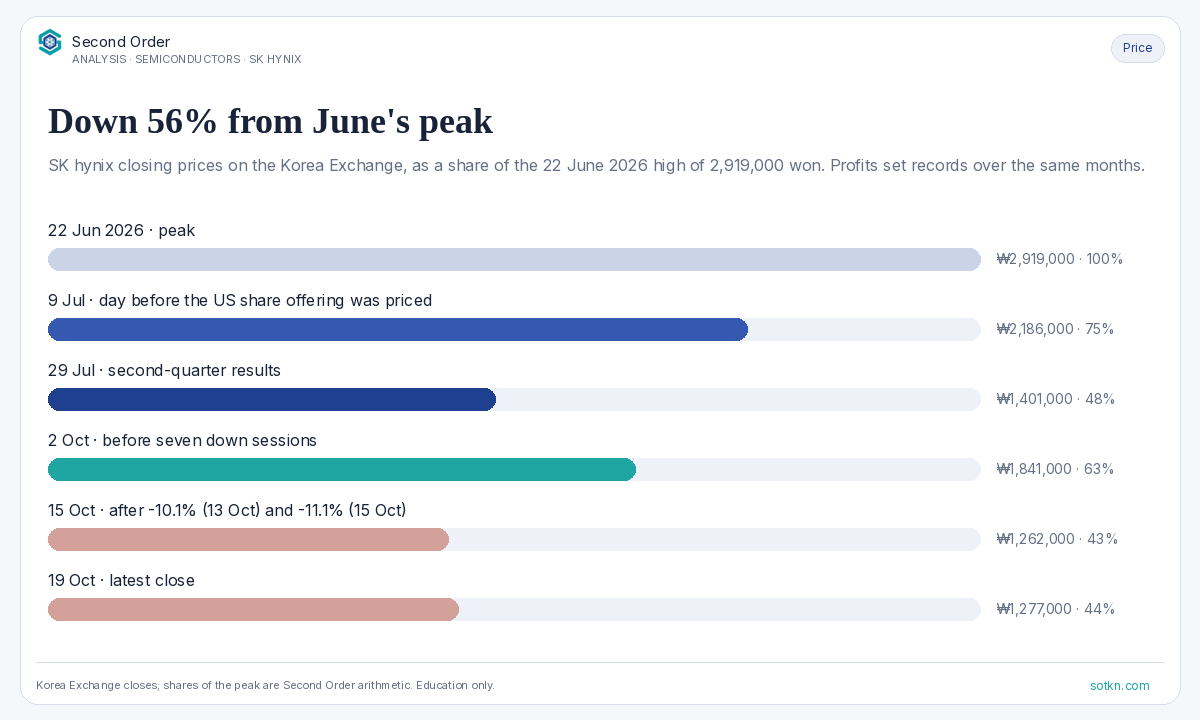
Chart 1 — From June's peak to 19 October: closing prices on the Korea Exchange as a share of the 22 June high. Second Order arithmetic. Education only.
Why does SK hynix sit at the back-end step?
Memory is made in two halves. The front end prints DRAM circuits onto wafers. The back end turns those wafers into products. For HBM, the back end is the hard half: each wafer is thinned, drilled with thousands of vertical connections, stacked twelve or sixteen layers high, bonded, and tested before a customer will accept it. Our HBM explainer walks through the stack, and the SK hynix business model shows where the company sits on the map.
SK hynix began mass shipments of HBM4 in the second quarter and said it would ramp in the second half. On 14 October a Korean outlet reported that some back-end tools meant for this year were now expected next year, and that suppliers had not received a 2027 plan. The same report quoted a Daishin Securities analyst calling market worries about HBM4 quality at a major customer overdone, while allowing that some problems may have arisen in the back end. SK hynix said it was investing on schedule.
The report gave a second reason: new clean-room space at Yongin is expected to go to standard DRAM first, where prices are rising fast, not to HBM. It means the newest HBM sits behind the step that SK hynix itself is pacing.
There is a customer side too. Counterpoint Research said on 9 October that most Rubin products will likely use 12-high HBM4, not the 16-high stacks SK hynix has shown. And on 18 October the Seoul Economic Daily reported that Nvidia had asked all three of its HBM suppliers, SK hynix included, to make the base die of its custom HBM on TSMC's 3nm process, and that Samsung had agreed. None of the companies has confirmed it, as our Samsung Wire noted. The back end is where 2027's shares get decided.
So SK hynix's stuck step is not demand or money. It is the back end, and how fast SK hynix chooses to widen it. Our Samsung piece looked at the front end, the wafer pool; this is the step after it.
What does ₩1,277,000 already assume?
A memory maker's price is a bet on how long good times last. Three answers compete:
- The peak ends this year. Two more quarters at the second quarter's rate, then back to a business the size of 2025
- The peak lasts into 2029. About 11 more quarters at that rate, then back to 2025's size
- The peak is the new normal. The second quarter's rate holds for good
A tip sheet would pick a side. Analysis asks which answer the price already needs.
Our read, in one line: the price already assumes Scenario B. At ₩1,277,000 the market pays about ₩933 trillion, which on our arithmetic buys about 11 more quarters at the second quarter's operating profit rate, roughly to early 2029, before a fall back to a business the size of 2025. The sell-off is not pricing a broken step; it is pricing a shorter peak. The back-end step matters because it decides how much of 2027's HBM SK hynix keeps. The scenarios and the arithmetic are below.
The free preview ends here.
—— Still to read · ~9 of 14 minutes ——
MEMBERS CONTINUE HERE
- Who gets paid, in order, while the back end waits
- What the price pays for, in years of profit
- Three scenarios with the arithmetic
- What the market could be right about
- Six practical takeaways
- Members' FAQ