Who Makes Custom AI Chips? The Partners Behind Big Tech's ASICs
A custom AI chip is designed by the company that will run it, then built with a design partner that turns it into a chip TSMC can make. Broadcom, Marvell, Alchip, GUC and MediaTek do that job. They get paid when chips ship; the owner gets paid only once they run.
EXPLAINED · Players · Last reviewed: 17 Oct 2026 · Next review: after Broadcom's fiscal fourth-quarter 2026 results
A custom AI chip is an accelerator that a cloud company or AI lab designs for its own work instead of buying a general-purpose GPU. Most are built with a design partner, such as Broadcom, Marvell, Alchip, GUC or MediaTek, which turns the design into a chip TSMC can make and ships it.
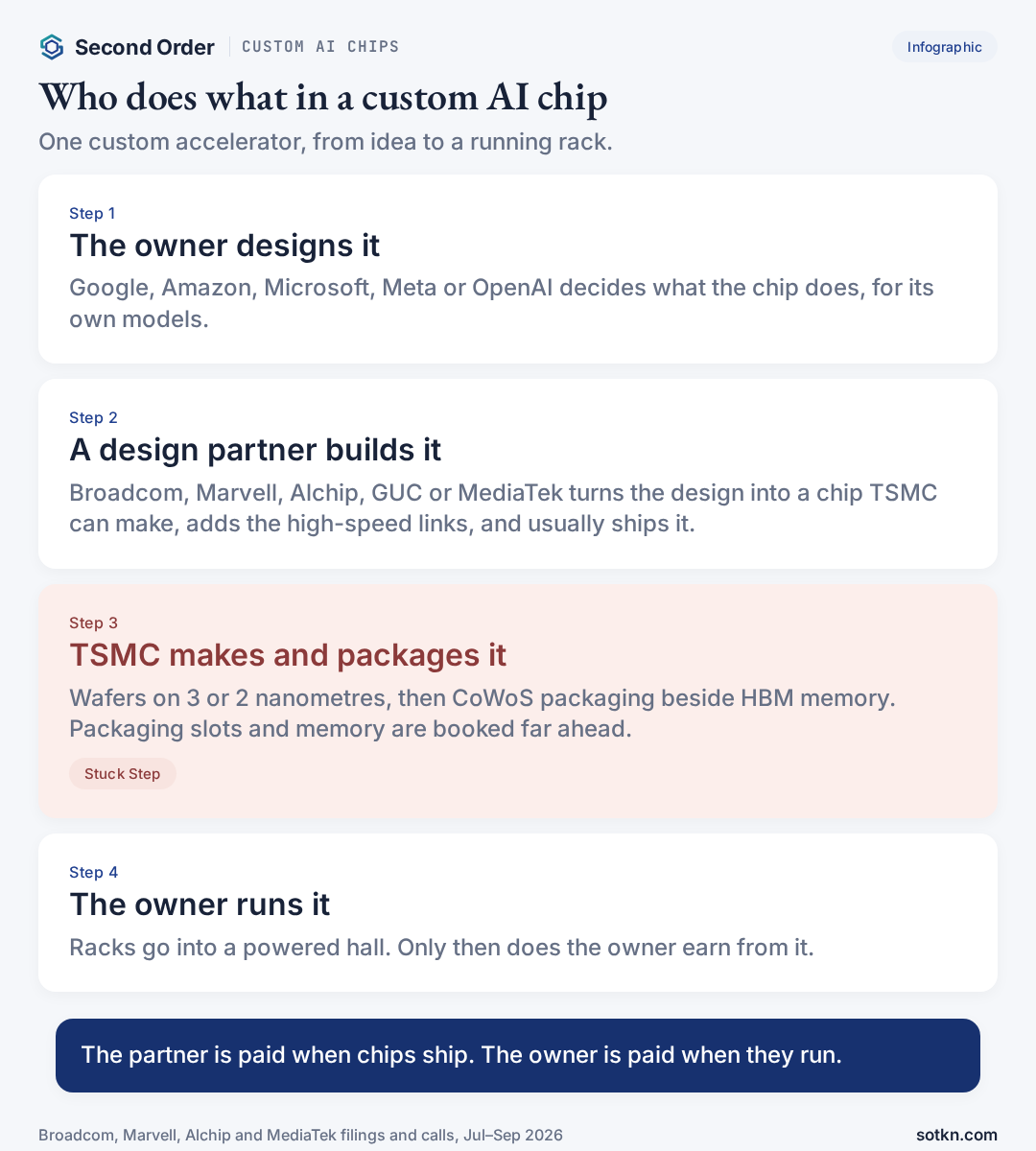
In short. Custom AI chips have two makers. The owner, such as Google, Amazon, Microsoft, Meta or OpenAI, designs what the chip does. A design partner, such as Broadcom, Marvell, Alchip, GUC or MediaTek, turns the design into a chip TSMC can make, books the wafers and packaging, and usually ships it. The partner is paid when chips ship: Broadcom booked $16.7 billion of AI chip revenue in the quarter to 2 August 2026. The owner earns only once the chips run in a powered hall. That gap, and the packaging slots in between, is where the money waits.
Why an investor cares: a custom chip moves money through two companies at two different times. The design partner books revenue when chips ship. The owner earns only once those chips are racked in a powered hall and serving customers. Knowing who sits where tells you whose numbers move first. This page sits beside who makes AI chips, which maps the whole chip stack, and what a TPU is, the best-known custom chip.
Who makes custom AI chips?
Two companies, not one. The owner is the cloud company or AI lab that will run the chip. It decides what the chip is for, writes the architecture, and owns the result. Google with its TPU, Amazon with Trainium, Microsoft with Maia, Meta with MTIA and OpenAI with its first chip, called Jalapeño, are all owners.
The design partner is a chip company that turns that architecture into something a factory can make. It does the physical layout, supplies the high-speed links and memory interfaces it has already built for other chips, designs the package, and books the wafers and packaging at TSMC. In most cases it then sells the finished chip to the owner. Broadcom and Marvell call these chips XPUs; the industry also calls them AI ASICs, short for application-specific integrated circuits.
Behind both stand the same suppliers as any AI chip: TSMC for the wafers and the CoWoS packaging, and the memory makers for the high-bandwidth memory stacked beside the chip. Who makes HBM covers that last role.
| Role | What it does | Who does it |
|---|---|---|
| Owner | Decides what the chip does, for its own models, and owns the design | Google (TPU), Amazon (Trainium), Microsoft (Maia), Meta (MTIA), OpenAI (Jalapeño) |
| Design partner | Turns the design into a chip TSMC can make, adds high-speed links and memory interfaces, designs the package, books capacity, usually ships the finished chip | Broadcom, Marvell, Alchip, GUC, MediaTek |
| Foundry and packaging | Makes the wafers, then packages the chip beside high-bandwidth memory | TSMC, with CoWoS packaging |
| Memory | Supplies the HBM stacks that sit next to the chip | SK hynix, Samsung, Micron |
Roles only, not a ranking. Sources under References.
Which partner builds which chip?
Start with Broadcom. On its 2 September 2026 call it said it had six custom accelerator customers. It named Google, whose Ironwood TPUs it was shipping in high volume, and Anthropic, which buys TPUs through Broadcom. It also named OpenAI, whose Jalapeño chip it ships, and Meta, for which it plans three generations of MTIA chips by the end of 2027.
Marvell is the other US partner. On 29 July 2026 it signed an agreement with Google to develop custom chips that attach to the TPU, including AI inference accelerators and memory and network controllers. It filed the details on 19 August 2026.
Three Taiwanese companies do the same job. Alchip said its 3-nanometre accelerator shipments to a North American cloud customer began in May 2026. Analysts identify that chip as Amazon’s Trainium3, which Amazon says is built on 3 nanometres, though Alchip does not name the customer. GUC, part-owned by TSMC, is widely presumed to build Microsoft’s Maia chips, but Microsoft has not named its partner. MediaTek, best known for phone chips, said on 31 July 2026 that its first AI accelerator for a major US cloud customer goes into production in the fourth quarter of 2026.
| Owner and chip | Design partner | Dated fact |
|---|---|---|
| Google · TPU | Broadcom; Marvell on chips that attach to the TPU | Broadcom shipped Ironwood TPUs in high volume to Google and Anthropic in the quarter to 2 Aug 2026. Marvell signed its Google agreement on 29 Jul 2026 |
| OpenAI · Jalapeño | Broadcom | 1.3 GW planned for 2027, said on 2 Sep 2026; the next generation is approaching tape-out |
| Meta · MTIA | Broadcom | Three generations due by the end of 2027, 3 GW in sight through 2028, said on 2 Sep 2026 |
| Amazon · Trainium3 | Alchip (reported) | Alchip's 3nm accelerator shipments to a North American cloud customer began in May 2026; analysts identify it as Trainium3 |
| Microsoft · Maia 300 | Not named by Microsoft; GUC presumed | Primary Microsoft inference system from 2027, said on 12 Oct 2026; made on TSMC 2nm |
| Unnamed US cloud customer | MediaTek | First AI accelerator in production from Q4 2026; second in high volume in 2028, said on 31 Jul 2026 |
Pairings as the companies state them; "reported" and "presumed" where the owner has not confirmed. Sources under References.
What does a design partner actually do?
It carries the design from drawing to delivery. The owner knows what math its models need. The partner knows how to lay out tens of billions of transistors so the chip works at TSMC’s newest nodes, how to wire it to memory and to thousands of other chips, and how to get it through testing on the first attempt.
Most of the value sits in parts the owner would rather not build itself. The fastest links between chips, called SerDes, and the interfaces to high-bandwidth memory are hard to design and are reused across customers. So is the package design, which puts a processor and several memory stacks on one base and keeps them powered and cool.
There are two ways the money flows. In the first, the partner buys the wafers and packaging, sells the finished chip, and books the whole chip as revenue. Broadcom works this way, which is why its AI revenue tracks chip shipments. Alchip’s own results show the same pattern: it said its gross margin fell as production revenue grew. Our read is that more of what it sold was silicon it had paid TSMC for.
In the second, the owner buys wafers from TSMC itself and pays the partner for design work and specific parts. That gives the owner more control and the partner less revenue per chip. Either way, the chip belongs to the owner. Marvell’s filing shows how far that goes: Google decides whether Marvell may sell the custom product to anyone else.
Who gets paid first?
The design partner, as chips ship. Broadcom’s AI chip revenue was $16.7 billion in the quarter to 2 August 2026, up 221% on a year earlier, and it guided to $21.7 billion for the next quarter. Alchip’s revenue rose to $241.7 million in the second quarter of 2026 from $132.4 million in the first, about 83% (our arithmetic), as the 3-nanometre accelerator started shipping. MediaTek expects its data-centre revenue to pass $2 billion in 2026.
The owner gets paid later, and in a different way. Google earns when cloud customers use TPU hours. Microsoft earns when Copilot and its other services answer requests. A lab such as Anthropic pays over years. Between the partner’s invoice and the owner’s first dollar sit packaging, racking and a powered hall.
Broadcom now measures its customers in gigawatts of data-centre power rather than chip counts. It expects Anthropic to deploy 1 gigawatt of Ironwood in 2026 and 5 gigawatts of the next TPU in 2027, with sight of 10 more in 2028. For OpenAI it plans 1.3 gigawatts of Jalapeño in 2027, and for Meta 3 gigawatts through 2028.
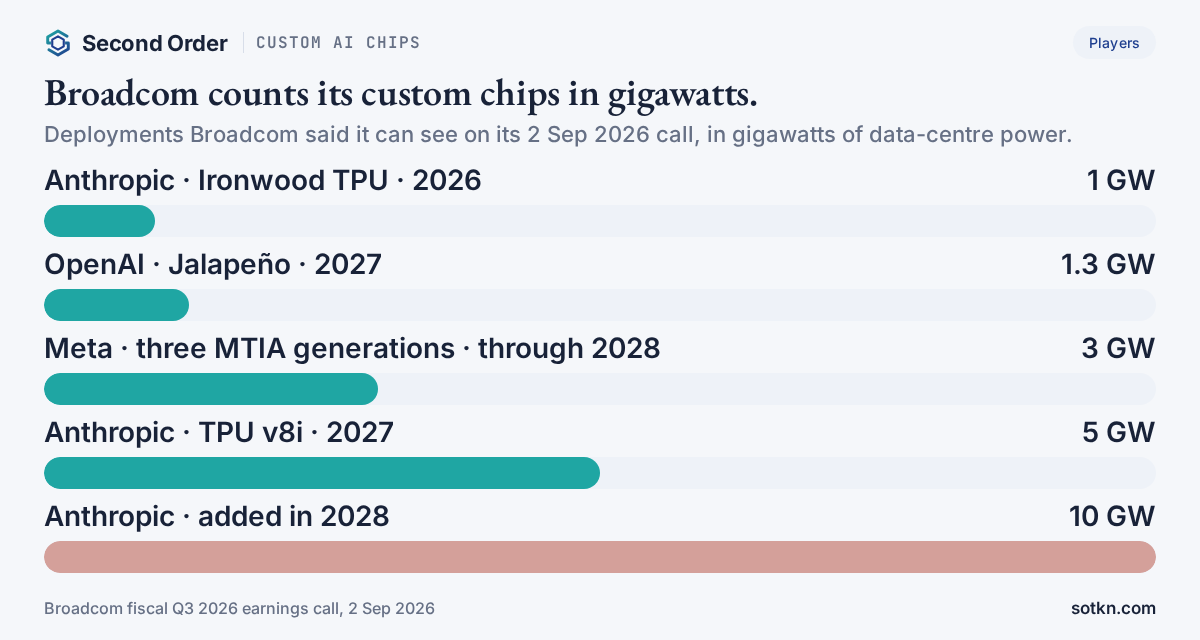
Those figures only turn into revenue for the owner once halls with that much power exist. That is why custom chips connect straight back to AI capex and to the hall-building clocks on the AI Data Centers layer.
Why do hyperscalers build their own chips?
To make each answer cheaper. Running a model, called inference, is a cost the owner pays every time a user asks something. A chip built for one company’s models can drop features a general-purpose GPU carries and spend that power and silicon on the work that company actually runs.
The claims are the companies’ own. Microsoft says Maia 300 delivers about 40% more tokens per megawatt than leading GPU systems. Broadcom’s chief executive said a co-developed chip can run at half the cost of a GPU. Neither figure has been independently tested. When halls are short of power, tokens per megawatt is the number that matters, which is why inference is where custom chips land first. TPU vs GPU sets one custom chip against the GPU it competes with.
Microsoft draws the line clearly. On 12 October 2026 it said Maia becomes its primary inference system from 2027, at multi-gigawatt scale, while training stays on Nvidia and AMD. Our Maia 300 Catalyst note traces what that changes.
Where is the stuck step?
In packaging and memory, booked by the design partner. Every one of these chips is a large processor that has to be packaged beside high-bandwidth memory, which means a CoWoS slot at TSMC and HBM from one of three makers. Both are booked far ahead. How CoWoS works and what an interposer is explain the packaging itself.
The partners show it in how they spend. MediaTek’s board approved a discretionary $5 billion financing budget on 31 July 2026, partly to secure supply chain capacity. Its second accelerator, worked through with its packaging partner, is due in high volume only in 2028. A design partner that cannot get packaging slots cannot ship, however good the design.
Then comes the clock everyone shares: a powered hall. A chip shipped in December earns its owner nothing until the rack is plugged in. Who makes advanced packaging maps the packaging side of that wait.
What to check next
Broadcom’s fiscal fourth-quarter results, against its $21.7 billion AI revenue guide and any change in its six-customer count. MediaTek’s first accelerator entering production in the fourth quarter. Marvell’s custom revenue for its fiscal third quarter, the first in which Google’s purchases count toward its warrant. Microsoft’s Maia 300 deployments in 2027. The money side of the same story is in Broadcom’s chip financing Wire.
Common misconceptions
- People assume Google makes its own TPU. Actually Google designs it; Broadcom builds and ships it, and TSMC makes the silicon.
- People assume a custom chip is cheap to build. Actually it needs the same leading-edge wafers, CoWoS packaging and HBM as a GPU, booked just as far ahead.
- People assume the design partner owns the chip. Actually the owner does; Marvell’s filing gives Google the say over whether its custom product can be sold to anyone else.
- People assume custom chips replace GPUs. Actually they take work, mostly inference, inside the companies that design them; Microsoft keeps training on Nvidia and AMD.
- People assume a partner’s revenue means the owner is earning. Actually the partner is paid at shipment; the owner earns only once the chips run in a powered hall.
FAQ
Who makes custom AI chips?
Two companies share the job. The owner, such as Google, Amazon, Microsoft, Meta or OpenAI, designs what the chip does. A design partner, such as Broadcom, Marvell, Alchip, GUC or MediaTek, turns that design into a chip TSMC can make, and usually ships the finished part. TSMC makes the silicon and packages it with high-bandwidth memory.
What is an AI ASIC?
An application-specific integrated circuit built for AI work, mostly the matrix math behind training and running models. Google's TPU, Amazon's Trainium, Microsoft's Maia and Meta's MTIA are all AI ASICs. Broadcom and Marvell call them XPUs.
Who makes Google's TPU?
Google designs it. Broadcom builds and ships it; it said on 2 September 2026 that it was delivering Ironwood TPUs in high volume to Google and Anthropic. Marvell signed an agreement with Google on 29 July 2026 to develop custom chips that attach to the TPU ecosystem, including AI inference accelerators.
Who makes Amazon's Trainium chip?
Amazon designs it through its Annapurna Labs unit. Alchip said its 3-nanometre accelerator shipments to a North American cloud customer began in May 2026; analysts identify that chip as Trainium3, which Amazon says is built on 3 nanometres. Alchip does not name the customer.
Why do hyperscalers make their own AI chips?
To cut the cost of each answer their models give. A chip built for one company's workloads can skip parts a general-purpose GPU carries. Microsoft claims Maia 300 gives about 40% more tokens per megawatt than leading GPU systems, a company figure that has not been independently tested.
Do custom AI chips replace Nvidia?
Not in the data so far. They take a share of the work, mostly inference, inside the companies that design them. Microsoft, for example, says training stays on Nvidia and AMD while Maia becomes its main inference system from 2027.
Is this a list of stocks to buy or sell?
No. Second Order Explained pages explain who does what and how the money moves. They do not give buy or sell calls or rank companies.
Related: TPU; TPU vs GPU; who makes AI chips; hyperscaler; rack-scale AI; HBM.
Stack doors
Layer: Hyperscalers. Also: Semiconductors, Neoclouds, AI Data Centers. Markets: US, Taiwan.
Get the Wire — short daily notes when custom chip orders, packaging slots and hyperscaler spending move.
How we check this
Broadcom’s revenue and customer deployments come from its 2 September 2026 results release and earnings call. Marvell’s Google agreement comes from its 19 August 2026 filing with the US Securities and Exchange Commission, MediaTek’s plans from its 31 July 2026 call, and Alchip’s shipments from its second-quarter 2026 release. Each was re-checked on 17 Oct 2026. Where an owner has not confirmed its partner, as with Amazon and Alchip or Microsoft and GUC, we say “reported” or “presumed”. Performance claims such as tokens per megawatt are the companies’ own figures and are labelled that way. Where we work something out ourselves it is labelled “our arithmetic”. This page explains who does what. It does not rank companies or give buy or sell calls.
Last reviewed: 17 Oct 2026 · Next review: after Broadcom's fiscal fourth-quarter 2026 results
Spot an error? Tell us and we will correct it and note the change here.
References
- Broadcom — Third quarter fiscal year 2026 financial results (2 Sep 2026) — AI semiconductor revenue $16.7 billion in the quarter to 2 Aug 2026, up 221%; Q4 guide $21.7 billion; demand for custom AI accelerators
- Broadcom — Fiscal Q3 2026 earnings call transcript (2 Sep 2026) — six XPU customers; Ironwood and TPU v8i; Anthropic 1 GW in 2026 and 5 GW in 2027; OpenAI Jalapeño 1.3 GW in 2027; three MTIA generations for Meta, 3 GW through 2028
- Alchip Technologies — 2Q26 investor presentation (Aug 2026) — gross margin down on a rising share of production revenue; N3 accelerator shipments to the North American cloud customer from May, ramping through 3Q26
- Marvell — Form 8-K on the Google commercial agreement and warrant (19 Aug 2026) — agreement of 29 Jul 2026 for custom silicon attached to the TPU ecosystem; warrant vesting per $500 million of custom product revenue through fiscal 2033
- Marvell — Q2 fiscal 2027 earnings call transcript (Motley Fool, call held 27 Aug 2026) — custom business to accelerate from the second half of fiscal 2027 and more than double in fiscal 2028
- Alchip Technologies — 2026 second quarter financial results (Aug 2026) — revenue $241.7 million vs $132.4 million in Q1; 3nm accelerator shipments to a North American customer began in May
- MediaTek — 2Q26 earnings call transcript (31 Jul 2026) — first AI accelerator ASIC for a major US cloud customer in production from Q4 2026; data centre revenue above $2 billion in 2026; 2027 market $80 billion, share target 15–20%; $5 billion financing budget
- Amazon — Trainium3 UltraServers generally available (2 Dec 2025) — Trainium3 on 3nm; up to 144 chips per UltraServer
- The Inference — Microsoft detailed its Maia 300 chip but won't name its builder (14 Oct 2026) — Maia 300 on TSMC 2nm with HBM4; design partner not named; GUC presumed
- Wikimedia Commons — Tensor Processing Unit 3.0, photo by Zinskauf, CC BY-SA 4.0 — featured image base photo