What Is AI Inference? How Neoclouds Get Paid for It
AI inference is running a trained AI model to answer a new request. It is the part of AI people use, so it is billed again and again, by the token or by the GPU hour. The stuck step is the spare GPU kept ready that earns nothing.
EXPLAINED · Mechanism · Last reviewed: 10 Oct 2026 · Next review: after CoreWeave’s Q3 2026 results (Nov 2026)
AI inference is running a trained AI model to answer a new request, such as a chat reply, a piece of code or a search summary. Training builds the model once. Inference runs every time someone uses it, and each answer is billed in tokens or GPU hours.
In short. Inference is the part of AI that people actually use, so it is the part that gets billed again and again. Deloitte expects it to be about two-thirds of all AI compute in 2026, up from half in 2025. Neoclouds sell it two ways: by the GPU hour (an H100 at Nebius costs $4.50 an hour on demand) or by the token (Nebius lists chat models from $0.06 to $15 per million). The stuck step is the spare GPU. Requests arrive in spikes and models take time to load, so platforms keep GPUs ready that earn nothing.
Why an investor cares: inference is the recurring revenue that has to pay back the chips bought for AI. It is how a neocloud turns GPUs into cash, and why clouds now price AI in AI tokens.
What is AI inference?
A model is trained once, on huge amounts of data. After that, every question it answers is inference. The model reads the request (input tokens) and writes the answer (output tokens), and a GPU does the work.
Each answer is cheap. Deloitte notes that asking a model to summarise a document takes only a tiny fraction of the compute needed to train it. But billions of requests add up: Deloitte expects inference to be about two-thirds of all AI compute in 2026, up from a third in 2023 and half in 2025. Source: Deloitte TMT Predictions 2026.
Agents push volume up further. Nebius told shareholders that in agent work, such as coding or search agents, one task drives many model calls, so use grows with how much work is automated, not with how many people log in. Source: Nebius Q2 2026 letter.
AI training vs inference: what is the difference?
Training teaches the model. Inference uses it. The two run on mostly the same chips but are sold and planned differently.
| AI training vs AI inference |
|---|
| When it runs: training runs in big planned jobs before a model launches. Inference runs every time a user or an agent asks, all day. |
| How it is sold: training is usually sold as reserved blocks of GPUs on long contracts (our read). Inference is billed as used, per GPU hour or per token. |
| Shape of demand: training is steady once a job starts. Inference follows users, so it comes in spikes. |
| What matters most: for training, how many chips can work as one. For inference, how fast the answer comes back and what each token costs. |
| Chips: mostly the same high-end GPUs. Inference-only chips are growing; Deloitte puts that market above $50 billion in 2026. |
Sources: Deloitte TMT Predictions 2026 (17 Nov 2025); NVIDIA Q2 FY2027 call (26 Aug 2026). The “how it is sold” row is Second Order’s read.
NVIDIA’s pitch is one platform for both: its chief executive told analysts on 26 August 2026 that its systems are “great at training, great at inference”. It also said Groq 3 LPX, its rack-scale system built for fast interactive inference, is in full production. Sources: NVIDIA call and NVIDIA results. For a chip built mainly for Google’s own AI work, see what a TPU is.
How do neoclouds get paid for inference?
There are two meters: the GPU hour and the token.
| Two ways a neocloud sells inference |
|---|
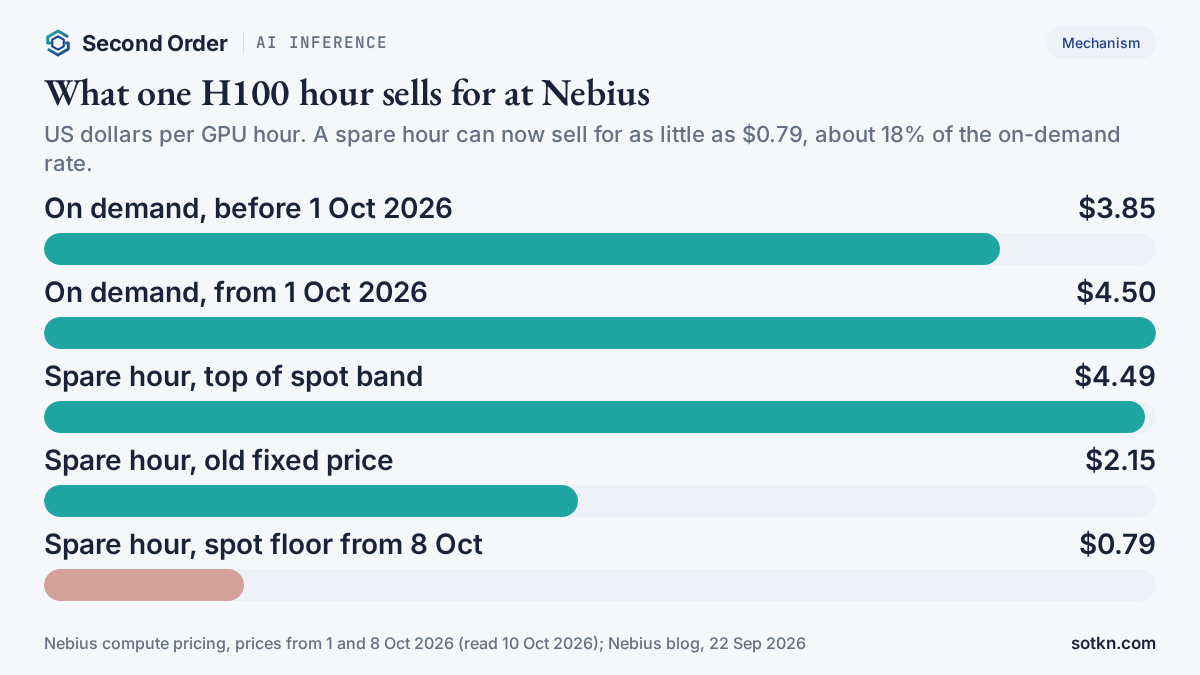
| By the GPU hour: the customer rents the chip and runs the model. Nebius H100 on demand: $4.50 an hour from 1 Oct 2026 (was $3.85). Spare (interruptible) H100 hours: from $0.79 to $4.49 since 8 Oct, moving as often as every 15 minutes. |
| By the token: the neocloud runs the model and bills per million tokens read and written. Nebius Token Factory: gpt-oss-120b $0.15 in / $0.60 out; DeepSeek-V4-Pro $1.75 / $3.50; Kimi-K3 $3 / $15. |
| Who carries the idle risk: by the hour, the customer pays whether the chip is busy or not. By the token, the neocloud pays for any GPU it keeps ready that no one is using (our read). |
Sources: Nebius compute pricing and Token Factory catalog, both read 10 Oct 2026. The idle-risk row is Second Order’s read.
Per token, writing costs more than reading: output is 2 to 5 times the input price on the models above. A request that reads 2,000 tokens and writes 500 on Kimi-K3 costs about 1.35 cents (2,000 × $3 ÷ 1 million + 500 × $15 ÷ 1 million = $0.006 + $0.0075, our arithmetic). A million such requests is about $13,500. Sources: Token Factory catalog and Nebius compute pricing.
Per-token selling is new and still small. CoreWeave said booked yearly revenue (ARR) for its managed inference service grew from $1 million to more than $100 million in the few months since launch, and it expects at least $250 million by the end of 2026. Its whole business brought in $2.6 billion in the June quarter, about $10.4 billion a year at that pace, so per-token inference is about 1% of it (booked ARR against quarterly revenue × 4, not like for like; our arithmetic). Sources: CoreWeave call and CoreWeave results.
Nebius does not split out inference revenue. It said work on Token Factory, its per-token service, more than tripled in the June quarter, inside AI cloud revenue of $574.9 million, up 514% on a year earlier. Source: Nebius Q2 2026 letter. The hour-based side is covered in GPU as a service.
Who gets paid when you ask an AI a question?
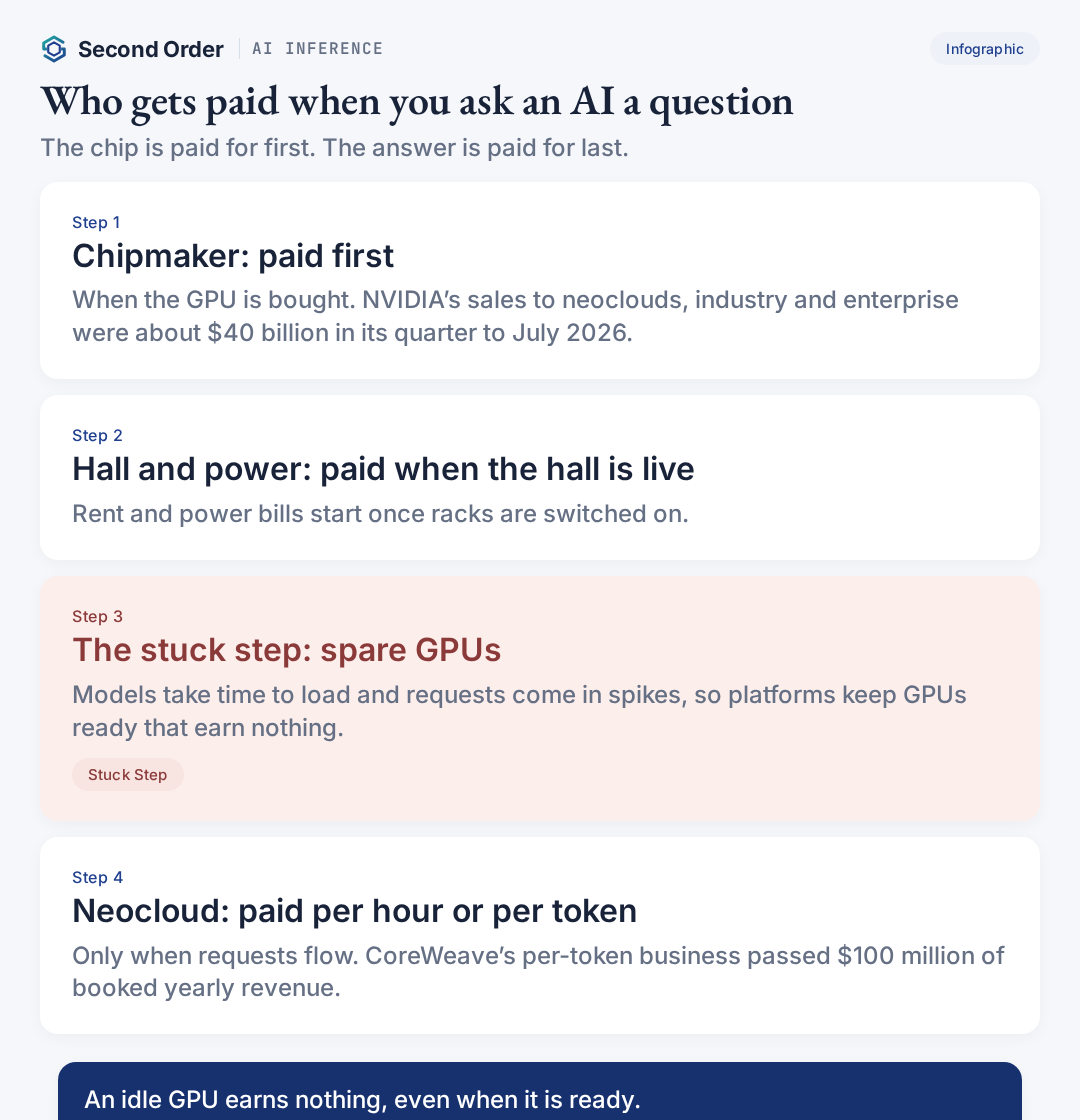
The money moves in a set order, and the answer is paid for last.
- 1. The chipmaker, first. Paid when the GPU is bought. NVIDIA said sales to neoclouds, industry and enterprise were about $40 billion in its quarter to late July 2026, up 138% on a year earlier, driven by neocloud capacity additions. NVIDIA call.
- 2. The hall and the power, next. Rent and power bills start once racks are switched on. See what an AI data center is.
- 3. The neocloud, per hour or per token. Only when requests flow. CoreWeave raised prices about 25% across its chip types in July 2026, citing demand and the returns customers see as they “shift to inference”. CoreWeave call.
- 4. The model maker or app, last. Paid by the end user, through a subscription or a paid API.
Where is the stuck step?
The spare GPU. To answer fast, a platform needs the model loaded on a GPU before the request arrives. Nebius said on 1 October 2026 that cold starts, the time a model needs to load before serving a single request, leave GPUs idle when demand spikes and new copies spin up, and that this “forces platforms to hold spare capacity just to hit their service-level targets”. It calls this the “idle GPU tax”, and bought a start-up called Inferize to cut it. Terms were not disclosed. Source: Nebius. Our Wire: Nebius acquires Inferize.
Selling spare hours cheaply is the other fix. Since 8 October 2026 Nebius prices its interruptible GPU hours by live demand, from $0.79 an hour for an H100, about 18% of the $4.50 on-demand rate (0.79 ÷ 4.50, our arithmetic). A spare hour sold at the floor earns little; an idle one earns nothing. Sources: Nebius blog and Nebius pricing. Our Wire: Nebius moves spare GPU hours to spot prices.
Behind both sits plain shortage. CoreWeave said growth of its inference service was “constrained only by our near-term capacity”, and NVIDIA expects supply to stay a bottleneck at least to the end of its 2028 financial year, in January 2028. So a neocloud can be short of GPUs overall and still pay for spare ones it holds ready. How busy chips are is the number to watch: see GPU utilization. Our read of what Nebius’s price assumes about it is in the Nebius idle-GPU Analysis.
What would prove this wrong?
- Cold-start fixes work quickly. If Nebius reports clearly higher use of its GPUs after Inferize, spare GPUs stop binding and plain capacity is the only limit.
- Per-token prices fall faster than chip costs. Then the stuck step moves to margin. Watch the Token Factory price list and NVIDIA’s chip prices.
- Per-token selling stalls. If CoreWeave ends 2026 well short of $250 million of managed inference ARR, inference stays mostly a GPU-hour business on long contracts, as in take-or-pay GPU contracts.
What to check next
CoreWeave and Nebius report their September-quarter results in November 2026 (dates not yet set at 10 October); look for the managed inference ARR and Token Factory growth. Nebius shows its live spot price only in its console. NVIDIA guided to about $108 billion of revenue for its quarter to October. The US door, CoreWeave neocloud contracts, tracks the contract side.
Common misconceptions
- People assume inference is cheap, so it needs few chips. Actually each answer is cheap, but the volume is huge: Deloitte expects inference to be about two-thirds of AI compute in 2026.
- People assume inference runs on special cheap chips. Actually most still runs on the same high-end GPUs used for training, though inference-only systems are entering production.
- People assume a neocloud’s inference revenue is all per token. Actually most is still sold by the GPU hour. CoreWeave’s per-token service is about 1% of its revenue pace.
FAQ
What is AI inference?
Running a trained AI model to answer a new request, such as a chat reply or a piece of code. Training builds the model once; inference happens every time it is used.
What is the difference between AI training and inference?
Training teaches the model, in big planned runs before launch. Inference uses the model, all day, every time someone asks. Training is usually sold as reserved GPU capacity; inference is billed as it is used.
How is AI inference priced?
Two ways. By the GPU hour, when the customer runs the model (Nebius charges $4.50 an hour for an H100 on demand). Or by the token, when the cloud runs it (Nebius Token Factory lists chat models from $0.06 to $15 per million tokens).
Why does inference need so many GPUs if each answer is cheap?
Because there are billions of answers. Deloitte expects inference to be about two-thirds of all AI compute in 2026, up from half in 2025.
Who sells AI inference?
Hyperscalers such as Google and Microsoft, neoclouds such as CoreWeave and Nebius, and model makers through their own paid APIs.
Is this a list of stocks to buy or sell?
No. Second Order Explained pages explain how the money moves. They do not give buy or sell calls.
Related terms: AI tokens, the unit inference is billed in; GPU utilization; neocloud; GPU as a service.
Stack doors
Layer: Neoclouds. Also: Hyperscalers, AI Data Centers, Semiconductors. Markets: US.
Get the Wire — short daily notes when GPU prices, contracts and capacity move.
How we check this
Company figures come from CoreWeave’s, Nebius’s and NVIDIA’s own results, filings, calls and price pages; the compute split comes from Deloitte. Each is dated below and was re-checked on 10 Oct 2026. Where we work something out ourselves, the arithmetic is shown and labelled “our arithmetic”. This page explains how the money moves. It does not give buy or sell calls.
Last reviewed: 10 Oct 2026 · Next review: after CoreWeave’s Q3 2026 results (Nov 2026)
Spot an error? Tell us and we will correct it and note the change here.
Sources
- Deloitte — TMT Predictions 2026: More compute for AI, not less (17 Nov 2025; checked 10 Oct 2026)
- CoreWeave — Second quarter 2026 results, SEC filing (11 Aug 2026)
- The Motley Fool — CoreWeave Q2 2026 earnings call transcript (call 11 Aug 2026)
- Nebius — Q2 2026 shareholder letter, SEC Ex. 99.2 (Aug 2026)
- Nebius — Nebius acquires Inferize (1 Oct 2026)
- Nebius — Compute pricing in Nebius AI Cloud (prices from 1 and 8 Oct 2026; read 10 Oct 2026)
- Nebius — Introducing spot pricing for preemptible VMs (22 Sep 2026)
- Nebius Token Factory — model catalog and per-token prices (read 10 Oct 2026)
- NVIDIA — Second quarter fiscal 2027 results, SEC filing (26 Aug 2026)
- NVIDIA — Q2 fiscal 2027 earnings call, corrected transcript (26 Aug 2026)