What Is PUE? Power Usage Effectiveness in AI Data Centers
PUE is a data center's total energy divided by its IT energy. The industry averaged 1.52 in 2026; Google ran 1.09 in 2025. With the grid connection fixed, PUE decides how many megawatts a hall can lease, and the tenant usually pays for the overhead.
EXPLAINED · Mechanism · Last reviewed: 18 Oct 2026 · Next review: after Uptime Institute's 2027 survey or Germany's final PUE amendment
PUE, or power usage effectiveness, is a data center’s total energy use divided by the energy its IT equipment uses. A PUE of 1.5 means that for every unit of power reaching the servers, another half unit goes to cooling, power conversion and lighting.
In short. PUE tells you how much of a data center’s power never reaches a chip. The industry average was 1.52 in Uptime Institute’s 2026 survey; Google’s fleet ran at 1.09 in 2025. For an AI data center the ratio is money. The grid connection is fixed, so PUE decides how many megawatts of IT load a site can lease, and in many leases the tenant pays the power bill, overhead included. The stuck step is that PUE is mostly locked in at design, by climate and cooling choice, and places short of power, such as Singapore, now make a low PUE a condition of getting megawatts at all.
Why an investor cares: an AI data center is sold by the megawatt, but two megawatts are involved. The grid sells power at the meter; the tenant leases power at the rack. PUE is the exchange rate between them, so it shapes what a site can earn and what the tenant’s power bill is. See also what an AI data center is and how much water an AI data center uses, PUE’s sister measure.
What is PUE?
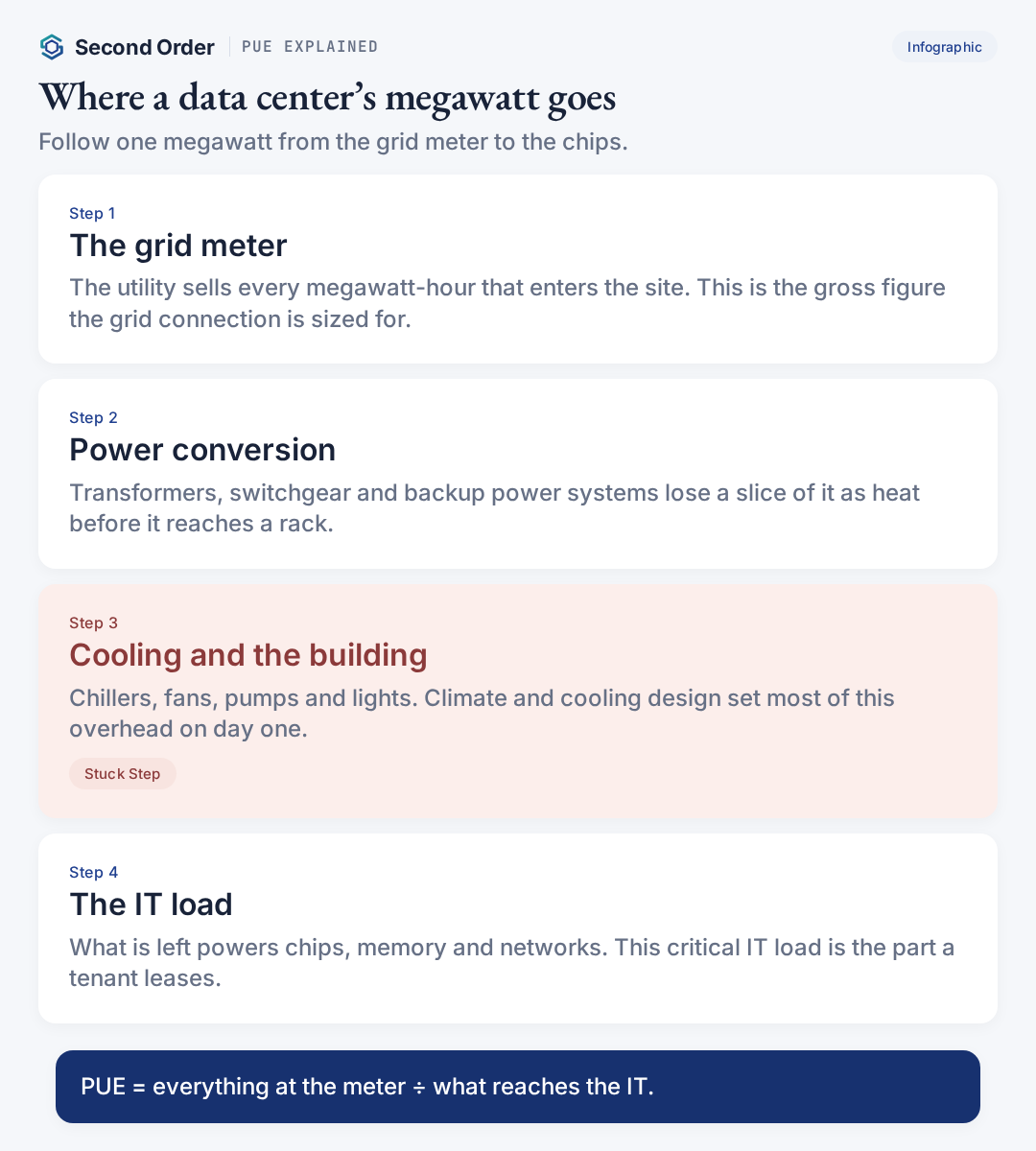
PUE is a ratio of two energy numbers, introduced by The Green Grid, an industry group, in 2007. On top is everything the facility draws from the grid over a period, usually a year. Underneath is the part used by the IT equipment itself: servers, accelerators, storage and network switches. The closer the result is to 1.0, the less energy goes anywhere else.
The gap is overhead. Much of it is cooling: chillers, fans, pumps and the heat-rejection plant on the roof. The rest is lost converting and distributing power, in transformers, switchgear and backup power systems, plus lighting and offices. Google gives the plain version: a PUE of 2.0 means that for every watt of IT power, another watt goes to cooling and distributing power.
How do you calculate PUE?
Divide total facility energy by IT energy for the same period. Take a hall whose IT equipment draws a steady 10 megawatts all year. That is 87,600 megawatt-hours of IT energy. If the meter at the grid connection reads 113,880 megawatt-hours for the year, the PUE is 1.3. The overhead is the difference, 26,280 megawatt-hours (our arithmetic).
The measuring is harder than the formula. A cool month flatters the number, which is why Google reports a trailing twelve-month figure measured in all seasons. Overhead does not shrink in step with IT load, so a half-empty new hall usually shows a worse PUE than it will when full; Microsoft says its figures should improve as new sites fill up.
Rulebooks differ too. The IEA notes that Germany judges the annual average, Singapore performance at full IT load and Japan an average across each operator’s sites. Uptime Institute’s advice is that PUE works best for tracking one site over time.
What is a good PUE for a data center?
For a new, large hall, 1.3 or lower is good and 1.2 or lower is strong. Uptime Institute’s 2026 survey put the industry average at 1.52, almost unchanged for seven years, but almost one in four respondents work in a data center averaging below 1.3. Recent builds routinely reach 1.3 or better where the climate allows fresh-air or evaporative cooling, the survey says.
The average stays high because old halls stay open: 27% of respondents work in data centers over 15 years old.
| Who or what | PUE | Period | What it tells you |
|---|---|---|---|
| Industry average (Uptime Institute survey, 644 operators) | 1.52 | 2026 survey | Roughly flat for seven years |
| Respondents’ largest data centers (same survey) | 1.45 | 2026 survey | Bigger and newer sites do better |
| Equinix global fleet | 1.37 | 2025 | About 5% better than 2024 |
| TeraWulf platform | 1.25 | Stated May 2026 | Company claim for its AI campuses |
| Singapore DC-CFA2 rule | 1.25 or better at 100% IT load | Launched 1 Dec 2025 | Condition for new capacity |
| Germany, new data centers | 1.2 | Operating from July 2026 | Annual average, within two years |
| Microsoft owned fleet | 1.17 | FY25 (to 30 Jun 2025) | Asia Pacific 1.28; Americas and Europe 1.16 |
| Bitdeer Tydal, Norway (design) | About 1.1 | Announced 4 Aug 2026 | Cold climate; 121 IT MW from about 133 gross MW |
| Google fleet | 1.09 | 2025, trailing twelve months | Measured all year, all overhead |
Figures as each source states them; rules are limits, company figures are their own. Methods differ, so compare with care. Sources under References.
The spread follows who owns the building and who pays the power bill. Google and Microsoft run their own halls for their own servers and report 1.09 and 1.17. Equinix, a colocation landlord with many older multi-tenant sites (our read), reported 1.37 for 2025 after spending $36 million across 79 sites. Our pages on what Equinix does and on hyperscale vs colocation explain the two building types.
Why does PUE decide how many megawatts a data center can lease?
Because the grid connection is fixed and tenants lease IT power, not grid power. A site’s grid connection is sized in gross megawatts at the meter. A tenant leases critical IT load, the power available to its racks. Everything in between is overhead, and PUE sets its size.
TeraWulf put it bluntly in its investor presentation of 8 May 2026: “Gross MW = Scale. Critical IT MW = Monetizable Capacity.” Its five sites added up to 2,870 megawatts gross but 2,272 megawatts of critical IT. Bitdeer’s lease for its Tydal campus in Norway, announced on 4 August 2026, works the same way: 121 megawatts of IT load, supported by an estimated 133 megawatts gross, at a PUE of about 1.1.
| Site or platform | Gross power | Critical IT | Gross ÷ IT |
|---|---|---|---|
| Bitdeer Tydal, Norway (4 Aug 2026) | About 133 MW | 121 MW | 1.10 |
| TeraWulf platform, five sites (8 May 2026) | 2,870 MW | 2,272 MW | 1.26 |
Megawatts as the companies state them. The last column is our arithmetic; it is a capacity ratio, not a measured PUE. Sources under References.
Now hold the grid connection fixed. At the 2026 industry average of 1.52, a 100-megawatt connection leaves about 65.8 megawatts for IT. At 1.25, the figure Singapore now asks for, it leaves 80 megawatts. That is 14.2 megawatts more capacity to lease from the same connection (our arithmetic).
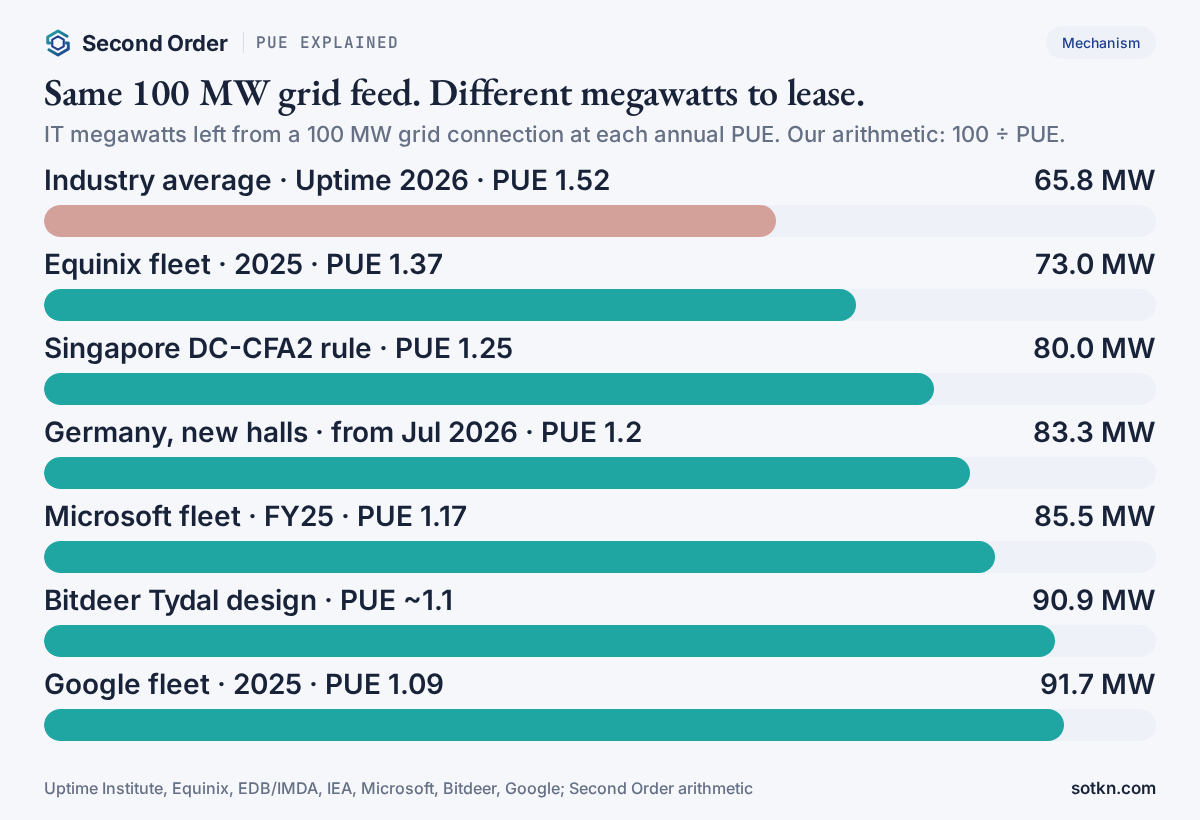
Put a price on it. Bitdeer expects about $2.4 million a year of lease revenue per IT megawatt over its 16-year Tydal term. At that rate, the 14.2-megawatt gap is worth about $34 million a year (our arithmetic). That is one contract’s rate in one country, not a market price, but it shows the scale: on a power-limited site, a better PUE is extra capacity to lease without a bigger grid connection.
One caution. Annual PUE is an average, while a grid connection is sized for the worst hour, a hot afternoon at full load. So the gross megawatts a site needs can sit above what its annual PUE implies. Our read is that this is why the gross-to-IT ratios companies disclose are capacity planning numbers, not PUE readings, and why the two should not be swapped.
Who pays for the overhead?
Usually the tenant, through the power bill. Bitdeer’s Tydal lease is a clear example. The tenant pays an average of about $202 per kilowatt of IT load per month, and on top of that reimburses electricity costs on a pass-through basis. The landlord is paid on IT kilowatts. The utility is paid on every megawatt-hour at the meter. The tenant pays for both, including whatever the cooling plant burns.
That makes PUE the tenant’s cost line. Take a tenant running 10 megawatts of IT all year, which is 87,600 megawatt-hours. At a PUE of 1.52 its share of overhead is about 45,552 megawatt-hours a year; at 1.1 it is about 8,760. The difference, roughly 36,800 megawatt-hours, is energy the tenant pays for that never computes (our arithmetic).
So landlords sell efficiency: Equinix said in April 2026 that steady PUE improvement lets customers feel confident their equipment runs efficiently. Where a landlord pays the power bill for a flat price instead, overhead becomes its margin risk (our read). How a data center lease works covers who carries which cost.
Where is the stuck step?
At design, and then at the regulator. Most of a hall’s PUE is set before it opens, by its cooling design and its climate. Uptime Institute says the most efficient cooling is not practical in every climate, and expects building in subtropical and desert regions to slow the industry’s progress. Changing cooling in a live hall is costly and disruptive.
The climate effect shows up in the companies’ own numbers. Microsoft’s Asia Pacific fleet ran at 1.28 in FY25, against 1.16 in the Americas and in Europe. Google’s two Singapore facilities ran at 1.12 and 1.14 in the first quarter of 2026, against 1.09 for its whole fleet. Hot, humid places cost more overhead per megawatt of chips (our read).
Singapore turned that into a gate. Its second Data Centre Call for Application, launched on 1 December 2025, offered at least 200 megawatts. Winners must run a hall at a PUE of 1.25 or better at full IT load, earn Green Mark Platinum certification and use IT equipment meeting a national efficiency standard. On 21 August 2026 the government provisionally allocated 50 megawatts each to Digital Realty, Equinix, Keppel Data Centres and ST Telemedia Global Data Centres, from more than 20 proposals. Our Singapore note on the 200 MW licence follows who gets paid, and what Keppel DC REIT does shows the landlord side.
Others set hard limits. Germany requires data centers starting operation from July 2026 to reach an annual average PUE of 1.2, and existing sites 1.5 from July 2027 and 1.3 from July 2030, the IEA reports; a cabinet-approved draft would relax the existing-site limits to 1.6 and 1.4. China’s 2024 action plan targets 1.25 for new large data centers and 1.2 in its national hub clusters.
Where power is rationed, then, PUE stops being a sustainability footnote. It becomes a condition of getting megawatts at all: in Singapore, a design that cannot hit the number does not get the capacity. Malaysia shows the other side of the same squeeze: much of the power booked by its data centres is not yet used.
What PUE does not tell you
PUE measures the building, not the work. The IEA’s October 2026 review says PUE and water usage effectiveness are incomplete: neither shows how efficiently IT equipment uses power or how much useful computing comes out. A low PUE does not mean low total use either.
A hall running at 1.1 full of idle accelerators still wastes energy. That is a utilisation problem, covered in GPU utilization. Singapore’s rule pairs its PUE limit with an IT efficiency standard and asks operators to work with users on equipment utilisation.
Water is the other trade-off. Evaporative cooling towers use less electricity, which lowers PUE, but they consume water; dry coolers save water but need more electricity in hot weather, the IEA notes. Read the two together. Denser racks change the overhead too; see rack-scale AI.
What to check next
Uptime Institute’s 2027 survey, for whether the 1.52 average breaks lower. Germany’s final vote on its PUE amendment. The first halls built under Singapore’s DC-CFA2 allocations. Equinix’s 2026 figure against 2025’s 1.37. Bitdeer’s Tydal Phase 1, targeted to start by 31 December 2026; our Bitdeer Malaysia Wire tracks its Malaysia campus. For build clocks, see how long it takes to build an AI data center.
Common misconceptions
- People assume a data center’s megawatts are all for computing. Actually the grid figure includes overhead; TeraWulf’s 2,870 gross megawatts carry 2,272 megawatts of critical IT.
- People assume PUE figures compare cleanly across companies. Actually periods, load and boundaries differ; Germany judges an annual average, Singapore performance at full IT load.
- People assume a low PUE means an efficient AI data center. Actually PUE measures the building only; idle or inefficient chips do not show up in it.
- People assume the landlord pays for the cooling. Actually in pass-through leases such as Bitdeer’s Tydal deal, the tenant reimburses the electricity, overhead included.
FAQ
What is PUE in a data center?
PUE, or power usage effectiveness, is a data center’s total energy use divided by the energy used by its IT equipment over the same period. Anything above 1.0 is overhead: cooling, power conversion losses and lighting.
How do you calculate PUE?
Divide the energy the whole facility used by the energy the IT equipment used, usually over a full year. A hall whose servers used 87,600 megawatt-hours while the building used 113,880 megawatt-hours has a PUE of 1.3.
What is a good PUE for a data center?
For a new, large data center, 1.3 or lower is good and 1.2 or lower is strong. Uptime Institute’s 2026 survey put the industry average at 1.52, with almost one in four respondents working in a data center below 1.3. Google reported 1.09 for its fleet in 2025, and Singapore now asks for 1.25 or better at full IT load for new capacity it allocates.
What is the average PUE of a data center?
About 1.5. Uptime Institute’s 2026 survey of 644 operators found an average annual PUE of 1.52, down from 1.54 in 2025 and roughly flat for seven years.
What is Google’s data center PUE?
1.09 for 2025, measured as a trailing twelve-month average across all of Google’s large data centers in stable operation, in all seasons. Its two Singapore facilities ran at 1.12 and 1.14 on the same basis in the first quarter of 2026.
Does a lower PUE mean a data center uses less water?
Not necessarily. Evaporative cooling towers use less electricity, which lowers PUE, but they consume water. Dry coolers save water but need more electricity, especially in hot weather.
Why does PUE matter to investors?
Because the grid connection is fixed and tenants lease IT megawatts. The lower the PUE, the more of a site’s grid power can be sold as IT capacity. Where the tenant pays the power bill, as in Bitdeer’s Tydal lease, a lower PUE also means a smaller bill for the same computing.
Is this a list of stocks to buy or sell?
No. Second Order Explained pages explain how a mechanism works and where the money moves. They do not give buy or sell calls.
Related: AI data center; data center water usage; data center lease; hyperscale vs colocation; GPU utilization; rack-scale AI.
Stack doors
Layer: AI Data Centers. Landlords: Equinix, Digital Realty, Keppel DC REIT. Also: Hyperscalers, Neoclouds. Markets: Singapore, Malaysia.
Get the Wire — short daily notes when data center power, efficiency rules and leases move.
How we check this
Industry averages come from Uptime Institute’s Global Data Center Survey 2026. Company PUE figures come from Google’s and Microsoft’s own efficiency pages and Equinix’s 22 April 2026 update. Singapore’s rule comes from the EDB and IMDA fact sheets of 1 December 2025 and 21 August 2026, and Germany’s and China’s rules from the IEA’s October 2026 policy review. Lease and megawatt figures come from Bitdeer’s and TeraWulf’s filings with the US Securities and Exchange Commission. Each was re-checked on 18 Oct 2026. Company PUE figures are the companies’ own and are measured in different ways, which we say where it matters. Where we work something out ourselves it is labelled “our arithmetic”, and where we interpret it is labelled “our read”. This page explains a mechanism. It does not give buy or sell calls.
Last reviewed: 18 Oct 2026 · Next review: after Uptime Institute's 2027 survey or Germany's final PUE amendment
Spot an error? Tell us and we will correct it and note the change here.
References
- Uptime Institute — Global Data Center Survey 2026 (July 2026) — industry average annual PUE 1.52 (n=644), largest data centres 1.45, 23% of respondents below 1.3, 27% in facilities over 15 years old; PUE introduced by The Green Grid in 2007
- Google Data Centers — Power usage effectiveness (2025 fleet PUE; 2026 quarterly table) — fleet-wide trailing twelve-month PUE 1.09 in 2025; Singapore campuses 1.12 and 1.14 TTM in Q1 2026; measurement boundaries
- Microsoft Datacenters — Measuring energy and water efficiency (FY24–FY25) — global PUE 1.17 in FY25; Asia Pacific 1.28; Americas and EMEA 1.16; owned fleet operational 12 months
- Equinix — Powering AI doesn’t have to mean abandoning sustainability goals (22 Apr 2026) — global annualised average PUE 1.37 in 2025, about 5% better than 2024; $36 million spent across 79 sites
- EDB and IMDA Singapore — Launch of second Data Centre Call for Application, DC-CFA2 (1 Dec 2025) — at least 200 MW; PUE of 1.25 or better at 100% IT load; Green Mark for Data Centres Platinum; SS 715:2025 IT efficiency; 50% green energy
- EDB and IMDA Singapore — Four data centre proposals selected under DC-CFA2 (21 Aug 2026) — 200 MW provisionally allocated, 50 MW each to Digital Realty, Equinix, Keppel Data Centres and ST Telemedia Global Data Centres; more than 20 proposals
- IEA — Powering Artificial Intelligence (October 2026) — PUE rules by jurisdiction: Germany 1.2 for new data centres from July 2026, existing 1.5 from 2027 and 1.3 from 2030, draft relaxation; China 1.25 and 1.2; PUE and WUE incomplete; load sensitivity
- Bitdeer — $4.7 billion, 16-year AI/HPC lease for Tydal, Norway (4 Aug 2026) — 121 IT MW supported by about 133 gross MW; PUE about 1.1; about $202/kW/month with electricity reimbursed on a pass-through basis; about $2.4 million a year per IT MW
- TeraWulf — Q1 2026 investor presentation (8 May 2026) — “Gross MW = Scale. Critical IT MW = Monetizable Capacity.”; 2,870 MW gross vs 2,272 MW critical IT; PUE 1.25
- Wikimedia Commons — Data center roof, photo by Rsparks3, CC0 (taken 23 Nov 2025) — featured image base photo