
Capex vs Depreciation: Why AI Spending Hits Profit Later
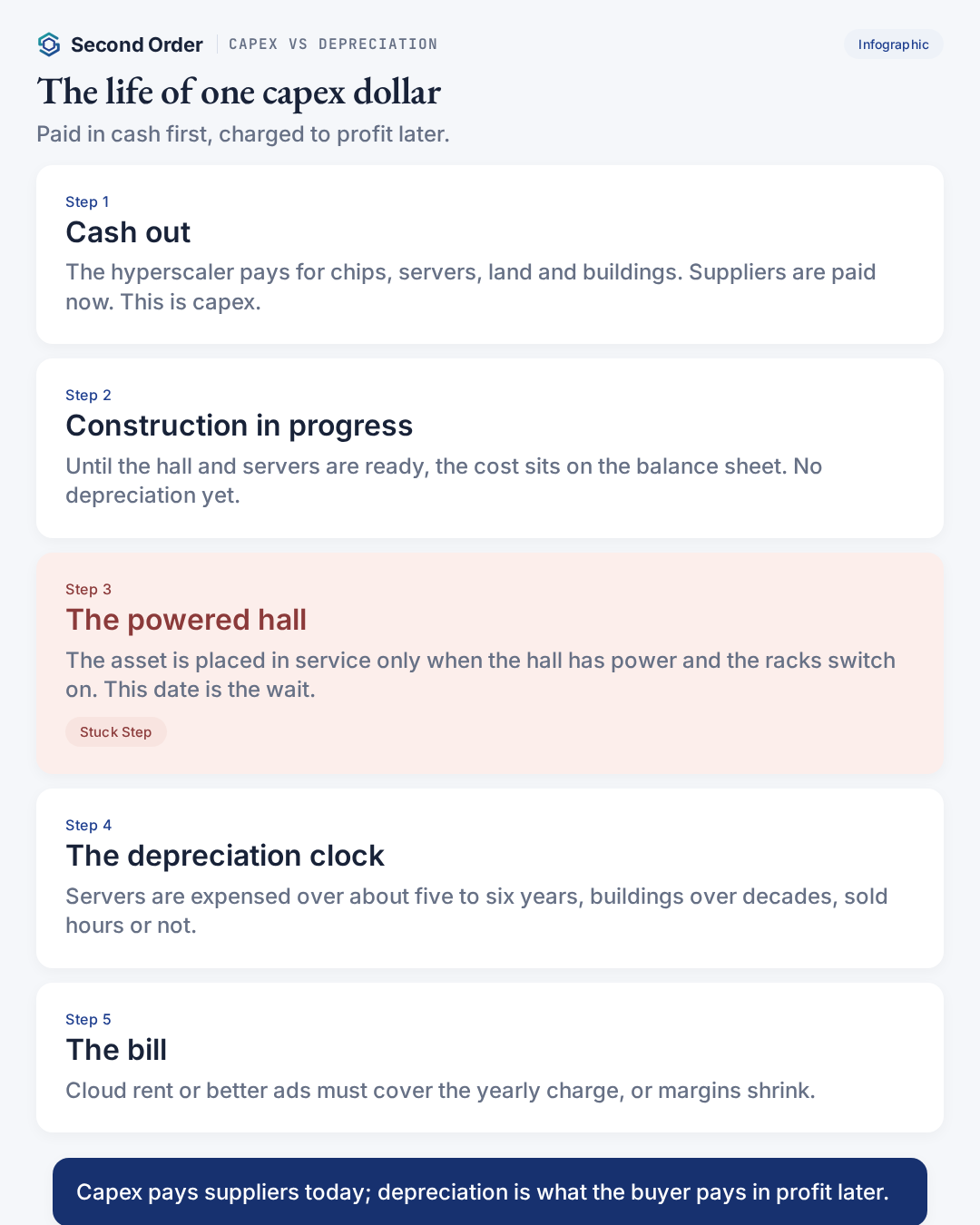
Capex is the cash out today; depreciation is the bill that reaches profit over the next five to six years. The five biggest AI buyers spent about four dollars in cash for every dollar of depreciation they booked in their latest quarters, and the clock only starts when a powered hall switches on.

EXPLAINED · Versus · Last reviewed: 22 Oct 2026 · Next review: after Alphabet, Microsoft and Amazon report third-quarter 2026 results (28 and 29 Oct 2026, US time)
Capex is cash spent now on long-lived assets such as servers and data halls; depreciation is that cost charged against profit, slice by slice, over the assets’ useful life.
In short. Capex is the cash; depreciation is the cost. A hyperscaler pays for servers and halls today, and the expense reaches its profit over the next five to six years for servers, longer for buildings. In their latest quarters Microsoft, Alphabet, Amazon, Meta and Oracle spent about $4 for every $1 of depreciation they booked, our arithmetic from their own figures. Suppliers are paid at the capex step. The depreciation clock starts only when a powered hall switches the servers on, and that is the step that sets the timing.
Why an investor cares: the AI build is paid for in cash today, but it reaches hyperscaler profit years later. Read only the profit line and you miss most of the spending; read only the capex line and you miss the bill that is coming. Our AI capex explainer covers what the money buys; this page is about when it turns into a cost.
What is the difference between capex and depreciation?
Capex is when the money leaves; depreciation is when the cost lands. A hyperscaler that buys $1 billion of servers pays the cash up front. It does not book a $1 billion expense that quarter. It records the servers as property and equipment, then charges a slice of their cost against profit every quarter for as long as it expects to use them.
So the same dollar shows up twice, at different times and on different statements. That timing gap is the whole story of AI spending in 2026.
| Capex | Depreciation | |
|---|---|---|
| What it is | Cash paid now for long-lived assets: chips, servers, network gear, land, buildings | The same cost charged against profit in slices over the assets’ useful life |
| When it happens | When the company pays | From the day the asset is ready for use, for about five to six years on servers |
| Where it shows | Cash flow statement (purchases or additions to property and equipment) | Income statement, inside cost of revenue and operating costs |
| Cash or non-cash | Cash | Non-cash; the cash already left |
| What sets its size | Management’s budget and supply of chips, power and halls | Past capex, the useful-life estimate, and when assets go into service |
| Who gets paid | Chip makers, server builders, builders, landlords | Nobody new; it is the buyer’s own cost catching up |
| What it tells you | How fast the build is growing | How much of the build profit must now carry |
Our summary of standard accounting as the hyperscalers describe it in their filings.
Does capex hit the income statement?
Not when it is spent. Capex sits on the balance sheet until the asset is ready for use. From then on, depreciation moves it into the income statement a little at a time, much of it inside cost of revenue.
Simple arithmetic shows the scale. Straight-line over six years, $1 billion of servers costs about $167 million a year in depreciation. Over five years it is $200 million a year. The cash is identical; only the schedule changes. Our capex vs opex page covers the other choice, renting GPU hours instead of buying them, which turns the whole cost into an operating expense as it is used.
How big is the gap between capex and depreciation now?
About four to one. In their latest reported quarters the five largest AI buyers spent about $197 billion in cash on property and equipment and booked about $48 billion of depreciation and amortization (our sum; the quarters cover slightly different months). The rest of that spending has not reached profit yet.
| Company | Quarter | Capex (cash) | Depreciation & amortization | Capex ÷ D&A | A year earlier |
|---|---|---|---|---|---|
| Oracle | Jun–Aug 2026 | $28.5B | $3.2B (+134%) | 9.0x | $8.5B vs $1.4B · 6.3x |
| Alphabet | Apr–Jun 2026 | $44.9B | $7.1B (+42%) | 6.3x | $22.4B vs $5.0B · 4.5x |
| Meta | Jul–Sep 2026 | $33.9B | $7.2B (+44%) | 4.7x | $18.8B vs $5.0B · 3.8x |
| Microsoft | Apr–Jun 2026 | $35.8B | $11.0B (+18%) | 3.2x | $17.1B vs $9.3B · 1.8x |
| Amazon | Apr–Jun 2026 | $54.2B | $20.0B (+31%) | 2.7x | $32.2B vs $15.2B · 2.1x |
Capex = purchases or additions to property and equipment in the cash flow statement. D&A as each company labels it: Alphabet counts depreciation of property and equipment only; Microsoft includes “other”; Amazon includes content and lease amortization. Ratios and growth rates are our arithmetic.
The gap is widening, not closing. A year earlier every one of the five had a lower ratio. Capex roughly doubled at Microsoft and Alphabet and more than tripled at Oracle, while depreciation grew 18% to 134%. Depreciation is a trailing number: it reflects what was bought and switched on in the past five or six years, and the biggest purchases are the newest.
Meta’s third-quarter results, released after the US close on 21 October 2026 (early on 22 October in Singapore), are the freshest example. It bought $33.9 billion of property and equipment in the quarter, against depreciation and amortization of $7.2 billion, up 44% in a year. It narrowed its 2026 capital spending outlook, including finance-lease principal, to $135–145 billion.

When does depreciation start?
When the asset is placed in service, not when it is paid for. Alphabet’s annual report says depreciation begins once assets are ready for their intended use. Meta’s says land and construction in progress are not depreciated.
That waiting room is large. Meta had $50.5 billion of construction in progress at the end of 2025, up from $26.8 billion a year earlier. Amazon had $71.7 billion, up from $46.6 billion. That money is spent (Meta says its construction in progress is mostly data centres), and none of it is yet a cost in the profit line.
Leases add a second queue. Microsoft had $329.1 billion of leases, mainly data centres, signed but not yet started at 30 June 2026, beginning between fiscal 2027 and 2033. Meta had $103.77 billion, Amazon $96.4 billion and Alphabet about $58.5 billion at the end of 2025. Those costs arrive as each hall is handed over; how a data-centre lease works explains the mechanics.
How does useful life change depreciation?
A longer life means a smaller yearly charge and higher reported profit, with no change in cash. A shorter life does the opposite. That is why every change in the estimate is disclosed.
Two changes in 2025 show the size. Meta lengthened most servers and network assets to 5.5 years, which cut its 2025 depreciation by $2.92 billion and lifted net income by $2.59 billion. Amazon went the other way for a subset of servers, from six years to five, citing the pace of AI technology; that added $1.4 billion of depreciation and took $1.0 billion off net income. Alphabet depreciates servers over generally six years, Microsoft over two to six. GPU depreciation goes deeper on why the life of an AI chip is the contested number.
Who gets paid, and where is the stuck step?
The suppliers are paid at the capex step, in cash, now. Chip makers, memory makers, server assemblers, builders and landlords see the money in the quarter it is spent; who the hyperscalers are lays out what each buyer is spending. Depreciation pays nobody. It is the buyer’s own cost catching up with it.
The stuck step sits between the two: the powered hall. Bought servers cannot go into service until a hall has power, so the date a hall energises decides when depreciation starts and when the matching revenue can start. How long it takes to build an AI data center shows why that runs in years, and our note on how hyperscalers buy power covers the deals behind it.
Our read: once a hall switches on, the clock runs whether or not the hours are sold. A server that sits idle still costs its depreciation every quarter, which is why GPU utilization matters so much to the return. Alphabet’s finance chief said on its July call that the heavier investment will keep pressure on profit through higher depreciation and data-centre running costs such as energy.
What would prove this wrong?
- Depreciation catches up fast. If capex flattens while depreciation keeps rising, the ratio falls toward 1x and the bill has arrived.
- Useful lives get cut. If more buyers follow Amazon to shorter server lives, the yearly charge jumps without any new spending.
- Construction in progress stops growing. If halls go into service faster than new ones start, the waiting room empties and power is no longer the step that sets the timing.
What to check next
Alphabet and Microsoft report third-quarter results on 28 October 2026 and Amazon on 29 October (US time). In each, check three lines: purchases of property and equipment, depreciation in the cash flow statement, and any change in server useful lives. Hyperscaler capex lines to watch shows where each company puts them, and cash capex explains why finance leases make the headline number differ.
Common misconceptions
- People assume capex is an expense the quarter it is spent. Actually it goes onto the balance sheet and reaches profit only through depreciation.
- People assume depreciation is a cash cost. Actually the cash left at the capex step; depreciation is an accounting charge, which is why it is added back in the cash flow statement.
- People assume depreciation starts when the servers are bought. Actually it starts when they are placed in service; until then they sit in construction in progress.
- People assume a longer useful life means the servers last longer. Actually it is an estimate that changes reported profit; Meta and Amazon moved theirs in opposite directions in 2025.
FAQ
What is the difference between capex and depreciation?
Capex is the cash a company pays out now for long-lived assets such as servers and data centres. Depreciation spreads that cost over the assets’ useful life as an expense in the profit and loss. Capex shows in the cash flow statement; depreciation shows in operating costs.
Is depreciation included in capex?
No. Capex is the purchase; depreciation is the later expense that comes from it. The same dollar appears twice in the accounts at different times: once as cash out, then again, in slices, as a cost against profit.
Does capex hit the income statement?
Not when it is spent. Capex goes onto the balance sheet as property and equipment. It reaches the income statement only through depreciation, which starts once the asset is ready for use and runs over its useful life.
Why is hyperscaler capex so much bigger than depreciation?
Because spending has roughly doubled in a year while depreciation still reflects older, smaller purchases. In their latest quarters Microsoft, Alphabet, Amazon, Meta and Oracle spent about $197 billion on property and equipment against about $48 billion of depreciation and amortization, our sum of their own figures.
How long do hyperscalers depreciate servers?
Five to six years for most servers today. Alphabet uses six, Meta 5.5, Microsoft two to six, and Amazon five to six after cutting a subset of servers from six to five years in 2025, citing the pace of AI technology.
When does depreciation start on a data centre?
When the asset is placed in service. Halls and servers still being built sit in construction in progress, which is not depreciated. Meta had $50.5 billion and Amazon $71.7 billion in construction in progress at the end of 2025.
Is this a signal to buy or sell hyperscaler shares?
No. This page explains how the accounts work and where the money moves. It does not rank companies or give buy or sell calls. Not investment advice. Do your own research.
Related: AI capex; GPU depreciation; capex vs opex; cash capex; remaining performance obligation; who are the hyperscalers.
Stack doors
Layer: Hyperscalers. Also: AI Data Centers, Neoclouds. Markets: US, where first power in Virginia sets when new halls can go into service.
Get the Wire — short daily notes when hyperscaler spending, depreciation and capacity move.
Not investment advice. Do your own research.
How we check this
Every capex, depreciation, useful-life and lease figure on this page comes from the companies’ own results and annual reports: Alphabet on 22 July 2026, Microsoft on 29 July, Amazon on 30 July, Oracle on 10 September and Meta on 21 October (US time), plus each company’s latest Form 10-K. Each figure was re-checked on 22 Oct 2026. Each company defines its spending and depreciation lines differently and the latest quarters cover different months, so ratios, growth rates and combined totals are labelled “our arithmetic” or “our sum” and are rough. Where we interpret, it is labelled “our read”. This page explains how the accounts work. It does not rank companies or give buy or sell calls. Not investment advice. Do your own research.
Last reviewed: 22 Oct 2026 · Next review: after Alphabet, Microsoft and Amazon report third-quarter 2026 results (28 and 29 Oct 2026, US time)
Spot an error? Tell us and we will correct it and note the change here.
References
- Meta — Third-quarter 2026 results (21 Oct 2026) — purchases of property and equipment $33.9B vs $18.8B; depreciation and amortization $7.15B vs $4.96B; capex incl. finance-lease principal $34.91B; 2026 outlook narrowed to $135–145B
- Microsoft — FY26 fourth-quarter results (29 Jul 2026) — additions to property and equipment $35.8B in the quarter, $115.9B in the year; depreciation, amortization and other $11.0B in the quarter
- Microsoft — Form 10-K for fiscal 2026 (filed Jul 2026) — servers and network equipment depreciated over two to six years; $329.1B of leases, mostly data centres, not yet commenced, starting fiscal 2027 to 2033
- Alphabet — Q2 2026 earnings release (22 Jul 2026) — purchases of property and equipment $44.9B vs $22.4B; depreciation of property and equipment $7.1B vs $5.0B
- Alphabet — Q2 2026 earnings call transcript (22 Jul 2026) — CFO: higher investment will keep pressure on the P&L through higher depreciation and data-centre costs such as energy; 2026 CapEx guide $195–205B
- Alphabet — Form 10-K for 2025 (filed Feb 2026) — servers and network equipment generally six years; depreciation starts once assets are ready for use; $58.5B of data-centre leases not yet commenced
- Amazon — Second-quarter 2026 results (30 Jul 2026) — purchases of property and equipment $54.2B vs $32.2B; depreciation and amortization $20.0B vs $15.2B
- Amazon — Form 10-K for 2025 (filed Feb 2026) — subset of servers cut from six to five years from 1 Jan 2025 (+$1.4B depreciation, −$1.0B net income in 2025); construction in progress $71.7B; leases not yet commenced $96.4B
- Meta — Form 10-K for 2025 (filed Jan 2026) — most servers and network assets extended to 5.5 years (−$2.92B depreciation, +$2.59B net income in 2025); construction in progress $50.5B, not depreciated; $103.77B of leases not yet commenced
- Oracle — Q1 fiscal 2027 results (10 Sep 2026) — capital expenditures $28.5B vs $8.5B; depreciation $3.16B vs $1.35B