Capex vs Opex: Buying GPUs vs Renting GPU Hours
Capex vs opex is the split between buying an asset that lasts years and paying a running cost as you go. Renting GPU hours turns a buyer’s capex into opex, but the capex does not vanish. The neocloud pays it first.
EXPLAINED · Versus · Last reviewed: 07 Oct 2026 · Next review: after CoreWeave and Nebius Q3 2026 results
Capex vs opex is the split between buying an asset that lasts years and paying a running cost as you go. Capex, or capital expenditure, is cash spent on things like GPU servers and buildings. Opex, or operating expense, is the cost of running the business now, like rented GPU hours, power and staff.
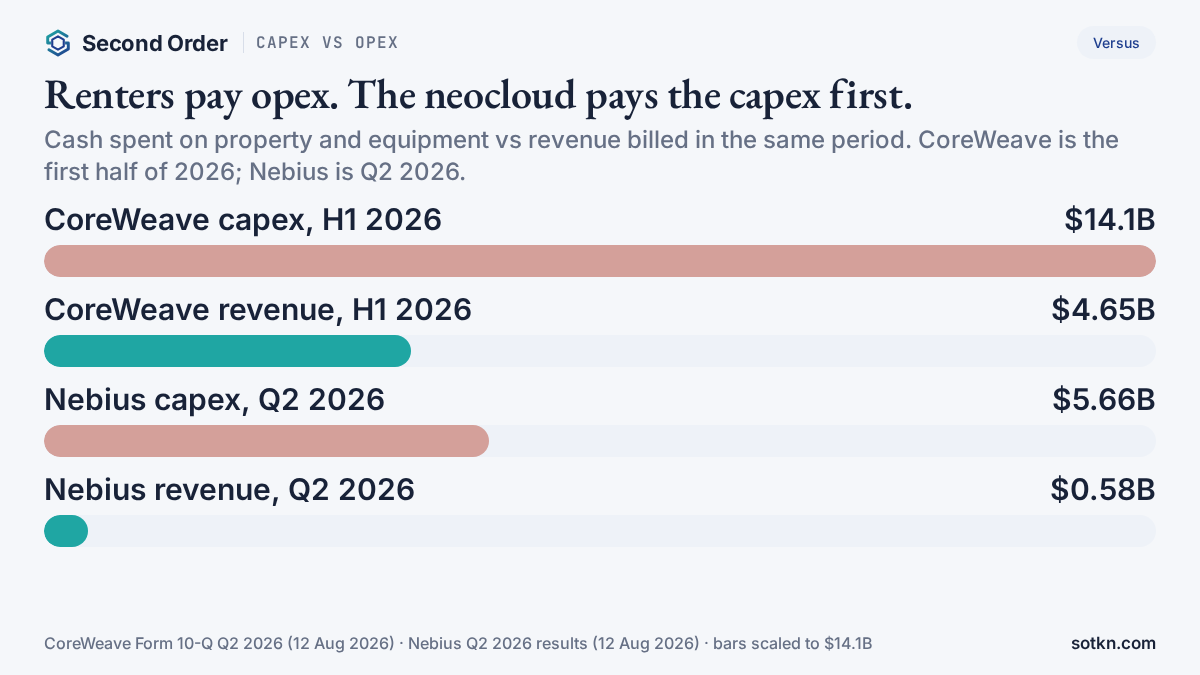
In short. Capex vs opex sits on the Neoclouds layer. Buy GPU servers and the cash leaves on day one; the cost reaches profit later, as depreciation over about six years. Rent GPU hours and you pay as you go, as opex. But renting does not remove the capex. It moves it to the neocloud, which borrows to buy the kit. CoreWeave spent $14.1 billion on property and equipment in the first half of 2026, against $4.65 billion of revenue.
Why an investor cares: one company’s opex is another company’s revenue, and its capex. When an AI lab rents GPU hours, someone else has already paid for the GPUs. For how that up-front cash works, see cash capex, explained. For how the hours are sold, see GPU as a service, explained.
What is the difference between capex and opex?
Capex buys something that lasts. Opex pays for something you use up now. That is the whole split.
The difference is timing. Capex cash leaves on the day the kit is paid for, but it reaches profit slowly, as depreciation. Opex reaches profit in the same period you pay it. So two companies can spend the same cash and report very different profits.
| Capex (buy the GPUs) | Opex (rent GPU hours) | |
|---|---|---|
| What you pay for | Servers, chips, networking, buildings | Hours of GPU time, power, staff, cloud bills |
| When the cash leaves | Up front, when the kit is paid for | As you use it, or on a contract schedule |
| Where it shows | Cash-flow statement (investing); asset on the balance sheet | Income statement (cost of revenue, R&D) |
| How it hits profit | Slowly, as depreciation over the useful life (CoreWeave: 6 years) | At once, in the period it is used |
| Who carries an idle GPU | The owner | The provider, unless the renter signed take-or-pay |
| AI example | CoreWeave: $14.1B of kit bought in H1 2026 | Meta: cost of revenue +33% in Q2 2026 on infrastructure and third-party cloud |
Capex vs opex examples in AI compute
Buying. Say a company spends $1 billion on GPU servers this year. All $1 billion of cash leaves now. CoreWeave depreciates its technology equipment over six years, its FY2025 10-K says. On a straight line, that is about $167 million of expense a year ($1 billion ÷ 6, no salvage, our arithmetic). Microsoft gives its servers and network equipment two to six years. For why the life matters, see GPU depreciation, explained.
Renting. Nebius lists an NVIDIA H100 at $4.50 per GPU-hour on demand from 1 October 2026, up from $3.85. One GPU running every hour of a year is 8,760 hours. At list price that is $39,420 of opex (8,760 × $4.50, our arithmetic). Contract buyers pay what their contract says, not the list, so treat this as a list-price example, not a typical bill. See Nebius’s October price rise.
The renter has no asset to depreciate and no up-front cash. It also has no GPU at the end. The bill stops when the hours stop, unless a contract says otherwise.
Is renting GPUs capex or opex?
Mostly opex, but not always. Plain cloud bills are a running cost. Long leases are different. Under US accounting, a lease of more than a year goes on the balance sheet.
Meta shows the opex side. Its Q2 2026 10-Q, filed 30 July 2026, says cost of revenue rose 33% to $11.33 billion, “primarily due to higher infrastructure expenses related to our data centers, technical infrastructure, and third-party cloud services.” That is rented compute landing straight in costs. Meta also lists $349.31 billion of non-cancelable commitments, mostly third-party cloud capacity plus its own servers, network gear, data centres and consumer hardware.
Microsoft shows the lease side. In its FY2026 10-K, filed 29 July 2026, operating leases cost $6.97 billion as one running line. Finance leases cost $7.95 billion, split into $5.40 billion of amortisation and $2.55 billion of interest. A finance lease looks a lot like owning, paid for over time.
| Microsoft, year to 30 June 2026 | Amount | What it means |
|---|---|---|
| Additions to property and equipment | $115.9B | Cash capex: kit and buildings it bought |
| Operating lease cost | $6.97B | One running cost, like rent |
| Finance lease cost | $7.95B | Split: $5.40B amortisation + $2.55B interest — it looks like owning |
| New finance-lease assets | $24.6B | Assets put on the balance sheet through leases, not cash purchases |
| Leases signed, not yet started | $329.1B | Mostly datacenters; start between FY2027 and FY2033 |
The big number is the one not started. Microsoft says it had $329.1 billion of additional leases, primarily for datacenters, that had not yet commenced at 30 June 2026. They start between fiscal 2027 and fiscal 2033, with terms of one to 20 years. Its purchase commitments of $194.1 billion also include take-or-pay contracts.
Who carries the capex when you rent?
The provider does. Renting moves capex off the renter’s cash-flow statement and onto the neocloud’s. That is the business model.
CoreWeave is the clearest print. Its Q2 2026 10-Q, filed 12 August 2026, shows $14.1 billion of property and equipment bought in the first half of 2026, up from $3.9 billion a year earlier. Revenue in the same six months was $4.65 billion. Capex was about three times revenue (14.117 ÷ 4.653 = 3.0, our arithmetic). See what CoreWeave does.
Nebius shows the same pattern, more sharply. In Q2 2026 it reported revenue of $582.3 million and spent $5.66 billion on property, equipment and intangibles. That is about 9.7 times revenue in one quarter (5,657.4 ÷ 582.3, our arithmetic). Its operating cash flow was still $2.25 billion positive in the quarter.
The capex is paid for with debt and with contracts. CoreWeave had $35.6 billion of debt principal at 30 June 2026 and $1.18 billion of net interest expense in the half. Its 10-K says committed contracts run one to six years and are “take-or-pay,” paid whether the hours are used or not. In Q2, 98% of its revenue came from those commitments. See take-or-pay GPU contracts and who finances GPU clusters.
Who gets paid, and where is the stuck step?
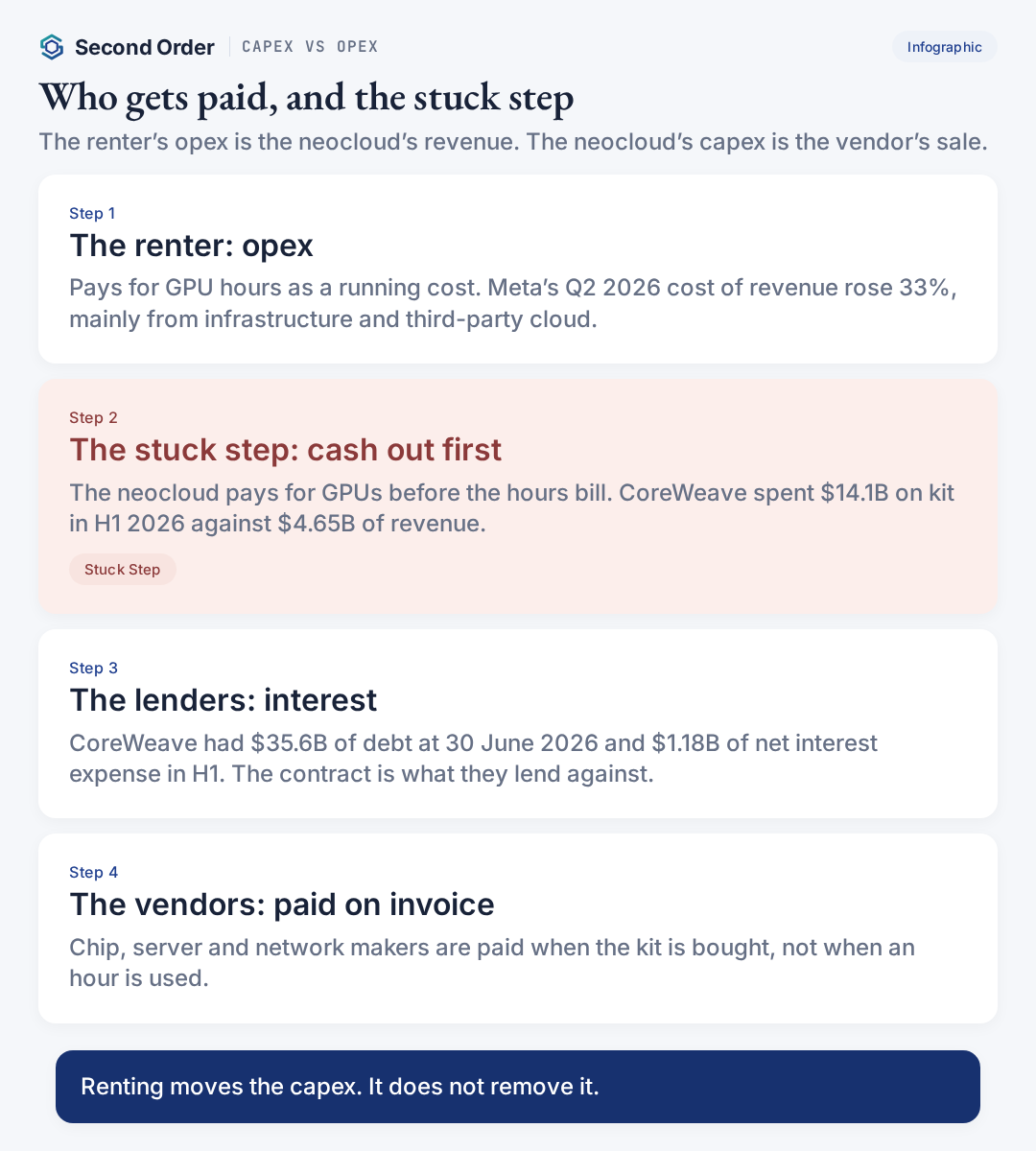
The renter pays the neocloud as opex. That opex is the neocloud’s revenue. The neocloud has already paid the chip, server and network makers, as capex, on their invoices. Lenders are paid interest along the way. Vendors are paid first. The neocloud is paid last, hour by hour.
The stuck step is the gap between cash out and hours billed. The neocloud carries it. CoreWeave reports $103.7 billion of remaining performance obligations, with 41% expected as revenue in the 24 months to June 2028. That is work promised, not cash received. Until the halls are live and the hours bill, the kit is paid for and the revenue is not.
The risk also sits in few hands. CoreWeave’s largest customer was 36% of Q2 2026 revenue and the second was 26%. A renter can shift its spend; the owner still holds the servers and the debt.
Why rent GPUs instead of buying them?
Speed and cash. Renting gets a lab compute without building a hall or waiting for servers. It keeps cash on hand and turns a large up-front bill into a running cost.
The trade-off is control and price. On-demand rates can move, as Nebius’s did on 1 October 2026. Long contracts fix the supply but lock in the payments. Meta, for example, has contingent obligations to buy up to $14.72 billion of cloud capacity over five years, reduced only if the provider can sell it elsewhere.
Which is cheaper depends on how busy the GPU stays. An owned GPU that sits idle still depreciates. A rented hour you do not use costs nothing, unless you signed take-or-pay. For the bigger version of this choice, see neocloud vs hyperscaler.
Common misconceptions
- People assume renting GPUs means no capex. Actually the capex moves to the provider. CoreWeave bought $14.1 billion of kit in six months to rent out.
- People assume every rental is opex. Actually a long lease goes on the balance sheet. Microsoft’s finance leases cost $7.95 billion, split into amortisation and interest.
- People assume capex hits profit when it is spent. Actually it reaches profit slowly, as depreciation. A $1 billion buy over six years is about $167 million a year.
- People assume opex is always flexible. Actually take-or-pay contracts bill whether the hours run or not. Meta lists $349.31 billion of non-cancelable commitments.
FAQ
What is the difference between capex and opex?
Capex is cash spent on assets that last more than a year, like servers and buildings. It is spread over the asset’s life as depreciation. Opex is the cost of running the business now, like rent, power, staff and cloud bills. It hits profit in the period you pay it.
Is cloud computing capex or opex?
For the customer, cloud computing is usually opex. You pay for hours as you use them, and the bill goes straight into costs. For the cloud provider, the same servers are capex. Meta’s Q2 2026 10-Q says its cost of revenue rose 33%, mainly from infrastructure costs including third-party cloud services.
Are GPUs capex or opex?
Bought GPUs are capex. The cash leaves when the servers are paid for, and the cost reaches profit over the useful life the owner picks. CoreWeave uses six years for its technology equipment. Rented GPU hours are opex for the renter.
Is a lease capex or opex?
It depends on the lease. Under US accounting, a long lease goes on the balance sheet. An operating lease shows one running cost. A finance lease is split into amortisation and interest, which looks a lot like owning. Microsoft reported $6.97 billion of operating lease cost and $7.95 billion of finance lease cost in its year to 30 June 2026.
Does renting GPUs avoid capex?
No. It moves the capex to someone else. The neocloud or cloud provider buys the GPUs and pays for them first. CoreWeave spent $14.1 billion on property and equipment in the first half of 2026, against $4.65 billion of revenue.
Why does capex not hit profit right away?
Because the asset is expected to earn for years. The cost is spread over its useful life as depreciation. On a $1 billion server buy with a six-year life, that is about $167 million of expense a year, while all $1 billion of cash has already gone.
Is this a list of stocks to buy or sell?
No. Second Order Explained pages explain who does what and how the money moves. They do not give buy or sell calls.
Related terms
- Cash capex — the cash that leaves before AI hours bill.
- GPU as a service — how rented GPU hours are sold.
- GPU depreciation — how bought servers reach profit over time.
- Take-or-pay GPU contracts — rented hours that bill even when idle.
Stack doors
Layers: Neoclouds and Hyperscalers. Markets: how CoreWeave’s contracts become cash. Analysis: when GPUs are ordered before renters sign.
Get the Wire — short daily notes when GPU prices, contracts, or capex prints move.
How we check this
Figures come from company filings and results releases, each dated in the list below: Microsoft’s 10-K, Meta’s and CoreWeave’s 10-Qs, CoreWeave’s 10-K, and Nebius’s Q2 2026 release. The GPU-hour price is Nebius’s own posted list price, as checked on the date shown. Where we work something out ourselves, like a six-year depreciation slice or a year of rented hours, the arithmetic is shown in full. This page explains how the money moves. It does not give buy or sell calls.
Last reviewed: 07 Oct 2026 · Next review: after CoreWeave and Nebius Q3 2026 results
Spot an error? Tell us and we will correct it and note the change here.
Sources
- Microsoft Form 10-K FY2026 — additions to property and equipment $115.9B; servers 2–6 year lives; lease costs; $329.1B of leases not yet commenced; purchase commitments incl. take-or-pay (filed 29 Jul 2026)
- Meta Form 10-Q Q2 2026 — cost of revenue +33% on infrastructure incl. third-party cloud services; $349.31B non-cancelable commitments; up to $14.72B contingent cloud capacity (filed 30 Jul 2026)
- CoreWeave Form 10-Q Q2 2026 — H1 purchases of property and equipment $14.1B, revenue $4.65B, RPO $103.7B, debt $35.6B, 98% committed-contract revenue (filed 12 Aug 2026)
- CoreWeave Form 10-K FY2025 — technology equipment 6-year life; committed contracts 1–6 years, take-or-pay, often prepaid (filed 2 Mar 2026)
- Nebius Q2 2026 results (Form 6-K, Ex. 99.1) — revenue $582.3M; purchases of property, equipment and intangibles $5.66B (12 Aug 2026)
- Nebius GPU price list — NVIDIA HGX H100 on-demand $4.50 per GPU-hour from 1 Oct 2026 (checked 7 Oct 2026)