299 MW of 3,000: Who Gets Paid While Virginia's $100B Data Center Campus Waits for Power
A $100 billion plan for 21 data centers in rural Virginia needs 3,000 MW. The utility has to promise 299 MW by the end of 2028. The rest comes from gas plants Stack must build itself. The scarce thing is the first power.

A field in rural Virginia has just become one of the largest data center plans in America. Stack Infrastructure wants to build 21 data centers needing 3,000 MW at the Berry Hill megasite, about $100 billion over three decades. The land is cleared, the gas pipeline is on site and the water is booked. The electricity is not. The utility has to promise 299 MW by the end of 2028, about a tenth of the plan. The stuck step is the first power.
US PULSE · AI DATA CENTERS · Data as at 20 Oct 2026 · Next update: GE Vernova's third-quarter results on 28 Oct
Affects: AI Data Centers · Hyperscalers — Markets: US · Korea · Taiwan
Education only, not advice to buy or sell any security. Figures are as filed or stated by the companies, the regulators or the newspapers named. Our own sums are labelled.
The numbers that matter this week
Power the campus needs
3,000 MW
21 data centers · about 15 years
PlanUtility power promised
299 MW
By the end of 2028
Stuck stepNew substation needed
150 MW
By mid-2028
ClockLand sale to the authority
$737.8M
About 2,990 acres
PaidAppalachian Power, Virginia
540 MW
Signed · 24,881 MW asked for
QueueState permit decision
Mid-March 2027
Virginia DEQ and Army Corps
ClockFigures from the Berry Hill project summary filed 8 October 2026 as reported by Virginia Business and the Chatham Star-Tribune on 19 October 2026, and from Appalachian Power’s testimony in Virginia case PUR-2026-00044. Status chips are Second Order’s read.
On this page: Why it matters · What changed · The plan · First power · The utility · Own gas · The pattern · Our math · Who gets paid · What is stuck? · Dates next · What would change this · FAQ
Why does a field in Virginia matter to who gets paid in AI?
Because an AI data center is only worth something once it is switched on. The chips, the cooling and the building can all be bought. The power has to be delivered, and it arrives through a long chain: a power plant, high-voltage lines, a substation that steps the voltage down, and switchgear inside the site. Until the last link is in place, the halls sit dark and nobody pays to use them.
Most headlines about giant campuses give the full size: so many gigawatts, so many billions. That number is the end of the story, often fifteen years away. The number that decides who gets paid this decade is smaller and harder to find. It is how much power arrives first, and when. At Berry Hill, the filings put that number in plain sight: 299 MW by the end of 2028, against 3,000 MW at full size.
That gap tells you the order of the money. The people who own the land, clear it and lay the pipes are paid now. The utility is paid once it delivers. The gas plant builders and the power gear makers are paid as they build. The developer, and whoever leases the halls, are paid last, building by building, as power reaches each one.
We have followed the same question from other US doors. Our NiSource–Microsoft 1,100 MW Pulse looked at a utility building plants for one buyer from 2028. Our US fuel cell power Pulse followed halls that buy their own power. Our PJM capacity Pulse showed why the regional grid is short of new supply. Berry Hill puts all three in one place.
1 · The land
Who: Danville–Pittsylvania authority
Paid: $737.8M sale; grading can start early
2 · The first power binds
Who: Appalachian Power and a new substation
Paid: 299 MW by end-2028; 150 MW substation by mid-2028
3 · Own gas plants
Who: Two generation campuses on site
Paid: Carry the rest of the 3,000 MW over time
4 · The halls
Who: Stack and an unnamed tenant
Paid: Paid as each building gets power
What changed between 8 and 19 October?
The project was announced in the spring as a land deal. This month the paperwork turned it into a plan with megawatts, acres and dates, and the politics around it got louder.
- 8 October — the filing. An environmental firm working for Stack filed a 92-page summary of what it calls Project Crossroads with the Virginia Department of Environmental Quality and the US Army Corps of Engineers. It lays out 21 data centers, 3,000 MW of power, two natural gas generation campuses on site, water from the cities of Eden and Danville, and the power conditions in the purchase agreement.
- 9 October — the federal ruling. The Federal Energy Regulatory Commission rejected most of the PJM grid operator's plan for connecting giant new loads such as data centers without matching new supply. It kept only a definition of large loads and a registry of where they sit. Energy Central's reading on 19 October: who pays to connect them is now a state-by-state question.
- 16 October — the early start. The Danville–Pittsylvania Regional Industrial Facility Authority voted to let Stack start grading about 400 acres before it completes the land purchase, for a $250,000 fee. The county's economic development director said speed is key to meeting customer demand.
- 19 October — the details and the push-back. Virginia Business and the Chatham Star-Tribune published the filing's details. The same evening, protesters in downtown Danville called for a statewide pause on new data center approvals, citing power bills, drought and water, and pointed to Berry Hill by name, WSET reported.
Put together, the plan got bigger on paper and closer in time, while the question of who pays for its power moved to Richmond. That is exactly where the first-power step gets decided.
What is Stack planning at Berry Hill?
Stack Infrastructure is a Denver-based developer that builds and runs data centers for large customers. In the spring the regional authority approved selling it nearly 3,000 acres of the Southern Virginia Megasite at Berry Hill, a publicly owned industrial site in Pittsylvania County near Danville, for $737.8 million. Stack plans to buy 2,990 acres; the campus itself would cover about 1,733 acres, and 445 acres would go into a permanent conservation easement.
A performance agreement signed in May commits Stack to invest at least $73.5 billion and create at least 2,050 jobs at an average wage of $80,500. The company itself talks of about $100 billion over three decades and 2,500 jobs over 20 years. The county calls it one of the largest single-site investments ever announced in the US. The application notes there are no local incentives; the authority expects up to $48 million a year in property tax at full build, shared between the county and Danville.
The site was not picked at random. The application says Stack looked at up to ten other sites in the county and none matched Berry Hill for land, water, gas and transport. The megasite's own overview shows why: a Williams Transco gas pipeline with a gate station on site, water lines with 7 million gallons a day of capacity, a sewer line, a rail spur, and a 138 kV substation from AEP, the parent of Appalachian Power.
The timetable is long. The state and federal permit decision is expected by mid-March 2027. Construction tied to the permit is expected to start in the third quarter of 2027. Full build-out is estimated at about 15 years. No tenant has been named.
What the filing says
What is still open
Where does the first power come from?
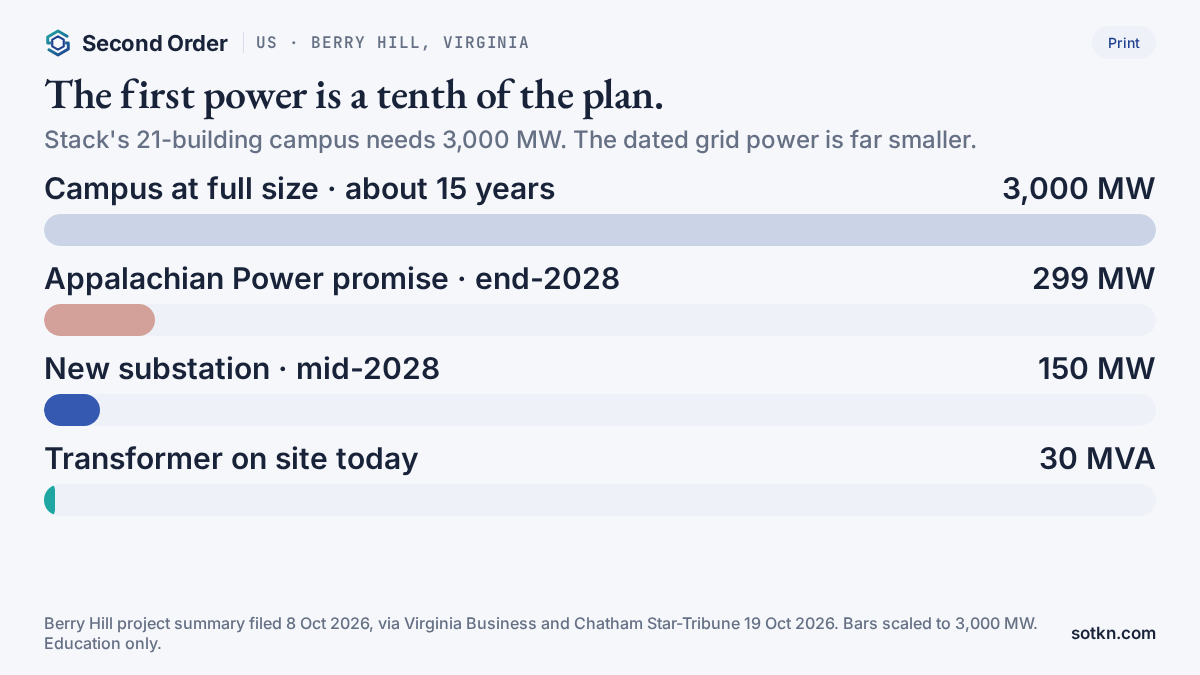
From the local utility, and only a slice of it. The purchase agreement says that for the deal to go ahead, Appalachian Power must provide a document stating it can supply the project at least 299 MW by the end of 2028. The Chatham Star-Tribune describes this as a private agreement already made between Stack and the utility. Either way, 299 MW is the first block of grid power the campus can count on.
To use it, the site needs a 150 MW substation by the end of the second quarter of 2028. The filing says there is a clear path to that, because an on-site substation already exists with a 30 MVA transformer and 138 kV lines. The megasite's marketing page describes that substation as offering 100 MW of immediately available power. A 30 MVA transformer is roughly a hundredth of what the full campus needs (our arithmetic). The Chatham Star-Tribune places the 150 MW substation on the 80-acre southwest energy campus, ready by early 2028.
So the first power runs on a clock that is set by others. A substation has to be designed, its transformers and breakers ordered and delivered, the lines connected and tested. The utility has to show it can serve the load without hurting its other customers. If any one of those slips, the first building waits, and so does the first payment from whoever leases it.
Big transformers and breakers are where the queue is longest. Yesterday's Korea power gear Pulse found US tech companies booking Korean switchgear two years ahead and 69% of Korea's big transformer exports going to America. A substation due by mid-2028 needs its gear ordered well before then.
What has Appalachian Power signed up for?
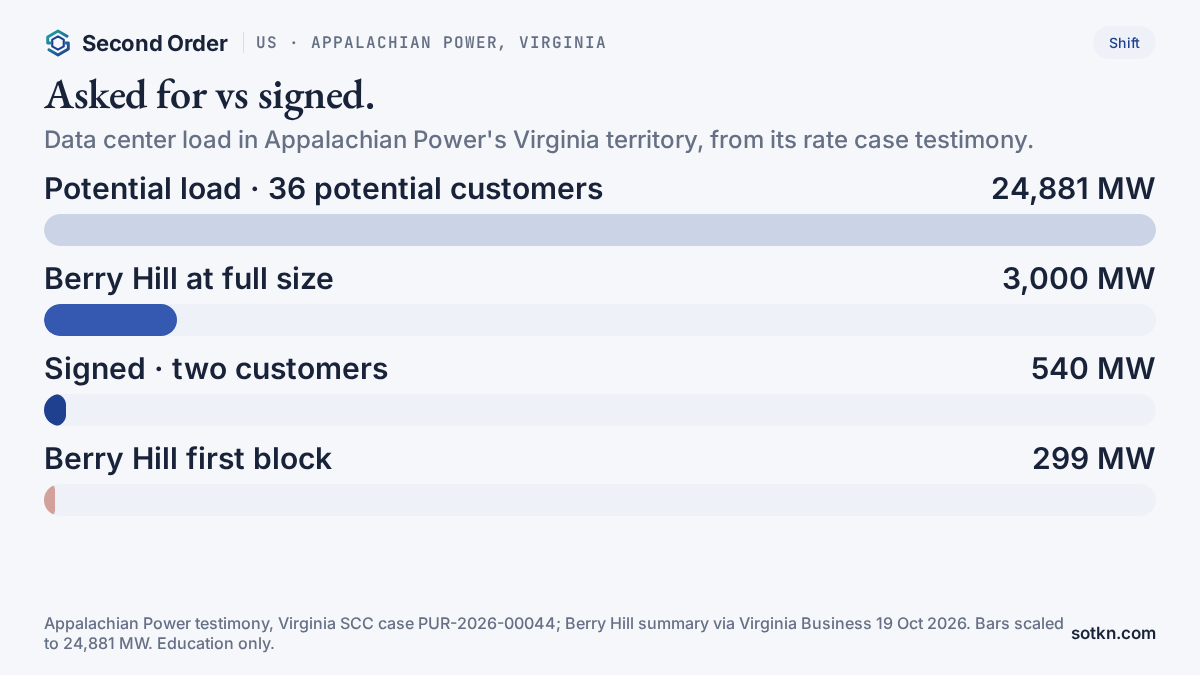
Less than it is being asked for, by a wide margin. In its Virginia rate case filed this spring, Appalachian Power told the State Corporation Commission it has contracted 540 MW of data center load in Virginia, with two customers that have signed electric service agreements, worth about 3.8 million megawatt-hours a year. It also listed 24,881 MW of potential load from 36 potential customers in various stages of inquiry or negotiation. And it said it has no new large-load customers in service yet.
Put Berry Hill against that. The full campus, at 3,000 MW, is about 12% of everything Appalachian Power is being asked for in Virginia, and more than five times what it has signed (our arithmetic). We cannot tell from the public record whether Stack's 299 MW is inside the 540 MW already signed or comes on top.
The terms tell you how the utility protects itself. Under the large-load rules the commission approved on 1 June, any new load of 100 MW at one site, or 150 MW across sites, signs for at least 14 years, with up to four years to ramp up. It pays for at least 80% of its contracted demand every month, used or not. Unless it has a strong credit rating, it posts collateral equal to 24 months of its expected bill. It can cut its contract by up to 20% after five years with 42 months' notice; beyond that, it pays an exit fee.
In plain words: the utility is paid for the power it reserves, not just the power that is used. That is good for the utility and its other customers. It also means a developer who reserves 299 MW pays for most of it from the day service is available, whether or not the halls are full. The money for the first power starts flowing to the utility before it flows to the developer.
One more detail matters. Appalachian Power's testimony says it is a Fixed Resource Requirement utility inside the PJM grid, which means it cannot buy capacity in PJM's auction and must line up its own. Every megawatt it promises a data center has to come from its own plants or contracts. That helps explain why 299 MW is the promise and the rest is left to Stack's own generation. For scale, the coal and gas plants Appalachian Power owns add up to about 5,900 MW, so Berry Hill at full size would equal about half of them (our arithmetic, from the plant list in the testimony).
Why is Stack building its own gas plants?
Because the grid cannot carry 3,000 MW to one rural site any time soon, and because the politics now demand that data centers pay their own way. The filing describes two natural gas generation campuses on the site: an 80-acre Southwest Energy Generation Campus and a 125-acre Northeast Energy Generation Campus that will power the rest of the campus. Their size in megawatts and their start dates are not given.
The county's economic development director put the reason simply: one of the key ways of ensuring there is no impact on ratepayers is generating the electricity on site. That line matters more after this month. Energy Central's reading of the FERC order is that the fight over who absorbs the cost of the AI build-out is now a state-by-state patchwork. Protesters in Danville want Virginia's General Assembly to consider a moratorium on new data center approvals when it returns in January.
Building your own power moves the stuck step rather than removing it. The gas is there: the Transco pipeline has a gate station on site. The machines that burn it are not. BlockWest Research reported in early October that GE Vernova had 116 GW of gas turbine backlog and slot reservations in July against about 20 GW of yearly output, which is close to six years of work (our arithmetic). A developer that wants turbines for the late 2020s has to be in that queue already. Engines, fuel cells and batteries are the other routes, each with its own lead times.
We traced what happens when sites above about 250 MW have no named power plant in the members' Analysis on dedicated power above 250 MW. For a country that has simply capped new halls instead, see the Israel 200 MW cap Wire.
Is this one campus or a US pattern?
A pattern. Across the US, the giant numbers are announced first and the power arrives in small blocks. BlockWest counted eleven of the largest US AI campuses tracked by Epoch AI: together they plan 14,358 MW of IT power, and 4,121 MW, or 28.7%, was running in early October. The plans are three and a half times bigger than what is live.
- Ohio: SoftBank's 10 GW plan went to PJM for study as 800 MW first and 9,570 MW more. The first block is about 8% of the total (our arithmetic). The developer has committed to pay for new transmission.
- Indiana: NiSource's deal with Microsoft adds about 1,100 MW of generation, with power from 2028, under a large-load rate where the buyer funds what it needs.
- Kentucky: Meta's Mason County campus needs 2.2 GW and a set of new substations before it can run.
- Kansas: Digital Realty's De Soto plan offered $20 million of household credits to the town ahead of a 600 MW campus.
- Indiana again: a 960 MW nuclear plan backed by Amazon, which AEP and X-energy agreed on 19 October to study at a retired coal station, shows Appalachian Power's parent hunting for long-dated supply too.
Berry Hill fits the shape exactly. A headline of 3,000 MW and $100 billion. A first block of about 10% from the utility by the end of 2028. The rest from power the developer has to build. The headline sells the site. The first block decides when anyone gets paid.
For what the full chain of a campus like this costs, see how much it costs to build an AI data center. For why the build clock runs years from land to live, see how long it takes to build an AI data center.
Our math: what do the numbers say?
- First block: 299 MW of 3,000 MW is 10.0% of the campus at full size; 2,701 MW, or 90%, has to come from somewhere else (our arithmetic).
- Substation: 150 MW by mid-2028 is 5% of the full campus and about half of the 299 MW promise (our arithmetic).
- Today's transformer: 30 MVA is roughly 30 MW at best, about 1% of 3,000 MW (our arithmetic; MVA and MW are close but not the same).
- Per building: 3,000 MW across 21 data centers is about 143 MW each on average (our arithmetic). The first 299 MW covers about two of them.
- Pace: 3,000 MW over about 15 years is about 200 MW a year on average (our arithmetic).
- Cost per gigawatt: $100 billion for 3 GW is about $33 billion per GW, close to BlockWest's estimate of about $37.9 billion per planned GW for large US AI campuses (our arithmetic).
- Land: $737.8 million for 2,990 acres is about $247,000 an acre; the $250,000 early-access fee for 400 acres is about $625 an acre (our arithmetic).
- The utility's queue: 24,881 MW asked for against 540 MW signed is about 46 times; Berry Hill alone is about 12% of the asks (our arithmetic).
- Signed load: 3.8 million MWh a year on 540 MW means the two signed customers are expected to run at about 80% of the time on average (our arithmetic: 3.8 million ÷ (540 × 8,760)).
- Turbines: 116 GW of backlog and reservations against about 20 GW a year of output is about 5.8 years of work (our arithmetic).
What this tells you: the campus is not short of land, water, gas or money on paper. It is short of delivered electricity in the early years. Ninety per cent of its power is not yet tied to a dated source, and the 10% that is depends on a substation and a utility promise due in 2028.
Who gets paid first?
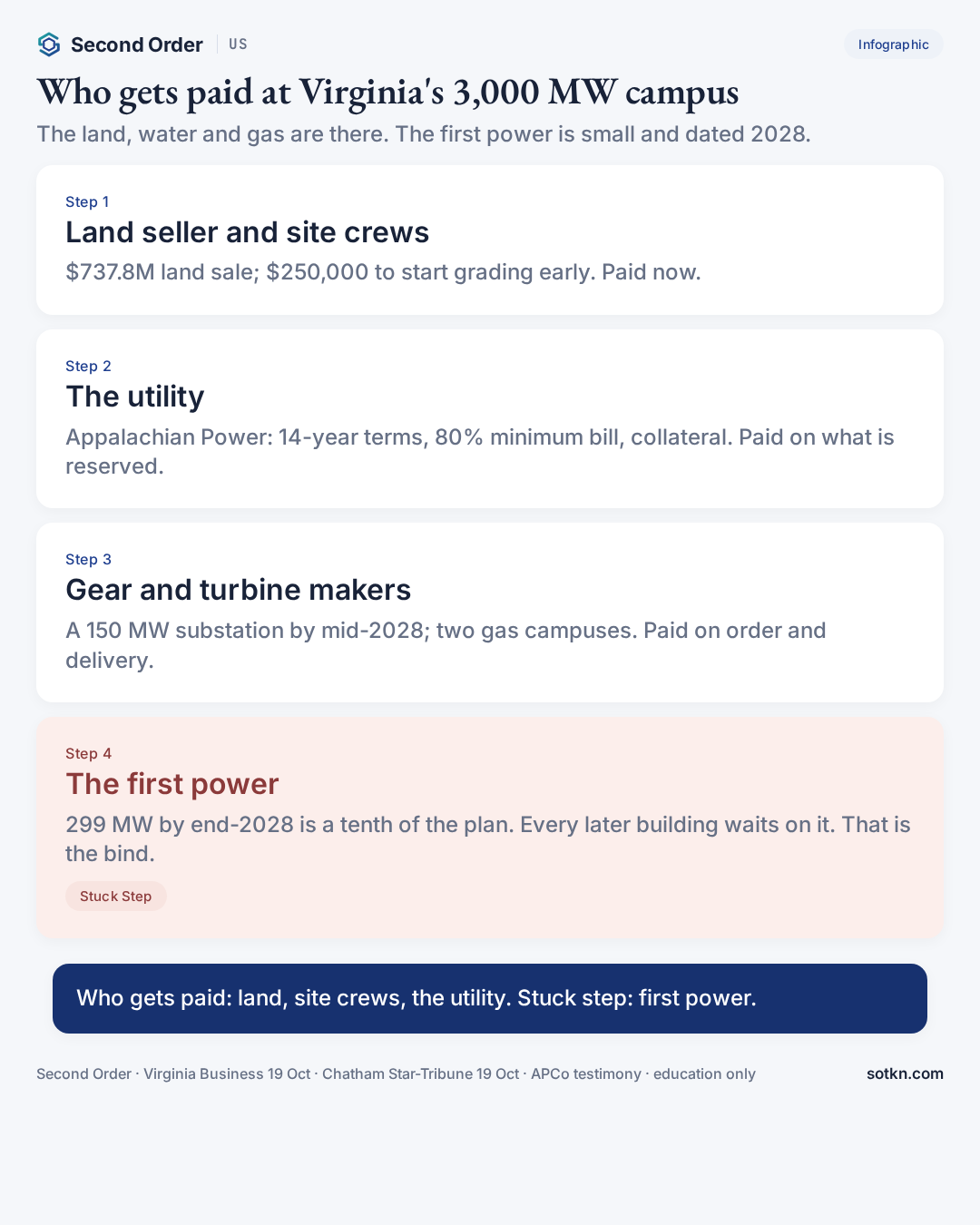
First, the landowner and the site crews — now. The regional authority is selling the land for $737.8 million and has already taken a $250,000 fee to let grading start early. Earthmoving contractors, engineers and the environmental consultants preparing the permits are paid as they work, long before any hall exists.
Second, the utility — on reserved capacity. Appalachian Power, part of AEP, is paid under 14-year contracts with an 80% minimum monthly bill and collateral posted at signing. Once the first 299 MW is available, it is paid for most of it whether the halls are full or not.
Third, the makers of power gear and generating machines — on order and delivery. The 150 MW substation needs transformers and switchgear by mid-2028. The two gas campuses need turbines or engines from queues that already run years ahead. The pipeline owner, Williams, sells gas transport once the plants run. Which suppliers win Berry Hill's orders is not public.
Fourth, the local governments — as buildings go up. Property tax of up to $48 million a year comes at full build, phased in building by building. Danville also sells water and sewer service to the site.
Last, Stack and its tenant — when each building is powered. Lease payments on a data center usually start when the hall is handed over with power, not when the lease is signed; see data center leases, explained. Until a tenant is named, nobody outside can say when that first payment lands.
One-line rule: at Berry Hill right now, the land seller and site crews are paid first, the utility is paid on what is reserved, the gear and turbine makers are paid as they deliver, and the developer and its tenant wait for each building's power. The stuck step is the first power.
So what is the stuck step?
First power: the utility megawatts and the substation that carry the first buildings before the campus's own gas plants can carry the rest. Not land: it is sold. Not gas or water: both are at the fence line. Not money on paper: the plan is backed by a signed investment floor. Three things make this step stick:
- A small first block: 299 MW by the end of 2028 is a tenth of the plan. Every building after the first two depends on power that has no dated source yet.
- Gear and machines in queues: the substation's transformers and breakers, and the turbines for the gas campuses, come from factories already booked years ahead.
- Politics in Richmond: with FERC handing cost questions to the states and a moratorium push due in January, the terms for new large loads in Virginia could still change.
So-what: whoever controls the first megawatts, the utility and the gear makers, is paid before whoever needs them. A 3,000 MW plan is worth what its first 299 MW can earn until the next block is dated. For the general pattern of cash sticking where the bind sits, see where the stuck step moves.
Which dates test this read next?
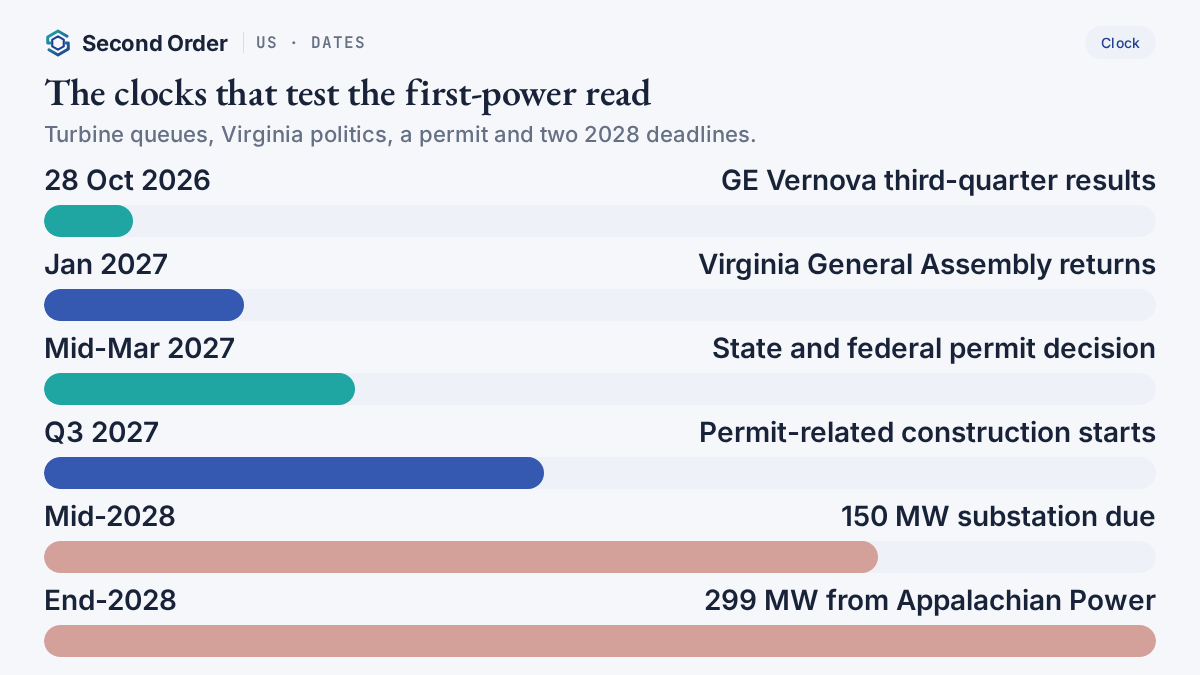
- 28 October 2026 — GE Vernova's third-quarter results. The test: whether the gas turbine backlog and slot reservations keep growing, which sets how fast on-site gas can arrive.
- January 2027 — Virginia's General Assembly returns. The test: whether a moratorium or new cost rules for data center power get a hearing.
- By mid-March 2027 — the state and federal permit decision on Berry Hill. The test: whether the wetland and stream permits clear on time.
- March 2027 — Appalachian Power's new Virginia rates take effect, if approved. The test: how large-load terms are tightened or confirmed.
- Third quarter 2027 — permit-related construction is due to start. The test: whether Stack names a tenant or a gas plant supplier.
- End of second quarter 2028 — the 150 MW substation is due. The test: whether the first power arrives on time.
- End of 2028 — Appalachian Power's 299 MW. The test: the first block in full, and what is dated next.
The near dates test the queues and the politics. The 2028 dates test the first power itself.
What would change this view?
- Appalachian Power signs a much larger, dated block for Berry Hill — the first-power bind would loosen and the gas plants would matter less early on.
- Stack names a tenant with a firm start date and a turbine or engine order — the second block would be dated, and the stuck step would move to construction.
- Virginia passes a moratorium or tougher cost rules in 2027 — the bind would move from equipment to permission.
- The permit decision slips well past March 2027 — the clock would move from power to paperwork.
Practical takeaways
- Stack's Berry Hill plan: up to 21 data centers, 3,000 MW, about $100 billion over three decades
- First power: Appalachian Power to confirm at least 299 MW by the end of 2028; a 150 MW substation by mid-2028
- The rest: two on-site gas generation campuses, size and dates not disclosed
- Appalachian Power has signed 540 MW of Virginia data center load and is fielding 24,881 MW of requests
- No tenant named; permit decision by mid-March 2027
- Stuck step: first power
FAQ
What is Stack planning at Berry Hill?
A campus of up to 21 data centers on about 1,733 acres of the Southern Virginia Megasite at Berry Hill in Pittsylvania County, needing 3,000 MW of power, with two on-site natural gas generation campuses. Stack, a Denver data center developer, puts the investment at about $100 billion over three decades; its signed agreement with the local authority commits at least $73.5 billion. Full build is expected to take about 15 years.
How much power is promised, and when?
The purchase agreement requires Appalachian Power to confirm it can supply at least 299 MW by the end of 2028. The project also needs a 150 MW substation by the end of the second quarter of 2028. That first 299 MW is about a tenth of the 3,000 MW the campus needs at full size (our arithmetic). The rest is planned to come from Stack's own gas plants and later grid supply.
Who is the tenant?
Not disclosed. Neither the filing nor the local reports name a cloud company or AI lab as the customer. Until a tenant is named, nobody outside can say when lease payments start.
What is the stuck step?
First power. Land, water and gas are already at the site. What is short is the electricity for the first buildings: the utility's 299 MW and a new substation by 2028, before Stack's own gas plants can carry the rest. Every later building waits on that first block arriving on time.
Is this investment advice?
No. Education only. It maps who gets paid and which step is stuck. It is not a recommendation to buy or sell any security, and we leave out share prices, broker ratings and price targets on purpose.
Keep reading on the map
- US Markets hub — country page
- NiSource–Microsoft 1,100 MW Pulse · PJM capacity shortfall Pulse
- US fuel cell power Pulse — halls that buy their own power
- Korea power gear Pulse — the transformers US sites are booking
- SoftBank's 10 GW Ohio study Wire · Meta Mason County Wire
- How much an AI data center costs · How much water one uses
- Members' Analysis: dedicated power above 250 MW · If new halls stay capped at 200 MW
- AI Data Centers on the stack · Hyperscalers
- All Markets doors — Taiwan, Korea, US, China, Singapore, Australia, Malaysia
How we check this. The campus plan, the 3,000 MW figure, the two gas generation campuses, the 299 MW and 150 MW conditions, the existing transformer, the early access vote and the investment figures come from the project summary filed on 8 October as reported by Virginia Business and the Chatham Star-Tribune on 19 October 2026. The protest comes from WSET on 19 October. Site utilities come from the megasite’s own overview page. Appalachian Power’s signed and potential load, its large-load terms and its capacity status come from its testimony in Virginia case PUR-2026-00044 and the State Corporation Commission’s 1 June order as summarised by ReisingerGooch. The FERC order comes from Energy Central on 19 October. Campus totals and the turbine queue come from BlockWest Research on 5 October. The tenant is not named in any source we found, and we do not guess it. Share prices, broker ratings and price targets are left out on purpose. Anything we worked out ourselves is labelled “our arithmetic”. The references we used are listed at the end. Our editorial standards →
Not investment advice. Do your own research.
References
- Virginia Business, Details emerge on $100B data center campus in Southern Virginia, 19 Oct 2026. virginiabusiness.com — project summary filed 8 October: 21 data centers, 3 GW, two on-site gas facilities; early access to grade about 400 acres for $250,000; Appalachian Power to confirm at least 299 MW by end-2028; 150 MW substation by mid-2028; existing 30 MVA transformer and 138 kV lines; $73.5 billion minimum investment.
- Chatham Star-Tribune, 'Project Crossroads' details 21 data centers across 1,733 acres at Berry Hill, 19 Oct 2026. chathamstartribune.com — 92-page application to Virginia DEQ and the US Army Corps of Engineers; 3,000 MW; Southwest and Northeast energy generation campuses; about 15 years to full build; no local incentives; water from Eden and Danville; permit decision by mid-March 2027.
- WSET, Danville protesters call for pause on new Virginia data centers, 19 Oct 2026. wset.com — Virginia Organizing campaign for a statewide pause; utility bills, drought and water; moratorium push for the January General Assembly.
- Southern Virginia Megasite at Berry Hill, Site overview, accessed 20 Oct 2026. southernvirginiamegasite.com — 3,528-acre public megasite; Williams Transco pipeline gate station on site; AEP double-circuit 138 kV substation marketed with 100 MW available; 7 MGD water.
- Appalachian Power, direct testimony of William K. Castle, Virginia SCC Case PUR-2026-00044, May 2026. scc.virginia.gov — 540 MW of Virginia data center load contracted with two customers; 24,881 MW from 36 potential customers; no new large load customer yet in service; FRR entity; large-load collateral and exit terms; new rates from March 2027.
- ReisingerGooch, SCC approves new rate schedule for Appalachian Power large energy users, including data centers, 15 Jun 2026. reisingergooch.com — final order 1 June 2026: loads of 100 MW at a site or 150 MW aggregated; 14-year initial term with up to four years of ramp; 80% minimum monthly billing demand; collateral and exit fees.
- Energy Central, FERC Just Handed the Data-Center Bill Back to the States, 19 Oct 2026. energycentral.com — FERC order of 9 October rejected most of PJM's interim large-load service, kept a large-load definition and registry; cost questions go to the states.
- BlockWest Research, The gigawatt ledger: tracking AI data center campuses and power deals, 5 Oct 2026. blockwest.co — eleven large US AI campuses: 14,358 MW planned, 4,121 MW operating; about $37.9 billion per planned gigawatt; GE Vernova 116 GW gas turbine backlog plus slot reservations against about 20 GW a year of output.
- Akros index events, GE Vernova third-quarter 2026 earnings webcast, 28 Oct 2026. akrostec.com — GE Vernova third-quarter webcast scheduled for 28 October 2026.