
69% Goes to America: Who Gets Paid as Big Tech Books Korea's Power Gear Years Ahead
Korea's memory makers just had their worst week since 2008. Its power gear makers spent the same week signing two-year deals with US Big Tech. Seven in ten big transformers Korea exports now go to America. The scarce thing is a factory slot.
Korea's memory makers just had their worst week on the stock market since 2008. In the same week, Korea's power gear makers signed deals with US Big Tech that run to 2028. LS Electric booked its 2027 batch of switchgear for a US hyperscale data centre on a two-year contract, a week after a fuel cell power package for a data centre in Pennsylvania. Seven in ten big transformers Korea exports now go to America. Orders are not the problem. The stuck step is a factory slot.
KOREA PULSE · AI DATA CENTERS · Data as at 19 Oct 2026 · Next update: LS Electric's third-quarter results on 21 Oct
Affects: AI Data Centers · Hyperscalers · Semiconductors — Markets: Korea · US · Taiwan
Education only, not advice to buy or sell any security. Figures are as filed or stated by the companies, the government agencies or the newspapers named. Our own sums are labelled.
The numbers that matter this week
Big transformer exports to the US
69.4%
Share, Jan–Sep 2026 · 31.9% in 2023
ShiftShipped to the US, Jan–Sep
US$809M
Up 44.2% on a year
PaidLS Electric 2027 switchgear batch
US$125.2M
Two-year deal · 2028 not set
BookedBloom fuel cell site package
US$138.5M
Delivery Apr–Jul 2027
BookedFactory slots for big gear
Booked ahead
New plants land 2027–2028
Stuck stepUS rules on foreign grid gear
Due 24 Dec
Executive Order 14421
ClockFigures from the LS Corp filing of 19 October 2026, Seoul Economic Daily on 13 October 2026, Korea Customs Service data reported by the Korea Economic Daily on 16 October 2026 and the US Department of Energy. The 24 December date is 120 days after 26 August (our arithmetic). Status chips are Second Order’s read.
On this page: Why it matters · What changed · The contract · Where it goes · Booking ahead · Memory vs power gear · The US rule · Our math · Who gets paid · What is stuck? · Dates next · What would change this · FAQ
Why does Korean power gear matter to who gets paid in AI data centres?
Because a data centre full of chips does nothing until power reaches the racks, and power has to pass through heavy equipment on the way. At the grid end, giant transformers step high-voltage electricity down. Circuit breakers cut the flow if something goes wrong. Inside the site, switchgear splits the power into feeds for each hall and trips them off if a fault appears, so one short circuit does not take down a building of servers. None of this is clever like a GPU. All of it is big, heavy, built to order and slow to make.
Korea makes a lot of this gear and ships a growing share of it to America. Three listed companies lead: HD Hyundai Electric, Hyosung Heavy Industries and LS Electric. Their US buyers include power companies replacing old grid equipment and, more and more, data centre builders and the cloud companies behind them, buying for sites that will not switch on until 2027 or later.
That changes how they get paid. A maker of chips is paid when the chips ship, and the next order arrives every quarter. A maker of power gear signs an order today, builds it over many months, and bills as each piece is delivered. The size of the order book matters less than how fast the factory can turn it into delivered equipment. That is why the news this month is about factories and multi-year contracts, not just orders.
We have followed the same chain from other doors. Our US fuel cell power Pulse followed data centres that buy their own power plants; the Bloom Energy deal below is the Korean switchgear inside one of them. Our Schneider Catalyst showed data centre orders for electrical gear growing faster than the French group could ship them. For what the electrical chain costs inside a new site, see how much it costs to build an AI data center.
1 · The order
Who: US Big Tech and its builders
Paid: Book gear years ahead on long contracts
2 · The factory slot binds
Who: Big transformers, breakers, switchgear
Paid: New plants arrive in 2027 and 2028
3 · Paid on delivery
Who: HD Hyundai Electric, Hyosung, LS Electric
Paid: US$809M of big transformers to the US in nine months
4 · The site
Who: Data centre halls
Paid: If a site is late, its gear ships late
What changed between 1 and 19 October?
Five items in under three weeks, all pointing the same way. The buyers are locking in power gear for years, the Korean makers are adding factory space as fast as they can, and more of what they make is heading to the US.
- 1 October — grid transformers to 2030. LS Electric won a KRW 181.2 billion contract to supply 345 kV transformers for a North American AI data centre and power project, to be delivered in stages through 2030. THE Biz noted that it covers both the switching gear for the site's own power plant and the grid-side equipment that brings in bulk power.
- 13 October — the Bloom package. LS Electric signed a KRW 185.3 billion (US$138.5 million) deal with Bloom Energy to supply 38 kV switchgear and distribution transformers for a fuel cell power plant at a large US tech company's data centre in Pennsylvania, for delivery from April to July 2027. Seoul Economic Daily reported that LS's orders from Bloom have now passed US$500 million since April 2025.
- 16 October — a factory and a count. Hyosung Heavy Industries opened a new export-only plant in Changwon for circuit breakers rated 420 kV, 550 kV and 800 kV, doubling its capacity above 420 kV and doubling output of the insulating parts it makes in-house. The same day, Korea Customs data reported by the Korea Economic Daily showed big transformer exports to the US up 44.2% in the first nine months. A KIET report, from the state-funded industry think tank, said the bottleneck in building AI data centres has widened to power equipment, the grid and cooling.
- 16 to 18 October — the memory sell-off. Samsung Electronics and SK hynix had their steepest weekly share falls since 2008, the Korea Herald reported, as foreign investors sold a net KRW 11.21 trillion of Kospi shares in one week on worries about US interest rates, the payback on AI spending and Chinese competition.
- 19 October — the two-year deal. LS Electric filed a KRW 168.9 billion (US$125.2 million) contract for 38 kV switchgear for a US hyperscale data centre project. It is the 2027 batch of a two-year long-term agreement, following a US$115.0 million 2026 batch. LS said Big Tech is moving from short-term spot orders to contracts that secure volume over long periods.
Put together, the message is not that AI demand is safe. The stock market spent the week arguing the opposite for memory. It is that the companies building data centres are acting as if the equipment, not the demand, is the thing they might run short of.
What did LS Electric actually sign?
The filing is short and worth reading line by line. The contract is for power gear for a North American data centre, called the 2027 project. The value is US$125,229,300, or KRW 168.9 billion at the day's exchange rate. That is 3.40% of LS Electric's 2025 sales. The customer on paper is LS Electric America, LS's own US arm, which won the hyperscale data centre job; LS in Korea supplies it the switchgear. The order date, the date of the purchase order, is 16 October. The contract runs to 31 December 2027.
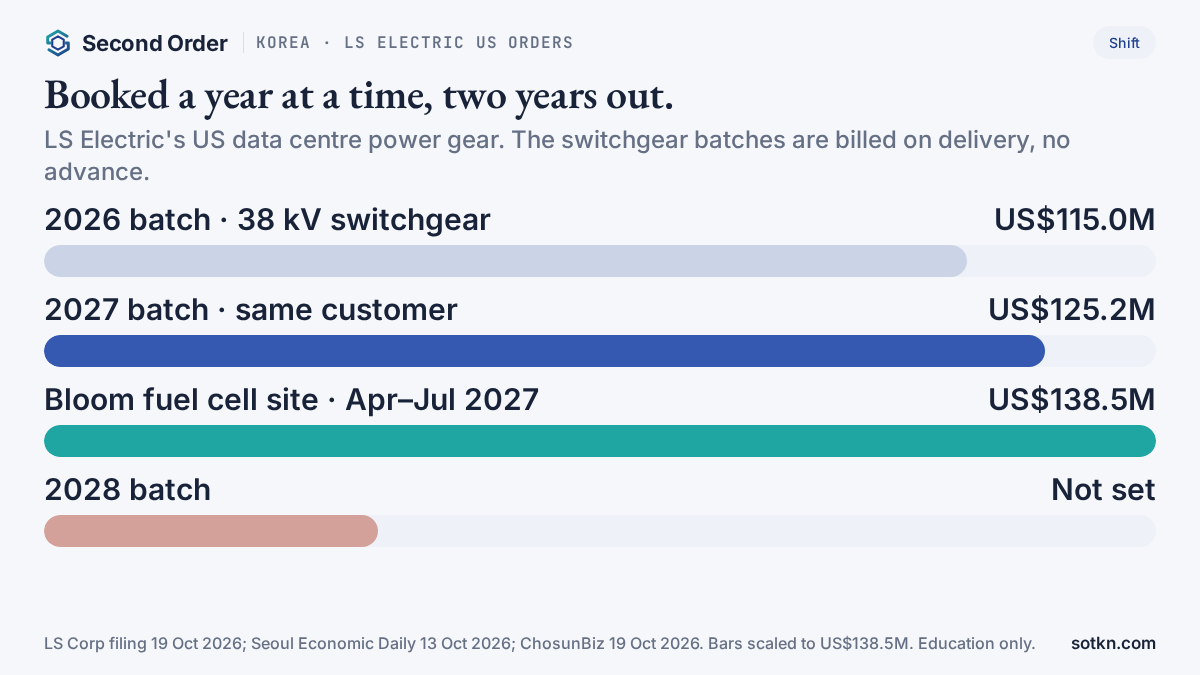
Two details matter for who gets paid. First, there is no down payment or advance. LS bills as each piece of equipment is delivered. So the money arrives through 2027, not now. Second, this is the second batch of the same project. LS filed the 2026 batch, worth US$114,974,772, on 13 April. The 2027 batch is about 9% bigger.
ChosunBiz filled in the rest from the company. The deal is a long-term agreement for two years, 2027 and 2028 in LS's words. The value filed covers next year's deliveries. How much ships in 2028 will be decided after more talks between the two sides. The gear is 38 kV high-voltage switchgear, which takes high-voltage power arriving at the site, splits it to each IT building at the right level, and cuts the circuit if there is a leak or short. LS is also discussing low-voltage switchgear, distribution transformers and ring main units, a kind of compact switch for the site's internal power loop, with the same customer.
The Bloom deal on 13 October is the same kind of business from another angle. Bloom Energy builds fuel cell power plants that sit on a data centre's own land. LS supplies the 38 kV switchgear and distribution transformers that connect those fuel cells to the halls, as one package, for a large tech company's site in Pennsylvania, with delivery from April to July 2027. Seoul Economic Daily reported that LS's orders from Bloom have passed US$500 million in about a year and a half.
What LS Electric has filed
What is still open
Where is Korea's power gear going?
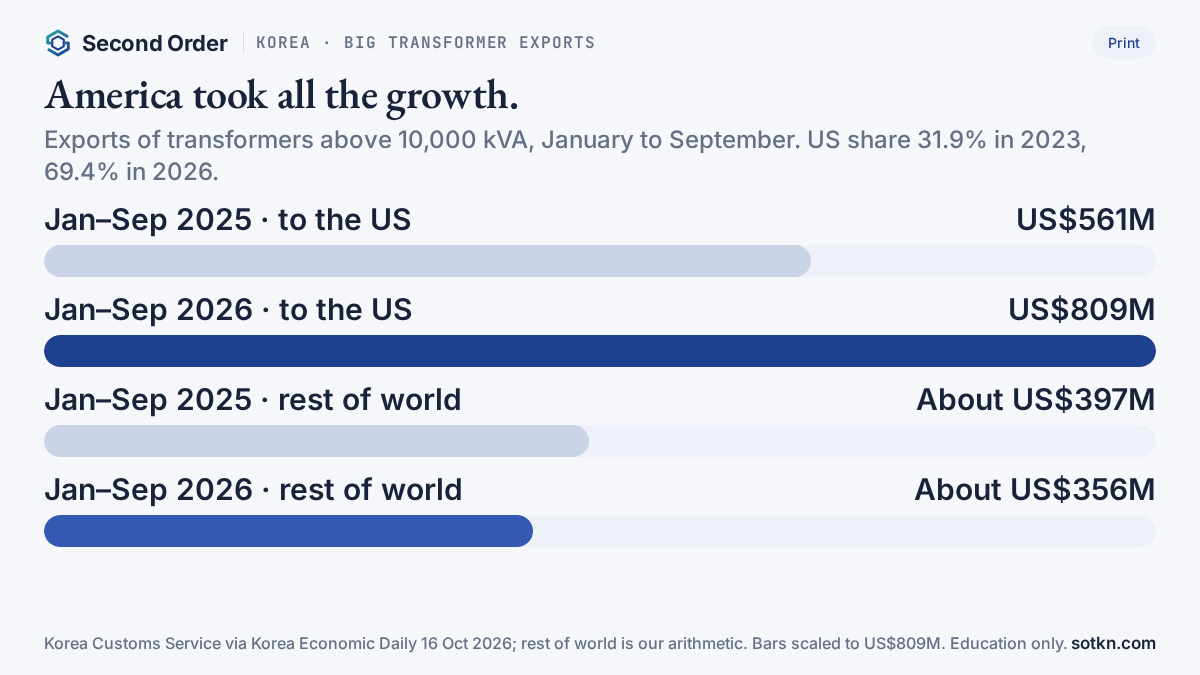
To America, more than ever. Korea Customs Service counts exports of big transformers, those above 10,000 kVA, the size used at power plants, large factories and the grid lines that feed data centres. In the first nine months of 2026 they came to US$1.165 billion, up 21.6% on a year and 73.4% on the same months of 2024, the Korea Economic Daily reported. Of that, US$809 million went to the US, up 44.2%. The US share has climbed from 31.9% in 2023 to 69.4% this year.
Look at what that means for everyone else. If the US took US$809 million out of US$1.165 billion, the rest of the world took about US$356 million, down from about US$397 million a year earlier (our arithmetic). America took more than all of the growth. Korean factories are not just busier. They are pointing more of their output at one market.
The September figures add a second clue. inews24 reported medium and large transformer exports of US$278 million for the month, up 54.8% on a year, while the average export price rose only 0.8%. So almost all of the gain was more units shipped, not higher prices. The price rises came earlier. Now the factories are delivering the backlog they booked during those years. inews24 also reported that LS Electric's transformer shipments rose on a year, with the US the biggest driver.
The newspaper gave two reasons. One is demand: AI data centres plus the replacement of old US grid equipment. The other is policy. An industry official told the Korea Economic Daily that without Washington's pressure on Chinese power equipment, Korean transformer makers would have struggled to enjoy this boom.
The chip side of Korea's exports looks very different; see our Korea customs ICT Pulse. For a US site that needs this kind of grid gear, our Meta Mason County Wire counted eight 345/138 kV transformers and 91 breakers across three substations.
Why are buyers booking power gear years ahead?
Because the factories are full, and the new ones are not ready yet. A data centre builder can sign a lease in a week and pour concrete in months. A large transformer or a high-voltage breaker is built to order, tested and shipped across the Pacific. If the builder waits until the hall is nearly done to order its gear, the hall waits for the gear. The safe move is to book factory time first, which is what a two-year contract does.
Every one of the three Korean makers is adding space, and most of it lands in 2027 and 2028:
- Hyosung Heavy Industries: the new Changwon breaker plant doubles its export capacity above 420 kV from now. In the US it has put about US$300 million into its Memphis, Tennessee transformer plant, and the Korea Economic Daily reports a US$157 million expansion to lift output there by more than half by 2028. In June it signed a joint venture agreement with Quanta, the US infrastructure group, to make high-voltage breakers in America.
- HD Hyundai Electric: its Alabama plant has grown from about 70 big transformers a year when it opened in 2011 to 105 now. It began building a second Alabama plant in March, which it expects to lift local output by 50% once complete. Its second-quarter new orders were US$1.44 billion, up 44.6%, and its order backlog US$8.49 billion, up 29.6%.
- LS Electric: it opened a second extra-high-voltage transformer plant last December, a KRW 100.8 billion investment. In the US it is building what it calls a complete local chain, from sales and design to production and service, around LS Electric Utah in Cedar City and its Bastrop campus in Texas.
Read that list as a timetable. Hyosung's breaker plant is open now. HD Hyundai's second Alabama plant, Hyosung's Memphis expansion and the US breaker venture are later. Until they arrive, a buyer who wants gear in 2027 is competing for the factory time that exists today. LS's customer did not just order 2027's switchgear. It reserved the right to talk about 2028's first.
It is the same habit the cloud companies already show one step down the chain, where they sign long leases to secure powered halls before they are built; see data center leases, explained. For the full build clock from land to live, see how long it takes to build an AI data center.
Memory sold off and power gear signed: what is the market telling us?
That the money and the equipment are on different clocks. The memory sell-off was about the future: whether AI spending can keep growing when interest rates are high and the companies building data centres have to borrow more to do it. A chipmaker's sales can drop within a quarter if buyers pause.
Power gear has a different risk. The orders are signed, and the gear is built to a site's needs. The danger is not usually a cancelled order. It is a late site. If a data centre is delayed, the customer asks for its transformers or switchgear later, and the maker bills later. Brokers cited by the Korea Economic Daily on 12 October expect Hyosung's third-quarter profit to come in below what the market expects, partly because shipments to the Middle East were pushed back and some delivery dates were moved at customers' request.
So the power gear makers carry the site's clock, not the stock market's. LS bills on delivery with no advance. A site that slips by a quarter moves a quarter of revenue with it. That is a timing risk, not a demand risk, but it is real, and it is the first thing to check in this month's results.
For the funding worries behind the sell-off, see our CoreWeave credit Wire. For where SK hynix's own stuck step sits, see the members' Analysis on the HBM4 back end.
What does the US rule change?
Who is allowed to sell into the US grid. Executive Order 14421 declares a national emergency over foreign-made equipment in the bulk power system, the high-voltage network and the plants that keep it stable. It lets the Energy Secretary block purchases, imports or installation of such equipment when it is linked to a covered foreign entity and poses an unacceptable risk. The Department of Energy's FAQ, updated on 6 October, lists substation transformers, circuit breakers, protective relays, grid-connected inverters, battery storage and backup power systems among the equipment in scope.
Three lines in the FAQ matter here. It is not a blanket ban on foreign gear; it targets equipment linked to covered foreign entities. It applies to transactions started after 26 August 2026. And equipment at a data centre is not automatically excluded just because it sits behind the meter; it depends on how it connects to the grid. The department must publish its rules within 120 days, which lands on 24 December (our arithmetic).
On our read, the rule helps the Korean makers in two ways. It makes Chinese gear harder to buy, and it rewards suppliers who can show where every part came from. It also raises the value of US factories, which is where Hyosung, HD Hyundai and LS are all spending. The detail that matters for them, how strictly components are traced, arrives with the December rules.
Our math: what do the numbers say?
- US share: US$809 million of US$1.165 billion is 69.4% of big transformer exports in January to September (our arithmetic, matching the customs figure).
- Everyone else: the rest of the world fell from about US$397 million to about US$356 million, down about 10%. The US gained about US$248 million while total exports gained about US$207 million, so the US took more than all of the growth (our arithmetic).
- Volume, not price: September value up 54.8% with prices up 0.8% means shipped volume rose about 54% (our arithmetic: 1.548 ÷ 1.008).
- LS's batches: the 2027 batch of US$125.2 million is about 9% above the 2026 batch of US$115.0 million; together about US$240 million, with 2028 still open (our arithmetic).
- LS's October: KRW 181.2 billion on 1 October, KRW 185.3 billion on 13 October and KRW 168.9 billion on 19 October make about KRW 535 billion, about 10.8% of LS Electric's 2025 sales of KRW 4.97 trillion (our arithmetic).
- Hyosung's September: KRW 220 billion of its KRW 386.5 billion in orders was 765 kV gear, about 57% (our arithmetic).
- HD Hyundai Electric's queue: a US$8.49 billion backlog is about six quarters of new orders at the second quarter's US$1.44 billion pace (our arithmetic; it ignores sales out of the backlog).
- Alabama: 70 to 105 transformers a year is a 50% rise; another 50% on 105 would be about 158 a year once the second plant is done (our arithmetic; it assumes the 50% is on today's output).
- Bloom: more than US$500 million of orders in about 18 months is roughly US$28 million a month on average (our arithmetic).
- US rule clock: 26 August plus 120 days is 24 December 2026 (our arithmetic).
What this tells you: Korean power gear is not short of buyers. It is short of the time to build. Exports are rising on volume, not price, which means the factories are shipping all they can. The buyers have answered by booking a year at a time, two years out. The money is real, but it arrives piece by piece, on delivery.
Who gets paid first?
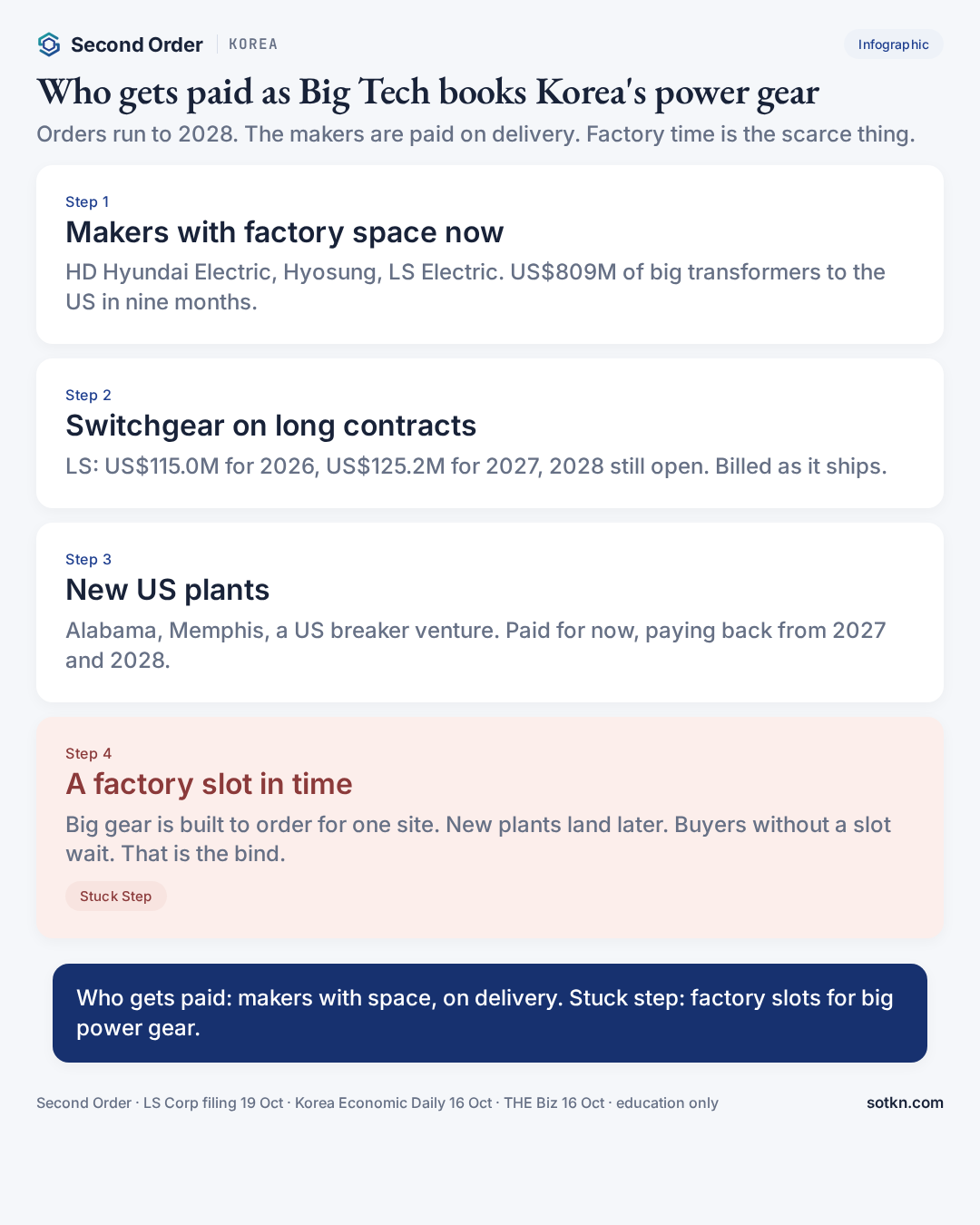
First, the makers with factory space running now — on delivery. HD Hyundai Electric, Hyosung and LS Electric shipped US$809 million of big transformers to the US in nine months, and their order books run years ahead. They are paid as each unit leaves the factory and arrives on site, not when the order is signed.
Second, the switchgear and site-package suppliers — on long contracts. LS's 2027 batch and its Bloom package are smaller than a grid transformer order but come back every year the site grows. A two-year deal with an open 2028 is the kind of contract that turns a one-off sale into a repeat line, if the site keeps building.
Third, the US plants and their builders — when they open. Hyosung's Memphis expansion, HD Hyundai's second Alabama plant, LS's Utah and Texas operations and the Hyosung–Quanta breaker venture are paid for now and pay back from 2027 and 2028. The US rule due in December, on our read, adds to the case for building there.
Fourth, the on-site power developers — on the data centre's own clock. Bloom and its fuel cell projects buy switchgear to connect their plants to the halls. They are paid when the site runs, which is after the gear arrives.
Last, the data centre builders without booked gear — they pay and wait. A hall that is finished but missing its switchgear or its grid transformer earns nothing. For the pattern of cash sticking where the stuck step sits, see where the stuck step moves.
One-line rule: in Korea's power gear chain right now, makers with factory space are paid first on delivery, switchgear suppliers are paid on long contracts, the new US plants are paid when they open, and the builders without booked gear wait. The stuck step is a factory slot.
So what is the stuck step?
Factory slots for big power gear, in time for the sites they serve. Not orders: the order books run to 2028 and beyond. Not price: export prices have stopped rising while volume climbs. Not policy: Washington is pushing buyers toward Korean and US-made gear. Three things make this step stick:
- New plants arrive later: apart from Hyosung's Changwon breaker plant, most of the new capacity in Alabama, Memphis and the US breaker venture lands in 2027 and 2028. Until then, today's factory time is what everyone is competing for.
- Built to order: big transformers and high-voltage breakers are made for a specific site and voltage. A slot booked for one project cannot simply be handed to another buyer.
- The site clock: when a data centre slips, its gear ships later and the maker is paid later. Hyosung's third quarter is the first test of how much that matters.
So-what: whoever has factory space now, and a US plant coming, gets paid first and for longer. Whoever needs gear and has not booked it waits behind the queue. In Korea this week the scarce thing was not memory or orders. It was time on the factory floor. At home, Korea's own data centre build has a different bind, grid connections near Seoul; see our Pohang AI data centre Pulse.
Which dates test this read next?
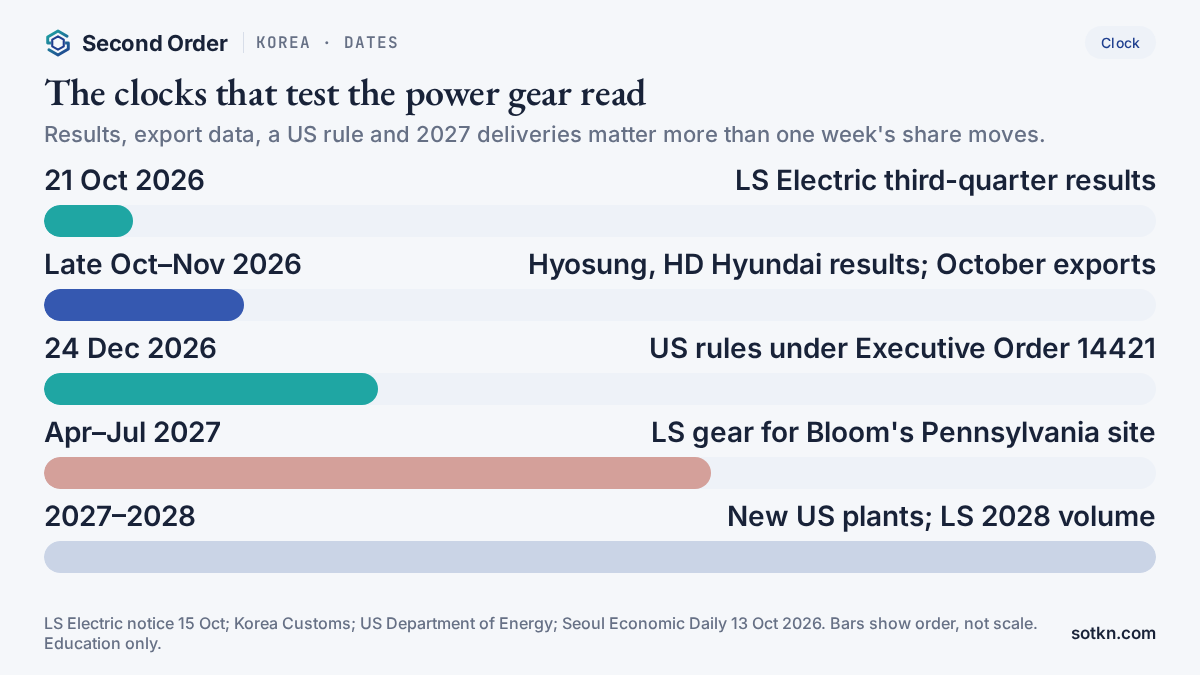
- 21 October 2026 — LS Electric's provisional third-quarter results. The test: whether power gear sales keep growing faster than orders, and what LS says about US data centre demand.
- Late October to early November 2026 — third-quarter results from Hyosung Heavy Industries and HD Hyundai Electric (dates not yet filed). The test: how much revenue moved with customers' delivery changes, and how fast backlogs grow.
- Mid-November 2026 — Korea Customs' full October export figures by product. The test: whether the US share of big transformer exports stays near 70% and volume keeps leading price.
- 24 December 2026 — the deadline for the Department of Energy's rules under Executive Order 14421. The test: how tightly parts and suppliers are traced, and whether Korean gear needs extra paperwork.
- April to July 2027 — LS's deliveries to Bloom's Pennsylvania fuel cell project. The test: whether the site is ready on time.
- During 2027 — deliveries under LS's 2027 switchgear batch, and talks on the 2028 volume. The test: whether 2028 is bigger again.
- 2027 to 2028 — HD Hyundai's second Alabama plant and Hyosung's Memphis expansion. The test: whether more US capacity loosens the slot bind.
The October and November dates test the delivery pace. The 2027 dates test whether the sites, not the factories, become the bind.
What would change this view?
- US data centre builders start delaying or cancelling sites in numbers — the bind would move from factory slots to site readiness, and long contracts would show their limits.
- New plants in Korea and the US come online early and prices fall — the slot would loosen and booking years ahead would matter less.
- The December US rules require tracing that Korean suppliers struggle to meet — the policy tailwind would turn into paperwork drag.
- LS's 2028 volume comes in smaller than 2027 — the first sign the biggest buyers think they have booked enough.
Practical takeaways
- LS Electric (19 Oct): US$125.2 million of 38 kV switchgear for 2027 on a two-year deal; 2028 volume open
- LS Electric (13 Oct): US$138.5 million package for Bloom's Pennsylvania fuel cell data centre site, April to July 2027
- Customs: 69.4% of Korea's big transformer exports went to the US in January to September; US$809 million, up 44.2%
- Hyosung (16 Oct): breaker capacity above 420 kV doubled; most other new capacity lands in 2027 and 2028
- Makers are paid on delivery; a late site means late revenue
- Stuck step: factory slots for big power gear
FAQ
What did LS Electric sign on 19 October?
A supply contract worth about KRW 168.9 billion, or US$125.2 million, for 38 kV switchgear going to a US hyperscale data centre project for an unnamed Big Tech customer. It is the 2027 batch of a two-year long-term agreement. The 2026 batch, worth about US$115.0 million, was filed in April. The 2028 volume is still to be agreed. There is no advance payment; LS bills as it delivers.
Why are US tech companies signing long-term deals for power gear?
Because the gear is scarce and slow to make. The big buyers are moving from one-off spot orders to contracts that lock in volume over several years, so a data centre that is still being built already has its switchgear and transformers booked. A hall without them cannot switch on.
How much of Korea's big transformer exports go to the US?
About 69% in the first nine months of 2026, up from about 32% in 2023, according to Korea Customs Service data reported by the Korea Economic Daily. Exports of transformers above 10,000 kVA reached US$1.165 billion, of which US$809 million went to the US.
What is the stuck step?
Factory slots for big power gear. Orders are not the problem; the makers are adding plants in Korea and the US, but most of the new space arrives in 2027 and 2028. Until then, a buyer without a booked slot waits. A second risk is the site itself: if a data centre is late, its gear ships late too, and the maker is paid later.
Is this investment advice?
No. Education only. It maps who gets paid and which step is stuck. It is not a recommendation to buy or sell any security, and we leave out share prices, broker ratings and price targets on purpose.
Keep reading on the map
- Korea Markets hub — country page
- Pohang AI data centre Pulse — financing and the grid at home
- SK hynix fab power Pulse — chip plants and Korea's grid
- US fuel cell power Pulse · NiSource–Microsoft 1,100 MW Pulse
- Schneider third-quarter Catalyst · Meta Mason County Wire
- How much an AI data center costs · How long it takes to build one
- Members' Analysis: dedicated power above 250 MW · Taipower grid Pulse
- AI Data Centers on the stack · Hyperscalers
- All Markets doors — Taiwan, Korea, US, China, Singapore, Australia, Malaysia
How we check this. The 2027 and 2026 contract values, the order date, the end date and the billing terms come from the LS Corp filing on LS Electric’s contract of 19 October 2026. The two-year term, the open 2028 volume and the shift from spot orders to long contracts come from LS Electric as reported by ChosunBiz on 19 October. The Bloom Energy package comes from Seoul Economic Daily on 13 October. Export figures are Korea Customs Service data reported by the Korea Economic Daily on 16 October and by inews24 on 6 October. Factory plans, Hyosung’s orders, HD Hyundai Electric’s orders and backlog and the KIET report come from THE Biz on 16 October and the Korea Economic Daily on 16 October. Hyosung’s delivery timing comes from brokers cited by the Korea Economic Daily on 12 October. The US rule comes from the Department of Energy’s FAQ updated 6 October. Share prices, broker ratings and price targets are left out on purpose. Anything we worked out ourselves is labelled “our arithmetic”. The references we used are listed at the end. Our editorial standards →
Not investment advice. Do your own research.
References
- LS Corp filing on LS Electric's supply contract (Seoul Economic Daily market signal), 19 Oct 2026. sedaily.com — 2027 North American data centre power gear batch, US$125,229,300 (KRW 168.9 billion); follows the US$114,974,772 2026 batch filed 13 April; PO dated 16 October; no advance payment, billed on delivery.
- ChosunBiz, LS Electric wins KRW 169b US AI data center power gear deal, 19 Oct 2026. biz.chosun.com — 38 kV switchgear under a two-year long-term agreement to 2028; 2028 volume to be agreed; Big Tech moving from spot orders to long contracts.
- Seoul Economic Daily, LS ELECTRIC wins $138 million order for U.S. data center power gear, 13 Oct 2026. en.sedaily.com — US$138.45 million of switchgear and distribution transformers for Bloom Energy's fuel cell project at a Big Tech data centre in Pennsylvania; delivery April to July 2027; Bloom orders above US$500 million since April 2025.
- THE Biz, AI power equipment race spreads to factory expansion, 16 Oct 2026. the-biz.co.kr — Hyosung breaker plant doubles 420 kV-plus capacity; Hyosung September orders KRW 386.5 billion; HD Hyundai Electric Q2 orders and backlog; Alabama second plant; KIET report on bottlenecks.
- Korea Economic Daily (Hankyung), Korean transformers ride the US data centre boom, 16 Oct 2026. hankyung.com — Korea Customs Service: transformers above 10,000 kVA, January to September exports US$1.165 billion; to the US US$809 million, up 44.2%; US share 69.4% vs 31.9% in 2023; US plant capacity plans.
- inews24, Medium and large transformer exports up 55%, 6 Oct 2026. inews24.com — September exports US$278 million, up 54.8% on a year; unit price up 0.8%, so volume drove the gain.
- Korea Economic Daily (Hankyung), Hyosung Heavy falls on lower third-quarter expectations, 12 Oct 2026. hankyung.com — brokers expect a miss on Middle East shipments pushed back and delivery dates moved at customers' request.
- US Department of Energy, FAQ on the bulk-power system executive order and RFI, 6 Oct 2026. energy.gov — Executive Order 14421: transformers and circuit breakers in scope; transactions after 26 August 2026; implementing rules within 120 days; data centre equipment not automatically excluded.
- The Korea Herald, Samsung, SK hynix suffer worst weekly stock rout since 2008, 18 Oct 2026. koreaherald.com — record foreign selling of KRW 11.21 trillion in a week amid rate, AI-spending and China competition worries.
- TipRanks (company notice), LS Electric sets date for provisional Q3 2026 results, 15 Oct 2026. blog.tipranks.com — provisional third-quarter results on 21 October 2026 via its IR site.


