What Is Free Cash Flow? Why AI Capex Took Hyperscalers Negative
Free cash flow is the cash a company’s operations bring in, minus the cash it spends on buildings and equipment. AI servers are paid for now and charged to profit over six years, so free cash flow falls first.
EXPLAINED · Mechanism · Last reviewed: 29 Oct 2026 · Next review: after Amazon’s third-quarter results (30 Oct 2026, Singapore time) and Alphabet’s 2027 capex guide
Free cash flow is the cash a company’s operations bring in, minus the cash it spends on buildings and equipment, which is called capital expenditure or capex.
In short. Free cash flow is operating cash flow minus capex. Profit spreads the cost of a server over about six years; free cash flow takes the whole cost in the quarter the cash leaves. That is why Alphabet reported minus $9.1 billion and Meta minus $2.1 billion of free cash flow for July–September 2026 while both made operating profits, and why Microsoft’s fell 27% to $18.6 billion. Our read: the suppliers are paid first, the hyperscaler is paid back one billed hour at a time, and the stuck step in between is capacity going live.
Why an investor cares: free cash flow is the money a company can actually pay out, save or use to cut debt, and for the biggest buyers of AI capacity it has turned from a cushion into a gap. When it goes negative, the spending is being funded from cash piles, bonds or new shares. Our guide to cash capex covers the spending side; this page covers what is left after it.
What is free cash flow?
Free cash flow is operating cash flow minus capex. Operating cash flow is the cash the business brings in after paying suppliers, staff and taxes. Capex, short for capital expenditure, is cash spent on things that last for years: servers, network gear, land and buildings.
Free cash flow is not a line that accounting rules require, so each company publishes its own version and explains it in its results. Alphabet’s is the plainest: net cash provided by operating activities less capital expenditures. Others subtract more, as the definitions table further down shows.
How do you calculate free cash flow?
Take two numbers from the cash flow statement and subtract one from the other. For Alphabet’s July–September 2026 quarter, operating cash flow was $42.3 billion and purchases of property and equipment were $51.4 billion. That leaves free cash flow of minus $9.1 billion, the figure Alphabet reported on 28 October.
| July–September 2026 | Operating cash flow | Cash capex | Free cash flow | Same quarter 2025 |
|---|---|---|---|---|
| Alphabet | $42.3B | $51.4B | −$9.1B | $24.5B |
| Meta | $32.8B | $33.9B, plus $1.0B of finance lease principal | −$2.1B | $10.6B |
| Microsoft (fiscal Q1 2027) | $58.0B | $39.4B | $18.6B | $25.7B |
| Three together | $133.1B | $124.7B | $7.4B | $60.7B |
From each company’s cash flow statement for the quarter to 30 September. Cash capex is purchases or additions of property and equipment. The 2025 column, the Microsoft and Meta 2025 figures and the three-company totals are Second Order arithmetic from the same statements.
Our arithmetic: the three companies together brought in $133.1 billion of operating cash in the quarter, up about 8% on a year earlier. Their cash capex roughly doubled, from $62.2 billion to $124.7 billion. So their combined free cash flow fell from $60.7 billion to $7.4 billion even though the businesses brought in more cash than before.
Why can profit rise while free cash flow goes negative?
Because profit and free cash flow count the same server at different speeds. Profit charges a slice of the cost each year through depreciation. Free cash flow takes the whole cost in the quarter the cash leaves. Our explainer on capex vs depreciation sets out the two clocks side by side.
Alphabet gave the clocks in numbers on its 28 October call. About 65% of its technical infrastructure spend in the quarter went on servers and networking, which generally have useful lives of six years. The other 35% went on data centers, with useful lives of 7 to 40 years.
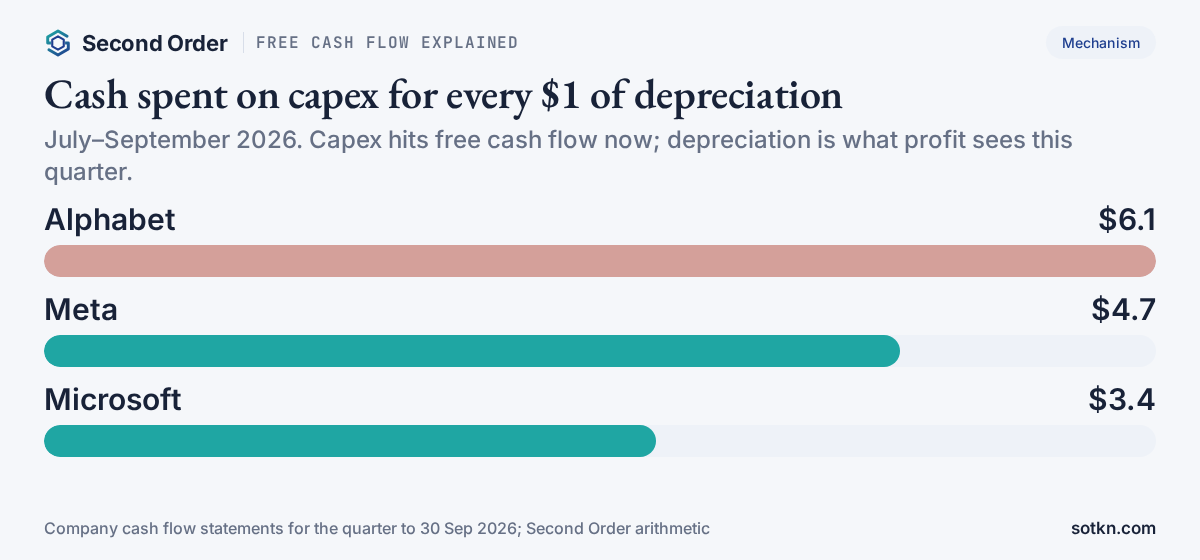
Our arithmetic: in July–September 2026 Alphabet spent about $6.1 of cash capex for every $1 of depreciation it charged against profit, Meta about $4.7 and Microsoft about $3.4, using each company’s depreciation line. Alphabet still reported $40.6 billion of operating income, up 30%. Free cash flow sees the $51.4 billion now; profit sees about $8.4 billion of depreciation now and the rest over the coming years.
The gap closes only when the spend stops growing or the new capacity bills enough to lift operating cash. Our guide to GPU depreciation covers why the useful life chosen for a server moves profit but not cash.
Why is hyperscaler free cash flow falling?
Because AI capex is growing faster than the businesses that pay for it. Meta’s operating cash flow rose to $32.8 billion in the quarter, but its purchases of property and equipment rose to $33.9 billion from $18.8 billion a year earlier. It now expects 2026 capex, including finance lease principal, of $135 billion to $145 billion.
Alphabet kept its 2026 capex guide at $195 billion to $205 billion and said spending will rise significantly in 2027. Its free cash flow was negative for a second quarter in a row, after minus $5.9 billion in April–June, and $19.7 billion over the trailing twelve months.
Microsoft stayed positive. Its operating cash flow rose 29% to $58.0 billion, but cash paid for property and equipment roughly doubled to $39.4 billion, and free cash flow fell 27% to $18.6 billion. Amazon, which reports over trailing twelve months, was already at minus $7.6 billion for the year to 30 June 2026, against plus $18.2 billion a year before. Our guide to who the hyperscalers are covers the four companies and their clouds.
How does each hyperscaler define free cash flow?
Differently, and the differences matter most where leases are involved. A finance lease, where a company rents a data center or servers on terms close to owning them, is a capital cost but not always a cash purchase.
| Company | How it defines free cash flow | What that means for the number |
|---|---|---|
| Alphabet | Operating cash flow less capital expenditures (purchases of property and equipment) | The plain version; lease payments are not subtracted |
| Meta | Operating cash flow less purchases of property and equipment and less principal payments on finance leases | Stricter: leased capacity is counted as it is paid for |
| Microsoft | Operating cash flow less cash paid for property and equipment | Headline capex of $45.2B includes $7.4B of finance leases that free cash flow leaves out |
| Amazon | Operating cash flow less purchases of property and equipment, net of proceeds from sales and incentives; quoted over trailing twelve months | Smoother, and reported over a year rather than a quarter |
From each company’s earnings release or call, on the dates in the list below.
Microsoft’s finance leases were $7.4 billion in the quarter. It counts the full value in headline capex when a lease starts, which is why it reported capex of $45.2 billion, but its free cash flow subtracts only the $39.4 billion of cash paid for property and equipment. Meta subtracts lease principal as it is repaid. Our explainer on finance vs operating leases covers why the same building can sit on two different lines.
Our read: compare free cash flow between companies only after checking what each one subtracts. A company that leases more of its capacity can show a higher free cash flow for the same build.
How is the gap being funded?
From cash piles, debt and, at Meta, new shares. Alphabet ended September with $265.1 billion of cash and marketable securities, including $90.4 billion of equity stakes. Its long-term debt rose to $125.1 billion from $46.5 billion at the end of 2025.
Meta’s long-term debt rose to $80.9 billion from $58.7 billion over the same nine months, and on 26 October it launched about $35 billion of share offerings; our Wire on Meta’s $35 billion equity raise covers the terms. Microsoft said it expects to keep generating free cash flow through its 2027 fiscal year, which ends in June 2027, and may tap other funding when it is attractive.
Free cash flow also leaves out promises not yet paid. Alphabet reported future purchase commitments of $924 billion at the end of September, the maximum it could owe under multiyear deals for capacity, inventory, leases and energy. Our guide to data center financing covers the debt that sits beside the hyperscalers’ own balance sheets.
Who gets paid, and where is the stuck step?
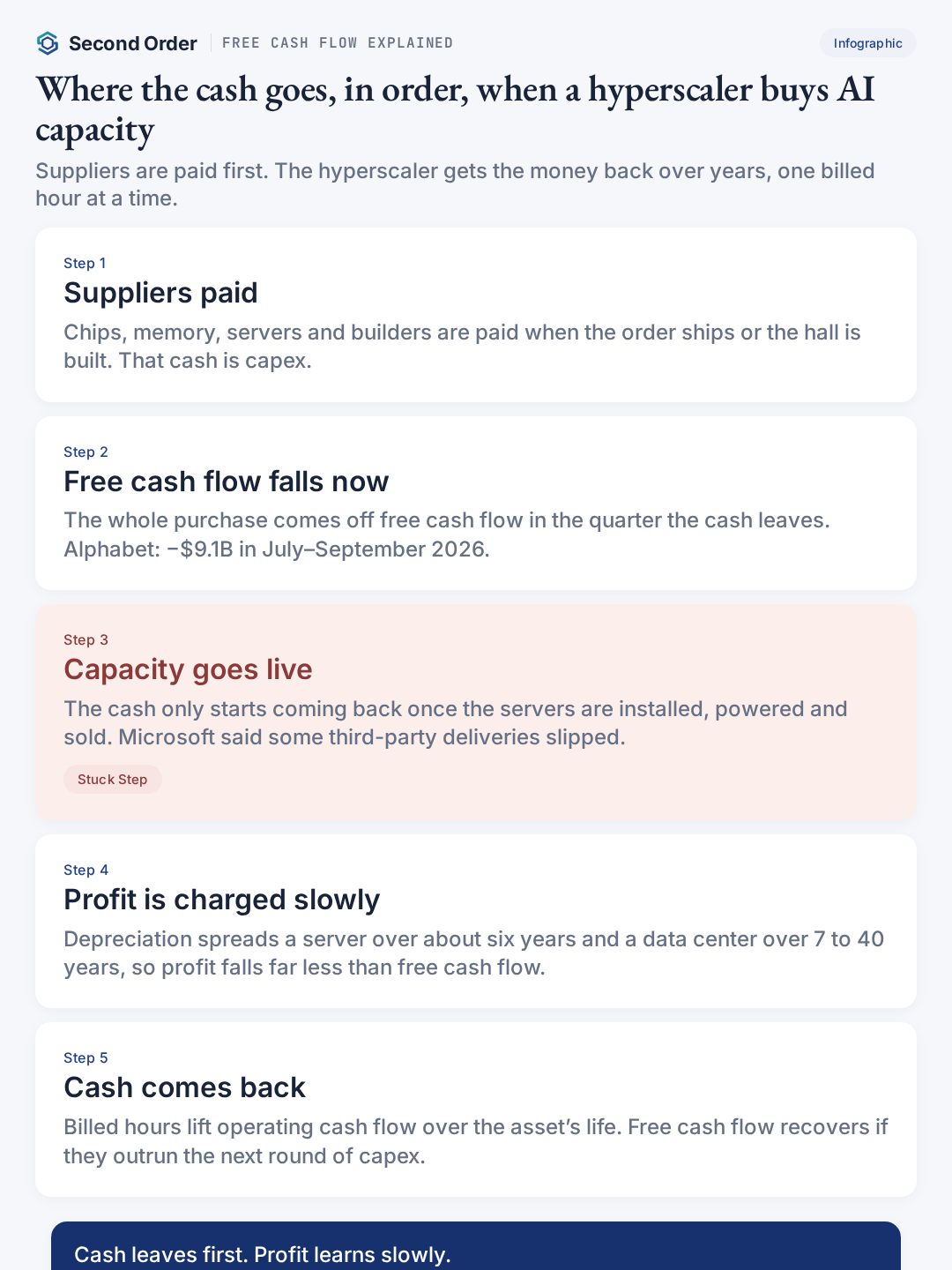
The suppliers are paid first: chipmakers, memory makers, server builders, network makers and the firms that build and power the halls. Their cash arrives when the hyperscaler’s capex goes out, which is the same quarter free cash flow falls.
The hyperscaler is paid last. It gets the money back as cloud customers, advertisers or its own AI services use the capacity, one billed hour at a time, over the six-year life of a server and decades for a building.
The stuck step is capacity going live. Cash that has left but sits in servers not yet installed, powered or sold brings nothing back. Microsoft said some third-party capacity deliveries it expected in its first quarter were delayed; our Wire on Microsoft’s late rented GPUs covers that story. Our Hyperscalers layer tracks how each company turns capex into billed hours.
What would change the view?
- Capex growth slows. If 2027 spending rises less than operating cash, free cash flow recovers even before the new capacity has paid for itself.
- New capacity bills faster. Google Cloud revenue rose 103% to $30.7 billion in the quarter. If that pace carries into operating cash flow, the gap narrows from the other side.
- More is leased than bought. Shifting builds to leases moves cost out of cash capex and into lease payments, which can lift reported free cash flow without changing the build.
What to check next
Amazon reports its third quarter on 29 October at 2 p.m. Pacific time, about 5 a.m. on 30 October in Singapore; watch its trailing-twelve-month free cash flow. Alphabet will give its 2027 capex plan on its fourth-quarter call. Our note on Meta’s third-quarter capex and cash flow covers the first of this season’s reports to show a negative quarter.
Common misconceptions
- People assume negative free cash flow means a company is losing money. Actually Alphabet and Meta both made operating profits in the quarter; their capex simply ran ahead of their operating cash.
- People assume free cash flow is the same at every company. Actually Meta subtracts finance lease principal, Microsoft leaves leases out, and Amazon nets off proceeds and reports over twelve months.
- People assume headline capex is the cash that left. Actually Microsoft’s $45.2 billion includes $7.4 billion of finance leases; $39.4 billion was cash paid for property and equipment.
- People assume a big cash pile means no funding gap. Actually Alphabet’s long-term debt rose about 2.7 times in nine months, to $125.1 billion, while it held $265.1 billion of cash and securities.
FAQ
What is free cash flow?
Free cash flow is the cash a company’s operations bring in, minus the cash it spends on buildings and equipment. Alphabet, for example, defines it as net cash provided by operating activities less capital expenditures.
How do you calculate free cash flow?
Take operating cash flow from the cash flow statement and subtract purchases of property and equipment. Alphabet’s July–September 2026 quarter: $42.3 billion of operating cash flow minus $51.4 billion of capex gives free cash flow of minus $9.1 billion.
Can a company have a profit and negative free cash flow?
Yes. Profit charges a server over its useful life, about six years at Alphabet, while free cash flow counts the whole purchase in the quarter the cash leaves. Alphabet made $40.6 billion of operating income in the third quarter of 2026 and still had negative free cash flow.
Why is hyperscaler free cash flow falling?
Because spending on AI servers and data centers is rising faster than the cash their businesses bring in. Alphabet, Meta and Microsoft together spent $124.7 billion of cash capex in July–September 2026, about double a year earlier, on our arithmetic from their statements.
Is negative free cash flow bad?
Not on its own. It means a company is spending more on long-lived assets than its operations bring in, and it has to fund the gap from cash, debt or new shares. Whether that is good depends on whether the new capacity bills enough over its life.
Is free cash flow the same as cash capex?
No. Cash capex is one part of the sum. Free cash flow is operating cash flow minus cash capex, so it shows what is left after the spend.
Is this a list of stocks to buy or sell?
No. This page explains how free cash flow works and how each company defines it. It does not rank companies or give buy or sell calls. Not investment advice. Do your own research.
Related: cash capex; capex vs depreciation; AI capex; GPU depreciation; remaining performance obligation; what a hyperscaler is.
Stack doors
Layer: Hyperscalers. Also: Google, Meta, Microsoft and Amazon. Markets: US.
Get the Wire — short daily notes when hyperscaler capex and cash flow move.
Not investment advice. Do your own research.
How we check this
Cash flow figures come from each company’s own earnings release and cash flow statement: Alphabet and Microsoft on 28 October 2026, Meta on 21 October 2026, and Amazon on 30 July 2026. Useful lives, finance lease treatment and capex guidance come from the companies’ earnings calls, dated in the list below. Year-earlier free cash flow for Alphabet, Meta and Microsoft, the three-company totals and the capex-to-depreciation ratios are our arithmetic from the same statements, and are labelled as ours on the page. The order of who gets paid, and the stuck step, are our read. The featured photograph is credited in its caption. This page explains how free cash flow works. It does not rank companies or give buy or sell calls. Not investment advice. Do your own research.
Last reviewed: 29 Oct 2026 · Next review: after Amazon’s third-quarter results (30 Oct 2026, Singapore time) and Alphabet’s 2027 capex guide
Spot an error? Tell us and we will correct it and note the change here.
References
- Alphabet — Third quarter 2026 results, earnings release (Exhibit 99.1, 28 Oct 2026) — operating cash flow $42,290M, purchases of property and equipment $51,355M, free cash flow −$9,065M (Q2 2026 −$5,855M; TTM $19,747M); depreciation $8,369M; long-term debt $125,102M against $46,547M at 31 Dec 2025; Alphabet’s free cash flow definition
- Alphabet — Q3 2026 earnings call transcript, via The Motley Fool (call 28 Oct 2026) — about 65% of technical infrastructure spend on servers and networking with useful lives of 6 years, 35% on data centers at 7 to 40 years; full-year 2026 capex guide $195–205B unchanged, significantly higher in 2027; purchase commitments $924B
- Meta — Meta Reports Third Quarter 2026 Results (21 Oct 2026) — operating cash flow $32,786M, purchases of property and equipment $33,942M, finance lease principal $964M, free cash flow −$2.12B; depreciation and amortization $7,154M; 2026 capex guide $135–145B; long-term debt $80,922M
- Microsoft — FY27 first quarter press release and financial statements (28 Oct 2026) — net cash from operations $58,000M against $45,057M; additions to property and equipment $39,367M against $19,394M; depreciation, amortization and other $11,744M
- Microsoft — Q1 FY2027 earnings call transcript, via Stock Analysis (28 Oct 2026) — capex including finance leases $45.2B; finance leases $7.4B counted in capex at commencement; cash paid for PP&E $39.4B; free cash flow $18.6B; about three quarters of capex on short-lived assets; some third-party capacity deliveries delayed
- CNBC — Microsoft Q1 earnings report (28 Oct 2026) — free cash flow down 27% to $18.63B; Microsoft expects to keep generating free cash flow through fiscal 2027 and may tap other funding when attractive
- Amazon — Second quarter 2026 results, earnings release (Exhibit 99.1, 30 Jul 2026) — trailing-twelve-month operating cash flow $161.4B, purchases of property and equipment net of proceeds and incentives $169.0B, free cash flow −$7.6B against +$18.2B a year earlier; Amazon’s free cash flow definition
- Amazon — To webcast third quarter 2026 results conference call (15 Oct 2026) — third-quarter results call on 29 Oct 2026 at 2:00 p.m. PT