What Is the Biggest AI Data Center in the World? Check the Meter
By power actually switched on, the biggest AI data center in October 2026 is Amazon’s New Carlisle campus in Indiana, at an estimated 1,037 MW. By plans, it is Meta’s 5 GW Hyperion in Louisiana, which is not running yet. The gap between the two lists is where the money waits.
EXPLAINED · Mechanism · Last reviewed: 28 Oct 2026 · Next review: after Epoch AI’s next site update and Louisiana’s ruling on Entergy’s power plan for Meta’s Hyperion
Measured by power that is actually switched on, the biggest AI data center in the world in October 2026 is Amazon’s campus in New Carlisle, Indiana, built for Anthropic as Project Rainier, at an estimated 1,037 MW of IT power, just ahead of xAI’s Colossus 2 in Memphis at about 946 MW. Measured by plans, the biggest is Meta’s Hyperion in Richland Parish, Louisiana, which Meta says will reach 5 GW of compute capacity, but none of it is running yet.
In short. “Biggest” depends on the meter. By power switched on, Epoch AI, which estimates the largest AI sites from satellite images and permits, puts Amazon’s New Carlisle campus first at about 1,037 MW of IT power and xAI’s Colossus 2 second at about 946 MW. By plans, Meta’s Hyperion leads at 5 GW, but has nothing running yet. By compute, Colossus 2 leads; by floor area, Microsoft’s Fairwater Wisconsin is among the largest. The meter that matters for money is power switched on, because only live megawatts bill. Across six giant campuses Epoch tracks, between none and about 62% of the projected build-out is running today (our arithmetic). The stuck step is the same everywhere: getting a gigawatt to one site. Who gets paid first: the utilities and power-plant builders, the chip and equipment sellers, and the financiers who fund the shell. The owner earns last, when the halls are energized. In Asia, the biggest AI campuses are in Johor, not Singapore.
Why an investor cares: the size in the headline is rarely the size that earns money. A campus bills when its power is switched on, so the gap between announced and running megawatts is time the owner pays for and others get paid in. This page builds on what an AI data center is and asks one question: which AI data center is actually the biggest, and by what meter?
What is the biggest AI data center in the world?
By the measure that matters most, power that is running today, it is Amazon’s campus in New Carlisle, Indiana. Amazon calls it Project Rainier and built it for Anthropic. Epoch AI, a research group that tracks the largest AI sites using satellite images, permits and company disclosures, estimates it at about 1,037 MW of IT power in October 2026. That is the power its computers can draw, before cooling. Add cooling and other overhead and Epoch puts the whole facility at about 1,244 MW.
For a sense of scale, Epoch notes that the city of San Diego draws about 800 MW on average. One AI campus in rural Indiana now has the electrical capacity of a large city.
Second is xAI’s Colossus 2 in Memphis at about 946 MW, then Microsoft’s Fairwater Atlanta at about 636 MW. Fourth is a campus most people outside Asia have never heard of: DayOne’s Nusajaya site in Johor, Malaysia, at about 473 MW. The table shows the rest of the top group, with how much of each planned build-out is running (our arithmetic).
| Campus (owner; main user) | Where | IT power running, Oct 2026 (est.) | Projected build-out (est.) | Share running (our arithmetic) |
|---|---|---|---|---|
| New Carlisle / Project Rainier (Amazon; Anthropic) | Indiana, US | 1,037 MW | 1,925 MW, early 2028 | 54% |
| Colossus 2 (xAI, part of SpaceX) | Memphis, Tennessee, US | 946 MW | 1,531 MW, early 2027 | 62% |
| Fairwater Atlanta (Microsoft) | Georgia, US | 636 MW | not projected | n/a |
| DayOne Nusajaya (operator DayOne; chip owner not listed) | Johor, Malaysia | 473 MW | not projected | n/a |
| Prometheus (Meta) | New Albany, Ohio, US | 471 MW | 1,022 MW, late 2028 | 46% |
| DayOne Kempas (operator DayOne) | Johor, Malaysia | 422 MW | not projected | n/a |
| Stargate Abilene (Oracle; OpenAI) | Texas, US | 421 MW | 843 MW, late 2026 | 50% |
| Fairwater Wisconsin (Microsoft) | Wisconsin, US | 369 MW | 2,263 MW, mid-2028 | 16% |
| Hyperion (Meta; Blue Owl joint venture) | Louisiana, US | 0 MW | 1,632 MW by early 2028; Meta plans 5 GW | 0% |
IT power is the power the computers can draw, before cooling and overhead. Estimates from Epoch AI’s dataset updated 26 October 2026, which Epoch says land within a factor of 1.4 of the true value about 80% of the time. Meta’s 5 GW is its own plan.
Two cautions. Epoch’s figures are estimates; it says they land within a factor of 1.4 of the true value about 80% of the time. And its list is not complete. It tracks 95 sites with 14.2 GW of IT power and estimates that this covers about 43% of the world’s deployed AI compute. The five biggest sites on its list hold about 25% of the power it tracks (our arithmetic).
Why do rankings of the largest data centers disagree?
Because each picks a different meter. There are four in common use, and each crowns a different winner.
- Power switched on. New Carlisle leads. This is the only meter that maps to rent or revenue today.
- Power planned. Meta’s Hyperion leads at 5 GW of planned compute capacity. Meta announced that on 13 July 2026, alongside more than $50 billion of investment in the region. On Epoch’s own projections, which only count what it can see being built, Microsoft’s Fairwater Wisconsin is the largest planned site at about 2,263 MW by mid-2028.
- Chips and compute. Colossus 2 leads at about 1.11 million H100-equivalents, against about 818,000 at New Carlisle, even though it draws less power. Its Nvidia B200 and B300 chips deliver more compute per megawatt: about 1,175 H100-equivalents per MW, against about 790 at New Carlisle (our arithmetic). See what a GPU cluster is.
- Land and floor space. Microsoft said in September 2025 that Fairwater Wisconsin covers 315 acres with three buildings and 1.2 million square feet under roof, and called it the world’s most powerful AI datacenter. Epoch describes Hyperion’s tract as more than three times the size of New York’s Central Park.

Company figures and outside estimates can also differ for the same site. SpaceX’s S-1 filing of 20 May 2026 says Colossus II brought online a first cluster of about 110,000 Nvidia GB200 chips and about 210 MW of compute power in 91 days, then a second cluster of 110,000 GB300 chips and 220 MW in 64 days. That is about 430 MW of what the filing calls compute power (our arithmetic). Epoch’s 946 MW is higher because it assumes the next phase, which the filing puts at over 400 MW more, is already running, and because Epoch counts all IT load. Same campus, two honest numbers, two meters.
Our view: when you read “world’s largest data center”, ask which meter and on what date. A press release usually quotes the plan. A satellite estimate quotes what is built. Only one of them sends invoices.
How much of the biggest AI data centers is actually running?
Less than the headlines suggest. Taking Epoch’s current estimate as a share of its own projected build-out for each site, Colossus 2 is about 62% switched on, New Carlisle about 54%, Stargate Abilene about 50% and Meta’s Prometheus in Ohio about 46% (our arithmetic). Fairwater Wisconsin is about 16%. Hyperion is at zero: Epoch’s satellite images from April 2026 show construction, not compute.
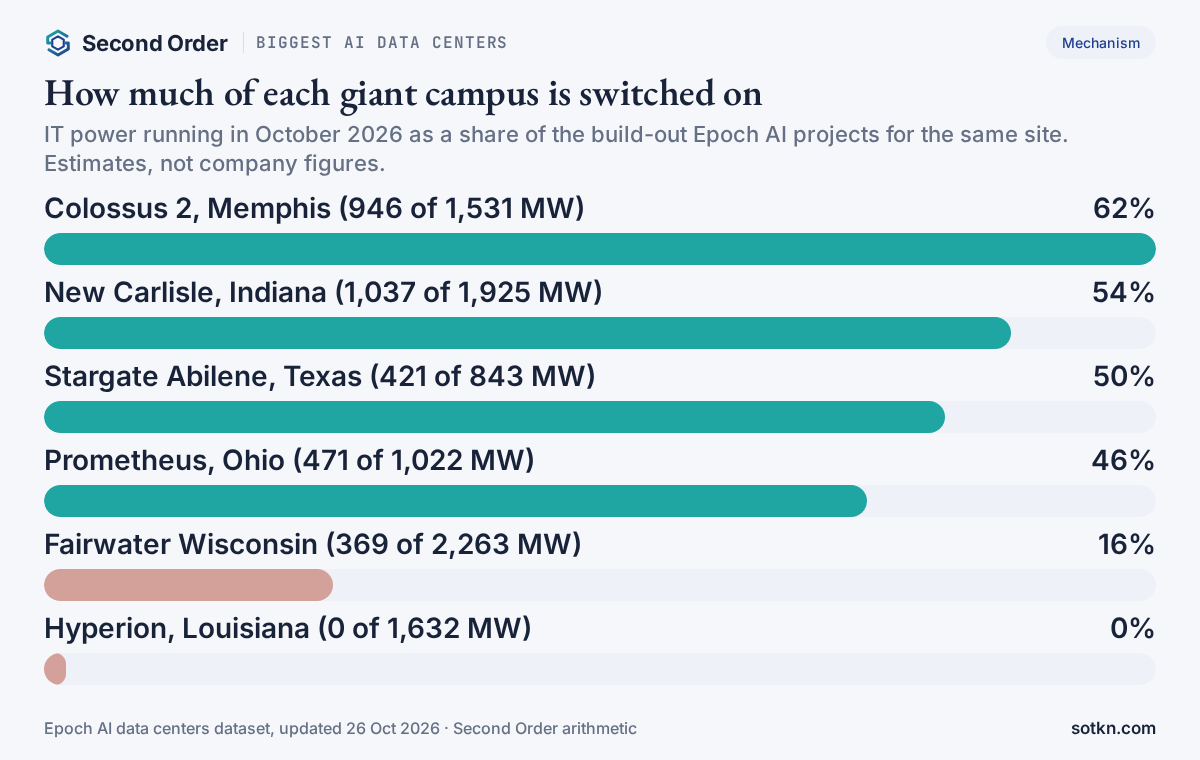
Against Meta’s own 5 GW plan, Hyperion’s gap is larger still. Epoch projects about 1,632 MW of IT power there by early 2028, about a third of the plan (our arithmetic). The rest is years of building and, above all, power. Our page on how long an AI data center takes to build explains why the building is the quick part.
What is the stuck step for the biggest campuses?
Getting a gigawatt to one piece of land. No grid was built to deliver that much power to a single customer, so the biggest campuses either wait for new plants and lines or bring their own.
Hyperion shows the scale. To serve Meta’s expansion, Entergy Louisiana announced on 27 March 2026 a plan for seven new combined-cycle gas plants totaling more than 5,200 MW, about 240 miles of new 500 kV transmission lines, batteries at three sites and nuclear uprates, paid for by Meta. It is the first project filed under the Louisiana Public Service Commission’s new fast-track Lightning Amendment. Meta has also committed to help fund up to 2.5 GW of clean and renewable power. Our page on how hyperscalers buy power explains these deals.
Colossus took the other route. SpaceX’s S-1 describes Colossus II as data centers in Memphis, Tennessee, and Southaven, Mississippi, and Epoch’s site notes record gas turbines across the state line being connected as the first cluster came online. Speed came from controlling the power, not just the building.
The pattern repeats in Asia. Malaysia’s utility TNB told analysts on 28 August 2026 that it had 61 secured data center projects with 8.35 GW of maximum demand, but actual data center load in June 2026 was 1,256 MW. Our Malaysia Pulse on Johor’s grid connections covers that wait in detail.
Who gets paid when a data center gets this big?
- Utilities and power-plant builders, first. Entergy’s plan for Hyperion is paid for by Meta, and Entergy puts the combined customer benefit of its two Meta agreements at about $2.65 billion. The wires and turbines get built and paid for before a single rack bills.
- Chip and equipment sellers. Amazon said in October 2025 that Project Rainier went live with nearly half a million of its own Trainium2 chips. Colossus II’s first two clusters alone used about 220,000 Nvidia chips (our arithmetic, from the S-1). See who buys AI GPUs.
- Builders and financiers of the shell. In October 2025 Meta moved Hyperion into a joint venture 80% owned by funds managed by Blue Owl Capital, to fund about $27 billion of development costs; Blue Owl put in about $7 billion of cash and Meta took a one-time distribution of about $3 billion. Our data center financing page and our Wire on Hyperion’s bond follow that money.
- Landlords and developers. Not every giant campus is self-built. Epoch’s notes on Stargate Abilene cite announcements from its developer, Crusoe, while Oracle owns the chips and OpenAI uses them, and the two Johor campuses carry the name of their operator, DayOne. See who builds AI data centers.
- Last: the owner of the compute. It earns nothing on the unfinished share of a campus. At Hyperion that is all of it for now, which is why the size of the plan and the size of the bill can drift apart. Our data center cost page shows where the money goes.
What is the biggest AI data center in Asia?
Johor in Malaysia holds Asia’s biggest AI campuses on Epoch’s list. DayOne’s Nusajaya site, at about 473 MW of IT power, ranks fourth worldwide, and its Kempas site, at about 422 MW, ranks sixth. Together they are about 895 MW (our arithmetic). Epoch counts about 1,138 MW across all Malaysian sites it tracks, about 8% of its global total, second only to the United States at about 84% (our arithmetic). Epoch notes that it uses a lower bar outside the US, so read those shares as a floor for tracked sites, not a census. Our page on where AI data centers are located explains why Johor became the hub.
TNB’s own numbers point the same way: of Malaysia’s 8.35 GW of secured data center demand, 5.6 GW, or 67%, is in Johor. TNB also showed a Cushman & Wakefield ranking that puts Johor first among Asia-Pacific markets that operators prefer, ahead of Sydney and Shanghai.
Singapore is the opposite case. It rations new capacity, and in August 2026 its Economic Development Board and IMDA provisionally allocated 200 MW in total, 50 MW each to four operators. That entire national round is about a fifth of the power Epoch estimates is running at New Carlisle alone (our arithmetic). See our Singapore Pulse on its power plan for data centres and what Keppel DC REIT does.
Australia has no campus on this scale yet, and Epoch tracks only about 41 MW of AI sites there. The plans are large, though: NEXTDC said in its FY26 results that it has bought a site for M5 Melbourne and begun planning for up to 1.2 GW of IT capacity. See what NEXTDC does.
What would change this ranking?
- Hyperion switches on. If Entergy’s plants and lines arrive on schedule, Meta’s campus could pass every site on this list. Watch Louisiana’s ruling on the plan.
- Colossus 2’s next phase lands. The S-1’s extra 400 MW or more would make it the largest running site, if New Carlisle does not grow faster.
- Better data. Epoch covers about 43% of deployed AI compute by its own estimate. Sites in China or elsewhere with less satellite and permit data could rank higher than shown.
- Distributed builds. On Epoch’s list, Google’s AI capacity sits across several sites of about 300 to 370 MW each, in Oklahoma and Ohio, rather than one giant campus, so a per-site ranking understates it.
How to read a “world’s largest data center” claim
- Which meter? Running power, planned power, chips or floor space are four different answers.
- IT or facility power? Facility power includes cooling and overhead and can be 20–40% higher than IT power on Epoch’s default assumptions. See PUE.
- What date? A gigawatt by 2030 is a plan; a gigawatt today is a campus.
- Who is the source? Company plans, regulatory filings and satellite estimates each have a different bias.
- Where is the power coming from? A named utility, plant and date is the strongest sign the number will become real.
FAQ
What is the biggest AI data center in the world?
By power that is switched on today, Amazon’s New Carlisle campus in Indiana, built for Anthropic as Project Rainier, at an estimated 1,037 MW of IT power in October 2026, according to Epoch AI, which tracks the largest sites from satellite images and permits. xAI’s Colossus 2 in Memphis is second at about 946 MW. By announced plans, Meta’s Hyperion in Louisiana is the biggest at 5 GW of compute capacity, but it is not running yet.
What is the largest data center in the world by planned size?
Meta’s Hyperion campus in Richland Parish, Louisiana. Meta said on 13 July 2026 that it is expanding the site to 5 GW of compute capacity, with more than $50 billion of investment. Epoch AI, which only projects what it can see being built, expects about 1,632 MW of IT power there by early 2028, about a third of the 5 GW plan (our arithmetic). On Epoch’s own projections, Microsoft’s Fairwater Wisconsin, at about 2,263 MW by mid-2028, is the largest planned site it tracks.
How big is Meta’s Hyperion data center?
Meta plans 5 GW of compute capacity on a tract Epoch AI describes as more than three times the size of New York’s Central Park. To power it, Entergy Louisiana has proposed seven new gas-fired plants totaling more than 5,200 MW, about 240 miles of new 500 kV lines and batteries at three sites, all paid for by Meta. Epoch’s satellite images from April 2026 showed no compute running yet.
How big is xAI’s Colossus?
In its May 2026 S-1 filing, SpaceX, which now owns xAI, said Colossus and Colossus II together provide about 1.0 GW of compute power. Colossus II’s first cluster of about 110,000 GB200 chips and about 210 MW came online in 91 days, and a second of 110,000 GB300 chips and 220 MW followed in 64 days, with a next phase of over 400 MW planned. Epoch AI estimates Colossus 2 at about 946 MW of IT power and the most AI compute of any site it tracks.
What is the biggest AI data center in Asia?
On Epoch AI’s list it is DayOne’s Nusajaya campus in Johor, Malaysia, at an estimated 473 MW of IT power, the fourth-largest AI site it tracks worldwide. DayOne’s Kempas campus, also in Johor, is sixth at about 422 MW. Together they make up most of the roughly 1,138 MW Epoch counts in Malaysia, the second-largest country on its list after the United States (our arithmetic).
How much power does the biggest AI data center use?
Epoch AI estimates New Carlisle can draw about 1,037 MW for its computers and about 1,244 MW for the whole facility once cooling and other overhead are added. For scale, Epoch notes that the city of San Diego draws about 800 MW on average. These are capacity estimates, not metered use: a site does not run flat out all the time.
Why do lists of the largest data centers disagree?
Because they measure different things. Some rank power that is running now, some rank announced plans, some rank chips or compute, and some rank floor space or land. A company’s own figure may count only server power, while an outside estimate counts all IT load. Always check which meter a ranking uses and on what date.
Is Singapore building giant AI data centers?
Not on this scale. Singapore rations new capacity. In August 2026 its Economic Development Board and IMDA provisionally allocated 200 MW in total, 50 MW each to four operators. That whole national round is about a fifth of the power Epoch estimates is running at New Carlisle alone (our arithmetic). The region’s giant campuses are going up across the border in Johor.
Is this a list of stocks to buy or sell?
No. Second Order Explained pages explain how the money and the constraints move. They do not give buy or sell calls. Not investment advice. Do your own research.
Related: what is an AI data center; hyperscale vs colocation; AI training; who the hyperscalers are; Meta’s unstarted data center leases; what Applied Digital does.
Stack doors
Layer: AI Data Centers. Also: Hyperscalers, Neoclouds, Semiconductors. Markets: US, Malaysia, Singapore, Australia.
Get the Wire — short daily notes when a giant AI campus gets its power, its chips or its money.
How we check this
The ranking uses Epoch AI’s public AI data centers dataset, downloaded on 28 October 2026 (last updated 26 October 2026, CC BY 4.0). Epoch estimates power from satellite and drone images, permits and company disclosures; its figures are estimates, not company numbers, and it covers about 43% of the world’s deployed AI compute by its own estimate, with a lower bar for sites outside the US. Company figures come from SpaceX’s S-1 filing, Meta’s July 2026 and October 2025 announcements, Entergy Louisiana’s March 2026 release, Microsoft’s and Amazon’s 2025 posts, TNB’s 2QFY2026 analyst briefing, the EDB and IMDA fact sheet, and NEXTDC’s FY26 release, all listed under References and read on 28 October 2026. Every share, sum and ratio we derived is labelled “our arithmetic”. Company “compute power” and Epoch’s “IT power” are not always the same measure, as the Colossus example shows. The featured photo is “Data center roof” by Rsparks3 (CC0, Wikimedia Commons), graded by Second Order; it is not one of the campuses named here. This page explains how the money and the constraints move. It does not give buy or sell calls. Not investment advice. Do your own research.
Last reviewed: 28 Oct 2026 · Next review: after Epoch AI’s next site update and Louisiana’s ruling on Entergy’s power plan for Meta’s Hyperion
Spot an error? Tell us and we will correct it and note the change here.
References
- Epoch AI — Data on AI data centers: dataset, site directory and “Largest AI data centers ranked by power capacity, 2026” (updated 26 Oct 2026, CC BY 4.0) — 95 sites, 14.2 GW of IT power tracked, 43% estimated coverage; current and projected IT power and H100-equivalents per site (New Carlisle, Colossus 2, Fairwater, DayOne Nusajaya and Kempas, Prometheus, Stargate Abilene, Hyperion); method and accuracy notes
- Space Exploration Technologies Corp. — Form S-1 registration statement (filed 20 May 2026) — Colossus and Colossus II about 1.0 GW of compute power; Colossus II clusters of about 210 MW and 220 MW, online in 91 and 64 days; next phase over 400 MW
- Meta — Deepening our investment in Richland Parish, Louisiana (13 Jul 2026) — Richland Parish expanded to 5 GW of compute capacity; more than $50 billion; seven new gas plants, three batteries, nuclear uprates; up to 2.5 GW of clean energy
- Entergy Louisiana — New agreement with Meta (news release, 27 Mar 2026) — seven combined-cycle gas plants totaling more than 5,200 MW; about 240 miles of 500 kV lines; batteries at three sites; filed under the Lightning Amendment; about $2 billion of customer savings plus $650 million
- Meta — Joint venture with funds managed by Blue Owl Capital to develop Hyperion (21 Oct 2025) — Blue Owl funds 80%, Meta 20%; about $27 billion of development costs; about $7 billion cash contribution; about $3 billion distribution to Meta
- Microsoft — Inside the world’s most powerful AI datacenter (18 Sep 2025) — Fairwater Wisconsin: 315 acres, three buildings, 1.2 million square feet under roof; hundreds of thousands of GPUs in one cluster
- Amazon — AWS activates Project Rainier (29 Oct 2025) — nearly half a million Trainium2 chips, used by Anthropic, less than a year after announcement
- Tenaga Nasional Berhad — Analyst briefing 2QFY2026 (28 Aug 2026) — 61 secured data centre projects, 8.35 GW; Johor 5.6 GW, 67%; actual load 1,256 MW in June 2026
- EDB and IMDA — Four data centre proposals selected in DC-CFA2 (fact sheet, 21 Aug 2026) — 200 MW provisionally allocated, 50 MW each to four operators
- NEXTDC — FY26 results (ASX release, 27 Aug 2026) — M5 Melbourne site acquired, planning for up to 1.2 GW of IT capacity