
Up to 13 GW by 2031: Who Gets Paid While Singapore's New Data Centres Wait on Green Fuel
Singapore's new five-year power plan adds five gas plants, S$5.3 billion of grid and three times the storage. New data centres must run more than half on green energy. The first green fuel lands at end-2028. That is the stuck step.

Singapore has a new plan for its power system, and data centres are one of the main reasons it gives for needing one. On 26 October the Energy Market Authority said peak demand, 8.6 GW in August, could reach 9.9 GW to 13 GW by 2031. Five new gas-fired plants, S$5.3 billion of grid and three times the battery storage are coming first. But the newest data centres were not given power on gas alone. To win their 200 MW in August, the four operators promised to run more than half of it on green energy. The first imported green gas is due at the end of 2028. The stuck step is the green fuel.
SINGAPORE PULSE · AI DATA CENTERS · Data as at 26 Oct 2026 · Next update: SIEW data centre and grid forum, 28 Oct
Affects: AI Data Centers · Hyperscalers — Markets: Singapore · Malaysia · Australia · US
Education only, not advice to buy or sell any security. Figures are as published by Singapore’s Energy Market Authority, the Economic Development Board, IMDA, Keppel and Sembcorp, or as reported by CNA, The Business Times and The Straits Times, unless another source is named. Our own sums are labelled.
The numbers that matter this week
Peak power demand, August 2026
8.6 GW
EMA, 26 Oct
RisingPeak demand by 2031
9.9–13 GW
+15% to +51% (our arithmetic)
SurgingNew gas plants, 2026–2031
5
+26% on ~12 GW of capacity
BuildingGrid spend, 2025–2029
S$5.3bn
11x the previous five years
BuildingBiomethane sandbox
300 MW
First supply by end-2028 · EDB, 23 Oct
LateGreen share promised by new halls
>50%
On 200 MW awarded in Aug · our read
Stuck stepFigures from the Energy Market Authority (26 Oct 2026, as reported by CNA and The Business Times), the Economic Development Board (23 Oct and 21 Aug 2026) and IMDA. Percentage ranges are our arithmetic. Status chips are Second Order’s read.
On this page: Why it matters · What Singapore announced · How fast demand grows · Gas and wires first · What the new halls promised · The green fuel · Power from abroad · The Indonesian gas cut · Our math · Who gets paid · What is stuck? · Dates next · What would change this · FAQ
Why does Singapore's power plan matter to who gets paid in data centres?
Because in Singapore, power is the permit. Land and power are tight, so the state decides how many new megawatts data centres get, and on what terms. It has handed out new capacity in small, rationed batches. Whoever holds powered halls today earns more on every renewal, as we saw in Keppel DC REIT’s latest quarter. Whoever wants to build new halls has to win an award first.
That makes the national power plan the closest thing Singapore has to a data centre supply forecast. If the system can carry more load, more halls can follow. If it cannot, the existing halls stay scarce and the new ones stay rationed.
This week brought two pieces of that forecast: on 23 October, who will bring green gas into Singapore and when; on 26 October, how much demand to expect and what will be built to meet it. Read together, they show which parts of the chain are paid now and which part decides when the newest halls can keep their promises.
1 · The plant
Who: Gas-fired plant owners and their turbine makers build five new plants by 2031
Paid: Paid on build · +26% capacity
2 · The wires
Who: The grid adds seven substations and 1,400 km of high-voltage cable
Paid: Paid on build · up to S$5.3bn
3 · The green fuel
Who: Keppel, Sembcorp and Tuas Power import biomethane; imports by cable later
Paid: First supply end-2028 · 300 MW
4 · The hall
Who: Digital Realty, Equinix, Keppel and STT GDC build 200 MW on Jurong Island
Paid: >50% must be green
What did Singapore announce on 23 and 26 October?
On Friday 23 October, at the first Singapore Industry Decarbonisation Forum, Deputy Prime Minister Gan Kim Yong announced the companies chosen to run Singapore’s biomethane sandbox. The Economic Development Board picked three power generators, Keppel Energy, Sembcorp Utilities and Tuas Power Generation, to import biomethane, a renewable gas made from organic waste, and sell it in Singapore. The sandbox covers up to 300 MW, runs for 15 years, and the first supplies are due by the end of 2028. The gas, or power made from it, is meant for data centres and manufacturers. Keppel and Sembcorp each take up to 120 MW; Tuas Power takes the rest.
On Monday 26 October, Minister for Energy, Trade and Industry Tan See Leng opened Singapore International Energy Week with the Singapore Energy Lecture, and the Energy Market Authority released a five-year plan for the power system. He called it the most significant build-up of Singapore’s energy infrastructure in decades. It covers generation, gas, the grid, solar, storage and power imports. One line from the lecture sums up the mood: “the fastest megawatt will be the winning megawatt”.
Neither announcement is about data centres alone. Both name them. The biomethane statements from EDB, Keppel and Sembcorp all point to data centres as customers, and Sembcorp ties its role directly to the 200 MW of halls awarded in August. The power plan names data centres, with chip plants and electric transport, as the main reasons demand will rise. For the August award and the new licence law, see our licence and 200 MW Pulse; this piece is about the power behind those halls.
How fast could Singapore's power demand grow?

The Energy Market Authority gave a range, not a single number. Peak demand was 8.6 GW as of August 2026. By 2031 it could be anywhere from 9.9 GW to 13 GW. That is a rise of 1.3 GW at the low end and 4.4 GW at the high end, or about 15% to 51% (our arithmetic). The authority said the pace depends on when the new projects come on stream.
To put the data centres in scale: the 200 MW awarded in August is about 2.3% of today’s peak, and 1.5% to 2.0% of the 2031 range (our arithmetic). Singapore’s existing data centres draw far more than that already. So the new halls alone do not explain the high case. But they are the part of new demand that the state has already approved by name, with conditions attached.
What gets built first: gas, wires and storage
The plan is clear about the order. Gas comes first, because about 95% of Singapore’s electricity is made from natural gas today.
Five new gas-fired power plants will start running between 2026 and 2031. Together they lift generation capacity by about 26% from around 12 GW, or roughly 3.1 GW more, to about 15.1 GW (our arithmetic). The authority is already assessing proposals for more plants to run from 2032, from a request that closed last month, and says it will issue more requests over the next five years if demand keeps growing. The minister said the government is ready to step in where needed to make sure there is enough capacity.
The gas to run them has to come in. About half of Singapore’s gas now arrives as liquefied natural gas from around the world, the rest by pipe from its neighbours. A second LNG terminal at Jurong Port, due by 2030, lifts the capacity to turn LNG back into gas from 10 to 15 million tonnes a year, half as much again. A bigger first terminal on Jurong Island is being studied. A possible energy cluster on Pulau Tekong, with hydrogen-ready gas plants and another LNG terminal, is also under study.
The grid is the second big spend. Singapore expects to invest up to S$5.3 billion in it between 2025 and 2029, eleven times as much as in the previous five years. That pays for seven new transmission substations by 2031, against four in the last five years, and for the high-voltage cable network to grow by 18%, from about 7,700 km to about 9,100 km by 2030. The country is also studying whether to more than triple its 50 km of cable tunnels, which let new lines go in without digging up roads.
Storage is the third. Battery capacity rises from about 350 MWh today to just over 1 GWh by 2030. Batteries can soak up spare power and release it at the peak, or cover a sudden loss of supply while grid upgrades are still being built. The authority has opened a consultation asking the industry what kinds of storage can be deployed at scale.
All three are paid as they are built, whoever ends up using the power. The gas plants also need turbines, which are now among the most queued machines in the energy world. Our gas turbine Analysis looked at who holds the cash while those queues run into 2030.
What did the new data centres promise?
In August, the Economic Development Board and IMDA gave 50 MW each to Digital Realty, Equinix, Keppel Data Centres and ST Telemedia Global Data Centres, chosen from more than 20 proposals. All four halls will sit in a low-carbon data centre park that JTC is developing on Jurong Island, beside the island’s power plants and chemical works.
The award came with conditions. Each winner committed to go beyond the minimum green rules set for the round and to power more than 50% of its capacity from green energy. The fact sheet lists the pathways that count: biomethane, low-carbon ammonia, low-carbon hydrogen and solar panels built into or onto the building. Each hall must also use liquid cooling, run 100% energy-efficient IT equipment and meet the top Green Mark grade for data centres.
Keppel has given the most detail on its hall. Keppel Data Centre Singapore 11 is an AI-ready building on Jurong Island with an expected investment of more than S$1 billion, funded by Keppel Data Centre Fund III and its co-investors, not by the listed REIT. It targets a power usage effectiveness below 1.2 (see PUE explained) and expects more than half its power to come from a mix of green pathways. Keppel already runs 1,900 MW of generation on Jurong Island across two gas-fired plants, one of them built to take hydrogen, and is doing design work on a 55 to 65 MW zero-emission ammonia plant there.
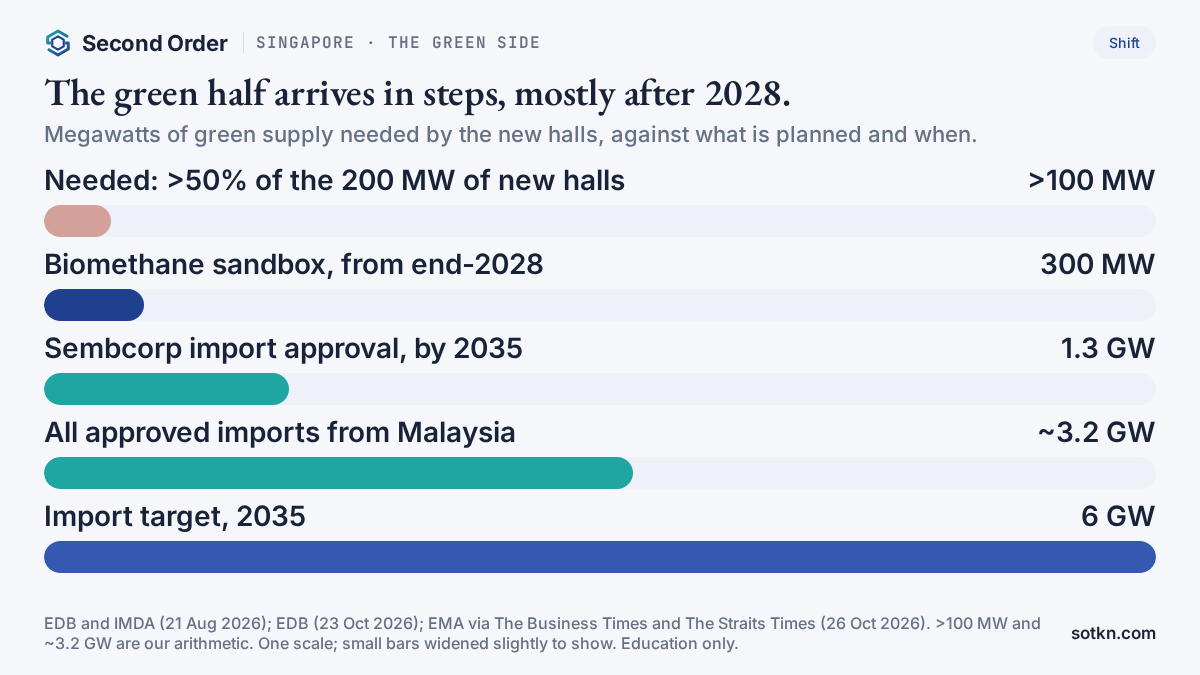
Here is the snag. On a grid that is about 95% gas, “more than half green” cannot come from the grid as it is. It has to come from fuel or power that does not yet flow into Singapore at scale. For a 50 MW hall, that is more than 25 MW of green supply; for all four, more than 100 MW (our arithmetic). The halls can be built on the normal timetable. The green half needs a supply chain that is only now being set up.
What is biomethane, and how much is coming?
Biomethane is biogas from food waste, farm waste, animal manure or sewage sludge, cleaned up until it is almost pure methane. Chemically it is the same as the methane in natural gas. That is why EDB calls it a drop-in: it can go through the same pipes and the same gas turbines, with no change to equipment. For a country that burns gas for 95% of its power, that matters more than any other green fuel on the list.
The sandbox lets the three companies bring in up to 300 MW worth of it, measured as the power it could make. EDB says that is enough for about 600,000 public housing flats a year. Sembcorp put its own share in fuel terms: up to 7.18 trillion British thermal units a year, or about 120 MW of power. In heat that is about 2.1 TWh a year, enough for roughly 1.1 to 1.2 TWh of electricity in a modern gas plant (our arithmetic; the plant efficiency is our assumption).
How the gas reaches a data centre differs by company. Keppel says it will handle the biomethane together with natural gas as one pooled fuel for its gas plants on Jurong Island, and sell the lower-carbon power to manufacturers and data centre operators, including its own data centre arm. Sembcorp says the fuel is particularly important to new data centres, naming the 200 MW and its more-than-50% rule.
Three facts limit how much this solves, and how soon. First, the first supplies are due by the end of 2028, not now. Second, 300 MW is shared with manufacturers, not reserved for data centres. Third, the sandbox is a test: EDB says it exists to try out the commercial, regulatory and operating rules for imports, and to shape the framework for wider use later. None of the three named a specific supplier or buyer contract in these announcements.
On paper the size fits. More than 100 MW of green supply for the four halls is about a third of the sandbox, and Keppel’s up to 120 MW is well over the more than 25 MW its own hall needs (our arithmetic). The question is timing and cost, not volume.
What about green power from Malaysia and further away?
The other big green route is power by cable. Singapore aims to import 6 GW of low-carbon electricity by 2035, about 30% of its demand that year, the minister said. On 26 October the Energy Market Authority gave Sembcorp Utilities and its partners a conditional approval to import up to 1.3 GW of renewable power from and through Peninsular Malaysia, including offshore wind from Vietnam and solar from Malaysia. Its partners include Petronas and Tenaga Nasional, through MY Energy Consortium, and PetroVietnam Technical Services. Sembcorp is working towards first imports by 2035.
That is the fourth import project between Singapore and Malaysia. Sembcorp already has approvals for 300 MW from Johor and 1 GW from Sarawak, and Southern Solar Alliance has one for 600 MW from Peninsular Malaysia. Add them up and about 3.2 GW of the 6 GW target now has a conditional approval from Malaysia alone (our arithmetic). Singapore has also given conditional approvals to projects from Australia, Cambodia, Indonesia and Vietnam.
The cables are coming too. Marine surveys for a second link to Peninsular Malaysia start this month. If it goes ahead, it adds up to 2 GW by 2030 to the 1 GW the existing link can carry in either direction.
There is a paperwork step as well. A data centre that buys green power from Malaysia needs proof that the power is green, usually a renewable energy certificate. The minister said EMA has set up a working group with Malaysia’s Energy Commission to line up how those certificates are used in cross-border trade. On the Malaysian side, the terms for green power sold to data centres are already a live question; see our Malaysia green power grid charge Pulse.
And there is a price test. The minister said Singapore is not pursuing imports at all costs: projects must offer a viable and competitive price against other ways to cut carbon, including buying international carbon credits. That line matters for data centres. It means the cheapest green option, not the greenest one, sets the pace.
Solar helps only at the edges. Singapore has 2.3 GWp of panels and now targets 4 GWp by 2035, but the minister said solar can meet no more than 10% of projected demand in 2050.
Does Indonesia's gas cut change the picture?
It adds urgency, not a shortage. Over the weekend before the lecture, Indonesia began cutting some of its piped gas to Singapore, reportedly to put its own needs first. The Energy Market Authority said the cut is less than 2% of Singapore’s total daily gas demand. The minister said Singapore has handled such disruptions before because it has built in buffers: about half its gas is LNG from many sources, and power plants must be able to run on diesel from reserves if gas is cut badly. On the same day Singapore and Saudi Arabia agreed to work towards storing Saudi crude oil in the Jurong Rock Caverns from the second half of 2027.
He also warned about resource nationalism, suppliers putting their own needs first even against signed contracts. Singapore will keep the lights on with gas from wherever it can. The green half is harder: it depends on cross-border fuel and power deals of exactly the kind a more nationalist region makes harder to sign.
Our math: what do the numbers say?
- Demand: 9.9 GW less 8.6 GW is 1.3 GW (+15%); 13 GW less 8.6 GW is 4.4 GW (+51%). The gap between the low and high case is 3.1 GW (our arithmetic).
- Generation: 26% on about 12 GW is about 3.1 GW, for about 15.1 GW by 2031. Against a 13 GW peak that leaves about 2.1 GW of nameplate headroom, against 3.4 GW today; against a 9.9 GW peak, about 5.2 GW. Nameplate is not all available at once, so treat these as a rough guide (our arithmetic).
- Grid: S$5.3 billion over five years is about S$1.06 billion a year. Eleven times the previous five years means about S$0.48 billion was spent then (our arithmetic).
- New halls: 200 MW is 2.3% of 8.6 GW and 1.5% to 2.0% of the 2031 range. Run flat out for a year, it is about 1.75 TWh, about 3% of the roughly 60 TWh Singapore uses a year, as the minister put it (our arithmetic; an upper bound).
- Green share: more than 50% of 200 MW is more than 100 MW, about a third of the 300 MW sandbox. For Keppel’s 50 MW hall, more than 25 MW against an allocation of up to 120 MW (our arithmetic).
- Sembcorp’s fuel: 7.18 trillion Btu is about 2.1 TWh of heat; at 55% plant efficiency, about 1.16 TWh of power, or about 130 MW running all year, close to the 120 MW it states (our arithmetic and assumption).
- Imports: 300 MW plus 1 GW plus 600 MW plus 1.3 GW is about 3.2 GW with conditional approval from Malaysia, about 53% of the 6 GW target (our arithmetic).
What this tells you: Singapore is building gas plants, wires and batteries at the fastest pace in decades, and those are paid as they are built. The newest data centres are a small slice of demand, but they carry a condition the grid cannot meet as it stands. The green supply that meets it arrives in steps: biomethane from end-2028, more cable capacity by 2030 and most imported green power around 2035.
Who gets paid first?

First, the gas plant owners and the companies that build their plants — on construction. Five plants are already scheduled and more are being sought for 2032. Their owners sell power whatever share of demand ends up green, and the turbine makers and builders behind them are paid as the plants go up.
Second, the grid — on construction. Up to S$5.3 billion of substations and cable is spent before any new hall switches on, and it is needed whether the power is gas or green.
Third, the gas importers and terminal owners — on volume. A 50% larger LNG terminal capacity by 2030 and a region where piped gas is less certain make imported LNG the backbone of the plan.
Fourth, the fuel aggregators — Keppel, Sembcorp and Tuas Power — from end-2028, on the green fuel they sell. They sit in the middle of the chain: they will buy biomethane abroad and sell it, or power made from it, to halls and factories that need a green share. Keppel said the appointment is not expected to have a material effect on this year’s earnings per share. This is a slow income, not a quick one.
Fifth, the hall operators who own their own power — when the hall opens. Keppel can supply its own data centre from its own gas plants with its own biomethane, which is what it means by power to rack. Operators without a generator have to buy most of their green share from someone else, such as one of the three aggregators, which leaves them more exposed to its price and timing.
Last, the ones who wait longest: tenants who want green power in Singapore, and listed landlords whose existing halls get scarcer while the new ones wait. Keppel DC REIT does not own the new Keppel hall; its value is in renewals of halls it already has (Keppel DC REIT quarter; Keppel DC REIT rebuild Analysis). Digital Core REIT’s deal, put to its unitholders on 22 October, includes a 2.5% interest in one Singapore data centre.
One-line rule: in Singapore’s power build, gas plants, wires and LNG are paid as they are built; the green fuel is paid only when it arrives; and the newest halls cannot keep their green promise until it does. The stuck step is the green fuel.
So what is the stuck step?
The green fuel: the low-carbon supply that lets a new Singapore hall run more than half green. Not the building, which can go up on a normal timetable. Not the grid, which is getting eleven times the money. Not gas, which Singapore buys from many sources. Four things make it stick:
- The first fuel is late. Biomethane imports start by end-2028. Until then, the green share has to come from the other listed pathways: panels on the building, which are small, or ammonia and hydrogen projects still at the design stage.
- The supply chain is new. No specific supplier or buyer contract was named in the announcements. The sandbox exists to work out the rules, so terms may change as it runs.
- The bigger green source is far off. Most imported green power is aimed at 2035, and each project still needs approvals in several countries, power purchase deals and financing.
- Price decides. Singapore says imports must compete with other ways to cut carbon, including carbon credits. A cheap option can win even if it is not the one the halls had in mind.
This is the kind of bind our stuck-step Analysis describes: once halls and grid are being paid for, the bind moves to the next input that nobody can rush. In Singapore it is not power in general. It is green power with a paper trail.
Which dates test this read next?

- 27 October 2026 — Digital Core REIT third-quarter business update, after trading. The first print since its 22 October unitholder meeting on the deal that adds a small Singapore stake.
- 28 October 2026 — SIEW Spotlight forum on powering data centres and strengthening grids. Listen for green supply terms for the Jurong Island halls.
- Mid-2027 — EMA expects to appoint a consultant for the Pulau Tekong energy cluster study, which takes about two years.
- February to August 2028 — EDB and IMDA said they would review the need for another data centre call in 18 to 24 months after August 2026 (our dates from that window).
- End-2028 — First biomethane supplies due under the sandbox. The first real test of the green half.
- 2030 — Second LNG terminal, storage over 1 GWh, 3 GWp of solar, about 9,100 km of cable and, if it goes ahead, the second 2 GW link to Malaysia.
- 2031 and 2035 — Five new gas plants running and peak demand somewhere between 9.9 GW and 13 GW; then the 6 GW import target and Sembcorp’s 1.3 GW.
What would change this view?
- Early fuel. If any of the three aggregators names a supplier and a data centre buyer with delivery before end-2028, the stuck step loosens.
- Looser rules. If the green condition can be met with certificates or credits rather than physical green supply, the bind moves from fuel to price.
- Faster cables. If the second Malaysia link and early import projects arrive well before 2035, imported green power takes over from biomethane as the main route.
- Low demand. If peak demand tracks the 9.9 GW case, more halls could be approved sooner, and gas headroom stops being a question at all.
Practical takeaways
- Singapore’s peak demand was 8.6 GW in August and could reach 9.9 GW to 13 GW by 2031, led by chip plants, data centres and electric transport
- Five gas plants add about 26% to generation by 2031; the grid gets up to S$5.3 billion in 2025–2029; storage triples by 2030
- The 200 MW of new halls on Jurong Island must run more than 50% green, on a grid that is about 95% gas
- The 300 MW biomethane sandbox (Keppel 120 MW, Sembcorp 120 MW, Tuas Power the rest) delivers from end-2028; most imported green power is aimed at 2035
- Gas, wires and LNG get paid as they are built; fuel aggregators and new halls wait; stuck step: the green fuel
FAQ
How much electricity will Singapore need by 2031?
The Energy Market Authority said on 26 October 2026 that Singapore's peak electricity demand was 8.6 GW as of August and could reach between 9.9 GW and 13 GW by 2031. That is a rise of about 15% to 51% (our arithmetic). It said the increase comes mainly from semiconductor plants, data centres and electric transport, and that the pace depends on when those projects start up.
Why do Singapore's new data centres need green fuel?
The four operators awarded 200 MW in August 2026 under the second Data Centre Call for Application committed to power more than 50% of that capacity from green energy, through pathways such as biomethane, low-carbon ammonia, low-carbon hydrogen and building-mounted solar. About 95% of Singapore's power comes from natural gas, so the green half has to be imported or made. The first imported biomethane under the new 300 MW sandbox is due by end-2028.
Is this investment advice?
No. Education only. It maps who gets paid and which step is stuck. It is not a recommendation to buy or sell any security, and we leave out share prices, broker ratings and price targets on purpose.
Keep reading on the map
- Singapore Markets hub — country page
- Licence and 200 MW · Keppel DC REIT quarter · Data centre REIT listing on hold — recent Singapore Pulses
- Keppel DC REIT Tokyo buy · Keppel DC REIT rebuild Analysis
- Malaysia green power grid charge · Malaysia unused power · Princeton Digital Johor loan — across the causeway
- NEXTDC billing date — when the power date slips in Australia
- If gas turbines stay booked into 2030 · AI lab prepays for gas power · A 1 GW virtual power plant
- How hyperscalers buy power · PUE explained · Where AI data centers are located
- What an AI data center costs · Data center financing · Where does the stuck step move?
- AI Data Centers on the stack · All Markets doors — Taiwan, Korea, US, China, Singapore, Australia, Malaysia
How we check this. The five-year plan figures come from the Energy Market Authority’s 26 October 2026 release and the minister’s Singapore Energy Lecture at the opening of Singapore International Energy Week, as reported the same morning by CNA, The Business Times and The Straits Times; where the three differ in wording we use the plainest figure they share. The biomethane sandbox comes from the Economic Development Board’s own release of 23 October and the statements Keppel and Sembcorp issued that day; the split between the three companies is as reported by The Business Times. The data centre award and its green-energy rule come from the EDB and IMDA fact sheet of 21 August and Keppel’s release of the same day. Every sum we worked out is labelled “our arithmetic”, and we say where a sum is only a rough guide. Share prices, broker ratings and price targets are left out on purpose. The references we used are listed at the end. Our editorial standards →
Not investment advice. Do your own research.
References
- CNA, Singapore launches five-year energy infrastructure plan to meet growing demand, sets new solar target, 26 Oct 2026. channelnewsasia.com — the five-year plan figures.
- The Business Times, Inside Singapore's new five-year energy plan: S$5.3 billion grid upgrade, trebling of storage capacity, 26 Oct 2026. businesstimes.com.sg — the lecture, 2032 plants, Malaysia imports and certificates.
- The Straits Times, S'pore to tap diverse energy sources, explore new tech, to weather resource nationalism: Tan See Leng, 26 Oct 2026. straitstimes.com — the gas cut, the LNG share and the import target.
- Singapore Economic Development Board, Singapore appoints Keppel Energy, Sembcorp Utilities and Tuas Power Generation for Southeast Asia's first biomethane import pilot, 23 Oct 2026. edb.gov.sg — the 300 MW sandbox and its timing.
- The Business Times, Keppel Energy, Sembcorp Utilities and Tuas Power to supply biomethane in pilot project, 23 Oct 2026. businesstimes.com.sg — the split between the three companies.
- Sembcorp Industries, Sembcorp supports Singapore's energy diversification as approved biomethane aggregator, 23 Oct 2026. sembcorp.com — Sembcorp's volume and the link to new data centres.
- Keppel, Keppel appointed biomethane aggregator by Singapore's Economic Development Board for 15 years, 23 Oct 2026. keppel.com — Keppel's allocation and how it will use the fuel.
- Singapore Economic Development Board and IMDA, fact sheet: four data centre proposals selected as part of DC-CFA2, 21 Aug 2026. edb.gov.sg — the 200 MW award and its green-energy rule.
- Keppel, Keppel awarded 50 MW new data centre capacity under Singapore's second Data Centre Call for Application, 21 Aug 2026. keppel.com — Keppel DC SGP 11 and Keppel's Jurong Island power.