
Keppel DC REIT Is Emptying Its Oldest Singapore Hall. What Does the Price Assume?
Keppel DC REIT's distribution rose 11.7%, but its oldest Singapore hall is 46% full as it winds down for a possible rebuild in a city that rations power. What the price assumes, who gets paid first, three scenarios with the arithmetic shown.

ANALYSIS · MEMBERS CONTINUE · 5 min free / 14 min full · Data as at 23 Oct 2026
Keppel DC REIT owns data centres in ten countries, more than half of them by value in Singapore, where new power for data centres is rationed. On Friday 23 October it reported an 11.7% rise in distribution per unit for the first nine months, and its units closed the day up about 4% at S$2.13. The same update shows its oldest Singapore hall, Keppel DC Singapore 1, still 46.3% occupied as the manager winds it down for a possible rebuild. What does the price already assume about that step?
In short
- The question: what is Keppel DC REIT's unit price assuming about the rebuild step, the point where an owner of old, powered Singapore halls has to empty one and rebuild it before it can earn at modern rates?
- The answer: Scenario B. At S$2.13 the units yield about 5.3% on the last twelve months' distributions (ours) and trade at about 1.21 times book value (ours). The price assumes the distribution holds roughly flat while the oldest hall empties: Tokyo and Sydney fill the hole, and the rebuild itself earns nothing for years
- Why: Keppel DC Singapore 1 earned about S$16.5 million in 2025, roughly 0.6 cents a unit (ours). Its book value works out at about S$2,800 a square foot of lettable space (ours), against about S$9,700 for the REIT's newest Singapore hall
- The stuck step: the rebuild. The hall's contracts run out in about 1.2 years on average. A bigger, denser hall needs design, money and, in a city that handed out only 200 MW of new data centre power in August, a power and licence answer that has not been disclosed
- Behind the wall: who gets paid, in order, while the old hall empties · one hall, two prices · three scenarios, arithmetic shown · what the market could be right about · six practical takeaways · Members' FAQ
- What would break it: a disclosed rebuild plan with added power, while the units stay near today's yield (then the market is not paying for the rebuild at all)
- Nothing here is a recommendation. This is a map of what the price requires, with the working shown
What's in this piece: the numbers that matter · why Keppel DC REIT sits at the rebuild step · what S$2.13 already assumes · members from here · who gets paid while the old hall empties · one hall, two prices · three scenarios, arithmetic shown · our read · what would change the view, with dates · practical takeaways · FAQ · references
The numbers that matter
| What | Figure | Date | What it tells us |
|---|---|---|---|
| Unit price | S$2.13 close; S$2.05 close the day before | SGX, 23 Oct 2026 | Up about 4% on the update |
| Units | About 2.75 billion after 297.6 million new units sold at S$2.10 | 10 Sep 2026 | The unit base grew about 12% |
| Market value | About S$5.85 billion (ours) | 23 Oct 2026 | About 1.21 times book of about S$1.76 a unit (ours) |
| Distribution | 8.571 cents for nine months, +11.7%; last twelve months about 11.28 cents (ours) | 23 Oct 2026 | About 5.3% at S$2.13 (ours) |
| Occupancy | Portfolio 93.0%; contracted power capacity about 96% | 30 Sep 2026 | The rest of the portfolio is full |
| The old hall | Keppel DC Singapore 1: 46.3% occupied, 15 clients, contracts 1.2 years on average | 30 Sep 2026 | 53.3% at the end of 2025 |
| Tokyo | 88.62% of Tokyo Data Centres 4 and 5 for about S$1.37 billion, completed 1 Oct | 2026 | Growth bought abroad |
| Leverage | 36.2%; 38.8% after the 1 October yen drawdown | 30 Sep 2026 | Close to the manager's 40% internal ceiling |
| Guangdong | S$10.9 million set aside for unpaid bills in the first half | 1H 2026 | Booked income not collected |
| Singapore power | 200 MW of new capacity awarded in August, across four operators | Aug 2026 | New halls are scarce |
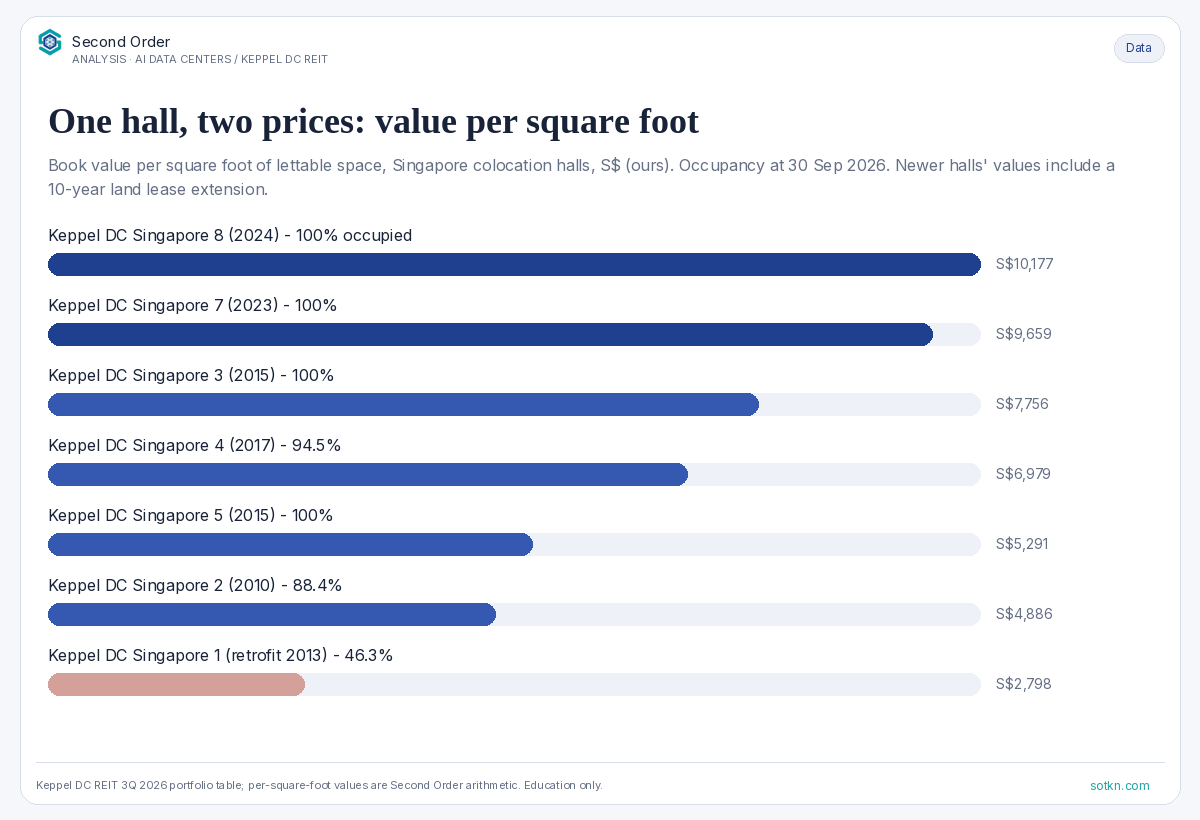
Chart 1 — Book value per square foot of lettable space for Keppel DC REIT's Singapore colocation halls, Singapore dollars, from the REIT's 3Q 2026 portfolio table; Second Order arithmetic. Education only.
Why does Keppel DC REIT sit at the rebuild step?
A data centre landlord earns from halls that already have power, cooling and customers. In most markets the risk is building too slowly. In Singapore the government decides the pace. In August it awarded 200 MW of new capacity to four operators, 50 MW each, all on Jurong Island, after more than 20 bids. On 7 October Parliament passed a law that will license every data centre of 3 MW or more. Our Singapore licence Pulse covered both.
That makes an existing, connected Singapore hall unusually valuable. Keppel DC REIT owns eight of them. Seven are full or close to it. The eighth, Keppel DC Singapore 1 in Serangoon North, is not. The building dates from the 1990s, became a data centre in 2001 and was last retrofitted in 2013. Occupancy fell from 53.3% at the end of 2025 to 46.5% at the end of June and 46.3% at the end of September. On the July results call, the manager's chief executive said the REIT was "making preparations for a potential redevelopment" and described "a calibrated ramping-down process".
So the old hall empties on purpose. Its customers leave as contracts end, and the REIT gives up their income to get the floor back. What happens next has not been published: how big the new hall would be, what it would cost, and how much power it could draw. That last question is the one Singapore answers slowly.
Meanwhile the REIT grows elsewhere. It bought most of two full Tokyo halls for about S$1.37 billion, paid for with new units and yen loans, which our Tokyo Pulse mapped. New contracts at its Sydney hall start from the end of 2026. For how the REIT makes money, see what Keppel DC REIT does.
The rest of the portfolio is doing its job. Occupancy rose to 93.0% at the end of September, about 96% of power capacity is contracted, and contracts renewed this year were priced about 14% higher, led by Singapore and Australia. The question is not demand. It is how long one old hall takes to become a new one.
What does S$2.13 already assume?
A REIT's price is a bet on the distribution and on the yield investors want for it. For the rebuild step, three answers compete:
- The step stays stuck. The old hall empties, no rebuild plan or power arrives for years, renewals add little and borrowing costs rise
- The step waits. The old hall empties, but Tokyo, Sydney and modest price gains on renewals fill the hole
- The step clears. Renewals reprice at the recent pace, the unpaid Guangdong bills are resolved, and the rebuild gets a plan with power
Our read, in one line: the price already assumes Scenario B. At S$2.13 the units are valued as if the distribution stays near the last twelve months' 11.3 cents while the old hall empties. They pay nothing for the rebuild, or for the Guangdong money. The scenarios and the arithmetic are below.
The free preview ends here.
—— Still to read · ~9 of 14 minutes ——
MEMBERS CONTINUE HERE
- Who gets paid, in order, while the old hall empties
- One hall, two prices
- Three scenarios with the arithmetic
- What the market could be right about
- Six practical takeaways
- Members' FAQ