
16% Rent Resets, 28% More Interest: Who Gets Paid in Keppel DC REIT's Quarter
Keppel DC REIT's 23 October update shows renewals repricing about 16% higher and 96% of its power contracted. It also shows interest costs up 28% in nine months. Rent resets when a contract ends. Interest resets now.
Keppel DC REIT's third quarter shows how money is made in Singapore data centres when new power is rationed: you raise the price of halls you already have. On 23 October the REIT said renewed contracts started about 16% above the ones they replaced, and about 96% of its power capacity is contracted. The same update shows finance costs up 28.1% in nine months, more than twice as fast as net property income. Lenders and the sponsor are paid every quarter. Unitholders are paid as contracts roll, and most of the rent does not roll until 2028 and 2029. The stuck step is the renewal calendar.
SINGAPORE · AI DATA CENTERS · Data as at 23 Oct 2026 · Next update: Keppel DC REIT's full-year 2026 results, expected late January 2027
Affects: AI Data Centers · Hyperscalers · Neoclouds — Markets: Singapore · Australia · Malaysia · US
Education only, not advice to buy or sell any security. Figures are as filed by the REIT unless labelled as our arithmetic. The REIT gave no management commentary with this quarterly update.
The numbers that matter this week
Renewal reversion, 3Q
~16%
~14% for nine months · ~5% in 2Q
FiledPower capacity contracted
~96%
~97% with the new Tokyo halls
FiledFinance costs, nine months
+28.1%
Net property income +13.1%
FiledAggregate leverage
38.8%
Pro forma after 1 Oct yen loans · 36.2% at 30 Sep
FiledRent expiring by end-2027
~8%
~44% expires in 2028–29 (our arithmetic)
OursThe renewal calendar
The bind
Rent resets only when a contract ends
Stuck stepFigures from Keppel DC REIT's 3Q 2026 operational update of 23 October 2026 and its 1H 2026 results of 23 July 2026. Status chips are Second Order’s read.
On this page: Why it matters · What changed · The renewals · The interest bill · The calendar · New power · Across the region · Our math · Who gets paid · What is stuck? · Dates next · What would change this · FAQ
Why does one REIT's quarterly update matter for Singapore's AI data centres?
Because Keppel DC REIT is the clearest public window into what a powered Singapore hall earns. It was the first data centre REIT listed in Asia, it owns eight data centres in Singapore, and it reports the two numbers that matter most in a city where new power is handed out in rounds: how much of its power is already sold, and how much more customers pay when a contract comes up for renewal.
Both numbers moved the right way for owners this quarter. About 96% of the REIT's power capacity is now contracted, up from about 95% at the end of June. And contracts that renewed and started in the third quarter did so at about 16% more than the contracts they replaced. When almost everything is let, the only way to earn more from the same building is to charge more for it, and Singapore's customers are paying.
The other side of the same update is less comfortable. The REIT has been growing by buying, mostly in Japan, and buying with debt. Its finance costs for the nine months rose 28.1%, against 13.1% for net property income. A landlord's rent resets only when each contract ends. Its interest bill resets with every loan it draws. This quarter shows the two clocks running at different speeds.
This builds on our earlier Singapore coverage rather than repeating it. Our licence Pulse of 9 October set out how Singapore rations new data centre power. Our Tokyo Pulse of 11 October mapped the REIT's S$1.37 billion purchase of two Tokyo halls. For how the REIT makes money in the first place, see what Keppel DC REIT does. For why rent starts only when power and a tenant are both in place, see data center leases, explained.
1 · The lenders
Who: Banks and note holders
Paid: Interest every quarter · finance costs +28.1% in nine months
2 · The sponsor
Who: Keppel
Paid: Fees, the Keppel lessee on Singapore halls, about 16% of units
3 · The unitholders
Who: Public and institutional investors
Paid: DPU +11.7% on an enlarged unit base
4 · The renewal calendar
Who: Contracts that must end before rent can reset
Paid: ~8% of rent by end-2027 · ~44% in 2028–29 (ours)
What changed between July and 23 October?
Four filings, read in order, take the REIT from a first-half print to a bigger, more indebted business whose Singapore halls are repricing faster.
- 23 July — the first half. Distribution per unit rose 11.3% to 5.714 cents. Reversion for the half was about 10%, of which about 5% in the second quarter. About 95% of power capacity was contracted, leverage was 34.0%, 87.0% of S$2.3 billion of borrowings was at fixed rates, and interest cover was 6.9 times. The REIT said most of its electricity costs are contractually recoverable from clients.
- 21 August — Singapore's power round. The Economic Development Board and IMDA provisionally allocated 200 MW of new data centre capacity, 50 MW each to Digital Realty, Equinix, Keppel Data Centres and ST Telemedia Global Data Centres, from more than 20 proposals. All four will build on Jurong Island. Keppel said its 50 MW will go to a new hall, Keppel DC SGP 11, to be funded by its private Keppel Data Centre Fund III and co-investors.
- September to 1 October — the Tokyo purchase. The REIT agreed to buy 88.62% of two full hyperscale halls in Inzai, Greater Tokyo, for JPY 168.4 billion, about S$1.37 billion, partly funded by a S$625 million placement of new units that was about 3.4 times covered. The rest came from yen loans, and the deal completed on 1 October.
- 23 October — the third-quarter update. Nine-month distribution per unit of 8.571 cents, up 11.7%. Reversion of about 14% for nine months and about 16% for the quarter, with renewals and new contracts in Singapore and Australia. Occupancy up to 93.0%. Finance costs up 28.1%. Leverage at 36.2%, and 38.8% pro forma once the 1 October yen loans are counted.
Read together, this is not a demand problem. Customers are renewing at higher prices and the halls are close to full. It is a timing and funding story: the price gains arrive contract by contract, and the cost of growing elsewhere arrives up front.
How fast are Singapore's halls repricing?
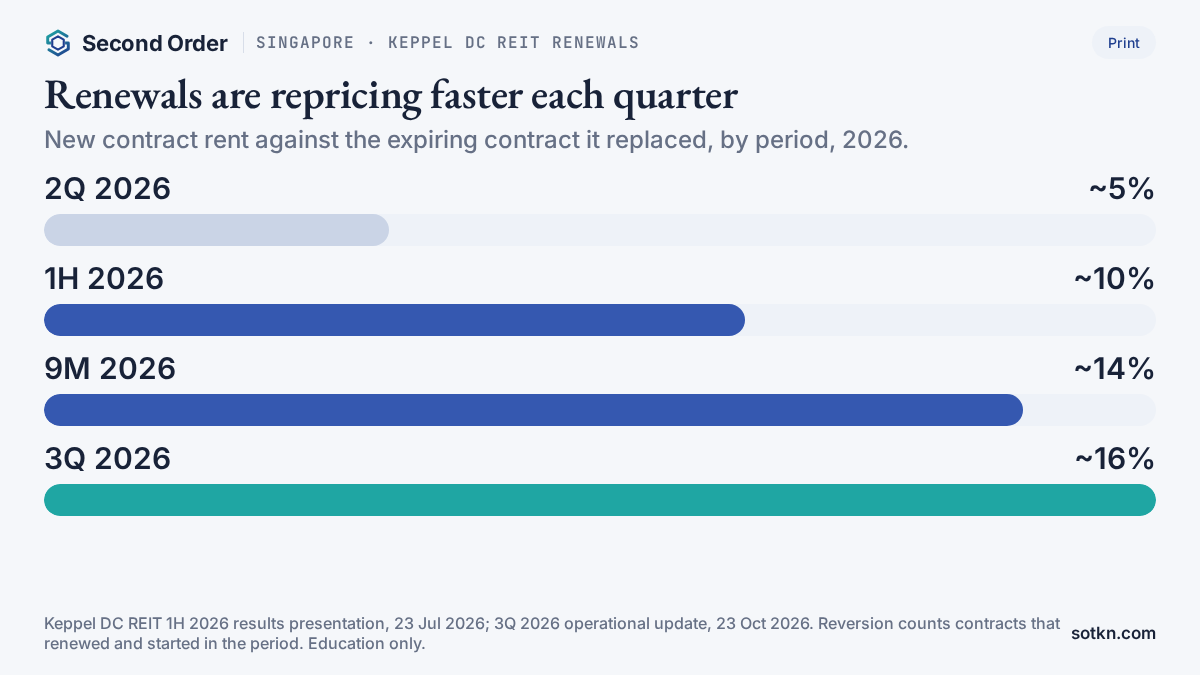
Faster each quarter this year. The REIT measures reversion as the rent on contracts that renewed and started in a period divided by the rent on the contracts they replaced. It reported about 5% for the second quarter, about 10% for the first half, about 14% for the first nine months and about 16% for the third quarter alone. It said the gains came from renewals and new contracts in Singapore and Australia.
Two details keep that number honest. First, it counts only contracts that have started. Renewals signed this year that begin later are excluded, so the reported figure lags what has been agreed. Second, it is a portfolio number. The REIT does not split it by country in the update, so we cannot say how much of the 16% is Singapore. What we can say is that the REIT names Singapore and Australia as where the renewals happened.
Why can Singapore landlords push prices like this? Because their customers cannot easily go elsewhere. A colocation customer has servers, network links and staff routines built around a hall. Moving is costly and slow, and in Singapore there are few powered halls to move to. For the difference between renting space in a shared hall and leasing a whole building, see hyperscale versus colocation.
Filed by the REIT (30 Sep 2026)
Where the rent comes from
The right-hand table is the engine. Three-quarters of the rent sits on colocation contracts with less than three years left on average. Short contracts are a risk if demand fades, and an advantage when it does not, because they come back to the landlord to be repriced. The REIT also said in July that most electricity costs pass through to clients, so a rise in Singapore's power prices lands mainly on tenants, not on the REIT's margin. The landlord sells access to power; the tenant pays for the power itself.
Why did the interest bill grow twice as fast as the rent?
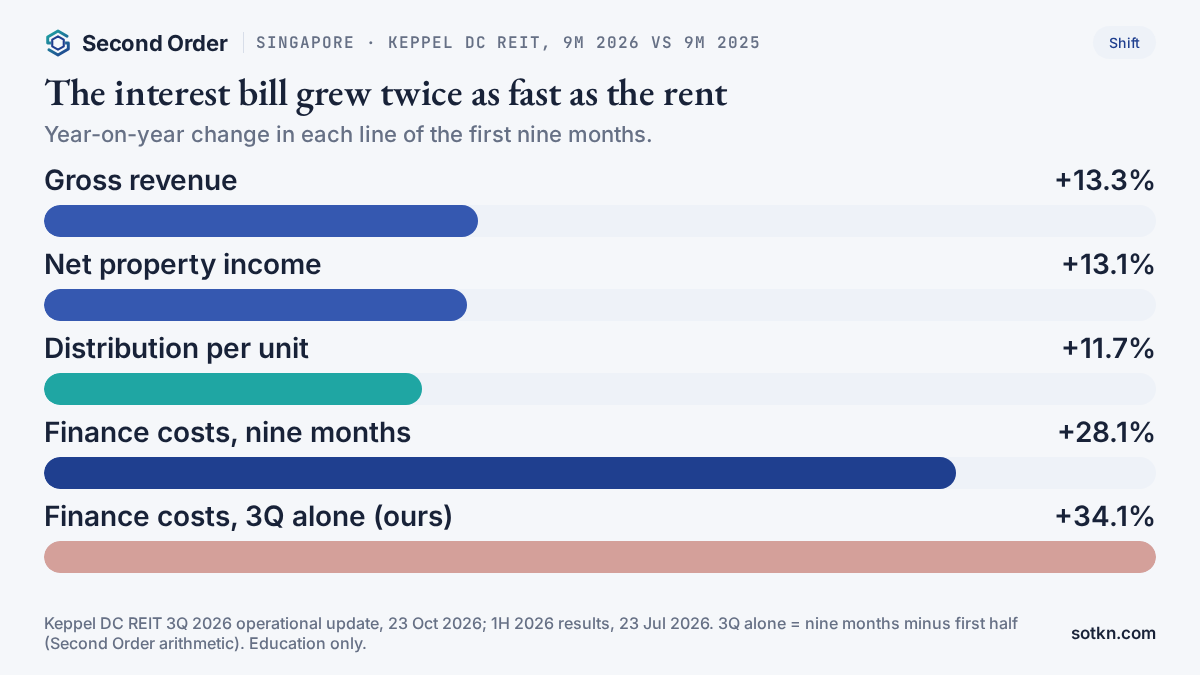
Because the REIT borrowed to grow. In the nine months to 30 September, gross revenue rose 13.3% to about S$365.3 million and net property income rose 13.1% to about S$316.8 million. Finance costs rose 28.1% to about S$46.7 million, while finance income fell 6.2%. The update names the causes: acquisition loans drawn in the fourth quarter of 2025, and the payment to extend the land leases at Keppel DC Singapore 7 and 8 by ten years.
The third quarter on its own shows the gap more sharply. Taking the nine months and subtracting the first half, net property income for the quarter was about S$106.4 million, up about 9.3% on the same quarter of 2025, while finance costs were about S$16.0 million, up about 34.1% (our arithmetic). Of every extra dollar of net property income over the nine months, about 28 cents went to extra interest (our arithmetic).
The debt is also more exposed to rates for now. Borrowings rose from about S$2.3 billion at 30 June to about S$2.8 billion at 30 September, and that excludes a further JPY 24 billion yen loan and a loan for Japanese consumption tax, both drawn on 1 October to complete the Tokyo deal. The share at fixed rates fell from 87.0% to 69.6%. The REIT says yen interest-rate swaps start in December 2026 and will lift fixed debt back to the high 80s per cent. Yen debt is now 50.7% of the total.
The REIT's own sensitivity table puts limits on the risk. Average cost of debt was 2.7% in the third quarter and 2.6% for nine months. Interest cover fell from 6.9 times in June to 6.5 times. A one-point rise in the average rate on all borrowings would take cover to 4.7 times, and a quarter-point change in rates moves pro forma third-quarter distribution per unit by about 0.2%, the REIT says. Its outlook adds that rates remain elevated, with further rises still possible.
None of this is unusual for a landlord that grows by acquisition. It is why distribution per unit rose 11.7% while distributable income rose 16.7%: the September placement added units before the Tokyo halls added income, which starts from 1 October. For how data centre owners fund halls, and who stands first in line for the cash, see data center financing, explained.
When can most of the rent reset?
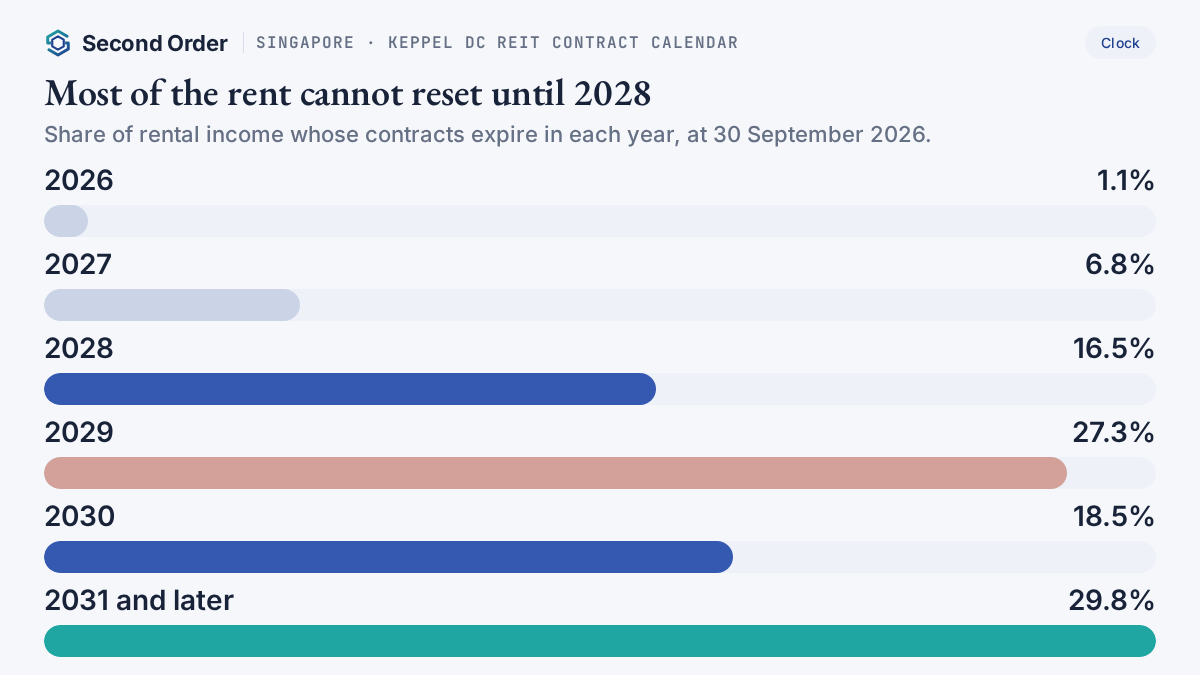
Mostly not before 2028. By rental income, the REIT's contract calendar at 30 September shows 1.1% of rent expiring in the rest of 2026 and 6.8% in 2027. Then it widens: 16.5% in 2028, 27.3% in 2029 and 18.5% in 2030, with 29.8% running to 2031 or later. Most of the 2028 and nearly all of the 2029 expiries are colocation contracts, the kind that have been repricing.
Compare that with June. At 30 June, 2.6% of rent was due to expire in 2026. By 30 September it was 1.1%. That is roughly one and a half points of rent leaving the 2026 column in a single quarter, consistent with the batch behind the 16% reversion (our reading of the two calendars). The pipeline for the next five quarters is thinner: about 7.9% of rent through the end of 2027 (our arithmetic).
That is the core of this quarter. Singapore's halls are full and customers are paying more when they renew. But a landlord cannot reprice a contract that has not ended. With about 8% of rent coming up for renewal before 2028 and about 44% in 2028 and 2029 (our arithmetic), most of the gain the market can see in today's reversion number is still years from reaching the distribution.
There are ways to move the clock. A landlord can agree early renewals at new terms, add power to an existing building, or redevelop. The REIT lists all three among its tools: repositioning, power intensification, redevelopment and capital recycling. One project has a date. The upgrade of Keppel DC Singapore 8 is on track to finish in the second half of 2027. Elsewhere in the portfolio, new contracts at Gore Hill in Sydney start from the end of 2026, and the REIT says that hall's revenue will more than double when they do.
Who gets Singapore's new data centre power?
Not, so far, the listed REIT. Singapore adds data centre capacity in rounds. In August, the second round gave out 200 MW: 50 MW each to four operators, from more than 20 proposals, all on Jurong Island. The government said it will review the need for another round in 18 to 24 months, which puts the next decision somewhere between February and August 2028.
Keppel won one of the four awards. Its 50 MW goes to Keppel DC SGP 11, an AI-ready hall with expected investment of more than S$1 billion, to be developed by Keppel and funded by Keppel Data Centre Fund III and its co-investors. That is Keppel's private fund money, not the REIT's balance sheet. Whether the hall ever reaches the REIT is a question for later; nothing in the 23 October update says it will. Our licence Pulse covered the award and the new licensing law in detail.
So the REIT's Singapore growth for now has to come from inside its own fence. Its asset mix shows where the new money went instead. At 30 June, Singapore was 62.8% of about S$6.3 billion of assets and Japan 13.4%. At 30 September, after Tokyo, Singapore was 51.9% of about S$7.6 billion and Japan 28.6%. On our arithmetic, the REIT's Singapore assets stayed at about S$3.9 billion to S$4.0 billion while its Japanese assets rose from about S$0.8 billion to about S$2.2 billion. Growth went abroad, and it went on borrowed and newly raised money.
The REIT's own outlook slide explains why owning a connected hall is the prize. Citing JLL, it charts average grid connection lead times of roughly four years in Singapore and about ten years in Tokyo and Amsterdam, reading off its chart, and says power availability remains the key constraint on new data centre development. Singapore's wait for a connection is not the longest. Its bind is the permission to draw new power at all, and that comes in 200 MW rounds.
How does Singapore compare with the rest of the region?
Four markets, four places the money waits. In Melbourne, as our NEXTDC M3 Pulse found and our guidance-cut follow-up confirmed, the halls were built and the last street of wire was not, so billing slipped. In Malaysia, as our unused-power piece set out, power is still on offer and the government charges for capacity that is booked and left idle. In Tokyo, the REIT bought halls that already had power, because new connections there take years.
Singapore is the mature case. Power is rationed by policy, so the scarce asset is a hall that already has it. Owners of those halls do not wait for wire; they wait for contracts to end so they can reprice them. That is a better problem than Melbourne's. It is still a wait.
The listing route is tight too. As our REIT IPO Pulse found on 17 October, a planned Singapore listing of AirTrunk assets was pushed back to early 2027. And Singapore's other data centre REIT, Digital Core, has been changing its own mix, which our Digital Core Analysis mapped. For the other big local operator, see what Nxera does.
Our math: what do the numbers say?
- Third quarter alone: net property income about S$106.4 million against about S$97.4 million a year earlier, up about 9.3%; finance costs about S$16.0 million against about S$11.9 million, up about 34.1% (our arithmetic: nine months minus first half).
- Where the extra income went: net property income rose about S$36.6 million over nine months and finance costs about S$10.2 million, so about 28% of the gain went to extra interest (our arithmetic).
- Interest as a share of property income: about 14.7% in the first nine months of 2026, against about 13.0% a year earlier; about 15.0% in the third quarter, against about 12.2% (our arithmetic).
- Units versus income: distributable income rose 16.7% and distribution per unit 11.7%; the gap of about five points is mostly the larger unit base after September's placement, which the REIT names as an offset (our reading).
- Renewal calendar: 1.1% plus 6.8% is about 7.9% of rent expiring by the end of 2027; 16.5% plus 27.3% is about 43.8% in 2028 and 2029 (our arithmetic).
- Floating-rate debt: 30.4% of about S$2.8 billion is roughly S$0.85 billion at floating rates until the December swaps, before the 1 October yen loans (our arithmetic).
- The 1 October yen loan: JPY 24 billion is about S$196 million at the JPY 100 to S$0.815 rate the REIT used for the deal (our arithmetic).
- Room to borrow: at 38.8% pro forma leverage, or 37.9% excluding the consumption-tax loan, the REIT has roughly S$150 million to S$300 million of new debt before reaching its 40% internal ceiling, against about S$673 million in June (our rough arithmetic on the REIT's ratios).
- Where assets sit: Singapore about S$3.96 billion in June and about S$3.94 billion in September; Japan about S$0.84 billion rising to about S$2.17 billion (our arithmetic on the REIT's percentages and rounded totals).
What this tells you: the Singapore halls are doing more with the same buildings, and the price gains are accelerating. But the growth the REIT bought this year was paid for up front, and its interest bill now rises faster than its property income. The balance sheet has little room left at 40%, so the next leg of growth leans on the renewal calendar, upgrades or new units.
Who gets paid first?
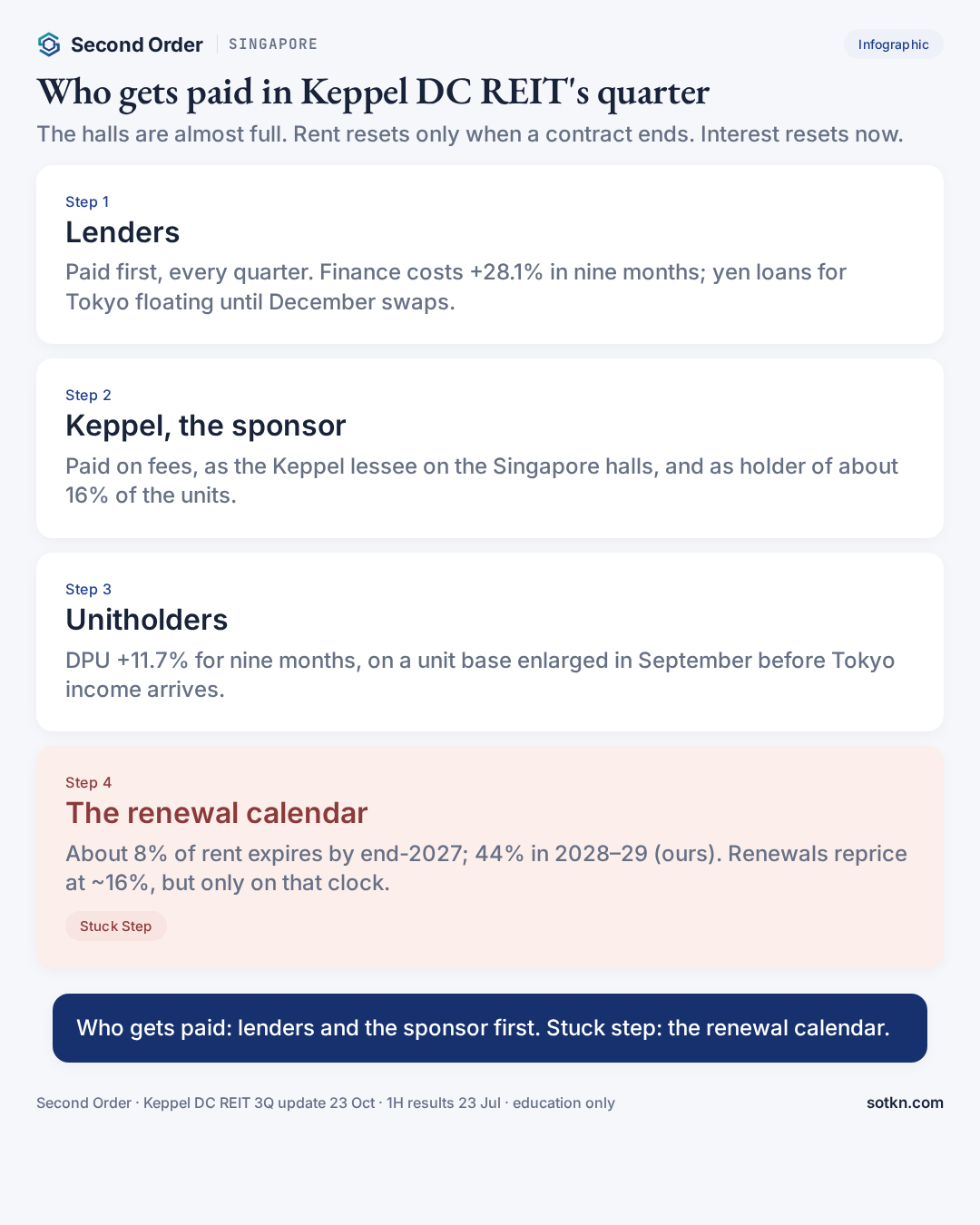
First, the lenders — every quarter. About S$46.7 million of finance costs in nine months, up 28.1%, on borrowings that grew by about half a billion Singapore dollars in a quarter. Interest is owed whether a contract renews this year or in 2029. Until the December swaps, about 30% of the debt also floats.
Second, Keppel, the sponsor — on a schedule. Keppel holds about 16% of the units, and its wholly owned manager earns the REIT's management fees. Seven of its eight Singapore halls are leased to Keppel lessees, which contract with the end customers, and the REIT shares the swings in their income and costs. When the REIT grows, Keppel's fee base grows with it. And the new Singapore megawatts from August sit in Keppel's private fund.
Third, the tenants' power suppliers — through the tenants. The REIT says most electricity costs are recoverable from clients, and its 3Q update says it has limited exposure to power cost swings. A rise in energy prices, which the REIT's outlook flags, is paid mainly by the customers using the power, not the landlord.
Fourth, the unitholders — as income grows faster than units. Distribution per unit for nine months rose 11.7%, and the Tokyo halls start contributing from 1 October. The 16% reversion reaches them contract by contract, on the calendar. For the full set of tools a landlord uses to lift income without new land, see what Keppel DC REIT does.
Fifth, the customers — later, as compute they can keep running. A hyperscaler or enterprise that renews pays more, but keeps its servers where they are in a city where new capacity is rare. For how AI workloads change what a hall must provide, see what an AI data center is.
One-line rule: in Keppel DC REIT's quarter, lenders and the sponsor are paid on a schedule that does not wait. Unitholders are paid as the rent resets. The stuck step is the renewal calendar.
So what is the stuck step?
The renewal calendar: the dates on which contracts end and can be repriced. Not demand: 96% of power is contracted and renewals are rising. Not power costs: they pass to tenants. Not, for now, the debt: interest cover is 6.5 times. Three things make this step stick:
- Contracts end when they end. About 7.9% of rent comes up before the end of 2027 (our arithmetic). Early renewals can pull some forward, but the REIT does not publish how many it has agreed.
- New Singapore power does not come to the REIT. Keppel's 50 MW from August is funded by its private fund, and the next round is only reviewed in 18 to 24 months. The REIT cannot add Singapore halls the easy way.
- The balance sheet has little room. At 38.8% pro forma against a 40% ceiling, more buying would likely need new units, as the September placement did. Upgrades such as Keppel DC Singapore 8 take until the second half of 2027.
So-what: in Singapore's data centres this quarter, the scarce thing is not customers or power contracts. It is time. The halls are full, and their price is rising, but the REIT can only collect that price as each contract ends. Its interest bill does not wait for the calendar.
Which dates test this read next?
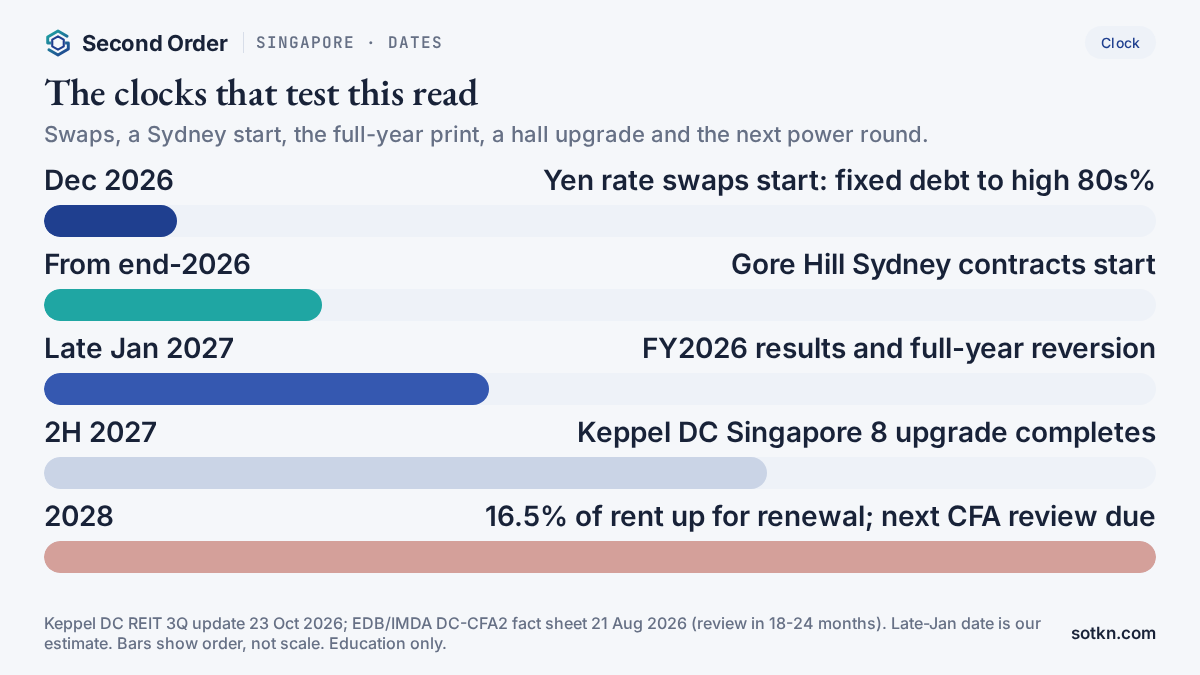
- December 2026 — yen interest-rate swaps start. The test: fixed-rate debt back to the high 80s per cent, and finance costs that grow no faster than income.
- From the end of 2026 — new Gore Hill contracts in Sydney start. The test: whether that hall's revenue more than doubles, as the REIT says.
- Late January 2027 — full-year 2026 results (our estimate from past timing). The test: the full-year reversion, the Tokyo halls' first quarter of income, and the distribution for 10 September to 31 December.
- Second half of 2027 — the Keppel DC Singapore 8 upgrade finishes. The test: whether added power or space shows up as new income from an existing building.
- 2028 — 16.5% of rent comes up for renewal, and Singapore's next capacity round is due for review between February and August. The test: whether renewals still reprice near today's pace, and whether any new Singapore power reaches the REIT.
The first two dates are about cost and one hall. The middle date tells us whether the reversion holds for a full year. The last is when the calendar finally opens.
What would change this view?
- The REIT discloses large early renewals at higher prices — the calendar would matter less than it looks.
- Reversion falls back toward the second quarter's 5% — the price gain, not the timing, would become the question.
- New Singapore capacity is offered to the REIT, from Keppel or a later round — the REIT would have a way to grow at home.
- Rates rise by a point on the floating part of the debt before the swaps start — the interest clock would bind before the renewal clock.
Practical takeaways
- 23 Oct: Keppel DC REIT's nine-month distribution per unit rose 11.7% to 8.571 cents
- Renewals repriced about 16% in the third quarter, up from about 5% in the second
- About 96% of power capacity is contracted; occupancy 93.0%
- Finance costs rose 28.1% in nine months, against 13.1% for net property income
- Leverage 38.8% pro forma after the Tokyo yen loans, against a 40% internal ceiling
- About 8% of rent expires by end-2027; about 44% in 2028–29 (our arithmetic)
- Lenders and the sponsor are paid first. Stuck step: the renewal calendar
FAQ
What did Keppel DC REIT report on 23 October 2026?
A third-quarter business update. Distribution per unit for the nine months to 30 September was 8.571 cents, up 11.7% from 7.670 cents, on distributable income up 16.7% to about S$228.0 million. Net property income rose 13.1% and finance costs rose 28.1%. Renewed contracts repriced about 14% higher over nine months and about 16% in the third quarter. About 96% of power capacity was contracted, occupancy was 93.0%, and aggregate leverage was 36.2%, or 38.8% pro forma after yen loans drawn on 1 October to buy two Tokyo halls.
What is a rental reversion?
It compares the rent on a contract that has just been renewed or replaced with the rent on the contract that expired. Keppel DC REIT calculates it as the signing rent of contracts renewed and started in the period divided by the rent of the contracts they replaced. A reversion of about 16% means the new contracts started at roughly 16% more than the old ones. It counts only contracts that have actually started.
Why did interest costs rise faster than rent?
Because the REIT borrowed to buy. The update links higher finance costs to acquisition loans drawn in the fourth quarter of 2025 and to the payment for extending the land leases at Keppel DC Singapore 7 and 8. Borrowings rose from about S$2.3 billion at 30 June to about S$2.8 billion at 30 September, and the share at fixed rates fell from 87.0% to 69.6% until yen rate swaps start in December 2026.
When can most of Keppel DC REIT's rent reset?
Mostly in 2028 and 2029. At 30 September, 1.1% of rental income was on contracts expiring in 2026 and 6.8% in 2027, against 16.5% in 2028 and 27.3% in 2029. About three-quarters of rental income is on colocation contracts that average 2.8 years, so the calendar turns faster than a typical property trust, but not fast enough to reprice most of the book before 2028.
Does Keppel DC REIT get Singapore's new data centre power?
Not directly, so far. In August Singapore handed out 200 MW of new capacity, 50 MW each to four operators. Keppel's share goes to a new Jurong Island hall, Keppel DC SGP 11, which Keppel will develop and its private Keppel Data Centre Fund III and co-investors will fund. The listed REIT is not named as the funder. Its Singapore growth today comes from repricing and upgrading the halls it already owns.
Is this investment advice?
No. Education only. It maps who gets paid and which step is stuck. It is not a recommendation to buy or sell any security, and we leave out unit prices, yields, broker ratings and price targets on purpose.
Keep reading on the map
- Singapore Markets hub — country page
- Singapore licence Pulse — 200 MW and a licence
- Keppel DC REIT Tokyo Pulse — the S$1.37 billion purchase
- Singapore REIT IPO Pulse — the listing door
- Digital Core REIT Analysis — the powered-hall step
- NEXTDC M3 Pulse · Malaysia unused-power piece
- AI Data Centers on the stack · What Keppel DC REIT does · What Digital Core REIT does
- Data center financing, explained · How long it takes to build an AI data center
- All Markets doors — Taiwan, Korea, US, China, Singapore, Australia, Malaysia
How we check this. Every Keppel DC REIT figure for the nine months and the third quarter comes from the REIT's 3Q 2026 operational update of 23 October 2026, filed on SGX. First-half and second-quarter figures, the 30 June contract calendar, the asset mix and the statement that most electricity costs are recoverable from clients come from the 1H 2026 media release and results presentation of 23 July 2026. Singapore's August capacity awards come from the EDB and IMDA fact sheet of 21 August 2026, and the plan for Keppel DC SGP 11 from Keppel's release of the same day. Third-quarter-only figures are the nine-month figures minus the first half, and are labelled as ours. The REIT issued no management commentary with this update, so we quote none. Unit prices, yields, broker ratings and price targets are left out on purpose. Anything we worked out ourselves is labelled “our arithmetic”. The references we used are listed at the end. Our editorial standards →
Not investment advice. Do your own research.
References
- Keppel DC REIT, 3Q 2026 Operational Updates (presentation, SGX filing), 23 Oct 2026. keppel.com — nine-month income lines, reversion, contracted power, occupancy, contract calendar, leverage, debt mix, interest cover, Tokyo terms, asset mix, outlook and grid lead-time chart.
- Keppel DC REIT, Unaudited results for the first half ended 30 June 2026 (media release), 23 Jul 2026. keppel.com — first-half income lines, ~10% reversion, ~95% contracted power, 34.0% leverage, S$673 million headroom, 87.0% fixed debt, 6.9 times interest cover.
- Keppel DC REIT, 1H 2026 results presentation, 23 Jul 2026. keppel.com — 2Q reversion of ~5%, electricity costs mostly recoverable from clients, June contract calendar and asset mix.
- Economic Development Board and IMDA, Four data centre proposals selected under DC-CFA2 (fact sheet), 21 Aug 2026. edb.gov.sg — 200 MW to four operators, more than 20 proposals, Jurong Island, review of another round in 18 to 24 months.
- Keppel, Keppel awarded 50 MW new data centre capacity under Singapore's DC-CFA2 (media release), 21 Aug 2026. keppel.com — Keppel DC SGP 11 on Jurong Island, more than S$1 billion, funded by Keppel Data Centre Fund III and co-investors.
- The Straits Times, Keppel DC Reit's nine-month DPU up 11.7% on organic growth, acquisitions, 23 Oct 2026. straitstimes.com — report of the update; the rise in leverage tied to the yen loans.