
18 Sen to Use the Wire: Who Gets Paid as Malaysia Prices Green Power for Data Centres
Malaysia's data centres can buy solar power straight from a developer, but it still travels on TNB's wires. On 13 October the regulator set that toll at 18 sen a unit, not the 14 sen the market heard in September. The grid is paid either way.
Malaysia's data centres can buy solar power straight from a developer, but it still has to travel on TNB's wires. On 13 October the Energy Commission set the toll for that trip: 14 sen a unit paid by the developer, fixed for ten years, plus a new 4 sen paid by the data centre. That is 18 sen, not the 14 sen the market heard in September. The grid is paid on every green unit either way. The stuck step is settled grid access terms, in time to switch on before the end of 2028.
MALAYSIA PULSE · AI DATA CENTERS · Data as at 18 Oct 2026 · Next update: amended CRESS guidelines, due by November 2026
Affects: AI Data Centers · Hyperscalers · Neoclouds — Markets: Malaysia · Singapore · Taiwan · Australia
Education only, not advice to buy or sell any security. Figures are as stated by the regulator, the companies or the analysts named. Our own sums are labelled.
The numbers that matter this week
Developer grid charge
14 sen/kWh
Fixed 10 years · switch on by 31 Dec 2028
SetNew green consumer charge
4 sen/kWh
Reviewed with the tariff · to end-2027 first
NewTotal to use the grid
18 sen/kWh
Was 20 sen · market heard 14
Stuck stepAll-in green price (analyst)
~50 sen/kWh
Against TNB's 55 sen data centre tariff
ReportedCRESS pipeline
~3 GW
11 applicants
ReportedBuilt so far
1 project
Under construction, per The Edge
ClockFigures from the Energy Commission's statement of 15 October 2026 and briefing of 13 October, The Edge Malaysia on 14 October 2026 and UOB Kay Hian on 14 October 2026. Status chips are Second Order’s read.
On this page: Why it matters · What changed · Inside the 18 sen · The price gap · Who has signed · Our math · Who gets paid · What is stuck? · Dates next · What would change this · FAQ
Why does a grid charge on green power matter to who gets paid in AI halls?
Because Malaysia's AI data centres have to buy a lot of green power, and almost all of it has to cross TNB's network to reach them. A solar farm in Perak or Kedah cannot run a cable to a hall in Johor. It sells its power to the data centre on paper, injects it into the grid, and the grid delivers it. The charge for that service decides how much of each green unit the grid keeps, how much the solar farm keeps, and how much the data centre saves, if anything.
The volume is not small. UOB Kay Hian analysts wrote on 14 October that the national Data Centre Task Force wants data centres to source at least 30% of their power from renewables, and that TNB expects about 13 GW of data centre demand over the next three to five years. Hyperscale tenants also bring their own clean-power targets. Rooftop panels on a hall cover a sliver of that. The rest has to come from large solar farms with batteries, bought through CRESS or from TNB itself.
This is a different question from the ones we have mapped in Malaysia so far. On 10 October our Malaysia power use Pulse followed how much grid capacity data centres have booked against how much they draw. On 13 October our DayOne financing Pulse followed the substations that set the pace of plugging in. Yesterday's unused-power charge piece followed the minister's plan to bill halls for power they book and do not use. This Pulse is about the green slice of the bill: what it costs to bring someone else's solar power down TNB's wires.
For what these buildings are, see what an AI data center is. For how efficiency changes the power bill, see PUE, explained.
1 · The wire binds
Who: Grid access terms for direct green power
Paid: 18 sen/kWh · fourth revision · guidelines due November
2 · Paid on every unit
Who: TNB and the grid operators
Paid: 14 sen from developers, 4 sen from consumers
3 · Racing the 2028 cut-off
Who: Solar and battery developers, their builders and lenders
Paid: Fixed charge for ten years if switched on by 31 Dec 2028
4 · Buyers of green power
Who: Data centres and their tenants
Paid: Save about five sen a unit, carry the floating four
What changed between 13 and 17 October?
Five items in five days, all from Putrajaya and Kuala Lumpur, drew one picture. Malaysia still wants green power flowing to data centres, but it wants the data centres, not other grid customers, to carry more of the cost of moving it.
- 13 October — the regulator's briefing. The Energy Commission, with TNB, the Single Buyer and the Grid System Operator, briefed about 100 industry participants in Putrajaya on the CRESS Acceleration Package announced by the energy ministry on 18 September. Developers that reach commercial operation by 31 December 2028 get a system access charge fixed at 14 sen per kWh for ten years, with a minimum contract of ten years. Green consumers pay a separate CRESS charge of 4 sen per kWh, set for the current tariff period and reviewed with it.
- 13 October — a proposal to make their own power. Deputy Energy Transition and Water Transformation Minister Abdul Rahman Mohamad said he had proposed that data centre operators generate their own electricity, choosing sources such as solar and batteries, and that data centres near water sources could be asked to build their own supply. The Edge reported that as at August, 45 of the 62 data centres with electricity supply agreements were operating, with about 6 GW of maximum load booked and about 1.37 GW used.
- 14 October — the market reads the fine print. The Edge reported the government had effectively firmed up the charge at 18 sen per kWh, an about-turn less than a month after announcing 14 sen. One solar developer called it a roller-coaster ride. UOB Kay Hian's analysts wrote that data centres had been keen on CRESS even at 20 sen, and that 11 applicants had put forward about 3 GW.
- 15 October — the regulator puts it in writing. The Energy Commission's statement confirmed the split and said supplementary amendments to the CRESS guidelines, covering technical rules, contracts and application documents, are expected by November 2026. It described the 4 sen as driven by the green consumer's own electricity use, separate from the developer's charge.
- 16 and 17 October — the verdicts. S&P Global Ratings said on 16 October that Malaysia's data centre growth has hit a reset because of tighter rules, while still projecting 33% a year to 2030. On 17 October The Star's business editorial said the charge had tempered investor euphoria towards renewable energy companies on Bursa Malaysia, and called the net cut just two sen.
Put together, the message is not that Malaysia has cooled on green power for data centres. It is that the grid has been priced back in. Green power can bypass TNB's generation, but not its wires, and the wires will be paid.
What is inside the 18 sen?
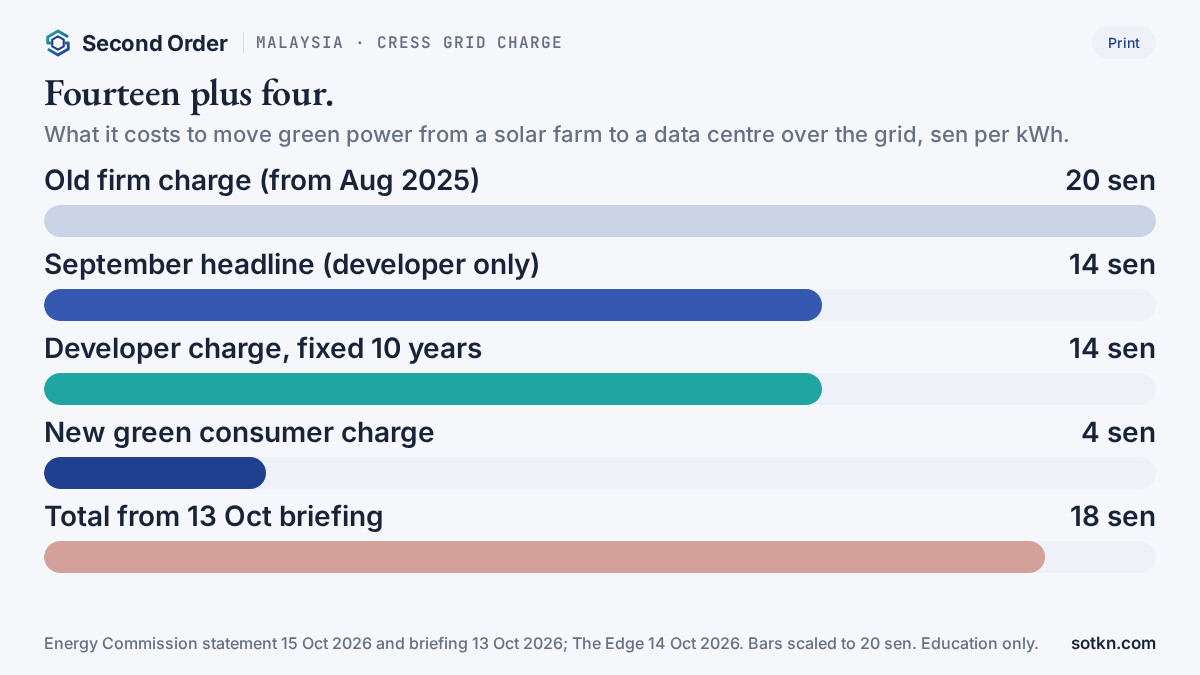
Start with the history. CRESS opened in 2024. In August 2025 the charge for firm supply was cut to 20 sen per kWh, and 40 sen for non-firm, with reviews every regulatory period capped at a 15% move. The Star's editorial puts today's 18 sen at seven sen, or 28%, below where the firm charge started. On 18 September the ministry announced 14 sen for developers. On 13 October the regulator added the 4 sen for buyers.
Then the split. In its briefing deck, the regulator broke the developer's 14 sen into four parts: 6.2 sen for the fast-response resources that keep the system balanced as more solar comes on, 1.4 sen for operating and regulating the system, 3.2 sen for developing the market, and 3.2 sen for strengthening and expanding the network. The buyer's 4 sen covers 1 sen of operations, 1.5 sen of market development and 1.5 sen of network expansion. In the regulator's words, the charge is now allocated by who carries which risk: the developer takes the revenue and financing risk, about 78% of the total, and the buyer takes the risk of using less or leaving early, about 22%.
Then the reason. The Edge reported that the extra 4 sen came amid concern that cheaper access could draw too many existing industrial customers off TNB's supply. Those customers already pay, through the base tariff, for the grid and power plants that were built for them. If they leave, a smaller pool is left to cover the same costs, which could push up the base tariff in the next review for 2028 to 2030. The current period's approved base spending is RM26.55 billion, with another RM16.27 billion of contingent spending, mainly for solar connections, batteries and grid upgrades.
And the trade. The 14 sen is now fixed for ten years from switch-on, which the old charge was not. For a solar developer borrowing against a ten-year contract, a known toll is worth more than a lower one that can move every three years. The price of that certainty is a deadline: a project that switches on after 31 December 2028 loses the package and pays whatever the prevailing rate is then.
The developer's 14 sen
The buyer's 4 sen
How much does a data centre actually save?

Less than the headlines suggest. UOB Kay Hian's analysts assume a developer charges about 32 sen per kWh for the energy itself. Add the 18 sen of grid charges and the green unit lands at about 50 sen. TNB's ultra-high voltage tariff for data centres is about 55 sen. That is a gap of about five sen a unit on the green slice.
On the whole bill, the gain is thinner. Projections from the Single Buyer, cited by the same analysts, put the monthly saving for a green consumer under the new package at about 2.54% against TNB's ultra-high voltage charges, up from about 1.39% under the old 20 sen charge. The rest of the hall's power still comes from TNB at the regulated tariff, and the 4 sen part of the green charge can rise at the next review.
So the saving is not why data centres sign. They sign because their tenants want clean power, because the task force wants at least 30% of it, and because a long contract at a known price is a hedge. The analysts expect the fuel-cost charge on regular tariffs to rise sharply from January 2027. If it does, the five-sen gap could widen without anyone changing CRESS at all.
The rules on water point the same way. The deputy minister's proposal also covered data centres building their own water supply where they sit near a source. For why water use is a separate test for these halls, see AI data center water usage.
Who has already signed green power deals?
If the grid charge is the toll, the useful question is who is already through the gate. Very few are, so far. The Edge reported that only one CRESS project, led by privately owned HLGY Energy in Kedah, is making advanced progress and under construction.
DayOne, the Singapore-headquartered operator that is TNB's largest customer, is the biggest buyer on record. It signed a 500 MW, 21-year CRESS deal with TNB in June 2025. On 4 June 2026 it added agreements with two TNB units covering about 1.5 GWp of solar and 2.2 GWh of batteries, taking its secured renewable supply in Malaysia past 1 GW. Here, TNB sits on both sides: its own renewables arm sells the power, and its grid carries it.
On 28 September a joint venture of SD Guthrie, Gamuda and Gentari, each holding about a third, signed a term sheet through G3nerasi Kinta for a 21-year contract to supply a US multinational technology company's Malaysian data centres. The project is a solar farm in Perak of at least 680 MWac with four-hour batteries, expected to earn more than RM10 billion of revenue over the term. Definitive agreements are targeted for the first quarter of 2027 and operations for 2029.
That date matters. On the published terms, the fixed 14 sen is for projects that switch on by 31 December 2028. A project that starts in 2029 would pay the prevailing rate instead, unless its timetable moves or a first phase starts earlier. The companies have not said which rate they assume; we flag it as an open question, not a finding.
The listed solar builders sit behind these deals. UOB Kay Hian estimates the addressable market at about RM20 billion, on 4 GW of demand at about RM5 million per MW, and expects a run of contract wins over the next three months as developers race the 2028 cut-off. Data centres that want clean power for AI halls, from hyperscalers to newer AI hosts such as the one in our Bitdeer Malaysia Wire, are the buyers they are racing for.
Our math: what do the numbers say?
- Real cut: 18 sen against the old 20 sen is a cut of 2 sen, or 10%. The September headline, 14 sen, read as a cut of 6 sen, or 30% (our arithmetic).
- Buyer's share: 4 sen out of 18 sen is about 22% of the total charge, matching the regulator's own risk split (our arithmetic).
- Balancing: 6.2 sen out of the developer's 14 sen is about 44%; the biggest single item pays for the resources that keep a solar-heavy grid stable (our arithmetic on the regulator's figures).
- Grid's slice: 18 sen out of an all-in green price of about 50 sen is about 36% of every green unit going to grid charges (our arithmetic on the analysts' figures).
- Per hall: a 100 MW hall running flat out uses about 876 GWh a year. If 30% of that came through CRESS, about 263 GWh, the grid charges would be about RM47 million a year, of which about RM10.5 million is the buyer's 4 sen. The five-sen gap to TNB's tariff would be worth about RM13 million (our arithmetic; it assumes firm supply and full use).
- Pipeline against need: 30% of 13 GW of expected data centre demand is about 3.9 GW. The 3 GW pipeline covers about 77% of that, and only one project is being built (our arithmetic).
- Clock: 31 December 2028 is about 26 months from today. With 18 to 24 months to build, a solar farm aiming for the fixed rate needs to start building between the end of 2026 and mid-2027 (our arithmetic on the analysts' build time).
- Perak deal: more than RM10 billion over 21 years averages about RM476 million a year of gross revenue (our arithmetic).
- Booked against used: about 1.37 GW used against about 6 GW booked is about 23% (our arithmetic on The Edge's figures).
What this tells you: Malaysia did not make green power cheaper for data centres this week. It made it more predictable for the people who build it, and it kept the grid's take close to where it was. The real cut is two sen. The real change is a ten-year fixed toll with a 2028 deadline attached.
Who gets paid first?
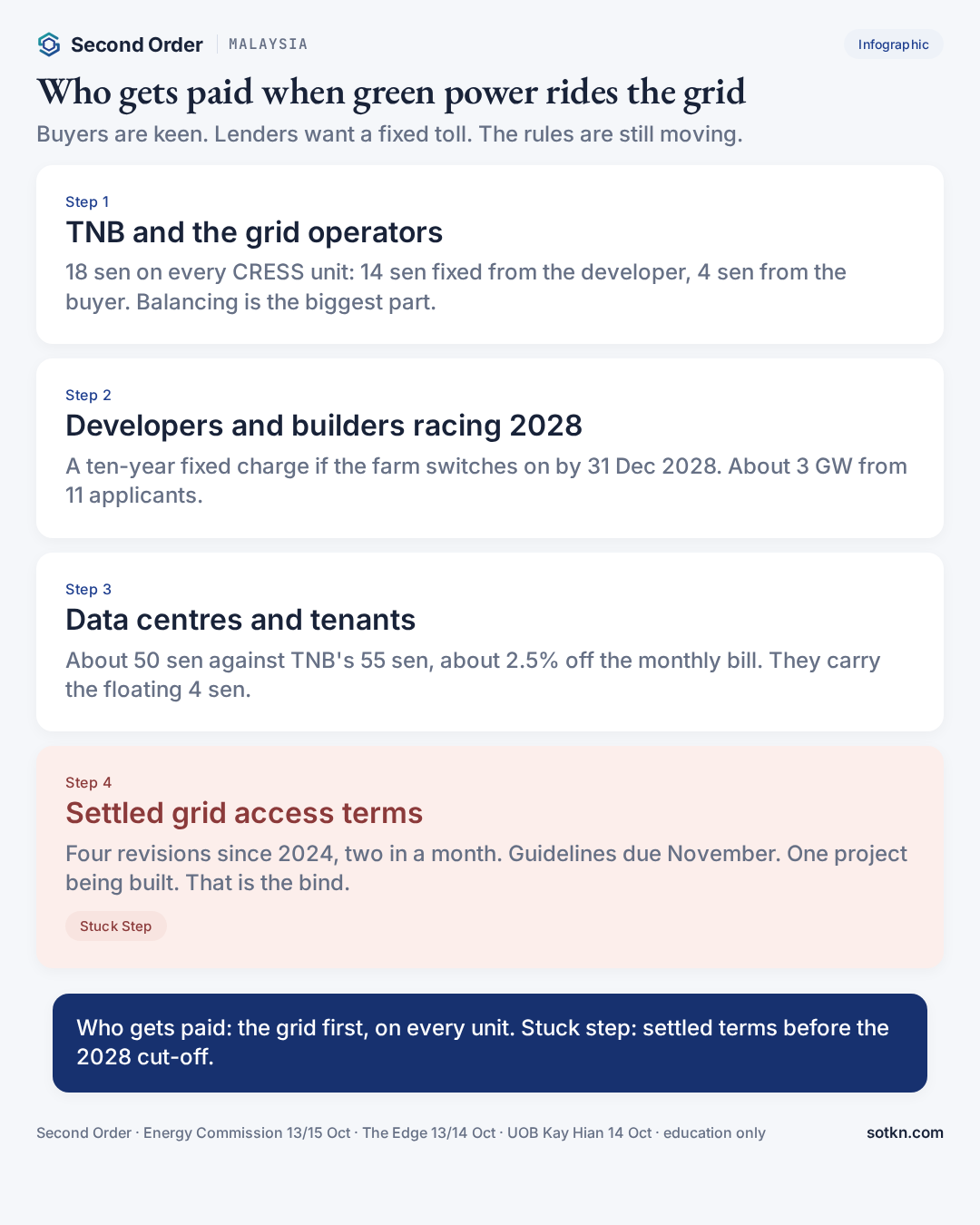
First, TNB and the grid operators — on every green unit. Whatever the developer charges and whatever the data centre saves, 18 sen of each CRESS unit goes to the system: 14 sen fixed for ten years from the developer, 4 sen from the buyer. The largest part, 6.2 sen, pays for the fast-response resources that balance the system, such as batteries and quick-start plants. Existing customers are protected from a cost shift, which is the point of the extra 4 sen.
Second, the developers and builders who can switch on by the end of 2028 — as projects reach financial close. A fixed toll for ten years is what banks need to lend against a ten-year contract. DayOne's TNB deals and the Perak joint venture are the large examples; the listed solar builders that win the construction work are paid as panels and batteries go in.
Third, the lenders — as the money is drawn. Solar farms with batteries are mostly project-financed. The Perak venture said its project would be funded with project debt and equity from the partners in proportion to their stakes. A known grid charge lowers the risk they price.
Fourth, the data centres — later, and by less. They save about five sen a unit on the green slice against TNB's tariff, about 2.5% of the monthly bill on the Single Buyer's estimate, and they carry the 4 sen that can move with the tariff. What they really buy is clean power their tenants require, at a price they can plan around for ten years.
Fifth, projects that miss 31 December 2028 — at the prevailing rate, whatever it is then. They lose the fixed charge. For the wider pattern of cash sticking at the stuck step, see where the stuck step moves.
One-line rule: in Malaysian green power for data centres right now, the grid is paid first on every unit, developers and builders that can switch on by 2028 are paid next, lenders are paid as money is drawn, and the data centres keep a thin saving. The stuck step is settled grid access terms in time for 2028.
So what is the stuck step?
Settled grid access terms for direct green power, in time to build before the end of 2028. Not demand: data centres were keen even at 20 sen, and 11 applicants have put forward 3 GW. Not money: a ten-year fixed toll is what lenders asked for. Not land: Perak, Kedah and Johor all have solar sites. Three things make this step stick:
- Moving rules: the charge has now been revised four times since 2024, twice in the past month, and the amended guidelines, contracts and technical rules are not due until November 2026.
- A hard deadline: the fixed 14 sen only applies to projects that switch on by 31 December 2028, which leaves little room once 18 to 24 months of building are counted.
- Policy still forming: the deputy minister's proposal that data centres make their own power, and the separate plan to bill unused booked power, could change how much a hall buys from the grid at all.
So-what: whoever can sign a contract and switch on a solar farm by the end of 2028 locks in a known grid toll for a decade, and gets paid. Whoever cannot pays whatever the rate is later. In Malaysian AI data centres this week, the scarce thing is not panels or buyers. It is a settled rule for using the wire. In Taiwan the grid owner is answering a related question by building substations and steering big AI halls next to power plants; see our Taipower grid Pulse.
Which dates test this read next?
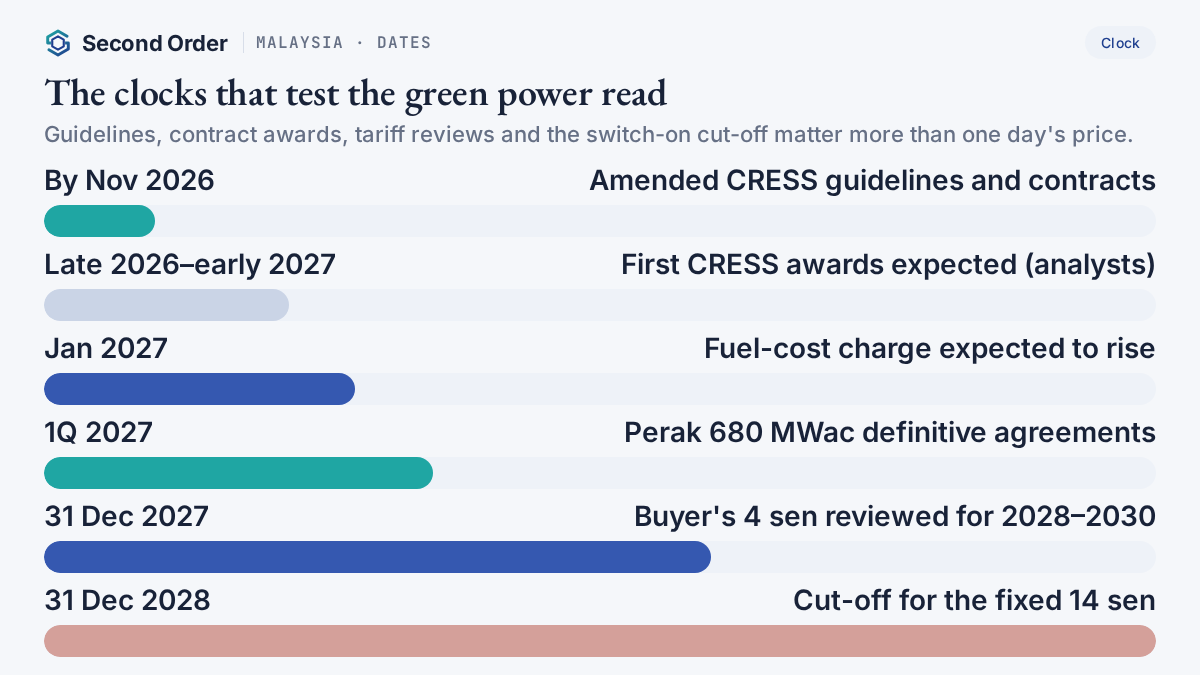
- By November 2026 — amended CRESS guidelines, contracts and technical rules from the Energy Commission. The test: whether the 18 sen holds and the paperwork is final enough to sign.
- Late 2026 to early 2027 — the first CRESS contract awards that UOB Kay Hian expects, about 1.5 GW soon. The test: whether signed contracts follow the pipeline.
- January 2027 — the expected rise in the fuel-cost charge on regular tariffs. The test: whether the gap between green power and TNB's tariff widens.
- First quarter of 2027 — definitive agreements for the Perak 680 MWac project. The test: which grid charge the deal assumes, given its 2029 start.
- 31 December 2027 — end of the current tariff period; the 4 sen buyer's charge is reviewed for 2028 to 2030. The test: whether the floating part of the toll rises.
- 31 December 2028 — the cut-off for the fixed 14 sen. The test: how many of the 3 GW actually switch on in time.
The November date tests the rules. The 2028 date tests whether anyone can build to them in time.
What would change this view?
- The November guidelines change the charge again, up or down — the rule would still be moving and the stuck step would stay stuck.
- The 2028 cut-off is extended — the race for 2028 would ease and late projects such as a 2029 start would keep the fixed rate.
- Data centres are required to build their own power instead of buying over the grid — the grid's slice of green power would shrink and on-site builders would gain.
- A wave of signed CRESS contracts and financial closes arrives by mid-2027 — the terms would be proven settled and the bind would move to building.
Practical takeaways
- Energy Commission (13 and 15 Oct): developers pay 14 sen/kWh fixed for 10 years if they switch on by 31 Dec 2028; buyers pay a separate 4 sen
- The Edge (14 Oct): that makes 18 sen in all, an about-turn from the 14 sen announced in September
- UOB Kay Hian (14 Oct): about 50 sen all-in against TNB's 55 sen data centre tariff; 11 applicants, about 3 GW
- Deputy minister (13 Oct): proposal that data centres make their own power, not yet a published rule
- The grid is paid first on every green unit; builders that can switch on by 2028 are paid next
- Stuck step: settled grid access terms for direct green power before the 2028 cut-off
FAQ
What is CRESS?
CRESS is Malaysia's Corporate Renewable Energy Supply Scheme. It lets a company, such as a data centre, buy renewable power straight from a private developer instead of only from TNB. The power still travels over the national grid, so the buyer and seller pay a system access charge for using it. The Energy Commission introduced the scheme in 2024 and has revised it four times since.
What changed on 13 October?
At a briefing in Putrajaya, the Energy Commission, TNB, the Single Buyer and the Grid System Operator set out the details of a package first announced on 18 September. Developers that switch on by 31 December 2028 pay a fixed 14 sen per kWh for 10 years. Green consumers, the buyers, pay a separate 4 sen per kWh that is reviewed with the regulated tariff. Together that is 18 sen, against 20 sen before. The market had read the September announcement as a cut to 14 sen.
Why does this matter for AI data centres?
Because they are the main buyers. Analysts at UOB Kay Hian say the Data Centre Task Force wants data centres to take at least 30% of their power from renewable sources, and the old charge made CRESS work mainly for ultra-high voltage users such as hyperscale halls. The charge sets how much of each green unit goes to the grid, and how fast solar farms can sign with data centres.
Do data centres now have to build their own power plants?
Not under any published rule we could find. On 13 October the deputy energy minister, Abdul Rahman Mohamad, said he had proposed that operators generate their own electricity, such as solar with batteries. The Star's business editorial on 17 October described it as a requirement for newly approved data centres. Until rules are published, we treat it as a proposal.
Is this investment advice?
No. Education only. It maps who gets paid and which step is stuck. It is not a recommendation to buy or sell any security, and we leave out share prices, broker ratings and price targets on purpose.
Keep reading on the map
- Malaysia Markets hub — country page
- Malaysia unused-power charge — halls billed for power they book
- DayOne financing Pulse — RM30 billion lent, substations set the pace
- Malaysia power use Pulse — 5.65 GW plugged in, 1.26 GW used
- Taipower grid Pulse — the same wire question in Taiwan
- Data center leases, explained · Hyperscale vs colocation
- AI Data Centers on the stack · Hyperscalers
- All Markets doors — Taiwan, Korea, US, China, Singapore, Australia, Malaysia
How we check this. The 14 sen and 4 sen charges, the 31 December 2028 cut-off, the 10-year minimum contract, the 3 GW pipeline and the November guideline date come from the Energy Commission's own statement of 15 October 2026 and its briefing deck of 13 October. The about-turn from 14 sen, the reasons behind it and the grid spending figures come from The Edge Malaysia on 14 October. The 50 sen and 55 sen comparison, the applicant count, the 30% renewable requirement and the Single Buyer savings estimate come from UOB Kay Hian's sector note of 14 October, and we label them as analyst figures. The own-power proposal and the booked-versus-used figures come from The Edge on 13 October. The G3nerasi Kinta and DayOne deals come from company filings as reported by The Star on 29 September and DayOne's release of 4 June. Share prices, broker ratings and price targets are left out on purpose. Anything we worked out ourselves is labelled “our arithmetic”. The references we used are listed at the end. Our editorial standards →
Not investment advice. Do your own research.
References
- Energy Commission of Malaysia (Suruhanjaya Tenaga), statement: ST held briefing on CRESS Acceleration Package, 15 Oct 2026. st.gov.my — briefing on 13 October with TNB, the Single Buyer and the Grid System Operator; fixed 14 sen/kWh for 10 years for projects switched on by 31 December 2028; separate 4 sen/kWh charge on green consumers; about 3 GW in the pipeline; guideline amendments by November 2026.
- Energy Commission of Malaysia, CRESS Acceleration Package briefing deck, 13 Oct 2026. st.gov.my — what the 14 sen and 4 sen pay for; risk split of about 78% and 22%; earlier 20 and 40 sen rates with three-yearly review.
- The Edge Malaysia, CRESS grid access charge now 18 sen/kWh after second revision in one month, 14 Oct 2026. theedgemalaysia.com — about-turn from 14 sen; concern over existing customers leaving the grid; only one CRESS project under construction; RP4 grid spending.
- UOB Kay Hian Malaysia, Renewable Energy sector update, 14 Oct 2026. uobkh.com.my — about 50 sen/kWh all-in under CRESS against a 55 sen ultra-high voltage tariff; 11 applicants for 3 GW; 30% renewable requirement for data centres; Single Buyer savings estimate.
- The Edge Malaysia, Deputy minister proposes data centre operators generate their own power, 13 Oct 2026. theedgemalaysia.com — own-generation proposal; 45 of 62 data centres with supply deals operating, about 6 GW booked and 1.37 GW used; renewables near 32% of capacity.
- The Star, Grid charges temper RE euphoria, 17 Oct 2026. thestar.com.my — net cut of two sen against the six sen first perceived; seven sen lower than when CRESS began.
- The Star, SD Guthrie, Gamuda and Gentari JV inks 21-year renewable energy deal for data centres, 29 Sep 2026. thestar.com.my — term sheet for at least 680 MWac of solar with four-hour batteries in Perak; over RM10 billion of revenue over 21 years; operations targeted for 2029.
- DayOne Data Centers, DayOne secures over 1GW renewable energy in Malaysia in landmark TNB partnership, 4 Jun 2026. prnewswire.com — about 1.5 GWp of solar and 2.2 GWh of batteries under CRESS with TNB units, on top of 500 MW signed in June 2025.
- The Star, Malaysia data centre market projected to grow 33% CAGR from 2025-2030, 16 Oct 2026. thestar.com.my — S&P Global Ratings: growth has hit a reset because of tighter rules.