Capex Outran Cash: Who Gets Paid While Meta's Halls Stay Dark
Meta on 21 Oct: Q3 capex $34.91bn, FCF -$2.12bn. Who gets paid is server and hall builders on cheques that already cleared. The stuck step is still live megawatts.

Meta printed third-quarter results on 21 October. Capital expenditures, including finance-lease principal, were $34.91 billion. Operating cash flow was $32.79 billion. Free cash flow was negative $2.12 billion. Who gets paid is the server, hall and network sellers on cheques that already cleared. The stuck step is still live megawatts: the CFO’s own phrase is capacity “scheduled to come online.”
US PULSE · Data as at 23 Oct 2026 · Next update: after Alphabet Q3 on 28 Oct, Intel Q3 on 29 Oct, or Meta’s Q4 print
Affects: Hyperscalers stack · Speed-to-power · AI data centres — Markets: US Markets hub · Korea · Taiwan · China
Education only, not advice to buy or sell any security. Figures: Meta exhibit 99.1 and the 21 October call. Own sums are labelled “our arithmetic”.
The numbers that matter this month
Q3 capex (incl. finance-lease principal)
$34.91bn
PPE $33.942bn + leases $0.964bn · servers, data centres, network
Cheque clearedQ3 free cash flow
−$2.12bn
Operating cash $32.79bn minus that capex · first negative quarter in this run
Outran cashQ3 revenue
$64.60bn
+26% YoY · advertising $63.06bn · Family of Apps $64.16bn
Ads still pay2026 capex guide
$135–145bn
Narrowed from $130–145bn by lifting the floor $5bn
Floor upCash vs debt
Net debt ~$1.25bn
Cash + securities $82.45bn · debt on the call $83.7bn (our arithmetic)
Just invertedLive megawatts
Still the bind
CFO: current capacity and what is “scheduled to come online”
Stuck stepStatus chips are Second Order’s read. Figures come from Meta’s 21 October 2026 exhibit 99.1 and the earnings call.
Why does the US matter now?
Because the US is where the largest AI buyers write the cheques, and this week’s print is one buyer’s cash identity — not a new hall going live, and not a Census construction sheet.
Every AI build still starts with the same shopping list: accelerators, memory, servers, a hall, and power. The buyers sit with the hyperscalers and the neoclouds. Korea invoices the memory. Taiwan invoices the leading-edge wafer and the package. The US invoices the spend. Yesterday’s Korea Customs 1–20 pulse (22 Oct) was the memory box. Taiwan’s door on 21 October was a wafer print with CoWoS still short — TSMC Q3 pulse (21 Oct). Today is the US buyer’s cheque against those two clocks.
Other US doors this month: $85B a year construction pulse (6 Oct), 299 MW of 3,000 in Virginia (20 Oct), 1,100 MW signed for Microsoft (19 Oct). Those were halls and interconnection. This pulse is the cash that is supposed to light them.
1 · Server / GPU sellers
Who: Nvidia and the rest of the kit on Meta’s mix
Paid: $34.91bn of Q3 capex, “servers, data centres, and network infrastructure”
2 · Hall builders
Who: US contractors and landlords on the same cheque
Paid: Shells go up. Census already had the yearly pace at $85bn.
3 · Bond desk
Who: Lenders on $24.91bn issued year-to-date
Paid: Coupon now. Class C in January is the next cheque-writing share class.
4 · Live megawatts
Who: The hall, once the busbar is live
Paid: Not yet. FCF went negative. Capacity is “scheduled.”
Labels: Paid on the cheque = capex already left the cash-flow statement. Paid as they pour = shells are in the Census count. Stuck step = live megawatts are not in this receipt.
If you only remember one thing: a $34.91 billion cheque is not a megawatt going live. Ads still grew 26%. The cash identity inverted. The bind did not move.
Muse is the product the cheque is meant to feed. Ten million people in the US and Canada set up the agent in about six weeks, Zuckerberg said. Meta is building capacity “to serve more than a billion people over the next few years,” and Muse is “very compute-intensive to run.” That is a utilisation ask on a hall that is still scheduled. Start with Speed-to-power if the long clock is new.
What changed on 21 October
One company paper. Meta Platforms filed exhibit 99.1 with the SEC and posted the same sheet on investor.atmeta.com on 21 October 2026. The Q3 call ran at 13:30 Pacific the same day. Susan Li, the CFO, walked the cash.
The totals. Revenue $64.601 billion, up 26% from $51.242 billion a year earlier, and up 26% in constant currency. Advertising $63.061 billion. Family of Apps $64.158 billion. Reality Labs $443 million, down 6%. Daily active people 3.64 billion on average in September, up 3%. Ad impressions up 10%; average price per ad up 14%.
The cash identity. Purchases of property and equipment $33.942 billion. Principal payments on finance leases $964 million. Together that is the $34.91 billion capex print. Operating cash flow $32.786 billion. Free cash flow −$2.120 billion. A year earlier the same identity was +$10.625 billion. Li said the capex was “driven by investments in servers, data centres, and network infrastructure.”
The year guide. Capex for 2026, including finance-lease principal, is now $135–145 billion, narrowed from $130–145 billion. The floor moved up $5 billion. The ceiling did not move down. Q4 revenue is guided $73–76 billion. Reality Labs losses are now $18–19 billion for the year, then “around $15 billion” in 2027 as investment is reallocated “primarily [to] AI.”
The balance sheet. Cash and cash equivalents $11.222 billion plus marketable securities $71.227 billion is $82.449 billion. The call rounded cash and marketable securities to $82.4 billion and debt to $83.7 billion. Long-term debt on the sheet is $80.922 billion, up from $58.744 billion at year-end 2025. Year-to-date proceeds from long-term debt, net, were $24.910 billion. Property and equipment, net, $253.222 billion, up from $176.400 billion. Headcount 66,775, down 15% year-over-year and down 12% from the second quarter after the May cut.
The operating line is not the cash line. GAAP operating income $12.988 billion includes a $9.89 billion attorneys-general charge. Excluding it, operating income would have been $22.88 billion, up 11%, Meta said. Expenses also grew on infrastructure and third-party AI token costs, including “higher third party cloud spend.” They are paying for rented compute while they buy their own. That is opex next to the cheque, not live megawatts.
Class C is a financing footnote, not a hall. The board approved a non-voting Class C common stock effective 19 January 2027. The special committee’s first listed reason is capital raising at “the scale of investment required” in AI. That is a future cheque-writing share class. It does not energise a busbar in October.

Our math: labelled our arithmetic
Meta already printed the dollars. What follows is addition and division on those figures, labelled as ours.
- The identity. $33.942bn of PPE plus $0.964bn of finance-lease principal is $34.906bn, the $34.91bn capex print. Operating cash $32.786bn minus that identity is −$2.120bn, the −$2.12bn free-cash-flow print.
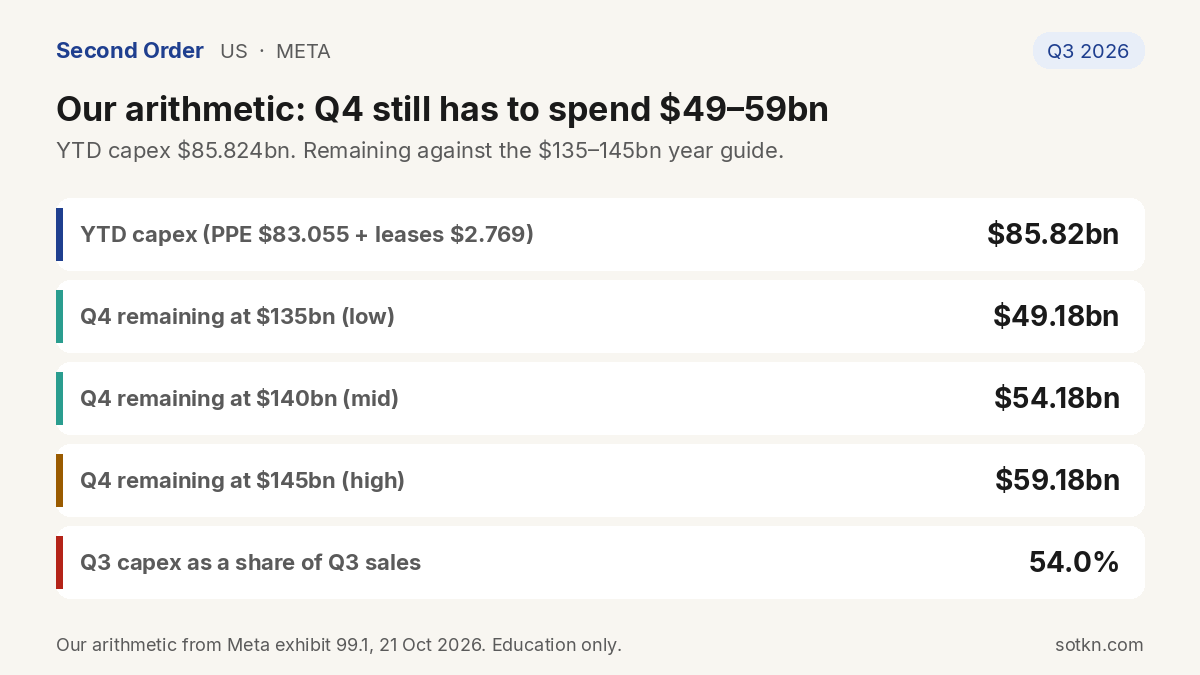
- Year-to-date capex. PPE $83.055bn plus leases $2.769bn is $85.824bn (our arithmetic).
- What Q4 still has to spend. Against $135bn, $49.176bn remains. Against $140bn, $54.176bn. Against $145bn, $59.176bn. Call it $49–59bn still to go in one quarter (our arithmetic).
- Share of sales. Q3 capex $34.91bn ÷ revenue $64.601bn = 54.0%. Year-to-date $85.824bn ÷ $181.712bn = 47.2% (our arithmetic). The third quarter ran hotter than the first nine months.
- If Q4 hits the midpoints. Revenue midpoint $74.5bn and remaining capex $54.176bn would be 72.7% of Q4 sales (our arithmetic). Treat midpoints as a guide, not a forecast.
- Cash versus debt. $83.7bn of debt minus $82.45bn of cash and securities is about $1.25bn of net debt (our arithmetic). A year ago free cash flow in the quarter was +$10.625bn. Year-to-date free cash flow is still +$11.049bn, down from +$29.508bn — a 62.6% drop (our arithmetic).
- The year-ago capex step-up. Q3 PPE $33.942bn versus $18.829bn is +80.3%. Lease principal $964m versus $545m is +76.9% (our arithmetic).

What this tells you: the ads engine still funded a $64.6 billion quarter, and still did not cover the kit cheque. It does not tell you what a Meta share is worth. We do not do price calls. Class C is a capital-structure tool. It is not a megawatt.
Where does the money stick?
At the step whose cheque already cleared, and not at the step that is still scheduled.

1. The kit sellers, on the $34.91 billion cheque. Li named the mix: servers, data centres, network. Nvidia and the rest of the accelerator stack collect when Meta’s PPE line moves. That is closer to cash than a remaining-performance obligation. The Wire already had Amazon taking $3 billion a month of Nvidia racks it cannot yet light (22 Oct). Meta’s print is the same shape from the other side of the invoice — the buyer, not the cloud.
2. Hall builders, as pour. The same cheque buys shells. Our $85B a year construction pulse (6 Oct) already had Census putting US data-centre building at a record yearly pace. Builders get paid as the concrete goes in. Servers are not in that Census number. Live power is not in this capex number either.
3. The bond desk, on $24.91 billion issued this year. Long-term debt is up $22.2 billion since December. Lenders are paid a coupon while the hall is still a schedule. Class C, effective 19 January 2027, is Meta’s stated tool for raising more capital without moving votes. That is a future cheque. It is not Q3 megawatts.
4. Live megawatts — not yet. Free cash flow went negative. The CFO’s language for capacity is “scheduled to come online.” Third-party cloud spend is rising in opex, which is what a buyer does when its own halls are not yet the live footprint. While this shape holds, the book is the kit sellers’ and the wait is still the busbar.
One-line rule: while this shape holds, the book is the kit sellers’ on the cheque, the wait is still live megawatts, and the headline is a cash-flow print.
Is live megawatts still stuck?
Yes. A $34.91 billion cheque is last quarter’s kit. It is not a named hall going live.
Three things keep it stuck. First, the cash identity. If live halls were absorbing the spend as operating capacity, free cash flow would not have flipped from +$10.6 billion a year ago to −$2.12 billion on a 26% revenue beat. Capex was 54% of Q3 sales on our arithmetic. That is a build print, not a utilisation print.
Second, the company’s own words. Li did not date a megawatt. She dated a schedule: “Our current capacity and what is scheduled to come online gives us the flexibility to allocate resources across model training, core business growth, and the development and support of new products.” Scheduled is the stuck-step word. Muse needing more than a billion people’s worth of capacity “over the next few years,” and a 10× inference-cost cut “in the next year,” is a utilisation hope sitting on that schedule. A hope is not a busbar.
Third, the neighbour clocks. Virginia’s first power was 299 MW of a 3,000 MW campus on 20 October. Microsoft’s NiSource paper was 1,100 MW signed, not live. PJM’s 6.8 GW short was 12 October. Members’ Analysis on 22 October asked what happens if cash books the finish before the line is live — and, separately, where the stuck step moves once packaging eases: through memory, to power. Meta’s cheque is the US-buyer version of that map. None of those clocks expires on an earnings sheet.
Two cautions before you read “capex is demand” as “halls are live.” Variant matters: servers, shells and network are three different lead times. A GPU crate on a pallet is not a qualified rack. Built is not the same as energised. Watch dated MW going commercial, not the PPE line. That is the most honest sign the step is getting unstuck. See How much does it cost to build an AI data center? and Data center leases explained if the hall clock is new.
What dates matter

- 21 October 2026 — Meta Q3. Capex $34.91bn. FCF −$2.12bn. Done.
- 28 October 2026, 13:30 Pacific — Alphabet Q3, per Alphabet IR. The next hyperscaler cheque.
- 28 October 2026 — Microsoft fiscal Q1, per Microsoft’s investor calendar. Another US buyer print.
- 29 October 2026, after the close — Intel Q3, per Intel IR. US wafer clock, not this hall clock.
- 19 January 2027 — Class C effective, per the 21 October release.
- Late January 2027 — Meta Q4. Did the remaining $49–59bn land, and did free cash flow stay negative?
- Not set — a named US hall going live with dated megawatts. That would move the stuck step.
The 21 October sheet coloured the cash identity. Only a dated megawatt, or a Q4 print where capex falls back inside operating cash without a demand cut, can move the stuck step.
How is this different from the $85B construction pulse?
The $85B a year construction pulse (6 Oct) was Census construction put-in-place: builders paid as halls go up, power the slower clock. Who got paid was the contractor. The stuck step was already live power.
Today is the buyer’s cash identity against that same stuck step. Who gets paid is the kit seller and the contractor, on $34.91 billion that already left. The stuck step is still live megawatts. Free cash flow went negative. Capacity is scheduled. The 6 October question is not retired. It now has a hyperscaler cheque next to it.
It is also different from 299 MW of 3,000 (20 Oct) (first power, not cash), 1,100 MW signed (19 Oct) (a utility paper), yesterday’s Korea Customs 1–20 pulse (22 Oct) (memory boxes), and the 21 October Taiwan TSMC Q3 pulse (CoWoS). Members’ cash-books-the-finish Analysis (22 Oct) is the map this print sits on. This piece is the dated Meta receipt.
What would change this view?
- Meta dates a US campus going commercial with named megawatts, not a remaining capex figure.
- Q4 free cash flow turns positive because operating cash outruns capex, without a demand cut in the kit mix.
- Third-party cloud spend in opex falls while utilisation of owned halls is disclosed as up.
- Alphabet, Microsoft or Amazon print a quarter where capex stays inside operating cash and a hall is dated live.
- Census construction and interconnection queues both slow for two prints, and mid-tier buyers report shorter power lead times.
- A named print puts memory or packaging, not live power, as the louder US bind for this buyer.
The view stays intact while free cash flow stays negative or only briefly positive, Q4 still has tens of billions of capex to spend, capacity language stays “scheduled,” and no named US hall is dated live against this cheque.
A strong Muse user print would not, on its own, change the view. Ten million agents is demand for compute. It is not a busbar. We will read Q4 for dated megawatts and for whether the remaining $49–59 billion landed inside operating cash, not as a substitute for the hall clock.
Practical takeaways
- Meta, 21 Oct: Q3 revenue $64.60bn (+26%); capex $34.91bn; operating cash $32.79bn; FCF −$2.12bn
- Year capex guide $135–145bn, floor lifted $5bn from $130bn
- Our arithmetic: YTD capex $85.82bn; Q4 still $49–59bn; Q3 capex 54% of sales
- Cash + securities $82.45bn versus debt $83.7bn; net debt ~$1.25bn (our arithmetic)
- Who gets paid: server and hall builders on the cheque; lenders on $24.91bn issued this year
- Stuck step: live megawatts. Scheduled capacity is not a live hall
- Watch 28 Oct (Alphabet, Microsoft), 29 Oct (Intel), Q4, Class C on 19 Jan 2027
FAQ
What did Meta print on 21 October 2026?
Third-quarter results. Revenue $64.60 billion, up 26%. Capital expenditures, including finance-lease principal, $34.91 billion. Operating cash flow $32.79 billion. Free cash flow −$2.12 billion. Full-year 2026 capex is now guided $135–145 billion.
Who gets paid on this print?
Server, data-centre and network sellers on the $34.91 billion cheque. Hall builders, on the shells that cheque also buys. Lenders, on $24.91 billion of debt issued year-to-date. This is a map of who gets paid, not a buy list.
Why are live megawatts still the stuck step if Meta spent $34.91 billion?
A cheque is not a hall going live. Free cash flow went negative. The CFO described capacity as “scheduled to come online.” Third-party cloud spend is still rising in operating costs. Dated megawatts are not in this receipt.
Is this the same as the 6 October $85 billion construction pulse?
No. That piece read Census construction put-in-place. This piece reads Meta’s Q3 cash identity against the same stuck step — live power. Builders were already paid as halls went up. Today the buyer’s cheque outran operating cash.
Is this investment advice?
No. Education only. It maps who gets paid and which step is stuck. It is not a recommendation to buy or sell any security.
Keep reading on the map
- US Markets hub — country page
- $85B a year construction pulse (6 Oct) — the hall-build clock this cheque sits next to
- 299 MW of 3,000 (20 Oct) — first power, not cash
- Speed-to-power — the long clock
- Where the stuck step moves — members’ map, packaging through memory to power
- Korea Customs 1–20 pulse (22 Oct) — yesterday’s Korea door
- All Markets doors
How we check this. Q3 revenue, capex, operating cash, free cash flow, the year guide, cash, debt, PPE and the $9.89bn charge: Meta exhibit 99.1, 21 October 2026, and the same-day call. Capex mix (“servers, data centres, and network infrastructure”) and “scheduled to come online”: the call. Alphabet 28 Oct and Intel 29 Oct: company IR. Own sums labelled “our arithmetic”. Our editorial standards →
Not investment advice. Do your own research.
References
- Meta Platforms, exhibit 99.1 to Form 8-K, 21 Oct 2026. SEC exhibit 99.1 · Meta IR — Q3 revenue $64.601bn; capex $34.91bn; FCF −$2.12bn; year capex $135–145bn.
- Meta Q3 2026 earnings call, 21 Oct 2026. Call materials — capex mix; “scheduled to come online”; cash $82.4bn; debt $83.7bn; Muse compute.
- Alphabet IR, 6 Oct 2026. Alphabet Q3 call date — 28 Oct 2026, 13:30 Pacific.
- Intel IR, 6 Oct 2026. Intel Q3 date — 29 Oct 2026, after the close.
- Second Order, $85B a Year construction pulse, 6 Oct 2026. $85B a year pulse (6 Oct) — the hall-build clock.
- Second Order, Korea Customs Oct 1–20 pulse, 22 Oct 2026. Korea 1–20 pulse (22 Oct) — yesterday’s memory door.