194 Days of Stock, Tools Running Late: Who Gets Paid as TI's Data Center Sales Nearly Double
Texas Instruments' data center sales rose about 95% in the third quarter, to about 13% of revenue. It has clean rooms to spare, but tools for its back-end lines are arriving late and its finished-goods cushion fell 14% this year. That is the stuck step.

Texas Instruments makes the cheap chips that every AI rack needs by the hundred: the parts that step power down, measure heat and current, and keep the expensive chips alive. On Wednesday it said its data center sales rose about 95% in a year and are now about one dollar in eight of its revenue. It also said it has clean rooms to spare. What it does not have enough of is time on the tools at the back of the line, where chips are packaged and tested. Those tools are arriving late, and the stock TI built up in the slow years is getting thinner. The stuck step is the back-end tool.
US PULSE · SEMICONDUCTORS · AI DATA CENTERS · Data as at 25 Oct 2026 · Next update: Vertiv third-quarter results, 28 Oct
Affects: Semiconductors · AI Data Centers · Hyperscalers — Markets: US · Malaysia · Taiwan
Education only, not advice to buy or sell any security. Figures are as published by Texas Instruments in its results release, its quarterly report and on its call, unless another source is named. Our own sums are labelled.
The numbers that matter this week
TI data center sales, year on year
~+95%
About +20% on the quarter · Q3 2026
SurgingData center share of TI revenue
~13%
About $0.79B of $6.06B (our arithmetic)
BiggerParts TI sells into data centers
~10,000
Generic part numbers · rising each quarter
BreadthInventory days
222 → 194
End-2025 to end-Q3 2026
Cushion thinnerFinished goods on the shelf
$1.97B → $1.69B
Down 14% this year (our arithmetic)
Cushion thinnerBack-end tool lead times
Stretching
CEO on the 21 Oct call · OSATs short too
Stuck stepFigures from Texas Instruments’ results release (21 Oct 2026), its 10-Q dated 23 Oct 2026 and its 21 Oct earnings call. Dollar figure for data center sales and percentage changes in stock are our arithmetic. Status chips are Second Order’s read.
On this page: Why it matters · What TI reported · Why racks need these chips · The stock cushion · The late tools · Why the clean room is not the bind · The price signal · The missing part · Our math · Who gets paid · What is stuck? · Dates next · What would change this · FAQ
Why do Texas Instruments' data center sales matter to who gets paid in AI?
Because they are a clean read on the boring half of the AI build. Most of the money in an AI rack goes to the accelerators and their memory. But a rack does not run on accelerators alone. Power arrives at high voltage and has to be stepped down, stage by stage, until it reaches the chip at under one volt. Fans, pumps and sensors have to be watched and controlled. Every board needs small chips that check current, temperature and timing. These parts cost cents or a few dollars each, and a rack needs a great many of them.
Texas Instruments is the largest maker of analog chips, and it makes most of its wafers in its own fabs, mostly in the US. When its data center line nearly doubles, two things are true at once. Racks are being built at a pace the parts makers can see in their order books. And if those cheap parts run short, an expensive rack waits for them.
We have followed this kind of slow input all month. In Taiwan it was woven glass cloth for circuit boards (Taiwan glass cloth Pulse). In Korea it was the high-voltage power line to a chip park. In the US this week the slow input sits inside a chipmaker that says it has room to grow: the tools that package and test its chips.
1 · The order
Who: Rack builders and hyperscalers order power and sensor chips
Paid: Data center sales ~+95% · ~10,000 parts
2 · The wafer
Who: TI makes wafers in its own 300 mm fabs in Texas and Utah
Paid: Clean room to spare · CHIPS Act cash
3 · The back end
Who: Chips are cut, packaged and tested, in house or at partners
Paid: Tool lead times stretching · partners short
4 · The shelf
Who: Finished chips wait in TI's stock for customers
Paid: Finished goods down 14% this year
What did Texas Instruments report on 21 October?
Revenue for the three months to September was $6.06 billion, up 11% on the second quarter and 28% on a year earlier. Net income was $2.43 billion, or $2.62 a share. Gross margin rose to 64%, up 2.8 points in a quarter. Operating profit was $2.87 billion, 47% of revenue, up 73% from a year earlier.
The analog business, which includes the power chips, grew 32% to $4.91 billion, and its operating margin rose from 39.8% to 51.0%. The embedded business, which makes small processors and controllers, grew 21% to $858 million. Every end market grew. Industrial, TI's largest, rose more than 40% and passed its 2022 peak for the first time. Cars rose by the mid-teens. Data center rose about 95% and about 20% on the quarter.
For the fourth quarter TI guided revenue of $5.8 billion to $6.3 billion. The middle of that range is about flat with the third quarter, at a time of year when TI's sales usually fall. Its chief executive, Haviv Ilan, put part of that down to data center, which he said does not follow the usual seasons.
Those are the headline numbers. The more useful ones for the AI map sit lower down: how much stock TI has left, how fast it is adding tools, and what it said about the back end of its lines.
Why does an AI rack need so many of TI's chips?

Think of the power path in a rack. Power comes in from the grid as alternating current, is turned into direct current, then stepped down again and again: in today's racks to 48 volts, then 12, then the fraction of a volt the accelerator wants. Each step uses power chips to switch, control and protect it. More power in a rack means more of these steps, or bigger ones.
The industry is now moving to 800-volt power inside the data hall, to cut copper and losses as racks pass a few hundred kilowatts. On its July call Ilan said 800 volts would come in stages, with extra conversion steps from 800 to 48 and from 48 to 12. To a parts maker, more stages means more parts. On Wednesday TI’s head of investor relations put it simply: more power, more power density and higher voltage all mean more opportunity for TI.
It is not only power. Ilan said racks need a lot of telemetry and cooling, and that customers are adding parts to watch and manage these very expensive assets. TI counts about 10,000 different parts that it sells into data centers, and the number grows every quarter. That breadth is the point. A rack is not held up for want of one big chip only; it can be held up for want of a small one. Our 250 kW rack Analysis looked at where the cash sticks as power per rack climbs; the parts in this story are the ones that multiply.
In dollars, TI does not say. At about 13% of $6.06 billion, data center was roughly $0.79 billion in the quarter. A year earlier, at about half that, it was roughly $0.40 billion, about 8.5% of revenue. The second quarter, about 20% below the third, was roughly $0.66 billion. All of that is our arithmetic on TI’s round numbers, so treat it as a range, not a figure. Data center sales also doubled in the second quarter, so this is the second quarter in a row near twice the year before.
Why does 194 days of stock matter?
TI runs its business on a choice most chipmakers do not make: it builds stock ahead of demand. Its quarterly report says the aim is to keep lead times dependable, and to build ahead the common parts that many customers use. In the slow years of 2023 to 2025 that meant a lot of chips on the shelf and a lot of questions from investors about why.
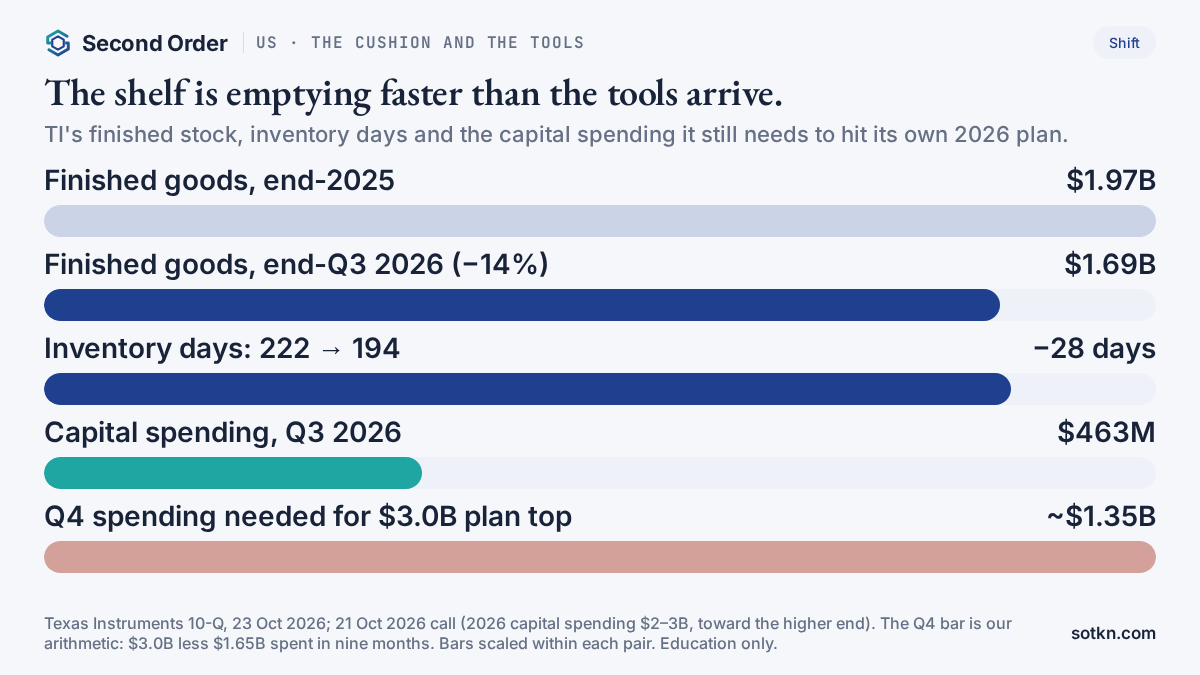
Now the shelf is being used. Inventory was $4.67 billion at the end of September, down $132 million from the end of 2025. Measured in days of cost, it fell from 222 to 194. Inside that total, finished chips ready to ship fell from $1.97 billion to $1.69 billion, down about 14% in nine months. Chips still in the line rose from $2.37 billion to $2.48 billion.
Read that plainly. TI is shipping out of its finished stock faster than it is refilling it, and more of its stock is now work in progress waiting to be finished. Finishing a chip means the back end: cutting the wafer, packaging each die and testing it. That is where the tools come in.
194 days is still a lot of stock. TI is not short in any general sense, and on the call it said it had helped data center and industrial customers out of its inventory and could commit supply into 2027 and beyond. The point is the direction and the mix. The cushion that makes TI the safe supplier is being spent, and the line that refills it runs through the back end.
Where exactly are the tools running late?
Ilan was asked twice about the back end. The first time, on capital spending, he said TI wanted to aim higher this year but was seeing lead times extending on tools, especially on the back end. The second time, asked whether it was moving more assembly and test in house, he said TI was not getting as much as it wanted from its outside assembly and test partners, known in the trade as OSATs, and that supply there was tight.
His answer to both is a new back-end site in Malaysia, which he said TI is ramping very quickly and described as its largest. Parts are being qualified and moved onto it. TI can add capacity every quarter, he said, because it has the room; how fast depends on how fast the tools arrive and on demand.
This fits what we have seen elsewhere. Malaysia is where a large share of the world’s chips are assembled and tested, and our Malaysia chip exports Pulse found that its record September was mostly chips passing through to be tested, packed and built into machines, with the stuck step in installed, qualified capacity. Nvidia this week put a $1.1 billion advance into KYEC’s US test plants and took its Amkor deals to $3 billion (Wire). When the biggest AI buyer pays up front for test slots and a supplier of cheap parts says its partners are short, the back end is tight from both ends of the price range.
The money shows it too. TI spent $463 million on capital in the third quarter and $1.65 billion in the first nine months, against $3.63 billion in the same months of 2025, when it was finishing its big new fabs. It says 2026 will be $2 billion to $3 billion, toward the higher end if the tools arrive as planned. TI books capital spending when tools are delivered, so a slower delivery shows up as lower spending. To reach $3 billion it would need about $1.35 billion in the fourth quarter, nearly three times the third (our arithmetic).
To be fair to TI, it does not call this a bottleneck. Asked if back-end tools could hold back growth, Ilan said a real gate is when you do not have the clean room and are stuck for years building one. TI does not have that problem. The tools, he said, are a matter of execution and of suppliers working through their own supply chains in a period of high demand everywhere. He also said he expects the front and back end to stay balanced.
We take him at his word on the long view. On the short view, the step that sets the pace this quarter and next is the one he named: tools for the back end, and outside partners who cannot fill the gap. That is what makes it the stuck step, even if it is a short one.
Why isn't the clean room the bind?
Because TI paid for it years ago. In the downturn TI kept building: big 300 mm wafer fabs in Sherman, Texas, and Lehi, Utah. Ilan said on Wednesday that TI had already taken care of the long-lead parts of the job, the clean rooms, the floors beneath them and the equipment that takes a long time to get and qualify. TI has slots reserved for 2027 and beyond, and will set the pace of new tools to the growth it wants.
In Utah, the first Lehi fab still has spare clean room, and a second shell there is in the last stages of completion. Analysts on the call said it would be ready by the end of the year. Ilan said moving from dirt to output takes about four years for a new fab, before the full ramp. That is the clock other analog makers face if they want to add capacity now. He said little analog capacity has been added in the four years since the last peak, especially in factories outside China and Taiwan.
The government is helping pay. TI is due up to $1.6 billion in direct CHIPS Act funding for its three big fabs, and has received $630 million so far. In the first nine months of 2026 it took in $1.10 billion of CHIPS Act cash and used $380 million of investment tax credit, a total cash benefit of $1.48 billion. Free cash flow over twelve months rose to $8.4 billion, from $2.4 billion a year earlier, helped by lower spending and the grants.
So the expensive, slow part of chipmaking is done. Spending now is on tools, and tools come in faster than clean rooms. That is also why capital spending has fallen to about the level of depreciation: $1.65 billion against $1.64 billion in the first nine months. Our capex vs depreciation explainer sets out why that matters for profit: the cost of the fabs is already being written off, so extra sales drop through at high margins.
What does the price signal say?
Prices for analog chips were flat in the first half of 2026. In the second half they started to rise. Ilan said some customers who wanted more supply, faster, came to TI in the middle of the year, and TI moved some prices, mainly in analog. He called it an uptick, not very large for this year.
The bigger talk is about 2027. Most of TI’s pricing is set once a year, and those talks are under way now. Ilan said customers are telling TI what supply they want to guarantee, and that has a pricing element. TI will say more with its January results.
The margins tell the same story. TI’s gross profit rose $1.16 billion on $1.31 billion more revenue from a year earlier, about 89 cents of each new dollar (our arithmetic). Its finance chief, Julie Knecht, put the quarter’s figure at about 90%, against a long-term model of 75% to 85%, and said higher sales did most of the work, with help from pricing and mix.
When a supplier says it has stock, has room, is raising prices and is talking with customers about guaranteed supply, the market is telling you where it thinks the risk is. Buyers are paying for certainty, not just for chips.
What happens when one cheap part is missing?
One analyst asked about kits. A rack, a power shelf or a cooling unit can only ship when every part is in. If one costs a few cents and is late, the whole kit waits. In the 2021 shortage this was called the golden screw. Ilan said he would not compare today with then, and that it is still early. He saw the problem mainly in cars, where customers held little stock, and said some industrial and data center customers had come to TI for help.
TI’s head of investor relations added that customers come to TI to lock in its share of the kit while they hunt for parts that are short elsewhere. That is a quiet signal. The bind in a rack is often not the chip in the headline. It is whichever input has the longest wait that week.
We have seen that rule play out in boards (TTM data center boards), in the gear that feeds power to the hall (Korea power gear Pulse) and in the power itself (Amazon’s racks waiting for power). For the parts TI makes, the wait today is a back-end slot.
Our math: what do the numbers say?
- Data center sales: about 13% of $6.06 billion is about $0.79 billion in the third quarter. At about +95%, a year earlier was about $0.40 billion, about 8.5% of $4.74 billion. At about +20% on the quarter, the second quarter was about $0.66 billion, about 12% of $5.46 billion (our arithmetic on TI’s rounded figures).
- Run rate: four quarters at the third-quarter pace is about $3.1 billion a year (our arithmetic).
- Finished goods: $1.97 billion to $1.69 billion is down about $274 million, or 14%, in nine months. Work in progress rose about $110 million, or 5% (our arithmetic).
- Inventory days: 222 to 194 is 28 days less stock, about 13% (our arithmetic).
- Capital spending: $1.65 billion in nine months. Reaching $3.0 billion needs about $1.35 billion in the fourth quarter, about 2.9 times the third quarter’s $463 million; reaching the $2.5 billion middle needs about $0.85 billion, about 1.8 times (our arithmetic).
- Incremental margin: gross profit up $1.16 billion on revenue up $1.31 billion is about 89% (our arithmetic; TI said about 90%).
- Grants: $630 million received of up to $1.6 billion in direct CHIPS Act funding is about 39% (our arithmetic).
What this tells you: demand is running ahead of how fast TI can finish chips, and the gap is being filled from the shelf. The shelf is still big, but it is shrinking. The pace of refilling is set by back-end tools, not by wafers or clean rooms.
Who gets paid first?

First, Texas Instruments — by the part, and at a better price. Its fabs are built and largely paid for, grants are coming in, and each new dollar of sales is landing at close to 90% gross margin. If 2027 contracts bring higher prices in return for guaranteed supply, it is paid for having held stock and room through the slow years.
Second, the back-end toolmakers — at the order. The tools that saw, bond, mould and test chips are the ones with stretching lead times. Every chipmaker adding assembly and test lines, from TI’s new Malaysia site to the test houses Nvidia is paying, is in the same queue. Toolmakers are paid when tools ship, and a queue lets them choose and price.
Third, the assembly and test partners — by the unit, and with a choice of customers. When TI says its partners are not supplying as much as it wanted, it means they have more work than room. They can fill their lines with whoever pays most or commits longest. Over time TI is moving work in house, so their gain from TI is for now, not for good.
Fourth, the rack and power builders — when the kit is complete. Firms that make power shelves, cooling units and server boards are paid when they ship, and they ship only when every part is in. Strong demand for them, seen in our Schneider third-quarter Catalyst, meets the risk that one small part is late.
Last, the ones who wait: buyers who held little stock and now need parts fast; smaller analog makers without spare clean room, who face a four-year build; and data center owners whose racks sit one part short.
One-line rule: in TI’s data center surge, TI is paid first and at better prices, the back-end toolmakers and test partners next; rack builders are paid when the kit is complete; and supply grows only as fast as the back-end tools arrive. The stuck step is the back-end tool.
So what is the stuck step?
The back-end tool: the machines that package and test TI’s chips, and the outside partners who would otherwise do that work. Not demand, which is rising. Not the wafer fabs, which have room. Not money, which TI has and the government is adding to. Three things make it stick:
- Everyone wants the same tools. AI accelerators, memory and cheap analog chips all need assembly and test. Lead times stretch for all of them at once.
- The partners are full. TI says it is not getting as much as it wanted from outside assembly partners, so it must build its own lines, which takes tools.
- The cushion is shrinking. Finished goods are down 14% this year. Stock bridges the gap only while it lasts.
It is a short bind, measured in quarters, not years. That is what our stuck-step Analysis would predict: TI cleared the slow bind, the clean room, years ago, so the next one shows. If the tools arrive, the bind moves on, possibly to the clean rooms of makers who did not build ahead.
Which dates test this read next?

- 28 October 2026 — Vertiv third-quarter results. Vertiv makes power and cooling gear for data centers and buys parts like TI’s. Watch for any word on parts shortages holding up shipments.
- 29 October 2026 — Intel third-quarter results. Another US chipmaker adding server capacity; watch what it says about packaging and test supply.
- By 31 December 2026 — TI’s fourth-quarter capital spending. Close to $3 billion for the year would mean the tools came in; well below would mean they are still late.
- By 31 December 2026 — Completion of TI’s second fab shell in Lehi, Utah, which it said is in the last stages.
- January 2027 — TI’s fourth-quarter results and its first word on 2027 pricing. Watch inventory days and finished goods: a further fall means the shelf is still bridging the gap.
- February 2027 — TI’s capital management update, where it said it would give more on spending for 2027.
What would change this view?
- Tools arrive. If TI’s fourth-quarter spending lands near $3 billion for the year and finished goods stop falling, the bind has eased.
- Partners catch up. If outside assembly and test houses add room faster than demand, the gap closes without TI’s own lines.
- Data center slows. If AI rack orders cool, TI’s stock is more than enough and the back end stops mattering.
- The bind moves. If customers’ kits are held up by other parts, the stuck step for racks is elsewhere, even if TI’s own back end is tight.
- Prices do not move. If 2027 contracts come in flat, buyers do not see a shortage worth paying for, and our read is too strong.
Practical takeaways
- TI’s data center sales rose about 95% in the third quarter, about 13% of revenue, roughly $0.79 billion by our arithmetic
- It sells about 10,000 different parts into data centers, and 800-volt power adds conversion steps that need more of them
- It has clean room to spare, but back-end tool lead times are stretching and outside partners are short
- Finished goods fell 14% this year and inventory days from 222 to 194; capital spending is behind plan
- TI gets paid first, then back-end toolmakers and test partners; stuck step: the back-end tool
FAQ
How fast are Texas Instruments' data center sales growing?
TI said on 21 October 2026 that data center revenue rose about 95% from a year earlier and about 20% from the second quarter, and was about 13% of its $6.06 billion of third-quarter revenue. That is roughly $0.79 billion in the quarter by our arithmetic. TI does not publish the dollar figure.
What is holding back Texas Instruments' supply?
Not clean room space, which TI says it has plenty of. Its chief executive said tool lead times are stretching, especially for back-end assembly and test, and that TI is not getting as much as it wanted from outside assembly partners, so it is ramping its own new site in Malaysia. TI says this is execution, not a gate.
Is this investment advice?
No. Education only. It maps who gets paid and which step is stuck. It is not a recommendation to buy or sell any security, and we leave out share prices, broker ratings and price targets on purpose.
Keep reading on the map
- US Markets hub — country page
- Meta capex and cash · NiSource and Microsoft power — recent US Pulses
- Malaysia chip exports — where chips are packaged and tested
- Taiwan glass cloth · Korea power gear — the slow input elsewhere
- Nvidia pays for test capacity · AWS sold out into 2028 · Amazon racks waiting for power
- Schneider third quarter · TTM data center boards
- If AI racks reach 250 kW · Where does the stuck step move?
- Semiconductors on the stack · What does KLA do? · Capex vs depreciation
- All Markets doors — Taiwan, Korea, US, China, Singapore, Australia, Malaysia
How we check this. Revenue, segment results, inventory, finished goods, capital spending, depreciation and CHIPS Act cash come from Texas Instruments’ own quarterly report to the SEC, dated 23 October 2026, and its results release of 21 October. Data center growth, its share of revenue, tool lead times, assembly partner supply, the Malaysia site, clean room space and pricing come from what TI’s chief executive and finance chief said on the 21 October call, read in full in a published transcript and checked against the July call. TI does not publish a dollar figure for data center sales; ours is labelled “our arithmetic”, as is every other sum we worked out. Dates for Vertiv and Intel come from their own notices or reports of them. Share prices, broker ratings and price targets are left out on purpose. The references we used are listed at the end. Our editorial standards →
Not investment advice. Do your own research.
References
- Texas Instruments, Form 10-Q for the quarter ended 30 September 2026 (SEC EDGAR), 23 Oct 2026. sec.gov — segment results, inventory and days, finished goods, capital spending, depreciation, CHIPS Act cash.
- Texas Instruments, TI reports third quarter 2026 financial results and shareholder returns, 21 Oct 2026. investor.ti.com — revenue, earnings, free cash flow, fourth-quarter outlook.
- The Motley Fool, Texas Instruments (TXN) Q3 2026 earnings call transcript, 21 Oct 2026. fool.com — data center growth and share, tool lead times, OSAT supply, Malaysia site, clean room, pricing, part numbers.
- Texas Instruments, Q2 2026 earnings call transcript (LSEG StreetEvents), 22 Jul 2026. investor.ti.com — data center doubled in the second quarter; 800-volt conversion stages.
- Intel, Intel to report third-quarter 2026 financial results, 6 Oct 2026. intel.com — results date, 29 October.
- 24/7 Wall St., Make or break for VRT on Oct. 28, 24 Oct 2026. 247wallst.com — Vertiv results date, 28 October.