20% Short, 30 Months Out: Who Gets Paid While Taiwan's AI Boards Wait on Glass Cloth
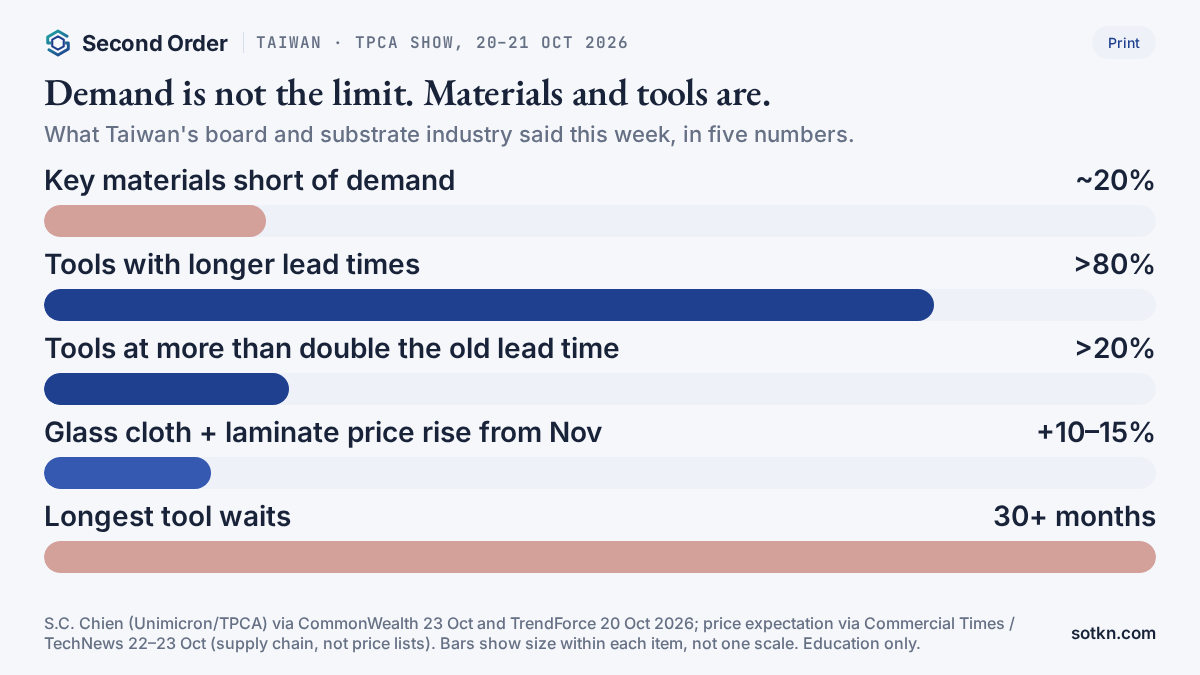
At Taiwan's circuit board show this week, the industry's own chairman said key materials run about 20% short and some tools take 30 months. Glass cloth is the tightest. The weavers are paid first; the board and substrate lines wait on the loom.

Taiwan's circuit board industry met in Taipei this week and the message from the stage was not about demand. Demand is not the problem. The chairman of the industry association, who also runs Taiwan's largest chip substrate maker, said key materials are running about 20% short and some of the machines needed to make more take over 30 months to arrive. The tightest material is one most investors never think about: woven glass cloth, the fabric inside every AI board and chip substrate. The weavers are being paid first. Everyone downstream waits on the loom. The stuck step is glass cloth.
TAIWAN PULSE · SEMICONDUCTORS · Data as at 24 Oct 2026 · Next update: November price rises take effect, 1 Nov
Affects: Semiconductors · Hyperscalers · AI Data Centers — Markets: Taiwan · Korea · Malaysia · US
Education only, not advice to buy or sell any security. Figures are as published by the companies or as reported by the publications named. Price rises are supply-chain expectations, not confirmed price lists. Our own sums are labelled.
The numbers that matter this week
Key board materials vs demand
~20% short
Unimicron chair S.C. Chien · TPCA Show, 20–21 Oct
ShortfallLead time, some specialist tools
30+ months
>80% of tools longer · >20% more than doubled
ClockGlass cloth and laminate prices
+10–15%
Expected from November · supply chain
PriceNan Ya electronic materials margin
30.9%
3.8% a year earlier · 3Q26, unaudited
Paid firstUnimicron sales, Q3 2026
NT$52.6bn
+54.9% y/y · +22.8% q/q (our arithmetic)
VolumeSubstrate capacity growth, 2024–2028
~2×
vs CoWoS ~6.8× · Chien's estimate
GapFigures from CommonWealth Magazine (23 Oct 2026), TrendForce (20 Oct 2026), Taiwan News (20 and 23 Oct 2026), Nan Ya Plastics' 3Q26 presentation (22 Oct 2026) and Unimicron's monthly sales page. Quarterly sums are our arithmetic. Status chips are Second Order’s read.
On this page: Why it matters · What was said · The cloth · Bigger packages · Prices · The weaver’s quarter · The substrate lines · Thirty months · Our math · Who gets paid · What is stuck? · Dates next · What would change this · FAQ
Why does a cloth shortage matter to who gets paid in AI hardware?
Because every AI chip sits on layers of it. An AI accelerator is a set of chips mounted on a substrate, a small but very complex circuit board that carries power and signals from the chips to the rest of the server. That package is then mounted on a much larger board, along with dozens of other boards in the rack: switch boards, power boards, midplanes. Every one of those boards and substrates is built from layers of copper-clad laminate, and every layer of laminate is built on woven glass fibre cloth soaked in resin.
In a normal market nobody thinks about the cloth. Now AI boards need far more of it, with more layers and larger areas, and the best of them need special grades that only a few companies can make. When a cheap, forgotten input becomes the thing everyone is short of, its makers are paid first and everyone else waits.
We have written a lot about the scarce steps further up the chain this month: TSMC's advanced packaging (CoWoS Pulse), memory (Nanya DRAM Pulse) and the racks themselves (Foxconn racks Pulse). When Nvidia booked two and a half times more substrate capacity on 21 October, our Catalyst note asked whether the materials inside substrates, such as specialist glass cloth, can grow as fast. This week Taiwan's board industry answered: not yet.
1 · The yarn and the cloth
Who: Glass fibre spun in furnaces, woven on looms
Paid: T-glass made at scale almost only by Nittobo
2 · The laminate
Who: Cloth plus resin plus copper foil
Paid: EMC, Nan Ya, ITEQ, TUC · prices up 10–15% from Nov
3 · The substrate and the board
Who: Unimicron, Kinsus, Nan Ya PCB; board makers
Paid: Prepaid by customers · capacity ~2× by 2028
4 · The buyer
Who: Chip designers, server makers, cloud builders
Paid: Pay more, wait longer
What did Taiwan's board industry say this week?
The Taiwan Printed Circuit Association's annual show opened at the Nangang Exhibition Center in Taipei on 20 October, with a leaders' summit on 21 October. The association's chairman, S.C. Chien, is also chairman of Unimicron, Taiwan's biggest maker of the substrates that AI chips sit on. What he and others said, as reported by CommonWealth Magazine, TrendForce, Taiwan News and the local business press:
- Materials are short. Supplies of key materials are falling about 20% short of demand, with the gap expected in 2027 on some reports. Low-expansion glass cloth, copper-clad laminate and ABF, the insulating film used in substrates, were named as particularly tight, along with advanced copper foil.
- Tools are late. Lead times have lengthened for more than 80% of equipment, and more than 20% of equipment now takes more than double its old lead time. Some specialised machines take more than 30 months to arrive.
- Capacity is not keeping pace. Chien projected that CoWoS packaging capacity grows about 6.8 times between 2024 and 2028 and hyperscaler spending about 6.3 times, while IC substrate capacity only about doubles and DRAM capacity grows about 1.8 times. He cautioned that the bases differ, so the multiples do not by themselves mean a shortage.
- Packages keep growing. AI substrates went from about one reticle (the size of one chip exposure) in early designs to about three in 2025, five targeted in 2026 and five to nine in 2027 and 2028, possibly 12 to 14 eventually. AI chips can draw more than 1,000 amps.
- The industry is still growing fast. The association forecasts that Taiwanese board makers' worldwide production reaches about US$35.7 billion in 2026, above NT$1 trillion for the first time. Prismark Partners expects high-end board output to rise 32% to about US$3.4 billion and IC substrate output to rise 40%.
- Laminate stays short. Elite Material (EMC) chairman Tung Ting-yu said on the show's sidelines that high-end copper-clad laminate will stay short through at least 2030. EMC plans to triple its Taiwan capacity by 2028.
Unimicron executive president Timothy Lan added that the technology upgrade cycle has shortened from five years to about five months. When the people who make the substrates say the limit is their own inputs, that is worth noticing.
What is glass cloth, and why is it the tightest step?
Glass cloth starts as glass. It is melted in a furnace, drawn into fibres thinner than a hair, twisted into yarn and woven on looms. Laminate makers soak the cloth in resin and press it with copper foil; board and substrate makers stack and bond those sheets into boards with dozens of layers.
Three kinds of cloth matter for AI, and all three are tight.
- Low-expansion cloth, or T-glass. This grade barely expands when it heats up. That keeps a large chip substrate flat when an AI chip runs hot, so the connections do not crack and the package does not warp during assembly. The bigger the package, the more it matters. Japan's Nittobo makes the top grade at scale almost alone.
- Low-loss cloth, or low-Dk cloth. This grade lets very fast signals travel without fading. AI servers and switches move data at speeds where ordinary cloth loses too much signal. The second-generation version of this cloth sells at about twice the price of the first, according to analysts cited by the Commercial Times.
- Thin ordinary cloth. Plain electronic-grade cloth in thin weaves known by numbers such as 2116, 1080 and 1078. A board with many layers needs thin cloth for each one. As weavers have moved looms to the special grades, these thin standard weaves have become scarce too.
Why can't the weavers just make more? Because the furnaces that draw the yarn are large and slow to build, and the supply chain says there is limited room to install more thin-cloth looms quickly. Nan Ya Plastics, one of the largest weavers, says customers who once chose suppliers for range now choose them for material and a delivery date.
This matches what board makers outside Taiwan are seeing. On 23 October TTM Technologies, a US board maker, said laminate and T-glass lead times were around 12 weeks, sometimes 24 weeks and sometimes longer, as covered in our TTM Catalyst. The same cloth goes into boards made everywhere, so the bind is global even though much of the weaving is in Taiwan, Japan and China.
Why are AI chips eating so much more of it?
Because the package keeps getting bigger and the boards keep getting thicker. Chien's size path explains most of it. A substrate the size of one chip exposure was normal not long ago. A substrate three times that size was normal in 2025. Five times is the 2026 target, and five to nine times is on the roadmap for 2027 and 2028. Each step up in area needs more cloth per package, and it needs the low-expansion grade, because a larger panel warps more as it heats.
The chips themselves explain why the packages grow. AI accelerators are now built from several pieces of silicon, processor dies and stacks of high-bandwidth memory, placed side by side on a silicon sheet called an interposer, which then sits on the substrate. Our explainers on chiplets, interposers and HBM walk through each layer. More pieces mean a bigger interposer, and a bigger interposer means a bigger substrate.
The boards around the package are changing too. Layer counts on AI server boards have more than doubled, newer racks replace cables with boards such as midplanes, and laminate grades keep stepping up: EMC expects to launch M10 between the end of this year and early 2027. Each step uses more, and better, cloth.
Who is raising prices, and by how much?
The supply chain expects glass cloth and copper-clad laminate prices to rise by about 10% to 15% from November, according to reports in the Commercial Times and TechNews on 22 and 23 October. The size of the rise will vary by grade and supplier. These are expectations from the supply chain, not published price lists, and we treat them that way.
- The laminate maker in China. Kingboard Laminates, the largest Chinese laminate maker, has raised prices 12 times this year, according to the supply-chain survey reported by TechNews.
- The thin cloth. Prices of 1080-grade E-glass cloth, one of the thin weaves, have risen about 300% from their low to their peak. Some grades are so scarce that irregular quotes have appeared in unofficial channels.
- New capacity is the wrong kind. China Jushi, a leading glass fibre maker, is expected to start new lines in 2027, but mainly for thick 7628 cloth, not the thin weaves that are shortest. The supply chain expects the thin-cloth shortage to ease only from the second half of 2027, possibly not until 2028.
- The top grade. Nittobo said in early October that its planned T-glass price rises had largely been put through and that it had no further rises planned, unless energy costs stay high. Its lines are running at full load.
Notice where the pricing power sits. The maker of the scarcest grade has already raised prices and is sold out. The thin standard weaves are moving fastest now, because the looms went to the special grades. The laminate makers sit in the middle, passing cloth costs on with a lag. That is the order in which money moves.
What did the weaver's quarter show?
Nan Ya Plastics is part of the Formosa Plastics group and one of the few companies that runs the whole board materials chain under one roof: glass yarn, glass cloth, epoxy resin, copper foil and copper-clad laminate. Its third-quarter presentation, published on 22 October, is the clearest record so far of what a shortage like this does to the people who own the scarce input.
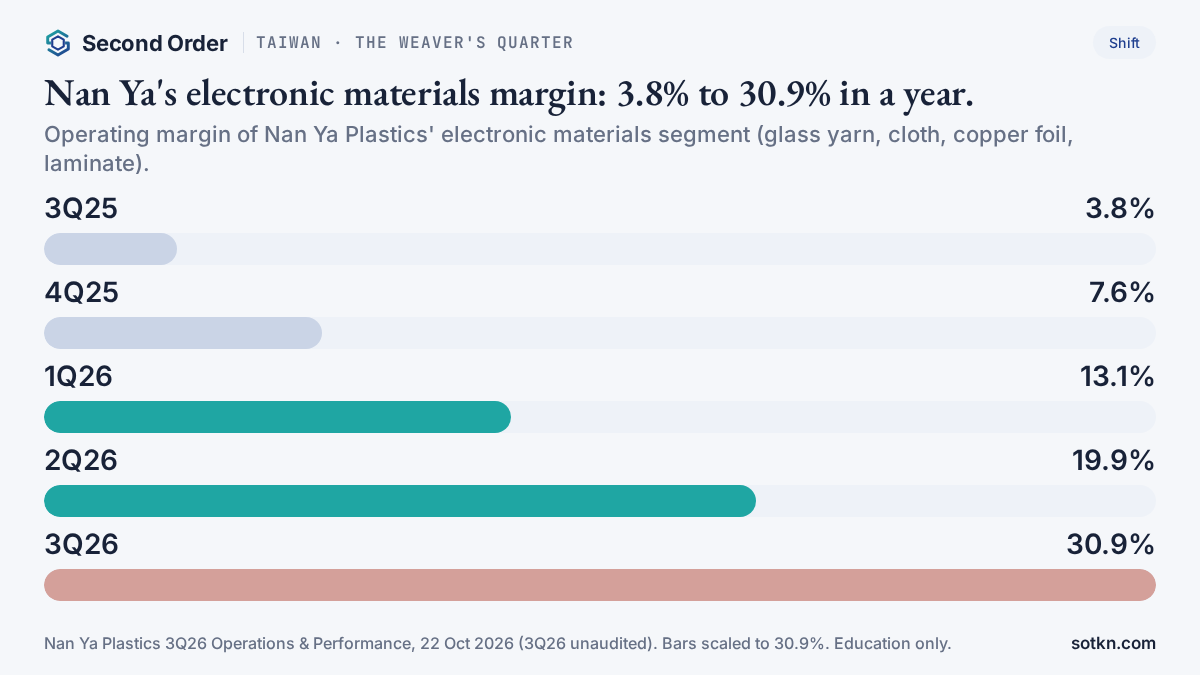
- Margin. The operating margin of its electronic materials business went from 3.8% in the third quarter of 2025 to 7.6%, 13.1%, 19.9% and then 30.9% in the third quarter of 2026. Five quarters, eight times the margin.
- Profit. Electronic materials operating profit rose 96.1% from the second quarter, adding NT$8.42 billion, and made up 93.8% of group operating profit.
- Mix. Electronics rose to 58.1% of group revenue, from 46.6% a year earlier and 52.6% in the second quarter. Group revenue was NT$95.60 billion, against NT$64.18 billion a year earlier.
- Full lines. The company said utilisation across its electronic materials lines is approaching full load and that it is moving capacity toward high-end grades. It also said equipment suppliers face shortages, widening the gap.
The important line is the reason for the margin. Nan Ya said prices rose month after month and that price rises have spread from high-end grades to standard ones. That is a seller's market at the bottom of the chain. It is not the company doing something new in the quarter; it is the company owning capacity that everyone needs when there is not enough of it.
Not to be confused with its memory affiliate Nanya Technology (Nanya DRAM Pulse), whose stake also lifted Nan Ya Plastics' earnings; the margin path above is electronic materials alone.
Taiwan Glass shows the same pattern from a smaller base. It reported September revenue of NT$4.97 billion, up 34.1%, and has raised its glass cloth capacity by about 50% this year, according to the Commercial Times. It is building its high-end cloth capacity in three phases; the third, of more than NT$2 billion for second-generation low-loss and low-expansion cloth, is due in 2027, according to MoneyDJ.
And Nittobo is building in Taiwan. In an interview reported on 6 October, its president said the company has decided to add a new furnace for glass yarn at its Taiwan plant and a new cloth plant in Fukushima, Japan. Its Taiwan subsidiary in Chiayi already began T-glass production earlier this year, according to Taiwanese press reports. Japanese media report that Nittobo aims to triple its T-glass capacity by its 2028 financial year from 2025, but its president has said demand is so large the expansion cannot keep up.
What does this mean for Taiwan's substrate makers?
The substrate makers are busy and well paid, but their output is capped by their inputs. Unimicron is the clearest case.
- Sales are rising fast. Unimicron's monthly sales went from NT$16.25 billion in July to NT$17.75 billion in August and NT$18.65 billion in September, up 64.7% on a year earlier. That makes about NT$52.6 billion for the third quarter, up about 54.9% on a year earlier and about 22.8% on the second quarter (our arithmetic).
- AI is most of it. In the second quarter, AI data centre uses made up 61% of revenue and ABF substrates, the kind used under AI chips, 52%. Gross margin rose from 18% to 24.8%, the company said on its September earnings call.
- Customers pay in advance. Customers are funding expansion through long-term agreements with prepayments. Unimicron's cash rose to NT$93 billion at the end of June and, management said, above NT$100 billion after that.
- New plants come later. New plants are due for volume in 2027 and 2028. Nvidia said on 21 October that it has a capacity reservation agreement with Unimicron, with new capacity starting in the second quarter of 2027 and reaching full output by mid-2028.
The customer pays in advance to secure capacity. The substrate maker then has to buy cloth, laminate and film from suppliers who are sold out, and tools with queues of up to 30 months. The prepayment buys a place in line; it does not make the loom or the machine arrive sooner.
Why do some machines take 30 months?
Because toolmakers are being asked to expand at the same time as everyone else. A substrate line needs laser drills, plating lines, film laminators, exposure tools and inspection gear; a glass fibre plant needs furnaces and looms. More than 80% of equipment now comes with longer lead times, and more than one in five tools takes more than double its old lead time.
Thirty months is about the time it takes to plan, build and start a whole new factory in normal times. Here it is the wait for some single machines. That is the clock that sets when new cloth and new substrate capacity can arrive, regardless of how much money customers put up. Inspection is part of the same gate; our KLA Stack page and members' KLA Analysis cover why yield checks are their own bottleneck as packages grow.
Our math: what do the numbers say?
- Unimicron third quarter: NT$16.25 billion plus NT$17.75 billion plus NT$18.65 billion is about NT$52.6 billion, against about NT$34.0 billion a year earlier (up about 54.9%) and NT$42.9 billion in the second quarter (up about 22.8%) (our arithmetic).
- Nan Ya electronic materials revenue: 58.1% of NT$95.60 billion is about NT$55.5 billion in the third quarter of 2026, against 46.6% of NT$64.18 billion, about NT$29.9 billion, a year earlier; up about 86% (our arithmetic).
- Nan Ya electronic materials operating profit: 30.9% of about NT$55.5 billion is about NT$17.2 billion, against 3.8% of about NT$29.9 billion, about NT$1.1 billion, a year earlier. Revenue less than doubled; profit rose about fifteenfold (our arithmetic on the company's segment shares and margins).
- Capacity gap to 2028: CoWoS about 6.8 times 2024 levels against substrates about 2 times. On equal bases that would be a gap of more than three to one; the bases are not equal, as Chien said, so this is a direction, not a forecast (our arithmetic).
What this tells you: in this squeeze the money moves first to whoever owns furnaces and looms. Unimicron is growing fast too, but through existing lines; its next big step waits on plants due in 2027 and 2028.
Who gets paid first?
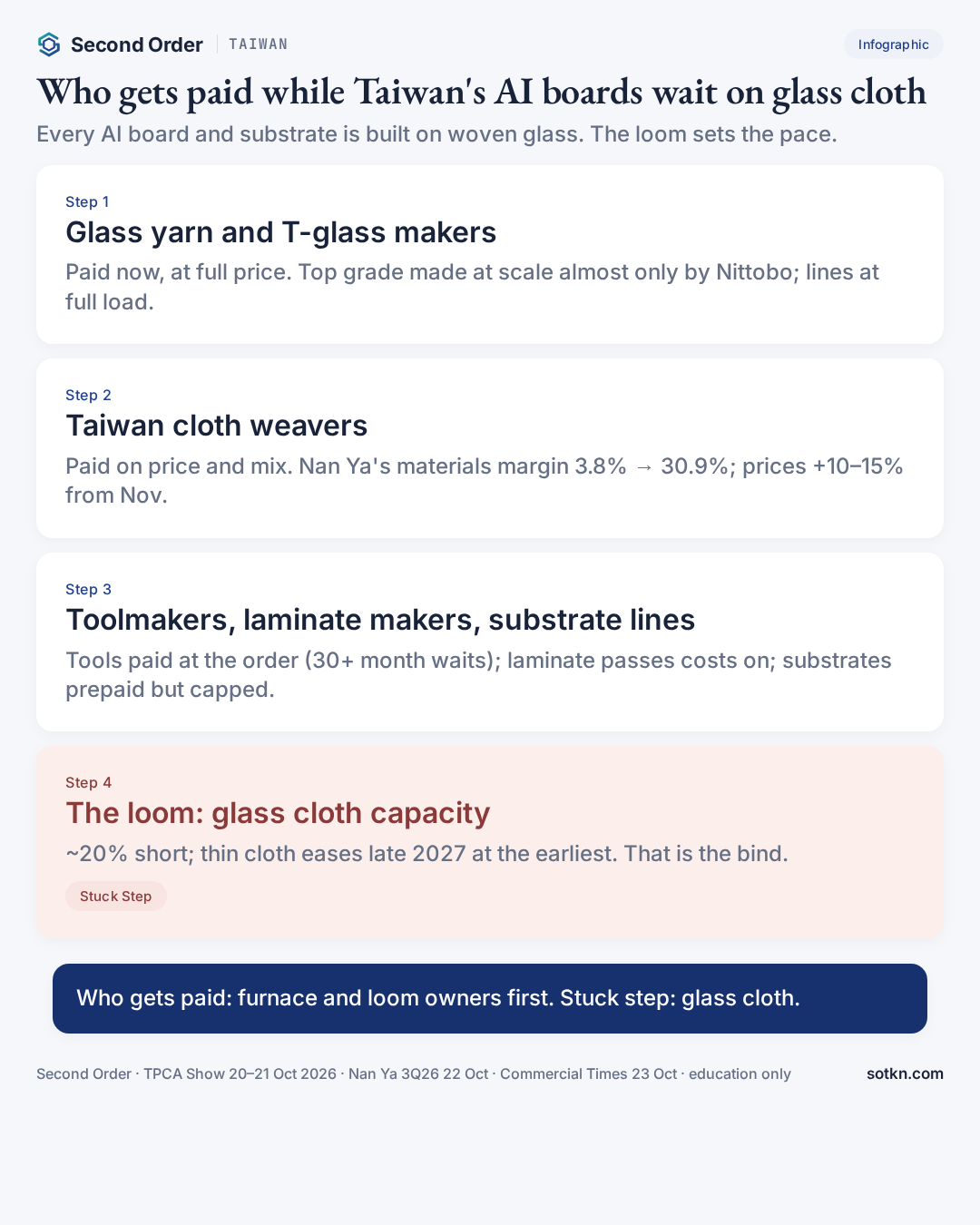
First, the makers of the scarce glass — now, at full price. Nittobo for the top T-glass grade, at full load with its price rises through, including its Taiwan plant in Chiayi. Nothing downstream ships without the cloth.
Second, the Taiwanese yarn and cloth weavers — now, on price and mix. Nan Ya Plastics, Taiwan Glass and Grace Fabric gain twice: prices rise on standard thin cloth because looms have moved, and they sell more of the dearer special grades as they qualify them. Nan Ya's margin path is the clearest evidence.
Third, the toolmakers — at the order, with deposits. Every furnace, loom, drill and plating line ordered today is paid for well before it runs. With waits of up to 30 months, their order books stretch far ahead.
Fourth, the laminate makers — on the pass-through. EMC, Nan Ya, ITEQ and Taiwan Union Technology raise prices and sell better grades such as M9, but buy cloth in a sold-out market, so their margin depends on passing costs on quickly.
Fifth, the substrate and board makers — on volume through existing lines, with cash up front. Unimicron, Kinsus and Nan Ya PCB are full and prepaid. But their next large step in output waits on plants due in 2027 and 2028 and on cloth and tools arriving for them.
Last, the buyers — chip designers, server makers and cloud builders — pay more and wait longer. The cost of each AI server rises a little with every price step in the materials below it. The cloud builders' capital budgets, such as the one in our Meta capex Pulse, absorb it. Consumer electronics makers, competing for the same thin cloth, are at risk of being crowded out.
One-line rule: in Taiwan's board materials squeeze, whoever owns the furnace and the loom is paid first, the toolmakers are paid at the order, and the substrate lines are paid in advance but ship only as fast as the cloth arrives. The stuck step is the loom.
So what is the stuck step?
Glass cloth, and specifically the capacity to make the special grades and the thin weaves: furnaces that draw the yarn and looms that weave it. Not demand, which every speaker at the show said is strong. Not the substrate makers' willingness to build, which is backed by customer prepayments. Not the money, which is plentiful. Three things make it stick:
- One supplier for the top grade. Nittobo makes most of the world's T-glass. Rivals in Taiwan, China and elsewhere are trying to qualify their own, but a substrate cannot be changed once it is built, so customers test new cloth for months before switching.
- Slow machines. New furnaces and looms take a long time to build and start, and some equipment now takes more than 30 months to arrive. The shortage of thin cloth is expected to ease only from late 2027.
- Rising intensity. Each new generation of AI package is larger and each new board has more layers and a better grade of laminate. So demand for the special cloth grows faster than the number of chips.
This is the pattern in our stuck-step Analysis: if packaging catches up, the stuck step moves somewhere else. This week Taiwan's board industry said where part of it has gone: down the chain, to a woven fabric most people have never heard of.
Which dates test this read next?
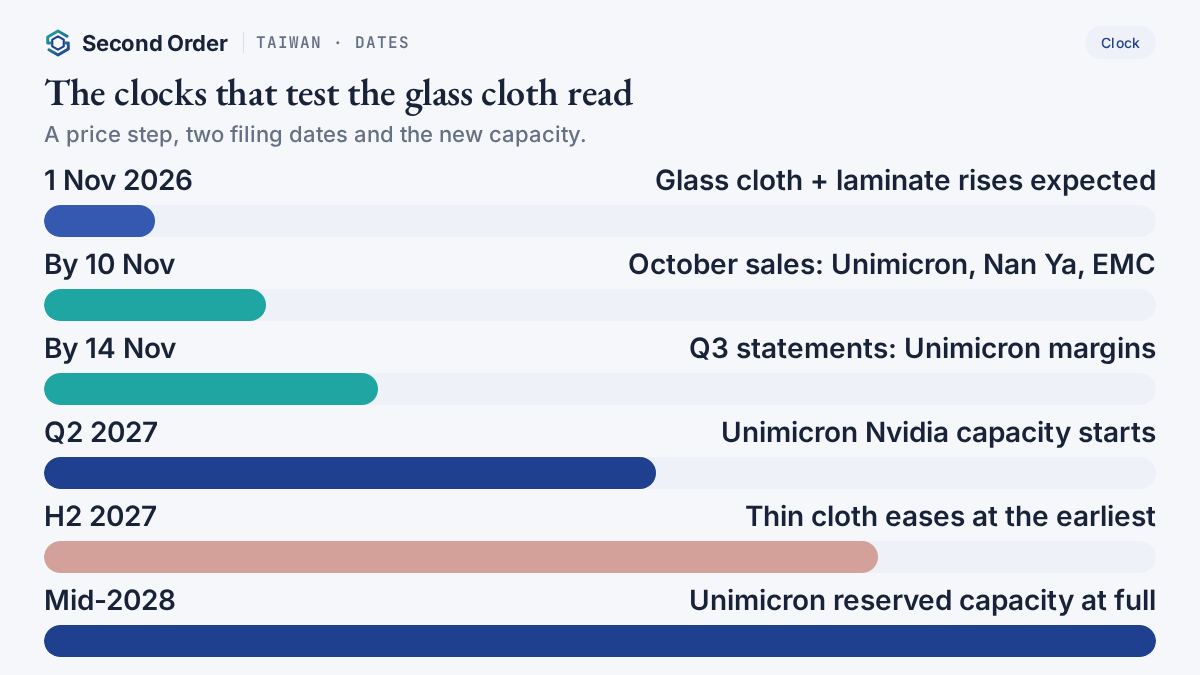
- 1 November 2026 — The expected start of 10% to 15% rises in glass cloth and laminate prices. Whether they stick, and how widely, is the first test.
- By 10 November 2026 — Taiwanese listed companies report October sales. Watch Unimicron, Nan Ya Plastics, Taiwan Glass and EMC for whether growth holds or flattens as capacity caps it.
- By 14 November 2026 — The deadline for third-quarter financial statements in Taiwan. Unimicron's quarter should show whether the substrate margin keeps rising with prices or gets squeezed by materials.
- Second quarter of 2027 — Unimicron's Nvidia-backed capacity starts to come on, if cloth and tools arrive on time.
- Second half of 2027 — The earliest the thin-cloth shortage is expected to ease, as new capacity and Taiwan Glass's third phase come on. Nittobo's new Taiwan furnace is part of its plan to triple T-glass capacity by its 2028 financial year.
- Mid-2028 — Unimicron's reserved capacity at full output. By then Chien's capacity multiples to 2028 can be checked against what was built.
What would change this view?
- If the November price rises fail to stick, or are rolled back, the shortage is less severe than the supply chain says and the weavers' pricing power is weaker.
- A faster qualification of T-glass from rival suppliers in Taiwan, China or Korea would loosen Nittobo's hold on the top grade and move the bind elsewhere.
- Signs of double-ordering, the risk CommonWealth's panel flagged, would mean part of today's shortage is customers stockpiling. An inventory correction would ease prices quickly.
- A slowdown in AI spending by the cloud builders would turn the bind from supply to demand, and the cloth makers' margins would fall fastest.
Practical takeaways
- Taiwan's board industry says key materials run about 20% short and some tools take over 30 months
- Glass cloth is the tightest: T-glass from essentially one supplier, and thin cloth because looms are scarce
- Glass cloth and laminate prices are expected to rise 10% to 15% from November
- Nan Ya's electronic materials margin went from 3.8% to 30.9% in a year; owning the loom pays first
- Substrate makers are full and prepaid, but their next step waits on 2027–2028 plants; stuck step: the loom
FAQ
What is the shortage Taiwan's circuit board makers are warning about?
At the Taiwan Printed Circuit Association show in Taipei from 20 October 2026, Unimicron chairman S.C. Chien, who also chairs the association, said supplies of key materials are running about 20% short of demand and some specialised equipment takes more than 30 months to arrive. The tightest materials are low-expansion glass cloth, often called T-glass, thin glass cloth, high-end copper-clad laminate and advanced copper foil.
Why does glass cloth matter for AI chips?
Glass cloth is woven glass fibre that gives circuit boards and chip substrates their strength and keeps them flat when they heat up. AI chip packages are now several times the size of a normal chip, so the substrate under them must not warp. The low-expansion grade that does this is made at scale almost only by Japan's Nittobo, and thin cloth for high-layer boards is also short because there are not enough weaving looms.
Is this investment advice?
No. Education only. It maps who gets paid and which step is stuck. It is not a recommendation to buy or sell any security, and we leave out share prices, broker ratings and price targets on purpose.
Keep reading on the map
- Taiwan Markets hub — country page
- TSMC CoWoS · Nanya DRAM · Foxconn AI racks · September exports · US parks
- Nvidia substrate bookings · TTM board orders · Samsung Electro-Mechanics substrates
- Malaysia chip exports — where the parts pass through
- Meta capex Pulse — the buyer's side
- Where cash sticks Analysis · Wiwynn working-capital Analysis · KLA inspection Analysis
- Semiconductors on the stack · Chiplets explained · Interposers explained · HBM explained
- All Markets doors — Taiwan, Korea, US, China, Singapore, Australia, Malaysia
How we check this. What was said at the Taiwan Printed Circuit Association show comes from CommonWealth Magazine’s report of 23 October 2026 and TrendForce’s round-up of 20 October 2026, which cites Wealth Magazine, the Economic Daily News, MoneyDJ and the Central News Agency. Elite Material’s comments are as reported by Taiwan News on 20 October. Price expectations for November are as reported by the Commercial Times via Taiwan News on 23 October and by TechNews on 22 October; they are supply-chain estimates, not company price lists. Nan Ya Plastics’ figures come from its own third-quarter presentation of 22 October (unaudited). Nittobo’s comments are from a Nikkei interview as carried by MoneyDJ and TechNews on 6 October. Unimicron’s sales are from its monthly revenue page. Anything we worked out ourselves is labelled “our arithmetic”. Share prices, broker ratings and price targets are left out on purpose. The references we used are listed at the end. Our editorial standards →
Not investment advice. Do your own research.
References
- CommonWealth Magazine, Taiwan PCB Output to Hit Record High, but AI Boom Exposes Supply Chain Risks, 23 Oct 2026. english.cw.com.tw — TPCA forecast; Chien on the 20% materials gap and 30-month tools; Prismark forecasts.
- TrendForce, Unimicron Warns of IC Substrate Crunch: Up to 30-Month Equipment Lead Times, 20% Material Gap in 2027, 20 Oct 2026. trendforce.com — tight materials, equipment lead times, capacity multiples to 2028, substrate sizes.
- Taiwan News, Taiwan's Elite Material says copper-clad laminate shortage to persist, 20 Oct 2026. taiwannews.com.tw — high-end laminate short through 2030; Taiwan capacity to triple by 2028.
- Taiwan News, Taiwan's Nan Ya sees structural shift in PCB materials market, 23 Oct 2026. taiwannews.com.tw — November price rises; thin cloth; Kingboard; easing from late 2027.
- TechNews, Glass cloth and CCL shortage pressure rises, price increases brewing for November (Chinese), 22 Oct 2026. technews.tw — thin cloth grades and supply-chain price survey.
- Nan Ya Plastics, 3Q26 Operations & Performance (investor presentation), 22 Oct 2026. npc.com.tw — revenue, segment shares and electronic materials margins by quarter; outlook.
- TechNews (MoneyDJ, citing Nikkei), Nittobo: T-Glass demand exceeds supply, lines at full load (Chinese), 6 Oct 2026. technews.tw — full lines; new Taiwan furnace and Fukushima plant; prices.
- MoneyDJ, AI lifts T-Glass demand; Taiwan Glass keeps expanding (Chinese), 7 Oct 2026. moneydj.com — Taiwan Glass's three-phase high-end cloth expansion, phase three due 2027.
- Unimicron Technology, Monthly Sales Revenue, Sep 2026 data, published Oct 2026. unimicron.com — monthly net sales, 2025 and 2026.