NT$1 Trillion Month: Who Gets Paid When Foxconn Ships AI Racks
Foxconn's September sales hit NT$1.16 trillion, its first month above NT$1 trillion. But in the June quarter it kept about NT$2.37 of each NT$100 as profit. Parts sellers get paid first. Building and testing the racks sets the pace.

Foxconn just had its biggest month ever. In September 2026 it sold NT$1.16 trillion of goods, the first month above NT$1 trillion. Much of the jump came from AI server racks. But Foxconn keeps a thin slice of each sale. The makers of the chips and parts inside get paid first. The stuck step, on our read, is building and testing the racks.
TAIWAN PULSE · Data as at 7 Oct 2026 · Next update: after Foxconn’s third-quarter results on 12 Nov 2026
Affects: Semiconductors · Hyperscalers · Neoclouds — Markets: Taiwan · US · Korea · China
Education only, not advice to buy or sell any security. Company figures are as reported. Monthly sales are unaudited. Outlooks are company views, not facts yet. Analyst estimates are labelled as such.
The numbers that matter this month
Foxconn sales, September 2026
NT$1,158.6B
+38.42% on a year · +25.70% on August · first month over NT$1T
PrimaryThird-quarter sales
NT$3.03T
+47.12% on a year · estimate was NT$2.83T (LSEG)
PrimaryNet profit per NT$100 of sales
NT$2.37
June quarter 2026 · gross NT$6.12
PrimaryAI rack shipments, 2026
More than double
Company outlook, 12 Aug 2026
OutlookBuild and test
Still the bind
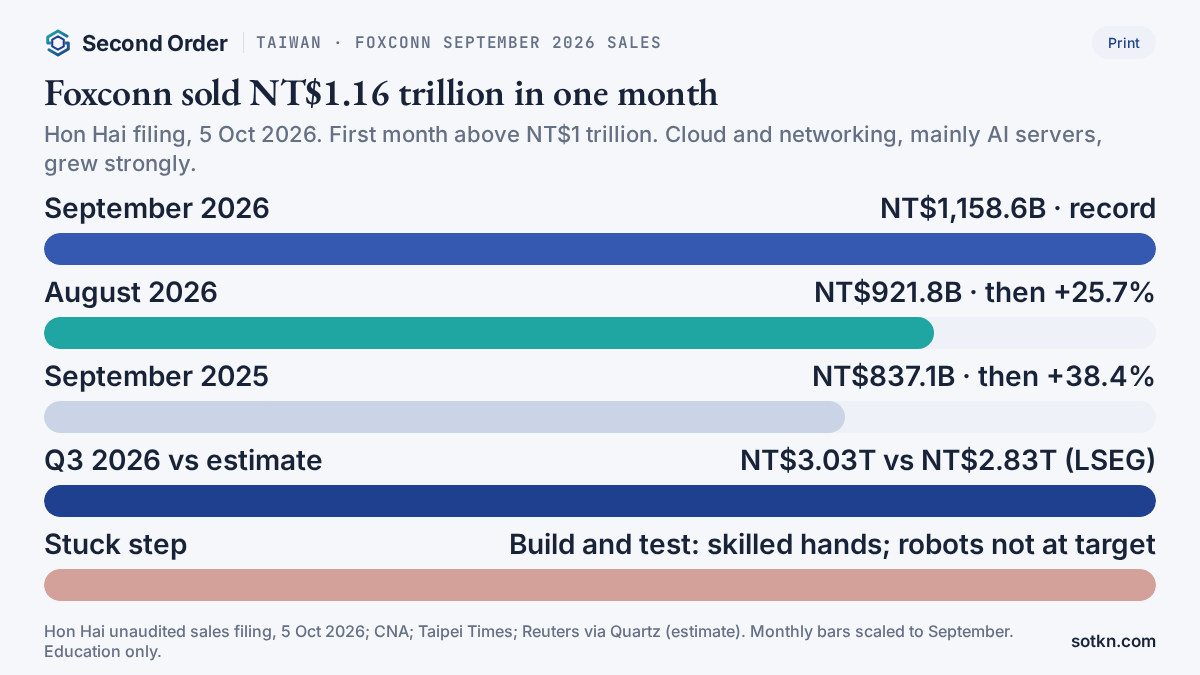
Test-tray robots: over 95% success vs 99.5% target
Stuck stepTaiwan exports, August 2026
US$82.4B
+41% · a monthly record (Ministry of Finance)
PrimarySources: Hon Hai sales filing, 5 Oct 2026; Hon Hai Q2 results, 12 Aug 2026; CNA and Reuters, 5 Oct 2026; Nvidia blog 2 Oct 2026 via CNA; Ministry of Finance via CNA, 9 Sep 2026. Status chips are Second Order’s read.
On this page: Why Foxconn? · What changed · Our math · Where money goes · Is build and test stuck? · Dates next · How this differs · What would change this · FAQ
Why does Foxconn matter for Taiwan now?
Because Foxconn is where many AI chips turn into AI racks. A chip on its own does nothing. It has to sit on a board, inside a tray, inside a rack, with power, cooling and cables. Foxconn does that work at huge scale. CNA puts its share of the world’s AI server market at more than 40%.
Its monthly sales come out around the 5th, weeks before most results. So they are an early, hard number on the AI build.
For more on the chip side, see what TSMC does, who makes AI chips and the Taiwan Markets hub. The question here is not “is AI demand strong?” Foxconn’s sales say it is. The question is who keeps the money, and what limits how fast racks go out the door.
1 · Foxconn buys the parts
Who: Chip, memory and part makers
Paid: Paid when Foxconn buys · costs were NT$93.88 of each NT$100 of sales (Q2, our arithmetic)
2 · Racks are built and tested
Who: Foxconn lines and test benches
Paid: Test trays still lean on skilled hands · robots not yet at target
3 · Racks ship and are billed
Who: Foxconn, then the cloud buyers
Paid: NT$1,158.6B of sales in September · Foxconn keeps a thin slice
What changed in September?
Three things changed. The size of the month, the beat on the quarter, and what the factory floor told us.
The month. Foxconn sold NT$1,158.6 billion in September, per its filing of 5 Oct. That is about US$36.5 billion, using the Taipei Times conversion. A year earlier it sold NT$837.1 billion. In August it sold NT$921.8 billion. So sales rose 38.42% in a year and 25.70% in a month.
What drove it? Foxconn said its cloud and networking products, which are mainly servers, grew strongly from a year ago as customers sped up orders for AI products. Its components and computing products also grew strongly. The jump from August was helped by phones: new smartphone launches lifted its consumer electronics sales.
The quarter. Third-quarter sales were NT$3.03 trillion, up 47.12% on a year and 20.44% on the quarter before. Analysts had expected NT$2.83 trillion, Reuters reported, citing an LSEG SmartEstimate. Foxconn beat that by about NT$200 billion, or about 7% (our arithmetic).
The factory floor. On 2 Oct, Nvidia posted a blog about robots, built with Foxconn, that help assemble parts for GB300 NVL72, its rack of 72 GPUs. It shows where the hard, slow work sits.
Foxconn sales (unaudited filing, 5 Oct)
What Foxconn said on 12 Aug (Q2 results)
Hon Hai unaudited sales filing (5 Oct 2026); Hon Hai Q2 2026 results (12 Aug 2026); CNA and Taipei Times (5–6 Oct 2026); Reuters via Quartz (5 Oct 2026).
Our math: how much does Foxconn keep?
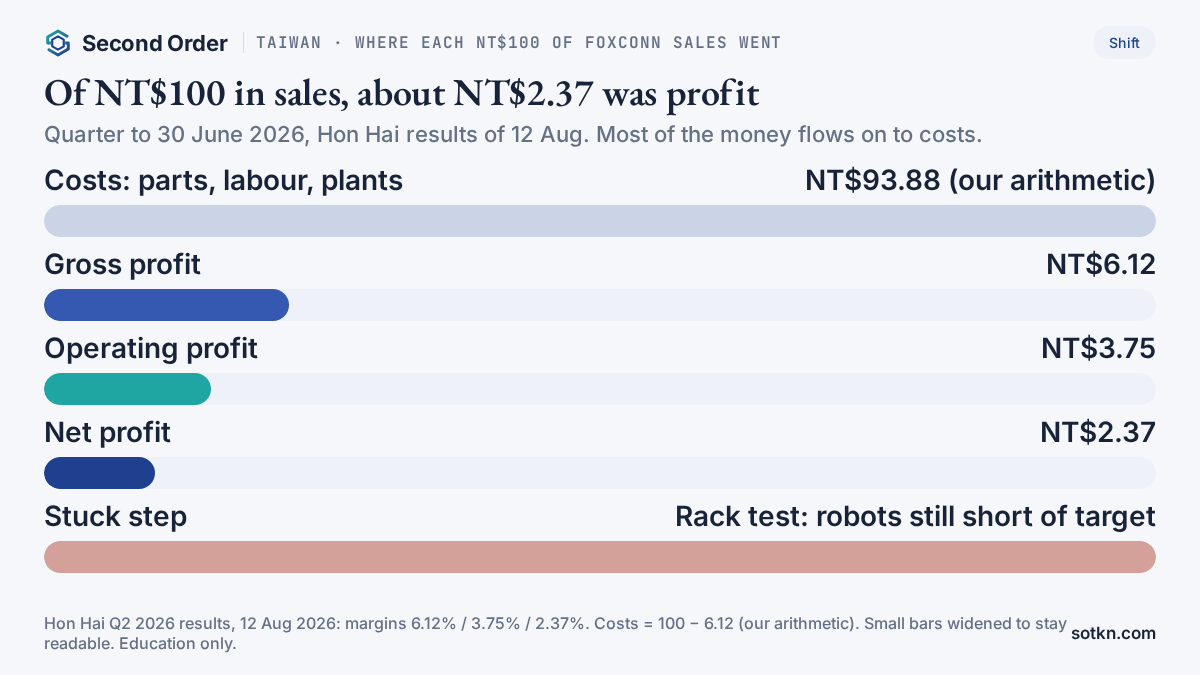
Sales are what comes in the door. Profit is what is left after paying for everything. For Foxconn the gap is wide. Here are the sums.
- In the June quarter, Foxconn’s gross margin was 6.12%. So of each NT$100 of sales, about NT$93.88 went on the cost of making the goods (our arithmetic).
- Operating margin was 3.75%. Net margin was 2.37%. So about NT$2.37 of each NT$100 was left as profit for owners.
- September’s NT$1,158.6 billion works out to about NT$38.6 billion of sales a day (our arithmetic).
- If September earned the same margins as the June quarter — a big if — gross profit would be about NT$70.9 billion and net profit about NT$27.5 billion (our arithmetic). That is an illustration, not a forecast.
So where does the other NT$93.88 go? Foxconn does not split its costs in the release. But cost of goods is what it pays to make what it sells: parts, people and plants. For an AI rack, the parts include the chips, memory, boards, power gear and cables. Foxconn buys most of those chips from others.
Thin is not small, though. First-half operating margin was 3.67%, above Foxconn’s own 3% target.
Cash is the other half. First-half capital spending was NT$80.9 billion, up 5%, and the yearly interest bill rose by NT$6.6 billion. Adjusted EBITDA, a rough cash-earnings measure, was NT$227.7 billion, up 52%. Capex was about a third of that (our arithmetic). See cash capex, explained.
Where does the money go?
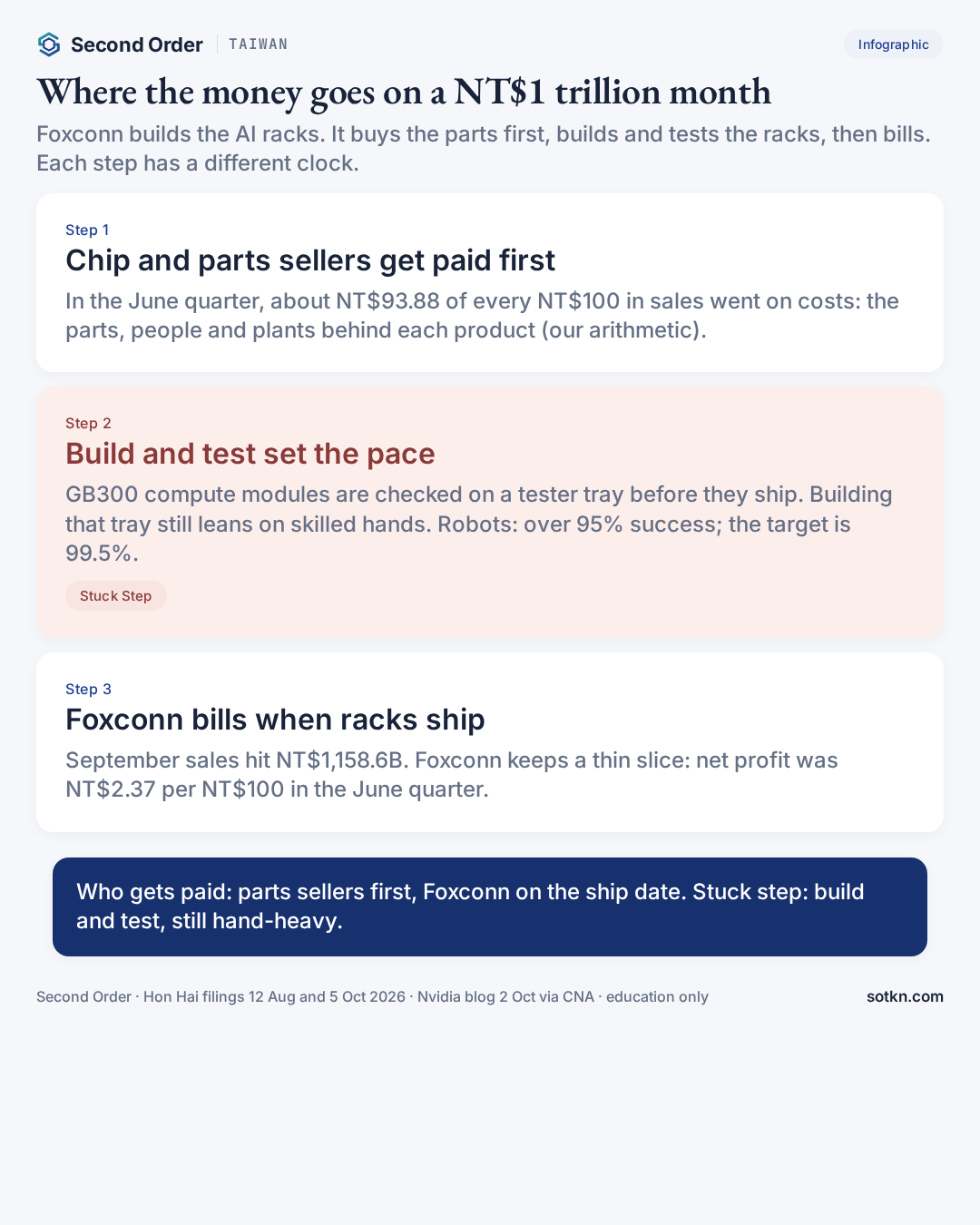
Follow one rack. The money moves in a line. Each stop has its own clock.
First, the chip and part makers. Foxconn buys the chips, memory and other parts before it builds. Those sellers are paid on their own terms, before the rack is done. The AI chips themselves are made by TSMC for Nvidia and others, and the memory comes from a few makers. This is the front of the pay line. See CoWoS, explained for the chip packaging step that comes before Foxconn.
Second, Foxconn itself. It is paid when finished racks ship and its customers pay. It keeps a thin slice of each sale, but it ships a lot. In August it said AI rack shipments should more than double this year.
Third, the cloud firms that buy the racks. They pay Foxconn when the racks arrive. They earn back that money later, as their own customers use the computing power. That can take years. See Hyperscalers, explained and GPU as a service, explained. Foxconn said cloud firms’ rising capital spending is what drives its rack volumes.
Taiwan as a whole sees the same flow. In August, Taiwan’s exports hit a record US$82.4 billion, up 41%, the Ministry of Finance said. Information and communications products, which include servers, were US$33.10 billion, up 41.8%. That is about 40% of all exports (our arithmetic).
There is a hint of what comes next, too. Taiwan’s export orders were US$103.0 billion in August, up 71.4%, the Ministry of Economic Affairs said. Not all of those goods are made in Taiwan; many are built in overseas plants.
Part makers sit at the front of the line. Foxconn sits in the middle. The cloud firms sit at the back. In between: the work of building and testing each rack.
Is build and test the stuck step?
On our read, yes, inside the factory. It is not the only limit. But Foxconn and Nvidia are now openly working on it.
Here is what Nvidia’s 2 Oct blog said, as reported by CNA and TechNews. The GB300 tester tray checks that each compute module works before it ships. Building that tray still relies heavily on skilled workers. Nvidia and Foxconn picked the two hardest jobs to hand to robots.
- Busbar fitting: placing a long, heavy metal power bar and tightening 16 screws. Robots succeed more than 95% of the time. The target time is under 124 seconds. TechNews says the full job now takes about 160 seconds, with the screws the slow part.
- Connector fitting: pushing in four cables of different sizes. Robots succeed 90% to 95% of the time. The target is under 72 seconds.
- The factory bar for both jobs is at least 99.5% success, with no knocks to the tray. TechNews says even small damage can mean the whole system is scrapped.
What do those numbers mean in plain terms? At 95% success, up to 5 tries in 100 miss. The target is 1 miss in 200. On time, 160 seconds against 124 is 36 seconds over, or about 29% slower than the goal (our arithmetic).
Why not use normal factory machines? Nvidia said designs change fast and volumes are fairly low, so fixed automation does not work. Cables bend. Parts sit at slightly different angles.
Foxconn made the same point in August, in its own words. It said its scale and in-house parts help it keep efficiency and yields up “in the face of high unit price and highly complex AI products.” Complex and costly means slow to build and costly to get wrong.
Two cautions before you read “stuck” as “broken”:
- The robot figures are for two tasks on one test tray. They are not Foxconn’s overall production yield, which it does not publish.
- Sales still grew fast. The stuck step sets the pace of growth. It has not stopped it.
Outside the factory, there is a second clock. Racks need finished, powered halls before they earn anything. In the US, power was the stuck step in the US data-hall building Pulse. The next Nvidia rack, Vera Rubin, is in the CoreWeave Vera Rubin Pulse. The general pattern is in Where does the stuck step move?.
What dates matter
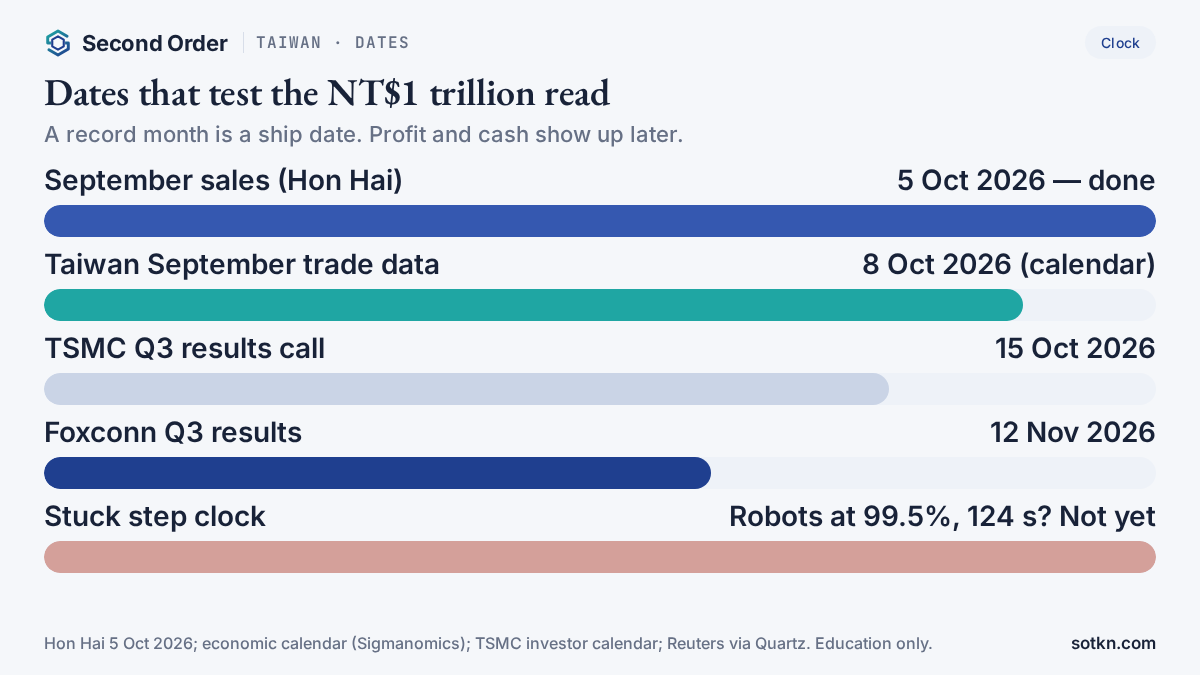
Dates to watch
Hon Hai 12 Aug and 5 Oct 2026; Reuters via Quartz 5 Oct 2026; Ministry of Finance via CNA 9 Sep 2026; TSMC investor site; economic calendars (Sigmanomics, Investing.com). We do not invent dates.
How is this different from …
- Taiwan PMI Pulse (5 Oct): factory surveys. This is one company’s cash.
- Chiayi land (3 Oct), Baipu (23 Sep), TSMC capex and revenue (29 Sep, 16 Sep): the chip and packaging steps. This piece starts where they stop: the rack.
- China Alibaba 20 GW Pulse (7 Oct): There, a buyer waits on chips. Here, the builder has the chips and the limit is how fast racks are built and tested.
What would change this view?
The “thin slice, build and test sets the pace” read weakens if:
- Foxconn’s third-quarter margins on 12 Nov rise well above the June quarter’s 6.12% gross and 2.37% net
- Nvidia and Foxconn say the test-tray robots have hit 99.5% success and the time targets
- Monthly sales keep jumping while Foxconn says nothing about build or test limits
- Cloud firms cut capital spending, so the limit moves from the factory to demand
It stays intact while sales grow far faster than profit, the robots stay short of target, and Foxconn keeps stressing how complex the AI racks are.
Practical takeaways
- Foxconn sold NT$1,158.6 billion in September 2026, its first month over NT$1 trillion (filing, 5 Oct 2026)
- Third-quarter sales were NT$3.03 trillion, up 47.12%, ahead of a NT$2.83 trillion estimate
- In the June quarter Foxconn kept about NT$2.37 of each NT$100 as net profit
- Who gets paid first: the chip, memory and part makers; Foxconn is paid when racks ship
- Stuck step: building and testing racks — test-tray robots are at over 95% success against a 99.5% target
FAQ
What did Foxconn report on 5 Oct 2026?
Hon Hai, known as Foxconn, said its unaudited September 2026 sales were NT$1,158.6 billion, up 38.42% on a year. It is the first month it has sold more than NT$1 trillion.
Why does a record month not mean record profit?
Because Foxconn keeps a thin slice. In the quarter to 30 June 2026 its gross margin was 6.12% and its net margin was 2.37%, per its 12 Aug 2026 results. Third-quarter profit is due on 12 Nov 2026.
Who gets paid?
First, the makers of the chips and other parts that go into the racks. They are paid when Foxconn buys. Foxconn gets paid when finished racks ship to its customers. The cloud firms that buy the racks get paid last, when their customers use the computing power.
What is the stuck step?
On our read, building and testing the racks. Nvidia said on 2 Oct that the tester tray used to check GB300 modules before shipment still relies heavily on skilled workers. Robots built with Foxconn have passed 95% success on one key task. The factory target is 99.5%.
Is this investment advice?
No. Education only. It maps who gets paid and which step is stuck. It is not a recommendation to buy or sell any security.
Keep reading on the map
- Taiwan Markets hub — country page
- Taiwan PMI Pulse (5 Oct) — the factory survey
- TSMC capex split Pulse (29 Sep) — the chip maker’s spending
- Baipu CoWoS validation Pulse (23 Sep) — the packaging step
- China Alibaba 20 GW Pulse (7 Oct) — a buyer waiting on chips
- US data-hall building Pulse (6 Oct) — where power binds
- Who makes AI chips — primer
- Semiconductors stack — layer map
How we check this
September and year-to-date sales come from Hon Hai’s unaudited monthly sales filing of 5 Oct 2026. Third-quarter sales and the growth rates come from the company statement as reported by CNA and Reuters. Margins, capex and the rack outlook come from Hon Hai’s second-quarter results of 12 Aug 2026. The robot figures come from an Nvidia technical blog post of 2 Oct 2026, as reported by CNA and TechNews. Taiwan trade figures come from the Ministry of Finance and the Ministry of Economic Affairs. Where we work something out ourselves, the sum is shown and labelled our arithmetic. We do not use the Taipei Times figure of NT$3.27 trillion for the quarter, because it does not match the company’s monthly sales.
Last reviewed: 7 Oct 2026 · Next review: after Foxconn’s third-quarter results on 12 Nov 2026
Spot an error? Tell us and we will correct it and note the change here.
Not investment advice. Do your own research.
Sources
- Hon Hai — Unaudited consolidated revenue for September 2026 (5 Oct 2026): foxconn.com
- Hon Hai — Un-audited monthly sales ended 30 Sep 2026, regulatory filing (5 Oct 2026): sharecast.com
- Hon Hai — Second quarter 2026 financial results (12 Aug 2026): foxconn.com
- CNA — Hon Hai reports first monthly sales over NT$1 trillion (5 Oct 2026): focustaiwan.tw
- Taipei Times — Hon Hai monthly revenue surpasses NT$1 trillion (6 Oct 2026): taipeitimes.com
- Quartz, citing Reuters — Foxconn third-quarter revenue beats estimates (5 Oct 2026): qz.com
- CNA — Nvidia, Hon Hai use robots to improve GB300 assembly success rates (5 Oct 2026): focustaiwan.tw
- TechNews — Nvidia and Hon Hai target 99.5% robot success on GB300 (4 Oct 2026): technews.tw
- CNA — Taiwan’s August exports hit record on AI demand (9 Sep 2026): focustaiwan.tw
- Ministry of Economic Affairs — Export orders in August 2026 (22 Sep 2026): moea.gov.tw
- TSMC — 2026 Q3 quarterly results page: investor.tsmc.com