TSMC Baipu Mini-Loop: Who Gets Paid When CoWoS Tools Must Clear Validation First
September 2026 in one line: Baipu breaks ground as a CoWoS tool-and-materials validation hub — modular Mini-Loop, not another volume fab — with a stated 25–50% efficiency aim and expected operations in Q4 2029.
Kaohsiung’s Baipu Industrial Park broke ground on 21 Sep 2026 with TSMC as the anchor — and the story is not another CoWoS volume fab. Per Commercial Times and TrendForce, TSMC is building a modular Mini-Loop so back-end equipment and materials clear hardware, software and process integration before they hit CoWoS mass lines. The stated aim is a 25% to 50% lift in validation efficiency. Who gets paid is whoever clears that gate, plus OSATs clustering beside it. The stuck step is qualifying tools and materials fast enough for a packaging ramp that Jun He says can compound at more than 80% a year through 2027 — while Baipu itself is only expected to operate from Q4 2029.
TAIWAN PULSE · Data as at 23 Sep 2026 · Next update: after Baipu permits / tenant list / next Jun He path print
Affects: Semiconductors · The Stack — Markets: Taiwan · Korea · US · China
Education only, not advice to buy or sell any security. Efficiency aims and capacity CAGRs are company remarks as reported by dated trade press. ASE and SPIL site facts are company or wire-service prints.
The numbers that matter this month
Baipu groundbreaking
21 Sep 2026
Kaohsiung Baipu Industrial Park · Reuters / CTEE / TrendForce
Fresh printMini-Loop validation-efficiency aim
25–50%
Jun He via Commercial Times / TrendForce 21 Sep 2026 · stated aim
Stated aimCoWoS capacity CAGR through 2027
>80%
Jun He · TrendForce / CTEE 21 Sep 2026 · company estimate as reported
Ramp clockExpected Baipu operations
Q4 2029
Reuters citing Kaohsiung Deputy Mayor Lo Ta-sheng 21 Sep 2026
Ops clockTSMC Baipu footprint (reported)
~3 ha · 2 buildings
Validation lab + talent centre · not a CoWoS volume fab
ScopeQualifying tools/materials fast enough
Stuck step
Back-end OEMs ~6.5% front-end scale · R&D ~1/20 (Jun He, CTEE 2 Sep)
Stuck stepSources: Reuters 21 Sep 2026; TrendForce 21 Sep 2026; Commercial Times 2 & 21 Sep 2026. Status chips are Second Order’s read.
On this page: Why Taiwan? · What Baipu is (and is not) · Validation efficiency · Our math · Where money sticks · Is validation still stuck? · Dates to watch · vs revenue / capacity / Wire · What would change · FAQ
Why does Taiwan’s packaging-validation gate matter now?
Because AI accelerators are not only a wafer-start story. Larger packages, more HBM stacks and faster 3DIC iteration push the scarce step into advanced packaging — and into whether new tools and materials can be qualified before the next generation lands. Taiwan still hosts the densest CoWoS and OSAT cluster. When TSMC builds a dedicated Mini-Loop beside that cluster, the money map shifts from “who can add a line” to “who can clear the gate.”
Foundry packaging gate
Who: TSMC Advanced Packaging
Paid: Owns CoWoS process + Mini-Loop qualification path for tools/materials
Tool + material validation
Who: Back-end equipment / materials OEMs
Paid: Must clear soft/hard/process integration before mass CoWoS introduction
OSAT production cluster
Who: ASE / SPIL (+ Kaohsiung & Yunlin builds)
Paid: Get paid when qualified packages and test capacity land beside the gate
Accelerator demand
Who: GPU / ASIC designers + hyperscalers
Paid: Pull larger CoWoS-L-class packages through 2028 (see Wire)
Chain is Second Order’s reading frame. Evergreen: foundry and advanced packaging explained · CoWoS explained. Sibling Taiwan doors: TSMC revenue Pulse · CoWoS capacity Pulse · CoWoS-L through 2028 Wire.
What changed — Baipu is a validation hub, not more CoWoS wafers
The fresh print is the 21 Sep 2026 groundbreaking. Reuters reports TSMC will build two buildings at Baipu — a technology validation laboratory and a talent training centre — with operations expected in Q4 2029. The park is about 88.7 hectares, of which about 53.6 hectares are industrial. Commercial Times adds that phase-one leasing is reportedly full, TSMC anchors the south on roughly three hectares, and Baipu is explicitly not another advanced-packaging mass-production fab.
The design choice is the Mini-Loop. At SEMICON Taiwan 2026’s 3DIC Global Summit (reported 2 Sep 2026), Jun He said TSMC will not build a fixed, complete production line at Baipu. 3DIC technology is moving nearly one generation a year; a full line would risk obsolescence. Modular Mini-Loop modules can be reconfigured as the process changes — bring in the module that needs testing, modify it in an adjacent supplier lab, and send it back without shipping tools back to a distant headquarters.
What Baipu is vs is not (as reported)
Sources: Reuters 21 Sep 2026; Commercial Times 2 & 21 Sep 2026; TrendForce 21 Sep 2026.
What is the 25–50% validation-efficiency claim?
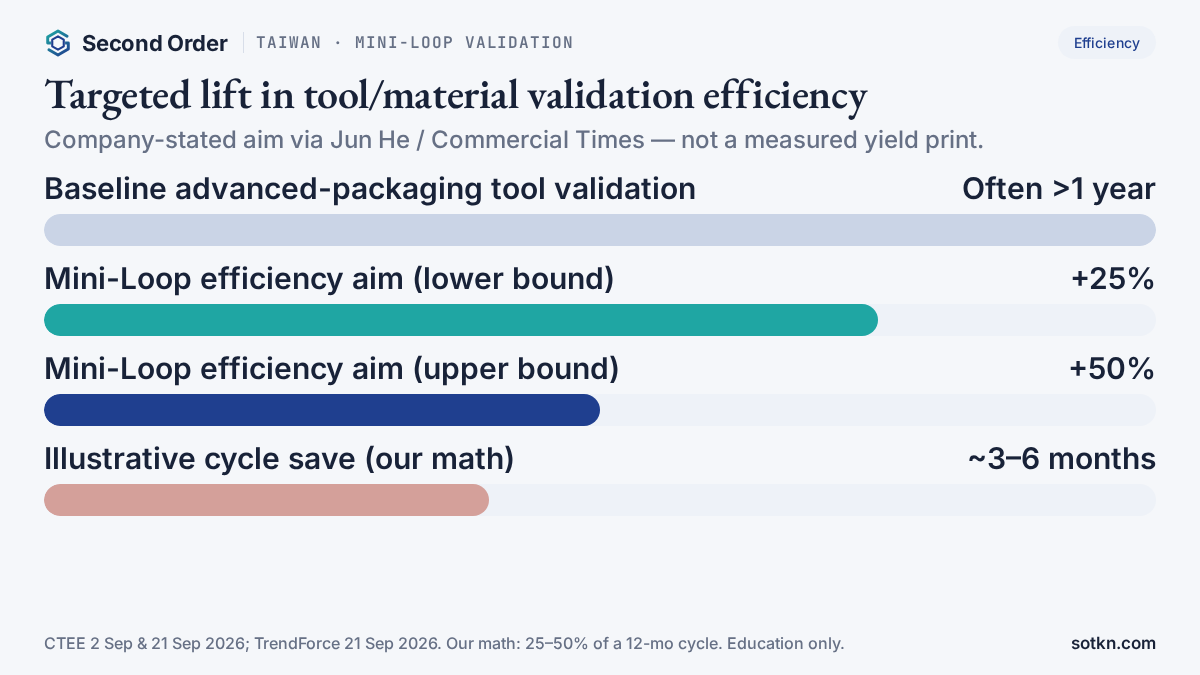
It is a stated aim, not a measured yield. Commercial Times and TrendForce on 21 Sep 2026 report Jun He’s target: improve semiconductor equipment and materials validation efficiency by 25% to 50% by qualifying tools on the Mini-Loop before CoWoS mass introduction. The 2 Sep Commercial Times piece, from the same SEMICON remarks, said validation often takes more than a year today, with a nearer-term aim of about 25% improvement and compressing the cycle to within a year — and feedback from weeks or months down toward hours when labs sit next to the loop.
Why TSMC is stepping in: Jun He told the same audience that major back-end equipment makers are only about 6.5% of front-end peers’ economic scale and invest roughly one-twentieth as much in R&D. As AI packages iterate faster, suppliers cannot keep validating alone. Baipu is framed as a co-development and standardisation platform — Commercial Times calls it a “test track” for advanced-packaging equipment localisation — with ITRI and the Metal Industries R&D Center pulled in for β-site, smart inspection and digital-twin work so Kaohsiung’s precision-metal base can clear higher-value equipment gates.
Our math — what does 25–50% buy on a twelve-month cycle?
If a baseline advanced-packaging tool qualification often runs more than twelve months (Commercial Times, 2 Sep 2026) and Mini-Loop targets a 25% to 50% efficiency lift (21 Sep reporting), a straight illustration is three to six months saved per cycle: 0.25 × 12 = 3 months; 0.50 × 12 = 6 months. That is our arithmetic from stated percentages — not company guidance, not a promise that every tool will print the same save, and not a claim that 2026–27 CoWoS shortages disappear.
Our illustration from dated stated figures
What this tells you: Mini-Loop is aiming at cycle time on qualification, which is the hidden queue behind every new bonder, laser, AOI and material that must enter CoWoS. What it does not tell you: Baipu does not add CoWoS wafer starts in 2026–27. The near-term ramp still runs through existing TSMC packaging lines and OSAT builds already timed for 2027–28. Treat the efficiency band as a thesis clock, not a capacity print.
Where does the money stick?
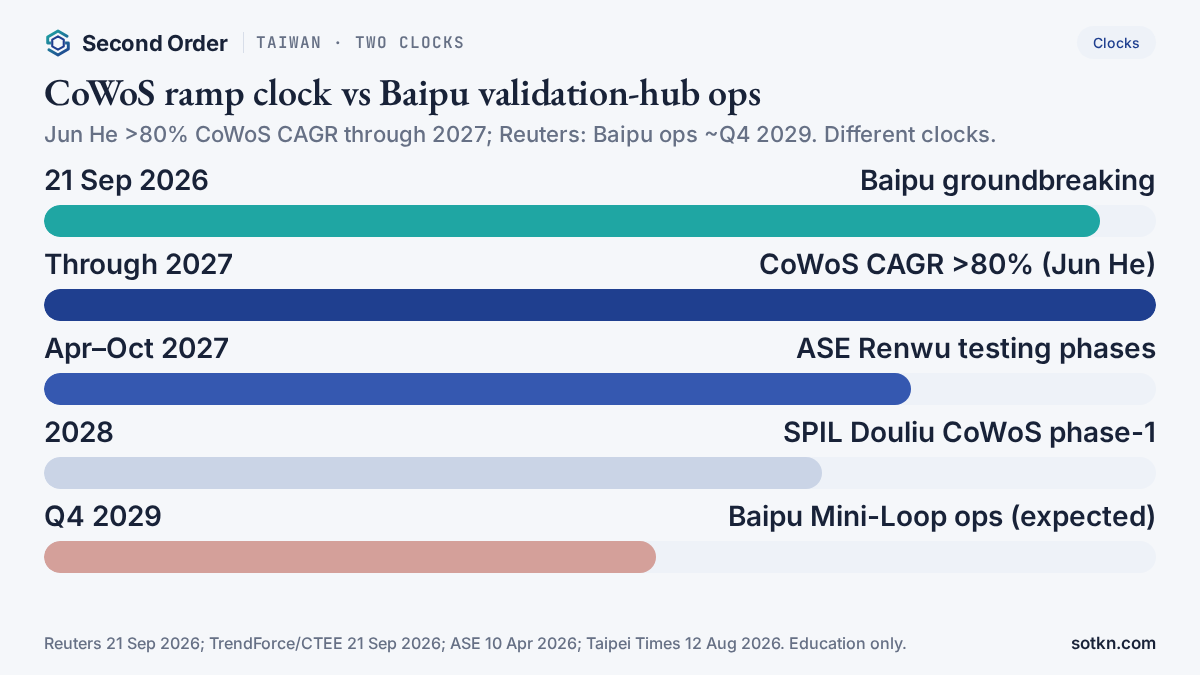
Follow who clears the gate and who sits beside it. First, back-end equipment and materials suppliers that pass Mini-Loop co-development get paid when TSMC — and later OSATs — can introduce tools without a year-plus solo validation slog. Second, ASE and SPIL get paid when packaging and test capacity lands next to that qualification path: ASE’s Renwu hi-tech testing cluster broke ground 10 Apr 2026 (company: more than NT$108.3 billion with WinWay and HTT; Phase I April 2027, Phase II by October 2027), and Commercial Times says ASE is also planning two facilities at Baipu. SPIL broke ground 11–12 Aug 2026 on a NT$100 billion Douliu CoWoS plant aimed at first-phase operations in 2028. Third, TSMC keeps the gate — who qualifies, which modules enter the loop, and which process generations the platform tracks.
Is tool/material validation still stuck?
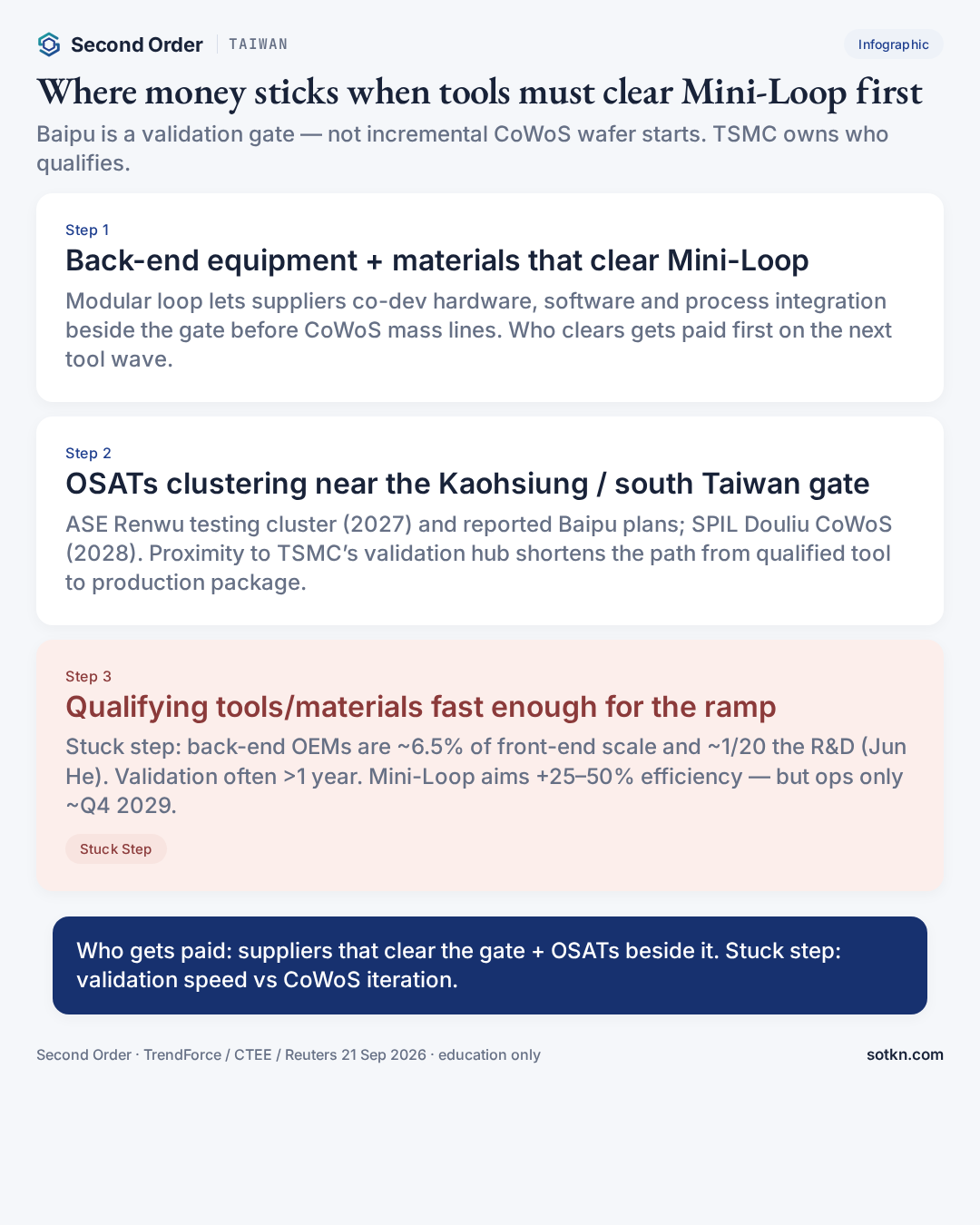
Yes for the near clock — and Baipu is the longer fix. Jun He’s own framing is that back-end OEMs lack front-end scale and R&D intensity, while CoWoS capacity is estimated to grow at more than 80% CAGR through 2027 with growth continuing through 2029. That ramp is already colliding with validation cycles that often exceed a year. Mini-Loop targets a 25–50% efficiency lift, but Reuters’ Q4 2029 ops date means the dedicated hub does not erase 2026–28 qualification queues. Watch existing production CoWoS lines, ASE Renwu (2027) and SPIL Douliu (2028) for the near stuck step; watch Baipu permits, named tenants and which process modules enter the loop for the next stuck step.
Near vs next stuck step
Two cautions. First, do not count Baipu hectares as CoWoS wafer starts — sources say no commercial chip output. Second, CoWoS-L remaining mainstream through 2028 (Wire, 23 Sep 2026) is a technology-path print; this Pulse is the qualification-path print. Both can bind at once.
What dates matter more than the groundbreaking photo?
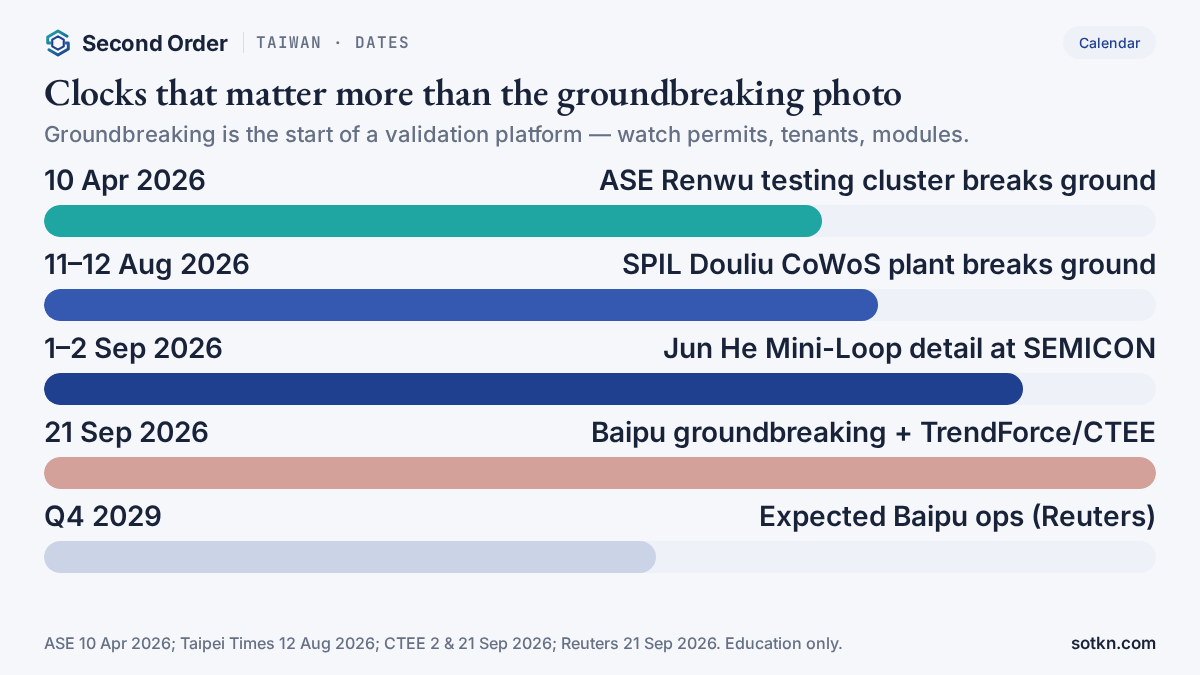
Groundbreaking is the start of a platform, not the finish of a shortage. The dates that move cash are building permits and construction milestones at Baipu, named equipment and materials tenants, which Mini-Loop modules turn on first, ASE Renwu phase starts in 2027, SPIL Douliu phase-1 in 2028, and the next Jun He or TSMC packaging-path print that updates the CoWoS CAGR or CoPoS/glass-substrate side story TrendForce also flagged.
How is this different from revenue, capacity, and the CoWoS-L Wire?
Three Taiwan doors already live — do not collapse them. The September revenue Pulse tracks NT$ sales prints and what the wafer vs packaging mix implies for cash. The CoWoS capacity Pulse maps units and the packaging gate as a volume bind. The 23 Sep Wire keeps CoWoS-L as the mainstream AI packaging architecture through 2028 versus EMIB-T. This Pulse adds the validation layer: even if units rise and CoWoS-L stays the path, tools and materials still have to clear a gate TSMC is now institutionalising at Baipu.
Read with: TSMC revenue · Sep 2026 · TSMC CoWoS capacity · CoWoS-L through 2028 Wire · HBM explained.
What would change this view?
The view stays intact while Baipu remains a modular validation and training hub, the efficiency aim stays in the 25–50% band as reported, CoWoS keeps compounding on Jun He’s path, and OSATs keep building toward the south Taiwan gate.
Practical takeaways
FAQ
What is TSMC’s Baipu Mini-Loop?
A modular advanced-packaging equipment and materials validation platform planned at Kaohsiung’s Baipu Industrial Park. Per Commercial Times and TrendForce (21 Sep 2026), it is not a CoWoS volume fab: selected process modules are assembled to qualify tools and materials before they enter mass CoWoS lines.
When did Baipu break ground, and when does it operate?
Groundbreaking was 21 Sep 2026. Reuters, citing Kaohsiung officials, says TSMC’s two buildings — a technology validation laboratory and a talent training centre — are expected to begin operations in the fourth quarter of 2029.
What does the 25–50% figure mean?
It is TSMC’s stated aim, via Advanced Packaging VP Jun He as reported by Commercial Times and TrendForce on 21 Sep 2026, to improve equipment and materials validation efficiency by 25% to 50%. It is not a measured factory yield print.
Who gets paid if Mini-Loop works?
Back-end equipment and materials suppliers that clear Mini-Loop qualification before CoWoS mass introduction, plus OSATs that cluster near the Kaohsiung gate (ASE’s Renwu testing build-out; reported ASE Baipu plans; SPIL’s Douliu CoWoS plant). TSMC owns the qualification gate.
How is this different from the CoWoS capacity and revenue Pulses?
The revenue Pulse tracks NT$ sales prints. The capacity Pulse maps wafer-equivalent CoWoS units. This Pulse maps the validation gate — whether tools and materials can clear fast enough for the next packaging generation. Cross-link; do not collapse them.
Is this a buy list of ASE, SPIL, or packaging-equipment names?
No. This Pulse maps who gets paid and which step is stuck. It is education only, not a recommendation to buy or sell any security.
Keep reading on the map
- Foundry and advanced packaging explained
- CoWoS explained
- TSMC CoWoS capacity Pulse
- TSMC revenue Pulse · Sep 2026
- Wire — CoWoS-L through 2028
- Stack · Semiconductors
- Taiwan Markets hub
How we check this
Figures come from dated trade press, company remarks as reported, and wire services, each named below. Stated efficiency aims and capacity CAGRs are labelled as such — not as measured yields or guidance. Where we work something out ourselves, the arithmetic is shown in full.
Last reviewed: 23 Sep 2026 · Next review: after Baipu building permits, named tenant/module list, or next Jun He capacity-path print
Spot an error? Tell us and we will correct it and note the change here.
Sources
- TrendForce — TSMC Plans Mini-Loop at Kaohsiung to Speed CoWoS Tool Validation (21 Sep 2026)
- 工商時報 — 白埔基地動土;Mini-Loop 先進封裝設備「試車場」 (21 Sep 2026)
- 工商時報 — 台積電高雄白埔設驗證產線(何軍 SEMICON / Mini-Loop 細節) (2 Sep 2026)
- Reuters — Taiwan breaks ground on advanced packaging park anchored by TSMC (21 Sep 2026)
- ASE Holdings — Renwu plant groundbreaking (hi-tech testing cluster) (10 Apr 2026)
- Taipei Times — SPIL breaks ground in Yunlin (Douliu CoWoS plant) (12 Aug 2026)
- Focus Taiwan — SPIL Douliu advanced packaging plant (12 Aug 2026)
- Second Order — TSMC CoWoS capacity Pulse (sibling · units)
- Second Order — TSMC revenue Pulse (sibling · NT$ prints)
- Second Order — CoWoS-L through 2028 Wire (sibling · tech path)
Education only. Not investment advice. Do your own research. Second Order may correct figures if primary sources revise them — next planned refresh after Baipu permits, a named tenant/module list, or the next dated Jun He packaging-path print.