NT$168.1bn Shipped, Cash from the Bond: Who Gets Paid While MediaTek's Accelerator Stays in Stock
MediaTek is paid on chips it already shipped: NT$168.058 billion of third-quarter sales, and NT$28.199 billion of profit. Parent shareholders are paid on NT$27.882 billion. The stuck step is the first accelerator, still mostly in stock.
MediaTek is paid on chips it already shipped: NT$168.058 billion of third-quarter sales, and NT$28.199 billion of profit. Parent shareholders are paid on NT$27.882 billion. The stuck step is the first accelerator, still mostly in stock. NVIDIA's US$3.5 billion bond is a conversion claim, not this quarter's chip margin.
TAIWAN PULSE · Data as at 3 Nov 2026 · Next update: MediaTek's fourth-quarter results
Affects: Semiconductors · Hyperscalers — Markets: Taiwan · US · Korea
Education only, not advice to buy or sell any security. Figures are from the 30 October release and call, and from the 31 August bond circular, dated below. Lines marked our arithmetic are worked on this page.
The numbers that matter this month
The print is MediaTek's unaudited consolidated third quarter, ended 30 September 2026. The company released it on 30 October and held the call the same afternoon. Statement lines below are the company's NT$ millions, written here in billions. Where a total is off by NT$1 million, that is the company's own rounding note, not a gap we filled.
| Line | Figure | Change |
|---|---|---|
| Q3 revenue | NT$168.058 billion | +10.4% vs Q2 · +18.3% vs a year earlier |
| Q3 gross margin | 46.3% | +0.1 point vs Q2 · −0.2 point vs a year earlier |
| Q3 operating income | NT$27.102 billion | +18.5% vs Q2 · +22.2% vs a year earlier |
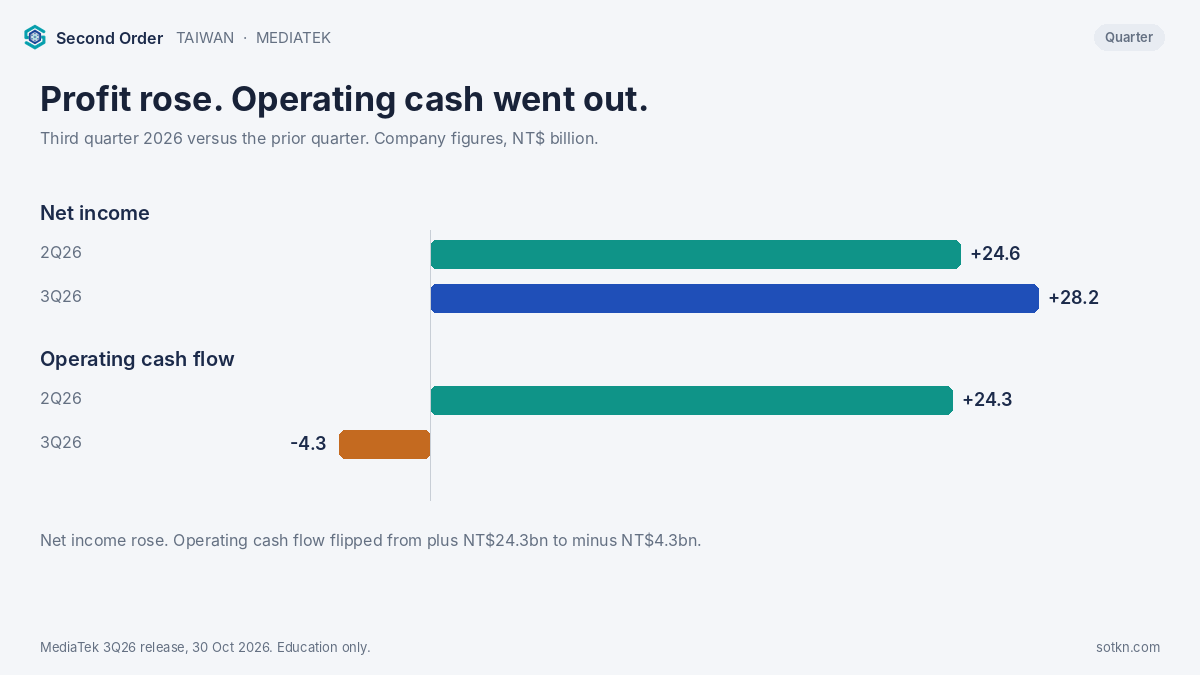
| Q3 net income | NT$28.199 billion | +14.6% vs Q2 · +10.8% vs a year earlier |
| Q3 profit to parent shareholders | NT$27.882 billion | +14.6% vs Q2 · +10.6% vs a year earlier |
| Q3 operating cash flow | minus NT$4.256 billion | Prior quarter was plus NT$24.251 billion |
| Cash from financing | NT$107.703 billion | Prior quarter was about nil |
| Cash and financial assets, current | NT$278.320 billion | Was NT$198.403 billion on 30 June |
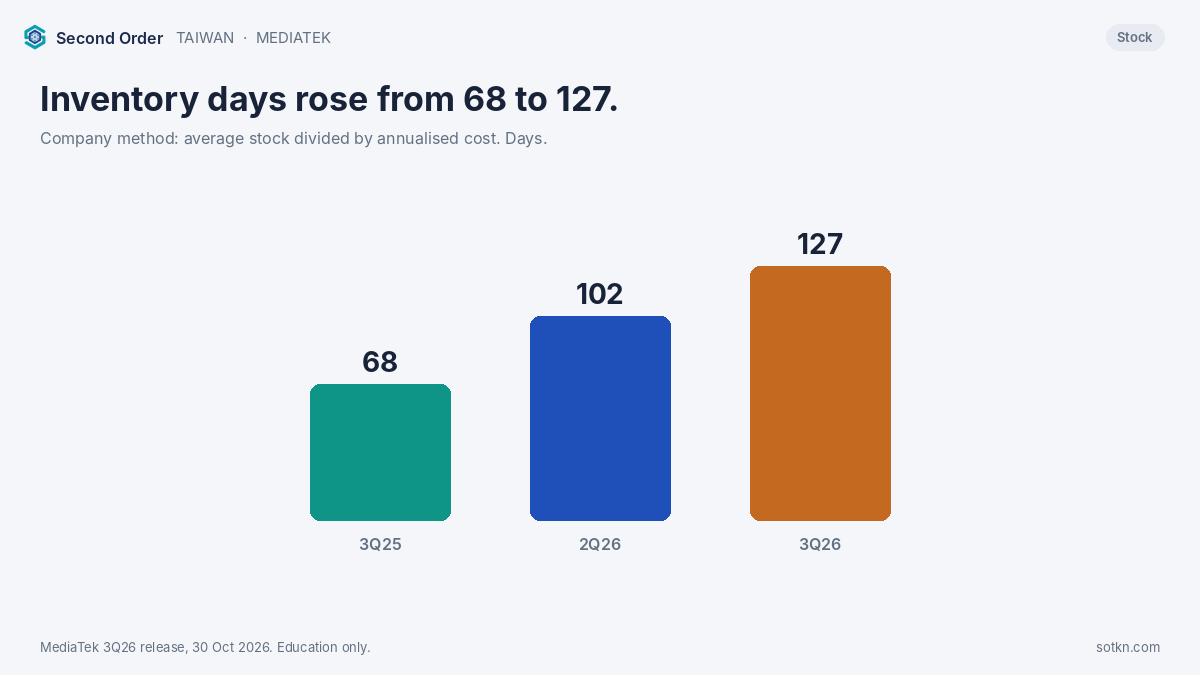
| Inventory | NT$153.531 billion | 127 days · was 102 days in Q2 · 68 days a year earlier |
| Q4 revenue guide | NT$210.1–221.8 billion | +25% to +32% vs Q3, at NT$31.7 per US$1 |
| Q4 accelerator guide | US$2.5 billion | Company figure for the fourth quarter, not for Q3 |
Source: MediaTek third-quarter release, 30 October 2026, and the call the same day. Status chips are Second Order's read. Profit rose on chips that shipped. Operating cash went out. The accelerator dollar is a fourth-quarter guide.
Why does Taiwan matter now?
Because a Taiwanese design house just printed the quarter in which an AI accelerator moved from a plan into a warehouse, and the cash that arrived came from a bond rather than from that chip.
Korea is paid when a memory stack is allocated. That door is the SK hynix third-quarter pulse. TSMC is paid when the wafer ships. MediaTek does not run that fab. It designs the chip, buys the wafer and the package, and gets paid when a customer takes the finished part.
The finished parts that paid the company were mostly Smart Edge: 58% of revenue, up 20% on the quarter and 63% on the year. The company named a 5G thin modem, AI tablets, AI PCs, automotive cockpits, and TV chips with more DRAM than a year ago. Mobile phones were 37%, down 1% on the quarter and 17% on the year. Power chips were 5%, up 18% on the year, tied to data-centre share gains.
The accelerator is a different sentence. Demand is "very strong." Shipments commenced in September. The Chinese remarks on the same call call those shipments small-volume. The US$2.5 billion is the company's confidence for the fourth quarter, not a line in the third-quarter income statement. Taiwan, in this print, is paid on the edge chips that already left. The data-centre chip is the step that has not yet become the quarter's cash.
What changed
The release is the first full quarter in which that accelerator is on the page as a shipment, and the first quarter in which the US$3.9 billion bond shows up in the cash.
Revenue beat the company's prior range. The release does not reprint that old range, so we do not invent it. Gross margin was 46.3%, which the chief executive said was in line with what the company had expected. The income statement ties the sales increase to Smart Edge volume and to higher DRAM content in TV chips. It does not attribute the quarter's revenue to the accelerator.
The bond is older paper than this earnings print, and the print is what shows the money arriving. The 31 August offering circular is for US$3.9 billion of zero-coupon bonds due 2031. NVIDIA subscribed for US$3.5 billion. The chief executive said Alphabet participated too. The circular does not print Alphabet's amount, so that slice stays unnamed. Conversion can start on 9 December 2026 at NT$4,513.75, using a fixed NT$31.6430 per US$1.
The call added four facts that are not in the income statement. The fourth-quarter accelerator guide is US$2.5 billion, against an earlier figure a questioner called slightly higher than US$2 billion. A second accelerator is aimed at high volume in the first quarter of 2028. A second customer is confirmed, with revenue expected in 2028, and that customer is not from China. No name and no dollar. Full-year 2027 operating margin is expected above 20%. That is a year-ahead sentence, not a result.
RTX Spark PCs, with NVIDIA graphics and a MediaTek chip, were already on sale in mid-October. That product has shipped. It is not the stuck step.
Our math
These lines are our arithmetic, from the release. The income-statement identities that close are the company's. The one-million gaps are the rounding note on the face of the statement.
The quarter's own additions. Gross profit NT$77.848 billion minus operating expenses NT$50.746 billion is operating income NT$27.102 billion. Add non-operating income NT$6.471 billion and the pre-tax line is NT$33.573 billion. Tax of NT$5.374 billion leaves net income of NT$28.199 billion. Research was NT$42.237 billion, 25.1% of sales.
The stated rates match the lines. Extra sales versus the prior quarter are NT$15.875 billion, which is the 10.4%.
Extra profit on the extra sales. Gross profit rose NT$7.540 billion, a 47.5% incremental gross margin. Net income rose NT$3.594 billion, a 22.6% incremental net margin. Parent profit of NT$27.882 billion is 98.9% of printed net income. Non-controlling interests are NT$0.316 billion. Parent plus that line is NT$1 million short of net income, the rounding note.
Inventory days. Average stock of NT$125.976 billion over annualised cost of NT$360.836 billion is 127.4 days, which rounds to the company's 127. The same method gives the company's 43 receivable days.
The cash bridge closes. Operating cash flow minus NT$4.256 billion, investing outflow NT$23.417 billion, financing inflow NT$107.703 billion, and a negligible exchange gain, add to a NT$80.057 billion rise in cash equivalents. Opening cash equivalents NT$189.001 billion plus that rise equal the closing NT$269.058 billion. At the quarter's average rate of NT$31.99 per US$1, the rise is US$2.503 billion. The fourth-quarter accelerator guide is US$2.5 billion. Same size, different meaning. One is cash already in the bank. The other is revenue the company has not printed.
The bond is not that bridge. US$3.9 billion at the quarter's average rate is NT$124.761 billion. Non-current liabilities rose NT$116.590 billion. Short-term loans rose NT$24.850 billion. Financing cash was NT$107.703 billion. Those four numbers do not form an identity, and the summary we have does not split the financing line. We do not force one. Ending cash equivalents of NT$269.058 billion are US$8.411 billion at the same average rate. Cash and current financial assets are NT$278.320 billion, 28.8% of total assets, which is the company's ratio.
NVIDIA's US$3.5 billion at the circular's fixed rate of NT$31.6430 is NT$110.751 billion, or 24.5 million shares at NT$4,513.75. Earnings per share of NT$17.50 on parent profit of NT$27.882 billion imply about 1,593 million shares, so NVIDIA's piece is about 1.5%. The whole bond would be about 1.7% if it converts. The window opens on 9 December. That is dilution, not the stuck step.
Fourth-quarter guide, checked. NT$210.1 billion is 25.0% above this quarter. NT$221.8 billion is 32.0% above it. Both match the company's "25% to 32%." US$2.5 billion at the guided NT$31.7 is NT$79.250 billion, which is 37.7% of the low end and 35.7% of the high end. A question on the call put the accelerator at 30% of fourth-quarter revenue. Thirty percent of the midpoint, at the same rate, is about US$2.04 billion, near the old "slightly above US$2 billion" description. We use the company's US$2.5 billion.
At the middle of the guide, a 45% gross margin and a 26% expense ratio is a 19% operating margin. The band, using the full plus-or-minus ranges together, runs from about 15.5% to about 22.5%. The company did not print 19%. The chief financial officer said data-centre gross margin is still below the company average, and that he would not split an accelerator margin out of the blend. We do not solve for one.
This is not a price call. The share count and the 19% are arithmetic on published rates.
Where does the money stick?
With the chips that have shipped, in the stock that has not, and in a bond that is a claim on the company rather than a margin on a chip.
Shipped chips are paid. The accelerator is still mostly ahead of the invoice.
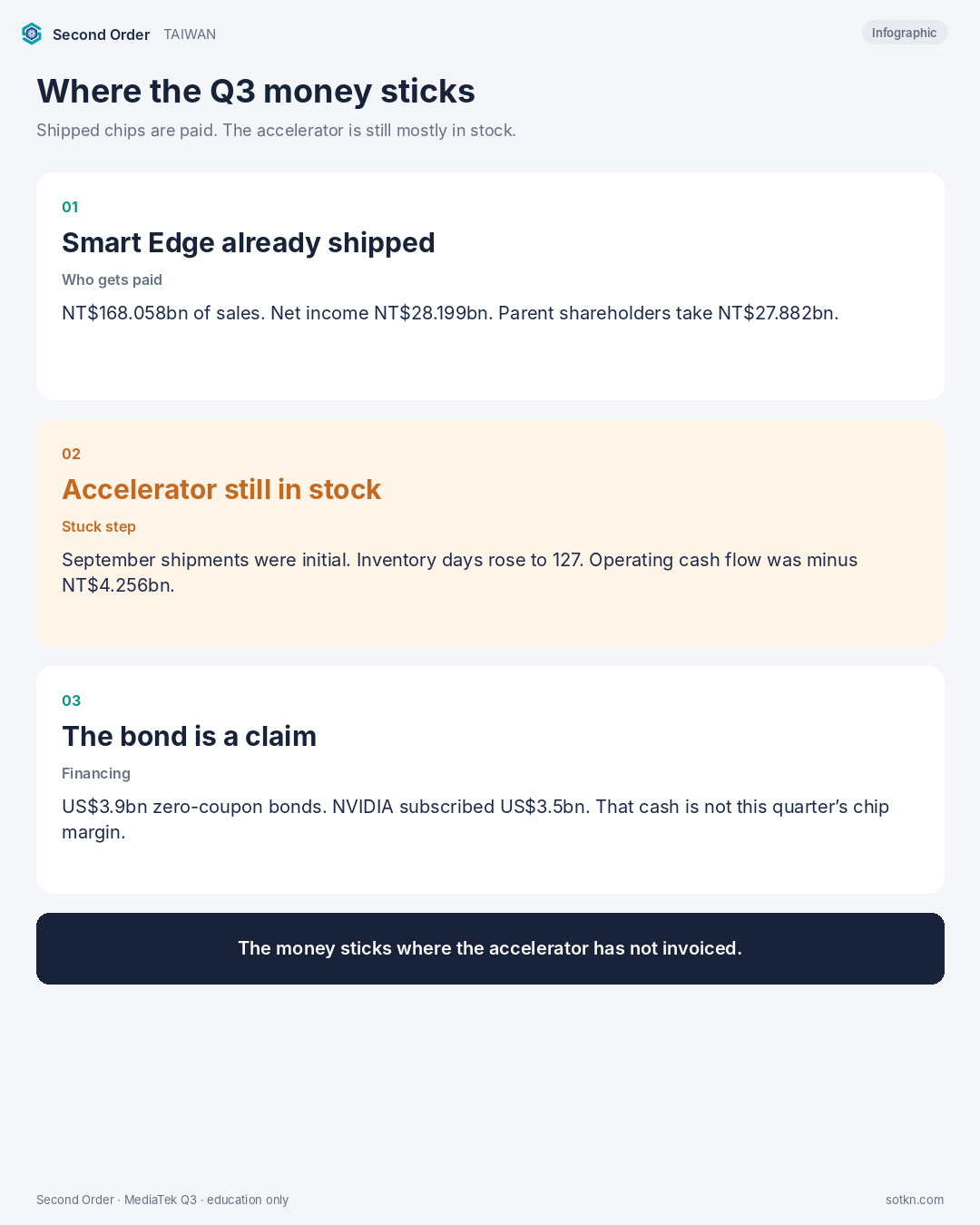
- Smart Edge already shipped. This is who gets paid now. Revenue NT$168.058 billion. Gross margin 46.3%. Net income NT$28.199 billion. Parent shareholders take NT$27.882 billion. The company named the products: modems, tablets, PCs, cockpits, TV chips. Research spending of NT$42.237 billion is the cost of staying in that design seat. It is a choice the company is making. It is not the stuck step.
- The accelerator, still in stock. This is the stuck step. Inventory rose from NT$98.421 billion to NT$153.531 billion, up NT$55.110 billion, or 56.0%. Days rose from 102 to 127, and from 68 a year earlier. Operating cash flow swung from plus NT$24.251 billion to minus NT$4.256 billion. The company did not split the warehouse between TV chips, phone chips, and the accelerator. We do not invent that split. What the statements show is that stock grew faster than cost, and that operations consumed cash in a quarter when profit rose.
- The bond. NVIDIA's US$3.5 billion is a conversion claim inside a US$3.9 billion zero-coupon issue. Financing cash was NT$107.703 billion. That cheque is why cash equivalents rose. It is not operating cash flow, and it is not revenue.
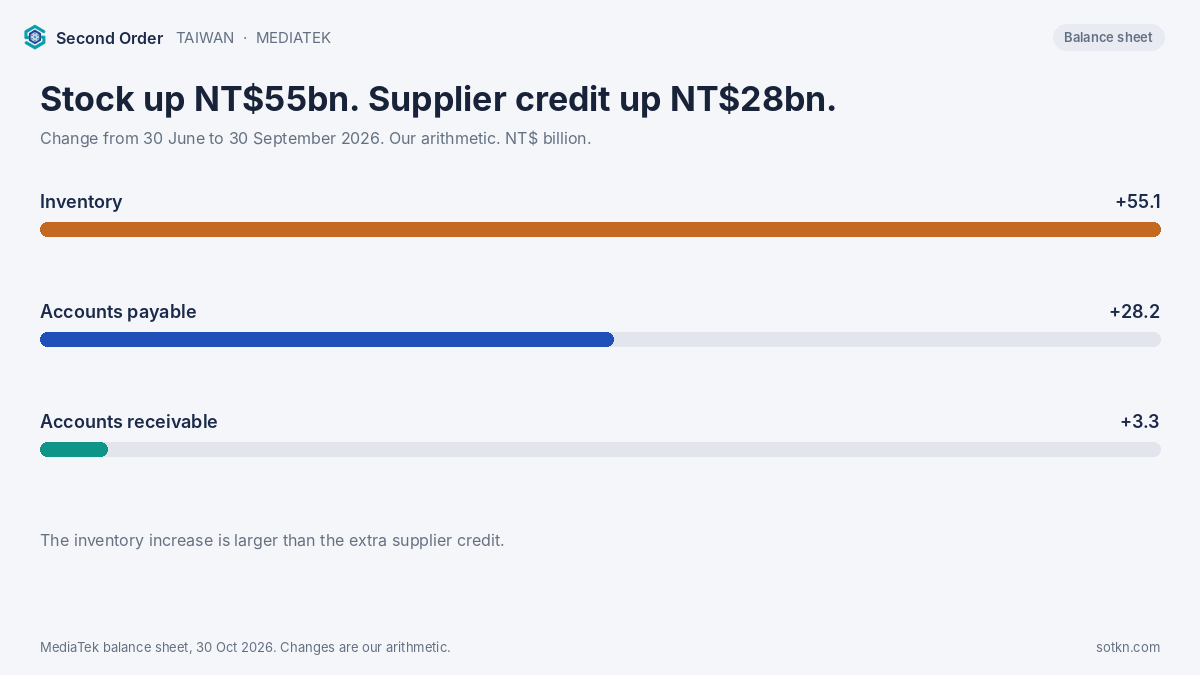
Suppliers carried part of the stock. Accounts payable rose from NT$51.328 billion to NT$79.530 billion, up NT$28.202 billion. Receivables rose only NT$3.315 billion. Inventory plus receivables minus payables is NT$30.223 billion. The swing in operating cash from the prior quarter's inflow is NT$28.507 billion. Close, and not an identity. On the company's day-count method, payable days are about 66 on our arithmetic, against 127 days of stock.
Is the accelerator still stuck?
Yes, for the quarter that closed. The company's own test is the fourth quarter, and that test has not printed.
September was a start, not a result. The English remarks say initial shipments. The Chinese remarks say small-volume shipments. The chief financial officer later said the US$2.5 billion is "mainly" a fourth-quarter figure. A little may sit in September. None of it is broken out in the third-quarter revenue line, and operating cash flow did not behave like a collected ramp.
The supply sentence is careful, and it should stay careful. The chief executive said it is hard to get the right amount of supply, that substrates are usually one of the most difficult items, and that the team has been lining up several suppliers. He sounded confident about delivering the fourth-quarter number. Confidence is not an invoice. The balance sheet is the invoice's absence: more stock, less operating cash.
The second chip is a later gate. Management's priority there is a US packaging process, with yield as the work. An analyst used the name EMIB-T. Management did not adopt that name. They said they are not dependent on one supplier, and that TSMC remains the most important partner. Some dies are taped out. High volume is the first quarter of 2028. A 448-gigabit SerDes is also taped out, and management said it will not be the critical path. The line that is stuck now is the one the cash statement has not collected.
What dates matter
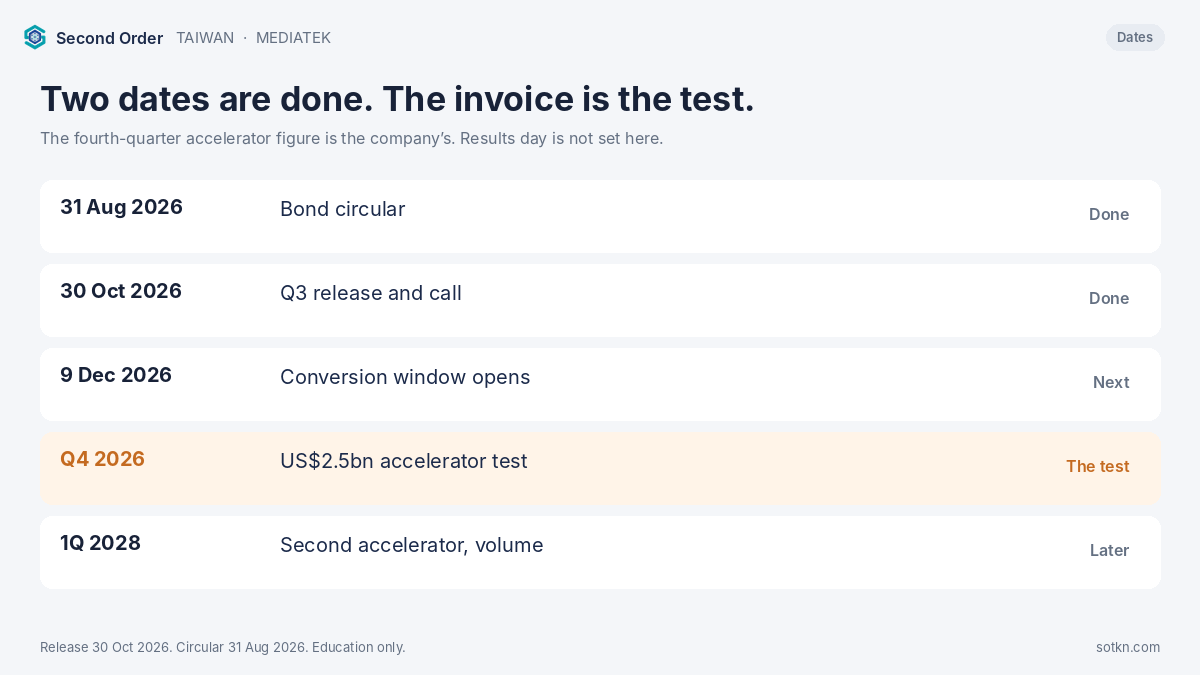
Five dates. Two have happened. The invoice is the one that tests this view.
| Date | What | What would count |
|---|---|---|
| 31 Aug 2026 | Offering circular for the US$3.9 billion bonds. | Done. NVIDIA's US$3.5 billion is in that document. |
| 30 Oct 2026 | Third-quarter release and the call. | Done. This pulse. |
| 9 Dec 2026 | Conversion window opens, on the circular. | A holder can convert. That is dilution, not revenue. |
| Fourth quarter 2026 | Revenue NT$210.1–221.8 billion. Accelerator US$2.5 billion. Gross margin 45%, plus or minus 1.5 points. | The invoice test. MediaTek has not named the results day in the materials used here. |
| First quarter 2028 | Second accelerator, high volume. A second customer's revenue. | A later print. No dollar yet. |
Sources: the 30 October release and call for the quarter and the guides, and the 31 August circular for the bond and the 9 December window. The 2027 sentences, about US$16 billion at the high end of the accelerator range and an operating margin above 20%, are a year, not a date.
How is this different from the ready shell?
The 2 November Taiwan pulse was a building. TSMC paid NT$38.8 billion for a finished display plant, clean rooms included, and the stuck step was machines waiting on floors. Cash in that story moves when a shell is bought and when tools are installed. The scarce object is a room.
This print is the opposite clock. MediaTek did not buy a shell. It sold NT$168.058 billion of chips, raised financing, and held NT$55.110 billion more inventory. The scarce object is a finished accelerator in a customer's rack, and the evidence that it is not there yet is an operating-cash line in the red. Floors are not the bind. An invoice is.
The September TSMC pulse had record monthly sales, with packaging as the step that set the pace. On this call TSMC is still "the most important partner." The number that sticks here is 127 days of stock and minus NT$4.256 billion of operating cash, not a wafer-start figure. SK hynix, in late October, was paid on memory it was already shipping. MediaTek's 46.3% is a gross margin, and the new product has not joined that kind of collection. The ratios are different kinds of ratio.
What would change this view?
Who gets paid is MediaTek on chips that shipped, and parent shareholders on nearly all of the profit. The stuck step is the first accelerator, still mostly ahead of the invoice. The bond is a claim, not a collection.
- The fourth-quarter print shows accelerator revenue near US$2.5 billion, and operating cash flow turns positive. That would move the stuck step off this quarter's warehouse.
- Inventory days fall back toward 102, or below, in that same print. A further rise, with the accelerator guide met, would say the ramp is still absorbing cash.
- Gross margin prints below 43.5%, the bottom of the guided band.
- Management says substrates or packaging cannot meet the fourth-quarter number. The 30 October tone was that supply is tight and the team has been lining it up.
- A second customer is named, with a dollar, before 2028. The audited annual report moves any unaudited ratio above by enough to change the arithmetic. This release is unaudited on its face.
Practical takeaways
- The quarter paid chips that already shipped: NT$168.058 billion of sales, 46.3% gross margin, NT$28.199 billion of net income.
- Operating cash flow was minus NT$4.256 billion. Financing brought in NT$107.703 billion. Those are not the same cheque.
- Inventory rose NT$55.110 billion and days rose to 127. The US$2.5 billion accelerator figure is a fourth-quarter guide.
- The next test is that fourth-quarter print. Conversion of the bond opens on 9 December 2026 and is not the stuck step.
FAQ
Who gets paid on MediaTek's third quarter?
MediaTek, on chips it already shipped. Parent shareholders, on NT$27.882 billion of the NT$28.199 billion profit. NVIDIA, on a US$3.5 billion conversion claim inside a US$3.9 billion bond, which is financing. The accelerator has not yet paid the quarter.
What was MediaTek's revenue and profit in the third quarter of 2026?
Revenue was NT$168.058 billion, up 10.4% on the quarter and 18.3% on the year. Net income was NT$28.199 billion. Gross margin was 46.3%. The statements are unaudited.
Why was operating cash flow negative?
Operating cash flow was minus NT$4.256 billion, against plus NT$24.251 billion in the prior quarter. Inventory rose NT$55.110 billion. The company's own cash bridge closes. The bond cash sits in financing, not in operations.
Is the first AI accelerator already shipping?
September shipments had started, and the company called them initial. The Chinese remarks call them small-volume. The US$2.5 billion figure is a fourth-quarter guide, not a third-quarter result.
Is the accelerator still the stuck step?
Yes, for the quarter that closed. Inventory days rose from 102 to 127. Operating cash flow turned negative. The company's test is fourth-quarter accelerator revenue of US$2.5 billion.
What date matters next?
The invoice test is the fourth quarter of 2026. Bond conversion can start on 9 December 2026. MediaTek has not named its fourth-quarter results day in the materials used here. A second accelerator is aimed at volume in the first quarter of 2028.
Keep reading on the map
- Markets: Taiwan: the ready shell, and machines waiting on floors · Taiwan: TSMC revenue and the packaging gate · Korea: SK hynix and the HBM4 allocation · Taiwan
- The Stack: Semiconductors
How we check this
Income, balance sheet, and cash-flow lines are from MediaTek's unaudited third-quarter release, 30 October 2026. Call points, including the US$2.5 billion guide and the supply remarks, are from the transcript of that day's call. The bond amount, NVIDIA's US$3.5 billion, the conversion price, and the 9 December window are from the 31 August 2026 offering circular. Subtraction and division are marked our arithmetic.
Last reviewed: 3 Nov 2026 · Next review: after the fourth-quarter print