NT$38.8 Billion for a Ready Shell: Who Gets Paid While Taiwan’s Machines Wait for Floors
Taiwan grew 14.36% in the third quarter, and almost half of it came from building and buying machines. Then TSMC paid NT$38.8 billion for a finished display plant, clean rooms included, while a server maker’s plant deal fell apart. Machines are arriving faster than floors.

Taiwan’s economy grew 14.36% in the third quarter, its fastest third quarter in 48 years, and almost half of that growth came from companies buying machines and putting up buildings. A day before the number came out, TSMC paid NT$38.8 billion for something it could not buy off a shelf: a finished factory, clean rooms included, from the display maker AUO. On the same day, a server maker’s deal for another AUO plant fell apart over the building’s specification and delivery date. Machines are arriving faster than there are floors to put them on. The stuck step is the ready floor.
TAIWAN PULSE · SEMICONDUCTORS · Data as at 2 Nov 2026 (DGBAS Q3 advance, TSMC filing, October PMI) · Next update: TSMC October sales around 10 November
Affects: Semiconductors · TSMC · Applied Materials — Markets: Taiwan · Korea · China
Education only, not advice to buy or sell any security. Growth rates are year on year unless we say otherwise. A PMI reading above 50 means more firms report a rise than a fall. NT$ is the New Taiwan dollar; one ping is about 3.3 square metres. Our own sums are labelled.
The numbers that matter this week
Q3 GDP growth
14.36%
Advance estimate · 2.94 pts above August forecast
HotInvestment (real)
+26.36%
Biggest rise in 20 quarters · 6.32 pts of growth (ING)
BuildingCapital equipment imports
+58.5%
Chip tools +35.66% · in NT$, Q3
ArrivingTSMC buys a ready plant
NT$38.8bn
AUO Taichung buildings + clean rooms · 29 Oct
PaidPower and factory gear orders
71.3
October PMI new orders · highest since June 2021
BookedThe ready floor
Short
Quanta’s plant deal died on spec and delivery date
Stuck stepDGBAS Q3 advance estimate 30 Oct 2026 (CNA, Focus Taiwan); ING; TSMC filing 29 Oct; AUO via TechNews; CIER October PMI 2 Nov. Status chips are Second Order’s read.
On this page: Why it matters · The quarter · Machines first · The shell · The deal that died · October · Our math · Who gets paid · What is stuck? · Dates next · FAQ
Why does a finished building matter so much?
Because a chip machine is useless until it has a home. The tools that print, etch and test chips must sit in a clean room: a sealed space where the air is filtered so hard that a speck of dust is rare, the temperature and humidity barely move, and the floor does not shake. Under and around that room sit huge systems for power, ultra-pure water, special gases, chemicals and exhaust. Building all of that takes years, and the clean room has to be finished before the first tool is rolled in (what is a clean room?).
So there are two clocks in any chip expansion. One is the machine clock: how long it takes to order, build and ship the tools. The other is the floor clock: how long it takes to put up the building, fit the clean room and hook up the power and water. When demand is calm, companies line the two clocks up. When demand jumps, the machine clock can run ahead, and the floor becomes the thing everyone waits on.
This week Taiwan gave three pieces of evidence that the floor clock is now the slower one. The growth figures show machines pouring in. TSMC paid a large sum to skip part of the floor clock by buying a finished plant. And a second plant deal, for a server maker, died because the building did not fit and could not be handed over in time. The chain looks like this.
1 · The order
Who: Chipmakers and server makers order tools and power gear
Paid: Toolmakers and equipment makers booked first
2 · The machine arrives
Who: Imports of capital equipment up 58.5% in Q3
Paid: Shippers, installers and importers paid
3 · The ready floor
Who: Finished building, clean room, power and water, to spec and on time
Paid: Decides when a machine can start work
4 · Output and sales
Who: Wafers, packages and servers ship to customers
Paid: Chipmakers and their customers paid last
What did the third-quarter numbers show?
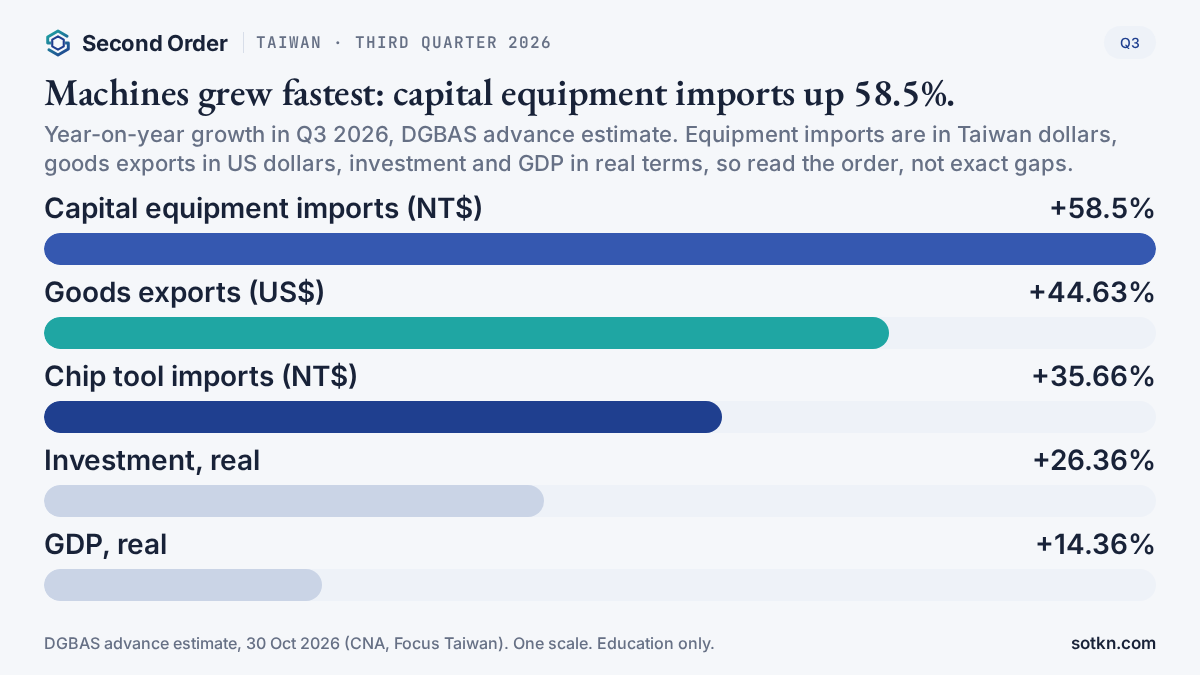
On 30 October, Taiwan’s statistics agency, the Directorate-General of Budget, Accounting and Statistics (DGBAS), published its first estimate of third-quarter growth: 14.36% from a year earlier. That was 2.94 percentage points higher than the agency’s own forecast in August, the fourth quarter in a row of double-digit growth, and the fastest growth for a third quarter in 48 years. Growth for the first nine months was 14.22%, the highest for that period in half a century.
The agency’s specialist, Chiang Hsin-yi, said the surprise came from two places: exports and business investment. Exports of goods, counted in US dollars, rose 44.63%, helped by demand for artificial intelligence, high-performance computing and cloud services, by companies stocking up on parts for new consumer gadgets, and by higher prices. In August the agency had expected third-quarter exports of about US$238 billion, already a very high number. The actual figure was about US$244.9 billion, the Central News Agency reported.
The bigger surprise, though, was investment. Real investment, which here includes changes in stock held by companies, rose 26.36%. That was 4.26 points above the August forecast and the biggest rise in 20 quarters. The agency put it down to companies building out AI infrastructure, upgrading to more advanced chipmaking processes and adding capacity. Spending on machinery, transport equipment, intellectual property and construction all grew.
Households were steady rather than spectacular. Private consumption rose 5.37% in real terms, almost exactly what the agency had forecast, helped by a recovering car market and the feeling of wealth from record share prices. Consumer prices rose 2.43% in the quarter, which the agency called on the high side but not yet a brake on spending.
ING’s economists broke the 14.36% down by where it came from. Domestic demand supplied 9.41 points and net exports, exports minus imports, supplied 4.94 points, the smallest contribution from trade since early 2025. Within domestic demand, gross capital formation, the official name for investment, supplied 6.32 points, up from 4.3 in the second quarter. Private consumption added 2.3 points and government spending 0.79. Put simply: in a quarter famous for exports, the biggest single engine of growth was Taiwan building and equipping its own factories. About 44% of all growth came from investment (our arithmetic, 6.32 divided by 14.36).
ING had expected 11.4% and the market about 12%. It raised its full-year forecasts again, to 13.1% for 2026 and 9.5% for 2027, while warning that last year’s export surge will make comparisons harder in the quarters ahead. The agency itself stresses that an advance estimate is built before much of the source data is in and will be revised.
Why do machines show up first?
Look at the two import numbers side by side. Taiwan’s imports of capital equipment, counted in Taiwan dollars, rose 58.5% in the quarter. Within that, imports of semiconductor equipment, the chipmaking tools themselves, rose 35.66%. Chip tools rose a lot. But the whole basket rose faster, which means the other capital equipment coming into Taiwan grew by more than 58.5% (our arithmetic: if one part of a total grows slower than the total, the rest must grow faster). The statistics release does not split that rest, but it named machinery and transport equipment, and the build-out it described is of AI infrastructure.
That fits what we saw last week in Taiwan’s factory output for September, where servers and other AI hardware ran ahead of the rest of electronics (Taiwan’s server floor). It also fits what ASE, the world’s biggest chip packaging and testing company, told investors on 29 October, when it raised its spending plan again and said testers were the fastest-growing part (ASE’s new floors). We will not re-tell ASE here. The point is that across the island the order for the machine goes out first, and the machine can arrive in months.
A building is different. A new chip plant in Taiwan typically goes through land, environmental review, power and water approvals, foundations that resist vibration, steel, the clean room shell, then fitting out the systems that keep the air clean and supply power, water and gases. Only then do the tools go in, one by one, each tested before the next. Every step has its own contractors, and most of them are busy. When thousands of machines are on order, every month of building time is a month of tools in crates.
There is a money side too. A tool sitting in a crate has been paid for, or at least ordered, but earns nothing. In accounting terms it is spending that has not yet started to wear out on the books, because it is not yet in use. Our explainer on the difference between spending and wear-and-tear walks through why that gap matters for profits (capex vs depreciation). The faster a company can get a floor ready, the sooner that cash starts to work.
What exactly did TSMC buy from AUO?
On 29 October, TSMC told the Taiwan stock exchange it had acquired nine registered buildings and their related facility systems in the Anlin section of Xitun District, Taichung. The filing lists the assets as buildings, clean rooms and a batch of facility equipment. The registered floor area is 429,030 square metres, about 129,782 ping, and the usable area is about 166,000 ping. The price is NT$38.8 billion before tax, about US$1.2 billion. The seller is AUO, the display panel maker, which is not a related party. TSMC said the purpose is “for operations and production.”
The price was negotiated, the filing says, with reference to market conditions and two independent appraisals. One valuer put the assets at NT$37.3 billion, the other at NT$38.8 billion. TSMC paid the higher of the two. That is about 4% above the lower appraisal (our arithmetic). Payment terms follow the property contract; AUO said it will be paid in instalments.
The site is AUO’s Taichung Phase II plant, and according to local reports cited by TrendForce it holds a fifth-generation and a 7.5-generation display panel line. Display plants are not chip plants. But they share the expensive bones: big, strong buildings, clean rooms, ultra-pure water, exhaust, power systems and room for heavy equipment. AUO’s chairman, Paul Peng, said the sale fits AUO’s shift toward owning fewer heavy assets and strengthening its finances.
Why would the world’s biggest chipmaker pay this much for a used building? TrendForce, citing Mirror Media, put it carefully: buying existing facilities could reduce some construction work compared with building a new fab from scratch, but any time saved depends on how well the facilities suit chipmaking and on the later refit and tool installation. In other words, TSMC is paying to move part of the floor clock forward. Our Wire on the purchase covered the headline (TSMC pays NT$38.8B for AUO’s Taichung plant); here we care about what it says about the queue.
The location helps explain it. TSMC already runs Fab 15 in Taichung, mainly making 7-nanometre and 28-nanometre chips and gradually adding 5-nanometre, according to the Commercial Times as cited by TrendForce. It is planning Fab 25 for 1.4-nanometre chips, and its AP5 advanced packaging plant nearby supports CoWoS-L, the packaging used for big AI chips. TSMC plans to spend about NT$1.5 trillion on four new 1.4-nanometre fabs in the Central Taiwan Science Park, completed in phases starting in 2027, the Central News Agency reported. A finished shell next door is a useful piece of that puzzle, whether it ends up holding packaging, testing, supporting work or something else. TSMC has not said which.
We have seen this pattern before. Samsung’s third quarter in Korea showed a chipmaker building clean-room shells first and filling them later (Samsung’s clean rooms), and our Analysis asked what happens to cash if new clean rooms sit empty into 2028 (if new clean rooms stay empty). Taiwan this week is the other side of that coin: a company paying up for a clean room that already exists.
Why did the Quanta deal fall apart?
AUO made two property announcements on 29 October. The second is the one that tells you the floor is the bind. In July, AUO’s board had agreed to sell its Huaya plant to Quanta Computer, one of the biggest makers of AI servers, for NT$19.7 billion. AUO expected a gain of about NT$13.39 billion. Quanta planned to use the plant to expand its AI server business.
After several rounds of talks, the two sides could not agree on the plant’s specifications or the delivery timetable, and AUO’s board voted to terminate the sale, TechNews reported. AUO said ending the deal does not affect its finances or business. Quanta had not explained how it would change its expansion plans at the time of writing.
Put the two deals next to each other. A chipmaker bought a finished plant at the top of its appraisal range. A server maker walked away from another one because the building was not the right shape and could not be handed over when it needed it. Both are about the same thing. A floor is only ready if it fits the machines and arrives on time. A building that is the wrong spec, or late, is not a ready floor at all.
This matters for server makers in particular. They have been racing to add space for AI racks, and we have tracked that build-out in our Foxconn piece (Foxconn’s AI racks). Server assembly needs less exotic space than chipmaking, but it needs a lot of it, with heavy floors, strong power and room to test full racks. When a deal like Huaya fails, the server maker has to find another building or build one, and the clock restarts.
What did October’s factory survey add?
The Chung-Hua Institution for Economic Research publishes Taiwan’s official manufacturing purchasing managers’ index, a monthly survey of factory buyers, for the National Development Council. The October reading came out on 2 November. The headline PMI eased 0.9 points to 62.5, still strong and the 13th month in a row of expansion. New orders slipped 0.4 points to 63.2. Unfinished orders, the backlog, grew at the slowest pace since January, at 53.9. Supplier delivery times and raw material prices both stayed around 70, which means many buyers are still waiting longer and paying more.
The industry split is where it gets interesting. Two groups are moving in opposite directions.
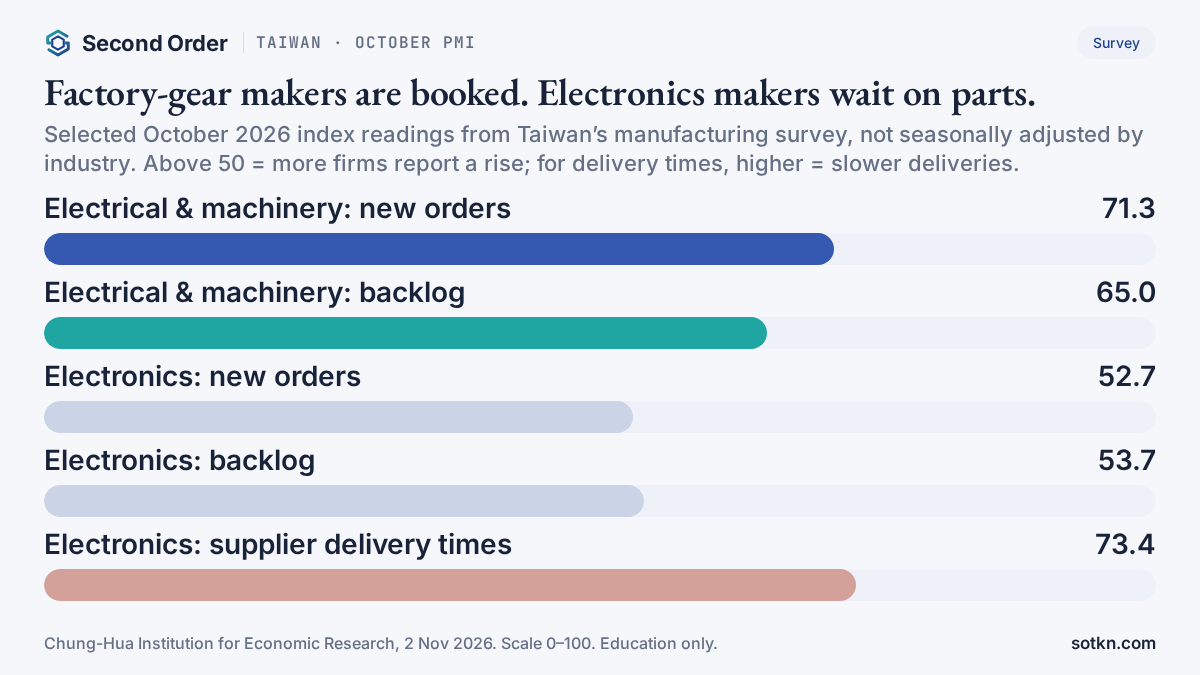
Electronics and optical makers slowed. Their PMI fell 2.6 points to 60.0, the slowest since March. New orders, before seasonal adjustment, fell 4.0 points to 52.7, and their backlog index fell to 53.7, the slowest since December 2025. But their supplier delivery time index was still 73.4, and the institute said shortages of key materials, rising costs and a mismatch where some parts are plentiful and others are short kept hurting deliveries. Their customers reported holding more stock than they need, the highest such reading since November 2022. AI servers and high-end electronics stayed relatively strong; consumer electronics parts and chip design were softer as higher prices put shoppers off.
Electrical and machinery equipment makers, by contrast, accelerated. Their PMI rose 0.1 point to 64.5, the fastest since August 2021. New orders hit 71.3, the fastest since June 2021. Their backlog rose to 65.0, also the fastest since June 2021. And their outlook for the next six months reached 75.0, the most optimistic since May 2021. The institute said the demand comes from AI data centres, power grid upgrades and investment in advanced chipmaking and packaging, and named heavy electrical equipment, power distribution systems, precision machining and chip production equipment. Because big equipment projects take a long time to build and deliver, these firms can see orders a long way ahead. Our explainer on who makes data centre power equipment covers the same kinds of firms (who makes data center power equipment).
Read together with the third quarter, October says the same thing in survey form. The firms that make the stuff that goes into a new factory, the transformers, switchgear, machines and tools, are busier than at any time in five years. The firms that make the products that come out of factories are still growing, but they are bumping into parts shortages, and some of their customers have stocked up. Our October PMI piece covered the September survey; this is the next month, and the gap between the two groups widened (Taiwan’s PMI).
What does our arithmetic say?
A few simple sums help make the numbers concrete. Every one is our own arithmetic on the published figures, and each has limits.
Taiwan’s quarter
The AUO shell
Investment’s share. About 44% of Taiwan’s third-quarter growth came from investment, on ING’s split. For an economy usually described as an export machine, that is a striking number. It means the build-out itself, not just the chips leaving the island, is driving the economy.
The appraisal gap. TSMC paid the higher of its two appraisals, about 4% above the lower one. That is not a wild premium. But it says the buyer was not haggling over the last billion. In a market where a ready building saves time, the seller has the stronger hand.
The seller’s gain. AUO expects a gain of about NT$18.5 billion after fees and estimated taxes, which is about 48% of the price. Roughly speaking, the market value of a finished, clean-room-equipped building in central Taiwan is now about double what it is carried at in AUO’s books (our reading; the gain is after costs, so this is approximate). Owners of old factories with good bones are being paid for the time they can save a buyer.
Price per square metre. The filing gives about 166,000 ping of usable space, roughly 549,000 square metres at 3.3058 square metres per ping (our conversion). That is larger than the registered area, which is normal when not every floor or service level is counted in the title. On usable space, TSMC paid about NT$70,700 per square metre for building, clean rooms and facility systems together (our arithmetic). The tools still have to be bought on top.
Shell against a new fab. TSMC’s reported plan for four 1.4-nanometre fabs in Taichung is about NT$1.5 trillion, or roughly NT$375 billion per fab on a simple split (our arithmetic). The AUO purchase is about a tenth of that. This is not a like-for-like comparison: a leading-edge fab includes its tools, and the AUO site is a shell that needs a refit. But it shows the scale. For TSMC, NT$38.8 billion to bring part of the floor clock forward is a small cheque.
Who gets paid while machines wait for floors?
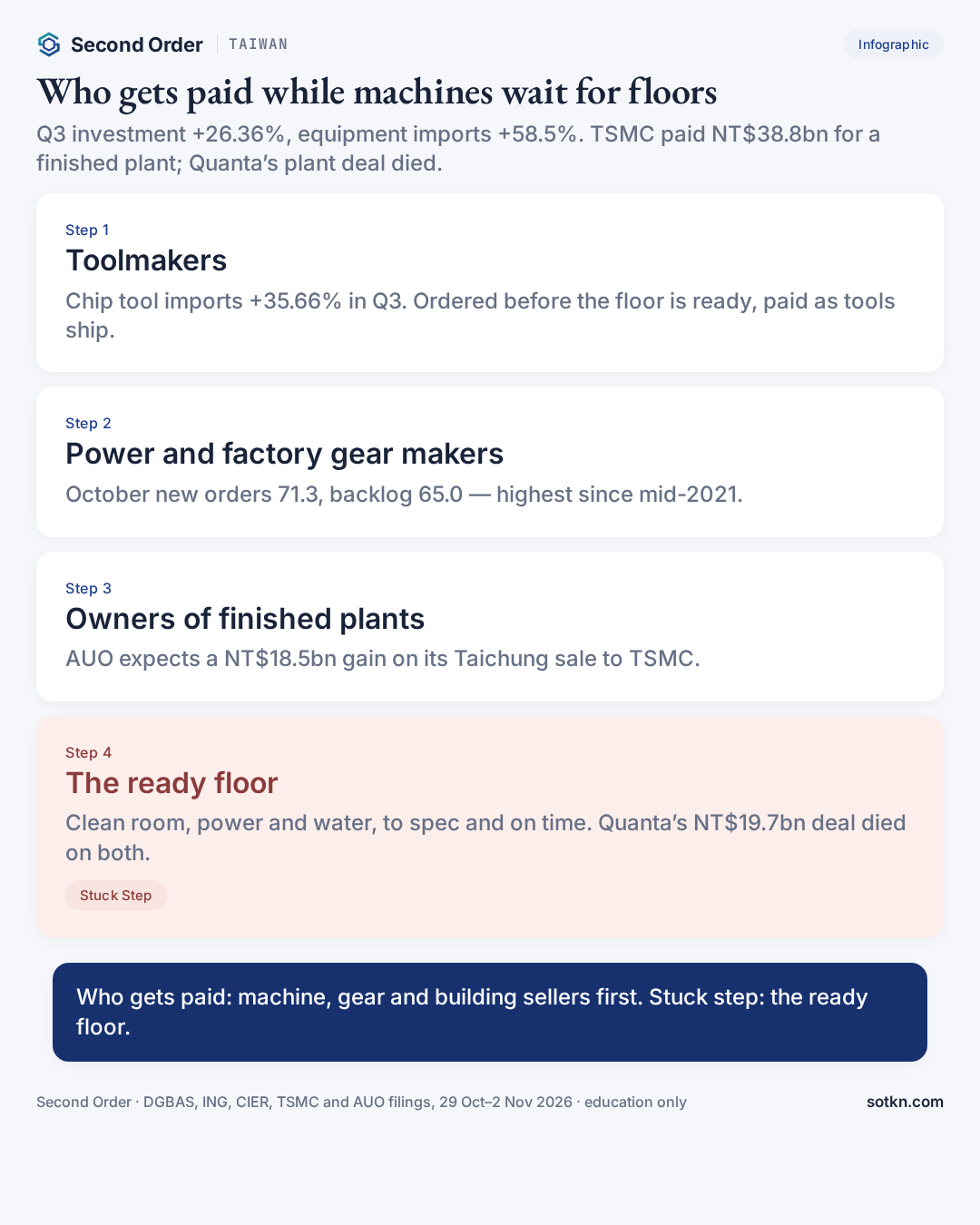
First, the toolmakers. Chip tool imports rose 35.66% in the quarter, and the order goes out before the building is ready. The big chip tool companies are mostly American, Japanese and Dutch, and they are paid as tools ship and are accepted. Our page on Applied Materials explains how one of them is paid (what does Applied Materials do?).
Second, the makers of power and factory equipment. The October survey shows electrical and machinery equipment makers with their highest new orders and biggest backlog since mid-2021. Transformers, switchgear, power distribution, precision machining and production equipment all have to be in place before a floor is ready, so these firms are paid on the way to the floor, not after it. Their long backlog is their protection.
Third, the owners of finished buildings. AUO is the clearest example: about NT$18.5 billion of expected gain on one sale. Any company holding a large, sound factory with clean rooms, strong power and water hookups in the right place now has an asset a chipmaker or server maker may pay for, as long as it fits and can be handed over on time.
Fourth, the builders. The statistics agency said construction investment grew in the quarter. Clean-room and facility engineering firms, the companies that fit air, water, gas and power systems, are paid on every new floor and every refit, including the one TSMC now has to do at the old AUO site.
Waiting: tools in crates, and the cash tied up in them; server makers like Quanta that need space and must start their search again; electronics makers short of key parts, whose backlog is shrinking even as their suppliers stay slow; and anyone whose plan assumes new capacity starts on schedule. Chipmakers themselves wait to be paid last, when the floor is ready and the wafers ship. For TSMC that wait is shorter than most, because it can afford to buy a finished building (what does TSMC do?).
One-line rule: when machines arrive faster than floors, the people who sell the machines, the power gear and the finished buildings get paid first, and the people who need the floor to make money wait.
So what is the stuck step?
The ready floor: a finished building with a clean room, power, water and air systems, built to the right specification and handed over on time. Not demand, which keeps beating forecasts. Not money, with investment up 26% and the biggest chipmaker paying top appraisal. Not even machines, which are arriving at a record pace. Four things make it stick:
- Machines outrun buildings. Capital equipment imports rose 58.5% in a quarter; a new chip plant takes years.
- Spec has to fit. Quanta’s NT$19.7 billion plant deal died on specifications and delivery timing.
- The fitters are busy. Power and factory equipment makers report their biggest backlog since mid-2021.
- Parts are still short. Electronics supplier delivery times sit at 73.4, so even a ready floor can wait on parts.
This is the move our stuck-step Analysis describes: when one input gets scarce, the bind shifts to whoever controls the slowest thing. For much of this year, the slowest thing we tracked in Taiwan was advanced packaging capacity (TSMC’s CoWoS). Packaging is still tight, but this week’s evidence says the slowest thing for the next wave is plainer: the building, its clean room and the power behind it. Power was also the theme of our Taipower piece, and the two are linked; a ready floor needs a ready grid connection (Taipower’s grid).
Which dates test this read next?
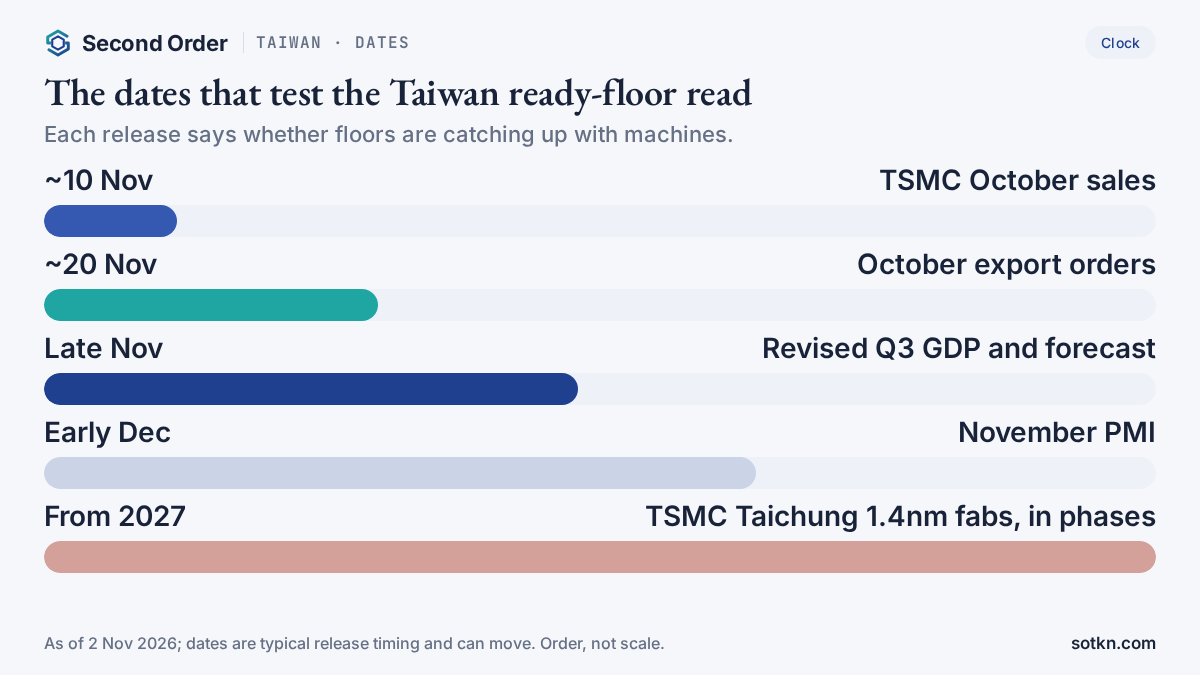
- Around 10 November — TSMC’s October sales. A strong month says demand is still running ahead of floors.
- Around 20 November — Taiwan’s October export orders from the economy ministry, the best read on orders still to be built.
- Late November — DGBAS’s revised third-quarter figures and new forecast. Watch whether investment’s 26.36% holds.
- Early December — The November PMI. Watch whether power and machinery orders stay above 70 and electronics delivery times ease.
- From 2027 — TSMC’s Taichung 1.4-nanometre fabs start to complete in phases; any word on what the AUO site will hold.
What would change this view?
- Investment revised down. If the late-November revision cuts the 26.36% sharply, the machines-first story is weaker than the advance estimate suggests.
- Quick refits. If TSMC moves tools into the AUO site within months, ready shells are plentiful enough and the bind is elsewhere.
- Equipment orders cool. If power and machinery new orders fall back toward 60 while chip tool imports stay high, floors are catching up.
- Parts bind harder. If electronics delivery times stay above 70 for months, the stuck step is parts, not floors.
Practical takeaways
- Taiwan grew 14.36% in the third quarter, and about 44% of that came from investment, on ING’s split
- Capital equipment imports rose 58.5% and chip tool imports 35.66%; the rest of the basket grew even faster
- TSMC paid NT$38.8 billion for AUO’s finished Taichung plant, at the top of two appraisals; AUO expects a NT$18.5 billion gain
- Quanta’s NT$19.7 billion plant deal with AUO died on specifications and delivery timing
- Toolmakers, power and factory equipment makers and owners of finished buildings are paid first; stuck step: the ready floor
FAQ
What did Taiwan report for the third quarter?
On 30 October the statistics agency, DGBAS, estimated that the economy grew 14.36% from a year earlier, 2.94 points above its August forecast and the fourth double-digit quarter in a row. Investment, including inventories, rose 26.36% in real terms, the biggest jump in 20 quarters. Imports of capital equipment rose 58.5% in Taiwan dollars, and chip tools within that rose 35.66%. ING calculates investment added 6.32 points of the 14.36.
Why did TSMC buy a display plant?
TSMC filed on 29 October that it bought buildings, clean rooms and facility equipment at AUO’s Taichung Phase II site for NT$38.8 billion before tax, for operations and production. A finished building with clean rooms already built can save some construction time compared with an empty plot, though how much depends on how well it suits chipmaking and how long the refit and tool installation take.
What is the stuck step?
The ready floor: a finished building with a clean room, power, water and air systems, built to the right specification and handed over on time. Taiwan is importing machines faster than ever, and makers of power and factory equipment report their fullest order books since 2021. The same day TSMC’s purchase went through, a server maker’s deal for another AUO plant collapsed over specifications and delivery timing.
Is this investment advice?
No. Education only. It maps who gets paid and which step is stuck. It is not a recommendation to buy or sell any security, and we leave out price targets and ratings on purpose.
Keep reading on the map
- Taiwan Markets hub — country page
- ASE’s new floors · Taiwan’s server floor · Taiwan’s PMI · TSMC’s CoWoS · Foxconn’s AI racks · Taipower’s grid
- Samsung’s clean rooms · CXMT’s unfinished bay — other markets
- What does TSMC do? · What does Applied Materials do?
- What is a clean room? · Capex vs depreciation · Who makes data center power equipment? · What is a 2nm chip?
- If new clean rooms stay empty · Where does the stuck step move?
- Semiconductors on the stack · All Markets doors — Taiwan, Korea, US, China, Singapore, Australia, Malaysia
How we check this. The third-quarter growth, investment, export and equipment import figures are the advance estimate from Taiwan’s statistics agency, DGBAS, published on 30 October 2026, as reported by the Central News Agency and Focus Taiwan; advance estimates are revised later. The split of growth into investment, consumption and net exports is ING’s calculation. The October PMI readings come from the Chung-Hua Institution for Economic Research’s own release of 2 November 2026. What TSMC bought, the price, the floor areas and the two appraisals come from TSMC’s stock exchange filing of 29 October; AUO’s expected gain and the cancelled Quanta sale come from AUO’s announcements as reported by TechNews; site details and TSMC’s Taichung plans are as reported by TrendForce, citing local media. Every sum we worked out is labelled “our arithmetic”. Price targets and ratings are left out on purpose. The references we used are listed at the end. Our editorial standards →
Not investment advice. Do your own research.
References
- Focus Taiwan (CNA), Taiwan Q3 GDP growth hits 14.36%, highest in 48 years, 30 Oct 2026. focustaiwan.tw — the 14.36% advance estimate, the gap to the August forecast, investment growth, capital equipment and chip tool imports, and private consumption.
- Central News Agency, 出口投資超預期 第3季經濟成長率14.36%創48年同期最高 (Exports and investment beat forecasts), 30 Oct 2026. cna.com.tw — goods exports up 44.63%, the US$244.9 billion export total against the US$238 billion forecast, and capital formation’s biggest rise in 20 quarters.
- ING THINK, Taiwan’s GDP beats forecasts yet again in the third quarter, 30 Oct 2026. think.ing.com — the split of growth between investment, consumption and net exports, and ING’s raised 2026 and 2027 forecasts.
- Chung-Hua Institution for Economic Research, 2026年10月台灣製造業採購經理人指數 (Taiwan manufacturing PMI, October 2026), 2 Nov 2026. cier.edu.tw — the October PMI, the electronics and the electrical and machinery equipment readings, supplier delivery times and the parts shortage.
- TSMC filing via Anue (cnyes), 台積電:公告本公司取得廠房及附屬設施 (TSMC acquires plant and facilities), 29 Oct 2026. news.cnyes.com — what TSMC bought, the floor areas, the NT$38.8 billion price, the two appraisals and the stated use.
- TechNews, 友達華亞廠出售廣達破局,台中廠388億元賣台積電 (AUO’s Quanta sale collapses; Taichung plant sold to TSMC), 29 Oct 2026. finance.technews.tw — AUO’s NT$18.5 billion expected gain, payment in instalments, and the cancelled NT$19.7 billion Huaya sale to Quanta over specifications and delivery timing.
- TrendForce, Display maker AUO to sell Taichung plants to TSMC for TWD 38.8B; separate Quanta deal canceled, 30 Oct 2026. trendforce.com — the Gen 5 and Gen 7.5 display lines on the site, the caveat on time savings, TSMC’s NT$1.5 trillion Taichung 1.4nm plan and its nearby fabs.