Who Makes Data Center Power Equipment? Transformers, Turbines, Gensets and Switchgear
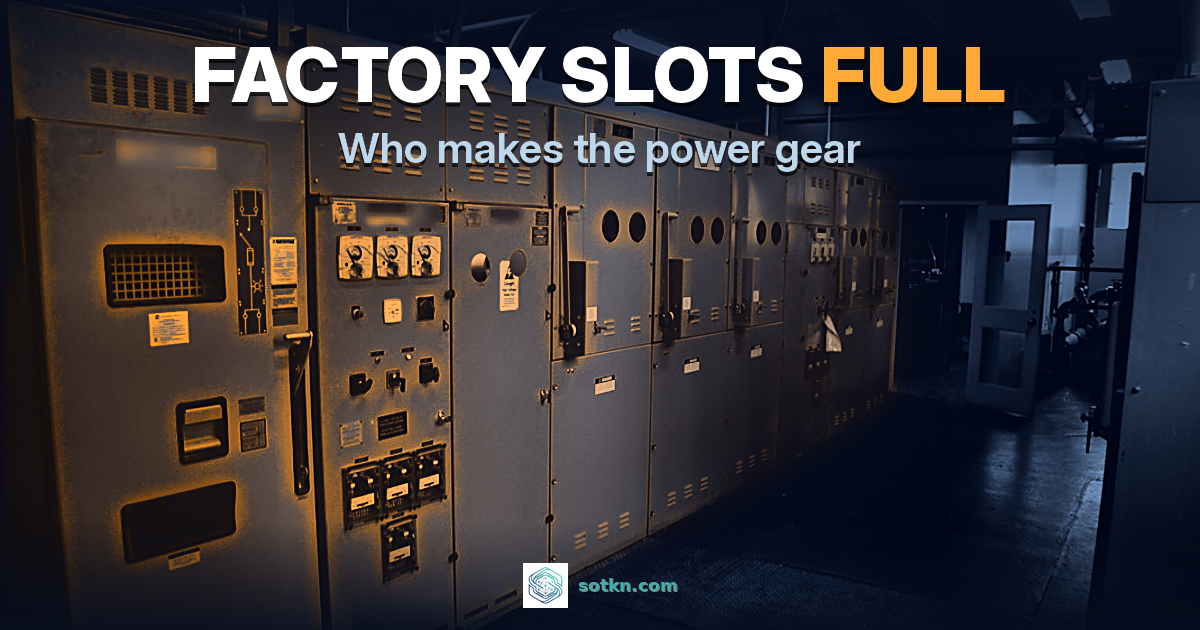
Data center power equipment is made by a small group of industrial firms. GE Vernova had 122 GW of gas equipment booked or reserved in September 2026, and Korea’s HD Hyundai Electric says its slots are full. The factory is the stuck step.
EXPLAINED · Players · Last reviewed: 1 Nov 2026 · Next review: after Cummins’s third-quarter results (5 Nov 2026) and Siemens Energy’s full-year results in November 2026
Data center power equipment is the electrical gear that carries power from the grid or an on-site plant to the servers: transformers, switchgear, generators, turbines, uninterruptible power supplies and power distribution units.
In short. A small group of industrial companies makes the gear that carries power into an AI data centre: transformers and high-voltage switchgear at the grid end, turbines and engines on site, diesel generators for backup, and switchgear, UPS and power distribution inside the hall. Much of it is booked years ahead. GE Vernova had 122 GW of gas equipment in backlog or slot reservations at 30 September 2026, and on our arithmetic that is about six years of shipments at its third-quarter pace. Our read: the gear makers are paid early, through deposits and reserved slots; the stuck step is factory capacity, which takes three to four years to add.
Why an investor cares: an AI hall earns nothing until power reaches the racks, and the gear that carries it is now booked years ahead. The companies that make it are paid first, often before the hall is finished. Our guide to how much power an AI data centre uses covers the load; this page covers who builds the path it travels.
Who makes data center power equipment?
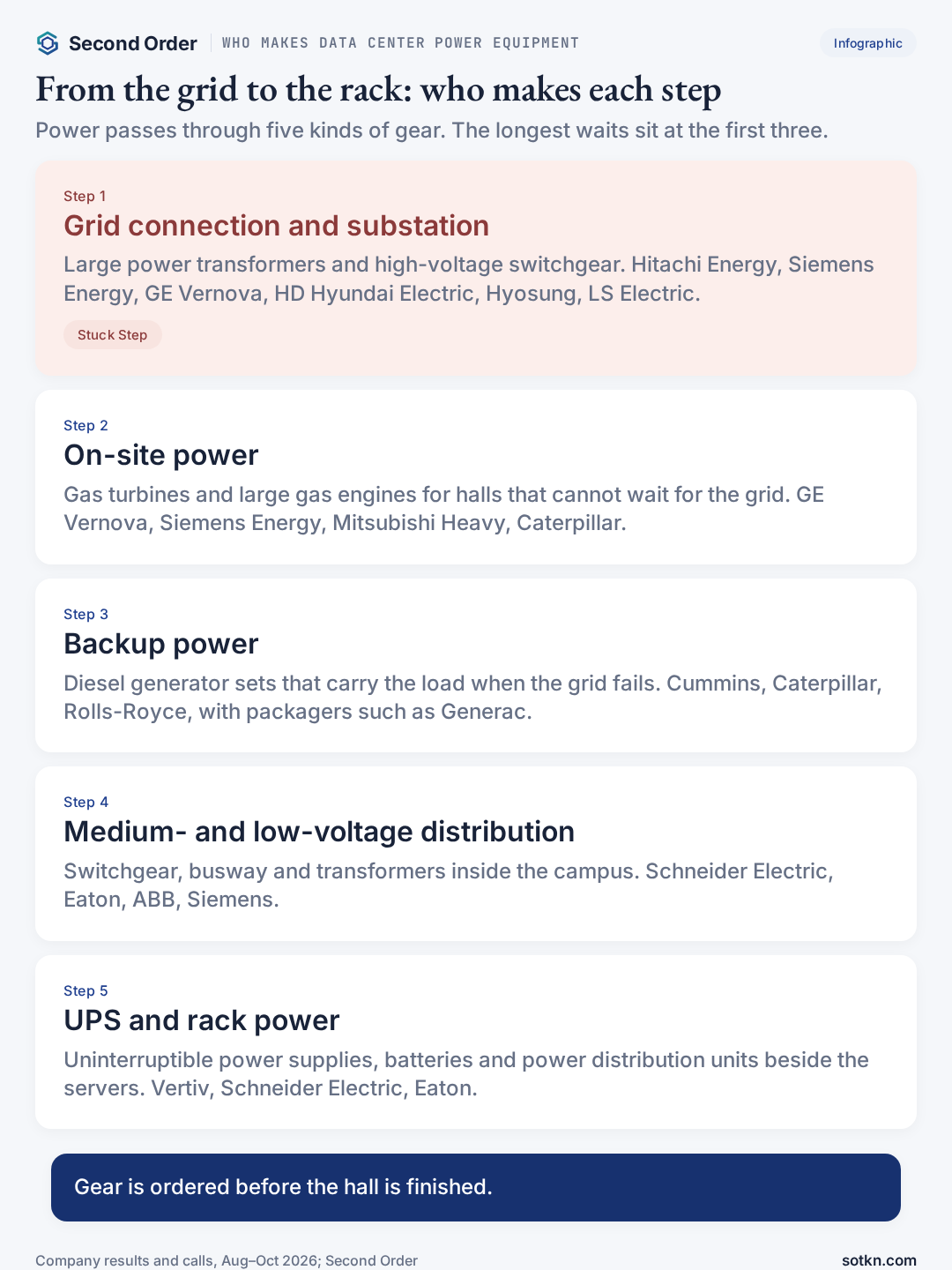
A short list of industrial firms, sorted by where the gear sits. Power reaches a data centre at high voltage, is stepped down and switched several times, is backed up by generators and batteries, and is finally split out to each rack. Each step has its own makers.
| Step | What the gear does | Who makes it (alphabetical) |
|---|---|---|
| Grid connection and substation | Large power transformers step grid voltage down; high-voltage switchgear protects the connection | GE Vernova (with Prolec GE), HD Hyundai Electric, Hitachi Energy, Hyosung Heavy Industries, LS Electric, Siemens Energy |
| On-site power | Gas turbines and large gas engines that run the hall before, or instead of, the grid | Caterpillar (including Solar Turbines), GE Vernova, Mitsubishi Heavy Industries, Siemens Energy |
| Backup power | Diesel generator sets that take the load in a grid outage | Caterpillar, Cummins, Rolls-Royce (mtu); packagers such as Generac |
| Medium- and low-voltage distribution | Switchgear, busway and smaller transformers that spread power around the campus | ABB, Eaton, Schneider Electric, Siemens |
| UPS and rack power | Battery-backed supplies that bridge the seconds before generators start; power distribution units at the rack | Eaton, Schneider Electric, Vertiv |
Roles, not a ranking. Several companies work at more than one step. Cooling is a separate supply chain and is not covered here.
The names repeat. GE Vernova and Siemens Energy sell both grid gear and turbines. Caterpillar sells turbines, gas engines and backup generators. Schneider Electric, Eaton and Vertiv cover most of the gear inside the building. That overlap is why one company’s results can say a lot about several steps at once.
Who makes transformers and grid gear for data centers?
Mostly Hitachi Energy, Siemens Energy and GE Vernova in Europe and the US, and HD Hyundai Electric, Hyosung Heavy Industries and LS Electric in Korea. This is the gear at the fence line: the large power transformers and high-voltage switchgear in the substation that ties the campus to the grid.
It is also where the shortage is sharpest. Wood Mackenzie estimated in August 2026 that power transformers were about 15% short of demand this year and substations about 8% short, with the 100 MVA-plus class the tightest. It said data centres had been turning to Chinese makers to cut the wait, which a US executive order banning bulk-power imports from certain countries, China above all, now shuts off. Wood Mackenzie put the imports at stake at more than $22 billion since 2025.
The makers say the same thing in their own words. HD Hyundai Electric said in October that its third-quarter orders fell 19.1% because “our slots are full”, not because demand slowed. Its order backlog stood at $8.84 billion. Hitachi Energy’s chief executive told CNBC-TV18 on 13 October: “We actually aren't coping.”
GE Vernova’s grid business tells the same story in dollars. Its Electrification equipment backlog was $42.2 billion at the end of September, up 60% in a year, and in October it agreed to buy Trench Group, a high-voltage equipment maker, for about $9 billion. Our Analysis on big transformers staying sold out to 2029 works through where that cash sticks; our Markets note on Korean power gear and US data centres covers the Korean makers.
Who makes gas turbines and on-site power for data centers?
GE Vernova, Siemens Energy and Mitsubishi Heavy Industries make the large frame gas turbines; Caterpillar makes smaller turbines through Solar Turbines, along with large gas engines. Developers buy them when a hall needs power sooner than the grid can deliver it, or as a campus’s main supply.
GE Vernova had 64 GW of gas equipment in backlog and another 58 GW held under slot reservations at 30 September 2026, 122 GW in all. It signed 11 GW of new contracts in the third quarter and shipped 5 GW. Our arithmetic: at that shipping pace the book is about 24 quarters, or six years, of work. The company is adding output, so the real wait is shorter, but the direction is clear.
Caterpillar said on 29 October that it was taking large engine orders as far out as 2029 and turbine orders into 2030. Its power generation sales to users rose 75% in the quarter, driven by data centres, and it plans to nearly triple large engine output from its 2024 level by 2030.
Some buyers are moving further up the chain. Our Stack page on what SpaceX does in AI covers its plan to cast its own turbine blades and vanes, the parts suppliers say run 12 to 18 months behind the rest of the machine. Our Analysis on gas turbines booked into 2030 covers the cash side.
Who makes backup generators for data centers?
Cummins, Caterpillar and Rolls-Royce, through its mtu brand, make most of the large diesel generator sets, and packagers such as Generac build systems around their engines. Every large hall carries enough of them to run on its own through a grid outage.
The wait here is about two years. Cummins said in August 2026 that a new order for its largest genset would arrive in the second half of 2028, and that some customers were stepping down to smaller sets because the big ones were sold out. It is adding 20 GW of capacity, phasing in through 2030.
Our Analysis on backup generators booked into 2028, published today, maps who keeps the margin in that queue.
Who makes the switchgear and UPS inside the data center?
Schneider Electric, Eaton, Vertiv and ABB do most of it. Inside the fence, power is stepped down again, switched, conditioned and backed up by batteries in an uninterruptible power supply, or UPS, which carries the servers for the seconds before generators start. Power distribution units then split it out to each rack.
Vertiv’s third quarter shows how far ahead customers are buying. Sales rose 61% to $4,313 million and organic orders more than doubled. Its deferred revenue, money customers have paid before delivery, reached $4,120.5 million at 30 September, against $1,814.7 million at the end of 2025.
Our arithmetic: that is about 2.3 times the year-end figure, a rise of about $2.3 billion in nine months, and equal to about 96% of a full quarter’s sales. Customers are paying up front to hold a place in the line.
Schneider Electric reported record third-quarter revenue of €11.46 billion on 16 October, up 16.9% organically, with triple-digit growth in data centre demand. Our Catalyst note on Schneider’s third quarter and Analysis on Vertiv’s prepaid gear line go further into both.
How far ahead is data center power equipment booked?
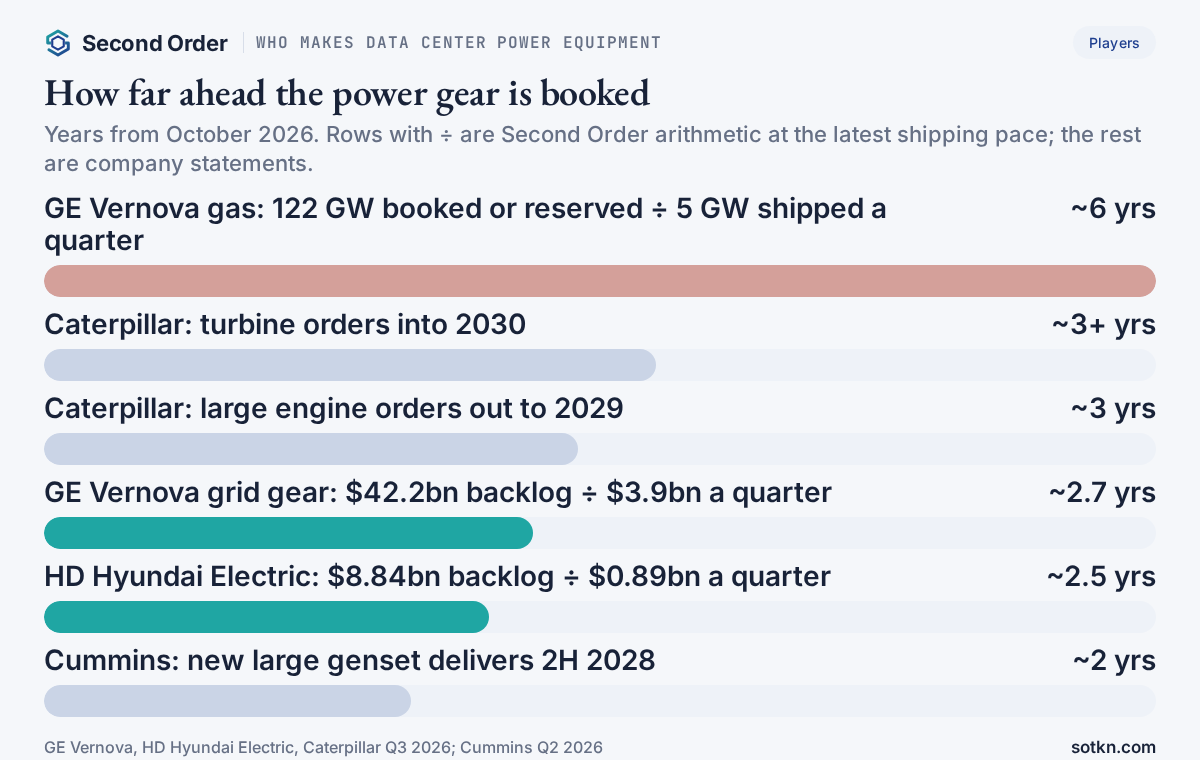
Two to six years, depending on the step. The longest books are in gas turbines and grid transformers; the shortest in the gear inside the hall, though even there customers are prepaying.
| Company and step | What it reported | What it tells you (our arithmetic where marked) |
|---|---|---|
| GE Vernova, gas turbines | 64 GW in backlog and 58 GW in slot reservations at 30 Sep 2026; 5 GW shipped in the quarter | 122 GW ÷ 5 GW a quarter ≈ 24 quarters, about six years, before planned capacity additions (ours) |
| GE Vernova, grid gear | Electrification equipment backlog $42.2bn, up 60% in a year; quarterly revenue $3.9bn | $42.2bn ÷ $3.9bn ≈ 10.8 quarters, about 2.7 years of work (ours) |
| HD Hyundai Electric, transformers | Order backlog $8.84bn; quarterly sales about $892m; orders down 19.1% because slots are full | $8.84bn ÷ $0.892bn ≈ 9.9 quarters, about 2.5 years (ours) |
| Caterpillar, engines and turbines | Record $78bn backlog, 58% due within 12 months; large engine orders out to 2029, turbines into 2030 | About $45bn ships within a year and about $33bn later (ours; whole company, not power alone) |
| Cummins, backup gensets | A new large genset ordered in August 2026 arrives in the second half of 2028 | About a two-year wait for the biggest backup units |
| Vertiv, UPS and hall power | Deferred revenue $4,120.5m at 30 Sep 2026, from $1,814.7m at end-2025; organic orders up more than 100% | Customer money held ahead of delivery rose about 2.3 times in nine months, to about 96% of a quarter’s sales (ours) |
Company figures from results and calls dated 4 August to 29 October 2026. Order-book years assume each company keeps shipping at its latest quarterly pace; all six are adding capacity, so treat them as a measure of how full the books are, not a forecast.
Set against a build, these waits are long. Hitachi Energy’s chief executive put a data centre at about two years to build and a new factory at three to four. Our guide to how long an AI data centre takes to build breaks down the rest of the clock.
Who gets paid, and where is the stuck step?
Our read: the gear makers are paid early, the hall owner pays and waits, and the stuck step is factory capacity.
- Gear makers are paid first. Slot reservations, deposits and prepayments arrive years before delivery. GE Vernova converted 13 GW of reservations into firm orders in the third quarter, and Vertiv held more than $4 billion of customer money ahead of delivery.
- Their suppliers come next. Turbine blades, transformer steel and insulation, and large engines all have their own queues. When a maker cannot get a part, its own customers wait.
- The hall owner pays and waits. A developer or neocloud can sign land, power and tenants, but it cannot energise the hall until the gear arrives. Until then it carries the cost without the revenue.
The stuck step is the factory. Demand can rise in a quarter; a new transformer or engine plant takes three to four years. Hitachi Energy says it is investing more than $9 billion and needs framework deals and reserved capacity from buyers to invest faster. Our guide to contracted power shows the same gap from the buyer’s side: signed megawatts that cannot earn until the gear is in.
Why does this matter for Singapore and Asia?
Because Asia is both a buyer and a maker. Schneider said its third-quarter growth was led by China and East Asia, with data centres the main driver. Korea’s transformer makers are filling US orders, and HD Hyundai Electric is spending 198 billion won on its Cheongju campus to meet AI data centre demand. Our note on Singapore’s power plan for data centres covers the grid side of the region’s tightest market.
For the region’s builders, a full order book abroad means a longer wait at home. Today’s Markets notes on Malaysia’s data centre approvals waiting on water and power checks and Australia’s data centre pipeline and the permit step show where projects stall before the gear even matters. Our read: once permits clear, the gear queue is the next clock.
What would change the view?
- Orders slow while capacity rises. If backlogs stop growing as new plants come on, the wait shortens and prepayments fall. Watch GE Vernova’s reservations and Vertiv’s deferred revenue.
- Cancellations appear. If data centre projects are dropped, slot reservations lapse and the order books thin. Watch for reservations that expire without turning into firm orders.
- Import rules loosen or tighten. The US restriction on Chinese bulk-power gear removes one way data centres cut lead times. Any change to it moves the transformer queue.
What to check next
Watch Cummins’s third-quarter results on 5 November for its genset wait, and Siemens Energy’s full-year results in November for its grid and gas books. Our AI Data Centers layer tracks the halls that need the gear, and our Stack page on how hyperscalers buy power covers the contracts behind it.
Common misconceptions
- People assume the GPU is the hard part to get. Actually a large transformer or turbine can take longer. Cummins’s biggest genset ordered in August 2026 arrives in late 2028.
- People assume a data centre plugs straight into the grid. Actually power passes through several stages of transformers and switchgear, plus generators and batteries, before it reaches a rack.
- People assume backlog is revenue already earned. Actually it is work still to ship. Caterpillar expects 58% of its $78 billion backlog to ship within a year; the rest comes later.
- People assume one company makes it all. Actually each step has different makers, and the bind moves between them.
FAQ
Who makes data center power equipment?
A small group of industrial companies. Hitachi Energy, Siemens Energy, GE Vernova and Korea’s HD Hyundai Electric, Hyosung and LS Electric make grid transformers and high-voltage gear. GE Vernova, Siemens Energy, Mitsubishi Heavy and Caterpillar make gas turbines. Cummins, Caterpillar and Rolls-Royce make generators. Schneider Electric, Eaton, Vertiv and ABB make the switchgear, UPS and distribution gear inside the hall.
What is the difference between a transformer and switchgear?
A transformer changes the voltage, for example from a high-voltage grid line down to the medium voltage a campus uses. Switchgear switches, protects and isolates circuits so faults can be cut off and power rerouted. A data centre needs both, at several stages between the grid and the rack.
Why is data center power equipment sold out?
Because demand from data centres, utilities and industry has risen faster than factories can be built. Hitachi Energy’s chief executive said in October 2026 that a data centre takes about two years to build but a factory three to four, so supply lags demand.
How long is the wait for a data center generator?
About two years for the largest units. Cummins said in August 2026 that a new order for its biggest genset would arrive in the second half of 2028, and Caterpillar said in October that it was taking large engine orders as far out as 2029.
Who makes gas turbines for data centers?
GE Vernova, Siemens Energy and Mitsubishi Heavy Industries make the large frame turbines, and Caterpillar’s Solar Turbines makes smaller industrial units. GE Vernova had 64 GW of gas equipment in backlog and 58 GW of slot reservations at the end of September 2026.
Do the hyperscalers make their own power equipment?
Mostly not. They buy it, often years ahead through framework deals and reserved factory slots. A few are reaching further back: SpaceX has said it is casting its own gas turbine blades and vanes for its AI power plans.
Is this a list of stocks to buy or sell?
No. This page explains who makes data center power equipment and where the wait sits. It does not rank companies or give buy or sell calls. Not investment advice. Do your own research.
Related: who builds AI data centres; how much power an AI data centre uses; contracted power; AI data centre; PUE.
Stack doors
Layer: AI Data Centers. Also: Hyperscalers. Markets: US, Korea, Singapore.
Get the Wire — short daily notes when power gear orders and lead times move.
Not investment advice. Do your own research.
How we check this
GE Vernova’s gas backlog, slot reservations, shipments and grid equipment backlog come from its third-quarter results filed on 28 October 2026. Vertiv’s sales, orders and deferred revenue come from its third-quarter results of 28 October 2026. Schneider Electric’s revenue and data centre demand come from Reuters’ report of 16 October 2026. Caterpillar’s backlog and order dates come from its earnings call of 29 October 2026, and Cummins’s genset wait from its call of 4 August 2026. HD Hyundai Electric’s figures come from The Herald Business on 27 October 2026. The Hitachi Energy quote and build times come from its chief executive’s CNBC-TV18 interview of 13 October 2026, and the shortage estimates from Wood Mackenzie on 31 August 2026. The order-book years, the Vertiv deposit ratios and the Caterpillar split are our arithmetic and are labelled as ours on the page. Which company sits at which step is our summary of what each sells. The order of who gets paid and the stuck step are our read. The featured photograph is credited in its caption. This page explains who makes data center power equipment. It does not rank companies or give buy or sell calls. Not investment advice. Do your own research.
Last reviewed: 1 Nov 2026 · Next review: after Cummins’s third-quarter results (5 Nov 2026) and Siemens Energy’s full-year results in November 2026
Spot an error? Tell us and we will correct it and note the change here.
References
- GE Vernova — third-quarter 2026 results, filed with the SEC (28 Oct 2026) — gas equipment backlog 64 GW and slot reservations 58 GW (122 GW together); 5 GW shipped in the quarter; Electrification equipment backlog $42.2 billion and quarterly revenue $3.9 billion; Trench Group deal
- Vertiv — third-quarter 2026 results, Form 8-K Exhibit 99.1 (28 Oct 2026) — net sales $4,313 million, up 61%; organic orders up more than 100%; deferred revenue $4,120.5 million at 30 September 2026 against $1,814.7 million at 31 December 2025; full-year sales guide $14,650 million
- Reuters via Investing.com — Schneider Electric raises 2026 targets again on booming data centre demand (16 Oct 2026) — third-quarter revenue €11.46 billion, up 16.9% organically; triple-digit data centre demand growth; growth led by China and East Asia
- Caterpillar — third-quarter 2026 earnings call transcript, via The Motley Fool (29 Oct 2026) — record $78 billion backlog, 58% expected to ship within 12 months; power generation sales to users up 75%; large engine orders out to 2029 and turbine orders into 2030; plan to nearly triple large engine output from 2024 by 2030
- Cummins — second-quarter 2026 earnings call transcript, via Stock Analysis (4 Aug 2026) — a new large genset ordered now arrives in the second half of 2028; Power Systems revenue a record $2.3 billion; 20 GW of added capacity phasing in through 2030; some buyers stepping down to smaller gensets
- The Herald Business — HD Hyundai Electric posts 15% rise in Q3 operating profit (27 Oct 2026) — third-quarter sales 1.18 trillion won ($892 million); order backlog $8.84 billion; orders down 19.1% because “our slots are full”; 198 billion won Cheongju expansion for AI data centre demand
- CNBC-TV18 — interview with Hitachi Energy chief executive Andreas Schierenbeck (13 Oct 2026) — “we actually aren't coping”; more than $9 billion of capacity investment; a data centre takes about two years to build, a factory three to four
- Wood Mackenzie — US executive order banning Chinese bulk-power equipment set to worsen critical transformer shortage (31 Aug 2026) — estimated 2026 shortages of 15% in power transformers and 8% in substations; 100 MVA-plus units most acute; data centres had used Chinese units to cut lead times