24 Data Centres on Hold: Who Gets Paid While Malaysia Checks the Water First
Malaysia has approved 117 data centres but only 55 are running, and 24 new applications now wait until states confirm there is enough water. Selangor has been asked for 634 million litres a day and has room for about 60. Water sellers and builders get paid first.
On 28 October, Malaysia’s investment minister told Parliament something new about the data centre queue. The government is holding back decisions on 24 new applications until it is sure there is enough water and electricity for them. And the order matters: a developer must first get the state to confirm the water. Only then does anyone check the power. A state without enough water, he said, must not host data centres even if it has the land. Of the 117 data centres already approved, 55 are running. The stuck step for the next wave is no longer only the grid. It is the water check.
MALAYSIA PULSE · AI DATA CENTERS · Data as at 28 Oct 2026 (Dewan Rakyat) · Next update: new treatment plants in Johor and Selangor during 2027
Affects: AI Data Centers · Equinix · Digital Realty — Markets: Malaysia · Singapore · Australia
Education only, not advice to buy or sell any security. Water figures are in million litres a day (MLD); one MLD is 1,000 cubic metres a day. Figures are as published by ministers, utilities and research houses on the dates given. Our own sums are labelled.
The numbers that matter this week
New applications
24 on hold
Until water and power are confirmed · 28 Oct
WaitingApproved data centres
117
RM385.7bn · 23–23.5 GW if all built
ApprovedActually running
55
19 being built · 16 not started · 27 off-grid
47% liveWater approved for DCs
445 MLD
Selangor, Johor, Negeri Sembilan, 2025–30 · 63.9 flowing
BookedSelangor requests
634 MLD
Room for ~60 MLD more in 2027–29 (BIMB)
TightThe water check
First
State confirms water before the power check
Stuck stepDewan Rakyat 21, 27 and 28 Oct 2026 (The Star, NST, FMT); Air Selangor (The Stratawire, 6 Oct); BIMB Research (The Star, 9 Oct). Status chips are Second Order’s read.
On this page: Why it matters · What changed · The ladder · Why water · Selangor · Johor · Reclaimed water · The land · Our math · Who gets paid · What is stuck? · Dates next · FAQ
Why does a water check matter for AI data centres?
Because a data centre is a box of computers that turns electricity into heat, and most of the big ones in Malaysia use water to carry that heat away. Cool water goes in, absorbs the heat, and some of it is lost to the air in cooling towers. The bigger and denser the AI hall, the more heat there is to move (what is an AI data center?).
Until now, the Malaysia data centre story has been told almost entirely in megawatts: how much power is booked, how much is used, who pays for the grid. We have written that story several times this month. What changed this week is that the government put water in front of the queue. Before an application gets to the power company, the state has to say it can supply the water. If it cannot, the application does not go forward.
That is a different kind of gate. Power in peninsular Malaysia is planned nationally, mostly through one utility, Tenaga Nasional, with a grid that can move electricity across states. Water is a state matter. Each state has its own operator, its own rivers and dams, its own treatment plants and its own reserve margin. So the question “is there room?” now has a different answer in Selangor than in Johor or Negeri Sembilan, and the answer is given by a different body. The chain now looks like this.
1 · The land
Who: Site bought or optioned; zoning fits a data centre
Paid: Landowners paid first, in cash
2 · The water check
Who: State and its water operator confirm supply within the reserve margin
Paid: Decides whether an application moves on
3 · The power check
Who: Tenaga Nasional and the task force confirm reserve; else off-grid
Paid: Grid builders and power sellers paid next
4 · Build and switch-on
Who: Halls fitted out; customers move in and start paying
Paid: Owners and lenders paid last
What did the ministers say this week?
Two ministers spoke on two days. On 27 October, the energy transition and water minister, Fadillah Yusof, set out the operating rules. Data centres must keep at least two days of water in storage on site, and must have backup generators, so that they do not pull on public supply during a drought or an outage. The national water regulator, known as SPAN, requires operators to use other sources for cooling, including recycled and reclaimed water and rainwater harvesting. Areas with low water reserve margins would not be considered for data centres, based on the views of state water operators.
On 28 October, winding up his ministry’s budget debate, the investment, trade and industry minister, Johari Abdul Ghani, set out the approval order. Applications go through the Malaysian Investment Development Authority, which takes advice from the Data Centre Task Force, a group of three ministries. Developers must first confirm water availability with the state government. Then the federal side checks electricity with Tenaga Nasional. “If a state does not have enough water, it must not be a host for data centres,” he said.
He added three things that matter for money. The government is holding back decisions on 24 new applications until it is satisfied there is enough water and electricity without hurting other industries, because the priority is to let the 117 approved projects proceed first. “We have to be very selective,” he said. He suggested states charge data centres higher water rates than ordinary users. And he said the government will also check investors’ financial strength, including whether they can honour power supply contracts that make them pay for capacity they book but do not use.
That last point is the booked-power charge we covered in October, and the green-power grid charge before it; we will not re-tell either here (booked, not used; the green-power grid charge). The new part is the order of the checks, and that water now sits at the front.
How far along are the 117 approved data centres?
The minister gave the clearest count yet of where Malaysia’s approvals stand. Of 117 approved data centres, representing RM385.7 billion of investment, 55 are operating, 19 are under construction and 16 have been approved but have not started building. The other 27 are at various stages of development and are expected to get their electricity from off-grid arrangements rather than the national grid.
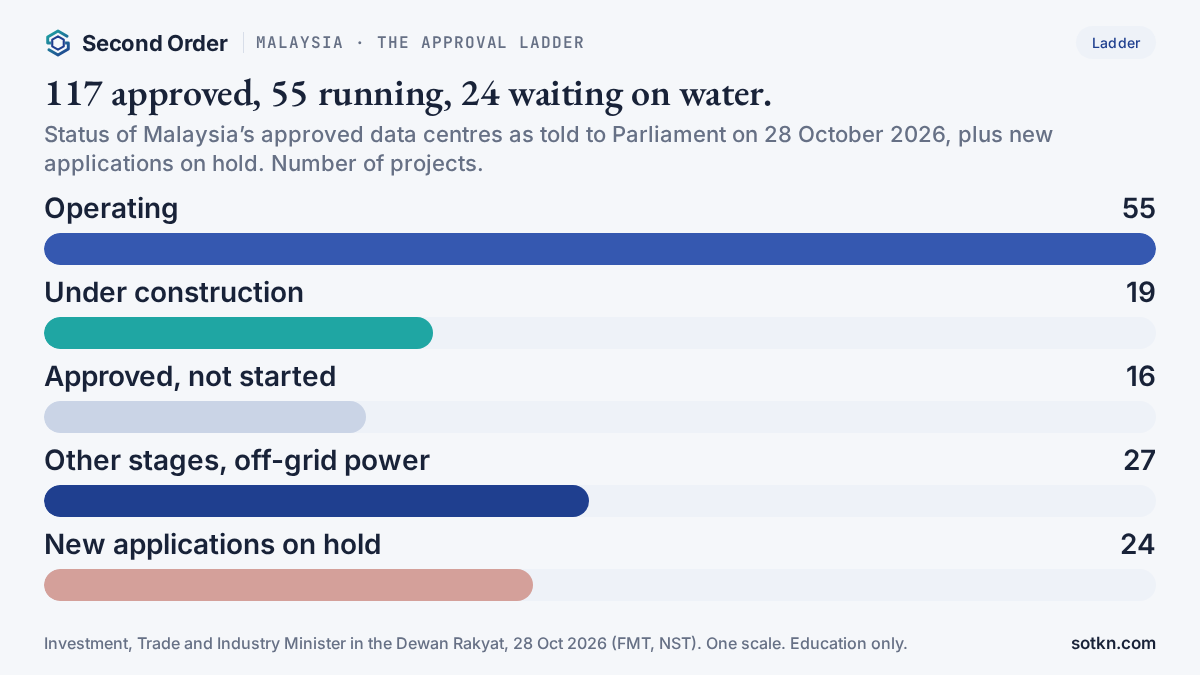
So fewer than half of the approved projects are running: 55 of 117, or 47% (our arithmetic). If all 117 were finished, the minister said, they would need 23,000 to 23,500 megawatts of electricity. For scale, the water minister told Parliament the day before that data centres had contracted 2,346 megawatts of power as of August and were using about 1,374 megawatts of it. The approved list, if built, would need about ten times what is contracted today (our arithmetic).
The 27 off-grid projects are worth a pause. They are approved, but they will not draw from the national grid; they will have to bring their own power. They still need water. And the 24 new applications on hold sit behind all of them. On average, each approved project represents about RM3.3 billion of planned spending (our arithmetic, RM385.7 billion divided by 117), so the 24 waiting are not small.
This is not a ban on data centres. But a queue where the approved projects go first, and the new ones wait for two separate yeses, is a slower queue. It looks a lot like the permit filter we mapped in Australia this morning (Australia’s permit).
Why does water come before power?
The plain reason is who runs it. Water supply is run by the states, and the minister told Parliament the federal government has no jurisdiction over state water supplies. Putrajaya can approve an investment and can talk to Tenaga Nasional about power. It cannot promise a litre of water. So it now asks the state first.
The second reason is the numbers. In a written reply on 21 October, the water minister said data centre projects in Selangor, Johor and Negeri Sembilan had been approved to use a combined 445.04 million litres a day between 2025 and 2030. Of that, 63.90 million litres a day had been approved for data centres already operating as of June, about 14% of the total. That leaves about 381 million litres a day approved but not yet flowing (our arithmetic). Those approvals will be drawn as halls switch on, on top of the normal growth in homes and factories.
The third reason is the margin. Water operators keep a reserve margin: spare treated water above normal demand, so a dry spell, a broken pipe or a plant shut for repairs does not cut people off. The national regulator’s benchmark is 15%. When a big new user arrives, it eats into that reserve directly. A data centre that asks for several million litres a day is a lot of reserve in one go.
Power has the same problem but more tools: the minister listed renewable energy, battery storage and off-grid generation where the grid is short, and 27 approved projects will bring their own power. Water has fewer quick fixes. A new treatment plant or reservoir takes years. That is why the government is checking it first, and why the water check is now the slowest permission in the chain (how long it takes to build an AI data center).
How tight is Selangor’s water?
Selangor, around Kuala Lumpur, is where the new land deal in this piece sits, so it is worth taking first. At the International Water Association’s world congress on 6 October, Air Selangor’s head of production, Azlan Abdullah, put the state’s data centre water requests at 634 million litres a day, about 11.6% of the utility’s average production. That splits into 60 approved applications for 276 million litres a day, eight committed at 148, and 11 at the pre-consultation stage at 210, according to his slides as reported by The Stratawire.
“When it comes in, it comes in bulk,” he said of data centre demand. Air Selangor serves more than 9.7 million people across Selangor, Kuala Lumpur and Putrajaya and produces about 5,400 million litres a day. It aims to keep a reserve margin of 10–15% above demand. Data centres there have paid a dedicated tariff of RM5.31 per cubic metre since 1 September 2025.
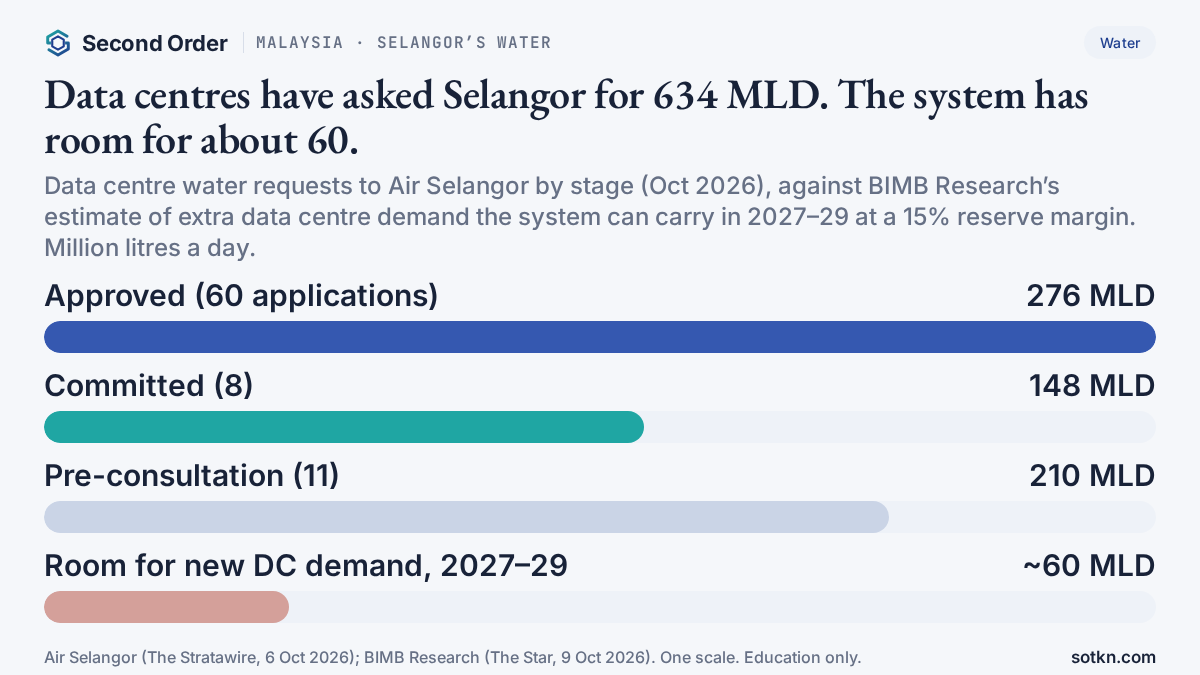
Now set that against what the system can carry. In a note reported by The Star on 9 October, BIMB Research said Selangor’s reserve margin had slipped from 17.86% in 2025 to 16.23% in August 2026, closer to the 15% minimum. With ordinary demand growing about 3% a year, it estimated the system can carry only about 60 million litres a day of extra data centre demand across 2027 to 2029 while keeping a 15% margin. That is about 10% of the state’s projected 632 million litres a day of data centre need.
Put the two side by side. The requests on Air Selangor’s books are more than ten times the headroom BIMB estimates for 2027 to 2029 (our arithmetic, 634 divided by about 60). Even the approved part alone, 276 million litres a day, is about 4.6 times that headroom (our arithmetic), although some of the approved water may already be flowing and the rest will be phased in as halls open. Either way, a new applicant in Selangor is asking for water the system has mostly already promised.
The relief is real but has dates on it. BIMB said the first stage of the Rasau treatment plant, 700 million litres a day due in 2027, should lift the reserve margin back to about 18%, though ordinary demand would absorb much of that, and it sees no further capacity until the 200 million-litre second phase at Labohan Dagang in 2029. Air Selangor’s four planned plants would add 2,360 million litres a day by 2031, about 37% more than today’s capacity on BIMB’s count. Until those run, the reserve margin is the gate.
And Johor, where most of the halls are?
Johor is Malaysia’s biggest data centre cluster, and its water is run by Ranhill SAJ, which operates 47 treatment plants able to produce 2,352 million litres a day. The reserve margin there is thinner than Selangor’s. The water minister told Parliament in June that Johor’s margin was about 14.4%. In a September note reported by The Star, HLIB Research put it at about 12.8%. Both are below the 15% benchmark. Our 28 October Pulse showed the same squeeze on Johor’s local power connections (Johor’s substation queue).
HLIB estimated that Johor’s roughly 1.1 gigawatts of live data centre capacity plus 8.5 gigawatts in the pipeline could eventually need about 400 million litres a day. That is about 17% of Ranhill SAJ’s current plant capacity (our arithmetic). Johor data centres pay a dedicated tariff of RM5.33 per cubic metre, introduced in the August 2025 tariff change; across the peninsula and Labuan the data centre band is RM5.30 to RM5.38.
New supply is coming. The minister said federal projects worth about RM1.63 billion would add 1,337 million litres a day of treated water by 2027, and four more projects financed by the state water asset company would add 388. Together that is about 1,725 million litres a day, roughly 73% of today’s plant capacity (our arithmetic). HLIB also expects Ranhill to build about RM3.5 billion of new treatment plants under an investor-owned model. The question is the order: the plants come over the next few years, and the applications are on the desk now.
Can reclaimed water skip the queue?
Partly, and this is where the new rules point. The regulator’s guidelines, published in September 2025, prioritise reclaimed water for cooling where it is available, or air-cooled systems that discharge nothing. Reclaimed water is treated sewage effluent, cleaned again until it is fit for cooling towers but not for drinking. It does not come out of the reserve margin that homes depend on.
Johor already has working examples, Bernama reported in July. Bridge Data Centres runs a plant in Ulu Tiram that takes effluent from the national sewerage company, Indah Water Konsortium, and cleans it with membranes and reverse osmosis; it processes five million litres a day and plans to expand to 20. Computility Technology, the Malaysian arm of ZData, opened a plant in Gelang Patah in March that processes four million litres a day and says it runs on 100% reclaimed water. DayOne draws and treats raw river water from Sungai Tebrau under an agreement with the state-owned Johor Special Water. AirTrunk’s own plant had not started operating at the time.
Selangor is behind but moving. Air Selangor’s joint venture with Indah Water, Central Water Reclamation, has so far saved about 3.3 million litres a day of drinking water, and two more reclamation plants are being built to supply areas where data centres will need water. “It is a start,” Azlan said.
The two-day storage rule adds a cost on top. A data centre drawing four million litres a day has to hold about eight million litres on site; if all 445 million litres a day of approved data centre water were flowing, the sector would need tanks for about 890 million litres (our arithmetic). That is steel, concrete and land inside the fence, paid for before the first customer moves in.
Where does the Klang land deal fit?
The same week gave the clearest example of who gets paid before the water check. On 29 October, the planter SD Guthrie agreed to sell 1,623 acres of freehold plantation land at Bukit Kerayong Estate, in Klang, Selangor, to a new joint venture for about RM933.6 million, Business Today reported. YTL Power and Bumi Assets each take 35% of the venture and SD Guthrie keeps 30%. The stated plan is an integrated industrial development.
The data centre angle comes from a research house, not the companies. MBSB Research, as reported by Business Today on 31 October, said the price works out to about RM13.20 per square foot, a 5% premium to an independent valuation of RM889 million, and that if about 500 acres were used for data centres at around 8 megawatts an acre, the site could in theory hold up to 4 gigawatts. MBSB itself called that an aggressive scenario rather than a confirmed plan.
Here is why the water check matters to that theory. Using HLIB’s Johor ratio of about 400 million litres a day for 9.6 gigawatts, a 4-gigawatt campus cooled the same way would need about 167 million litres a day (our arithmetic; cooling design changes this a lot). That is nearly three times the 60 million litres a day of extra data centre demand BIMB thinks Selangor can carry in 2027 to 2029 (our arithmetic). Under the new order of checks, that campus would only reach the power company after Selangor said yes on water, which on those numbers means reclaimed water, air cooling or waiting for new plants.
Meanwhile, the landowner’s part is done. SD Guthrie receives about RM933.6 million for the land, and keeps a 30% share of whatever the site ends up hosting. That is the first-paid seat in this chain.
Our math, in plain sums
- Running versus approved: 55 ÷ 117 = 47% of approved data centres operate today (our arithmetic).
- Average approved project: RM385.7 billion ÷ 117 = about RM3.3 billion each (our arithmetic).
- Power if all are built: 23,000–23,500 MW against 2,346 MW contracted in August = about ten times (our arithmetic).
- Approved water not yet flowing: 445.04 MLD − 63.90 MLD = about 381 MLD (our arithmetic, as of June).
- Tariff on that water: 381 MLD × 1,000 m³ × RM5.30 = about RM2.0 million a day, or roughly RM737 million a year if all of it flowed (our arithmetic, at the bottom of the tariff band).
- Selangor squeeze: 634 MLD requested ÷ ~60 MLD headroom (2027–29) = more than ten times; approved 276 MLD alone = about 4.6 times (our arithmetic).
- Johor demand: ~400 MLD (HLIB) ÷ 2,352 MLD Ranhill SAJ capacity = about 17%; new supply 1,337 + 388 = 1,725 MLD (our arithmetic).
- Two-day storage: 445 MLD × 2 = about 890 million litres of tanks if all approved water flowed (our arithmetic).
- Klang theory: 4 GW × ~42 MLD per GW (HLIB’s Johor ratio) = about 167 MLD, nearly three times BIMB’s Selangor headroom (our arithmetic).
What this tells you: the water already promised to data centres is several times what is flowing, the spare room in the two biggest states is thin, and the government has decided the next wave waits until that room is confirmed. The money that moves first is the money that makes or sells water.
Who gets paid first?
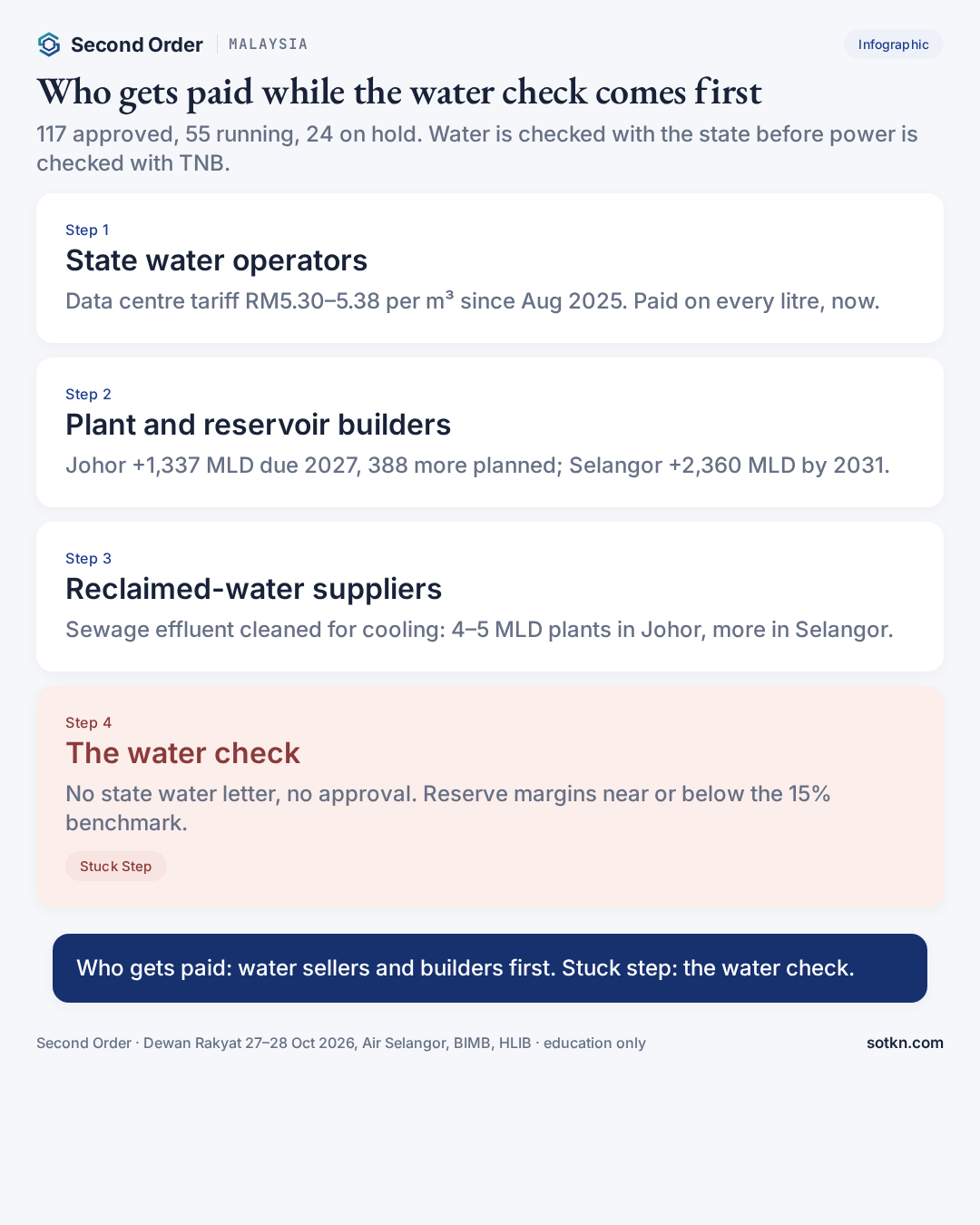
First, the state water operators — now, by the litre. Data centres already pay a separate tariff of RM5.30 to RM5.38 per cubic metre, and the minister has now suggested states charge them more than ordinary users. HLIB said the Johor data centre tariff has already strengthened earnings and cash flow at Ranhill SAJ, which is 80% owned by the listed Ranhill Utilities. Every approved hall that switches on adds volume at the higher rate.
Second, the builders of treatment plants, reservoirs and pipes — over the next few years. Johor’s federal and state-financed projects, Ranhill’s expected RM3.5 billion of new plants and Air Selangor’s 2,360 million litres a day of new capacity by 2031 are contracts for civil engineers, pipe makers, pump and membrane suppliers. Under the new rule, that new capacity is what releases the next data centre approvals, so the plants are now on the critical path.
Third, the reclaimed-water suppliers — next. If reclaimed water does not come out of the reserve margin, a site that can secure it should find the water check easier to pass. That puts value on sewage effluent near data centre land, on the national sewerage company and its joint ventures, on state water companies that sell raw water for private treatment, and on the membrane and treatment firms that build the plants inside the fence.
Fourth, the landowners — already. SD Guthrie’s Klang sale is the cleanest example: cash for plantation land now, with the data centre question left to the buyers. The tanks, backup generators and on-site plant needed to meet the new rules also push money to equipment makers early; our generator Analysis looked at how long that kind of order book can stay booked (the backup generator Analysis).
Waiting: the 24 applicants on hold; the 16 approved projects that have not broken ground; the 27 off-grid projects, which have solved power on paper but still need water; and investors in listed developers whose prices assume new campuses in Selangor or Johor start on time. Singapore customers looking north for space also wait (Singapore’s land lease).
One-line rule: when water comes first, the people who sell, store, clean and pipe water get paid first, the landowners have already been paid, and anyone still waiting for a state water letter waits longer.
So what is the stuck step?
The water check: the state’s confirmation, on its water operator’s advice, that a site can be supplied without cutting the reserve margin below the benchmark. Not demand, which keeps coming. Not money, with RM385.7 billion approved. Not even power, which off-grid projects are now solving for themselves. Four things make it stick:
- It now comes first. An application does not reach the power check until the state confirms water, and 24 are waiting.
- The margin is thin. Selangor is at about 16% and falling toward 15%; Johor is near 12.8–14.4%, already below it.
- Much is already promised. About 381 MLD of approved data centre water is not yet flowing, and Selangor has requests of 634 MLD.
- New plants take years. Johor’s new supply is due by 2027; Selangor’s next plants arrive in 2027, 2029 and through 2031.
This is the move our stuck-step Analysis describes: when one input gets scarce, the bind shifts to whoever controls the slowest permission. In October the slowest permission in Malaysia was the substation at the gate. With 27 projects going off-grid for power, the slowest permission for the next wave has moved upstream, to the state’s water.
Which dates test this read next?
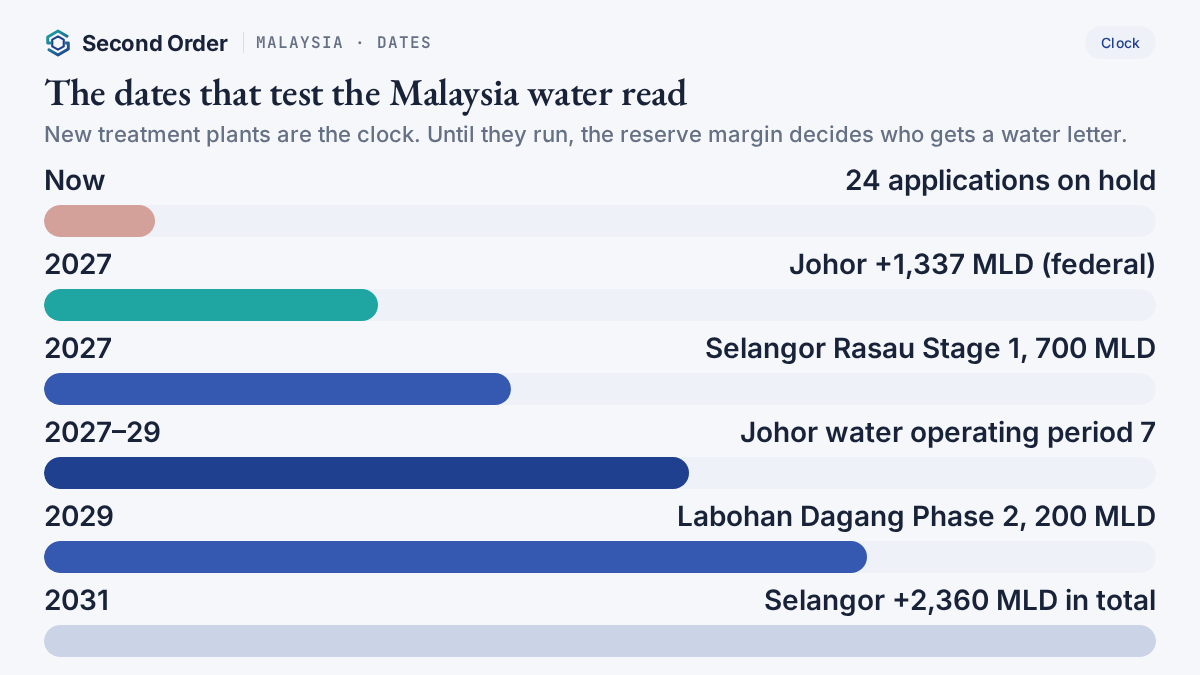
- Now — 24 applications on hold; watch for the first decisions and whether any come with reclaimed-water or air-cooling conditions.
- 2027 — Johor’s federal water projects (1,337 MLD) are due, and Selangor’s Rasau Stage 1 (700 MLD) should lift its reserve margin to about 18%.
- 2027 to 2029 — Johor’s next water operating period, which HLIB flags for possible higher allowed returns; BIMB’s ~60 MLD Selangor headroom window.
- 2029 — Labohan Dagang Phase 2 (200 MLD) in Selangor, the next new plant after Rasau on BIMB’s list.
- 2031 — Air Selangor’s four planned plants, 2,360 MLD in total, against projected data centre need of 632 MLD.
What would change this view?
- Fast decisions on the 24. If most of the held applications are cleared within months with standard conditions, the water check is paperwork, not a gate.
- Reclaimed water at scale. If reclaimed water and air cooling become the default for new halls, the reserve margin stops binding and the bind moves back to power.
- Plants on time. If Rasau and Johor’s 2027 projects arrive on schedule and margins rise above 15%, the queue clears faster than the numbers here suggest.
- Requests shrink. If the approved water, like approved power, turns out to be far more than halls actually use, the real squeeze is smaller than the booked numbers.
Practical takeaways
- Malaysia is holding back 24 new data centre applications until water and power are confirmed, water first, with the state
- Of 117 approved data centres, 55 run, 19 are being built, 16 have not started and 27 will use off-grid power
- Selangor has data centre water requests of 634 MLD and, on BIMB’s estimate, room for about 60 MLD more in 2027–29
- Johor’s reserve margin is near or below the 15% benchmark until new plants arrive from 2027
- Water sellers, plant builders and reclaimed-water suppliers are paid first; new applicants wait; stuck step: the water check
FAQ
What did Malaysia announce on 28 October?
The investment minister told Parliament the government is holding back decisions on 24 new data centre applications until it is sure there is enough water and electricity for them without hurting other industries. Developers must first confirm water with the state government; only then is power assessed with Tenaga Nasional. Of 117 approved data centres, 55 are operating, 19 are under construction, 16 have not started and 27 are at other stages using off-grid power.
Why does water come first?
Water belongs to the states, not the federal government, so Putrajaya cannot promise it. The minister said a state without enough water must not host data centres even if it has land. Reserve margins are thin: Johor was about 14.4% in June, and an HLIB note put it near 12.8% in September, against the 15% benchmark. Selangor has been asked for 634 million litres a day; BIMB estimates it can carry about 60 more in 2027 to 2029.
What is the stuck step?
The water check: the state’s confirmation that a site can be supplied without cutting into the reserve margin. Without it, an application does not move on to the power check. New treatment plants due from 2027 add room, and reclaimed water lets some sites skip the queue, but until then the reserve margin decides who gets a yes.
Is this investment advice?
No. Education only. It maps who gets paid and which step is stuck. It is not a recommendation to buy or sell any security, and we leave out price targets and ratings on purpose.
Keep reading on the map
- Malaysia Markets hub — country page
- Johor’s substation queue · Booked, not used · The green-power grid charge · DayOne’s RM30 billion · Plugged in, not used · Chip exports pass through
- Australia’s permit · Singapore’s land lease — other markets
- What does Equinix do? · What does Digital Realty do?
- How much power does an AI data center use? · Contracted power explained · How long it takes to build one · What it costs to build · Where AI data centers are located · Hyperscale vs colocation
- If backup generators stay booked · Where does the stuck step move?
- AI Data Centers on the stack · All Markets doors — Taiwan, Korea, US, China, Singapore, Australia, Malaysia
How we check this. The 24 applications on hold, the order of the checks and the status of the 117 approved data centres come from the investment minister’s Budget 2027 wind-up in the Dewan Rakyat on 28 October 2026, as reported by Free Malaysia Today and the New Straits Times. The storage, backup and cooling-water rules and the approved water totals come from the energy and water minister’s replies in Parliament, as reported by the New Straits Times and The Star. Selangor’s request totals are Air Selangor’s own slides at an industry congress, as reported by The Stratawire; the headroom estimate is BIMB Research’s, as reported by The Star; the Johor tariff, demand and reserve figures are HLIB Research’s and the minister’s. Research-house numbers are estimates, so we name them. The Klang land deal and MBSB Research’s theoretical capacity are as reported by Business Today; the capacity is not a confirmed plan. Every sum we worked out is labelled “our arithmetic”. Price targets and ratings are left out on purpose. The references we used are listed at the end. Our editorial standards →
Not investment advice. Do your own research.
References
- Free Malaysia Today, Govt puts 24 data centre applications on hold pending water, power checks, 28 Oct 2026. freemalaysiatoday.com — the 24 applications on hold, the order of the water and power checks, the 117 approved projects by stage and the investment and power totals.
- New Straits Times, States without sufficient water supply cannot host data centres, says Johari, 28 Oct 2026. nst.com.my — the minister’s quotes on water, higher water rates and off-grid power.
- New Straits Times, Data centres must store two days’ water, have backup power on site, 27 Oct 2026. nst.com.my — the two-day storage rule, backup generators, alternative water for cooling and contracted against actual power use.
- The Star, Data centres to bear costs, 21 Oct 2026. thestar.com.my — the 445.04 million litres a day approved for data centres, the 63.90 already flowing and the separate water tariff.
- The Stratawire, Data-centre requests equal 11.6% of Selangor’s water output, Air Selangor tells IWA congress, 6 Oct 2026. thestratawire.com — Air Selangor’s 634 million litres a day of data centre requests by stage, its reserve target and reclaimed water.
- The Star, Water demand set to rise, 9 Oct 2026. thestar.com.my — BIMB Research’s Selangor headroom estimate, the reserve margin trend and the treatment plant pipeline.
- Ranhill (The Star), Ranhill poised to benefit from Johor data centre and industrial growth, 21 Sep 2026. ranhill.com.my — HLIB Research on Johor’s data centre water tariff, demand estimate, reserve margin and Ranhill’s plant spending.
- The Star, Johor has enough water reserves to meet current demand, says Fadillah, 24 Jun 2026. thestar.com.my — Johor’s 14.4% reserve margin and the new treatment capacity due by 2027.
- The Star (Bernama), Johor data centres turn to recycled water, 23 Jul 2026. thestar.com.my — Ranhill SAJ’s plant capacity and the reclaimed-water plants serving Johor data centres.
- Business Today, YTL Power’s ambition for massive Klang Valley data centre campus inches closer, 31 Oct 2026. businesstoday.com.my — the Klang land sale to the SD Guthrie, Bumi Assets and YTL Power venture, its price per square foot and MBSB Research’s theoretical data centre capacity.