If Backup Generators Stay Booked Into 2028, Where Does Cash Stick?
Caterpillar takes large engine orders into 2029, Cummins delivers new 95-litre sets in late 2028 and Generac's data centre backlog nearly tripled. The engine, not the box, is the stuck step. Who gets paid, who waits, three scenarios.
ANALYSIS · MEMBERS CONTINUE · 5 min free / 14 min full · Data as at 1 Nov 2026
On 29 October Caterpillar said it is taking orders for its large engines "as far out as 2029" and that adding capacity is "still the top pacing factor" for its power business. A day earlier Generac said its backlog of generators for data centres had nearly tripled in 90 days, to about US$4.5 billion, after a supply deal with Amazon. Cummins says a new 95-litre generator set ordered today arrives in the second half of 2028. If backup generators stay booked into 2028, where does the cash stick?
In short
- The question: almost every AI hall keeps diesel generators on site to carry the load if the grid fails, roughly one megawatt of backup for each megawatt of load. The biggest generator sets are sold out for about two years. Who is paid while that queue runs, and who waits?
- The answer: Scenario B. The big engine block inside the generator, not the generator box or the hall, is the stuck step. Cash sticks first with the makers that build large diesel engines, then with buyers who signed frame deals and hold slots, then with the packagers that secured engines. Packagers earn about half the engine makers' margin. Developers without a slot, a parent guarantee or a deposit wait longest
- Why: lead times for 2.5 to 3.5 MW diesel sets run 62 to 82 weeks, against 16 to 24 weeks before 2020. Caterpillar's backlog is US$78 billion, up 96% in a year. Generac's data centre backlog is about US$4.5 billion, against about US$4 billion a year of capacity it expects only by the second half of 2027
- The squeeze: the same engine lines now sell gas engines that run full time as on-site power plants. Caterpillar says its capacity is "pretty fungible" between the two, so every prime-power campus competes with backup for the same slots
- What would break it: AI spending cooling so orders fall below shipments (A), or prime power and tighter air rules lengthening the queue (C). Nothing here is a recommendation
What's in this piece: the numbers that matter · why the engine became the clock · what the map assumes in one line · members from here · who gets paid, in order, and who waits · where the margin sits · three scenarios, arithmetic shown · our read · what would change the view, with dates · practical takeaways · FAQ · references
The numbers that matter
| What | Figure | Date | What it tells us |
|---|---|---|---|
| Caterpillar, third quarter | Backlog US$78B (+96%); Power and Energy sales US$8.8B (+18%) at a 24.4% margin; power generation sales to users +75% | Results, 29 Oct 2026 | Large engine orders run "as far out as 2029" |
| Caterpillar's backlog shape | 58% ships within 12 months, so about US$32.8B ships later (ours), from about US$6B in 2024 | Results, 29 Oct 2026 | A year-plus queue in one segment |
| Generac, third quarter | Data centre backlog about US$4.5B, from about US$1.6B 90 days earlier; Amazon deal worth US$2.4B of deliveries in 2027–28 | Results, 28 Oct 2026 | The third big supplier is now full too |
| Generac's capacity | About US$1.25B a year at end-2026, about US$4B by the second half of 2027; quoted lead time 45–50 weeks | Call, 28 Oct 2026 | Backlog about 1.1 years of its future full output (ours) |
| Cummins | New 95-litre sets delivered in the second half of 2028; Power Systems sales US$2.3B (+19%) at a 24.5% EBITDA margin | Second quarter, Aug 2026 | Buyers are stepping down to smaller engines |
| Rolls-Royce Power Systems | Orders £4.6B (+50%+), 1.8 times revenue; power generation orders +55%; margin 20.3% | Half year, 30 Jul 2026 | Europe's big engine maker books ahead too |
| Lead times, diesel sets | 1.5–2 MW 50–66 weeks; 2.5–3.5 MW 62–82; above 3.5 MW 90–110; pre-2020 16–24 | Contractor and dealer data, Jun–Aug 2026 | About three to four times the old wait |
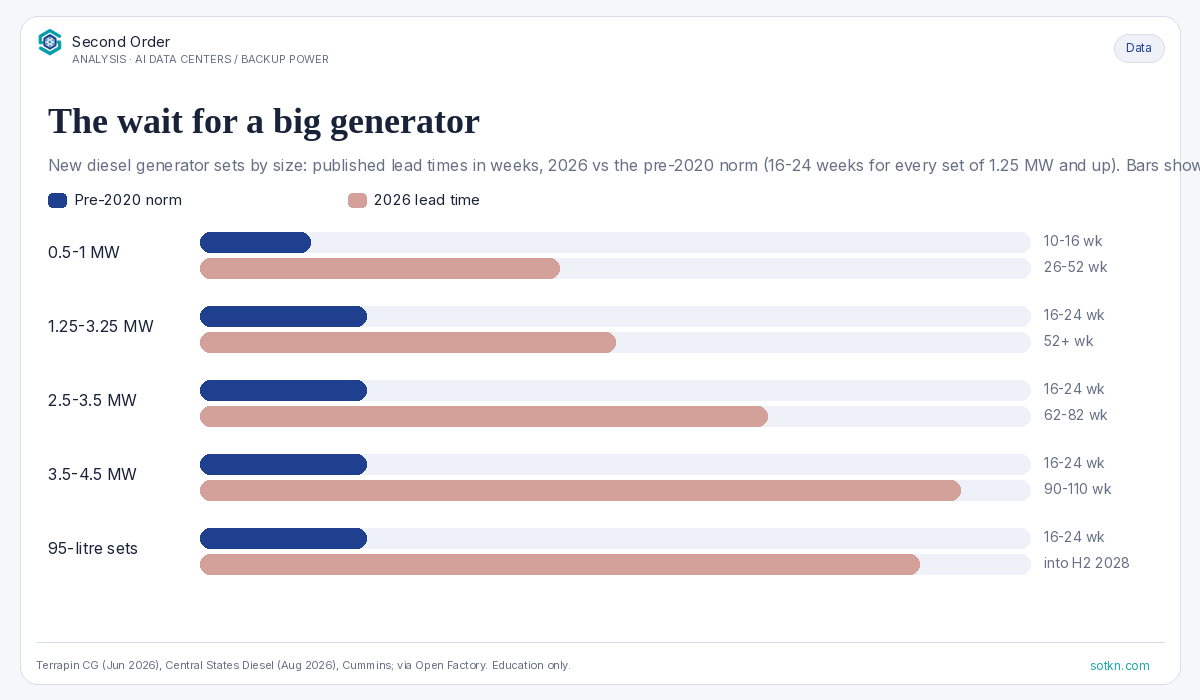
Chart 1 — Published 2026 lead times for new diesel generator sets by size, against the pre-2020 norm. Contractor slot-reservation data (June 2026) and dealer data (August 2026). Education only.
Why did the engine become the clock?
An AI hall cannot be handed over without backup power. If the grid fails, batteries carry the servers for minutes and diesel generators start within seconds and carry the load until the grid returns. A 100 MW campus typically installs 100 MW or more of generator sets, often 2 to 3 MW each. Our data centre tiers explainer shows why the most reliable designs add spare units on top. US data centre diesel capacity rose from about 20 GW in 2018 to about 55 GW in 2024.
A generator set is a large diesel engine plus the alternator, enclosure, fuel tank and controls around it. The box can be built in many places; the large engine cannot. Engines of 60 to 95 litres come from a handful of plants run by Caterpillar, Cummins, Rolls-Royce's mtu business, Mitsubishi Heavy Industries and a few others. Generac, which entered the large data centre market only in 2025, told investors this week that it has two or three suppliers for every major part "with the exception of the engine", because of what its chief executive called the limited supply of high-horsepower diesel engines worldwide.
Supply grows slowly. Cummins doubled its 95-litre capacity in 2025 and sold the extra output into 2028. Caterpillar plans to almost triple large engine capacity from 2024 to 2030, partly by using a locomotive engine plant as a second assembly site. Caterpillar's chief executive described the ramp this week as "hand to mouth"; when one test cell went down in the third quarter, there was "no slack in the system".
So the queue holds. The question is not whether AI halls need backup engines; they do. It is who holds the cash and the slots while the queue runs into 2028, and how much of that cash reaches the companies that only package the engine. Our gas turbine Analysis found the same pattern for the machines that make power; this is the machine that keeps it on.
What does the map already assume?
Three answers compete:
- The queue eases. AI spending cools, projects are cancelled and new engine lines catch up. Orders fall below shipments and waits shorten towards a year
- The queue holds. Orders keep running about a third ahead of shipments, makers add output as fast as they can, and the wait for a big engine stays about 20 months into 2030
- The queue tightens. Gas engines for full-time on-site power take more of the same lines, stricter air rules push buyers towards cleaner engines with extra exhaust equipment, and the wait grows
Our read, in one line: the map already assumes Scenario B. The large engine block, not the generator box or the hall, is the stuck step. Cash sticks first with the engine makers, then with buyers who hold slots under frame deals, then with packagers that secured engines, at about half the engine makers' margin. Developers with no slot, no parent guarantee and no deposit wait longest. The scenarios and the arithmetic are below.
The free preview ends here.
—— Still to read · ~9 of 14 minutes ——
MEMBERS CONTINUE HERE
- Who gets paid, in order, and who waits
- Where the margin sits: engine makers against packagers
- Three scenarios with the arithmetic
- Why output is the same in every scenario
- Five practical takeaways
- Members' FAQ