What Are Data Center Tiers? Tier I to IV in AI Data Centers
Data center tiers grade the spare generators, batteries and second paths that keep a hall running. That spare kit is bought but rarely used, and AI builders are now splitting over how much of it a GPU hall needs.
EXPLAINED · Mechanism · Last reviewed: 24 Oct 2026 · Next review: after Caterpillar reports third-quarter 2026 results, or when Uptime Institute publishes its next AI resiliency research
Data center tiers are a four-level rating, Tier I to Tier IV, of how well a data center’s power and cooling keep running through maintenance and equipment failure.
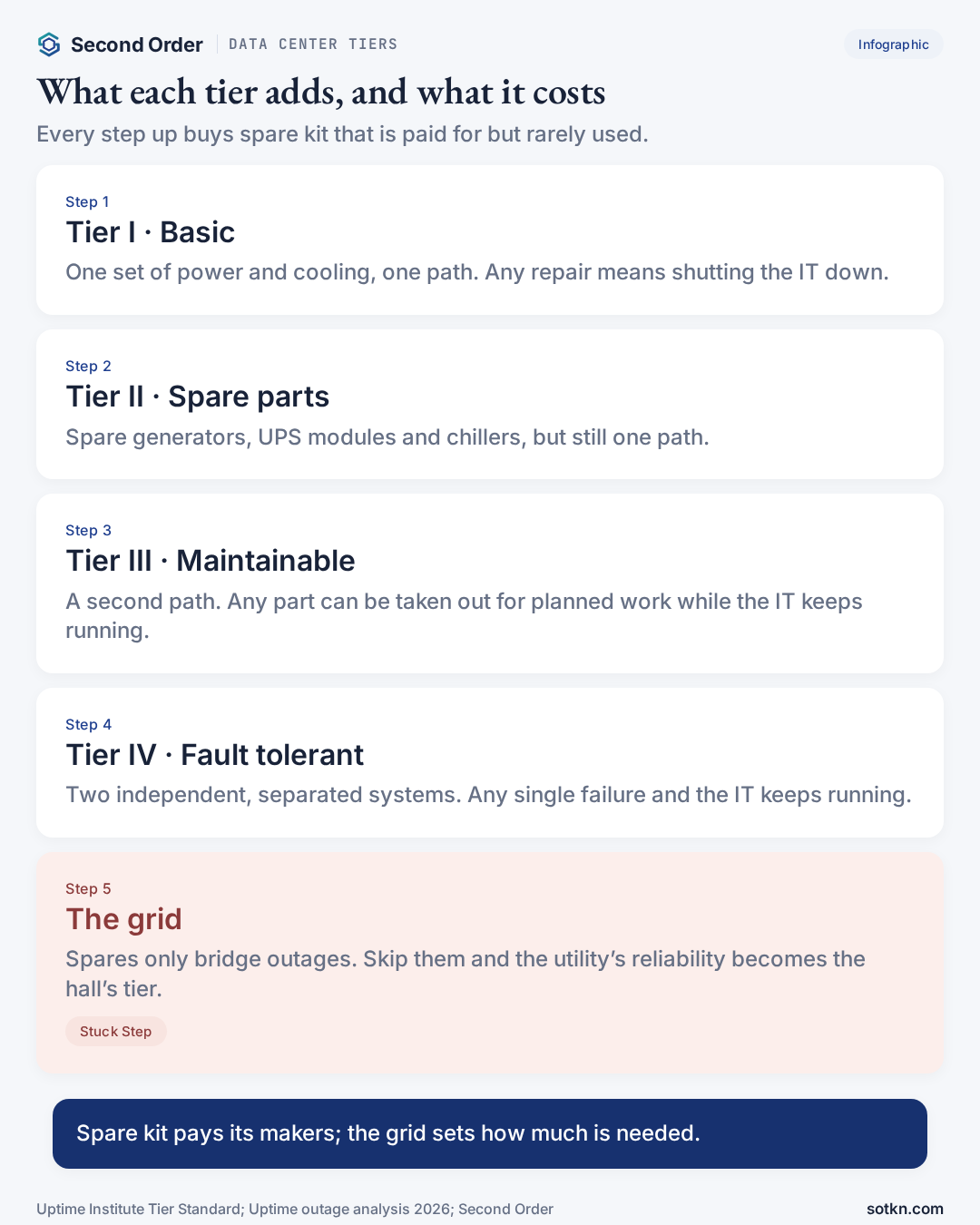
In short. Data center tiers grade the backup inside a facility: spare generators, batteries, chillers and second power paths. Tier III means any part can be taken out for maintenance while the computers keep running; Tier IV means a single failure will not stop them. That spare kit is bought, installed and maintained but rarely used, and generator makers are being paid for it: Caterpillar’s power generation sales rose 29% in the second quarter of 2026, mainly for data centres. AI is splitting the market. Microsoft built its Atlanta AI site without on-site generators or UPS for the GPUs and leans on the grid, while landlords still sign tenants on Tier III and Tier IV halls. The stuck step is the grid: when builders skip the spares, the utility’s reliability becomes the hall’s tier.
Why an investor cares: every tier step buys equipment that does no computing. Spare generators, batteries and second power paths are capex that suppliers are paid for today, and the tier a landlord can promise shapes which tenants sign. For AI halls the question is live, because the biggest builders are deciding how much of that spare kit a GPU hall really needs. Our AI data center explainer covers what sits inside the building; this page is about what keeps it running.
What are the four data center tiers?
Data center tiers run from Tier I, a single set of power and cooling with no spares, to Tier IV, where two independent systems keep the computers running through any single failure. Uptime Institute created the system and is the only firm that certifies it. It says it has issued more than 4,300 Tier awards in over 120 countries.
Each tier includes everything in the tier below. The test is not how much equipment is installed but what happens when a piece of it is taken away, either on purpose for maintenance or by surprise when it breaks.
| Tier | Uptime name | What it adds | Planned maintenance | One equipment failure | Common shorthand |
|---|---|---|---|---|---|
| Tier I | Basic capacity | Dedicated IT space, a UPS, cooling and on-site generation; one path, no spares | Site shutdown | Hits the IT | N |
| Tier II | Redundant capacity components | Spare generators, UPS modules, chillers, pumps; still one path | Site shutdown still needed | May hit the IT; a path failure will | N+1 components |
| Tier III | Concurrently maintainable | Spares plus independent distribution paths; IT dual-powered | No shutdown | Can still hit the IT | N+1 with two paths |
| Tier IV | Fault tolerant | Independent, physically separated systems and active paths | No shutdown | IT keeps running | Often 2N |
Tier names and requirements from Uptime Institute’s Tier Standard: Topology; every tier also requires twelve hours of on-site fuel. The redundancy shorthand is common industry usage, not part of Uptime’s definition.
What is the difference between Tier III and Tier IV?
Tier III survives planned work; Tier IV survives unplanned failure. In a Tier III hall every generator, UPS module, chiller and cable path can be switched out for servicing while the IT load keeps running. Uptime is explicit that a Tier III site is still exposed to an equipment failure or an operator error.
Tier IV adds fault tolerance. The two systems must be physically separated, so a fire or flood in one cannot take out the other, and the IT equipment itself must be built to draw power from both. That separation is what makes Tier IV expensive: it is two plants, two sets of rooms and two sets of routes, not one plant with spares.
What do N, N+1 and 2N mean?
N is the amount of equipment needed to carry the full load. N+1 adds one spare unit. 2N installs two complete systems, each able to carry the load alone. They are the everyday shorthand behind the tiers, and they show where the money goes.
| Design | Generator sets installed | Spare sets | Share of backup kit that is spare | What it survives |
|---|---|---|---|---|
| N | 20 | 0 | 0% | Nothing: one set down and the hall is short |
| N+1 | 21 | 1 | about 5% | One set failing or in service |
| N+2 | 22 | 2 | about 9% | One set in service and another failing |
| 2N | 40 | 20 | 50% | Losing a whole system |
Illustration for a hall whose full load needs 20 identical generator sets. Our arithmetic; real designs also size for cooling load, derating and growth.
The arithmetic is simple. Going from N+1 to 2N on a hall that needs 20 generator sets means buying 19 more sets that should almost never run. That is why redundancy is a design choice with a price tag, not a box to tick. Uptime adds a warning: component count does not decide the tier, because it also judges the distribution paths. It says Tier IV is even possible with just N+1 components if they are connected to redundant paths, while a site with spares on a single path stays Tier II.
Does an AI data center need Tier III or Tier IV?
It depends on the work. Inference answers live users, so an outage is visible at once and the case for high resiliency is clear. Training is a long batch job that can stop and restart from a saved checkpoint, so some builders accept less backup. Our training vs inference page explains the split.
The industry has not settled. In Uptime Institute’s 2025 survey of organisations training AI in their own or colocated halls (69 answers, more than one allowed), 52% reported some redundant components, 29% concurrently maintainable infrastructure and 19% fully fault tolerant 2N+1. Another 14% had basic capacity with no redundancy and 13% had no resiliency requirement at all.
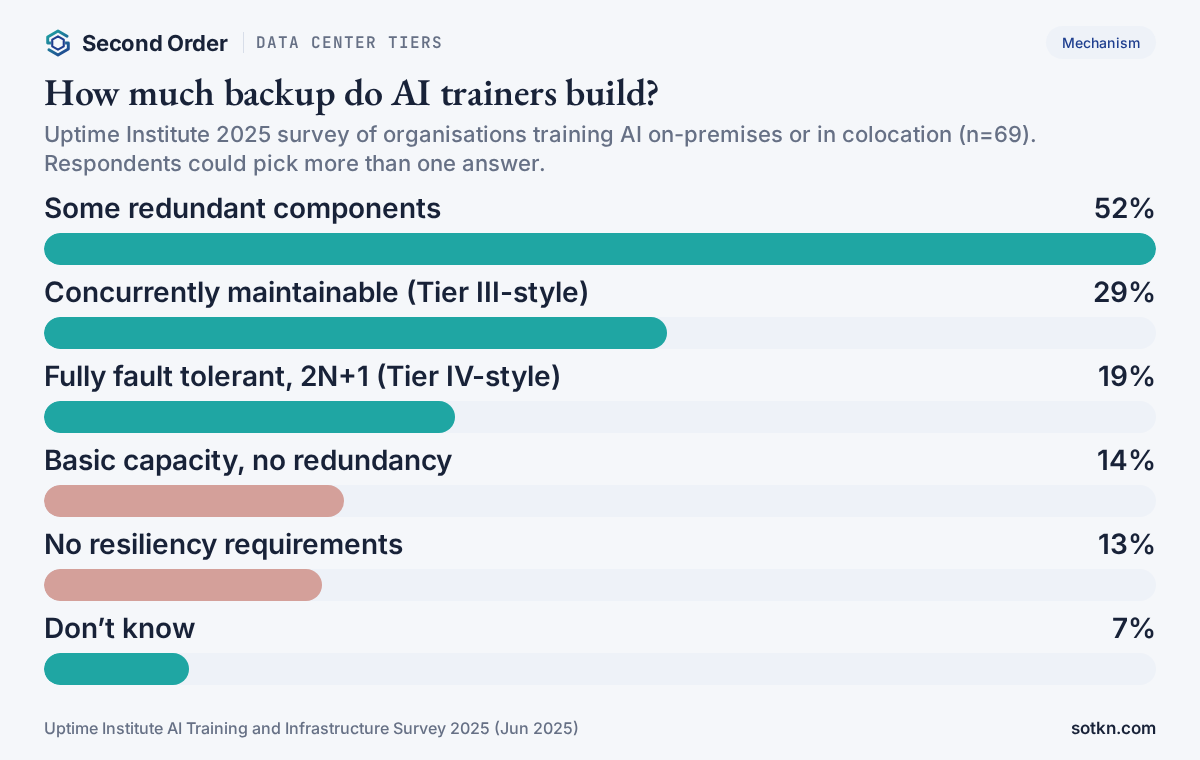
Uptime’s May 2026 outage report says some large AI sites were built at speed using crypto-mining-style designs with relatively low resiliency, but that more recent evidence points toward higher levels such as Tier III. Its explanation: training runs already stop and restart to deal with failing chips, and a major power or cooling failure on a huge cluster wastes expensive work even if no end user notices.
Why did Microsoft drop generators at its Atlanta AI site?
Because it chose the grid as its backup. Microsoft said on 12 November 2025 that the Atlanta site of its Fairwater AI data centers was selected for resilient utility power and can achieve four-nines availability at three-nines cost. With highly available grid power, it said, it could forgo traditional resiliency for the GPU fleet: on-site generation, UPS systems and dual-corded distribution. It added on-site energy storage to smooth the power swings that large training jobs create. What Microsoft does covers where these sites fit in Azure.
Our read: this does not abolish the tier, it moves it. A hall with no generators is exactly as reliable as the power line feeding it. Microsoft can do that where the grid is strong and where training work can be shifted between linked sites. A landlord selling to many tenants, or a site on a weaker grid, cannot.
What does a tier rating mean for a data center lease?
It is part of what the tenant is paying for. Landlords lease critical IT megawatts, the power the tenant’s servers can actually use, and the tier says how well those megawatts are protected. Our data center lease explainer covers how those contracts are priced; three 2026 deals show tiers in the paperwork.
- CleanCore and Cerebras, Minnesota (29 July 2026). A campus designed to Tier 3 standards, with about 55 MW of utility power for 40 MW of critical IT load, under a 10-year agreement worth about $800 million at the start. That is roughly $2 million per critical IT megawatt per year, our arithmetic from the stated totals.
- PowerHouse Arcola, Virginia (15 January 2026). A hyperscale lease on a campus of up to 120 MW of utility capacity, marketed as “Tier III+/IV-ready”. Uptime says terms like “Tier III plus” have no basis in its system.
- NEXTDC KL1, Kuala Lumpur (14 May 2026). A facility designed for 65 MW of IT capacity on Tier IV design principles, which NEXTDC said would be the first Uptime Tier IV-certified data centre in Peninsular Malaysia. Uptime’s Malaysia award list now shows KL1 with Tier IV certificates for both its design documents and its constructed facility.
Our read: most of the gap between utility power and critical IT, 55 MW against 40 MW in Minnesota, is the cooling and electrical overhead that PUE measures. Redundancy is a different cost, mostly extra equipment that PUE does not show. For a landlord such as NEXTDC, a certified tier is part of how it wins enterprise, government and cloud tenants; Uptime notes that some healthcare providers, outsourcers and state governments require Tier III.
Who gets paid, and where is the stuck step?
The makers of backup equipment are paid first, at build time. Caterpillar’s power generation sales were $3.10 billion in the second quarter of 2026, up 29% from $2.41 billion, driven by large engines and turbines mainly for data centres. Every spare set in an N+1 or 2N design is one more engine sold, and UPS, switchgear and transfer-switch makers sell into the same spare capacity.
Landlords are paid next, if the tier lets them charge for protected megawatts and sign long contracts. The tenant pays both, through rent per critical IT megawatt.
The stuck step is the grid. Spare generators and batteries only bridge an outage; they do not create supply. Uptime’s 2026 report says power caused 45% of impactful outages in 2025, led by UPS, transfer-switch and generator failures, and that limited grid capacity or delays in interconnection can restrict redundancy options. Outages linked to single-corded IT equipment also rose. Our read: as AI builders lean harder on the utility, the tier of a hall is increasingly set outside its fence. NEXTDC’s Melbourne power delay and Malaysia’s gap between booked and used power show the same constraint from the landlord side.
What would prove this wrong?
- Grid-backed AI halls go mainstream without outages. If more builders copy Microsoft’s no-generator design and failures stay rare, spare kit per megawatt shrinks and backup suppliers lose a slice of each build.
- Training sites keep moving up to Tier III. If Uptime’s next research confirms the shift it described in May 2026, AI halls carry the same spares as cloud halls and the split closes the other way.
- Generator orders slow while data centre capex keeps rising. That would mean redundancy is being designed out faster than halls are being added.
What to check next
Watch the next quarterly results from generator makers such as Caterpillar for data-centre demand, and any new AI campus announcement for its stated tier and its utility-to-IT megawatt ratio. Our cost of building an AI data center page shows how electrical plant fits into the bill, and the AI Data Centers layer tracks the landlords.
Common misconceptions
- People assume N+1 equipment makes a site Tier III. Actually Uptime judges the whole topology, including independent distribution paths, not just the spare count.
- People assume “Tier III+” or “Tier IV-ready” is a rating. Actually only Tier I to IV exist, and only a certificate says whether the design, the built facility or its operations were checked.
- People assume Tier III never goes down. Actually Tier III protects planned maintenance; an unplanned failure or operator error can still cause an outage.
- People assume tiers measure efficiency. Actually tiers measure resilience; efficiency is measured by PUE, a separate number.
FAQ
What are data center tiers?
Data center tiers are Uptime Institute’s four-level rating of how well a facility’s power and cooling keep running through maintenance and failure. Tier I has no spare capacity; Tier II adds spare components; Tier III can be maintained without shutting down IT; Tier IV keeps IT running through any single failure.
What is the difference between Tier III and Tier IV?
Tier III is concurrently maintainable: any component or path can be taken out for planned work without stopping IT, but an unplanned failure can still cause an outage. Tier IV is fault tolerant: independent, physically separated systems keep IT running after any single failure.
What do N, N+1 and 2N mean in a data center?
N is the amount of equipment needed to carry the full load. N+1 adds one spare unit, so the load survives one unit failing or being serviced. 2N duplicates everything, so a whole system can be lost. These are shorthand for components; Uptime’s tiers also judge the distribution paths.
Does an AI data center need Tier III?
It depends on the work. Inference serves live users and needs high resiliency. Training is a batch job that can restart, so some builders accept less. In Uptime’s 2025 survey of AI trainers, 29% reported concurrently maintainable infrastructure and 19% fully fault tolerant.
Is Tier III+ a real data center tier?
No. Uptime Institute, which owns the Tier system, says terms like “Tier III plus” have no basis in Tiers. Only Tier I to IV exist, and a certificate states whether it covers the design documents, the constructed facility or ongoing operations.
Who certifies data center tiers?
Uptime Institute certifies its own Tier Classification, and says it has issued more than 4,300 Tier awards in over 120 countries. Other standards, such as TIA-942 rated levels, use similar ideas but are separate schemes.
Is this a list of stocks to buy or sell?
No. This page explains how data center tiers work and where the money goes. It does not rank companies or give buy or sell calls. Not investment advice. Do your own research.
Related: PUE; what is an AI data center; data center lease; hyperscale vs colocation; AI training vs inference; data center financing.
Stack doors
Layer: AI Data Centers. Also: Hyperscalers, Neoclouds. Markets: Malaysia, Australia and US, where landlords sell certified megawatts.
Get the Wire — short daily notes when data center power, leases and capacity move.
Not investment advice. Do your own research.
How we check this
Tier definitions come from Uptime Institute, which owns the Tier Classification System: its Tier Standard: Topology, its Tier pages and its own published myths list. Survey and outage figures come from Uptime’s AI Training and Infrastructure Survey 2025 and its Annual outage analysis 2026. Company facts come from the companies’ own filings and releases: Microsoft (12 November 2025), PowerHouse (15 January 2026), NEXTDC (14 May 2026), CleanCore (29 July 2026), Caterpillar (4 August 2026). Each figure was re-checked on 24 Oct 2026. Generator counts in the N, N+1 and 2N table are an illustration, and the per-megawatt contract figure is our arithmetic from CleanCore’s stated totals. Both are labelled. Where we interpret, it is labelled “our read”. This page explains how data center tiers work. It does not rank companies or give buy or sell calls. Not investment advice. Do your own research.
Last reviewed: 24 Oct 2026 · Next review: after Caterpillar reports third-quarter 2026 results, or when Uptime Institute publishes its next AI resiliency research
Spot an error? Tell us and we will correct it and note the change here.
References
- Uptime Institute — Tier Classification System (accessed 24 Oct 2026) — Tier I basic capacity; Tier II redundant capacity components; Tier III concurrently maintainable; Tier IV fault tolerant; over 4,300 Tier Certifications in 120+ countries
- Uptime Institute — Data Center Site Infrastructure Tier Standard: Topology (2018 edition) — fundamental requirements per tier, incl. dual-powered IT at Tier III, compartmentalisation at Tier IV, twelve hours of on-site fuel
- Uptime Institute Journal — Myths and misconceptions regarding the Tier system (20 Jul 2017) — “Tier III plus” has no basis in Tiers; N+1 components alone do not make Tier III; design and constructed-facility certificates differ
- Uptime Institute — AI Training and Infrastructure Survey 2025 (Jun 2025) — AI training resiliency levels (n=69): some redundant components 52%, concurrently maintainable 29%, fully fault tolerant 19%, basic or none 14%, no requirements 13%
- Uptime Intelligence — Annual outage analysis 2026 (11 May 2026) — power 45% of impactful outages in 2025; UPS, transfer switch and generator failures dominant; some AI sites built crypto-style, trend toward Tier III; grid limits can restrict redundancy options
- Microsoft — Infinite scale: the architecture behind the Azure AI superfactory (12 Nov 2025) — Atlanta Fairwater site capable of 4×9 availability at 3×9 cost; forgoes on-site generation, UPS and dual-corded distribution for the GPU fleet
- CleanCore Solutions — Colocation agreement with Cerebras, Form 8-K exhibit 99.1 (29 Jul 2026) — Minnesota campus designed to Tier 3 standards; about 55 MW utility capacity, 40 MW critical IT; 10 years, about $800M initial contract value
- PowerHouse Data Centers — Hyperscale lease at PowerHouse Arcola (15 Jan 2026) — Loudoun County campus, up to 120 MW utility capacity, marketed as “Tier III+/IV-ready”
- NEXTDC — KL1 Kuala Lumpur goes live (14 May 2026) — 65 MW of IT capacity, built to Tier IV design; Uptime’s Malaysia award list shows KL1 with Tier IV design and constructed-facility certificates
- Caterpillar — Second-quarter 2026 results (4 Aug 2026) — power generation sales $3.098B vs $2.407B, +29%, large reciprocating engines and turbines primarily for data centres