What Is Contracted Power? Why Neocloud Megawatts Aren’t Revenue Yet
Contracted power is the electricity a neocloud has signed rights to, not the power its GPUs are using. CoreWeave had 4.2 GW contracted in August 2026 but 1.5 GW active at 30 June; the gap is where revenue waits.

EXPLAINED · Mechanism · Last reviewed: 31 Oct 2026 · Next review: after CoreWeave’s third-quarter results (10 Nov 2026, US time) and Nebius’s (12 Nov 2026)
Contracted power is the data centre electricity a company has signed rights to, through land, lease and power agreements, whether or not any of it is switched on yet.
In short. Contracted power is the electricity a neocloud has signed rights to. Active power is the part its GPUs are actually drawing for customers. CoreWeave had about 4.2 GW contracted in August 2026 against about 1.5 GW active at 30 June, so on our arithmetic roughly two thirds of its signed power was not yet earning. Our read: landlords, power-gear makers and GPU sellers are paid before that power goes live; the neocloud is paid last; and the stuck step is getting each hall built, energised and handed over.
Why an investor cares: a neocloud’s headline gigawatts are mostly a promise of future capacity, not capacity that is earning today. Revenue starts only when a hall is built, energised, filled with GPUs and handed to a customer. Our guide to neoclouds covers the business model; this page covers the unit they count it in.
What is contracted power?
Contracted power is a right, not a running machine. A neocloud signs a lease with a data centre developer, buys land with a grid connection agreement, or commits to a power supply deal. Each of those gives it a claim on a number of megawatts at a site.
Add those claims up and you get contracted power. CoreWeave reported about 3.7 GW at 30 June 2026 and about 4.2 GW by its results call on 11 August. Nebius expects 5 GW by the end of 2026, up from the more than 4 GW it pointed to in May.
None of that says how much of the power is switched on. A gigawatt of contracted power can be a finished hall running at full load, a shell still being built, or a field waiting for a substation.
Contracted, connected and active power: what is the difference?
Contracted power is signed. Connected power is built and hooked up. Active power is drawn by working GPUs. Nebius set out the three terms in its February 2026 shareholder letter, and CoreWeave uses contracted and active in a similar way.
| Term | What it means | Earning yet? |
|---|---|---|
| Pipeline / powered land | Sites, options and letters of intent with a route to power. CoreWeave keeps more than 1.5 GW of these outside its contracted number | No |
| Contracted power | Land, lease and power agreements signed. Nebius: “power secured by contracted land and power commitments” | No |
| Connected power | Power connected into a built data centre (Nebius’s term) | Not yet; GPUs may still be going in |
| Active power | Power being drawn by installed IT equipment | Yes, once the customer accepts the capacity |
Definitions as the companies use them in their 2026 letters and results. Contracted, connected and active power nest, each inside the one above, so the figures should never be added together. The pipeline row sits outside contracted power.
The counts nest inside each other. Active power is part of connected power, which is part of contracted power. Adding CoreWeave’s 4.2 GW and 1.5 GW to get 5.7 GW would double count.
Contracted power is also different from a customer contract. It is the supply side: the space and electricity the neocloud has secured. The demand side is backlog, the signed customer revenue not yet billed. Our guide to remaining performance obligation covers that side of the ledger.
How big is the gap between contracted and active power?
Large, and it is meant to be. Our read: neoclouds sign power years ahead because the scarce input is a site that can be energised, not the GPUs. The gap is the work still to do.
| Company | Signed | Built or live | Share live (our arithmetic) |
|---|---|---|---|
| CoreWeave | About 3.7 GW contracted (30 Jun 2026); about 4.2 GW (11 Aug) | About 1.5 GW active (30 Jun); guide more than 1.85 GW by year-end | About 41% on 30 June numbers; about 36% against the August figure |
| Nebius | 5 GW contracted targeted by end-2026 | 800 MW to 1 GW connected targeted by end-2026; about 170 MW active at end-2025 | 16–20% of the target would be connected |
| IREN | More than 5 GW data centre pipeline | About 0.3 GW (IT) cumulative delivery targeted for 2026; 0.8 GW (IT) for 2027 | About 6% by end-2026, 16% by end-2027 (mixes grid and IT bases; see below) |
Company figures from CoreWeave (11 Aug 2026), Nebius (12 Feb and 12 Aug 2026) and IREN (27 Aug 2026). The right-hand column is Second Order arithmetic. The companies use different bases, so compare each with itself over time, not with each other.
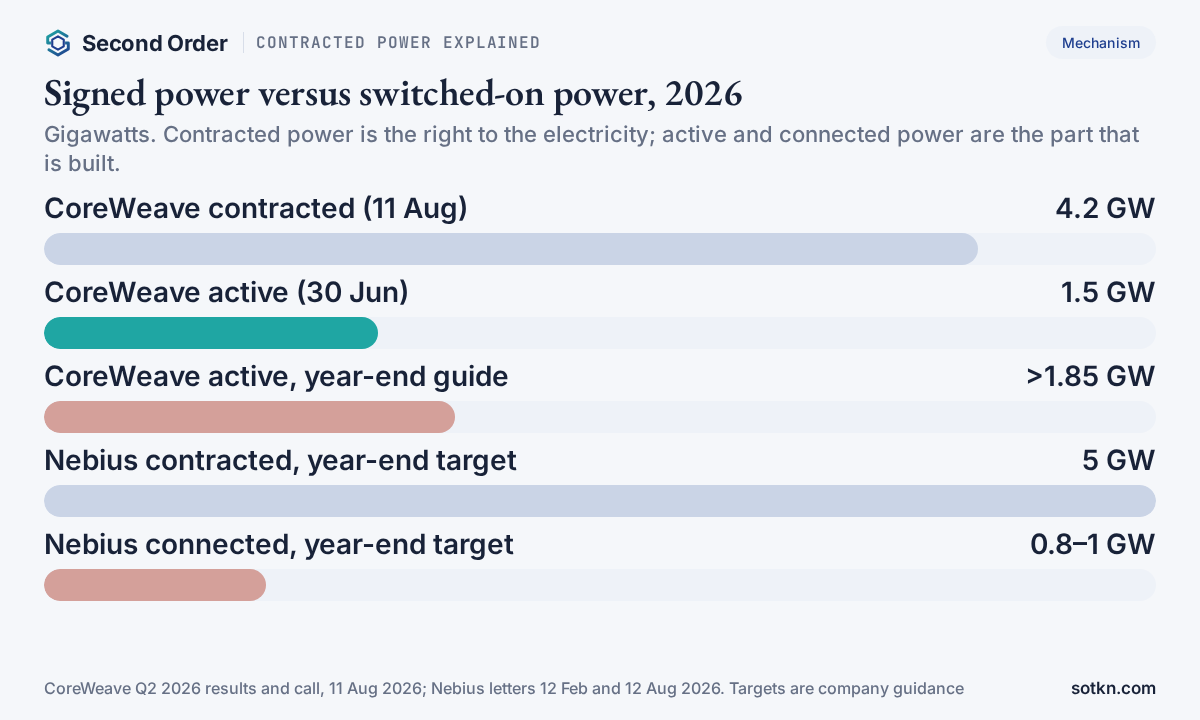
Our arithmetic: CoreWeave’s gap between contracted and active power was about 2.7 GW (4.2 GW less 1.5 GW). Its record second quarter added nearly 500 MW. At that pace the gap is about five and a half quarters of building, if no new power were signed.
But the year-end guide implies a slower second half. More than 1.85 GW by December means at least 350 MW more across two quarters. Bank of America analysts, as reported on 22 October, expect about 200 MW in the third quarter, taking active power to about 1.7 GW. That is an estimate; the company reports on 10 November, US time.
Our Analysis on CoreWeave’s power-on stuck step works through what that pace means for the share price; this page sticks to the term.
How long does contracted power take to go live?
One to three years is typical. The clock runs from signing through grid works, building, fit-out, GPU installation and testing to handover. Every one of those steps happens after the megawatts are already counted as contracted.
| What was signed | When it goes live, as stated | What it tells you |
|---|---|---|
| CoreWeave, 360 MW in Indonesia | Begins coming online about 18 months after the August 2026 call | A new country takes about a year and a half |
| CoreWeave leased sites | 393 MW at one site and 355 MW at others undelivered on 30 June 2026, arriving in phases between 2026 and 2028 | Even signed leases land over two to three years |
| Nebius, second Meta agreement | Capacity on track for early 2027 | Contracts signed in 2026 mostly earn from 2027 |
| IREN, Horizon 3–4 at Childress | Late-stage construction, targeting delivery in the fourth quarter of 2026 | A built hall still waits on commissioning and handover |
Timings are company statements from August 2026 filings, letters and calls, not guarantees.
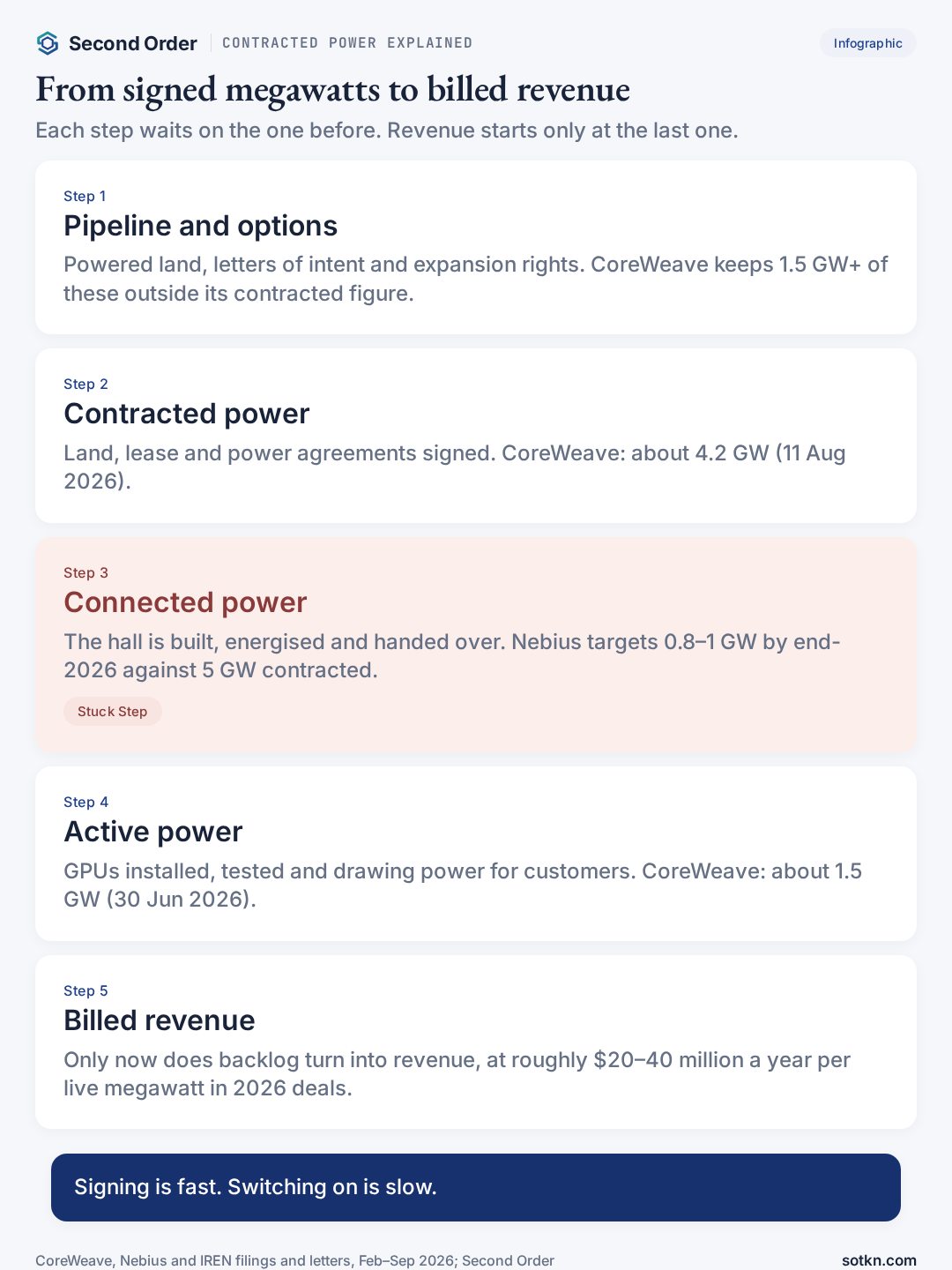
Our guide to how long an AI data centre takes to build breaks the build into its parts. The short version: the grid connection and the hall are the long poles, and GPUs can be ordered once both are in sight.
Who gets paid before the power is live?
Almost everyone except the neocloud. Contracted power sets off a chain of spending months or years before the first customer invoice.
Developers and landlords are paid first. CoreWeave’s 10-Q shows leases where rent is set by the landlord’s construction costs, with 748 MW still undelivered at 30 June across those sites on our arithmetic (393 MW plus 355 MW). Our read: the landlord is building for a signed tenant, so it can raise money against that lease before the neocloud earns a dollar from the site.
Power-gear makers are paid next, often in advance. Transformers, switchgear and cooling are ordered before the hall is finished. Our Analysis on Vertiv’s prepaid gear line shows customers paying up front to hold a place in the queue.
GPU sellers are paid when the systems ship. Much of that bill is now covered before power is live by customers and lenders. IREN said in August that recent customer prepayments cover 45–55% of GPU capex, and that its $3.6 billion GPU financing at 6.0% for the Microsoft contract, with prepayments, funds 96% of the related GPU capex. Nebius said 70% of its second-quarter deals carried prepayments covering 50–60% of capex.
The neocloud is paid last, once capacity is active and the customer accepts it. Until then it carries interest, rent and depreciation on equipment that is not yet earning. Our guide to GPU financing covers how those loans are built.
Where is the stuck step?
Our read: between contracted and connected. Signing power has become fast; Nebius raised its year-end contracted target three times in 2026, from more than 2.5 GW to 5 GW. Turning it into a built, energised hall is what sets the pace, and much of it sits with third parties: utilities, developers and contractors.
Delays show up there first. Our Wire covered an Nscale site running six months late, and our Wire on Nebius’s Rotterdam letter of intent showed how a headline site can be a letter of intent, not even contracted power.
A finished hall is not quite the end. GPUs still have to be installed, networked and run through acceptance tests before the power counts as active. IREN’s Horizon 3 and 4 halls were in late-stage construction in August with delivery targeted for the fourth quarter. Our read: that last stretch is weeks to months, not years.
What is a megawatt worth once it is live?
Tens of millions of dollars a year in 2026 contracts. IREN said recent three-year deals bring in more than $20 million of revenue per megawatt of IT power a year, with talks at about $25 million. CoreWeave said its short three-to-six-month deals in the third quarter priced at about $40 million per megawatt.
Our arithmetic: at $20 million per megawatt a year, 100 MW of active power brings in about $2 billion a year, or about $500 million a quarter. So each 100 MW that goes live one quarter late pushes back roughly $500 million of revenue. At the $40 million short-contract rate, it is about $1 billion.
That is why the gap matters more than the headline. Two neoclouds with the same contracted power can have very different revenue for years, depending on how fast each turns it on. Our guide to GPU rental prices covers what sets the per-hour price behind those per-megawatt figures.
Is an IT megawatt the same as a grid megawatt?
No. Grid power is what a site draws from the utility. IT power is the part that reaches the servers after cooling, power conversion and other overhead. IREN quotes its delivery targets and pricing in megawatts of IT. Pipeline and contracted figures do not always say which base they use.
Our arithmetic, for illustration: at a power usage effectiveness of 1.3, a 1,000 MW grid connection supports about 770 MW of IT load. Our guide to PUE explains the ratio. Check which base a company uses before comparing two figures.
Why does this matter for Singapore and Asia?
Because single sites in Asia’s tightest markets are small next to neocloud totals. CoreWeave entered the region with 360 MW in Indonesia. Our arithmetic: its nearly 500 MW added in the second quarter alone is about 12 times the 42 MW of the Singapore hall covered in our Markets note on Digital Core REIT’s SIN12. Our note on Singapore’s power plan for data centres covers the 200 MW of data centres awarded there in August 2026 and the grid plan behind them. Our read: where sites are this small, each signed megawatt is scarcer, and the gap between contracted and active power matters even more.
What would change the view?
- Active power catches up. If CoreWeave reports well above the 200 MW Bank of America expects for the third quarter, the pace of switching on is better than the guide implies.
- Contracted power stops rising. If neoclouds stop raising contracted targets, either the scarce input has eased or demand has. The second would show up in backlog first.
- Halls slip. If lease delivery dates move out beyond 2028 in the next 10-Q, the gap stays open longer and carrying costs build up before revenue starts.
What to check next
Watch CoreWeave’s third-quarter results on 10 November (US time) for active and contracted power, and Nebius on 12 November for any connected or active figure. Our CoreWeave Stack page, Nebius Stack page and IREN Stack page track each company’s numbers.
Common misconceptions
- People assume contracted power is capacity that is running. Actually it is a signed claim on electricity at a site. CoreWeave had about 1.5 GW active against about 3.7 GW contracted at 30 June 2026.
- People add contracted and active power together. Actually active power is part of contracted power. Adding them double counts.
- People assume a megawatt is a megawatt. Actually some figures are at the grid connection and some are IT load, and the gap between them is the cooling and conversion overhead.
- People assume contracted power means a customer has signed. Actually it is the supply side. Customer commitments show up in backlog, and revenue needs both to meet in a live hall.
FAQ
What is contracted power?
Contracted power is the data centre electricity a company has signed rights to, through land, lease and power agreements, whether or not any of it is switched on yet. Neoclouds such as CoreWeave and Nebius report it in megawatts or gigawatts.
What is the difference between contracted power and active power?
Contracted power is what a company has signed for. Active power is the part that is switched on and being drawn by installed IT equipment. Active power sits inside contracted power, so the two should never be added together.
What is connected power?
Connected power is the middle step used by Nebius: power connected into a built data centre. It is closer to revenue than contracted power, but the GPUs may not yet be installed, tested and handed to a customer.
How much contracted power does CoreWeave have?
About 4.2 GW as of 11 August 2026, up from about 3.7 GW at 30 June. Its active power was about 1.5 GW at 30 June, and it guided to more than 1.85 GW by the end of 2026. Its next update is due with third-quarter results on 10 November 2026, US time.
How long does contracted power take to go live?
Typically one to three years. CoreWeave said its 360 MW in Indonesia would begin coming online about 18 months after its August 2026 call, and its lease filings show undelivered power arriving in phases between 2026 and 2028.
Is contracted power the same as backlog?
No. Contracted power is the supply side: the space and electricity a neocloud has secured. Backlog, or remaining performance obligation, is the demand side: signed customer contracts not yet billed. Revenue needs both to meet in a live hall.
Is this a list of stocks to buy or sell?
No. This page explains what contracted power means and why it is not revenue yet. It does not rank companies or give buy or sell calls. Not investment advice. Do your own research.
Related: neocloud; who the neoclouds are; data centre lease; remaining performance obligation; PUE; GPU financing.
Stack doors
Layer: Neoclouds. Also: AI Data Centers. Markets: US, Singapore.
Get the Wire — short daily notes when neocloud power and contracts move.
Not investment advice. Do your own research.
How we check this
CoreWeave’s contracted and active power, backlog, guidance and Indonesia timing come from its second-quarter results and earnings call of 11 August 2026; undelivered lease megawatts come from its Form 10-Q for the quarter to 30 June 2026; the $40 million per megawatt figure comes from its 17 September 2026 release. Nebius’s definitions and figures come from its shareholder letters of 12 February and 12 August 2026. IREN’s pipeline, delivery targets, pricing and prepayments come from its FY26 results of 27 August 2026. The third-quarter estimate for CoreWeave is Bank of America’s, as reported by Proactive Investors on 22 October 2026, and is labelled as an analyst estimate. The shares live, the gap and quarters-to-close figures, the revenue-per-quarter examples, the grid-to-IT conversion and the Singapore comparison are our arithmetic and are labelled as ours on the page. The order of who gets paid and the stuck step are our read. The featured photograph is credited in its caption. This page explains what contracted power means. It does not rank companies or give buy or sell calls. Not investment advice. Do your own research.
Last reviewed: 31 Oct 2026 · Next review: after CoreWeave’s third-quarter results (10 Nov 2026, US time) and Nebius’s (12 Nov 2026)
Spot an error? Tell us and we will correct it and note the change here.
References
- CoreWeave — CoreWeave Reports Strong Second Quarter 2026 Results (11 Aug 2026) — active power up nearly 500 MW to 1.5 GW; contracted power about 3.7 GW at 30 June 2026; revenue backlog about $104 billion
- CoreWeave — Q2 2026 earnings call transcript, via Yahoo Finance (11 Aug 2026) — contracted power 4.2 GW as of the call, excluding more than 1.5 GW of powered land, options and LOIs; year-end active power guide raised to more than 1.85 GW; 360 MW in Indonesia coming online in about 18 months; target of at least 8 GW by 2030
- CoreWeave — Form 10-Q for the quarter ended 30 June 2026 (Aug 2026) — 393 MW undelivered at one leased site and 355 MW at other leased sites as of 30 June 2026, to be delivered in phases between 2026 and 2028; rent tied to the landlord’s construction costs
- CoreWeave — CoreWeave Continues to Contract New Compute Capacity at Higher Prices (17 Sep 2026) — three-to-six-month contracts at about $40 million per megawatt, annualised revenue divided by power required; contracted power about 4.2 GW as of 11 August 2026
- Nebius Group — Letter to shareholders, Q4 2025 (12 Feb 2026) — definitions of contracted, connected and active power; about 170 MW active at end-2025; 800 MW to 1 GW of connected power targeted by end-2026
- Nebius Group — Letter to shareholders, Q2 2026, filed with the SEC (12 Aug 2026) — year-end 2026 contracted power target raised to 5 GW from more than 4 GW; more than 1 GW a year deployed from 2027; 70% of deals with prepayments covering 50–60% of capex; second Meta agreement capacity due early 2027
- IREN — IREN Reports FY26 Results, filed with the SEC (27 Aug 2026) — more than 5 GW data centre pipeline; cumulative delivery targets of about 0.3 GW (IT) in 2026 and 0.8 GW (IT) in 2027; three-year contracts above $20 million revenue per MW (IT), about a two-year payback; prepayments 45–55% of GPU capex; $3.6 billion GPU financing at 6.0%
- Proactive Investors — CoreWeave capacity expansion to drive revenue growth, Bank of America says (22 Oct 2026) — Bank of America analysts expect about 200 MW added in the third quarter, taking active power to about 1.7 GW