63.4 Isn't Slots: Who Gets Paid When Taiwan PMI Hits a Five-Year High
October 2026 in one line: CIER/NDC printed September manufacturing PMI at 63.4% — who gets paid is Taiwan manufacturers on production invoices; the stuck step is still CoWoS slots, not a 63.4 survey print.

Chung-Hua Institution for Economic Research and Taiwan’s National Development Council dated 1 Oct 2026 printed September manufacturing PMI at 63.4% — the fastest expansion since August 2021. Who gets paid is Taiwan manufacturers on production invoices, still led by electrical & machinery (64.4%) and electronic & optical (62.6%). The stuck step is still CoWoS-class packaging and the long-short materials bind: a 63.4 survey print is not a working package slot, and electronic & optical new orders already dropped 10.8 percentage points.
TAIWAN PULSE · Data as at 5 Oct 2026 · Next update: after TSMC September revenue (8 Oct) or the October PMI
Affects: Semiconductors · Hyperscalers · Neoclouds — Markets: Taiwan · Korea · US · China
Education only, not advice to buy or sell any security. Official CIER/NDC figures are labelled as reported. Prior Taiwan Chiayi-land, TSMC-revenue, and capex-split Pulses are cross-linked, not re-led.
The numbers that matter this month
Taiwan manufacturing PMI (Sep)
63.4%
+0.9 pt · fastest since Aug 2021 · 12th month expanding
PrimaryProduction index
65.6%
+0.4 pt · fastest since Aug 2021 · 6th month expanding
PrimaryNew orders index
63.6%
−2.9 pt from 66.5 · still expanding, slower
PrimaryElectronic & optical PMI (NSA)
62.6%
New orders 56.7 (−10.8) · inventories 64.8
Primary63.4 ≠ CoWoS slots
Still the bind
Supplier deliveries 68.6 · E&O deliveries 73.8 · hardware still scarce
Stuck stepElectrical & machinery PMI (NSA)
64.4%
Fastest of six industry groups in September
PrimarySources: CIER/NDC Taiwan Manufacturing PMI, 1 Oct 2026 (September). Status chips are Second Order’s read. A PMI print is not a CoWoS wafer-per-month figure.
On this page: Why Taiwan? · What changed · Our math · Where money sticks · Is CoWoS still stuck? · Dates next · How this differs · What would change this · FAQ
Why does Taiwan matter now?
Because the factories that still decide how many AI accelerators can ship — leading-edge logic wafers and the advanced packaging that joins those dies to high-bandwidth memory — sit mostly in Taiwan. A purchasing-managers print this hot is a volume signal. It is not, by itself, a slot signal.
Same map as the gold TSMC revenue / CoWoS Pulse and CoWoS, explained. The fresh question is who gets paid on that busyness, and which stuck step still sits between a survey expansion and a shippable AI package.
1 · Production invoices (CIER 1 Oct)
Who: Taiwan manufacturers on this month’s output
Paid: PMI 63.4 · production 65.6 — electrical & machinery 64.4, E&O 62.6
2 · CoWoS / long-short materials
Who: Packaging slots + mismatched inputs
Paid: Not by a 63.4 headline — deliveries 68.6, E&O orders −10.8 pt
3 · Leading-edge wafers
Who: TSMC
Paid: Next cash clock is 8 Oct monthly sales — not this PMI
4 · HBM stacks
Who: Mostly Korea
Paid: Neighbour door — CIER flagged memory-configuration tweaks
Chain is Second Order’s map. Neighbours: Semiconductors stack · CoWoS explained · Hybrid bonding explained · Korea HBM DRAM capacity-mix Pulse · Where does the stuck step move?.
If you only remember one thing: a 63.4 PMI pays the factories that are already running; it does not unstick the step that still decides who ships on time.
What changed
The fresh primary print is dated 1 Oct 2026 on CIER — the September Taiwan Purchasing Managers’ Index, jointly issued with the National Development Council and mirrored in English by ISM. It is a survey of about 300 manufacturing purchasing and supply executives, not a company filing and not a customs print.
What the print actually says, in plain English: the seasonally adjusted manufacturing PMI rose 0.9 percentage point to 63.4%, a twelfth consecutive month above 50 and the fastest growth rate since August 2021. New orders, production, and employment all expanded. Supplier deliveries lengthened (a reading above 50 means slower deliveries). Inventories grew. Customers’ inventories flipped to “too high” at 50.7% after three months of “too low.” Prices printed 80.4%. Backlogs of orders slowed to 54.9%, the slowest expansion since January 2026. New export orders and imports still expanded but decelerated, to 58.1% and 57.8%. Future outlooks stayed above 60 at 61.4%, down 3.8 points.
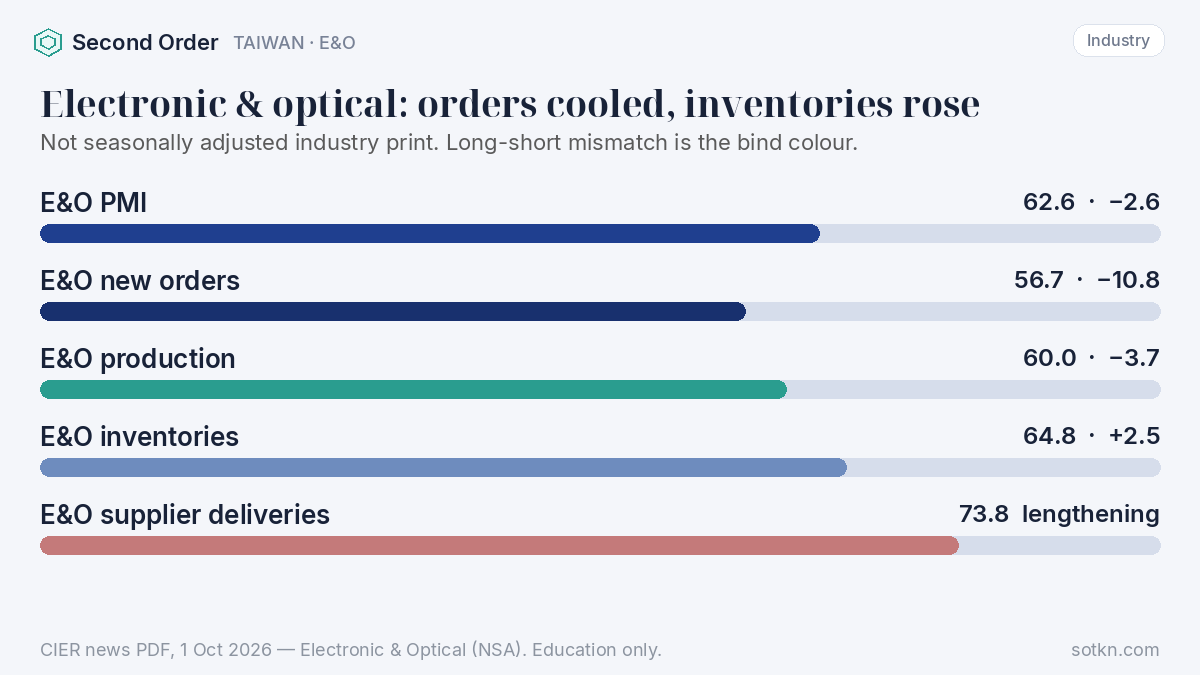
The industry cut is the tell. Electrical & machinery led at 64.4%. Electronic & optical — not seasonally adjusted — printed 62.6%, but new orders dropped 10.8 points to 56.7, production eased to 60.0, inventories rose to 64.8, and supplier deliveries and input prices printed 73.8 and 83.3. CIER: the industry moved from orders-and-production sprint into high-level expansion with slower orders and a long-short materials mismatch.
What the print does not say: a CoWoS wafer-per-month figure, a TSMC revenue print, or that packaging lead times shortened. Those gaps are the stuck step.
- CIER/NDC (1 Oct 2026): seasonally adjusted manufacturing PMI 63.4% (+0.9); production 65.6; new orders 63.6 (−2.9)
- Same: employment 57.6 (+1.6); supplier deliveries 68.6 (+2.0, 22nd month lengthening); inventories 61.4 (+3.2)
- Same: prices 80.4 (+5.1); backlog 54.9 (−5.8); new export orders 58.1 (−3.5)
- Same: electronic & optical PMI 62.6; E&O new orders 56.7 (−10.8); E&O inventories 64.8
- Same: electrical & machinery 64.4 — fastest of six industry groups
- Lien (CIER English, sourced to Commercial Times 2 Oct): AI hardware remains a limited resource; CSPs competing for capacity

CIER/NDC 1 Oct 2026 (September PMI). Education only.
CIER’s English note quotes President Hsien-Ming Lien that PMI has stayed above 60 for five consecutive months, that electronics production “approached a plateau,” and that the September data are more a slower expansion in electronic & optical than a collapse in demand. Treat that as institute commentary on this print, not as TSMC guidance.
Our math — labelled our arithmetic
The filing already prints the diffusion indexes. The arithmetic here is about what that scoreboard does and does not clear — not inventing a CoWoS slot count from a survey.
Our arithmetic — print vs stuck step
Inputs: ISM/CIER component table, 1 Oct 2026. The five-component average and the two gaps are Second Order’s arithmetic. “Not 1:1” is our judgment, not official guidance.
What this tells you: the headline 63.4 is internally consistent with the five components CIER publishes, and production is still running hotter than new orders even as backlogs slow. What it does not tell you: how many CoWoS-class packages cleared yield, or whether TSMC’s September sales will print above the gold Pulse’s Q3 math band. That cash clock is 8 October.
The electronic & optical gap is the sharper bind colour. New orders at 56.7 against inventories at 64.8 is an 8.1-point spread on our arithmetic — exactly the “long-short mismatch” CIER named. Supplier deliveries at 73.8 in that industry say the missing pieces are still late. CIER’s Chinese PDF adds that AI customers are adjusting product memory configurations because of supply limits. That is a neighbour HBM clock, not a reason to re-lead Korea in this Pulse.
CIER news PDF, 1 Oct 2026 — Electronic & Optical, not seasonally adjusted. Education only.
Primary vs neighbour clocks (label carefully)
Primary clock: CIER/NDC 1 Oct 2026. TSMC calendar and prior Pulses are neighbour doors.
Where does the money stick?
At the steps with the fewest good substitutes — and only after the stuck step can actually ship. A PMI print clears the claim that factories are still expanding. Packaging slots clear a yield gate. Those are different cheques.

Where money sticks on the September PMI print. Sources: CIER/NDC 1 Oct 2026. Education only.
- Production invoices (paying now). Electrical & machinery at 64.4 and electronic & optical at 62.6 are the industries still expanding fastest. Tool vendors, materials, and the factories running those lines get paid on this month’s output. That is the cash this print actually supports.
- Not the stuck step: the 63.4 headline. A five-year-high diffusion index is useful. It is not proof that CoWoS-class slots opened, or that the long-short mismatch CIER named has cleared.
- Neighbour scarcity (do not re-lead). Lien’s “limited resource” line and the memory-configuration note point at HBM and packaging together. Korea remains the memory door — see the HBM DRAM capacity-mix Pulse. Chiayi land remains a park gate — see Land Isn't Slots.
Same pattern as the August board-check / capex-split Pulse: money can be busy upstream without printing the scarce slots buyers are queuing for. A PMI is another upstream cheque.
Is CoWoS still stuck?
Yes. A purchasing-managers print does not shorten CoWoS lead times by itself.
Earlier Taiwan Pulses already mapped the bind: CoWoS capacity and the packaging gate, August revenue with packaging still setting the pace, Baipu CoWoS validation tools, and Chiayi packaging land. This Pulse adds the official September survey — and insists on the gap between 63.4 and working packages. Hybrid bonding is the next-join primer — not this lead.
Two cautions before you read “fastest PMI since 2021” as tomorrow’s supply:
- Variant still matters. CoWoS is a family. A hotter electrical-machinery PMI does not tell you whether the in-demand variant has slots.
- Lengthening deliveries are the honest bind colour in this print. Headline supplier deliveries at 68.6, electronic & optical deliveries at 73.8, and E&O new orders down 10.8 points while inventories rose — that is a mismatch, not a cleared gate.
If packaging catches up, the stuck step moves. Candidates stay HBM (mostly Korea) and power for data centres — see Where does the stuck step move?.
What dates matter

Dates to watch after the 63.4 PMI print. Education only.
Dates to watch
CIER/NDC 1 Oct; TSMC financial calendar; UDN 4 Oct MoF preview; Chiayi close is press-reported from the 3 Oct Pulse. Do not invent a Q3 results timestamp TSMC has not locked on the public calendar we checked.
On our arithmetic, there are three days from this Pulse (5 Oct) to the TSMC September sales slot (8 Oct), and seven days from the PMI print itself. The gold Pulse’s Q3 math still stands until that monthly number lands: July plus August already did most of the work.
How is this different from …
- TSMC August revenue Pulse (16 Sep): That piece was a company cash print (NT$514.8bn August). This piece is a national survey print. Cross-link; do not flatten 63.4 into TSMC’s monthly sales.
- TSMC August board / capex-split Pulse (29 Sep): That piece split a US$29.4bn Form 6-K cheque. This Pulse does not re-litigate that split.
- Chiayi packaging-land Pulse (3 Oct): That piece was a science-park consultation. This piece is the September PMI. Land still isn’t slots; 63.4 still isn’t slots either.
- Baipu CoWoS validation Pulse: Tools and validation capacity. This Pulse is factory diffusion indexes.
- Korea HBM capacity-mix Pulse (30 Sep) / Samsung HBM4 ask (3 Oct): Neighbour memory doors. CIER’s memory-configuration colour is why we link them — not why we re-lead them.
- China SMIC utilization Pulse (4 Oct): Peer foundry scoreboard on a different process and geo mix. Full fabs there were not leading-edge cash; a hot PMI here is not CoWoS cash.
- US Amazon leaseback Pulse (4 Oct): Neighbour financing ask ≠ closed. This Pulse stays on Taiwan’s survey bind.
What would change this view?
The “63.4 isn’t slots / CoWoS and long-short materials still bind” read weakens if:
- TSMC’s 8 Oct monthly sales break sharply versus the gold Pulse’s Q3 math band, in either direction, and management colour says demand — not packaging — moved
- CoWoS lead times shorten for buyers outside the top tier
- A later PMI shows electronic & optical new orders re-accelerating and supplier deliveries easing together
- A second packaging supplier qualifies on a leading AI chip, not only a survey expansion
- HBM or power, not packaging, becomes the louder bottleneck in primary company commentary
- The October PMI (due around 1 Nov) shows the electronics high-level expansion actually breaking
It stays intact while deliveries keep lengthening, electronic & optical orders stay slower than inventories, and packaging remains booked years ahead.
Practical takeaways
- CIER/NDC dated a real September PMI on 1 Oct — 63.4%, fastest since August 2021, twelfth month expanding
- Who gets paid: Taiwan manufacturers on production invoices — electrical & machinery 64.4, electronic & optical 62.6
- Production 65.6 still runs hotter than new orders 63.6 (our arithmetic: +2.0 points)
- Five components average 63.36, which rounds to the 63.4 headline (our arithmetic)
- Electronic & optical new orders dropped 10.8 points to 56.7 while inventories rose to 64.8 — the mismatch CIER named
- Stuck step remains CoWoS / long-short materials — 63.4 is not a working package slot
- Supplier deliveries 68.6 headline, 73.8 in E&O; prices 80.4
- Watch 8 Oct TSMC September sales, then the October PMI around 1 Nov
FAQ
What did Taiwan’s September PMI print?
CIER/NDC on 1 Oct 2026 reported a seasonally adjusted manufacturing PMI of 63.4% for September, up 0.9 point — twelfth month expanding, fastest since August 2021. Production 65.6%, new orders 63.6%, employment 57.6%, supplier deliveries 68.6%, inventories 61.4%.
Who gets paid on this Taiwan read?
Taiwan manufacturers get paid on production invoices — shipment and output at the lines that are still expanding, led in September by electrical & machinery equipment (64.4%) and electronic & optical (62.6%). This is a map of who gets paid — not a buy list.
What is the stuck step?
CoWoS-class advanced packaging and the long-short materials mismatch. A 63.4 PMI is a survey of whether activity expanded versus last month. It is not a working package yield. Headline supplier deliveries lengthened to 68.6; electronic & optical new orders dropped 10.8 points while inventories rose. Ready is not paid.
Did electronic & optical demand collapse?
No. CIER and Lien say the industry stayed in expansion at 62.6% and that September looks like slower expansion rather than a demand collapse. New orders at 56.7 are still above 50. The change is speed and mix — plus the inventory/delivery mismatch — not a sub-50 break.
When is TSMC’s next numbered print?
TSMC’s public calendar lists September monthly sales on 8 Oct 2026. Q3 results are typically mid-October; we do not invent a timestamp the calendar page we checked did not lock. Treat 8 Oct as the next hard cash clock.
How is this different from the Chiayi land Pulse?
Chiayi (3 Oct) was a science-park consultation: hectares are not slots. This Pulse is the national PMI: 63.4 is not slots either. Same stuck step, different dated trigger.
Is this investment advice?
No. Education only. It maps who gets paid and which step is stuck. It is not a recommendation to buy or sell any security.
Keep reading on the map
- Taiwan Markets hub — country door
- TSMC revenue / CoWoS Pulse — gold demand print
- Chiayi packaging land — land ≠ slots
- TSMC August board / capex split — cheque ≠ slots
- CoWoS, explained — packaging primer
- Korea HBM DRAM capacity mix — neighbour memory door
- Where does the stuck step move? — Analysis
- Semiconductors stack — layer map
How we check this
Figures come from the dated CIER/NDC PMI release (1 Oct 2026) and the English ISM mirror. Institute commentary (Lien) is labelled as commentary. Where we work something out ourselves, the arithmetic is shown in full and labelled our arithmetic.
Last reviewed: 5 Oct 2026 · Next review: after TSMC September monthly sales (8 Oct) or the October PMI
Spot an error? Tell us and we will correct it and note the change here.
Not investment advice. Do your own research.
Sources
- CIER September PMI news PDF (1 Oct 2026): cier.edu.tw PDF
- CIER English note / Lien (sourced to Commercial Times 2 Oct): cier.edu.tw/en
- ISM English component table (September 2026): ismworld.org PDF
- NDC English summary: ndc.gov.tw
- TSMC financial calendar (8 Oct monthly sales): investor.tsmc.com
- UDN MoF September-export preview (4 Oct 2026, forecast only): money.udn.com