NT$1.31 Trillion Paid: Who Gets Paid While Hon Hai's New AI Racks Still Ramp
Hon Hai was paid a record NT$1,305.3 billion in October. Cloud and networking slipped because new AI models are still ramping and supply is tight.
Hon Hai was paid a record NT$1,305.3 billion in October. The step that slipped is cloud and networking: new AI models are still ramping, supply is tight, and a consignment change moved the invoice.
TAIWAN PULSE · Data as at 9 Nov 2026 · Next update: after the 12 November results call
Affects: Semiconductors · Hyperscalers — Markets: Taiwan · US · Korea
In short: Hon Hai (Foxconn) reported unaudited October revenue of NT$1,305.3 billion on 5 November 2026, up 12.66% from September and 45.73% from a year earlier. Three of its four product lines grew on the month. Cloud and networking, the AI-rack line, slipped. The company said demand there stayed strong. It named a consignment-model shift, tight supply, and an early production ramp of new models. It did not say how much of the slip each cause explains.
Education only, not advice to buy or sell any security. Figures are from company and government pages dated as shown. Where we divide one printed number by another, the working is labelled our arithmetic.
The numbers that matter this month
October paid Hon Hai more than any month in its history, and the AI-rack line was the one segment that did not rise with it.
The English monthly report, dated 5 November 2026 and filed with the Taiwan Stock Exchange, prints consolidated revenue in millions of New Taiwan dollars. October is NT$1,305,320 million. The company rounds that to NT$1,305.3 billion and calls it the highest single month on record. September, the month it beat, was NT$1,158,633 million, which the same note calls the second-highest month, about NT$1.16 trillion. October 2025 was NT$895,709 million.
| Line | Figure | Change |
|---|---|---|
| October 2026 revenue | NT$1,305.3 billion | +12.66% vs September · +45.73% vs October 2025 |
| October revenue in US dollars | Not printed | +11.4% vs September · +39.7% vs a year earlier |
| January–October 2026 | NT$8,975,092 million | +40.40% vs the same ten months of 2025 |
| Same period in US dollars | Not printed | +38.4% vs a year earlier |
| Cloud and networking, October | No dollar split | Slight decline vs September; strong growth vs October 2025; led the year-on-year order |
| Next company dates | 12 Nov and 5 Dec | Third-quarter call, then November revenue |
Hon Hai printed segment direction, not segment dollars, and US-dollar percentages without a US-dollar total.
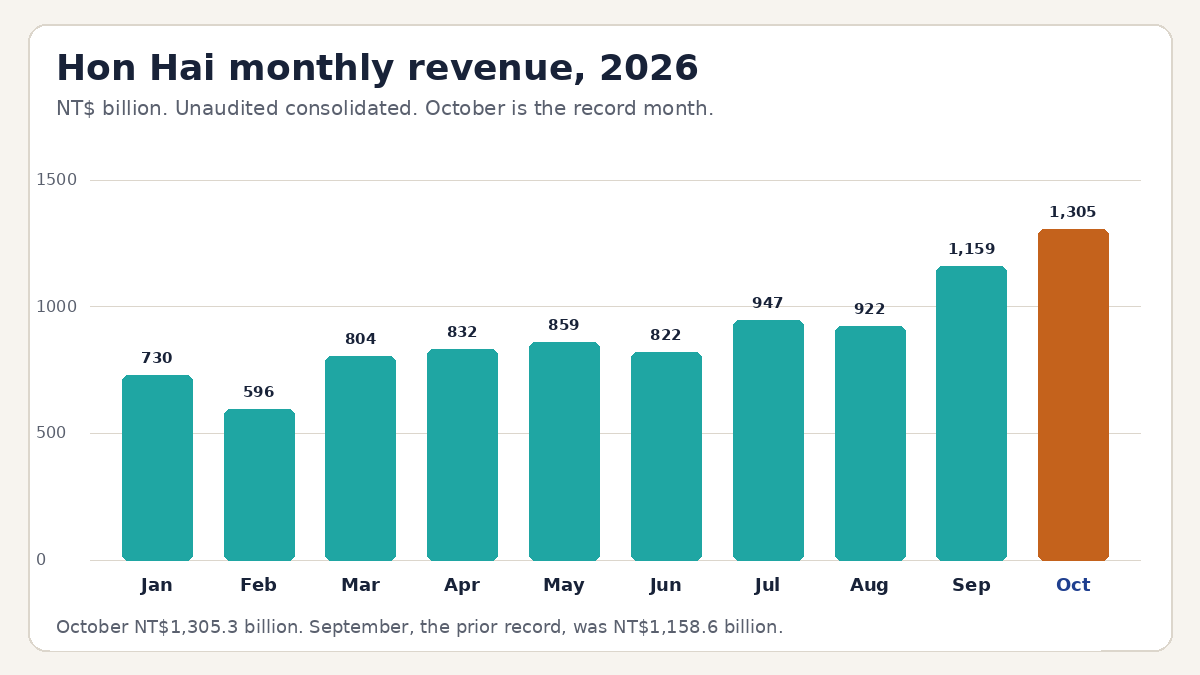
October is the high bar on Hon Hai's own table. The ten monthly rows are unaudited.
January was NT$730.0 billion and September NT$1,158.6 billion. October added NT$146.7 billion on our arithmetic. Two months in a row above NT$1 trillion is the company's point.
Why does Taiwan matter now?
Taiwan is where the AI rack becomes a thing a buyer can switch on, and October's invoice is the monthly proof of that step.
A foundry prints the die. Memory is stacked. CoWoS joins the two. Only then does an assembler put the module into a rack. Rack-scale AI is that cabinet. Hon Hai is paid at the cabinet.
The buyer's cheque for a finished rack lands on a Taiwan invoice before the hall is live in the United States. Hyperscalers are the customer. Semiconductors are the upstream invoice. Hon Hai reports the step in between on the fifth of each month.
The shares are uneven. On 12 August 2026 Hon Hai printed a second-quarter gross margin of 6.12% on NT$2.53 trillion of revenue. An assembler is paid on volume. A line that cannot ship the new model is the line that stalls.
Michael Chiang said on that August call that full-year AI rack shipments were expected to more than double, and that Vera Rubin racks were entering mass production in the third quarter. October is the first monthly look after that quarter. The year-on-year line still matches "strong." The month-on-month line does not.
What changed
The company set a revenue record and, in the same note, said the AI line dipped because the new models are not through the ramp.
Hon Hai's month-on-month order is its own. Smart consumer electronics showed strong growth, from pull-in and higher shipment prices. Computing showed significant growth, from pull-in of new products. Components and other products showed significant growth, from more core components and from other income. Cloud and networking recorded a slight decline. The sentence that binds: AI-related demand remained strong, while a consignment-model shift, tight supply, and early-stage production ramps of new models led to the dip.
Year on year the order flips. Cloud and networking leads, then smart consumer electronics, then components, then computing. All four grew strongly against October 2025. The AI line is larger than a year ago and smaller than September. Both sentences are in the same report.
The ten-month total is NT$8.98 trillion in the prose and NT$8,975,092 million on the table, up 40.40% from a year earlier. In US dollars it was up 38.4%. Cloud and networking led those ten months.
For the fourth quarter, Hon Hai expects AI-related operations to keep growing, and overall performance to be in line with market expectations. It does not publish the expectation. The note also has no segment dollars, no split of the three causes, no rack count, and no October margin.
A consignment shift can move revenue without a late rack. Goods can sit with the customer before the seller records the sale. Change that moment and the month's revenue moves even if the same racks left the dock. Hon Hai lists the shift first, then tight supply, then the early ramp, and does not rank them. The physical stuck step is the ramp plus tight supply. The consignment change is a second way the invoice can fall while demand is still called strong. The print does not weight the two.
Our math
The percentages on the page match the revenue rows. The currency gap is real, and it is not a second business.
Our arithmetic, using only figures printed on the 5 November report:
- October versus September: 1,305,320 ÷ 1,158,633 − 1 = 12.660%, which rounds to the 12.66% the company prints.
- October versus October 2025: 1,305,320 ÷ 895,709 − 1 = 45.730%, which rounds to 45.73%.
- Ten-month total versus the prior ten months: 8,975,092 ÷ 6,392,673 − 1 = 40.397%, which rounds to 40.40%.
- The ten monthly rows, as printed, add to 8,975,091 million. That is NT$1 million under the year-to-date line of 8,975,092 million. The table is in millions, so this is a one-unit rounding gap, not a second total. We use the year-to-date line when we talk about the ten-month sum.
- October's gain on September is 1,305,320 − 1,158,633 = 146,687 million, or NT$146.7 billion. That is the whole-company gain. Because cloud and networking declined, the other three lines grew by more than NT$146.7 billion combined. We cannot say by how much more. The company did not print the segment dollars.
- October is 1,305,320 ÷ 8,975,092 = 14.5% of the ten-month total. September and October together are 2,463,953 million, or 27.5%.
Hon Hai says the same October revenue was up 11.4% month on month in US dollars, against 12.66% in NT dollars, and up 39.7% year on year in US dollars, against 45.73%. Our arithmetic: 1.1266 ÷ 1.114 − 1 = 1.13%, the implied move in NT dollars per US dollar on the month if both rates describe the same revenue. On the year, 1.4573 ÷ 1.397 − 1 = 4.32%. The NT-dollar invoice rose faster than the US-dollar invoice. Hon Hai did not print the exchange rate or the US-dollar revenue. We do not invent either.
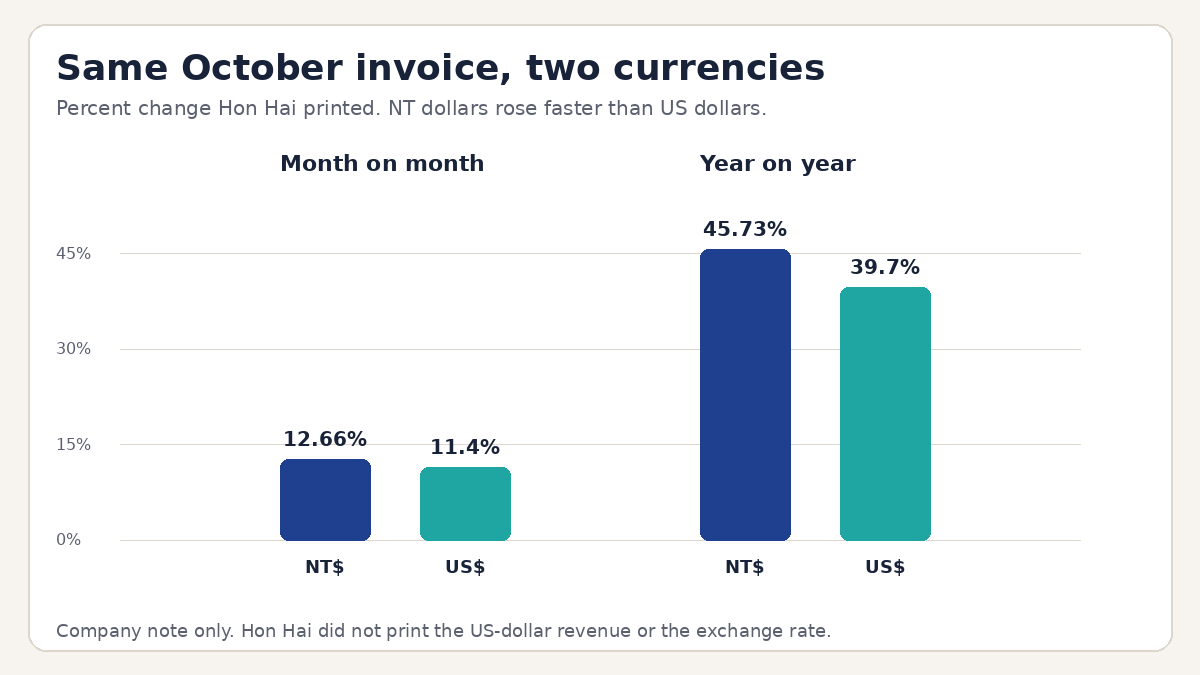
NT-dollar growth outran US-dollar growth on both horizons. Hon Hai printed the percentages and not the dollar amount.
This arithmetic does not say whether the record was already expected. The August gross-profit cross-check is in the next section's margin line: 154.5 ÷ 2,530 = 6.11% on our arithmetic, against the printed 6.12%.
Where does the money stick?
It sticks at Hon Hai's dock when the rack ships, and it sticks upstream when the new model cannot get the parts.
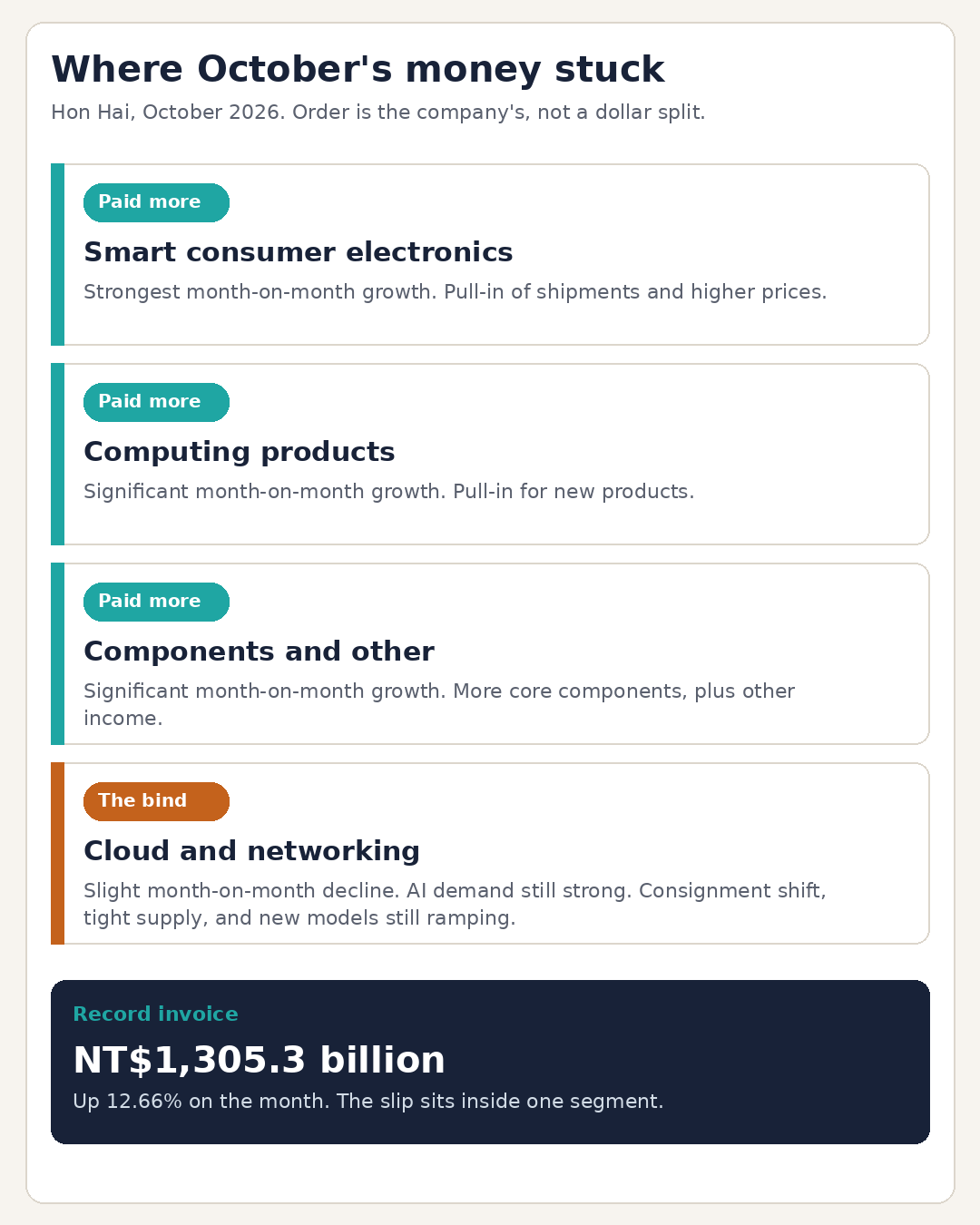
The company's own order, not a dollar split. Cloud and networking is the only line that fell on the month.
Hon Hai was paid NT$1,305.3 billion. Smart consumer electronics was paid for pull-in and higher prices. Computing was paid for pull-in of new products. Components were paid for more core parts and for other income. "Other income" is not a product. Treat it as a residual.
The AI rack is the line buyers mean. Year on year it led, which fits the August comment that rack shipments were expected to more than double. Month on month it slipped. Hon Hai is paid, on a thin margin, when that line ships. So are the sellers of the accelerator, the memory, and the package, who are mostly absent from this monthly note. Korea is the memory cheque. The foundry cheque is the next section.
"Tight supply" is why the new models are slow, in the company's words. A tight part stops the rack even after the customer has asked for it. The report does not name the part. We do not guess one.
Chiang, in August, put the advantage in the full rack rather than a single product, with Vera Rubin entering mass production in the third quarter and 800G-and-above networking expected to double for the year. October's slight decline does not cancel that year. It says "entered mass production" and the monthly invoice are not the same clock.
Is the new-model ramp still stuck?
Yes. The October sentence still calls the ramp early-stage, and it still calls supply tight.
The buyer of a new AI rack cannot skip that model. Hon Hai says those models are in an early ramp, and that AI demand remained strong. Demand is not the sentence that binds. The ramp is.
Two limits sit in the wording. "Slight" is not a number, and no segment dollar was printed, so a dip after a NT$1.16 trillion September can still leave the line high. And the consignment shift can do some of the work without a late rack. Until the 12 November call separates recognition from shipments, both readings stay open: racks waiting on parts, or racks that moved while the accountant's clock moved. The company put both in one sentence.
The year-on-year lead says the line has not collapsed. The month-on-month decline says the new model is not yet a smooth invoice. The stuck step is the ramp, not the existence of the business.
What dates matter
Four dates decide whether October was a one-month kink. Two are Hon Hai's. The other two had not printed when this was written.
| When | What | Why it matters |
|---|---|---|
| 9 Nov 2026, 16:00 Taipei | Ministry of Finance, October trade statistics | Scheduled, not yet a number at the time of this pulse. The country's export print is the wider invoice around Hon Hai's. |
| 10 Nov 2026, 13:30 Taipei | TSMC monthly sales for October | The foundry's October revenue was still blank on its 2026 monthly table when this was written. It is the upstream cheque. |
| 12 Nov 2026 | Hon Hai investor conference, third-quarter results | The first place segment dollars, margins, and the Vera Rubin ramp can be given as numbers rather than directions. |
| 5 Dec 2026 | Hon Hai monthly revenue for November | The test of whether cloud and networking's month-on-month slip reverses once the ramp has had another month. |
The trade release and the TSMC release are calendar entries, not results. An October export total, or a TSMC October sales figure, is not on those pages yet.
The 12 November call can unstick the story or confirm it. A segment table would show whether "slight" was a small dip off a high September. A sentence that drops "tight supply," or that counts racks, would move the stuck step. A repeat of the October wording would keep it.
How is this different from the foundry print?
This pulse is the assembler's invoice. The foundry print, which is not out for October, is a different cheque and a different stuck step.
TSMC's September pulse followed the wafer and the packaging slot. TSMC's 2026 monthly table, read on 9 November, still has an empty cell for October. The company's financial calendar places that release on 10 November at 13:30 Taipei time. Until that cell is filled, there is no October foundry number to set beside Hon Hai's NT$1,305.3 billion. The two firms can have a strong month and a stuck step at the same time, because they are paid at different points in the chain.
It is also not the two Taiwan pulses already on the door.
The 2 November piece was the ready factory shell. That stuck step is the building. Hon Hai's October stuck step is a model already in early production.
The 3 November MediaTek piece was a designer's inventory. Hon Hai sells the finished cabinet. Using that inventory, or TSMC's packaging gap, in place of Hon Hai's segment mix would mix three clocks.
A 6.12% second-quarter gross margin says the assembler is paid to turn other people's scarce parts into a shippable rack. When those parts are tight, the tightness shows up on this monthly invoice. The record is real. The line buyers care about is the one that did not rise.
What would change this view?
The view is that Hon Hai got paid a record, and the new-model ramp on the AI line is still the stuck step. It changes if any of these show up in a filing, not in a headline.
- [ ] The 12 November call prints cloud-and-networking revenue up on the month, and explains the October dip as consignment timing alone.
- [ ] Hon Hai drops "tight supply" and "early-stage ramp" and gives a shipment figure in line with the "more than double" year it described in August.
- [ ] The 5 December note shows cloud and networking up on the month, with no ramp and no shortage.
- [ ] TSMC's October revenue, due 10 November and not published yet, falls hard enough that the upstream invoice is the tighter step.
- [ ] A later filing shows the consignment change was the whole of the dip. Then the physical ramp was not the bind.
The view holds while that October sentence stands and no segment dollars contradict it.
Practical takeaways
- Hon Hai was paid NT$1,305.3 billion in October, a record, up 12.66% on the month and 45.73% on the year. The first ten months are NT$8.98 trillion, up 40.40%.
- Three lines grew on the month. Cloud and networking, the AI-rack line, slipped slightly. Year on year that same line led.
- The company named three causes and did not weight them: a consignment-model shift, tight supply, and an early ramp of new models. The ramp plus tight supply is the stuck step. The consignment shift can move the invoice without a late rack.
- In US dollars the same month was up 11.4%, not 12.66%. Our arithmetic puts the implied month-on-month currency gap at about 1.13%. Hon Hai did not print the rate.
- The next number that can settle the argument is the 12 November third-quarter call. November revenue follows on 5 December. TSMC's October sales are a different cheque, due 10 November.
FAQ
What was Hon Hai's revenue in October 2026?
NT$1,305.3 billion, a record. That was 12.66% above September and 45.73% above October 2025. The first ten months reached NT$8.98 trillion, up 40.40%.
Why did cloud and networking slip while the company set a record?
Hon Hai said AI demand stayed strong, and the segment still led year-on-year growth. The month-on-month dip came from a consignment-model shift, tight supply, and new models that are still in an early production ramp. The report does not split those three causes.
Who gets paid on this October print?
Hon Hai, on the record invoice. Smart consumer electronics, computing, and components all grew from September. Cloud and networking is the step that did not keep the pace.
Is the new-model ramp still stuck?
Yes, on the company's own October words. It called the ramp early-stage and the supply tight. The next test is the 12 November results call, then the 5 December revenue report.
When does the next hard number land?
Hon Hai's third-quarter investor conference is 12 November 2026. November revenue is due 5 December. TSMC's October revenue is scheduled for 10 November, and that cell was still blank on 9 November.
Keep reading on the map
- Explained: CoWoS · Rack-scale AI · HBM
- This door: Taiwan · The ready shell · MediaTek's inventory · TSMC in September
- Sibling doors: Korea · United States · China
- The stack: Semiconductors · Hyperscalers
How we check this
Figures in the table and the arithmetic come from Hon Hai's unaudited October revenue report dated 5 November 2026, and from its second-quarter results dated 12 August 2026 where the margin and the earlier rack comment are used. Those August sentences are labelled as earlier, not as October facts. TSMC's empty October cell is from the company's 2026 monthly revenue page, read on 9 November. The Ministry of Finance date is the scheduled announcement, not a trade result. Where a source is silent, the piece says so.
Last reviewed: 9 Nov 2026 · Next review: after Hon Hai's 12 November call, or after TSMC's October revenue if that print changes the upstream read.
References
- Hon Hai Precision Industry, unaudited consolidated monthly revenue report for October 2026, 5 November 2026. The revenue table, the four-segment directions, the US-dollar percentages, the fourth-quarter outlook, and the 12 November and 5 December dates. Hon Hai October 2026 revenue report
- Hon Hai Technology Group, second-quarter 2026 financial results, 12 August 2026. The 6.12% gross margin, the NT$2.53 trillion quarter, the NT$154.5 billion gross profit, and Michael Chiang's comments on AI rack shipments and Vera Rubin mass production. Hon Hai second-quarter 2026 results
- TSMC, 2026 monthly revenue table, read 9 November 2026. October's cell was blank. January through September figures are on the same page and are not the subject of this pulse. TSMC 2026 monthly revenue
- TSMC investor financial calendar, read 9 November 2026. October monthly sales are scheduled for 10 November 2026 at 13:30 Taipei time. TSMC financial calendar
- Ministry of Finance, R.O.C., event notice for the announcement of October 2026 export and import statistics, posted 6 November 2026. The announcement is set for 9 November 2026 at 16:00. This pulse does not use a trade result from that event. MOF October trade announcement