US$87.2B Record Month: Who Gets Paid When Taiwan's Servers Outsell Its Chips
Taiwan shipped a record US$87.2 billion of goods in September, and computers and servers outsold chips. Imports from Korea rose 82.5% to US$11.6 billion, much of it memory. TSMC is paid first, memory makers next, the server builders on volume. The stuck step is memory.
Taiwan shipped a record US$87.2 billion of goods in September. And the computers and servers outsold the chips, by about US$8 billion. The headline counts the whole rack. The money inside it splits very unevenly, and part of it goes to Korea.
TAIWAN PULSE · Data as at 11 Oct 2026 · Next update: TSMC results on 15 Oct; October exports on 9 Nov
Affects: Semiconductors · Hyperscalers · AI Data Centers — Markets: Taiwan · Korea · US · Malaysia
Education only, not advice to buy or sell any security. Government and company figures are as reported. Export values count the whole product, not the profit inside it. Our own sums are labelled.
The numbers that matter this week
Taiwan exports, September 2026
US$87.2B
+60.9% on a year · a monthly record
PrimaryComputers, servers, network gear
US$39.1B
+103.0% · 44.9% of all exports
PrimaryChips and electronic parts
US$31.1B
+45.3% · 35.7% of all exports
PrimaryImports from Korea
US$11.6B
+82.5% · most of it chips
PrimaryShare of the rise from servers (our math)
~60%
US$19.9B of the US$33.0B increase
Our mathMemory beside the chip
Memory
Price and supply set outside Taiwan
Stuck stepFigures from the Ministry of Finance release of 8 Oct 2026. Status chips are Second Order’s read.
On this page: Why Taiwan? · What the numbers say · What came in · Our math · Who gets paid · What is stuck? · Dates next · What would change this · FAQ
Why does Taiwan matter this week?
Because the first week of October is when Taiwan counts. On 7 and 8 October the big server builders filed their September sales, TSMC filed its own, and on 8 October the Ministry of Finance released the trade numbers for the month. Read together, they show where the AI build-out actually turns into shipments, and who keeps what.
We have already looked at the assembly end of this line. Earlier this week Foxconn sold more than NT$1 trillion in a single month and kept a thin slice of it. Last month we looked at how TSMC splits its spending. This Pulse steps back to the whole island: what Taiwan shipped, what it had to buy in to ship it, and which part of the rack sets the pace.
The short version: Taiwan is no longer mainly a chip exporter that also builds some computers. In September it was a computer exporter first. That changes who gets paid, because a server is mostly other people's parts.
1 · Cloud and AI buyers order racks
Who: Hyperscalers, AI labs, neoclouds
Paid: Exports to the US more than doubled to US$27.5B
2 · TSMC and the memory makers supply the core
Who: TSMC in Taiwan, memory makers in Korea
Paid: Paid per wafer and per memory stack, at high margins
3 · Server builders assemble and ship
Who: Quanta, Wistron, Wiwynn, Foxconn
Paid: Paid on volume, a thin slice of each rack
4 · Memory sets the pace
Who: The part Taiwan buys in
Paid: Imports from Korea up 82.5% to US$11.6B
What do the September numbers say?
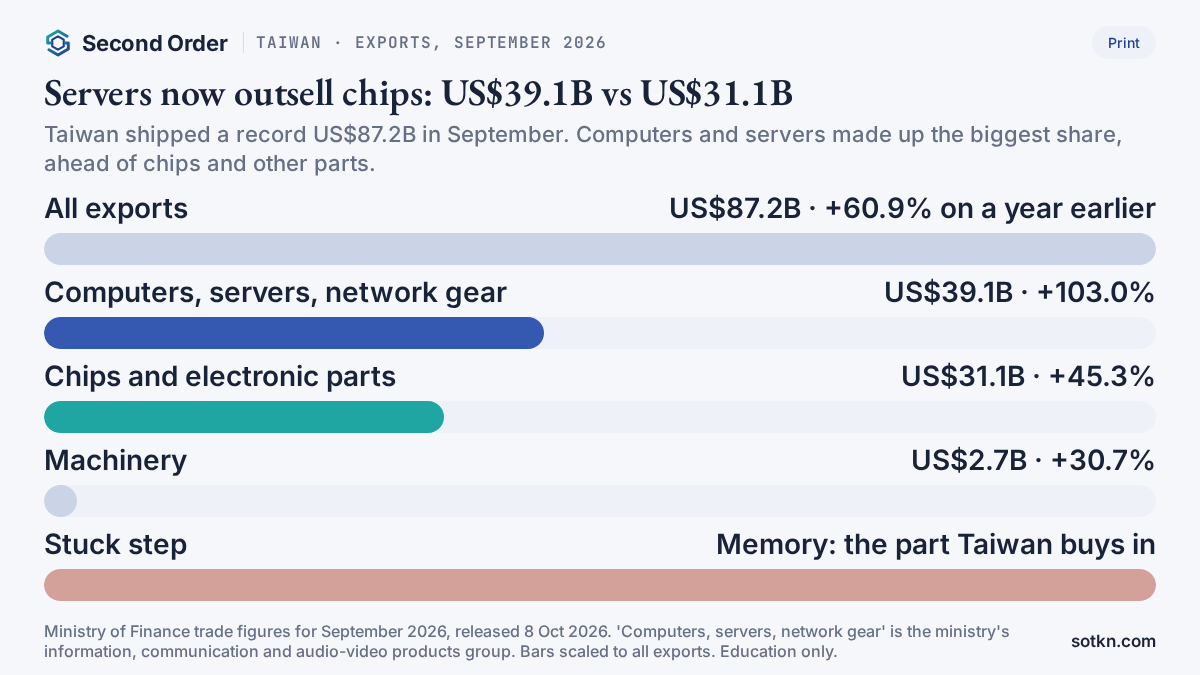
Start with the ministry's release. Exports rose 60.9% from September 2025 to US$87.22 billion, the highest for any single month and the 35th month of growth in a row. For the third quarter as a whole exports were US$244.92 billion, up 44.6%. From January to September they reached US$661.55 billion, up 46.2%.
Then the split by product. The ministry groups goods into broad families. Two of them are nearly the whole story:
- Information, communication and audio-video products — in plain words, computers, servers, graphics cards and network gear: US$39.13 billion, up 103.0%, 44.9% of all exports.
- Parts of electronic products — mostly chips: US$31.13 billion, up 45.3%, 35.7% of all exports.
- Machinery: US$2.74 billion, up 30.7%. Base metals: US$2.69 billion, up 22.9%. Mineral products: US$2.26 billion, up 86.4%.
So the server family was about US$8 billion bigger than the chip family in September. Over the first nine months the same pattern holds: US$290.97 billion of computers and servers against US$231.58 billion of chips and parts.
Where did it go? The United States took US$27.46 billion, up 106.2%, the second-highest month on record. Southeast Asia took a record US$18.88 billion, up 93.4%. China and Hong Kong took US$20.62 billion, up 30.2%. The ministry said the US and Southeast Asia together made up about 70% of the increase.
One honest caveat. Pantheon Macroeconomics, which had forecast 34% growth, told AFP that server shipments fell sharply in September 2025, which made a low base and inflated this year's headline. The level is still a record. The growth rate flatters it.
Taiwan exports, September 2026
Company sales, September 2026
What did Taiwan have to buy in?
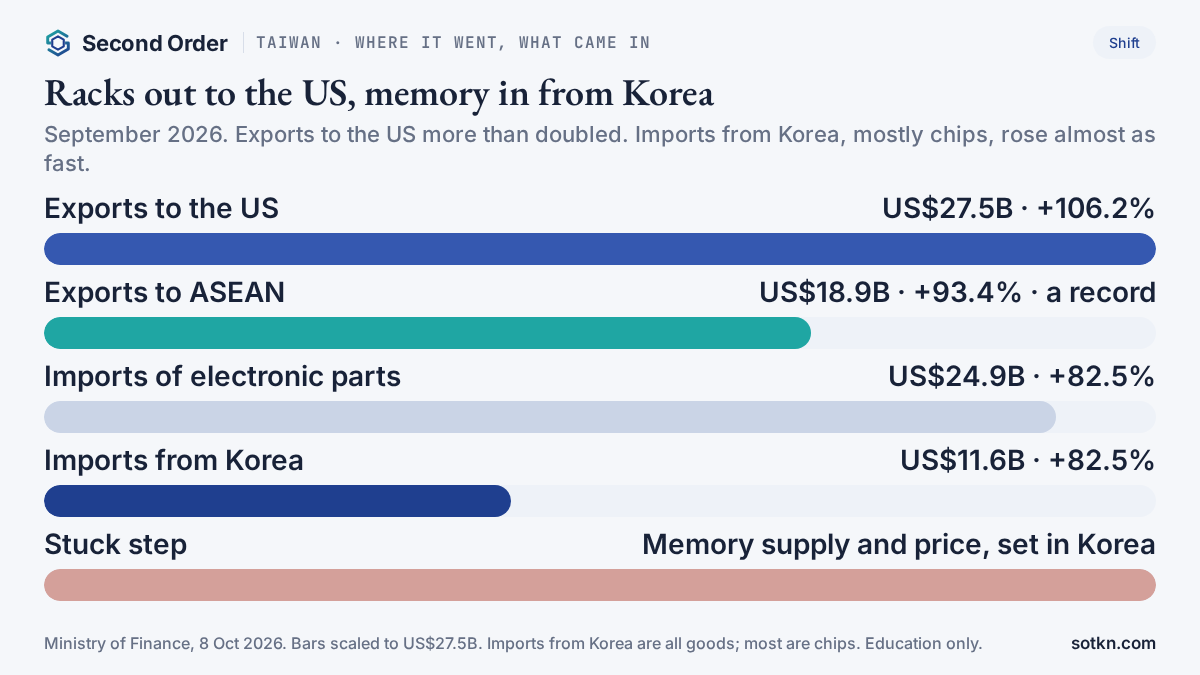
This is the part the export headline hides. Imports also set a record in September, US$63.59 billion, up 51.7%. The biggest import family was the same as the export one: parts of electronic products, US$24.92 billion, up 82.5%. Taiwan bought chips almost as fast as it sold them.
And the country it bought from fastest, among the big ones, was Korea. Imports from Korea rose 82.5% to US$11.63 billion, making Korea Taiwan's second-largest supplier after China and Hong Kong. Korean customs data for early September put chips at roughly 70% of what Korea ships to Taiwan, Tech Times reported.
The reason is the memory. AI chips need high-bandwidth memory, stacks of memory chips that sit right beside the processor (HBM, explained). Most of it is made in Korea by SK hynix and Samsung; the third maker is Micron. It is shipped to Taiwan, where TSMC packages it next to the processor, and only then does the finished chip go into a server. Korean trade data count that memory as an export to Taiwan, not to the US company that ends up owning the rack.
Korea's side of the same month shows the scale. Korea's chip exports hit a record US$60.3 billion in September, memory alone US$54.07 billion, Seoul Economic Daily reported (we covered it in the Korea chip exports Pulse). In August, Korea shipped US$3.32 billion of the customs category that includes HBM to Taiwan, up 32.2%, Chosun Biz reported, and US$1.62 billion to Malaysia, where packaging capacity is growing fast.
Our math: where did the extra money come from?
- The increase: September 2025 exports were about US$54.2 billion, so September 2026 added about US$33.0 billion (our arithmetic, from the ministry's growth rate).
- Servers' share: the computer and server family rose from about US$19.3 billion to US$39.1 billion, adding about US$19.9 billion, roughly 60% of the whole increase (our arithmetic).
- Chips' share: chips and parts rose from about US$21.4 billion to US$31.1 billion, adding about US$9.7 billion, roughly 29% (our arithmetic).
- Parts in versus parts out: Taiwan imported US$24.9 billion of electronic parts against US$31.1 billion exported, about 80% (our arithmetic). It is a parts hub, not just a parts maker.
- Korea: imports from Korea rose by about US$5.3 billion in a year. The whole September bill, US$11.6 billion, is about three-quarters of TSMC's September sales of about US$16.0 billion (our arithmetic; different measures, shown only for scale).
- Builders versus TSMC: Quanta, Wistron and Wiwynn together sold NT$878.7 billion in September, about 1.7 times TSMC's NT$511.9 billion (our arithmetic).
What this tells you: the fastest-growing part of Taiwan's exports is the part that contains the most bought-in value. A server shipped from Taiwan carries Taiwanese chips, Korean memory and parts from many places, and the export number counts all of it.
What it does not tell you: how much profit stays in Taiwan per rack, or how much of each import is memory rather than other parts. Those figures are not public. For how to read money spent before it earns, see cash capex, explained.
Who gets paid first?
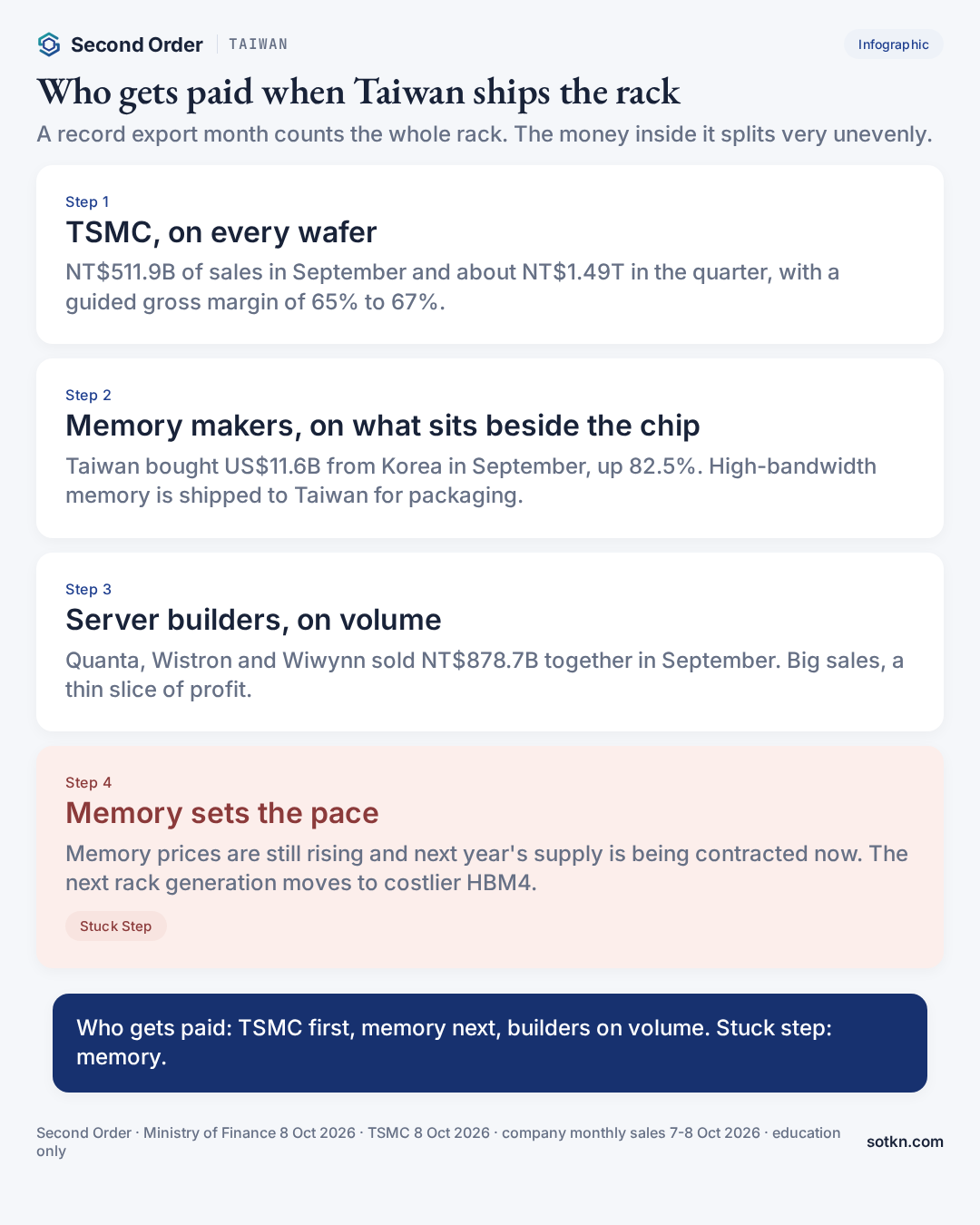
Follow one AI server rack from order to shipment. The money moves in a short line, and each stop keeps a very different share.
First, TSMC — on every wafer. TSMC said on 8 October that September sales were NT$511.86 billion, down 0.6% from August's high but up 54.6% from a year earlier. That puts the third quarter at about NT$1.49 trillion, above the NT$1.46 trillion analysts expected, AI Affairs reported. TSMC had guided to a gross margin of 65% to 67% and an operating margin of 56% to 58% for the quarter. If that guide held, roughly two-thirds of every TSMC sales dollar is left after the cost of making the chip (our arithmetic). For what TSMC actually does, see what does TSMC do?.
Second, the memory makers — on what sits beside the chip. They are paid when the memory is delivered for packaging, before the rack is built. Their prices are rising: Korean DDR5 contract prices climbed from US$37.5 in May to US$48 in September, and TrendForce expects the average price of high-bandwidth memory to rise 121% next year, with a 12-layer HBM4 stack going from about US$600 to about US$1,300, Seoul Economic Daily reported. See who makes HBM and the Samsung profit Pulse for where that money lands.
Third, the server builders — on volume. Wistron sold NT$380.81 billion in September, up 87.2%. Quanta sold NT$325.30 billion, up 76.7%, and said its third quarter was NT$1.116 trillion, up 125.2%. Wiwynn sold NT$172.62 billion, double a year earlier and a record. Those are enormous sales. But assembly keeps a thin slice: Foxconn's gross margin was 6.12% in the second quarter. If the three builders kept something similar (an assumption, not their reported numbers), their NT$878.7 billion of September sales would leave roughly NT$54 billion of gross profit, against roughly NT$338 billion for TSMC on far smaller sales (our arithmetic).
Fourth, the cloud buyers pay for all of it, last. They write the cheques for racks that will not earn until they are switched on in a data hall. See hyperscaler, explained for who they are, and the AI Data Centers stack for where the racks end up.
One-line rule: in Taiwan's record month, TSMC is paid first and keeps the most, memory makers are paid next and are raising prices, the builders are paid on volume, and the stuck step is the memory.
So what is the stuck step?
Memory. Not because there is none, but because its price and supply are set outside Taiwan and are still moving up, while the next rack generation moves to newer, costlier memory.
- Price: DDR5 contract prices rose about 28% from May to September (our arithmetic from the reported US$37.5 and US$48). TrendForce expects HBM prices to roughly double next year.
- Contracts: Micron said it has already contracted most of its HBM supply for next year at higher prices, Seoul Economic Daily reported, and Samsung and SK hynix are negotiating 2027 volumes and prices now.
- Next generation: Quanta said Nvidia's next rack platform, Vera Rubin, entered trial production at the end of the third quarter, with small shipments in the fourth quarter and the main ramp in the first quarter of 2027. Vera Rubin moves to HBM4, the memory whose price TrendForce expects to more than double.
- Cost pass-through: Quanta also said customers had pulled notebook orders forward earlier this year because of rising memory costs and unstable supply. The same pressure sits inside every server bill of materials.
What binds Taiwan's racks now
What does not bind
So-what: Taiwan's record is real, but the slice it keeps depends on a part it does not make. When memory prices rise, the memory makers collect first, the builders either pass the cost on or absorb it, and TSMC's share is untouched. Same rack, three different pay days. For the layer view, see HBM in the Semiconductors stack.
Which dates test this read next?
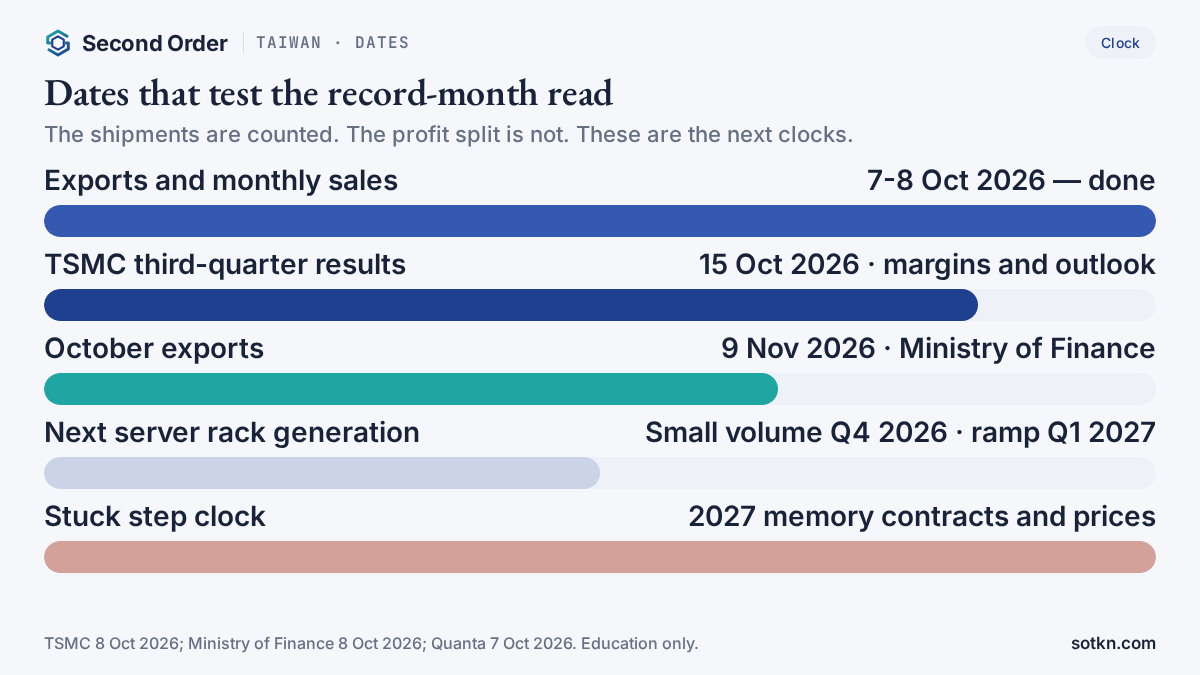
- 7–8 Oct 2026 — September sales from Quanta, Wistron, Wiwynn and TSMC; September trade figures. Done.
- 15 Oct 2026 — TSMC third-quarter results. The test: does the gross margin land inside 65% to 67%, and what does TSMC say about the fourth quarter?
- Around 10 Nov 2026 — October monthly sales from the server builders and TSMC.
- 9 Nov 2026 — October trade figures from the Ministry of Finance. The test: does the server family stay ahead of chips once the low base fades?
- Fourth quarter 2026 — small first shipments of Vera Rubin racks, per Quanta.
- First quarter 2027 — the main Vera Rubin ramp, and 2027 memory contracts settling.
The October trade number matters most. September 2025 was weak, which flattered this year's growth. If computers and servers still outsell chips in October, the shift is structural, not a base effect.
What would change this view?
- Memory prices stall or fall in 2027 contracts — the stuck step loosens and builders keep more of each rack.
- Imports from Korea slow while exports keep rising — more memory is being packaged elsewhere, for example in Malaysia, or more comes from Micron, which makes memory outside Korea.
- TSMC's margin lands below its guide on 15 Oct — the first stop in the line is keeping less than we assume.
- Server builders report rising margins — they are passing memory costs on, not absorbing them.
- October exports fall back sharply — September was more timing and low base than trend.
- US trade rules change for Taiwan-made servers — the route out to the US becomes the bind instead.
For the factory mood behind these numbers, see the Taiwan PMI Pulse.
Practical takeaways
- Taiwan exported a record US$87.22 billion in September, up 60.9%, flattered by a weak September 2025
- Computers and servers (US$39.13 billion) outsold chips and parts (US$31.13 billion) and made about 60% of the increase
- Imports from Korea rose 82.5% to US$11.63 billion; the memory inside AI chips is shipped to Taiwan to be packaged
- Who gets paid first: TSMC at a guided 65% to 67% gross margin; memory makers next; builders on volume
- Stuck step: memory, whose price and supply are set outside Taiwan and still rising
FAQ
How big was Taiwan's September export month?
A record. Taiwan's Ministry of Finance said on 8 Oct 2026 that exports rose 60.9% from a year earlier to US$87.22 billion, the 35th month of growth in a row. Imports also hit a record, US$63.59 billion, leaving a trade surplus of US$23.63 billion.
Do servers really outsell chips now?
In September, yes. The ministry's group for computers, servers and network gear shipped US$39.13 billion, up 103%. Chips and other electronic parts shipped US$31.13 billion, up 45.3%. The first group was 44.9% of all exports.
Why does Korea show up in a Taiwan story?
Because the memory inside AI chips is mostly made in Korea and shipped to Taiwan to be packaged next to the processor. Taiwan's imports from Korea rose 82.5% in September to US$11.63 billion. Korean trade data count that memory as exports to Taiwan, not to the US buyer at the end of the chain.
Who gets paid first?
TSMC, on every wafer, at a gross margin it guided at 65% to 67% for the quarter. Memory makers are paid next, on the memory that sits beside the chip. The server builders are paid on volume, with a thin slice of profit on each rack.
Why is memory the stuck step?
Because its price and supply are set outside Taiwan and are still moving up. Korean DDR5 contract prices rose from US$37.5 in May to US$48 in September, and TrendForce expects high-bandwidth memory prices to roughly double next year. The next rack generation, due to ramp in early 2027, moves to HBM4, the costlier kind.
Is this investment advice?
No. Education only. It maps who gets paid and which step is stuck. It is not a recommendation to buy or sell any security.
Keep reading on the map
- Taiwan Markets hub — country page
- Foxconn AI racks Pulse (7 Oct) — the thin slice
- Korea chip exports record Pulse — the memory side
- Samsung Q3 profit Pulse — who gets paid on memory
- TSMC capex split Pulse — where TSMC spends
- Semiconductors stack — layer map
- Who makes AI chips? · HBM, explained
- All Markets doors — Taiwan, Korea, US, China, Singapore, Australia, Malaysia
How we check this. Trade figures come from Taiwan's Ministry of Finance release. Company sales come from the companies' own monthly filings, as published or as reported by named outlets. Memory prices are as reported from Korean trade data and TrendForce. Analyst price targets and buy calls are left out on purpose. Anything we worked out ourselves is labelled “our arithmetic”. We do not invent margins, prices or dates. The references we used are listed at the end. Our editorial standards →
Not investment advice. Do your own research.
References
- Ministry of Finance (Taiwan), Trade Figures for Sep. 2026, 8 Oct 2026. mof.gov.tw — exports, imports, products and partners.
- AFP, Taiwan says exports hit record in September on AI demand, 8 Oct 2026. afp.com — 35th month of growth, Pantheon low-base note, US and ASEAN share of the rise.
- TSMC, September 2026 Revenue Report, 8 Oct 2026. pr.tsmc.com — NT$511.86B September, NT$3,898.73B year to date.
- AI Affairs, TSMC's September revenue rises 54.6% to NT$511.86 billion, 8 Oct 2026. aiaffairs.com — third quarter about NT$1.49T, estimate, margin guide, 15 Oct results.
- BigGo Finance, Quanta Computer's September revenue hits NT$325.3 billion, 7 Oct 2026. finance.biggo.com — Quanta sales, next rack generation timing, memory costs.
- SquawkNews, Wistron reports September revenue of NT$380.81 billion, 8 Oct 2026. squawknews.com — Wistron sales.
- TechNews, Wiwynn September revenue up 19.6% month on month, 8 Oct 2026. finance.technews.tw — Wiwynn sales.
- Seoul Economic Daily, Chip boom lifts September exports past $120 billion, 2 Oct 2026. en.sedaily.com — Korean memory exports, DDR5 prices, TrendForce HBM price outlook.
- Chosun Biz, Malaysia draws AI packaging investment as Korea's HBM exports surge, 22 Sep 2026. biz.chosun.com — Korean HBM-type chip exports to Taiwan and Malaysia, August.
- Tech Times, South Korea chips hit 47% of exports as AI demand shatters September record, 11 Sep 2026. techtimes.com — Korean customs data: chips about 70% of shipments to Taiwan.