$60.3B Shipped: Who Gets Paid When Korea’s Chip Exports Set a Record
Korea shipped $60.3 billion of chips in September 2026, up 262.8% on a year ago, and memory was about $54.1 billion of it. Memory makers get paid on chips that already left the country. The stuck step is new wafer output: tools are being bought, but they are not making wafers yet.

Korea shipped $60.3 billion of chips in September 2026. That is 262.8% more than a year ago and the first month ever above $60 billion, per the trade ministry’s release on 1 Oct. Memory was about $54.1 billion of it. Who gets paid is simple: the memory makers, on chips that have already left the country. The stuck step is new wafer output. Prices are still rising and tool imports are up, but new tools are not making wafers yet.
KOREA PULSE · Data as at 5 Oct 2026 · Next update: after October 1–20 customs data or Korean memory makers’ Q3 results
Affects: Semiconductors · Hyperscalers · Neoclouds — Markets: Korea · Taiwan · China · US
Education only, not advice to buy or sell any security. Ministry figures are labelled as reported. The memory split and price series come from press reports on the same release. Earlier Korea Pulses on the Samsung HBM4 ask, August chip output and HBM wafer mix are cross-linked, not re-led.
The numbers that matter this month
Chip exports, Sep 2026 (MOTIR)
$60.30B
+262.8% YoY · first month above $60B
PrimaryMemory chip exports
$54.07B
+358.6% from $11.79B · ~90% of chips (our arithmetic)
ReportedChips share of all exports
49.9%
$60.30B of $120.94B
PrimaryDDR5 16Gb contract price
$48.0
From $37.5 in May · +28% (our arithmetic)
ReportedNew wafer output
Still the bind
Tool imports +50.8% to $3.44B — tools bought, not yet wafers
Stuck stepComputer exports (incl. SSDs)
$7.00B
+435.3% YoY
PrimaryJan–Sep exports
$814.5B
Already above all of 2025 ($709.3B)
PrimarySources: MOTIR press release, 1 Oct 2026; Seoul Economic Daily, 2 Oct 2026 (memory split, price series). Status chips are Second Order’s read.
On this page: Why Korea? · What changed · Our math · Where money sticks · Is wafer output still stuck? · Dates next · How this differs · What would change this · FAQ
Why does Korea matter now?
Because Korea makes most of the world’s memory, and memory is the part of an AI server that is hardest to get right now. When Korea’s chip exports jump, it tells you how much memory actually left the factories and went to buyers.
That matters for one reason. A price ask is a hope. A contract is a promise. An export is a box that has shipped. Of the three, the export is the closest to cash. September gives us a very large box.
This sits on the same map as HBM, explained, the Semiconductors stack and the Korea Markets hub. The question this month is not “did Korea sell more chips?” It plainly did. The question is who gets paid on those shipments, and what is stopping supply from catching up.
1 · Chips ship (MOTIR 1 Oct)
Who: Memory makers
Paid: $60.3B of chips left Korea in September; memory ~$54.1B
2 · New wafers still wait
Who: Tools → installed → qualified
Paid: Tool imports +50.8% to $3.44B; new lines are not output yet
3 · Buyers keep paying more
Who: Server builders and clouds
Paid: DDR5 16Gb contract $37.5 → $48.0 since May
What changed in September?
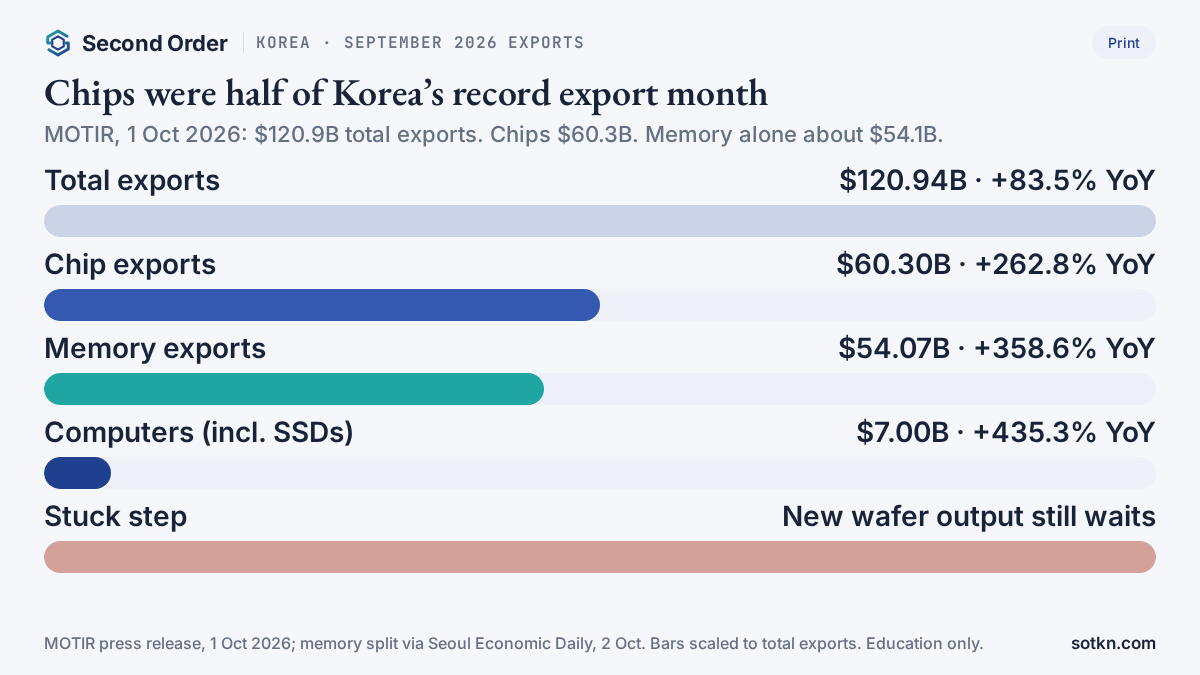
Three things changed. The size, the mix and the spread.
The size. Chip exports were $46.7 billion in August, which was itself a record, per Chosun Biz. September came in at $60.3 billion. One month later, a new record by a wide margin.
The mix. Memory was about $54.1 billion. That leaves about $6.2 billion for every other kind of chip Korea sells. So this is a memory story, not a broad chip story.
The spread. Buyers were not in one place. Exports to China rose 122.7% to $26.01 billion. Exports to the US rose 137.0% to $24.33 billion. Exports to ASEAN rose 92.6% to $21.29 billion, the first time above $20 billion. MOTIR named chips as a main driver in each of those markets.
One more line is worth reading slowly. Computer exports rose 435.3% to $7.00 billion. MOTIR put that down to AI infrastructure demand and the spread of agentic AI. In Korea’s trade data, that line includes SSD storage. It is another sign the buyers are building data halls, not phones.
September 2026 at a glance (MOTIR)
Where it went (MOTIR)
MOTIR 1 Oct 2026; memory split via Seoul Economic Daily 2 Oct; August chip figure via Chosun Biz 1 Oct.
Our math: was it only price?

A fair question. Memory prices have been rising all year. Maybe exports only look big because each chip costs more. Here is the check, step by step. This is our arithmetic.
- Memory exports went from $11.79 billion to $54.07 billion. $54.07 ÷ $11.79 = 4.6 times.
- The DDR5 16Gb contract price went from $37.5 in May to $48.0 in September. $48.0 ÷ $37.5 = 1.28, so up about 28%.
- The 128Gb NAND contract price went from $26.5 to $30.6. That is up about 15%.
- Memory’s share of chip exports: $54.07 ÷ $60.30 = about 90%.
- Chip exports month on month: $60.3 ÷ $46.7 = about 1.29, so up about 29% from August.
The price series only starts in May, so we cannot line it up exactly with a year ago. But a 28% price move in four months does not get you to 4.6 times. Something else grew too. MOTIR says what: shipment volumes kept expanding. Mix matters as well. High-value memory such as HBM is worth far more per chip than ordinary DRAM.
So the honest read is this. Price helped. Volume and mix helped. We cannot split them exactly with these numbers, and we will not pretend to.
Where does the money stick?
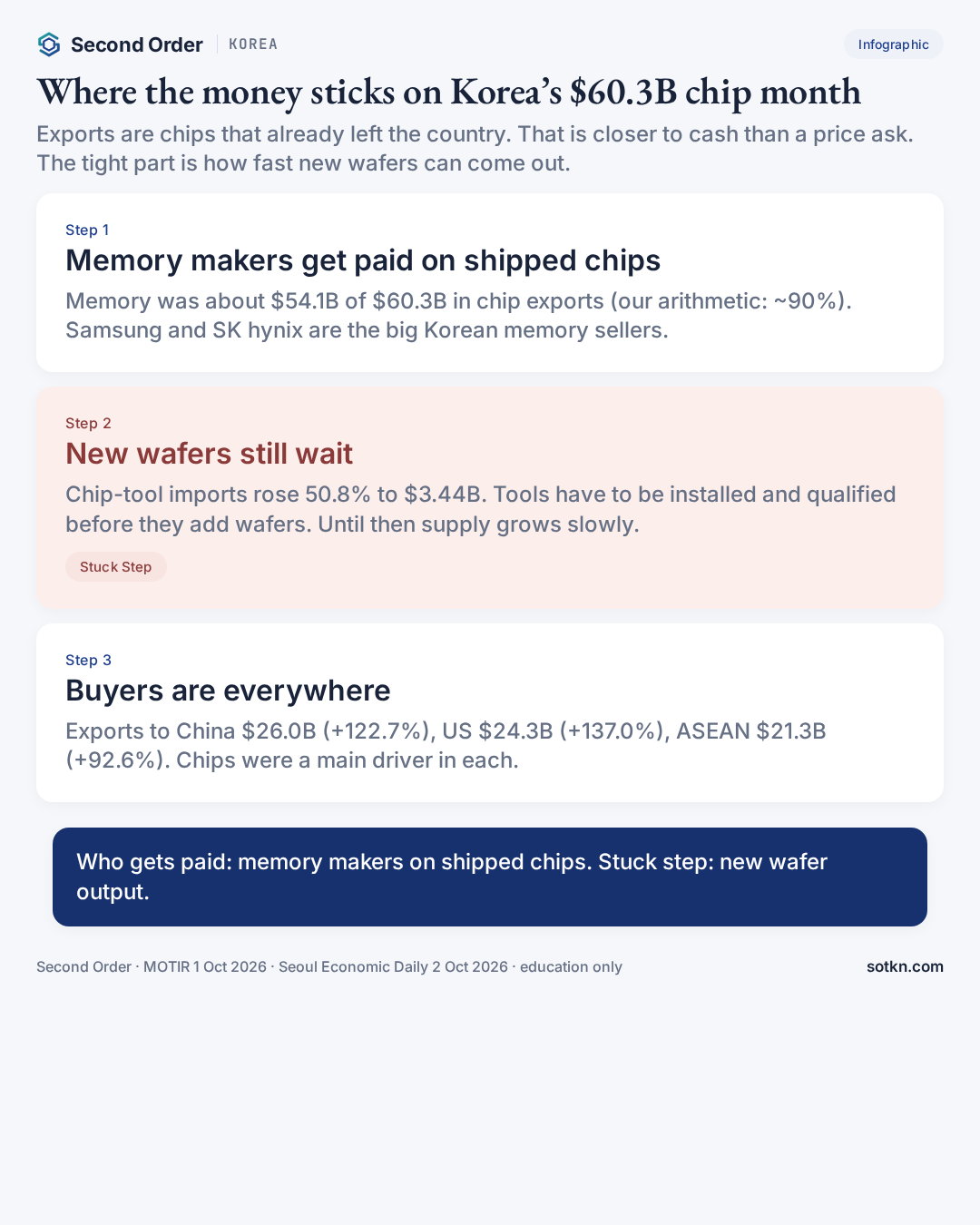
Follow the box. A memory chip leaves a Korean factory, is counted at customs, and lands with a server maker or a cloud company. Who gets paid at each step?
First, the memory makers. Samsung Electronics and SK hynix are Korea’s big memory sellers. They get paid on shipped chips at contract prices. An export figure is not profit. But it is money that has been invoiced for goods that moved. Compare that with our Samsung HBM4 ask Pulse (3 Oct), where the number was an opening price, not a settled one.
Second, the tool sellers. Korea imported $3.44 billion of chip-making tools in September, up 50.8%. Those tool makers get paid now, before the tools make anything. That is money going out of the memory makers to build the next lines.
Third, the buyers. Server makers and cloud companies are paying more per chip. DDR5 is up about 28% since May. They pay because memory is what lets their AI chips work. Without enough memory, an expensive accelerator sits half-used.
This is why memory makers sit near the front of the pay line right now. The neighbour read on the US side is Micron, which said it had locked in most of its 2027 output — see the Wire on Micron’s 2027 contracts.
Is new wafer output still stuck?
Yes. A record export month does not mean supply has caught up. It suggests the opposite.
Think about it plainly. If supply were catching up, prices would cool. They have not. DDR5 rose every month in the series, from $37.5 to $40.0 to $45.0 to $46.5 to $48.0. Buyers are still bidding for chips that do not exist yet.
The fix is more wafers. More wafers need more tools, more clean-room space and time. The tools are being bought: imports up 50.8%. But a tool in a crate is not a wafer. It has to be installed, tuned and qualified before it adds output that a customer will accept.
There is a second squeeze. HBM uses far more wafer per bit than ordinary DRAM. When makers move wafers to HBM, ordinary memory gets tighter too. Our earlier Korea HBM wafer-mix Pulse and the Analysis on HBM taking ~30% of DRAM wafers walk through that.
Two cautions before you read “record exports” as “problem solved”:
- Shipped is not added. A record month shows what the existing lines made and sold. It does not show new lines coming online.
- Tools bought are not wafers out. A 50.8% jump in tool imports is spending on the next step. Output from it comes later.
If new lines qualify and prices stop rising, the stuck step can move — to power, packaging or halls. See Where does the stuck step move? and the Micron clean-room Analysis.
What dates matter
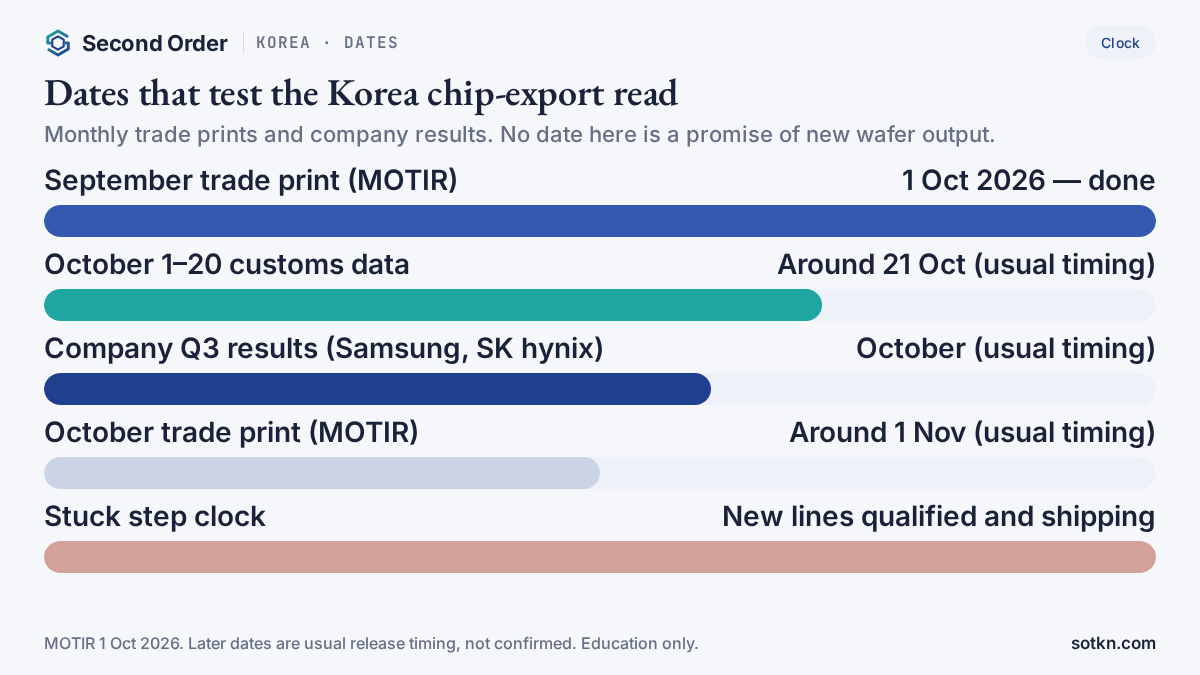
Dates to watch
MOTIR 1 Oct 2026. Later dates are usual release timing, not confirmed. Do not invent a date for new capacity.
How is this different from …
- Korea Samsung HBM4 ask Pulse (3 Oct): That piece was about an opening HBM4 price, which is not settled. This piece is about chips that already shipped.
- Korea chip exports, first 20 days Pulse (24 Sep): That piece read the early count: $34.1 billion of chips in 1–20 September. This piece reads the full month, $60.3 billion, and the memory split.
- Korea August chip output Pulse (30 Sep): That piece read factory output and shipments indexes. This piece reads export dollars from the trade ministry.
- Korea HBM wafer-mix Pulse (30 Sep): That piece was about how wafers are split between HBM and ordinary DRAM. Here it is the reason supply stays tight, not the lead.
- Taiwan PMI Pulse (5 Oct morning): Neighbour door. A survey of orders in Taiwan, not shipped value. Orders are not slots.
- China SMIC utilization Pulse (4 Oct): A foundry running full at the nodes it has. Different product, same lesson: full is not the same as more supply.
What would change this view?
The “shipped, but new wafers still wait” read weakens if:
- Contract prices for DDR5 or NAND stop rising or fall for two months in a row
- Memory makers say new lines are qualified and shipping at volume, with dates
- Chip exports drop sharply in the October customs data while prices hold — a demand sign, not a supply one
- Buyers report memory is easy to get and no longer limits server builds
- Power or packaging, not memory wafers, becomes the louder bottleneck in company reports
It stays intact while prices keep rising, tool imports keep climbing faster than output, and memory makers still describe supply as tight.
Practical takeaways
- Korea shipped $60.30 billion of chips in September 2026, up 262.8% — first month above $60 billion (MOTIR 1 Oct)
- Memory was $54.07 billion of that, up 358.6% — about 90% of chip exports (our arithmetic)
- Who gets paid: memory makers, on chips that already shipped — closer to cash than a price ask
- Tool sellers get paid too: chip-tool imports rose 50.8% to $3.44 billion
- Price helped (DDR5 +28% since May), but volume and mix did more — we cannot split them exactly
- Stuck step: new wafer output — tools bought are not wafers out
- Buyers were spread out: China $26.0B, US $24.3B, ASEAN $21.3B
- Watch October 1–20 customs data, Q3 results from Korea’s memory makers, and contract prices
FAQ
How much did Korea export in chips in September 2026?
Korea’s trade ministry (MOTIR) said on 1 Oct 2026 that chip exports rose 262.8% from a year earlier to US$60.30 billion. It was the first month above $60 billion. Total exports were $120.94 billion, up 83.5%. Chips were 49.9% of all exports.
How much of that was memory?
Memory chip exports were $54.07 billion, up 358.6% from $11.79 billion a year earlier, per Seoul Economic Daily’s report on the release (2 Oct 2026). By our arithmetic that is about 90% of chip exports.
Who gets paid?
Memory makers, on chips that have already shipped. Export figures count goods that left the country, so this is closer to cash than a price ask. Samsung Electronics and SK hynix are Korea’s big memory sellers. This is a map of who gets paid, not a buy list.
What is the stuck step?
New wafer output. Contract prices are still rising and imports of chip-making tools rose 50.8% to $3.44 billion. Tools have to be installed and qualified before they add wafers. Until they do, supply grows slowly and buyers keep paying more.
Was it just higher prices?
No. The DDR5 16Gb contract price rose about 28% from May to September ($37.5 to $48.0). Memory exports were 4.6 times their level a year ago. Price alone cannot explain that, and MOTIR says shipment volumes grew too. These numbers do not let us split price and volume exactly.
Is this investment advice?
No. Education only. It maps who gets paid and which step is stuck. It is not a recommendation to buy or sell any security.
Keep reading on the map
- Korea Markets hub — country door
- Korea Samsung HBM4 ask Pulse (3 Oct) — ask is not a settled price
- Korea chip exports, first 20 days (24 Sep) — the early count
- Korea August chip output Pulse (30 Sep) — factory side
- Korea HBM wafer-mix Pulse (30 Sep) — why supply stays tight
- Taiwan PMI Pulse (5 Oct) — orders are not slots
- China SMIC utilization Pulse (4 Oct) — full is not more supply
- HBM, explained — primer
- Semiconductors stack — layer map
- Micron clean-room Analysis — the wafer clock
How we check this
Headline figures come from the dated MOTIR press release (1 Oct 2026). The memory split and the DDR5 / NAND price series are taken from Seoul Economic Daily’s report on the same release (2 Oct 2026) and the ministry’s Korean-language release. Export value is not treated as profit, and tool imports are not treated as new output. Where we work something out ourselves, the sum is shown and labelled our arithmetic.
Last reviewed: 5 Oct 2026 · Next review: after the October 1–20 customs data, Korean memory makers’ Q3 results, or the October trade print
Spot an error? Tell us and we will correct it and note the change here.
Not investment advice. Do your own research.
Sources
- MOTIR press release — September 2026 exports (1 Oct 2026): english.motir.go.kr
- Seoul Economic Daily — memory split and price series (2 Oct 2026): en.sedaily.com
- Chosun Biz — September exports and August chip record (1 Oct 2026): biz.chosun.com