₩107 Trillion Quarter: Who Gets Paid First When Samsung Sells Memory
Samsung guided ₩107.4 trillion of third-quarter operating profit on 8 Oct, its first quarter over ₩100 trillion. Memory makers get paid first; phone, PC and cloud buyers pay more. Profit is not cash yet, and new cleanroom space sets the pace.

Samsung just guided the biggest quarter in its history. On 8 Oct 2026 it said operating profit for July to September was about ₩107.4 trillion, on sales of about ₩195 trillion. No Korean company has made ₩100 trillion in one quarter before. Most of it, by every account, is memory chips. Memory makers get paid first. But profit is not cash yet, the buyers are paying more, and the step that limits new supply is slow: new cleanroom space.
KOREA PULSE · Data as at 8 Oct 2026 · Next update: after Samsung’s third-quarter results call on 29 Oct 2026
Affects: Semiconductors · Hyperscalers · Neoclouds — Markets: Korea · Taiwan · US · China
Education only, not advice to buy or sell any security. Company figures are as reported. Guidance is preliminary and unaudited. Analyst estimates and press reports are labelled as such.
The numbers that matter this quarter
Samsung operating profit, Q3 2026 (guidance)
₩107.4T
+782.5% on a year · +20% on Q2 · first quarter over ₩100T
PrimarySales, Q3 2026 (guidance)
About ₩195T
+126.6% on a year · range ₩194–196T
PrimaryProfit per ₩100 of sales
About ₩55
Q3 guidance, our arithmetic · Q2 was ₩52.2
Our mathOwed by customers, 30 June 2026
₩96.4T
Receivables · ₩43.6T a year earlier
PrimaryPhone and network arm, Q2 2026
₩0.7T loss
Samsung cites high part costs across the industry
PrimaryNew cleanroom space
Still the bind
Samsung P5 Phase 1: H1 2027 (reports) · SK hynix Yongin Y1: Feb 2027
Stuck stepSources: Samsung, 8 Oct and 30 Jul 2026; SK hynix, 7 Aug 2026; press reports on P5. Status chips are Second Order’s read.
On this page: Why Samsung? · What Samsung said · Our math · Not cash yet · Who gets paid first · Is cleanroom space stuck? · Dates next · How this differs · What would change this · FAQ
Why does Samsung’s guidance matter for Korea now?
Because Samsung is the world’s largest memory chipmaker, and every AI chip needs fast memory beside it. When memory is short, the price goes up, and Samsung’s profit shows it first.
Samsung also reports early, about a week after the quarter ends. So it is the first hard number on what the AI build paid memory makers from July to September.
If you are new to the memory side, start with HBM, explained and who makes HBM. The question here is not “is memory demand strong?” Samsung’s number says it is. The question is who pays for that profit, how much of it is cash, and what limits new supply.
1 · Buyers pay more for memory
Who: Cloud firms, server makers, phone and PC makers
Paid: Conventional DRAM contract prices forecast +10–15% in Q4 (TrendForce)
2 · Memory makers book the profit
Who: Samsung, SK hynix and other memory makers
Paid: Samsung guided ₩107.4T of Q3 operating profit · about ₩55 of each ₩100 of sales (our arithmetic)
3 · New space gets built
Who: Tool makers, builders, then new fab lines
Paid: Samsung P5 Phase 1 tool move-in targeted for about May–June 2027 (reports)
What did Samsung say on 8 Oct?
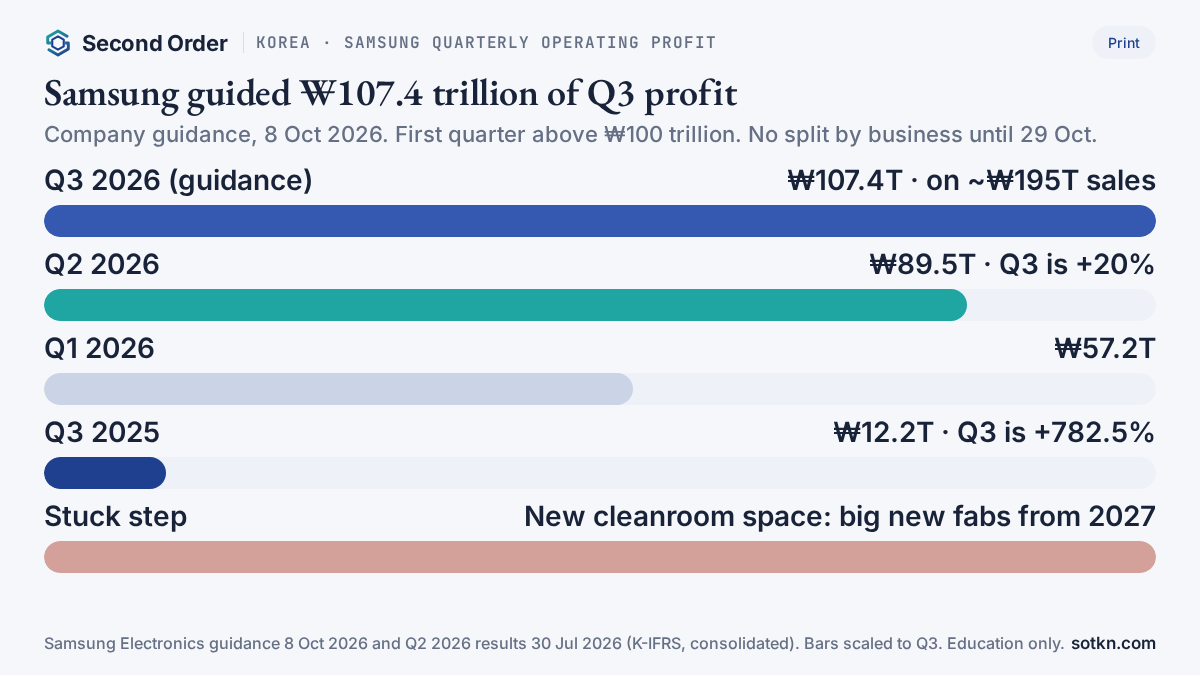
Two numbers: sales of about ₩195 trillion and operating profit of about ₩107.4 trillion. Each is the middle of a range, because Korean rules do not allow a range as the headline.
Profit rose 782.5% on a year and 20% on the quarter. Sales rose 126.6% on a year and 13.7% on the quarter, the Korea Herald reported. CNBC put the profit at about US$80.2 billion.
Was it more than expected? SBS said it beat a Yonhap Infomax consensus of ₩105.75 trillion by 1.6%. CNBC quoted an eToro analyst who said the record still fell short of expectations. Either way, it is a record, and the fourth record quarter in a row.
What Samsung did not say: where the profit came from. The split by business comes on 29 Oct. Industry insiders cited by SBS believe the chip division’s profit was about the same as, or a bit more than, the whole company’s. That would mean the other parts, taken together, made little or lost money.
Samsung guidance, 8 Oct 2026
Q3 business estimates reported by SBS (not company figures)
Samsung guidance (8 Oct 2026); Korea Herald, CNBC and SBS (8 Oct 2026). SBS figures are analyst and press estimates, not Samsung’s.
Our math: how big is ₩107.4 trillion?
- Of each ₩100 of sales in the quarter, about ₩55 was left as operating profit: 107.4 ÷ 195 = 55.1% (our arithmetic). In the June quarter it was ₩52.2.
- Over 92 days, that is about ₩1.17 trillion of operating profit a day (our arithmetic).
- Sales rose by about ₩23.5 trillion from the June quarter. Profit rose by about ₩17.9 trillion. So about ₩76 of each extra ₩100 of sales turned into extra profit (our arithmetic).
That third line is the key one. When most of the extra sales drop straight to profit, it usually means prices rose faster than costs. Samsung said as much in July: memory profit hit a record “despite limited capacity,” and the industry-wide rise in prices helped.
Compare that with the rack builders. Foxconn, the Taiwan firm that turns chips into AI racks, kept about NT$2.37 of each NT$100 as net profit in the June quarter, as we showed in the Foxconn Pulse. Samsung kept about ₩41.8 of each ₩100 as net profit in the same quarter, per its deck. Same AI build. Very different slice.
What is still not cash?

Operating profit says what Samsung earned, not what landed in the bank. For the third quarter we will not know until the cash-flow table on 29 Oct.
The June quarter, in Samsung’s own tables, is the best guide.
- Cash in from operations was ₩105.08 trillion in the quarter, more than the ₩89.5 trillion operating profit. So far, the profit has been turning into cash.
- But customers owed Samsung ₩96.4 trillion at 30 June 2026, up from ₩43.6 trillion a year earlier. That is bills sent, not yet paid. It is about 51 days of second-quarter sales (our arithmetic).
- Samsung spent ₩14.11 trillion buying plant and equipment in the quarter. First-half capex was about ₩28.0 trillion, per its half-year report.
- The tax bill is growing too. Income tax for the quarter was ₩22.8 trillion. Tax owed but not yet paid was ₩30.3 trillion at 30 June, against ₩7.6 trillion a year earlier.
- Samsung held ₩167.59 trillion of net cash at 30 June 2026, its cash minus its debts.
Samsung is not short of cash. The point is timing: guidance is a promise that cash will follow as customers pay. Some of the ₩107.4 trillion will still be sitting in unpaid bills on 30 September. Some will go to the tax office. Some will go into new fabs. See cash capex, explained for how to read that spending.
Prices are not locked forever either. TrendForce says some suppliers’ fourth-quarter price rises will lag the market because of the price rules in their long-term deals with buyers.
Who gets paid first?

Follow one memory chip. The money moves in a line, and each stop has its own clock.
First, the memory makers. Samsung, SK hynix and a few others sell the chips. When supply is short, they have the upper hand on price. That is why their profit jumps first. Samsung said in July that it expected server demand to keep the market undersupplied in the second half. See the HBM layer of the stack for who sits at this step.
Second, the buyers, who carry the cost. TrendForce expects conventional DRAM contract prices to rise 10–15% in the fourth quarter, after big rises earlier in the year, and NAND flash prices 15–20%. Cloud firms and server makers are buying more memory for AI servers. PC makers are buying hard because they expect supply to stay tight in 2027. See Hyperscalers, explained for the cloud buyers.
Phone makers feel it most. TrendForce says rising memory costs keep weighing on smartphone production. Samsung is its own example. Its phone and network arm lost ₩0.7 trillion in the June quarter, against a ₩2.8 trillion profit in the March quarter. Samsung blamed “elevated component cost pressures across the industry.” In plain terms, the chip side won and the phone side paid.
Third, the tool makers and builders. To make more memory, the makers must buy tools and build fabs, and they buy those long before the new lines make a single chip. Seoul Economic Daily reported in April that Samsung ordered about 20 EUV lithography machines from ASML for its P5 fab, worth more than ₩10 trillion, and about 70 lithography tools in all. See who makes EUV machines.
Is cleanroom space the stuck step?
On our read, yes. Demand is not the limit right now. Space to make more chips is.
A memory chip starts as a silicon wafer in a cleanroom: a huge, dust-free hall full of tools. You cannot add output faster than you can add cleanroom space and fill it with tools. Building that space takes years.
TrendForce says server memory will stay short in the fourth quarter because of limits on parts, packaging and test capacity, and on how flexibly makers can shift their front-end wafer lines. So makers move the wafers they have from phones and PCs to servers. That helps AI buyers and hurts phone buyers. It does not make more wafers.
- Samsung P5, Pyeongtaek: building of the Phase 1 cleanroom began in the third quarter of 2026, ZDNet Korea reported. Main piping should be largely done by about May to July 2027, Tech Times reported.
- Samsung wants tools moved into P5 Phase 1 from about May to June 2027, earlier than the July to August first planned, ZDNet Korea reported on 28 Sep. Full P5 operation is aimed at 2028.
- Reports differ on when real output comes. Seoul Economic Daily said in April that DRAM and HBM4 capacity could rise a lot in the first half of 2027. Tech Times said mass production at Phase 1 is aimed at the later part of 2028.
- SK hynix: its first Yongin fab, Y1, is on track to open its first cleanroom in February 2027, the company said on 7 Aug. Its next fabs, Cheongju M17 and Yongin Y2, open first cleanrooms in December 2028 and June 2029.
A caution: fab dates are company targets and press reports. The stuck step sets the pace of new supply; it has not stopped the money.
We looked at the same kind of limit for a US memory maker in the Micron clean-room Analysis, and at how Samsung splits its wafers in the HBM wafer-mix Pulse. The general pattern is in Where does the stuck step move?.
What dates matter

Dates to watch
Samsung IR events page; TrendForce 30 Sep 2026; SK hynix 7 Aug 2026; Seoul Economic Daily 6 Apr 2026; Tech Times 7 Sep 2026; ZDNet Korea via ChainCatcher 28 Sep 2026. We do not invent dates.
How is this different from …
- Korea chip exports record Pulse (5 Oct): what the whole country shipped. This is what one firm earned, and who paid for it.
- Samsung Vietnam test fab Pulse (6 Oct): the test step abroad. This is the wafer space at home.
What would change this view?
The “memory makers paid first, cleanroom space sets the pace” read weakens if:
- Samsung’s 29 Oct results show cash from operations well below operating profit, or receivables rising much faster than sales
- TrendForce or the makers say fourth-quarter contract prices are flat or falling
- P5 or Yongin Y1 bring big new output much earlier than reported
- Buyers cut back: cloud firms trim capital spending, or phone and PC makers cut memory orders hard
It stays intact while prices rise, makers say supply is short, and new space stays on a 2027-plus clock.
Practical takeaways
- Samsung guided ₩107.4 trillion of third-quarter operating profit on about ₩195 trillion of sales (8 Oct 2026)
- That is about ₩55 of each ₩100 of sales, and the first ₩100 trillion quarter for a Korean company
- Not cash yet: customers owed Samsung ₩96.4 trillion at 30 June; Q3 cash flow comes on 29 Oct
- Who gets paid first: the memory makers; buyers, including Samsung’s own phone arm, carry the cost
- Stuck step: new cleanroom space — Samsung P5 and SK hynix Yongin open from 2027
FAQ
What did Samsung say on 8 Oct 2026?
Samsung Electronics guided third-quarter 2026 operating profit of about ₩107.4 trillion, in a range of ₩107.3 trillion to ₩107.5 trillion, on sales of about ₩195 trillion. Profit rose 782.5% on a year and 20% on the second quarter. It is the first time a Korean company has made more than ₩100 trillion in a quarter.
Is the ₩107.4 trillion cash in the bank?
Not yet, and not all of it. It is a preliminary profit estimate. At 30 June 2026 customers owed Samsung ₩96.4 trillion. Third-quarter cash flow comes with full results on 29 Oct 2026.
Who gets paid first?
The memory makers, Samsung and SK hynix among them, selling scarce chips at rising prices. Buyers pay more. Tool makers and fab builders are next in line.
What is the stuck step?
On our read, new cleanroom space. More supply needs new fab space and tools. Samsung's P5 cleanroom is due in the first half of 2027 (reports); SK hynix targets February 2027 for Yongin.
Is this investment advice?
No. Education only. It maps who gets paid and which step is stuck. It is not a recommendation to buy or sell any security.
Keep reading on the map
- Korea Markets hub — country page
- Korea chip exports record Pulse (5 Oct) — the country’s shipments
- Samsung Vietnam test fab Pulse (6 Oct) — the test step
- Samsung HBM4 ask Pulse (3 Oct) — the HBM price
- Taiwan Foxconn Pulse (7 Oct) — the thin slice
- Semiconductors stack — layer map
How we check this
Third-quarter sales and operating profit come from Samsung Electronics’ earnings guidance of 8 Oct 2026. Second-quarter results, cash flow, receivables and tax come from Samsung’s results release and earnings deck of 30 Jul 2026, and first-half capex from its 2026 half-year report. Third-quarter business estimates are press and analyst estimates reported by SBS, not Samsung figures. Price forecasts are TrendForce’s. Fab dates come from SK hynix and labelled press reports. Where we work something out ourselves, the sum is shown and labelled our arithmetic.
Last reviewed: 8 Oct 2026 · Next review: after Samsung’s third-quarter results call on 29 Oct 2026
Spot an error? Tell us and we will correct it and note the change here.
Not investment advice. Do your own research.
Sources
- Samsung Electronics — Earnings guidance for third quarter 2026 (8 Oct 2026): news.samsung.com
- Samsung Electronics — Second quarter 2026 results (30 Jul 2026): news.samsung.com
- Samsung Electronics — 2Q 2026 earnings deck: segments, balance sheet, cash flow (30 Jul 2026): samsung.com
- Samsung Electronics — 2026 half-year business report (capex): samsung.com
- Samsung Electronics — Investor relations events (3Q26 call, 29 Oct 2026): samsung.com
- The Korea Herald — Samsung sees Q3 profit jump 783% to record W107.4tr (8 Oct 2026): koreaherald.com
- CNBC — Samsung forecasts record third-quarter profit (8 Oct 2026): cnbc.com
- SBS — Samsung posts 107 trillion won in Q3 operating profit (8 Oct 2026): sbs.co.kr
- TrendForce — AI server demand sustains memory contract price increases in 4Q26 (30 Sep 2026): trendforce.com
- Seoul Economic Daily — Samsung orders EUV machines for P5 (6 Apr 2026): sedaily.com
- Tech Times — Samsung P5 cleanroom piping starts (7 Sep 2026): techtimes.com
- ChainCatcher, citing ZDNet Korea — Samsung pulls forward P5 Phase 1 tool move-in (28 Sep 2026): chaincatcher.com
- SK hynix — Invests ₩54 trillion in Yongin Y2 and Cheongju M17 (7 Aug 2026): news.skhynix.com