Who Makes EUV Machines? ASML, Its Suppliers, and Its Rivals
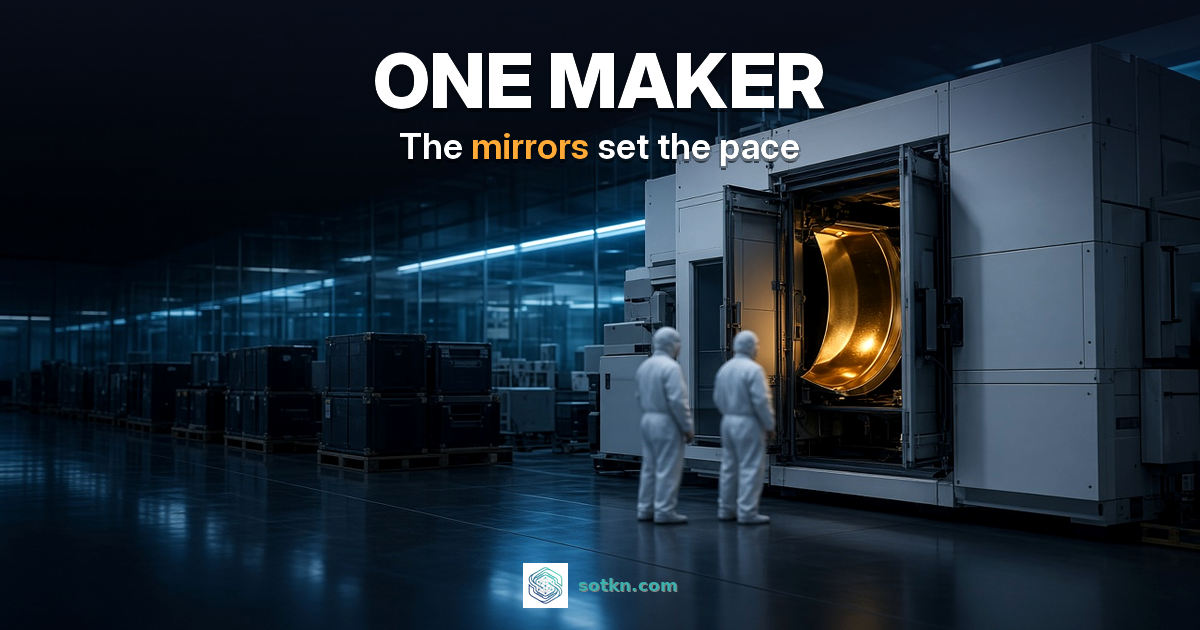
Only one company makes EUV lithography machines: ASML. The roles that matter sit inside the machine: Zeiss makes the mirrors, Trumpf makes the laser, and the optics set how many boxes ship.
EXPLAINED · Players · Last reviewed: 06 Oct 2026 · Next review: after Trumpf full-year results (15 Oct 2026) and ASML Q3 2026 results
An EUV machine is the scanner that prints the smallest layers of a leading-edge chip with 13.5-nanometre light. Only one company makes them: ASML, based in the Netherlands. Its own annual report calls it the world’s only manufacturer of EUV lithography systems. The other players are its suppliers inside the machine and its rivals in older types of lithography.
In short. EUV machines sit on the Semiconductors layer. ASML is the only maker. Zeiss makes the mirrors and Trumpf makes the laser inside each one. ASML says the mirror supply limits how many machines it can build. Canon and Nikon compete only in older lithography. So the useful question is not who beats ASML. It is how fast the suppliers inside the box can grow.
A simple way to see it. A chipmaker that wants to print a 3-nanometre-class chip needs EUV for its tightest layers. There is one place to buy that machine. For how the machine works and why it binds, see EUV lithography explained. This page is about the players around it.
Who makes EUV machines?
ASML makes all of them. Its FY2025 annual report, filed 25 February 2026, says it is “currently the world’s only manufacturer of EUV lithography systems.” It sells two kinds. Low-NA machines (the NXE family) are the volume workhorses. High-NA machines (the EXE family) print finer lines and are still early. ASML says customers had run more than 400,000 wafers on High-NA machines by the end of 2025.
ASML recognised 48 EUV systems in 2025, up from 44 in 2024. It does not sell the machine alone. It also earns from servicing and upgrading the fleet it has already shipped.
Who supplies the parts inside an EUV machine?
This is where the real players sit. ASML builds the machine, but it buys the hardest parts from a few suppliers. Its 20-F says it has about 5,100 suppliers, and that single sourcing is “especially true for EUV systems,” where parts are too complex to buy from two places.
| Role | Who | What they make | How they get paid |
|---|---|---|---|
| EUV scanner maker | ASML (Netherlands) | The full EUV machine, Low-NA and High-NA | Chipmakers pay per system, then for service and upgrades |
| Optics (the stuck step) | Carl Zeiss SMT (Germany) | Mirrors, illuminators, collectors; sole supplier to ASML | Paid by ASML; ASML also owns 24.9% of the holding company |
| Drive laser | Trumpf (Germany) | High-power CO2 lasers that hit molten tin to make EUV light | Paid by ASML as machines are built |
| Light source | Cymer (ASML company, San Diego) | ASML’s light-source centre | Inside ASML |
| Older lithography rivals | Canon, Nikon (Japan) | DUV scanners; Canon also nanoimprint tools | Paid by chipmakers for non-EUV layers |
| Would-be EUV entrant | China’s state-backed programme (reported) | EUV light-source prototype; no wafer exposed | No sales |
The mirrors come from Carl Zeiss SMT, part of the ZEISS Group. ASML calls it the sole supplier of its lenses, mirrors, illuminators and collectors. It adds that Zeiss can make them “only in limited numbers” at two sites in Germany, Oberkochen and Wetzlar. ASML has owned 24.9% of the Zeiss SMT holding company since 29 June 2017, and booked €216.7 million of profit from that stake in 2025.
Zeiss is growing with it. ZEISS Group’s Semiconductor Manufacturing Technology segment, which includes this work, had revenue of €5.055 billion in its year to September 2025, up from €4.122 billion. That is about 23% more (results released 18 December 2025).
The light comes from a laser. Trumpf, a German laser maker, supplies the high-power carbon dioxide lasers that fire at tiny drops of molten tin to make EUV light. In preliminary figures for its year to June 2026, Trumpf reported sales of €4.34 billion and orders of €4.5 billion. Its chief executive said its EUV work with ASML saw noticeable growth (optics.org, 28 July 2026). Cymer, which ASML owns, runs ASML’s light-source centre in San Diego.

Who are ASML’s competitors?
In EUV, nobody sells a rival machine today. ASML’s competition is in older lithography. Its 20-F says it competes “primarily with Canon and Nikon” in deep-ultraviolet (DUV) systems. DUV still prints most layers on most chips. It just cannot print the finest ones in one pass.
Canon also sells a different tool: nanoimprint lithography. It presses a patterned mask into the wafer like a stamp instead of shining light through it. Canon says its FPA-1200NZ2C can print lines of 14 nanometres, which it calls equal to the 5-nanometre node. Its 26 September 2024 shipment to the Texas Institute for Electronics was for research and prototypes, not volume chips.
China is trying to build its own. Tom’s Hardware reported on 4 August 2026 that a state-backed maker plans about five domestic immersion DUV machines in 2026 and about 20 in 2027. It also cited a Reuters report of an EUV light-source prototype in Shenzhen that makes EUV light but has not exposed a wafer. Beijing’s target is chips from it by 2028; Reuters’ sources said 2030 is more realistic. None of this has been confirmed by the companies.
Who gets paid, and where is the stuck step?
The chipmaker pays first. Foundries and memory makers pay ASML for each machine, then for service and upgrades. ASML’s largest customer alone was €7.8 billion, or 23.9% of its 2025 sales. That money is funded by chip demand downstream, including the cash capex that hyperscalers spend on AI chips.
ASML then pays the suppliers inside the box. Zeiss is paid for optics. Trumpf is paid for lasers. Thousands of smaller suppliers are paid for parts.
The stuck step is the mirrors. ASML says it plainly: “The number of lithography systems we are able to produce is limited by the production capacity of” Carl Zeiss SMT. So when ASML plans more machines, the real question is whether Zeiss can make more mirrors on the same clock. A scanner order with no optics behind it is a slot in a queue, not a machine.
Downstream, the machines decide which chips get printed at all. No EUV layers means no leading-edge die, and no die means nothing to stack with HBM or package in CoWoS. For who designs and makes the chips themselves, see who makes AI chips, and for the memory side, who makes HBM.

The clocks to watch now
ASML’s plan. In its 15 July 2026 release, ASML said its 2026 Low-NA EUV capacity is around 65. It plans to add 30% for 2027 and is studying another 30% for 2028. Our arithmetic: 65 × 1.3 is about 85 machines of capacity in 2027, and about 110 in 2028 if the second step goes ahead. Each step needs more mirrors and more lasers behind it.
Trumpf’s full year. Trumpf reports full results, with more detail on its laser business, on 15 October 2026. That is the next dated read on the light-source side.
China’s first wafer. The test for a rival EUV machine is simple: a wafer exposed and a chip made. Beijing’s reported target is 2028.
Common misconceptions
- People assume ASML has EUV competitors. Actually no one else sells an EUV machine. Canon and Nikon compete in DUV, which prints wider lines.
- People assume ASML makes the whole machine itself. Actually the mirrors come from Carl Zeiss SMT and the drive lasers from Trumpf. ASML says Zeiss capacity limits its output.
- People assume nanoimprint is an EUV replacement today. Actually Canon’s nanoimprint tool shipped for research and prototypes in 2024. It is not printing leading-edge chips in volume.
- People assume more orders mean more machines right away. Actually ASML builds to a capacity plan, about 65 Low-NA EUV systems in 2026, and every extra machine needs optics from one supplier.
FAQ
Who makes EUV machines?
Only ASML. Its FY2025 annual report (Form 20-F, filed 25 February 2026) says it is the world’s only manufacturer of EUV lithography systems. Other companies make key parts inside the machine, but none sells a rival EUV scanner.
Who are ASML’s competitors?
In EUV, none today. In older deep-ultraviolet (DUV) lithography, ASML names Canon and Nikon as its main rivals. Canon also sells a different kind of tool, nanoimprint lithography, so far for research and prototypes. China is building its own lithography tools, but reported output is small and its EUV prototype has not exposed a wafer.
Who makes the mirrors in an EUV machine?
Carl Zeiss SMT, part of the ZEISS Group in Germany. ASML calls it its sole supplier of lenses, mirrors, illuminators and collectors, and says Zeiss can make them only in limited numbers at two German sites. ASML owns 24.9% of the Zeiss SMT holding company.
Who makes the laser in an EUV machine?
Trumpf, a German laser maker, supplies the high-power carbon dioxide lasers. They fire at tiny drops of molten tin to make the EUV light. Cymer, an ASML company in San Diego, is ASML’s light-source centre.
Why can’t anyone else make EUV machines?
The machine needs a full chain that took decades to build: the mirrors, the light source, and thousands of single-sourced parts. ASML says single sourcing is especially true for EUV, where many parts are too complex to buy from two places. A rival would need to rebuild that chain, not just the scanner.
How many EUV machines does ASML make a year?
ASML recognised 48 EUV systems in 2025, up from 44 in 2024 (20-F). For 2026 it says its Low-NA EUV capacity is around 65, and it plans to add 30% for 2027 (Q2 2026 release, 15 July 2026).
Is this a list of stocks to buy or sell?
No. Second Order Explained pages explain who does what and how the money moves. They do not give buy or sell calls.
Related terms
- EUV lithography — how the machine prints and why it binds.
- Who makes AI chips — the designers and foundries that buy EUV time.
- Who makes HBM — the memory makers that also need EUV for advanced DRAM.
- Hybrid bonding — a later step that joins chips once they are printed.
- CoWoS — the packaging slot after the die exists.
Stack doors
Layer: Semiconductors. Markets: Taiwan and Korea.
Get the Wire — short daily notes when tool, optics, or fab clocks move.
How we check this
Who makes what comes from ASML’s own 20-F annual report and its Q2 2026 results release, quoted where the wording matters (“only manufacturer”, “sole supplier”, “limited by the production capacity”). Supplier figures come from ZEISS and from Trumpf’s preliminary results as reported by optics.org. China figures are labelled as reported, because no company has confirmed them. The 2027 and 2028 capacity numbers are our arithmetic on ASML’s stated +30% steps, shown in full. This page lists roles. It does not rank companies or give buy or sell calls.
Last reviewed: 06 Oct 2026 · Next review: after Trumpf full-year results (15 Oct 2026) and ASML Q3 2026 results
Spot an error? Tell us and we will correct it and note the change here.
Sources
- ASML Form 20-F FY2025 — only EUV maker; competes with Canon and Nikon in DUV; Carl Zeiss SMT sole optics supplier and capacity limit; 24.9% Zeiss SMT stake; 48 EUV systems recognised (filed 25 Feb 2026)
- ASML Q2 2026 results (Form 6-K) — Low-NA EUV capacity ~65 in 2026, +30% planned for 2027, another +30% being investigated for 2028 (15 Jul 2026)
- ZEISS Group FY2024/25 results — Semiconductor Manufacturing Technology revenue €5.055B vs €4.122B (18 Dec 2025)
- optics.org — Trumpf preliminary FY2025/26: sales €4.34B, orders €4.5B; EUV with ASML saw noticeable growth; CO2 lasers for EUV light; full results 15 Oct (28 Jul 2026)
- Canon — FPA-1200NZ2C nanoimprint lithography system shipped to Texas Institute for Electronics for R&D and prototypes (26 Sep 2024)
- Tom’s Hardware — China lithography roadmap: ~5 domestic immersion DUV systems in 2026, EUV light-source prototype with no wafer exposed, 2028 target (4 Aug 2026)