Leases Not Yet Commenced Explained: The Data Center Leases Hyperscalers Signed but Have Not Started
Leases not yet commenced are signed leases whose start date has not arrived. Five hyperscalers now report about US$1.3 trillion of them, and Meta’s and Alphabet’s grew by more than a quarter in three months. No lease payments flow until handover. The stuck step is the building and its power.
EXPLAINED · Mechanism · Last reviewed: 22 Nov 2026 · Next review: when Oracle files its next 10-Q and Microsoft, Meta, Alphabet, Amazon and CoreWeave file their next quarterly or annual reports
Leases not yet commenced are leases a company has signed whose start date has not arrived, so they sit in a footnote instead of on the balance sheet.
In short. What are leases not yet commenced? They are leases a company has signed that have not started, because the landlord has not handed over the building. They are not on the balance sheet yet. Companies show them in a footnote as the total future payments. At their latest filings, Microsoft, Meta, Alphabet, Amazon and Oracle reported about US$1.3 trillion of them, by our arithmetic. Meta’s pile grew 27.5% and Alphabet’s 53.2% in one quarter. Our read: signed is not paid. Landlords are paid only after handover. The stuck step is the building and its power.
Why an investor cares: this one footnote line shows how much data center space the largest cloud companies have promised to pay for, years before the first lease payment moves. This page sits in our Hyperscalers layer. Our data center lease explained page covers how a single lease is priced. This page explains the signed-but-not-started pile that sits behind those leases.
What are leases not yet commenced? The short answer
They are signed leases that have not begun. The tenant has agreed to lease a building, a site or equipment. The landlord has agreed to deliver it. But the start date has not come, because the thing being leased is not ready.
For a data center, that usually means the hall is still being built, or the power is not yet connected. The contract is real. The payments are not flowing yet.
US accounting rules keep these leases off the balance sheet until they start. So companies tell investors about them in a footnote. The figure is the plain sum of all the future payments, with no discount for time. That makes it a large number, and it is meant to be read as a promise, not a bill already due.
When does a lease commence?
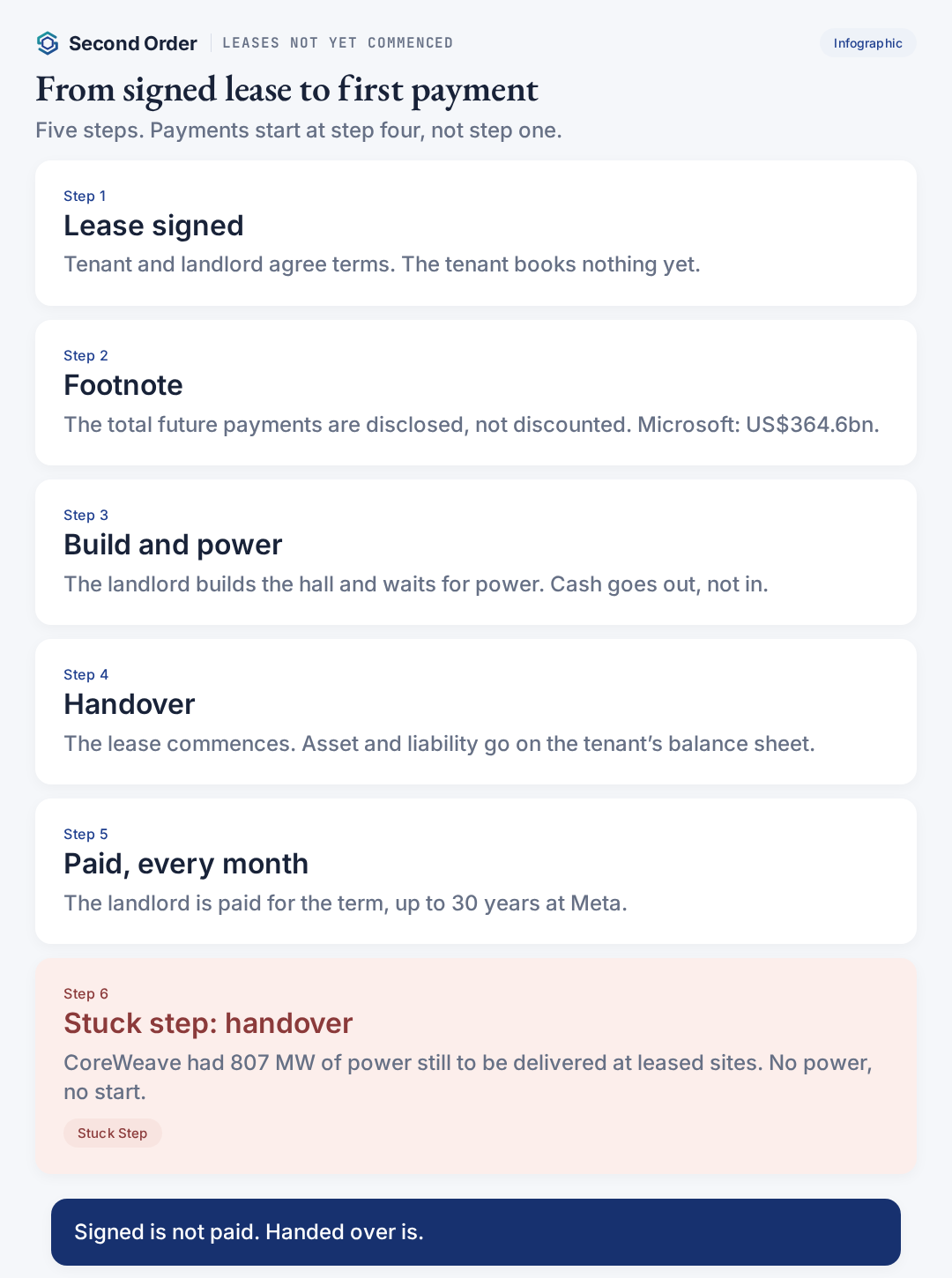
A lease commences on the day the landlord makes the asset available for the tenant to use. In a data center, that is handover. The building is finished, the cooling works and the power is on.
The date the contract is signed does not matter for this. A lease signed in 2026 for a hall that opens in 2029 commences in 2029. Until then, it waits in the footnote.
This is why the footnote gives a start window, not a single date. Microsoft says its leases will commence between fiscal 2027 and fiscal 2034. Meta says from late 2026 through 2036. Oracle says between the second quarter of fiscal 2027 and fiscal 2029. Each window is a list of handovers still to come.
Where do you find leases not yet commenced in a 10-Q?
Look in the leases note or the commitments note. The wording changes from company to company, but the shape is the same: an amount, a start window, a range of terms and a short description of what is being leased.
- Microsoft puts it right under its lease maturity table: additional leases, primarily for datacenters, that had not yet commenced.
- Meta puts it in its commitments note, next to its other contractual commitments, and lists data centers, energy-related infrastructure, colocations and network infrastructure.
- Alphabet puts it under its future lease payments table, and says the payments are not yet recorded.
- Amazon shows it as one line in its commitments table, split by year.
- Oracle calls it additional lease commitments, substantially all related to data center arrangements.
Four things to read every time. How big is the amount? When do the leases start? How long do they run? And are there conditions or carve-outs? The last one is easy to miss, and it often matters most.
How big are hyperscaler lease commitments now?
Very big, and growing fast. At their latest filings, five big US cloud companies reported about US$1,304 billion of leases signed but not started, by our arithmetic. Three of them, Microsoft, Meta and Alphabet, added about US$157.5 billion between them in the September quarter alone.
| Company (date) | Not yet commenced | Quarter before | Change | Starts | Terms | What the filing says it is |
|---|---|---|---|---|---|---|
| Microsoft (30 Sep 2026) | US$364.6bn | US$329.1bn | +10.8% | FY2027 to FY2034 | 1 to 20 years | Primarily datacenters; some subject to contractual conditions |
| Meta (30 Sep 2026) | US$355.73bn | US$278.99bn | +27.5% | Late 2026 to 2036 | Over 1 to 30 years | Data centers, energy-related infrastructure, colocations, network |
| Oracle (31 Aug 2026) | US$288bn | — | — | Q2 FY2027 to FY2029 | 15 to 19 years | Substantially all data center arrangements |
| Amazon (30 Sep 2026) | US$164.9bn | — | — | Not stated | Not stated | A line in the commitments table; type of property not stated |
| Alphabet (30 Sep 2026) | US$130.5bn | US$85.2bn | +53.2% | 2026 to 2031 | 1 to 26 years | Primarily data centers and energy infrastructure |
| CoreWeave (30 Sep 2026) | US$47.4bn | — | — | 2026 to 2029 | 7 to 17 years | Primarily data centers, equipment and offices; some leases left out |
Future payments, not discounted, from each company’s latest 10-Q. The quarter-before column is shown for Microsoft (from its 10-K), Meta and Alphabet, the three we compare in the text. Changes are our arithmetic. Oracle’s quarter ends a month earlier than the others.
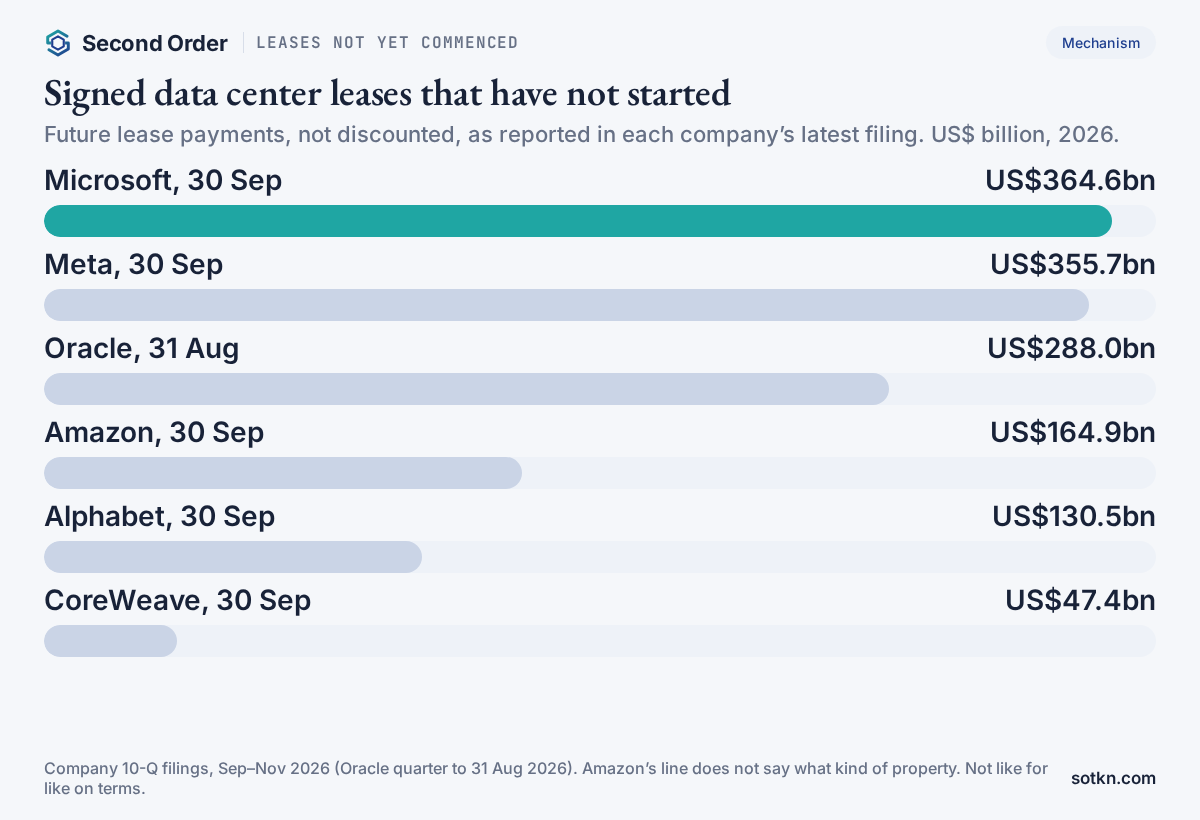
Two cautions before comparing them. First, Oracle’s figure is at 31 August, a month before the others. Second, the descriptions differ. Meta now includes energy-related infrastructure, which it did not list in June. Amazon does not say what its leases cover, and its filings describe a fulfillment network as well as data centers. So the total is a scale, not a precise sum of data halls.
Microsoft: US$364.6 billion, with conditions
Microsoft has the largest footnote. At 30 September 2026 it had US$364.6 billion of additional leases, primarily for datacenters, that had not yet commenced. At 30 June it was US$329.1 billion. That is US$35.5 billion more in one quarter, up 10.8%, by our arithmetic.
Two details moved. The start window now runs to fiscal 2034, a year later than the fiscal 2033 it gave in June. And the filing says some arrangements are subject to certain contractual conditions being met. It does not say which conditions, or how much of the total they cover.
Leases are also starting. In the quarter, Microsoft recorded US$6,523 million of new right-of-use assets for operating leases, against US$1,417 million a year earlier. That is about 4.6 times as much, by our arithmetic. Its finance lease cost rose 43.7% to US$2,471 million. Some of the pile is turning into real buildings, and real cost.
Our what Microsoft does page covers where this capacity goes, and our Microsoft GPU handover analysis covers the waiting.
Meta: US$355.73 billion, now with energy
Meta is close behind. At 30 September 2026 it had about US$355.73 billion of operating and finance leases that had not yet commenced. At 30 June the figure was about US$278.99 billion. That is about US$76.74 billion added in one quarter, up 27.5%, by our arithmetic. It is the biggest jump of the five in dollars.
The description changed too. In June, Meta listed data centers, colocations and network infrastructure. In September it added energy-related infrastructure. Its leases start from late 2026 through 2036, with terms from just over one year to 30 years.
Meta also lists US$454.52 billion of non-cancelable contractual commitments as a separate figure. Do not add the two together without reading what each covers. Our Meta leases not started Wire covers the jump when it was filed.
Alphabet, Amazon and Oracle
Alphabet grew fastest. Its leases not yet commenced rose from US$85.2 billion at 30 June to US$130.5 billion at 30 September 2026. That is up 53.2%, by our arithmetic. They are primarily data centers and energy infrastructure, starting between 2026 and 2031, with terms of one to 26 years.
Alphabet also pays some money early. It made US$994 million of lease prepayments in the first nine months of 2026 for leases not yet commenced, and expects to account for them as finance leases. It also says some of its data center leases are with entities it has an interest in but does not control.
Amazon shows the timing best. Its commitments table spreads US$164.9 billion of leases not yet commenced by year. Only US$2.6 billion falls in the last three months of 2026. About US$114.8 billion, or 69.6%, falls after 2030, by our arithmetic.
Oracle signs the longest leases. It had US$288 billion of additional lease commitments at 31 August 2026. They are substantially all data center arrangements, with terms of 15 to 19 years. Our what Oracle does and Amazon’s unstarted leases pages cover the two in more depth.
What happens on commencement day?
On the day a lease starts, it moves from the footnote onto the balance sheet. The tenant records two things. A right-of-use asset, for its right to use the building. And a lease liability, for the payments it owes.
The liability is smaller than the footnote figure. That is because it is the present value of the payments, discounted for time, while the footnote is the plain sum. Microsoft shows the gap on its leases already on the books: US$128.3 billion of future payments became US$98.5 billion of lease liabilities after imputed interest, by our arithmetic.
Then the cost starts. For an operating lease, the tenant books one lease expense each period. For a finance lease, it books depreciation and interest. Our finance lease vs operating lease page covers which label applies and why it changes profit lines.
Signed, not started vs already on the books
One way to see how fast a company is growing its space is to compare the two piles. On one side, leases signed but not started. On the other, future payments on leases that have already begun.
| Company | Signed, not started | Lease payments already on the books | Not started vs on the books |
|---|---|---|---|
| Oracle (31 Aug 2026) | US$288bn | US$63.2bn | 4.6x |
| Alphabet (30 Sep 2026) | US$130.5bn | US$28.8bn | 4.5x |
| Microsoft (30 Sep 2026) | US$364.6bn | US$128.3bn | 2.8x |
| CoreWeave (30 Sep 2026) | US$47.4bn | US$33.8bn | 1.4x |
| Amazon (30 Sep 2026) | US$164.9bn | US$139.4bn | 1.2x |
Both columns are future payments before discounting, from each company’s maturity or commitments table. Ratios are our arithmetic. Meta’s 10-Q does not give a comparable table, so it is left out.
Oracle and Alphabet have signed about four and a half times more than they already carry. Microsoft has signed nearly three times more. Amazon is close to even, partly because it already carries a large lease book. Our read: the higher the ratio, the more of a company’s future space depends on buildings that do not yet exist.
Do neoclouds have leases not yet commenced too?
Yes. Neoclouds, the GPU cloud companies, lease most of their data center space, so the line matters even more for them. CoreWeave had US$47.4 billion of leases not yet commenced at 30 September 2026. That is about 1.4 times the lease payments already on its books, by our arithmetic. They start between 2026 and 2029, with terms of seven to 17 years.
The more telling part is what CoreWeave leaves out. One single-site lease is excluded because its payments depend on the landlord’s construction costs, up to a cap of US$16.9 billion over 16 years. At that site, 453 MW of power was still to be delivered. Other leases with cost-based payments had 354 MW still to be delivered. Together that is 807 MW, by our arithmetic, all of it on leases that are signed but cannot fully start until the power arrives.
Our what CoreWeave does page covers its customers, and our CoreWeave power not live Wire covers the gap between contracts and live power. The neocloud explained page covers the business model.
Are leases not yet commenced the same as debt or capex?
Neither, yet. They are not debt, because nothing is owed until the asset is handed over. They are not capex, because the tenant is not buying the building. But they are a promise to pay, and once each lease starts it becomes a liability much like debt.
That is why we read them next to capex. A hyperscaler can grow its data center space by building, which shows up as capex, or by leasing, which shows up first in this footnote. Our AI capex explained and hyperscaler capex lines to watch pages cover the building side. The purchase commitment page covers the other big footnote promise, for chips and servers.
Who gets paid?
Our read: nobody is paid under the lease until handover. Before that, the money flows out, not in. After handover, the landlord is paid for years.
- Landlords and developers, after handover. They are paid for the full term, up to 30 years at Meta and 15 to 19 years at Oracle. Digital Realty, one landlord, had a record US$2.5 billion a year of signed leases that had not started at 30 September 2026, at full share.
- Builders and equipment makers, before handover. The landlord pays them to put up the hall and its power systems. Their cash comes first.
- Lenders to landlords. Our read: a signed lease with a large tenant is what a landlord borrows against to build. The filings here do not show those loans, so we do not size them.
- Waiting: the landlord, between signing and handover. Digital Realty said its third-quarter 2026 leases take 17 months on average to start. For that time, the lease is backlog, not revenue.
Where is the stuck step?
Our read: handover. Signing is not the problem. Meta alone added about US$76.74 billion of signed leases in one quarter. The slow part is turning each one into a finished, powered building.
CoreWeave’s filing shows it plainly. It lists hundreds of megawatts of power still to be delivered at sites it has already leased, due in phases between 2026 and 2028. Microsoft’s filing says some of its leases depend on contractual conditions being met. Every year the start windows stretch further out: Microsoft’s moved from fiscal 2033 to fiscal 2034 in a single quarter.
Our analysis of US$1.1 trillion of leases waiting on handover works through where the cash sticks if handovers slip. The contracted power and how long it takes to build an AI data center pages cover why the power clock is so long.
The clocks
- Last three months of 2026. Amazon’s schedule shows US$2.6 billion of payments on leases not yet commenced falling due.
- Quarter to 30 November 2026. Oracle’s next 10-Q shows whether its US$288 billion kept growing.
- Quarter to 31 December 2026. Microsoft, Meta, Alphabet, Amazon and CoreWeave report on it in their next filings. Watch the amount, the start window and any conditions.
- 2026 to 2028. CoreWeave’s 807 MW of undelivered power at leased sites is due in phases.
- Fiscal 2027 to fiscal 2029. Oracle’s leases are due to start.
- Fiscal 2027 to fiscal 2034. Microsoft’s US$364.6 billion of leases start.
- Late 2026 to 2036. Meta’s US$355.73 billion of leases start.
What would change the view?
- The pile shrinks without handovers. If the footnote falls but new right-of-use assets do not rise, leases are being cut, not started.
- Start windows keep stretching. If end dates keep moving out each quarter, handover is slipping and payments arrive later.
- Conditions get named. If Microsoft or others say a large share depends on conditions, the signed number is softer than it looks.
- Power arrives faster. If undelivered megawatts at leased sites fall quickly, the stuck step loosens and moves elsewhere.
- Hyperscalers build more themselves. If capex rises and new leases slow, the landlords’ share of the build shrinks.
Common misconceptions
- People assume leases not yet commenced are already on the balance sheet. Actually, they sit in a footnote until handover. Only then does the tenant record an asset and a liability.
- People assume the footnote figure is what the tenant owes today. Actually, it is the plain sum of payments over terms of up to 30 years, starting years from now.
- People assume a signed lease means money is flowing. Actually, the landlord is paid only from commencement. Digital Realty’s new leases take 17 months on average to start.
- People assume the five-company total is all data halls. Actually, Meta includes energy infrastructure, and Amazon does not say what its leases cover.
FAQ
What are leases not yet commenced?
They are leases a company has signed but that have not started, because the landlord has not yet handed over the building or equipment. Under US accounting they are not on the balance sheet yet. Companies disclose them in a footnote as the total future payments, not discounted.
When does a lease commence?
A lease commences on the day the landlord makes the asset available for the tenant to use. For a data center, that is handover: the building is finished and the power is on. Only then does the tenant record the lease on its balance sheet and start making the lease payments.
How much in data center leases have hyperscalers signed but not started?
About US$1.3 trillion across Microsoft, Meta, Alphabet, Amazon and Oracle, by our arithmetic from their latest filings. Microsoft reported US$364.6 billion and Meta about US$355.73 billion at 30 September 2026, Oracle US$288 billion at 31 August 2026, Amazon US$164.9 billion and Alphabet US$130.5 billion at 30 September 2026.
Are leases not yet commenced the same as debt?
No, not yet. Until a lease starts, it is a commitment in a footnote, not a liability on the balance sheet. When it starts, the tenant records a lease liability at the present value of the payments, which is smaller than the footnote total because it is discounted.
Can a lease not yet commenced be cancelled?
It depends on the contract, and the filings do not give the terms. Microsoft says some of its arrangements are subject to certain contractual conditions being met. CoreWeave leaves some leases out of its total because the payments depend on construction costs that are not yet known.
Why did leases not yet commenced jump in 2026?
Because the largest cloud companies are signing for more data center space than they can build themselves. Between June and September 2026, Meta’s total rose about 27.5%, Alphabet’s about 53% and Microsoft’s about 10.8%, by our arithmetic.
Who gets paid from leases not yet commenced?
Nobody is paid under the lease until handover. Before that, the money flows the other way: landlords and developers spend on land, buildings and power, and in our read much of that is borrowed. Once a lease starts, the landlord is paid every month for the lease term, which runs up to 30 years at Meta.
Where do I find leases not yet commenced in a 10-Q?
Look in the leases note or the commitments note of the financial statements. Microsoft puts it under the lease maturity table. Amazon puts it as a line in its commitments table. Oracle calls it additional lease commitments.
Related: data center lease explained; finance lease vs operating lease; sale-leaseback explained; remaining performance obligation; colocation explained; hyperscaler explained.
Stack doors
Layer: Hyperscalers. Players: Meta, Google and Amazon. Landlord side: Digital Realty. Markets: Meta’s third-quarter capex and cash flow. Wire: Alphabet’s data center backstops.
Get the Wire — short daily notes on where AI computing gets built and who pays for it.
Not investment advice. Do your own research.
How we check this
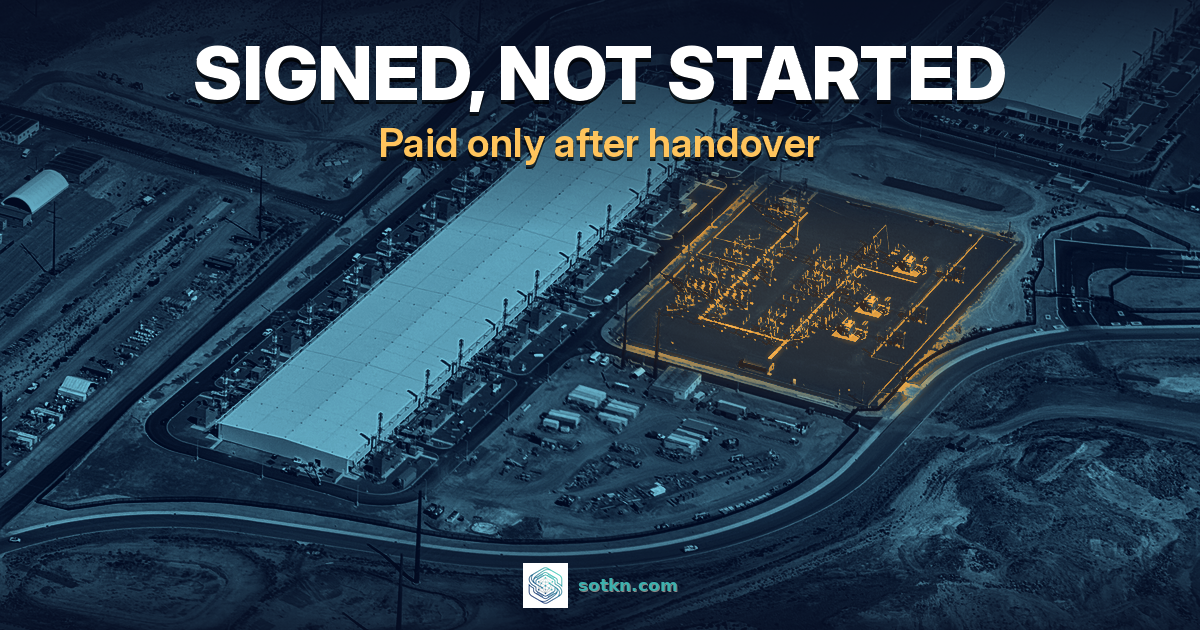
Every lease figure on this page comes from a company filing on the SEC’s EDGAR system, read in full by us. Microsoft’s figures come from its Form 10-Q for the quarter to 30 September 2026, filed 28 October 2026, and its Form 10-K for the year to 30 June 2026. Meta’s and Alphabet’s come from their 10-Qs for the quarters to 30 June and 30 September 2026. Amazon’s come from its 10-Q for the quarter to 30 September 2026. Oracle’s come from its 10-Q for the quarter to 31 August 2026. CoreWeave’s come from its 10-Q for the quarter to 30 September 2026. Digital Realty’s backlog and signing-to-start lag come from its third-quarter 2026 results release, filed as Exhibit 99.1 to its Form 8-K of 29 October 2026. None of these filings names the landlords behind the hyperscalers’ leases, and Amazon’s table does not say what kind of property its leases cover, so we do not say either. Totals, changes and ratios are our arithmetic, checked in code and labelled on the page; the five-company total mixes Oracle’s 31 August date with the others’ 30 September date. Who gets paid and the stuck step are our read. The featured image is a CC BY 4.0 aerial photograph of a data center hall and substation, graded by us; it is illustrative and does not show any lease named here. This page explains how a business works. It does not rate companies as investments or give buy or sell calls. Not investment advice. Do your own research.
Last reviewed: 22 Nov 2026 · Next review: when Oracle files its next 10-Q and Microsoft, Meta, Alphabet, Amazon and CoreWeave file their next quarterly or annual reports
Spot an error? Tell us and we will correct it and note the change here.
References
- Microsoft — Form 10-Q for the quarter ended 30 September 2026 (filed 28 Oct 2026) — Leases not yet commenced, primarily datacenters, US$364.6bn, some subject to contractual conditions, starting fiscal 2027 to fiscal 2034, terms 1 to 20 years; lease payment maturities; lease cost; right-of-use assets obtained
- Microsoft — Form 10-K for the fiscal year ended 30 June 2026 (filed 29 Jul 2026) — Leases not yet commenced US$329.1bn at 30 June 2026, starting fiscal 2027 to fiscal 2033
- Meta Platforms — Form 10-Q for the quarter ended 30 September 2026 (filed 22 Oct 2026) — Operating and finance leases not yet commenced about US$355.73bn: data centers, energy-related infrastructure, colocations and network infrastructure, starting late 2026 to 2036, terms over one year to 30 years
- Meta Platforms — Form 10-Q for the quarter ended 30 June 2026 (filed 30 Jul 2026) — Leases not yet commenced about US$278.99bn at 30 June 2026
- Alphabet — Form 10-Q for the quarter ended 30 September 2026 (filed 29 Oct 2026) — Leases not yet commenced US$130.5bn, data centers and energy infrastructure, starting 2026 to 2031; future lease payments on the books; lease prepayments; data center leasing VIEs
- Alphabet — Form 10-Q for the quarter ended 30 June 2026 (filed 23 Jul 2026) — Leases not yet commenced US$85.2bn at 30 June 2026
- Amazon — Form 10-Q for the quarter ended 30 September 2026 (filed 30 Oct 2026) — Commitments table: leases not yet commenced US$164.922bn by year; operating and finance lease liabilities including interest
- Oracle — Form 10-Q for the quarter ended 31 August 2026 (filed 11 Sep 2026) — US$288bn of additional lease commitments, substantially all data center arrangements, starting Q2 fiscal 2027 to fiscal 2029, terms 15 to 19 years; lease payment maturities
- CoreWeave — Form 10-Q for the quarter ended 30 September 2026 (filed 12 Nov 2026) — Leases not yet commenced US$47.4bn, starting 2026 to 2029; excluded single-site lease with 453 MW undelivered and a US$16.9bn cap; 354 MW undelivered at other sites
- Digital Realty — Third Quarter 2026 results release, Form 8-K Exhibit 99.1 (29 Oct 2026) — Signed-but-not-commenced backlog US$2.5bn of annualized GAAP base rent at 100% share, US$1.8bn at its share; 17-month average lag from signing to commencement