What Is a Carrier-Neutral Data Center? Many Networks, One Landlord
A carrier-neutral data center is a building where many networks and clouds can connect and the landlord does not make you use its own network. The landlord is paid for space, power and a monthly fee per cable, and the AI era has made the power part grow faster than the cable part.
EXPLAINED · Mechanism · Last reviewed: 21 Nov 2026 · Next review: after Equinix’s fourth-quarter 2026 results (February 2027) and Singtel’s full-year results for the year to March 2027
A carrier-neutral data center is a building where many telecom networks and cloud providers can connect, and where the landlord does not own the networks or make customers use one. Tenants choose their own carriers, and the landlord is paid rent for space and power plus a monthly fee for each cable that links two tenants inside the building.
In short. A carrier-neutral data center is a building open to any network, so tenants choose their own carriers and clouds. Who gets paid: the landlord, through rent plus a monthly fee for each cross connect (Equinix earned $465 million from interconnection in the third quarter of 2026, about 19% of its recurring revenue, our arithmetic). The stuck step: AI tenants buy power, not cables. NEXTDC’s cloud and AI customers hold 95% of its contracted megawatts but 9% of its cross connects, so the cable fee grows only when carriers and ordinary companies fill the building. Neutral is a rule about the building, not about who owns it.
Why an investor cares: the phrase “carrier-neutral” sounds like a technical label, but it describes a business model. A landlord that lets every network in earns a second income, on top of rent, from the cables that tie those networks together. This page builds on what an AI data center is and our colocation explainer, and answers one question: what is a carrier-neutral data center, and how is it different from one owned by a carrier?
What is a carrier-neutral data center?
It is a data center defined by who may connect, not by how big it is. The landlord provides the building, the power, the cooling and the cables between tenants. It does not sell a network of its own that tenants must use.
Three things usually mark one out.
- Many networks are inside. Equinix, which has run this model since it was founded in 1998, says in its 2025 annual report that more than 2,000 network service providers offer access to internet routes inside its data centers, and that it has more than 10,500 customers. Its own words for the model are “network-neutral” and “carrier-neutral”; they mean the same thing.
- Tenants choose. A bank can buy internet access from two or three carriers in the same building and switch between them, without moving its servers. Equinix says reaching a critical mass of networks in one place improves reliability and cuts costs for customers.
- The landlord is paid for the meeting, not only for the room. Besides rent, the landlord charges a monthly fee for each cross connect, the cable that joins two tenants. Digital Realty, the other global name, describes itself the same way in its annual report: “cloud- and carrier-neutral data center, colocation and interconnection solutions.” Our Stack page on Equinix and Stack page on Digital Realty show how the two earn money.
Neutral does not mean small, old or only in big cities. It means the doors are open. That is why you will see the label on a one-megawatt regional building and on a campus of tens of megawatts alike.
Carrier-neutral vs carrier-owned data center: what is the difference?
Who runs the building and who is let in. Equinix’s annual report explains the history in one sentence: the outsourcing market was once served by large telecom carriers that bundled their products and services with their colocation offerings, and it has since grown to include carrier-neutral multi-tenant data centers, cloud providers and others. A carrier-owned site is the old model. A neutral site is the landlord model.
| Question | Carrier-owned data center | Carrier-neutral data center | Self-built AI campus |
|---|---|---|---|
| Who runs it | A telecom company | A landlord such as Equinix, Digital Realty, NEXTDC or Nxera | The tenant or a developer building for one big tenant |
| Which networks can connect | Usually the owner’s network first; others by agreement | Any carrier or cloud that is in the building | Whatever the tenant brings, often its own fibre |
| How the landlord is paid | Space, power and the owner’s network services, often bundled | Space, power and a monthly fee per cross connect | Megawatts on a long lease; few cables to bill |
| Example from the filings | Singtel closed legacy sites and moved most customers to Nxera | Equinix: interconnection is 19% of recurring revenue | NEXTDC: cloud and AI hold 95% of megawatts, 9% of cross connects |
| What limits it | Tenants’ wish for choice and price competition | Getting carriers in first, then getting tenants to plug in | Grid power and build time |
Examples are from each company’s own filings listed under References. Neutral and owned are not opposites: a carrier group can own a neutral site.
The tidy picture has a catch. Neutral is a rule about the building, not about who owns it. Singtel is a carrier, yet it owns about 85% of Nxera, which describes DC West and DC Kim Chuan 2 in Singapore as carrier-neutral. Nxera’s newest site, DC Tuas, is a 58 MW carrier-neutral, multi-tenant building that is also joined to a submarine cable landing station, which Nxera says gives it lower latency and a direct path to international networks. Singtel’s own half-year filing shows the move from one model to the other: its Singapore ICT revenue fell 23% on lower data center revenue after the closure of legacy facilities, and most customers migrated to Nxera’s data centers. See our Stack page on Nxera.
Our view: when you read “carrier-neutral,” the useful question is not who owns the building. It is whether a competing carrier can really get in, on what terms, and at what price per cross connect.
Why does carrier neutrality matter?
Because choice protects the tenant, and it builds the landlord’s own business. Both effects come from the same crowd of networks.
- Choice and price. When several carriers can reach a tenant in the same building, they compete for its traffic, and the tenant can change supplier without a physical move.
- Resilience. A tenant can buy from two carriers that run separate routes, so one cable cut or one carrier outage does not take it offline.
- A flywheel for the landlord. Both Equinix and Digital Realty say it in their annual reports. Equinix calls some customers “key magnets” that draw in others, and says that the more balanced the customer base in each site, the more interconnection revenue it can earn. Digital Realty lists “the presence of carriers” among the things that attract customers. Carriers draw in banks and clouds, which draw in more carriers.
This is also why a new neutral site has a slow start. The label means nothing until the carriers arrive. Our data center tiers explainer covers the separate question of how reliable the building itself is.
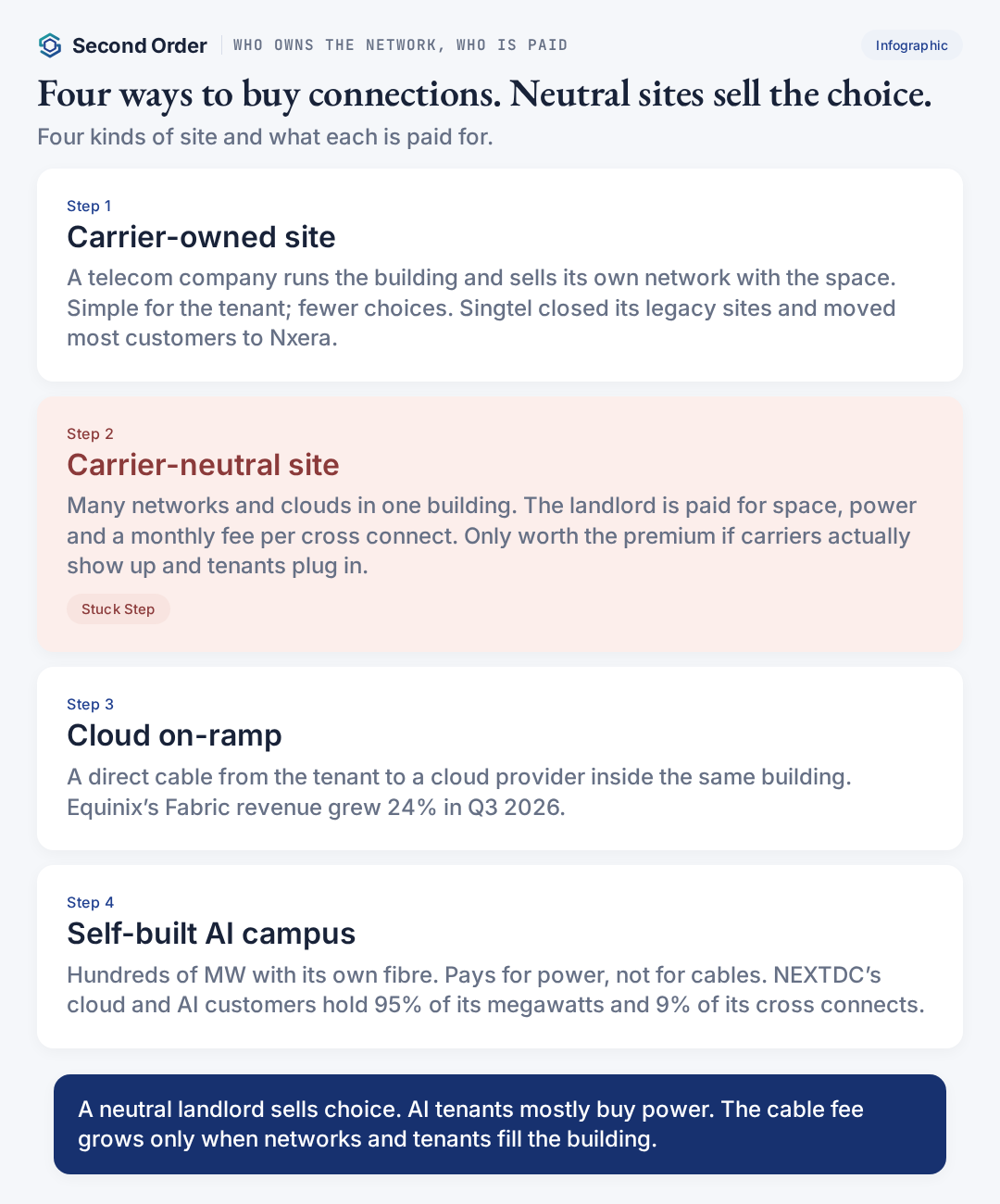
Who gets paid at a carrier-neutral data center?
Here is the original angle of this page: a neutral landlord is paid twice, once for the room and again for the meeting. The second line is the one that is special, and it is the one AI has not made bigger.
- The landlord, for space and power. Equinix’s colocation revenue, its rent for space and power, was $6,475 million in 2025, about 74% of its $8,739 million of recurring revenue (our arithmetic). It is the larger line by far.
- The landlord, for cables. Interconnection brought in $1,655 million in 2025, or 18.9% of recurring revenue (our arithmetic). In the third quarter of 2026 it was $465 million, up from $422 million, which is 19.0% of recurring revenue and 10.2% growth (our arithmetic). Over nine months it was $1,364 million against $1,222 million, up 11.6% (our arithmetic).
- The cloud on-ramp. Equinix says its Fabric revenue, from a connectivity service for linking clouds, networks and AI environments, rose 24% in the quarter, and it announced an Inference Exchange with Nvidia and Together AI for AI inference. See our AI inference explainer.
- The carriers. They pay to be in the building because the building holds their customers. Equinix counts more than 2,000 of them. Their gain is sales, not rent.
Now compare space with cables inside the same quarter. Worldwide, Equinix’s colocation revenue grew 11.5% year on year and its interconnection revenue grew 10.2% (our arithmetic). In Asia-Pacific the order flipped: interconnection grew 14.5%, from $83 million to $95 million, while colocation grew 9.8%, from $367 million to $403 million (our arithmetic).
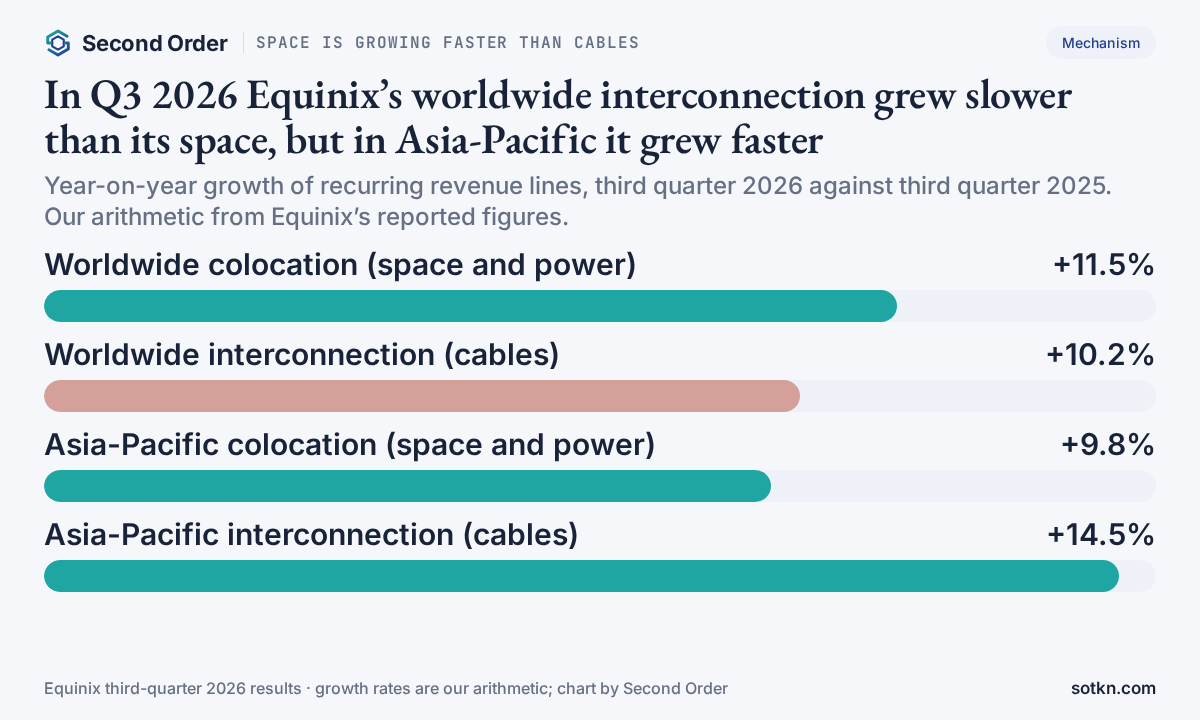
Read the picture with care: it is one landlord and one quarter, and the figures are in US dollars at reported rates. But it fits a pattern that the AI build is likely to keep: tenants are asking for more power faster than they are asking for more cables. Our data center lease explainer covers how the power side is paid.
Where is the stuck step?
In who buys the cables. A neutral landlord’s special income depends on carriers, banks and companies plugging in, and the biggest AI tenants do not behave that way.
AI tenants buy power. NEXTDC, the Australian operator, splits its tenants in its FY26 results presentation. At 30 June 2026, cloud and AI customers held 95% of its contracted megawatts but only 9% of its cross connects. IT providers held 59% of the cross connects and enterprise and government customers 32%. Interconnection made up 9% of its FY26 net revenue. In plain words: the megawatts go to a few large tenants, and the connections are bought by everyone else. Our contracted power explainer shows how those megawatts are counted.
The building has to earn its carriers first. A site with the label but without the carriers has no flywheel. This is the same step as in our edge data center explainer, where small sites live on connections rather than megawatts; here the same logic applies to any neutral building.
Contracted is not billed. Singtel’s half-year filing for Nxera shows the lag. Nxera had 146 MW operating at 30 September 2026, up from 88 MW a year earlier. Its contracted utilisation, measured against operating and under-construction capacity, was 72%. Its billing utilisation on operating capacity was 64%, down from 70% a year earlier as new capacity came on. The two use different bases, so we do not subtract them. The message is the one our GPU utilisation explainer makes about GPUs: cash follows use, not signing. Singtel also says DC Tuas is at full contracted capacity, after more than 90% of its 58 MW was committed before launch, which is more than 52 MW (our arithmetic). A full order book and a full bill are different things.
Our view: neutral landlords will keep growing because AI tenants are paying for megawatts. But the part that makes a neutral landlord special, the cable fee, grows only when carriers and ordinary companies fill the building. When you read that a site is “carrier-neutral,” ask how many networks are in it, not just how many megawatts it has.
Carrier-neutral data centers in Singapore, Malaysia and Australia
Singapore. Nxera’s Singapore capacity is 120 MW, of which DC Tuas’s 58 MW is about 48% (our arithmetic). Singtel says Singapore capacity is completely contracted. In August, with KKR, it completed the STT GDC acquisition, which Singtel says gives a combined 950 MW of operating capacity between STT GDC and Nxera. Equinix lists Singapore among its Asia-Pacific metros in its annual report. For the policy side, read our Singapore Pulse on Equinix SG6, what Nxera does and our Singapore door.
Malaysia. Singtel says Nxera’s Malaysia and Indonesia data centers will start operating by the end of its financial year, taking operating capacity to over 200 MW. The Malaysia site has secured commitments for 75% of its capacity, in a joint venture in which Nxera holds 49%. Equinix lists Johor and Kuala Lumpur among its Asia-Pacific metros. See our Malaysia Pulse on Johor’s grid connections and our Malaysia door.
Australia. NEXTDC is the clearest public view of how connections are bought in Australia, because it reports its cross connects by customer type. Equinix lists Sydney, Melbourne, Perth, Brisbane, Adelaide and Canberra in its annual report. See what NEXTDC does, our Australia Pulse on the NEXTDC bid and our Australia door.
What would change this view?
- AI tenants start buying cables. If inference exchanges and cloud on-ramps pull large AI tenants into many cross connects, the cable line grows with the power line again.
- Interconnection outgrows space worldwide. In Asia-Pacific it already did in the third quarter of 2026. A second quarter or two of the same worldwide would show the flywheel is back.
- Big tenants bypass the landlord. If hyperscalers and AI labs run their own fibre between campuses, the neutral landlord’s cable fee loses its biggest possible customer.
- Carrier-owned sites regain tenants. If carriers bundle price and power in ways that beat the neutral model, tenants will move back, the opposite of what Singtel’s filing shows today.
How to read a carrier-neutral data center headline
- How many networks are inside? A count of carriers matters more than a count of megawatts for the cable line.
- Who owns the building? A carrier group may own a neutral site. Check whether competing carriers can really connect.
- Contracted or billed? A full order book is not the same as full billing. Ask which one the figure is.
- Who pays for the connections? Interconnection is a separate recurring line: 19% of Equinix’s recurring revenue in its latest quarter, and 9% of NEXTDC’s FY26 net revenue (a different base, so not comparable).
FAQ
What is a carrier-neutral data center in simple terms?
A data center where the landlord does not own the networks, so many carriers and clouds can sit in the same building and customers pick whichever ones they like. Equinix, which has run this model since it was founded, says more than 2,000 network service providers offer internet access inside its sites.
What does carrier-neutral mean?
It means the building is open to any carrier. The landlord rents space, power and cables, but does not force tenants onto one network. Carrier-neutral and network-neutral mean the same thing; Equinix uses both words in its annual report.
What is the difference between a carrier-neutral and a carrier-owned data center?
Who owns the building and who is allowed in. A carrier-owned site is run by a telecom company, which historically bundled its own network with the space. A carrier-neutral site is run as a landlord business that lets competing networks in. Neutral is a rule about the building, not about who owns it: Singtel owns about 85% of Nxera, yet Nxera describes DC West, DC Kim Chuan 2 and DC Tuas as carrier-neutral.
How do carrier-neutral data centers make money?
From three lines: space, power and cables. The cable line is the neutral landlord’s special one. Equinix earned $465 million from interconnection in the third quarter of 2026, about 19% of its recurring revenue (our arithmetic), on top of rent for space and power.
What is a cross connect?
A physical cable inside the building that links two tenants, such as a carrier and a bank or a cloud provider. The landlord installs it and bills a monthly fee. It is the main way a neutral landlord is paid for the number of networks in the building.
Do AI data centers need to be carrier-neutral?
Not always. A large AI campus buys power in bulk and may bring its own fibre, so it needs few cross connects. NEXTDC’s cloud and AI customers hold 95% of its contracted megawatts but only 9% of its cross connects. Neutral sites matter most where many networks, banks and companies need to meet.
Are there carrier-neutral data centers in Singapore, Malaysia and Australia?
Yes. In Singapore, Nxera lists DC West, DC Kim Chuan 2 and DC Tuas as carrier-neutral, and Equinix runs sites there too. Equinix also lists Johor and Kuala Lumpur in Malaysia and several Australian cities. NEXTDC reports its cross connects by customer type in Australia.
Is carrier-neutral the same as colocation?
No. Colocation means renting space and power in someone else’s building. Carrier-neutral describes who may connect inside that building. Most carrier-neutral sites are colocation sites, but a colocation site run by a telecom company may not be neutral. Our colocation explainer covers the rental side.
Is this a list of stocks to buy or sell?
No. This page explains how the money and the constraints move around carrier-neutral data centers. It does not give buy or sell calls. Not investment advice.
Related: what is an AI data center; colocation explained; hyperscale vs colocation; edge data centers; data center tiers; where AI data centers are located; cloud egress; region vs availability zone; how much power an AI data center uses.
Stack doors
Layer: AI Data Centers. Also: Neoclouds, Hyperscalers, Semiconductors. Markets: Australia, Malaysia, Singapore.
Get the Wire — short daily notes when a data center deal names its megawatts, its customer and its date.
How we check this
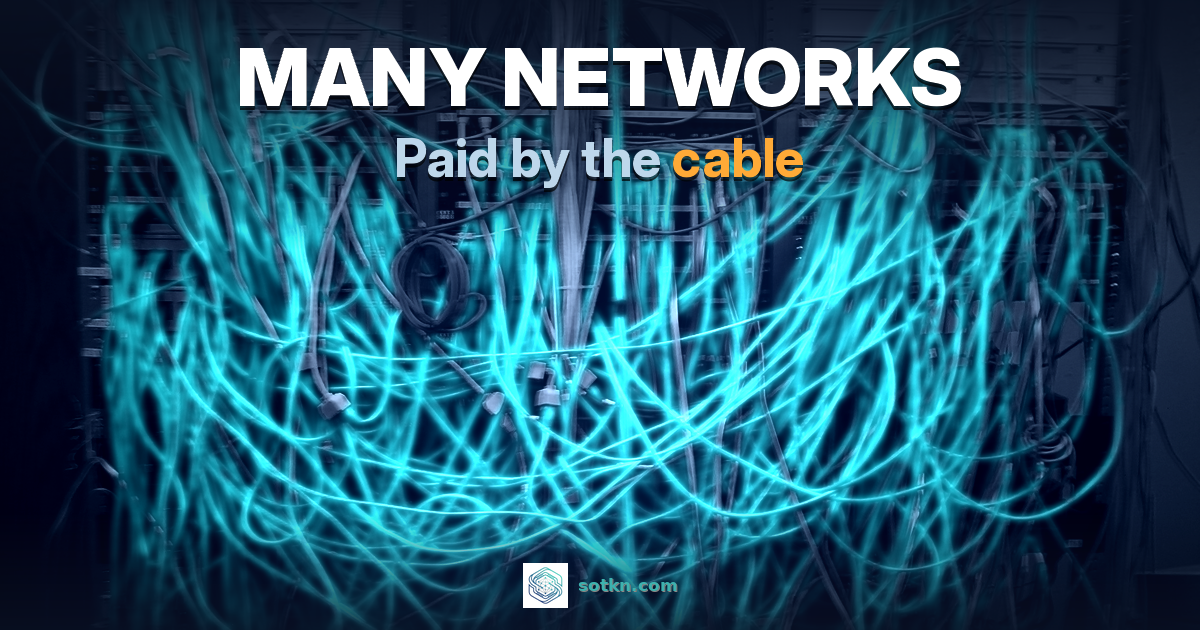
Figures come from Equinix’s annual report on Form 10-K for 2025 (filed with the SEC on 11 February 2026) and its third-quarter 2026 results release of 28 October 2026; Digital Realty’s Form 10-K for 2025; NEXTDC’s FY26 results presentation; Nxera’s release of 9 February 2026 on DC Tuas; and Singtel’s half-year news release and management discussion for the half year ended 30 September 2026. NEXTDC shares are as at 30 June 2026. Nxera’s 90% commitment figure refers to the time before DC Tuas opened. Contracted utilisation and billing utilisation are measured on different capacity bases in Singtel’s table, so we quote both and do not subtract one from the other. Every share, growth rate or capacity figure we derived is labelled “our arithmetic”. The featured photo shows a wiring closet photographed by Brian Hankins in 2005 and dedicated to the public domain, graded by Second Order; it is not a site named here. This page explains how the money and the constraints move. It does not give buy or sell calls. Not investment advice. Do your own research.
Last reviewed: 21 Nov 2026 · Next review: after Equinix’s fourth-quarter 2026 results (February 2027) and Singtel’s full-year results for the year to March 2027
Spot an error? Tell us and we will correct it and note the change here.
References
- Equinix — Form 10-K for the year ended 31 Dec 2025 (SEC, filed 11 Feb 2026) — network-neutral business model; 280 data centers, more than 10,500 customers and more than 2,000 network service providers; carriers historically bundled colocation with their own network products; full-year 2025 revenue by product and region (interconnection $1,655 million of $8,739 million recurring revenue; Asia-Pacific $326 million of $1,857 million); Singapore, Johor, Kuala Lumpur and Australian metros
- Equinix — Third-quarter 2026 results (28 Oct 2026) — interconnection $465 million of $2,442 million recurring revenue, up from $422 million; Asia-Pacific interconnection $95 million vs $83 million and colocation $403 million vs $367 million; nine-month interconnection $1,364 million vs $1,222 million; Fabric revenue up 24%; 6,900 net interconnections; Inference Exchange
- Digital Realty — Form 10-K for the year ended 31 Dec 2025 (SEC, filed 13 Feb 2026) — describes itself as a provider of cloud- and carrier-neutral data center, colocation and interconnection solutions; presence of carriers and dense customer concentrations drive interconnection revenue
- NEXTDC — FY26 results presentation (Aug 2026) — at 30 June 2026 cloud and AI customers hold 95% of contracted MW but 9% of cross connects; IT providers 59%, enterprise and government 32%; interconnection 9% of FY26 net revenue
- Nxera — DC Tuas opening release (9 Feb 2026) — 58 MW carrier-neutral, multi-tenant DC Tuas; Nxera Singapore capacity 120 MW; more than 90% committed before launch; integrated with a submarine cable landing station; Nxera lists DC West and DC Kim Chuan 2 as carrier-neutral
- Singtel — Half-year results news release, half year ended 30 Sep 2026 — Singapore capacity completely contracted; STT GDC acquisition completed in August with a combined 950 MW of operating capacity between STT GDC and Nxera; Malaysia and Indonesia data centres to start by the end of the financial year
- Singtel — Management discussion and analysis, half year ended 30 Sep 2026 (SGX) — Singtel Singapore ICT revenue down 23% after closure of legacy data centre facilities, with most customers migrated to Nxera; Nxera revenue S$198 million, up 20.7%; DC Tuas at full contracted capacity; Nxera operating highlights (146 MW operational, 72% contracted utilisation, 64% billing utilisation on operational capacity)