Region vs Availability Zone: What’s the Difference, and Why the Newest AI Chips Sit in One Zone
A cloud region is the location you choose; an availability zone is one of the separate sites inside it, with its own power. Zones protect you from a building failing, regions from a whole area failing. For AI, the zone matters more: Google offers its B200 machines in only 13 of its 130 zones.
EXPLAINED · Versus · Last reviewed: 15 Nov 2026 · Next review: after AWS opens its Saudi Arabia and Chile regions, or Google adds AI zones
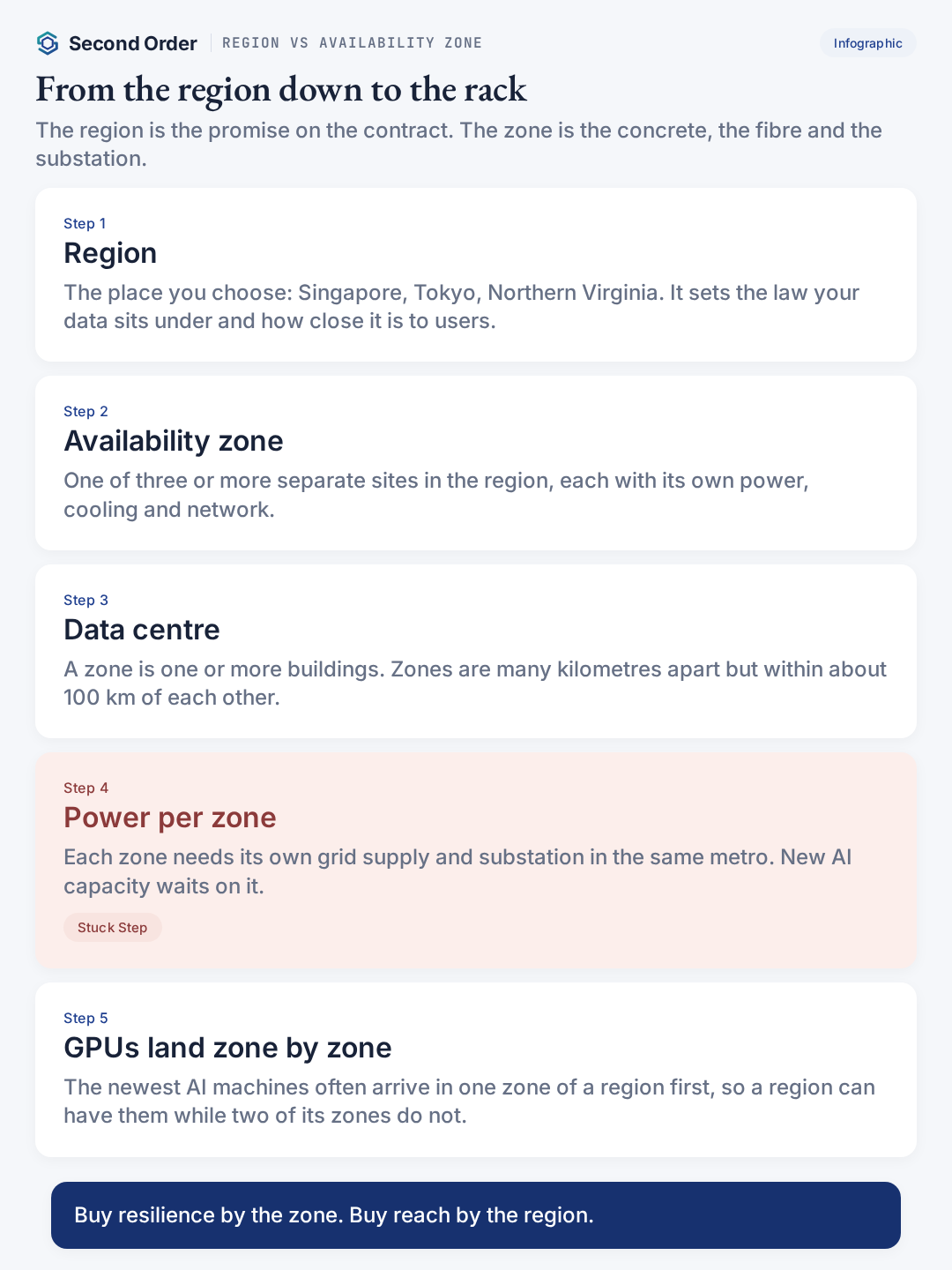
A cloud region is a geographic area, such as Singapore or Northern Virginia, where a cloud provider runs its services and keeps customer data. An availability zone is one of the separate sites inside a region: one or more data centres with their own power, cooling and network, linked to the other zones by fast fibre.
In short. A region is where your cloud lives; an availability zone is one of the separate sites inside it. Spread a system across zones and it survives a building or a power feed failing. Spread it across regions and it survives the whole area, or the provider’s regional software, failing, at a higher price: in Singapore, AWS charges US$0.010 per GB to move data between zones and US$0.08 to US$0.09 per GB to send it to another region. Our read: for AI the zone, not the region, has become the unit that is scarce. Google Cloud offers its Nvidia B200 machines in 13 of its 130 zones, and in only one zone in 9 of the 11 regions that have them. The stuck step is power at the zone: each one needs its own supply in the same metro.
Why an investor cares: regions are where cloud capital spending is announced, but zones are where it is poured. Each zone is a set of buildings with its own grid connection, so the zone decides how much power, land and fibre a provider has to secure in one metro, and which customers can get the newest chips there. This is the Versus companion to our cloud region Explained, and it sits under our Hyperscalers layer.
Region vs availability zone: the short answer
A region is the area. A zone is a site inside the area. When a company buys computing from Amazon Web Services, Microsoft Azure or Google Cloud, it first picks a region, which fixes where its data lives and which country’s rules apply. It then places each server, disk or database in one or more zones inside that region.
The two protect against different things. Zones are built so that one site can fail without taking down the others. Regions are far apart, so that a disaster, or a software fault that spreads across one region, does not reach the next. The table sets out the differences.
| Region | Availability zone | |
|---|---|---|
| What it is | A geographic area where the provider runs its services, such as Singapore or Northern Virginia | One of the separate sites inside a region: one or more data centres |
| How many | AWS 39, Google Cloud 43, Azure 59 on its public list | AWS 124, Google Cloud 130; usually three per region |
| Distance | Usually hundreds of kilometres or more from the next region | Many kilometres from the other zones, but within about 100 km |
| Protects against | Loss of a whole area, or a fault in the provider’s regional services | Loss of one site: a fire, flood, power cut or cooling failure |
| Latency between them | Too far for most systems to copy data in real time | Close enough to copy data in real time (synchronous replication) |
| Data transfer price (AWS Singapore) | US$0.08–0.09 per GB to other regions | US$0.010 per GB in, out or between zones |
| Decides | Which country’s rules apply, and how close you are to users | How resilient one deployment is, and which chips you can get |
| AWS uptime promise (EC2) | The 99.99% monthly “Region-Level” promise covers machines spread across two or more zones of one region | A single machine in one zone: 99.5% a month |
From AWS, Microsoft and Google Cloud documentation and AWS’s price list, listed under References. Counts as published on 15 November 2026. Not a ranking of providers or investments.
What is a cloud region?
A cloud region is the location on the contract. It is a group of data centres in one metro area that the provider sells as a single place, with a name such as Asia Pacific (Singapore), Southeast Asia or asia-southeast1, depending on the provider. The customer’s data stays in the region it chose unless it moves the data itself. That is why banks, governments and hospitals care about regions: a local region lets them keep data in the country. Our cloud region Explained covers why providers build new regions and how long they take.
Regions are a long way apart. Singapore’s nearest AWS neighbours, such as Jakarta and Malaysia, are separate countries with separate grids. That distance is the point: a typhoon, an earthquake or a national grid failure should not hit two regions at once.
What is an availability zone?
An availability zone is one of the separate sites that make up a region. AWS describes each one as one or more discrete data centres with redundant power, networking and connectivity. The zones in a region are linked by dedicated metro fibre that is fast enough to copy data between them as it is written, which engineers call synchronous replication.
The design rule is a balance. AWS says its zones are physically separated by many kilometres, but all within 100 km, or 60 miles, of each other. Too close, and one flood or power cut takes out two zones. Too far, and copying data between them becomes too slow for a database that has to confirm every write in both places.
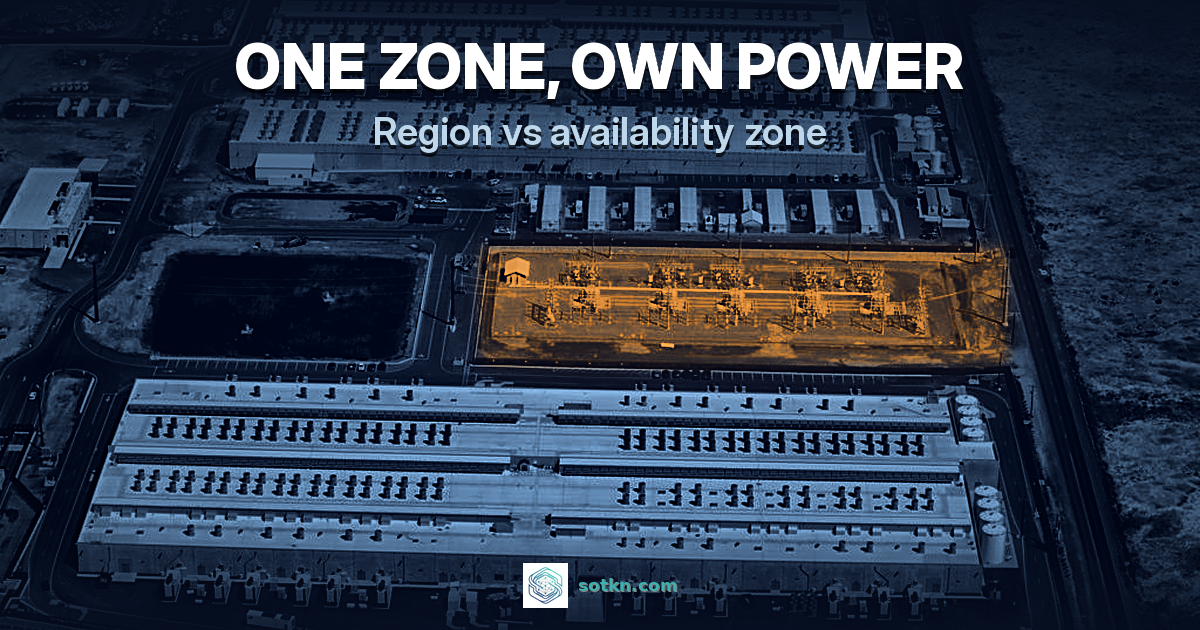
A zone is not one building. The photo at the top of this page shows part of a single AWS zone in Oregon: three large data halls and the substation that feeds them. A big zone can be several such campuses. What makes them one zone is that they share a failure boundary, while the next zone has its own power, cooling and network.
How AWS, Azure and Google Cloud differ
All three use the same words, but not in the same way. The counts below come from each provider’s public list on 15 November 2026. Our AWS vs Azure vs Google Cloud page compares the businesses; this table compares only the map.
| Provider | Regions | Zones | Zones per region | The catch |
|---|---|---|---|---|
| AWS | 39, plus 2 announced (Saudi Arabia, Chile) | 124, plus 7 announced | At least 3; about 3.2 on average | Every region has zones; new regions open with three |
| Google Cloud | 43 | 130 | 3 in 42 regions, 4 in one | Separate “AI zones” for GPU and TPU capacity sit away from the standard zones |
| Microsoft Azure | 59 listed | 3 in 41 regions, 4 in one | 3 or 4, or none | 17 listed regions have no availability zones; some services do not support zones even where they exist |
Counts from each provider’s public lists, accessed 15 November 2026. Averages are Second Order arithmetic.
- AWS. Lists 124 zones in 39 regions, about 3.2 zones per region by our arithmetic, with 7 more zones and 2 more regions announced, in Saudi Arabia and Chile. Every AWS region has at least three zones. North America alone has 31 zones in 9 regions, about 3.4 per region.
- Google Cloud. Lists 130 zones in 43 regions. By our count, 42 regions have three zones and one has four, so the average is almost exactly three. Google says zones and regions are logical labels for physical resources: a virtual machine or a zonal disk lives in one zone, while some resources, such as a static IP address, belong to the region.
- Microsoft Azure. Lists 59 public regions. By our count 42 of them offer availability zones, three in 41 and four in one, and 17 offer none, about 29%. All 17 are in countries where Azure has another region, and 14 of them are paired with a region in the same country that has zones, such as Australia Southeast with Australia East or UK West with UK South. Microsoft also warns that some services do not support zones even in regions that have them.
So “region” does not mean the same thing everywhere. On AWS and Google Cloud, choosing a region means choosing a group of zones. On Azure, a customer in a zoneless region who wants to survive the loss of a site has to use a second region.
Which one protects you from what?
Zones protect against physical failure at one site. Regions protect against everything that can go wrong across a whole area, including the provider’s own software.
AWS’s uptime promise for its EC2 computing service shows the difference. If a customer runs its machines in two or more zones of a region, AWS commits to 99.99% monthly uptime for that region. For a single machine, the commitment is 99.5%. In a 30-day month of 43,200 minutes, 99.99% allows about 4.3 minutes of downtime and 99.5% allows 216 minutes, or 3.6 hours, by our arithmetic. That is 50 times as much room for a single machine as for a deployment spread across zones. The remedy for a miss is a service credit on the bill, not compensation for lost business.
The October 2025 outage in Northern Virginia shows the limit of zones. AWS’s post-event summary says the trouble began at 11:48 PM Pacific time on 19 October and ended at 2:20 PM on 20 October, about 14 and a half hours by our arithmetic. The trigger was a race condition in the automated system that manages DynamoDB’s DNS records, which left the regional endpoint with an empty record. That system was itself run redundantly in three zones. The failure was in software that serves the whole region, so spreading machines across zones did not help.
DynamoDB errors lasted about 2 hours 52 minutes; new EC2 machine launches then failed for about 8 hours 11 minutes, by our arithmetic. AWS’s summary notes that customers using DynamoDB global tables could still read and write their copies in other regions. That is the case for multi-region: it costs more and is harder to run, but it is the only layer that survives a regional fault.
What does each layer cost?
Resilience is sold by the gigabyte. AWS’s price list for its Singapore region, published on 11 November 2026, charges US$0.010 per GB for regional data transfer “in/out/between EC2 AZs”. Data sent from Singapore to another AWS region costs US$0.08 per GB to Malaysia and US$0.09 per GB to Tokyo, Jakarta or Northern Virginia.
Our arithmetic: copying 100,000 GB, about 100 terabytes, from Singapore to Tokyo costs US$9,000 at list price; moving the same volume between zones is billed at US$1,000 at the zone rate. Sending data between regions from Singapore costs eight to nine times as much per gigabyte as moving it between zones. Prices vary by route: from Northern Virginia to Ohio, AWS charges US$0.01 per GB, one ninth of the Singapore-to-Virginia rate.
Compute is the bigger bill. Running a system in three zones usually means paying for enough spare machines that losing one zone does not overload the other two. Running a second region can mean paying for a whole standby copy. Customers choose how much of that insurance to buy; the provider is paid either way.
Why AI makes the zone matter more
For ordinary software, zones are interchangeable: a customer spreads its servers across three of them and stops thinking about it. For AI, they are not. The newest GPU machines arrive zone by zone, and often only one zone in a region has them.
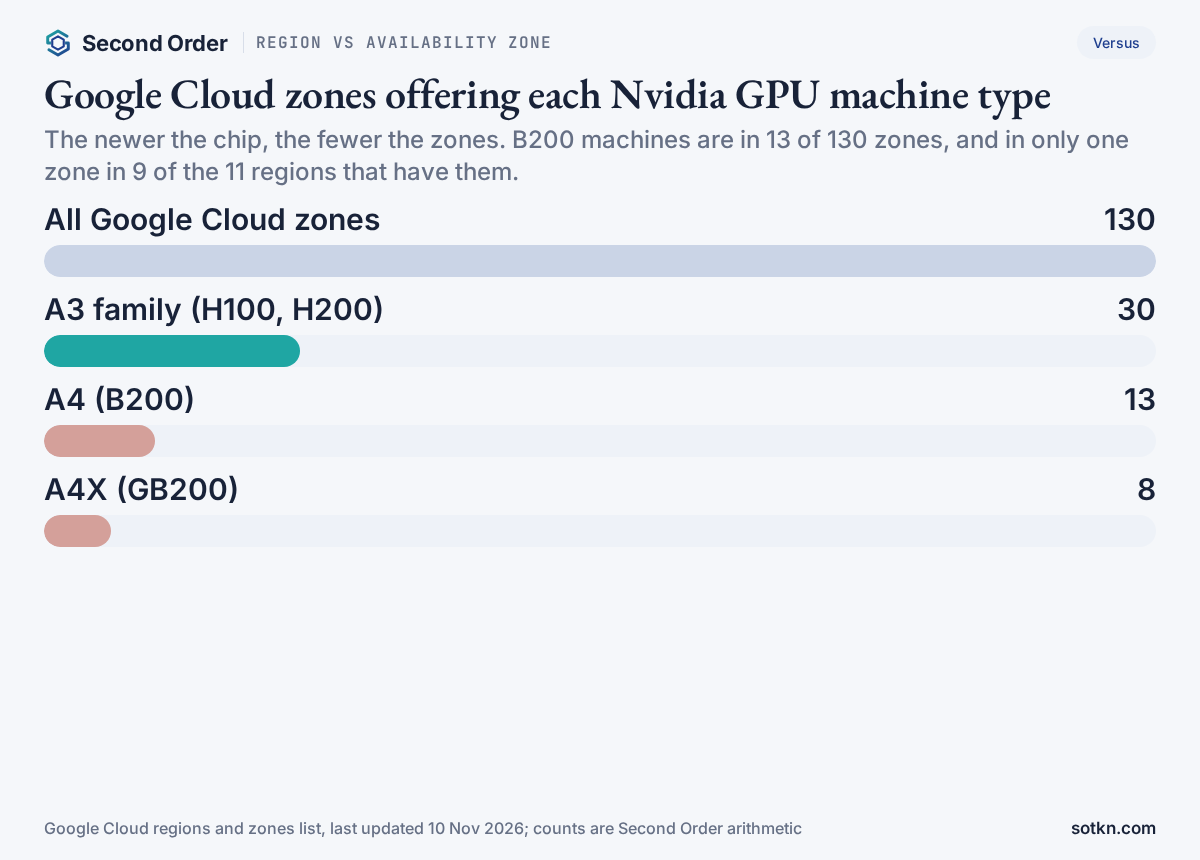
Google Cloud’s zone list makes this visible. By our count, its A4 machines, built on Nvidia’s B200, are offered in 13 of its 130 zones, about 10%, across 11 of its 43 regions. In 9 of those 11 regions, about 82%, only one zone has them. Its A4X machines, built on Nvidia’s GB200, are in 8 zones across 5 regions. The older A3 family, on Nvidia’s H100 and H200, is in 30 zones across 19 regions, and in 12 of those regions only one zone has it.
Singapore is a clear example. Google’s Singapore region has three zones in Jurong West. B200 machines are listed in only one of them, zone b; H100 and H200 machines in zones b and c; zone a has neither. Taiwan’s region in Changhua County lists A3 machines in one zone of three. A customer that wants B200 capacity in Singapore and the usual three-zone protection cannot get both from that list.
Google has gone further and built separate AI zones. Its documentation describes them as specialised zones with large GPU and TPU capacity, located away from the region’s standard zones. Three are listed: one in De Kooy for the Netherlands region, one in Austin for the Dallas region, and one in Lincoln, Nebraska for the Iowa region. Each is tied to a parent zone in the region and shares its software update schedule and sometimes its infrastructure, so a problem at the parent can reach the AI zone. Using one requires capacity reserved in advance. Our reserved vs on-demand GPU page covers how that capacity is bought.
The logic is power. A large training cluster needs more electricity than a standard zone in a crowded metro can supply, and it needs its chips close together rather than spread out for resilience. So the provider builds where the power is and keeps a link back to the region. Our read: for a training job, losing a zone usually means pausing and restarting from the last saved checkpoint, a risk many buyers accept. For an inference service answering customers in real time, it is a harder trade. Our GPU cluster Explained covers why chips in a cluster sit so close together.
Who gets paid?
Our read: the provider is paid for every layer of insurance a customer buys, and the landlords, utilities and builders around each zone are paid before any of it is sold.
- The cloud provider, on redundancy. Spare machines in a second and third zone, standby copies in a second region and every gigabyte moved between them are billed. A customer that follows the providers’ own advice to spread across zones pays for more capacity than it uses on a normal day.
- Landlords and utilities near each zone. A zone needs its own grid supply, cooling and buildings, within fibre reach of the others. Whoever holds powered land in the right metro is paid first. Our hyperscale vs colocation page covers when providers build and when they lease.
- Builders and electrical suppliers. Each new zone is a new set of halls, substations and backup generators. Three zones in one region means three independent power systems, not one large one.
- Fibre owners. The dedicated metro fibre between zones, and the long-haul links between regions, are paid for whether or not a customer ever fails over.
Where is the stuck step?
Our read: power at the zone. A provider can announce a region with a press release, but every zone inside it needs a separate grid connection in the same metro, within about 100 km of the others. When a metro runs short of power, the region cannot simply put its next zone in a cheaper place further away; that is the constraint Google’s AI zones work around by sitting further out and accepting a dependency on a parent zone. Our contracted power Explained covers how that power is secured.
The clock for customers is the chip roll-out. When a new GPU generation lands in one zone of a region, workloads that need it either accept single-zone risk or wait for the second and third zones to catch up. The number of zones that list a machine type is the measure to watch.
What would change the view?
- New chips arrive in every zone at once. If the next GPU generation is listed in all three zones of a region on day one, the zone stops being the scarce unit and the classic multi-zone design works for AI too.
- More AI zones, or more parent-zone dependencies. If Google and others add AI zones far from their regions, the region becomes looser, and resilience planning for AI has to account for a single parent zone.
- Another regional outage. Each regional software failure strengthens the case for multi-region designs, and the inter-region transfer bills that come with them.
- Azure fills its zoneless regions. If Microsoft adds zones to the 17 listed regions that have none, the gap between the three providers’ maps narrows.
The clocks: AWS’s Saudi Arabia and Chile regions and their 7 announced zones; changes to Google’s AI zone list and to the zones listing A4 and A4X machines; Azure’s regions list; and any revision of AWS’s EC2 uptime commitment.
Common misconceptions
- People assume an availability zone is one data centre. Actually it can be one or more data centres. The site in the photo is part of one zone and includes three halls.
- People assume running in three zones protects against any outage. Actually it protects against a site failing. The October 2025 Northern Virginia outage came from software serving the whole region.
- People assume every region has zones. Actually 17 of the 59 Azure regions on Microsoft’s list have none.
- People assume a region that offers a GPU offers it everywhere in the region. Actually Google lists its B200 machines in only one zone in 9 of the 11 regions that have them.
- People assume a region’s zones are next door to each other. Actually AWS puts its zones many kilometres apart, up to about 100 km, and Google’s AI zones sit further out, in a different city from the region’s standard zones.
FAQ
What is the difference between a region and an availability zone?
A region is a geographic area where a cloud provider runs its services, such as Singapore. An availability zone is one of the separate sites inside that region, with its own power, cooling and network. A region contains zones; a zone contains data centres.
How many availability zones are in a region?
Usually three. Every AWS region has at least three, and AWS averages about 3.2. Google Cloud has three zones in 42 of its 43 regions. Azure is different: 17 of the 59 regions on its public list have no availability zones at all.
How far apart are availability zones?
Far enough that one fire, flood or power cut should not hit two of them, close enough to copy data between them almost instantly. AWS says its zones are many kilometres apart but within 100 km of each other.
Is multi-AZ enough, or do I need multi-region?
Multi-AZ protects against one site failing. It does not protect against a fault in software or a service that runs across the whole region. AWS’s October 2025 outage in Northern Virginia was regional, and customers with database copies in other regions could keep working.
Does it cost more to send data between zones or regions?
Yes, and regions cost more. In Singapore, AWS’s price list charges US$0.010 per GB for data moving in, out or between zones, and US$0.08 to US$0.09 per GB for data sent to other regions such as Malaysia or Tokyo.
What is a Google Cloud AI zone?
A zone built for large GPU and TPU capacity, located away from a region’s standard zones and tied to one of them, its parent zone. It shares software update schedules and sometimes infrastructure with the parent, and needs pre-reserved capacity.
Does Singapore have availability zones?
Yes. Google Cloud’s Singapore region has three zones in Jurong West, and Azure’s Southeast Asia region in Singapore has three. On Google, B200 machines are offered in only one of the three Singapore zones.
Is this advice to buy or sell any company?
No. This page explains how cloud regions and zones work and who they pay. It does not rank companies as investments or give buy or sell calls. Not investment advice. Do your own research.
Related: cloud region; AWS vs Azure vs Google Cloud; hyperscale vs colocation; data centre tiers; where AI data centres are located; sovereign AI.
Stack doors
Layer: Hyperscalers. Players: Amazon, Microsoft and Google. Start with what a hyperscaler is and who the hyperscalers are.
Get the Wire — short daily notes on where AI computing gets built and who pays for it.
Not investment advice. Do your own research.
How we check this
AWS region and zone counts, the minimum of three zones and the 100 km spacing come from AWS’s Regions and Availability Zones page, read on 15 November 2026. Uptime commitments come from the Amazon Compute Service Level Agreement, last updated 25 May 2022. The October 2025 outage timeline comes from AWS’s own post-event summary for the Northern Virginia region. Data transfer prices come from AWS’s machine-readable price list for the Singapore region, published on 11 November 2026. Azure region and zone support comes from Microsoft Learn’s Azure regions list, read on 15 November 2026. Google Cloud zones, locations and machine types come from its regions and zones page, last updated 10 November 2026; AI zones from its AI zones page of the same date; and the chip behind each machine type from its GPU machine types page, last updated 13 November 2026. We counted zones and machine types from each provider’s published table, so a zone that offers a machine type to only some customers, or a hidden AI zone, may not show. Prices are list prices before discounts. Percentages, sums, minutes and multiples are our arithmetic, checked in code and labelled as ours on the page. Who gets paid and the stuck step are our read. The featured photograph is credited in its caption. This page explains how cloud locations work and who they pay. It does not rank companies as investments or give buy or sell calls. Not investment advice. Do your own research.
Last reviewed: 15 Nov 2026 · Next review: after AWS opens its Saudi Arabia and Chile regions, or Google adds AI zones
Spot an error? Tell us and we will correct it and note the change here.
References
- Amazon Web Services — Regions and Availability Zones, AWS Global Infrastructure (accessed 15 Nov 2026) — 124 Availability Zones in 39 regions, with 7 more zones and 2 more regions announced (Saudi Arabia and Chile); minimum three zones per region; zones within 100 km (60 miles) of each other; North America 31 zones in 9 regions
- Amazon Web Services — Amazon Compute Service Level Agreement (last updated 25 May 2022) — Region-Level SLA of 99.99% monthly uptime for EC2 deployed across two or more zones; Instance-Level SLA of 99.5%; service credits
- Amazon Web Services — Summary of the Amazon DynamoDB service disruption in the Northern Virginia (US-EAST-1) Region (event of 19–20 Oct 2025) — Event times, DNS race condition in a system run in three zones, EC2 launch failures, global tables in other regions
- Amazon Web Services — AWS Price List, Data Transfer, Asia Pacific (Singapore) (published 11 Nov 2026) — US$0.010 per GB for regional data transfer in, out or between EC2 zones; US$0.08–0.09 per GB from Singapore to other regions
- Microsoft Learn — Azure regions list (accessed 15 Nov 2026) — Azure public regions with availability zone support: 42 of 59 listed regions have zones; Southeast Asia (Singapore) has three
- Google Cloud — Compute Engine regions and zones (last updated 10 Nov 2026) — Definitions of zonal and regional resources; zone list with locations and machine types, including A3, A4 and A4X availability by zone
- Google Cloud — AI zones (last updated 10 Nov 2026) — AI zones located away from standard zones, parent-zone dependency, pre-reserved capacity, three listed AI zones
- Google Cloud — GPU machine types (last updated 13 Nov 2026) — A4X (Nvidia GB200), A4 (Nvidia B200), A3 Ultra (Nvidia H200) and other A3 types (Nvidia H100)