Who Makes EDA Software? The Toll Every Chip Design Pays Before It Is Made
Every chip is designed and checked in EDA software before a fab will print it. Three companies sell the full toolset, mostly on two- to three-year subscriptions; Synopsys and Cadence hold US$19.1bn of signed backlog. The pinch point is sign-off, the last check before tape-out.
EXPLAINED · Players · Last reviewed: 18 Nov 2026 · Next review: after Synopsys’s fiscal 2026 results on 8 December 2026, or when the US Affiliates Rule pause ends on 10 January 2027
EDA software, short for electronic design automation, is the software engineers use to design a chip and check that it will work before a factory makes it. Three companies supply complete sets of these tools: Synopsys, Cadence and Siemens.
In short. Every chip is designed and checked in EDA software before a fab will print it. Three companies sell complete sets of these tools: Synopsys, Cadence and Siemens. They are paid mostly on two- to three-year subscriptions, so the money is signed well ahead: Synopsys and Cadence alone carry US$19.1 billion of backlog, about 1.2 times what they expect to book as revenue in all of 2026, by our arithmetic. Our read: EDA is a toll on chip design, not on chip volume. It gets paid whether or not the chip sells. The stuck step is sign-off, the last check before tape-out, and the clock that matters now is export rules: China supplied about 16% of Cadence’s and 10% of Synopsys’s latest quarterly revenue, and a US rule on affiliates of listed Chinese companies is paused only until 10 January 2027.
Why an investor cares: EDA is the one cost every chip design carries, whether the chip ends up a hit or a write-off. It is paid early, on long contracts, by everyone from Nvidia-style designers to the cloud companies building their own chips. Knowing who collects it, and what could interrupt it, tells you where the design boom shows up first. This page sits in our Semiconductors layer and builds on our fabless explainer.
Who makes EDA software: the short answer
Three companies sell complete sets of chip design tools, from the first description of a circuit to the final check before manufacture: Synopsys and Cadence, both based in California, and Siemens, the German industrial group, through its Siemens EDA business. Around them sit sellers of ready-made chip blocks, makers of test hardware, and specialists in single steps. The table sets out the roles.
| Role | What they sell | Who plays it | How they are paid |
|---|---|---|---|
| Full-flow EDA suppliers | Tools for every step from writing the design to sign-off | Synopsys, Cadence, Siemens | Multi-year subscriptions, mostly two to three years |
| IP sellers | Ready-made, tested chip blocks such as memory and connection interfaces | Synopsys, Cadence, Arm and others | Licence fees, plus royalties on some chips shipped |
| Emulation hardware | Machines that run a design at speed before silicon exists | Synopsys, Cadence, Siemens | Hardware sales or leases, plus support |
| Simulation and system analysis | Physics checks for heat, power, signals and packaging | Synopsys (with Ansys), Cadence, Siemens | Subscriptions |
| Specialists and challengers | Single tools or local alternatives | Smaller tool makers; in China, companies such as Empyrean | Licences, often in one region or one step |
| The buyers | Pay for all of the above | Fabless designers, chipmakers with fabs, foundries, cloud companies that design their own chips | — |
Roles, not a ranking. Several companies play more than one role. Not a rating of companies or investments.
What does EDA software actually do?
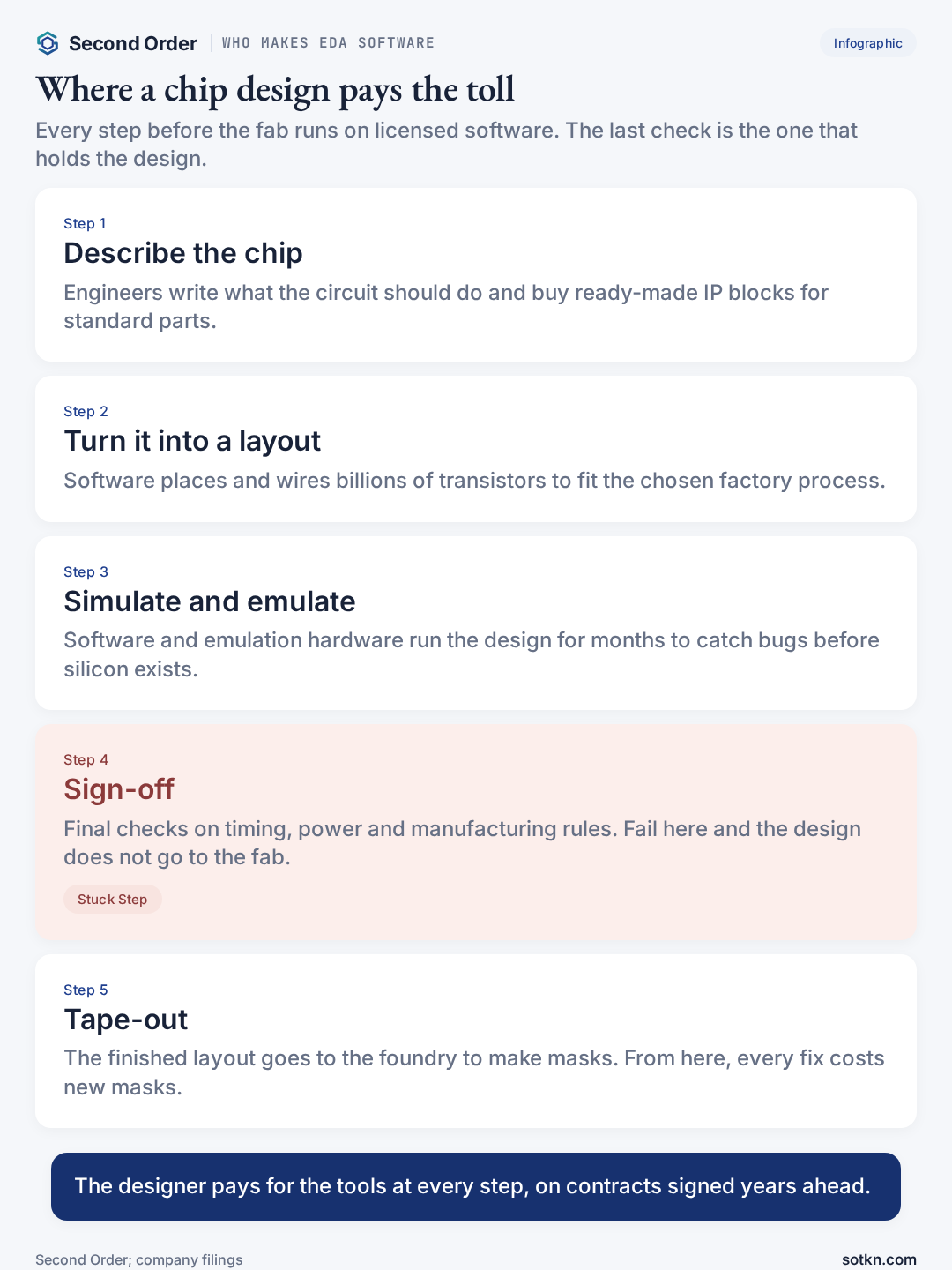
A modern processor holds tens of billions of transistors. No one draws them by hand. Engineers describe what the chip should do in a hardware language, and EDA software does the rest: it turns that description into logic, places and wires every transistor to fit one factory’s process, and then checks the result over and over.
The checking is most of the work. Designers simulate the chip in software and run it on emulation hardware, large machines that mimic the chip at speed, for months before any silicon exists. At the end comes sign-off: proof that the design meets its timing, power and manufacturing rules. Then the design is taped out, handed to the foundry to make photomasks. After that, a fix means new masks and months of delay.
The full-flow suppliers
Each of the three sells tools for every step, so a chip team can run a whole design on one supplier’s flow. In practice, most large customers mix tools from more than one.
- Synopsys. The bigger of the two US suppliers by revenue. In its quarter to 31 July 2026 it took in US$2.48 billion, up 42% on a year earlier, helped by Ansys, the simulation company it bought in 2025. Its Design Automation segment, the tools, made up 80.9% of revenue, with an adjusted operating margin of 45.2%. On 1 June 2026 it sold its processor IP business to GlobalFoundries to focus on its other IP.
- Cadence. Revenue of US$1.63 billion in its quarter to 30 September 2026, up 22%. Core EDA was 69% of revenue, system design and analysis 16% and IP 15%. Its gross margin was 85.6%: almost all of the cost of a software licence is in writing the software, not delivering it. No single customer reached 10% of its revenue.
- Siemens EDA. The former Mentor Graphics, now part of Siemens’s Digital Industries arm. Siemens does not report EDA alone, but its software business took in €2.14 billion in the quarter to 30 September 2026, up 13%, and Siemens said that growth was led by EDA, with large EDA contracts signed in the quarter.
| Latest quarter | Synopsys (to 31 Jul 2026) | Cadence (to 30 Sep 2026) |
|---|---|---|
| Revenue | US$2,477m, up 42% | US$1,633m, up 22% |
| Main segments | Design Automation 80.9%; Design IP 19.1% | Core EDA 69%; System Design and Analysis 16%; IP 15% |
| Signed backlog | About US$10.9bn | US$8.2bn |
| Backlog vs 2026 revenue guide | 1.12 times | 1.28 times |
| China share of revenue | 10.3% | 15.6% |
| Largest single customer | Not disclosed as a share | None at 10% or more |
Company filings. Synopsys’s fiscal year ends in October, so its quarters run a month ahead of Cadence’s. Synopsys’s growth includes Ansys, acquired in 2025. Shares, ratios and the guide comparison are our arithmetic.
The IP sellers
Many parts of a chip are standard: the interface to memory, the link to other chips, the circuits that meet a connection standard such as PCIe. Rather than design them again, chip teams license tested blocks, known as semiconductor IP.
Synopsys’s Design IP segment brought in US$473.8 million in its latest quarter, up 11%, at a 26.5% adjusted operating margin, lower than its tools business. Cadence sells IP too, about 15% of its revenue. Arm licenses processor designs that sit inside most phone chips and many custom data-centre chips. IP matters more as chips are split into chiplets, because every chiplet needs the links that join them.
Simulation, emulation and system analysis
The newest growth sits outside the chip itself. AI processors are now built as large packages, with memory stacked beside the logic and heat that has to be managed across the whole board. That takes physics simulation: heat, power, signals, stress. Synopsys bought Ansys for this; Cadence calls the same work system design and analysis, which grew 30% in its latest quarter; Siemens sells it too. The same tools are used for advanced packaging, where chips are joined side by side or stacked.
Emulation hardware is the other piece. Cadence said its hardware business had another record quarter, helped by its hardware cloud offering. These machines are bought or leased by chip teams so they can test software on a design long before the first chip comes back from the fab.
Who pays for EDA software?
- Fabless chip designers. Companies that design chips but own no fab pay for EDA from their research budgets. It is one of their largest costs after engineers. Our fabless vs IDM page explains the two ways to run a chip company; both buy EDA.
- Cloud companies that design their own chips. Google, Amazon, Microsoft and Meta now design accelerators and processors, often with a design partner. Each new design is new EDA spending. Our who makes custom AI chips page covers them.
- Chipmakers that own fabs. Memory makers, Intel and analog companies design their own chips, so they buy the tools too.
- Foundries. A foundry works with the EDA suppliers to certify their tools for each new process, so customers can design for it. Without that work, a new process such as 2nm cannot take designs.
How the toll is paid: subscriptions and backlog
EDA is sold on time-based licences. Synopsys says its main licences generally run two to three years and give the customer access to the licensed tools for the whole term, with updates. Cadence says 79% of its third-quarter revenue was recurring. Customers negotiate the total value of a contract rather than per-tool prices, and often commit a sum up front and choose the exact tools later.
That model fills the order book well ahead. Synopsys had about US$10.9 billion of signed but unrecognised contracts at 31 July 2026, about 1.12 times its fiscal 2026 revenue target; it expects about 49% of that, excluding flexible commitments, to turn into revenue within a year. Cadence had a record US$8.2 billion at 30 September, 1.28 times its 2026 outlook, with US$4.2 billion due within 12 months. Our backlog vs RPO page explains how to read these figures.
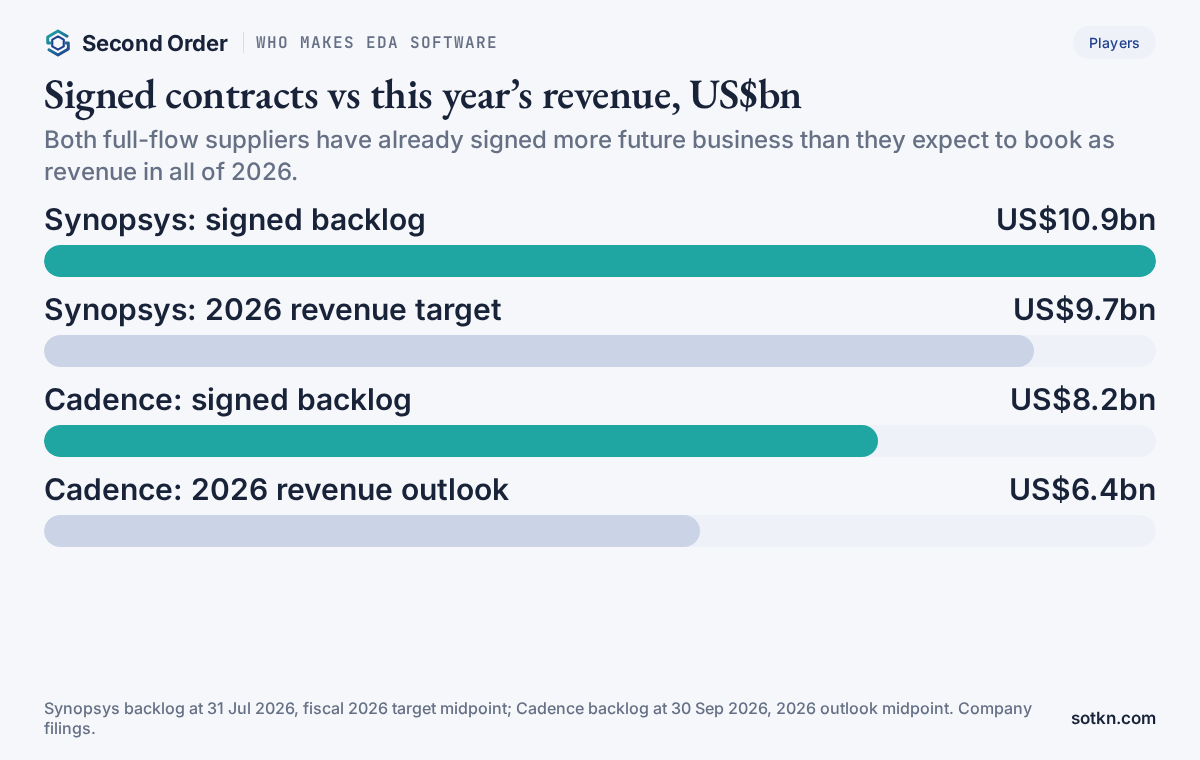
Part of each backlog is flexible: US$1.9 billion at Synopsys and US$0.9 billion at Cadence is committed spending whose exact products the customer will choose later. That is still signed money. It is just not yet assigned to a tool.
Who gets paid?
Our read: the EDA suppliers are paid on design starts, not on chip sales.
- The full-flow suppliers get paid first. A design pays for its tools years before it ships, and pays whether it sells or not. When more companies design their own AI chips, the suppliers gain even if only a few of those chips succeed.
- IP sellers get paid per design, sometimes per chip. A licence fee comes at design time; some IP also carries a royalty on each chip shipped, which ties part of the income to volume.
- Simulation and emulation get paid on complexity. The bigger and more tightly packed the chip, the more checking it needs. That is where the fastest growth is now.
- Foundries get paid later, if the design tapes out. A design that stalls at sign-off never becomes wafer orders. Our what TSMC does page covers the next step.
Where is the stuck step?
Our read: sign-off, the last check before tape-out. A design is only worth money to the foundry once it passes. Teams that are late almost always lose the time in verification, because every bug found after tape-out costs new masks and months. That is why customers keep buying more checking, more emulation hardware and more simulation, and why those lines are growing fastest. Our semiconductor yield page covers what happens once the design reaches the fab.
The second pinch is access. EDA tools are among the technologies the US controls for export. Synopsys’s filing notes restrictions on design software built for certain advanced chips and on tools for multi-chip packaging, and says some restrictions imposed in 2025 were later rescinded. A Chinese chip team that cannot license the latest tools cannot design for the latest processes, whatever fab capacity it has.
The China clock
China matters to both US suppliers. It accounted for US$255.5 million, or 10.3%, of Synopsys’s revenue in its latest quarter and US$255.1 million, or 15.6%, of Cadence’s, by our arithmetic. Cadence’s China revenue in the first nine months of 2026 was 35% higher than a year earlier.
The rule to watch is the Affiliates Rule, which would extend Entity List limits to any company 50% or more owned by a listed one. The US paused it in November 2025; on 9 November 2026 it extended the pause to 10 January 2027, 53 days after this review, tied to the wider US–China trade arrangement. Both companies’ outlooks assume export rules stay broadly as they are. Our China Markets door follows the rules; our note on the remote-access licence rule covers the latest US step on computing power.
Local suppliers are growing in China, led by Empyrean. For the most advanced digital chips, Chinese designers still rely mainly on the three main suppliers. Singapore, home to many chip design teams for global companies, is on the other side of the same rules; our Singapore licence note covers how they apply there.
What would change the view?
- Design starts slow. If AI chip projects are cancelled or merged, new contracts shrink. Backlog would cushion revenue for a year or two, so watch bookings and backlog, not revenue.
- Export rules tighten. If the Affiliates Rule takes effect on 10 January 2027 or EDA controls widen, China revenue is at risk. A swing of a tenth to a sixth of revenue is not small.
- AI design tools change the price. EDA suppliers are adding AI agents that do parts of a design engineer’s work; Cadence reports more than 100 active customer engagements for its own. If customers pay per task or per result rather than per seat, the toll could grow, or be cut by new entrants.
- A credible fourth supplier appears. A full-flow challenger for advanced chips, from China or from an AI-native start-up, would test how much of the toll is lock-in.
The clocks: Synopsys’s fiscal 2026 results on 8 December 2026, 20 days after this review, with its backlog and China share; the Affiliates Rule pause ending on 10 January 2027; Cadence’s fourth-quarter results early in 2027, against its US$1.695–1.725 billion guide; and Siemens’s next quarter, when it will show whether EDA renewals keep its software growth going.
Common misconceptions
- People assume EDA is a small niche. Actually Synopsys and Cadence alone expect about US$16.1 billion of revenue in 2026, by our arithmetic, and no chip of any kind is made without these tools.
- People assume EDA is paid per chip sold. Actually most of it is paid per design, on two- to three-year subscriptions, long before a chip ships. Only some IP carries royalties.
- People assume fabless companies avoid big fixed costs. Actually they carry design costs, with EDA among the largest, on every chip they start. Our fabless page explains.
- People assume one supplier dominates each customer. Actually most large teams mix tools from several suppliers, and Cadence has no customer at 10% of revenue. Our customer concentration page explains why that line matters.
- People assume China has already replaced US tools. Actually local suppliers lead in some niches, but China still supplied about a sixth of Cadence’s latest quarterly revenue.
FAQ
What is EDA software?
EDA, or electronic design automation, is the software used to design a chip and check it before manufacture. Engineers use it to describe the circuit, turn that description into a physical layout of billions of transistors, simulate it, and prove it meets timing, power and manufacturing rules before a fab prints it.
Who makes EDA software?
Three companies supply complete sets of chip design tools: Synopsys, Cadence and Siemens, whose EDA business was formerly Mentor Graphics. Smaller specialists sell individual tools, and Chinese companies such as Empyrean are building local alternatives.
Is EDA software sold as a subscription?
Mostly, yes. Synopsys says its main licences generally run two to three years. Cadence says 79% of its third-quarter 2026 revenue was recurring. Customers sign multi-year contracts, which is why both companies carry backlogs larger than a year of revenue.
Do fabless chip companies pay for EDA?
Yes. A fabless company owns no factory, but it still has to design and check every chip, so EDA is one of its biggest non-wage costs. Chipmakers that own fabs, foundries and the cloud companies that design their own chips all buy EDA as well.
What is semiconductor IP?
Semiconductor IP is a pre-designed, pre-tested block of a chip, such as a memory interface or a connection standard, that a designer licenses instead of building it from scratch. Synopsys, Cadence and Arm all sell IP; Synopsys reported US$473.8 million of Design IP revenue in its quarter to 31 July 2026.
Can China make its own EDA software?
China has local EDA companies, led by Empyrean, and they are growing. But the full sets of tools used for the most advanced chips still come mainly from the three US- and Europe-based suppliers. US export rules restrict some advanced EDA tools, and China accounted for about 16% of Cadence’s and 10% of Synopsys’s latest quarterly revenue.
Why does EDA matter for AI chips?
AI chips are among the largest and most complex chips made, and many companies, including cloud providers, now design their own. Each design takes more simulation, more checking and often more hardware emulation, so more EDA spending per chip.
Is this advice to buy or sell any company?
No. This page explains which companies play which roles in chip design software and how they are paid. It does not rate companies as investments or give buy or sell calls. Not investment advice. Do your own research.
Related: fabless explained; fabless vs IDM; who makes AI chips; who tests AI chips; photomasks; chiplets.
Stack doors
Layer: Semiconductors. Players: TSMC. Markets: China, Taiwan, Korea and Singapore.
Get the Wire — short daily notes on where AI computing gets built and who pays for it.
Not investment advice. Do your own research.
How we check this
Synopsys’s revenue, segment results and fiscal 2026 targets come from its results release of 26 August 2026; its revenue by type and region, backlog, licence terms, Processor IP sale and export-control discussion come from its Form 10-Q for the quarter to 31 July 2026. Its next results date comes from its notice of 5 November 2026. Cadence’s revenue, backlog and outlook come from its results release and CFO commentary of 26 October 2026, filed with the SEC; its revenue by country, customer concentration, flexible commitments and export-rule discussion come from its Form 10-Q for the quarter to 30 September 2026. Siemens’s software figures come from its fourth-quarter fiscal 2026 release of 12 November 2026; Siemens does not report its EDA business separately. The Affiliates Rule dates come from the US Bureau of Industry and Security notice in the Federal Register of 9 November 2026. Synopsys and Cadence report on different fiscal quarters, so we compare shares and ratios rather than adding quarters, except where labelled. Shares, ratios, growth rates and day counts are our arithmetic, checked in code and labelled as ours on the page. Who gets paid and the stuck step are our read. The featured image is a real macro photograph of a processor die, used under a CC0 licence and graded by us; it is illustrative and does not show a chip made with any particular company’s tools. This page explains roles and how they are paid. It does not rate companies as investments or give buy or sell calls. Not investment advice. Do your own research.
Last reviewed: 18 Nov 2026 · Next review: after Synopsys’s fiscal 2026 results on 8 December 2026, or when the US Affiliates Rule pause ends on 10 January 2027
Spot an error? Tell us and we will correct it and note the change here.
References
- Synopsys — Synopsys Posts Financial Results for Third Quarter Fiscal Year 2026 (26 Aug 2026) — Revenue US$2.477bn; Design Automation US$2,003.0m and Design IP US$473.8m with adjusted operating margins of 45.2% and 26.5%; fiscal 2026 revenue target US$9.69–9.74bn, assuming no further export-control changes
- Synopsys — Form 10-Q for the quarter ended 31 Jul 2026 — Revenue by type and by region (China US$255.5m, Korea US$325.6m, United States US$1,051.9m); backlog about US$10.9bn including US$1.9bn of flexible commitments; subscriptions generally two to three years; sale of Processor IP to GlobalFoundries on 1 Jun 2026; export-control risk
- Synopsys — Synopsys Announces Earnings Release Date for Fourth Quarter and Fiscal Year 2026 (5 Nov 2026) — Fourth-quarter and fiscal 2026 results due 8 Dec 2026
- Cadence — Cadence Reports Third Quarter 2026 Financial Results, SEC exhibit 99.01 (26 Oct 2026) — Revenue US$1.633bn; record backlog US$8.2bn with US$4.2bn expected within 12 months; 2026 revenue outlook US$6.387–6.417bn
- Cadence — CFO Commentary, Third Quarter 2026, SEC exhibit 99.02 (26 Oct 2026) — Recurring revenue 79% of the quarter; revenue mix by region (China 16%) and by product (Core EDA 69%, IP 15%, System Design and Analysis 16%); GAAP gross margin 85.6%
- Cadence — Form 10-Q for the quarter ended 30 Sep 2026 — Revenue by country (China US$255.1m); no customer at 10% or more of revenue; US$0.9bn of flexible commitments within backlog; Affiliates Rule status
- Siemens — Earnings Release Q4 FY 2026, July 1 to September 30, 2026 (12 Nov 2026) — Digital Industries revenue €5,594m, of which software €2,144m, up 13%; software growth led by the EDA business; large PLM and EDA contracts
- US Bureau of Industry and Security — Extension of the Suspension of Expansion of End-User Controls for Affiliates of Certain Listed Entities, Federal Register (9 Nov 2026) — The pause on the rule that would extend Entity List limits to companies 50% or more owned by listed parties is extended from 9 Nov 2026 to 10 Jan 2027